Hydrocarbons (JEE)
Cheatsheet Content
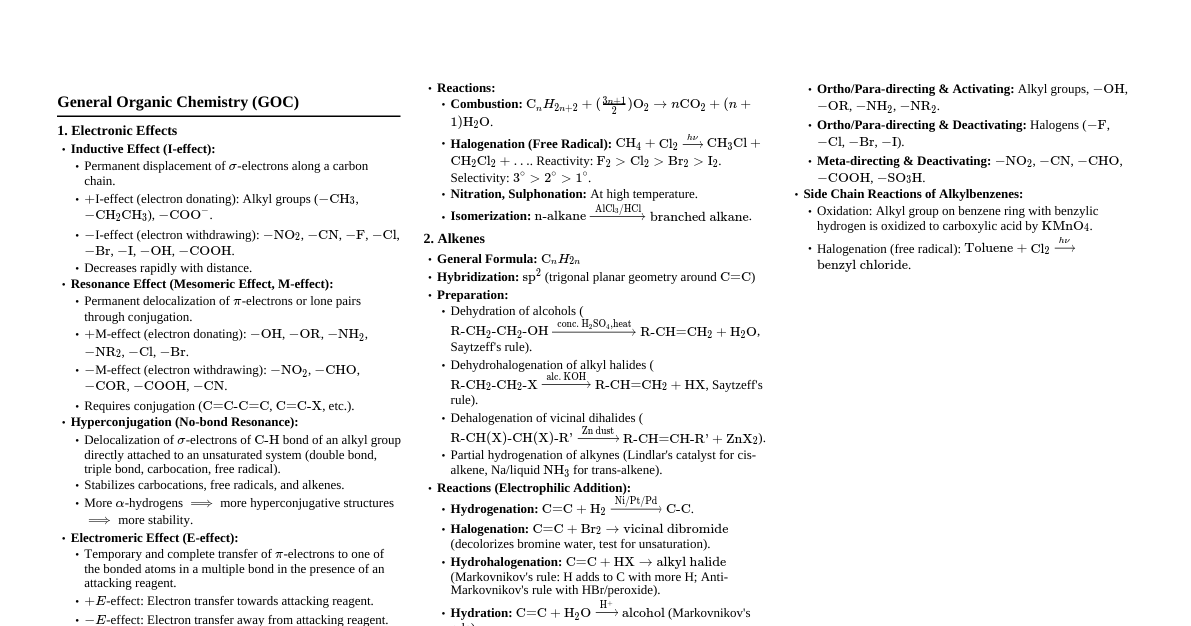
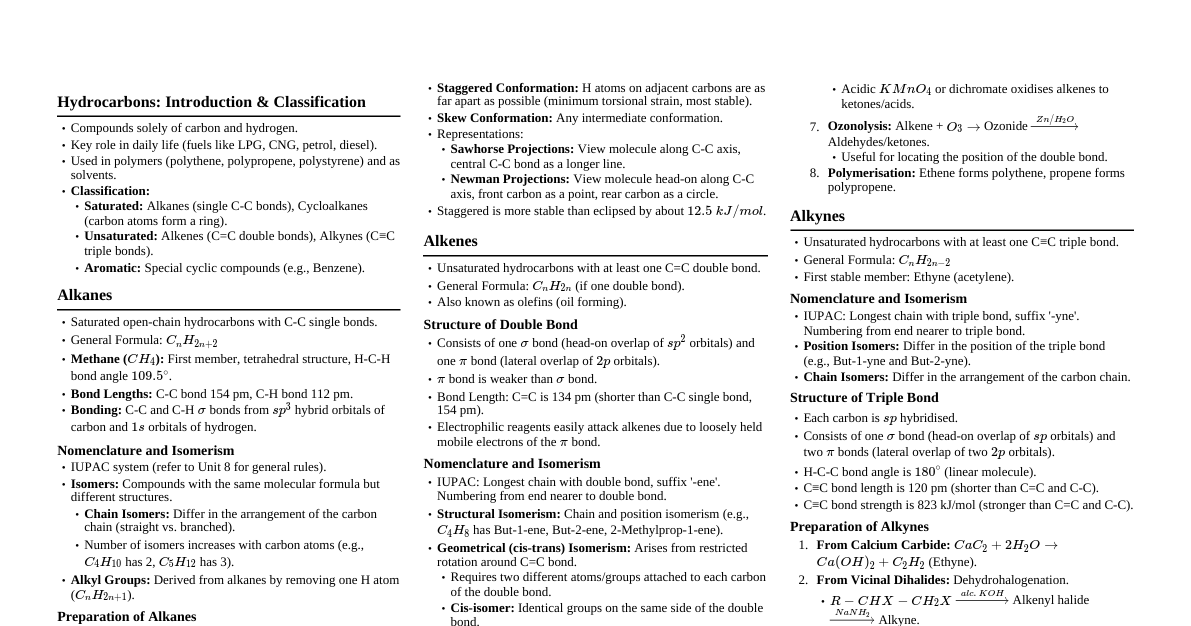
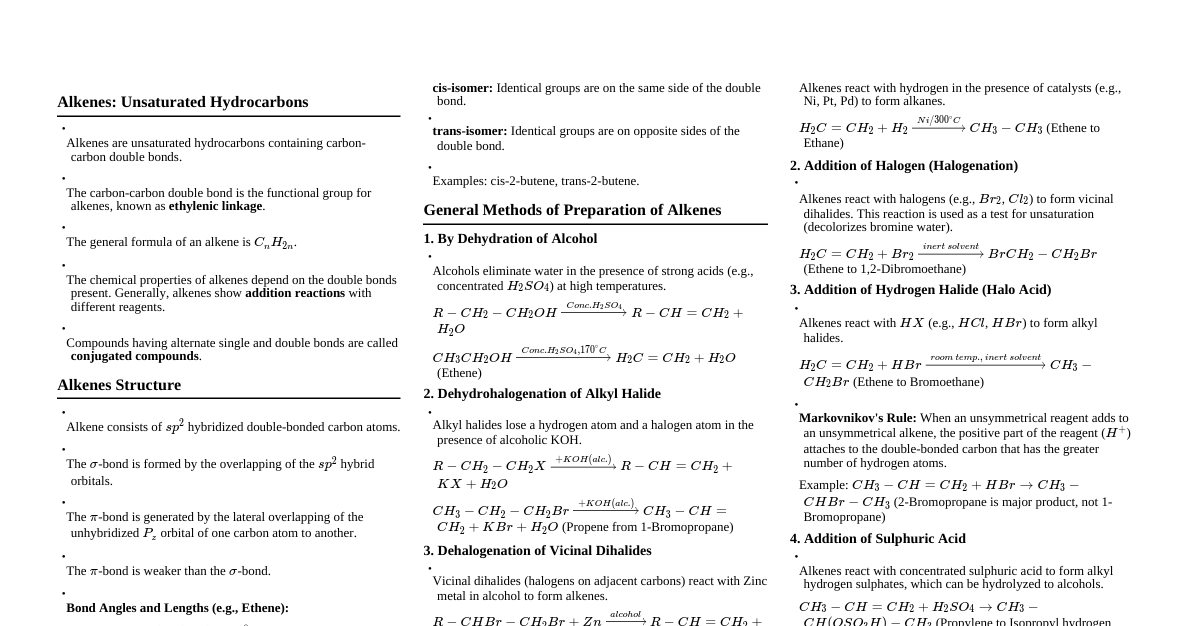
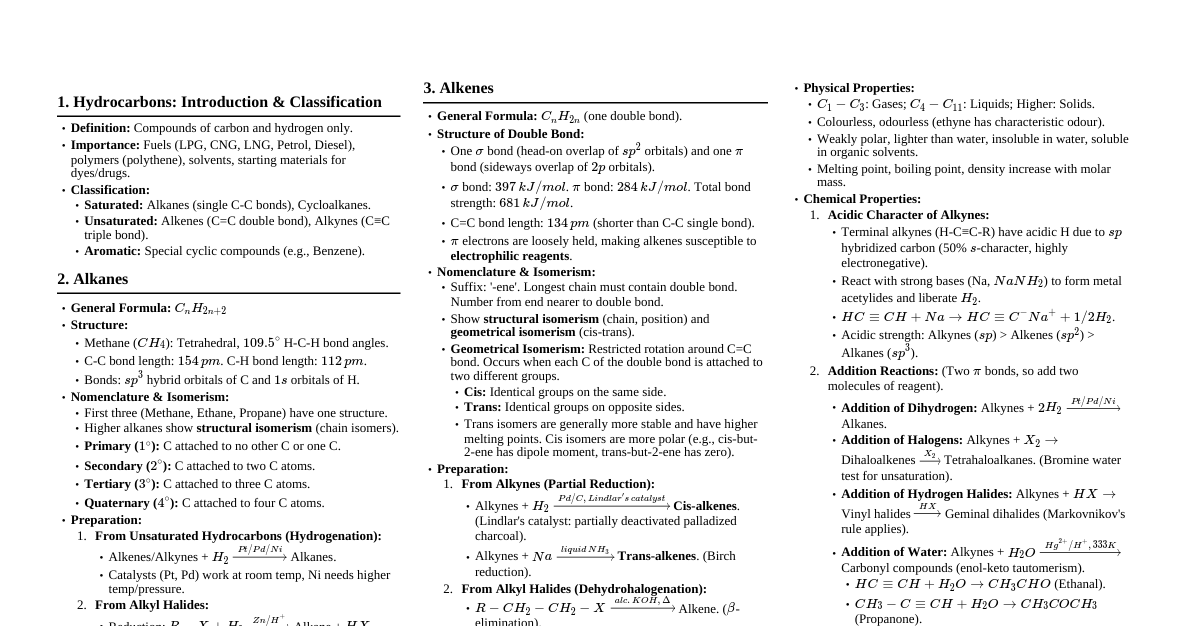
1. Alkanes 1.1 Introduction Saturated hydrocarbons, C-C single bonds. General formula: $C_nH_{2n+2}$ Paraffins ( parum affinis - little affinity). 1.2 Isomerism Chain isomerism: Different arrangement of carbon skeletal chain. Butane ($C_4H_{10}$): n-butane, isobutane Pentane ($C_5H_{12}$): n-pentane, isopentane, neopentane 1.3 Preparation From Unsaturated Hydrocarbons (Hydrogenation): $R-CH=CH_2 + H_2 \xrightarrow{Ni/Pt/Pd} R-CH_2-CH_3$ $R-C\equiv C-R' + 2H_2 \xrightarrow{Ni/Pt/Pd} R-CH_2-CH_2-R'$ From Alkyl Halides: Wurtz Reaction: $2RX + 2Na \xrightarrow{dry \ ether} R-R + 2NaX$ Produces symmetrical alkanes. Methane cannot be prepared. Reduction: $RX + H_2 \xrightarrow{Zn/HCl} R-H + HX$ $RX \xrightarrow{LiAlH_4 \ or \ NaBH_4} R-H$ From Carboxylic Acids: Decarboxylation ( सोडा लाइम ): $R-COONa + NaOH \xrightarrow{CaO, \Delta} R-H + Na_2CO_3$ Alkanes with one carbon less than the acid. Kolbe's Electrolytic Method: $2R-COONa + 2H_2O \xrightarrow{electrolysis} R-R + 2CO_2 + H_2 + 2NaOH$ Produces symmetrical alkanes. Methane cannot be prepared. 1.4 Physical Properties Non-polar, insoluble in water, soluble in organic solvents. Boiling points increase with molar mass due to increased van der Waals forces. Branching decreases boiling point (reduced surface area). 1.5 Chemical Properties Halogenation (Free Radical Substitution): $CH_4 + Cl_2 \xrightarrow{h\nu \ or \ \Delta} CH_3Cl + HCl$ Reactivity: $F_2 > Cl_2 > Br_2 > I_2$. Selectivity: $I_2 > Br_2 > Cl_2 > F_2$. Order of reactivity of H atoms: $3^\circ > 2^\circ > 1^\circ$. Combustion: $C_nH_{2n+2} + (\frac{3n+1}{2})O_2 \xrightarrow{\Delta} nCO_2 + (n+1)H_2O$ Controlled Oxidation: $CH_4 + O_2 \xrightarrow{Cu/573K/100atm} CH_3OH$ (Methanol) $CH_4 + O_2 \xrightarrow{Mo_2O_3} HCHO$ (Formaldehyde) Isomerisation: $CH_3CH_2CH_2CH_3 \xrightarrow{anhydrous \ AlCl_3/HCl} CH_3CH(CH_3)CH_3$ (n-butane to isobutane) Aromatization: $n$-Hexane $\xrightarrow{Cr_2O_3/Al_2O_3, \ 773K, \ 10-20atm}$ Benzene $+ 4H_2$ Pyrolysis (Cracking): Higher alkanes decompose at high temperatures into lower alkanes/alkenes. $C_6H_{14} \xrightarrow{773K} C_4H_8 + C_2H_6$ (Butene + Ethane) 2. Alkenes 2.1 Introduction Unsaturated hydrocarbons with C=C double bonds. General formula: $C_nH_{2n}$ Olefins (oil forming). 2.2 Isomerism Chain, position, and geometrical (cis-trans) isomerism. Geometrical Isomerism: Arises due to restricted rotation around C=C. Condition: Each carbon of the double bond must be attached to two different groups. $a \neq b$ and $c \neq d$ for $C(a)(b)=C(c)(d)$ 2.3 Preparation From Alkynes (Partial Reduction): $R-C\equiv C-R' + H_2 \xrightarrow{Lindlar's \ catalyst} R-CH=CH-R'$ (cis) $R-C\equiv C-R' + Na/Li \xrightarrow{liq. \ NH_3} R-CH=CH-R'$ (trans, Birch reduction) From Alkyl Halides (Dehydrohalogenation): $R-CH_2-CH_2-X \xrightarrow{alc. \ KOH, \Delta} R-CH=CH_2 + HX$ Follows Saytzeff's Rule: More substituted alkene is major product. From Alcohols (Dehydration): $R-CH_2-CH_2-OH \xrightarrow{conc. \ H_2SO_4, \Delta} R-CH=CH_2 + H_2O$ Ease of dehydration: $3^\circ > 2^\circ > 1^\circ$. Follows Saytzeff's Rule. From Vicinal Dihalides (Dehalogenation): $R-CHBr-CHBr-R' + Zn \xrightarrow{\Delta} R-CH=CH-R' + ZnBr_2$ 2.4 Physical Properties Similar to alkanes. Non-polar. Boiling points increase with molar mass. Branching decreases boiling point. Cis-isomers generally have higher boiling points due to higher polarity. 2.5 Chemical Properties (Electrophilic Addition) Addition of Hydrogen (Hydrogenation): $\xrightarrow{Ni/Pt/Pd}$ Alkanes. Addition of Halogens (Halogenation): $R-CH=CH_2 + Br_2 \xrightarrow{CCl_4} R-CHBr-CH_2Br$ (Decolorizes $Br_2$ water, test for unsaturation). Addition of HX (Hydrohalogenation): $R-CH=CH_2 + HX \rightarrow$ Markownikoff's Rule: H adds to carbon with more H's. $CH_3-CH=CH_2 + HCl \rightarrow CH_3-CHCl-CH_3$ (Major) Anti-Markownikoff's Rule (Peroxide Effect for HBr only): H adds to carbon with fewer H's. $CH_3-CH=CH_2 + HBr \xrightarrow{Peroxide} CH_3-CH_2-CH_2Br$ (Major) Addition of Water (Hydration): $R-CH=CH_2 + H_2O \xrightarrow{H^+} R-CH(OH)-CH_3$ (Markownikoff's Rule) Oxidation: Baeyer's Reagent (Cold, dilute, alkaline $KMnO_4$): $R-CH=CH_2 \xrightarrow{cold, dil. \ KMnO_4} R-CH(OH)-CH_2(OH)$ (Vicinal diol, pink color disappears) Hot, acidic $KMnO_4$ (Oxidative cleavage): $CH_3-CH=CH_2 \xrightarrow{hot, acidic \ KMnO_4} CH_3COOH + CO_2 + H_2O$ Terminal alkene yields $CO_2$. Internal alkene yields carboxylic acids/ketones. Ozonolysis: $R-CH=CH-R' \xrightarrow{1. O_3; \ 2. Zn/H_2O} R-CHO + R'-CHO$ (Aldehydes) If R or R' is $H$, formaldehyde is formed. If $R, R' \neq H$, ketones produced. Used to determine position of double bond. Polymerization: $n(CH_2=CH_2) \xrightarrow{High \ T, \ P, \ catalyst} -(CH_2-CH_2)_n-$ (Polyethylene) 3. Alkynes 3.1 Introduction Unsaturated hydrocarbons with C$\equiv$C triple bonds. General formula: $C_nH_{2n-2}$ 3.2 Preparation From Vicinal Dihalides (Dehydrohalogenation): $R-CHBr-CH_2Br \xrightarrow{alc. \ KOH} R-CH=CHBr \xrightarrow{NaNH_2} R-C\equiv CH$ Strong base like $NaNH_2$ is required for the second elimination. From Tetrahalides: $R-CBr_2-CBr_2-R' + 2Zn \xrightarrow{\Delta} R-C\equiv C-R' + 2ZnBr_2$ From Calcium Carbide: $CaC_2 + 2H_2O \rightarrow Ca(OH)_2 + HC\equiv CH$ (Ethyne) 3.3 Physical Properties Similar to alkanes and alkenes. Non-polar. Boiling points increase with molar mass. 3.4 Chemical Properties Acidity of Terminal Alkynes: Terminal alkynes have acidic H atoms ($sp$ hybridized carbon). $HC\equiv C-H$ $R-C\equiv C-H + Na \rightarrow R-C\equiv C^- Na^+ + \frac{1}{2} H_2$ $R-C\equiv C-H + Ag(NH_3)_2OH \rightarrow R-C\equiv C-Ag \downarrow + H_2O + 2NH_3$ (White ppt.) $R-C\equiv C-H + Cu(NH_3)_2Cl \rightarrow R-C\equiv C-Cu \downarrow + NH_4Cl + NH_3$ (Red ppt.) Acidity order: $HC\equiv CH > NH_3 > H_2O > ROH$ Addition Reactions: (Similar to alkenes, but two moles can add) Hydrogenation: $R-C\equiv C-R' + H_2 \xrightarrow{Lindlar's \ catalyst} R-CH=CH-R'$ (cis alkene) $R-C\equiv C-R' + Na/Li \xrightarrow{liq. \ NH_3} R-CH=CH-R'$ (trans alkene) $R-C\equiv C-R' + 2H_2 \xrightarrow{Ni/Pt/Pd} R-CH_2-CH_2-R'$ (Alkane) Halogenation: $HC\equiv CH + Br_2 \rightarrow CHBr=CHBr$ (1,2-Dibromoethene) $CHBr=CHBr + Br_2 \rightarrow CHBr_2-CHBr_2$ (1,1,2,2-Tetrabromoethane) Hydrohalogenation: (Markownikoff's Rule) $CH_3-C\equiv CH + HCl \rightarrow CH_3-CCl=CH_2$ (2-Chloropropene) $CH_3-CCl=CH_2 + HCl \rightarrow CH_3-CCl_2-CH_3$ (2,2-Dichloropropane) Addition of Water (Hydration): $HC\equiv CH + H_2O \xrightarrow{HgSO_4/H_2SO_4} [CH_2=CH-OH] \rightleftharpoons CH_3-CHO$ (Acetaldehyde, tautomerization) $CH_3-C\equiv CH + H_2O \xrightarrow{HgSO_4/H_2SO_4} [CH_3-C(OH)=CH_2] \rightleftharpoons CH_3-CO-CH_3$ (Acetone) Polymerization: Linear Polymerization: $n(CH\equiv CH) \xrightarrow{red \ hot \ Fe \ tube, \ 873K}$ Benzene Cyclic Polymerization: $2CH\equiv CH \xrightarrow{CuCl/NH_4Cl} CH_2=CH-C\equiv CH$ (Vinylacetylene) 4. Aromatic Hydrocarbons (Benzene) 4.1 Introduction Hydrocarbons containing benzene ring. Benzene: $C_6H_6$. Planar, cyclic, conjugated, $4n+2$ $\pi$ electrons (Huckel's Rule). 4.2 Preparation of Benzene From Ethyne (Cyclic Polymerization): $3CH\equiv CH \xrightarrow{red \ hot \ Fe \ tube, \ 873K}$ Benzene From Phenol: $C_6H_5OH + Zn \xrightarrow{\Delta} C_6H_6 + ZnO$ From Benzoic Acid (Decarboxylation): $C_6H_5COONa + NaOH \xrightarrow{CaO, \Delta} C_6H_6 + Na_2CO_3$ From Chlorobenzene (Reduction): $C_6H_5Cl + 2[H] \xrightarrow{Ni-Al \ alloy/NaOH} C_6H_6 + HCl$ 4.3 Physical Properties Colorless liquids, characteristic odor. Immiscible with water, miscible with organic solvents. Toxic, carcinogenic. 4.4 Chemical Properties (Electrophilic Substitution) Nitration: $C_6H_6 + HNO_3 \xrightarrow{conc. \ H_2SO_4, \Delta} C_6H_5NO_2 + H_2O$ (Nitrobenzene) Halogenation: $C_6H_6 + Cl_2 \xrightarrow{anhydrous \ FeCl_3} C_6H_5Cl + HCl$ (Chlorobenzene) Sulphonation: $C_6H_6 + conc. \ H_2SO_4 \xrightarrow{\Delta} C_6H_5SO_3H + H_2O$ (Benzenesulphonic acid) Friedel-Crafts Alkylation: $C_6H_6 + R-X \xrightarrow{anhydrous \ AlCl_3} C_6H_5-R + HX$ Rearrangement of carbocations may occur. Polysubstitution is possible. Friedel-Crafts Acylation: $C_6H_6 + R-COCl \xrightarrow{anhydrous \ AlCl_3} C_6H_5-COR + HCl$ No rearrangement. Prevents polysubstitution. 4.5 Addition Reactions (Under specific conditions) Hydrogenation: $C_6H_6 + 3H_2 \xrightarrow{Ni/Pt/Pd, \Delta} C_6H_{12}$ (Cyclohexane) Chlorination (in presence of UV light): $C_6H_6 + 3Cl_2 \xrightarrow{h\nu} C_6H_6Cl_6$ (Benzene Hexachloride, BHC, Gammexane) 4.6 Side Chain Oxidation Alkyl benzenes with at least one benzylic hydrogen are oxidized to benzoic acid by strong oxidizing agents. $C_6H_5-CH_3 \xrightarrow{hot \ alkaline \ KMnO_4} C_6H_5COOH$ Even long chains are oxidized to $-COOH$ at the benzylic carbon. 5. Directing Groups in Electrophilic Substitution Ortho-Para Directing & Activating Groups: $-OH, -OR, -NH_2, -NHR, -NR_2, -CH_3, -R, -C_6H_5, -X$ (halogens are deactivating but o,p-directing) Meta-Directing & Deactivating Groups: $-NO_2, -CN, -CHO, -COR, -COOH, -COOR, -SO_3H, -CCl_3, -NH_3^+$