Magnetism & EMI for NEET
Cheatsheet Content
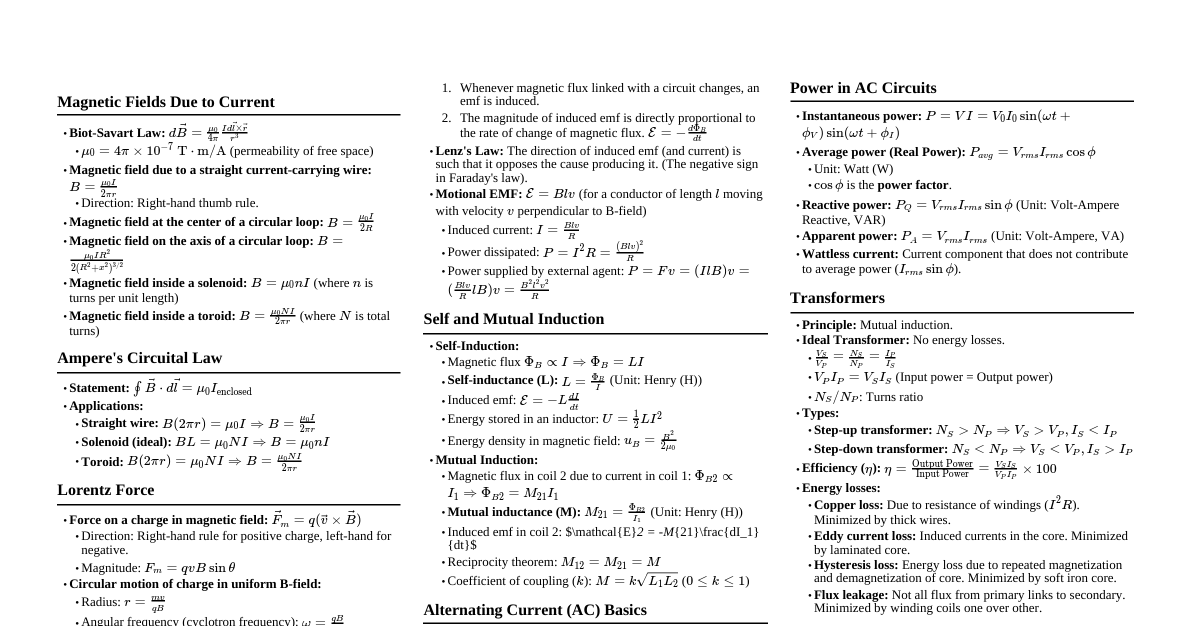
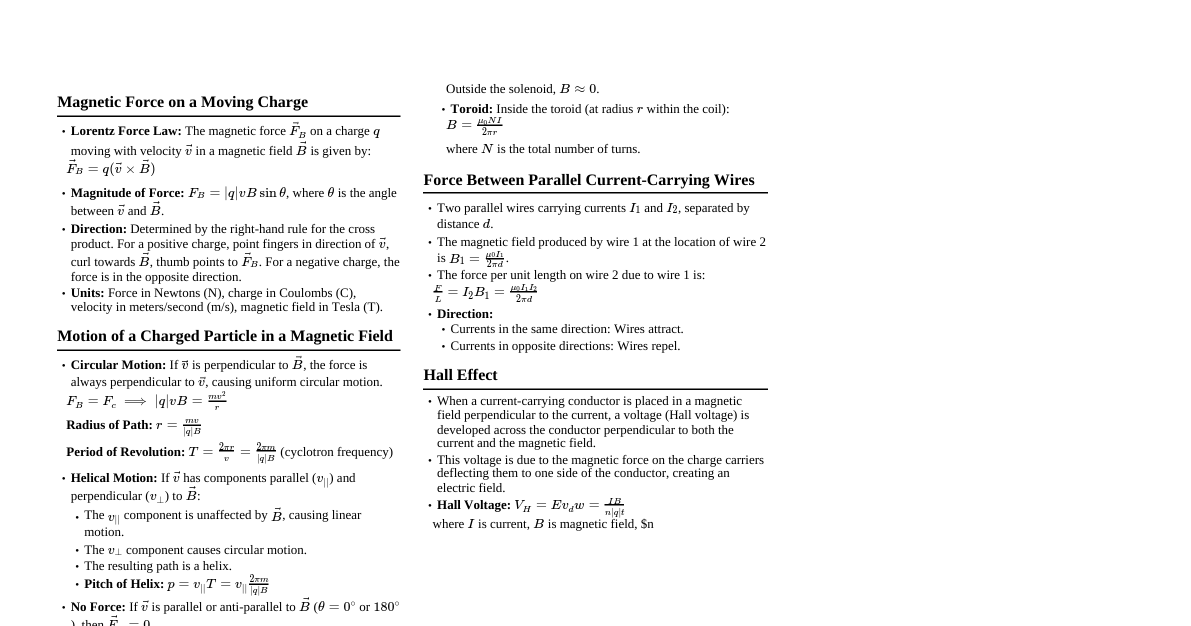
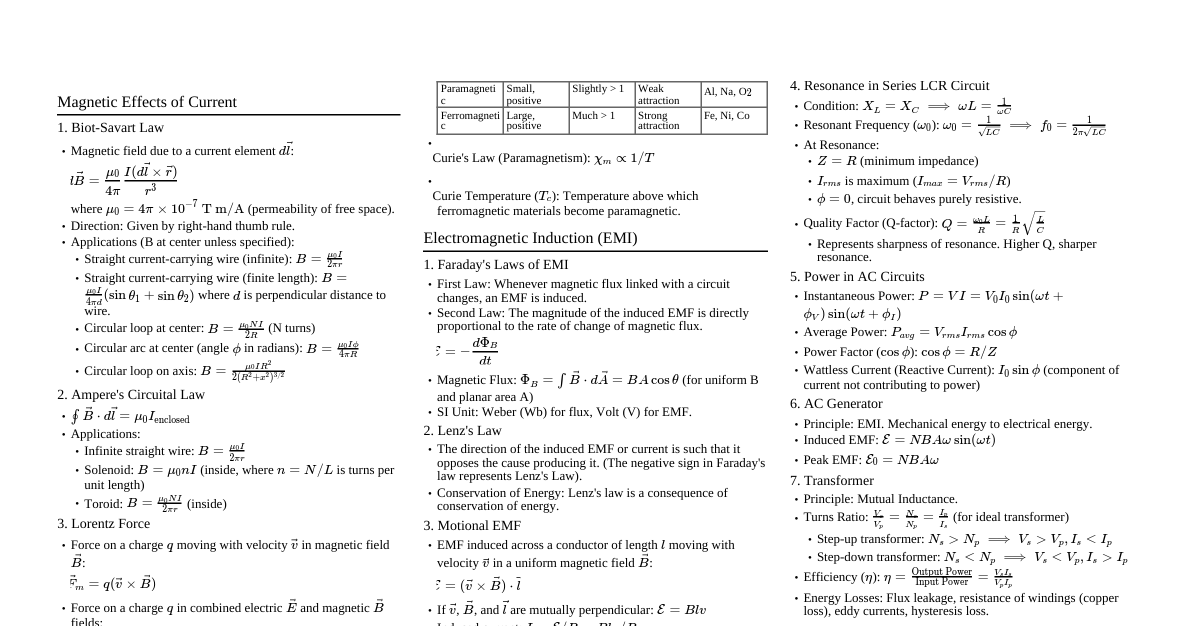
### Introduction & Strategy This cheatsheet offers a forensic analysis of NEET PYQs (2014-2026) and NCERT (Chapters: Moving Charges & Magnetism, Magnetism & Matter, Electromagnetic Induction) to identify high-yield concepts, formulas, and question patterns. A "ZERO-SKIP" policy ensures all critical details for NEET success are covered. The focus is on examiner patterns, common errors, and score-maximizing insights. ### PYQ Analysis Summary (2014-2026) - **High-Frequency Chapters:** Electromagnetic Induction (EMI) and Moving Charges & Magnetism (MCM) are consistently high-yield. Magnetism & Matter (M&M) usually has fewer but important questions. - **Conceptual vs. Numerical:** A balanced mix. MCM and EMI tend to have more numericals, while M&M has a higher proportion of conceptual/statement-based questions. - **Recurring Themes:** - **MCM:** Motion of charge in B-field (force, radius, frequency), Biot-Savart Law & Ampere's Law applications (straight wire, circular loop, solenoid, toroid), Galvanometer to Ammeter/Voltmeter conversion. - **M&M:** Earth's magnetic field (dip, declination), properties of dia/para/ferromagnetism, magnetic field lines characteristics. - **EMI:** Faraday's Law (induced EMF, current), Lenz's Law, Motional EMF, Self-induction, Mutual induction, AC Generator, Eddy Currents (applications). - **Inter-chapter Linkages:** Questions often combine concepts from current electricity, work-power-energy, and modern physics. - **Statement & Assertion-Reason:** Increasingly common, especially from NCERT theoretical statements. ### Moving Charges & Magnetism (NCERT Ch. 4) #### 4.1 Magnetic Force on Moving Charges & Current - **Lorentz Force (PYQ: 2015, 2017, 2019, 2022):** - $\vec{F} = q(\vec{E} + \vec{v} \times \vec{B})$ - Only magnetic force: $\vec{F_B} = q(\vec{v} \times \vec{B})$. Work done by magnetic force is always zero. (NCERT statement, PYQ: 2017, 2022 conceptual) - **Force on current-carrying conductor (PYQ: 2014, 2018, 2021):** - $\vec{F} = I(\vec{l} \times \vec{B})$ - For uniform `B`, $\vec{F} = I(\vec{L} \times \vec{B})$, where $\vec{L}$ is vector sum of length elements. - **Motion in a Magnetic Field (PYQ: 2016, 2018, 2020, 2023):** - Perpendicular entry: Circular path. Radius ($r = \frac{mv}{qB}$), Time period ($T = \frac{2\pi m}{qB}$), Frequency ($\nu = \frac{qB}{2\pi m}$). (High-yield formula) - Helical path: When $\vec{v}$ has a component parallel to $\vec{B}$. Pitch ($p = (v\cos\theta)T$). (NCERT diagram, PYQ: 2016) - Velocity Selector: $v = E/B$ for undeflected charge ($qE = qvB$). (PYQ: 2015) - Cyclotron: Principle, frequency ($f_c = \frac{qB}{2\pi m}$), maximum kinetic energy ($K_{max} = \frac{q^2B^2R^2}{2m}$). (Conceptual, PYQ: 2017 - statement) #### 4.2 Magnetic Fields: Sources & Laws - **Biot-Savart Law (PYQ: 2014, 2018, 2020, 2023):** - $d\vec{B} = \frac{\mu_0}{4\pi} \frac{I d\vec{l} \times \hat{r}}{r^2}$. Analogous to Coulomb's Law. (NCERT Comparison, PYQ: 2018 conceptual) - **Applications (High-yield, numerical/conceptual):** - **Straight wire:** $B = \frac{\mu_0 I}{2\pi r}$ (infinite wire). Finite wire: $B = \frac{\mu_0 I}{4\pi d}(\sin\phi_1 + \sin\phi_2)$. (PYQ: 2014, 2019, 2023) - **Circular loop:** At center $B = \frac{\mu_0 NI}{2R}$. On axis $B = \frac{\mu_0 NIR^2}{2(R^2+x^2)^{3/2}}$. (PYQ: 2016, 2020, 2022) - **Ampere's Circuital Law (ACL) (PYQ: 2015, 2017, 2021, 2024):** - $\oint \vec{B} \cdot d\vec{l} = \mu_0 I_{enclosed}$. (Analogous to Gauss's Law, PYQ: 2017 conceptual) - **Applications (High-yield, numerical/conceptual):** - **Solenoid:** $B = \mu_0 nI$ (inside, $n$ = turns/unit length). Field outside is zero. (PYQ: 2015, 2021, 2024 - statement) - **Toroid:** Similar to solenoid, field confined inside. (Conceptual, PYQ: 2017) - **Coaxial cable:** Field variation inside/outside conductors. (NCERT example, PYQ: 2019) #### 4.3 Force between two parallel current-carrying conductors - **Force per unit length (PYQ: 2014, 2018, 2022):** - $F/l = \frac{\mu_0 I_1 I_2}{2\pi d}$ (Attraction for parallel, repulsion for anti-parallel currents). - Definition of Ampere (NCERT statement, PYQ: 2018 conceptual). #### 4.4 Torque on Current Loop, Magnetic Dipole Moment - **Torque (PYQ: 2016, 2019, 2021):** - $\vec{\tau} = \vec{M} \times \vec{B}$, where magnetic dipole moment $\vec{M} = NI\vec{A}$. - Potential Energy: $U = -\vec{M} \cdot \vec{B}$. (PYQ: 2019) - **Moving Coil Galvanometer (MCG) (PYQ: 2015, 2017, 2020, 2023):** - Principle: Torque on current loop. - Radial magnetic field: Torque is constant. $\tau = NIAB$. - Current sensitivity, Voltage sensitivity. (Formulas and definitions, PYQ: 2020) - **Conversion to Ammeter:** Low resistance shunt ($R_s = \frac{I_g G}{I-I_g}$) in parallel. (High-yield, numerical, PYQ: 2015, 2023) - **Conversion to Voltmeter:** High resistance ($R_s = \frac{V}{I_g} - G$) in series. (High-yield, numerical, PYQ: 2017, 2023) ### Magnetism & Matter (NCERT Ch. 5) #### 5.1 Bar Magnet & Dipole Properties - **Magnetic field lines:** Properties (No intersection, form closed loops, high density = strong field). (NCERT diagram, PYQ: 2014, 2018 - conceptual) - **Bar magnet as equivalent solenoid:** Magnetic moment $M=NIA = m(2l)$. (PYQ: 2016, numerical) - **Torque and Potential Energy in B-field:** $\vec{\tau} = \vec{M} \times \vec{B}$, $U = -\vec{M} \cdot \vec{B}$. (Identical to current loop, PYQ: 2019) - **Work done:** $W = MB(\cos\theta_1 - \cos\theta_2)$. - **Gauss's Law in Magnetism (PYQ: 2017, 2022):** $\oint \vec{B} \cdot d\vec{A} = 0$. Implies no isolated magnetic monopoles exist. (Conceptual, PYQ: 2017, 2022 - statement/reason) #### 5.2 Earth's Magnetism (PYQ: 2014, 2016, 2018, 2020, 2023) - **Elements of Earth's magnetic field:** - **Declination ($\alpha$):** Angle between geographic and magnetic meridians. - **Dip (Inclination) ($\delta$):** Angle between Earth's total magnetic field $B_E$ and the horizontal component $B_H$. (High-yield definition and formula) - **Horizontal component ($B_H = B_E \cos\delta$).** - **Vertical component ($B_V = B_E \sin\delta$).** - $\tan\delta = B_V/B_H$. (Numerical, PYQ: 2016, 2020, 2023) - **Neutral points:** Where Earth's field cancels external field. (Conceptual, NCERT diagram) #### 5.3 Magnetization and Magnetic Intensity - **Magnetization ($\vec{M}$):** Magnetic moment per unit volume. - **Magnetic Intensity ($\vec{H}$):** $B = \mu_0(H+M)$. $H = B_{ext}/\mu_0 - M$. - **Magnetic Susceptibility ($\chi_m$):** $\chi_m = M/H$. Dimensionless. - **Relative Permeability ($\mu_r$):** $\mu_r = 1 + \chi_m$. (Formulas, PYQ: 2015, 2021) - **Permeability of medium ($\mu = \mu_0 \mu_r$).** #### 5.4 Magnetic Properties of Materials (High-yield conceptual, PYQ: Every year) - **Diamagnetism (PYQ: 2014, 2017, 2019, 2022):** - $\chi_m$ is small, negative. $\mu_r 1$. - Weakly attracted by magnet. Example: Aluminum, Sodium, Oxygen. - Curie's Law: $\chi_m \propto 1/T$. (Conceptual, PYQ: 2018, 2023 - statement) - **Ferromagnetism (PYQ: 2016, 2019, 2021, 2024):** - $\chi_m$ is large, positive. $\mu_r \gg 1$. - Strongly attracted by magnet. Example: Iron, Nickel, Cobalt. - Hysteresis: Retentivity, Coercivity (NCERT graph, PYQ: 2019, 2021 - conceptual). - Curie Temperature ($T_C$): Transition from ferromagnetic to paramagnetic. (PYQ: 2016 - statement) - **Permanent magnets (hard ferromagnets) vs. Electromagnets (soft ferromagnets).** (Conceptual, PYQ: 2019) ### Electromagnetic Induction (NCERT Ch. 6) #### 6.1 Faraday's Law & Lenz's Law - **Magnetic Flux ($\Phi_B = \int \vec{B} \cdot d\vec{A} = BA\cos\theta$).** Unit: Weber (Wb) or T m$^2$. (Definition, PYQ: 2014) - **Faraday's Law of Induction (PYQ: 2014, 2016, 2018, 2020, 2023):** - $\mathcal{E} = -\frac{d\Phi_B}{dt}$ (magnitude $|\mathcal{E}| = N|\frac{d\Phi_B}{dt}|$ for N turns). - Induced current: $I = \mathcal{E}/R = -\frac{1}{R}\frac{d\Phi_B}{dt}$. - Induced charge: $q = \int I dt = -\frac{1}{R}\int d\Phi_B = -\frac{\Delta\Phi_B}{R}$. (PYQ: 2016, 2020 - numerical) - **Lenz's Law (PYQ: 2015, 2017, 2019, 2022):** The direction of induced EMF/current opposes the cause producing it. (Conservation of energy, conceptual, PYQ: 2015, 2017 - statement/reason) #### 6.2 Motional EMF (PYQ: 2014, 2018, 2021, 2024) - **EMF induced across a conductor moving in a uniform magnetic field:** - $\mathcal{E} = (\vec{v} \times \vec{B}) \cdot \vec{l} = Blv$ (if $\vec{v}, \vec{B}, \vec{l}$ are mutually perpendicular). (High-yield formula) - Power required to pull conductor ($P = \frac{B^2l^2v^2}{R}$). (Derivation & application, PYQ: 2018) - **Rotating rod/disc in magnetic field:** - Rod (length L, rotating with $\omega$): $\mathcal{E} = \frac{1}{2}B\omega L^2$. (PYQ: 2014, 2021) - Disc: Same formula for EMF between center and rim. #### 6.3 Eddy Currents - **Definition:** Induced circulating currents in bulk conductors when magnetic flux changes. - **Applications:** Magnetic braking in trains, electromagnetic damping, induction furnace, energy meters. (Conceptual, PYQ: 2017, 2020 - statement based) - **Disadvantages:** Energy loss (heating). - **Reduction:** Laminated cores. (Conceptual) #### 6.4 Self-Induction & Mutual Induction - **Self-Induction (PYQ: 2015, 2019, 2022):** - $\Phi = LI$. $L$ = self-inductance. Unit: Henry (H). - Self-induced EMF: $\mathcal{E} = -L\frac{dI}{dt}$. (Definition, formula) - Energy stored in inductor: $U_L = \frac{1}{2}LI^2$. Energy density: $u_B = \frac{B^2}{2\mu_0}$. (High-yield, numerical, PYQ: 2019, 2022) - **Mutual Induction (PYQ: 2016, 2018, 2020):** - $\Phi_2 = MI_1$. $\Phi_1 = MI_2$. $M$ = mutual inductance. - Mutually induced EMF: $\mathcal{E}_2 = -M\frac{dI_1}{dt}$. - Coefficient of Coupling ($k$). $M = k\sqrt{L_1L_2}$. For ideal coupling, $k=1$. - **NCERT Value:** $M = \frac{\mu_0 n_1 n_2 A l}{2\pi}$ for coaxial solenoids. (Often simplified, conceptual) #### 6.5 AC Generator (PYQ: 2017, 2021) - **Principle:** EMI. - **Working:** Rectangular coil rotated in uniform B-field. - **Induced EMF:** $\mathcal{E} = NBA\omega \sin(\omega t)$. - **Peak EMF:** $\mathcal{E}_0 = NBA\omega$. (Conceptual, components, PYQ: 2017 statement) ### High-Yield Formulas (with PYQ Years) 1. **Lorentz Force:** $\vec{F} = q(\vec{E} + \vec{v} \times \vec{B})$ (2015, 2017, 2019, 2022) 2. **Magnetic force on current:** $\vec{F} = I(\vec{l} \times \vec{B})$ (2014, 2018, 2021) 3. **Radius of circular path in B-field:** $r = \frac{mv}{qB}$ (2016, 2018, 2020, 2023) 4. **Time period/Frequency:** $T = \frac{2\pi m}{qB}$, $\nu = \frac{qB}{2\pi m}$ (2016, 2018, 2020, 2023) 5. **Biot-Savart Law (straight infinite wire):** $B = \frac{\mu_0 I}{2\pi r}$ (2014, 2019, 2023) 6. **Biot-Savart Law (center of circular loop):** $B = \frac{\mu_0 I N}{2R}$ (2016, 2020, 2022) 7. **Ampere's Law (Solenoid):** $B = \mu_0 nI$ (2015, 2021, 2024) 8. **Force per unit length (parallel wires):** $F/l = \frac{\mu_0 I_1 I_2}{2\pi d}$ (2014, 2018, 2022) 9. **Torque on current loop/magnet:** $\vec{\tau} = \vec{M} \times \vec{B}$ (2016, 2019, 2021) 10. **Magnetic Dipole Moment:** $M = NIA$ (for loop), $M = m(2l)$ (for bar magnet) (2016, 2019) 11. **Galvanometer conversion (Ammeter):** $R_s = \frac{I_g G}{I-I_g}$ (2015, 2023) 12. **Galvanometer conversion (Voltmeter):** $R_s = \frac{V}{I_g} - G$ (2017, 2023) 13. **Earth's Magnetic Field Components:** $\tan\delta = B_V/B_H$, $B_H = B_E \cos\delta$ (2016, 2020, 2023) 14. **Curie's Law (Paramagnetism):** $\chi_m \propto 1/T$ (2018, 2023) 15. **Faraday's Law:** $\mathcal{E} = -N\frac{d\Phi_B}{dt}$ (2014, 2016, 2018, 2020, 2023) 16. **Induced Charge:** $q = -\frac{\Delta\Phi_B}{R}$ (2016, 2020) 17. **Motional EMF:** $\mathcal{E} = Blv$ (2014, 2018, 2021, 2024) 18. **EMF of rotating rod:** $\mathcal{E} = \frac{1}{2}B\omega L^2$ (2014, 2021) 19. **Energy stored in Inductor:** $U_L = \frac{1}{2}LI^2$ (2019, 2022) 20. **AC Generator Peak EMF:** $\mathcal{E}_0 = NBA\omega$ (2017, 2021) ### Important NCERT Lines & Observations - "The magnetic force on a charged particle is always perpendicular to its velocity and to the magnetic field." (Ch 4, PYQ: 2017, 2022 - conceptual/AR) - "No work is done by the magnetic force on the charged particle." (Ch 4, PYQ: 2017, 2022) - "Magnetic field lines form continuous closed loops." (Ch 5, PYQ: 2014, 2018) - "The magnetic field lines do not intersect." (Ch 5, PYQ: 2014, 2018) - "Gauss's law for magnetism states that the net magnetic flux through any closed surface is zero. This implies that isolated magnetic monopoles do not exist." (Ch 5, PYQ: 2017, 2022 - AR) - "Diamagnetic substances are weakly repelled by a magnet and their susceptibility is small and negative. Their magnetic properties are nearly independent of temperature." (Ch 5, PYQ: 2017, 2022 - statement) - "Paramagnetic substances are weakly attracted by a magnet and their susceptibility is small and positive. Their susceptibility varies inversely with absolute temperature (Curie's Law)." (Ch 5, PYQ: 2018, 2023 - statement) - "Ferromagnetic substances are strongly attracted and exhibit hysteresis. Above Curie temperature, they become paramagnetic." (Ch 5, PYQ: 2016, 2019, 2021) - "Lenz's law is a consequence of the law of conservation of energy." (Ch 6, PYQ: 2015, 2017 - AR) - "Eddy currents can be reduced by using laminated cores." (Ch 6, Conceptual) - "Self-inductance of a long solenoid: $L = \mu_0 n^2 A l$." (Ch 6, Conceptual, indirectly PYQ: 2019) - "The direction of induced emf or current is such that it opposes the change in magnetic flux that produced it." (Ch 6, Lenz's Law definition, PYQ: 2015, 2017) ### Common Mistakes & Traps 1. **Vector Cross Products:** Direction of $\vec{v} \times \vec{B}$ and $\vec{l} \times \vec{B}$ (Right-Hand Rule) is critical. Sign errors with 'q'. 2. **Lenz's Law:** Incorrectly identifying the direction of induced current/EMF. Always remember it OPPOSES the change. 3. **Units:** Incorrect units for B (Tesla), flux (Weber), inductance (Henry), force (Newton), current (Ampere). 4. **Conversions Galvanometer:** Mixing up series/parallel connections and formulas for Ammeter/Voltmeter. Remember Ammeter is low resistance (parallel), Voltmeter is high resistance (series). 5. **Earth's Magnetism:** Confusing angle of declination and inclination (dip). $\tan\delta = B_V/B_H$ is frequently tested. 6. **Properties of Magnetic Materials:** Misidentifying diamagnetic/paramagnetic/ferromagnetic properties (temperature dependence, susceptibility sign, examples). 7. **Faraday's Law:** Forgetting the 'N' for number of turns in a coil. 8. **Motional EMF:** Not using perpendicular components of $\vec{v}, \vec{B}, \vec{l}$ correctly. $Blv$ is only if they are mutually perpendicular. 9. **Solenoid/Toroid:** Remembering field is zero outside ideal solenoid, and uniform inside. 10. **Hysteresis Loop:** Confusing coercivity (force to demagnetize) and retentivity (residual magnetism). (PYQ: 2019) ### Trend Analysis & Predictions - **Conceptual Questions from NCERT:** High probability of statement-based, assertion-reason questions directly from NCERT lines, especially properties of magnetic materials (Ch 5) and fundamental laws (Lenz's Law, Gauss's Law in Magnetism). Example: "Which of the following is true about diamagnetic materials?" (PYQ: 2017, 2022). - **Formula-based Numericals:** Expect direct application of high-yield formulas, especially on motion of charges in B-field ($r, T, \nu$), Biot-Savart/Ampere's applications (straight wire/loop/solenoid), Motional EMF, Galvanometer conversions, and Earth's magnetism ($B_V, B_H, \delta$). These are often multi-step. - **Combined Concepts:** Questions combining magnetic effects of current with current electricity (resistance, power) or circular motion/work-energy concepts are likely. Example: Power dissipated in motional EMF problem (PYQ: 2018). - **Diagram-based/Graphical:** Identifying directions using Right Hand Rules, interpreting hysteresis loops (Ch 5), or understanding field patterns for solenoids/magnets. - **Predictions for future:** - More questions on energy stored in inductors ($U_L = \frac{1}{2}LI^2$) and energy density. - Detailed conceptual questions on eddy currents and their applications/disadvantages. - Variations of Motional EMF (e.g., rotating rod problems with more complex setups). - Questions distinguishing self vs. mutual inductance, or involving coupling coefficient 'k'. - Revisit of velocity selector concept with slight variations. - Comparisons between Biot-Savart and Ampere's Law (similarities/differences from NCERT). ### Last-Minute Revision Strategy 1. **Formula Sheet Mastery:** Have a concise formula sheet and know each variable, unit, and application. Test yourself on quick recall. 2. **Right-Hand Rules:** Practice all right-hand rules (for force, field direction) until instinctive. 3. **NCERT Reading:** Re-read "Summary" sections and bolded statements in NCERT for quick conceptual recap. Pay attention to diagrams and their captions. 4. **PYQ Review:** Re-solve missed PYQs. Focus on the method and identifying the trap, not just the answer. 5. **Conceptual Clarity:** Ensure you understand the underlying principles of Lenz's Law (conservation of energy), Gauss's Law for magnetism (no monopoles), and properties of magnetic materials. 6. **Unit Consistency:** Always check units in numerical problems. 7. **Identify High-Yield:** Prioritize chapters/topics with highest PYQ frequency (EMI, MCM). 8. **Avoid Common Errors:** Keep the "Common Mistakes & Traps" section in mind while solving.