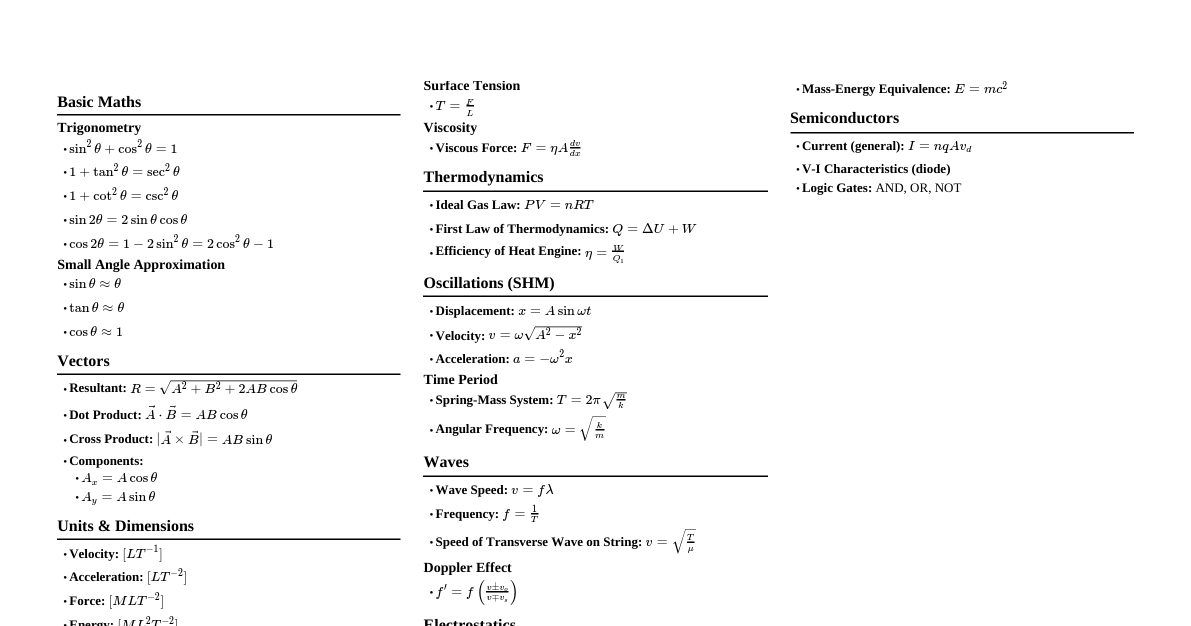
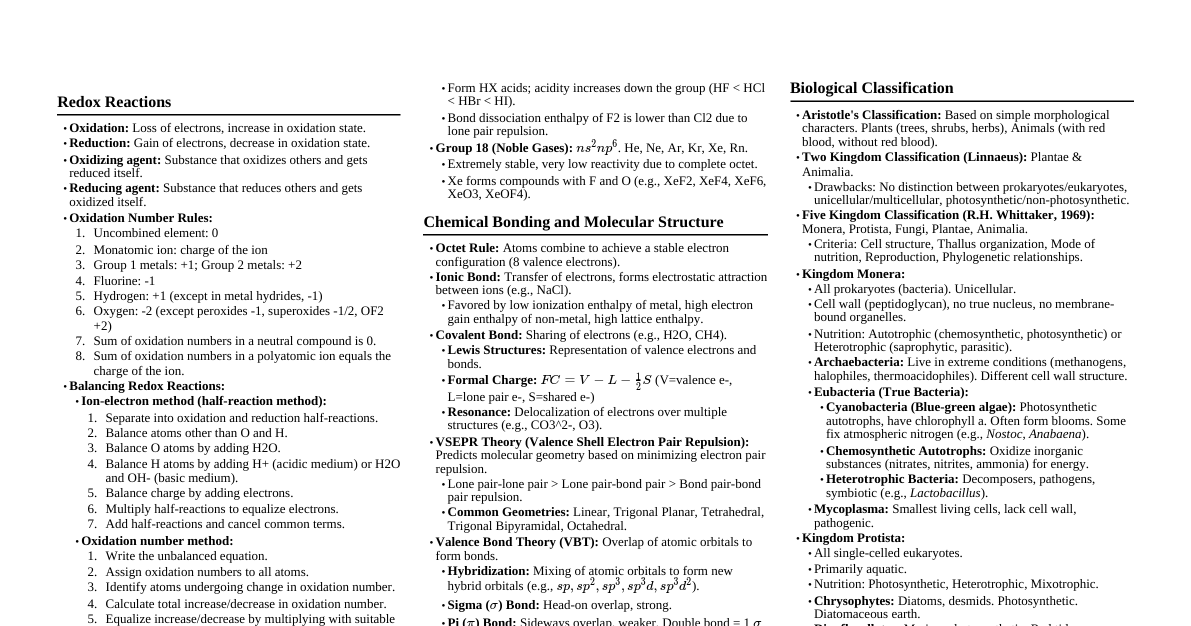
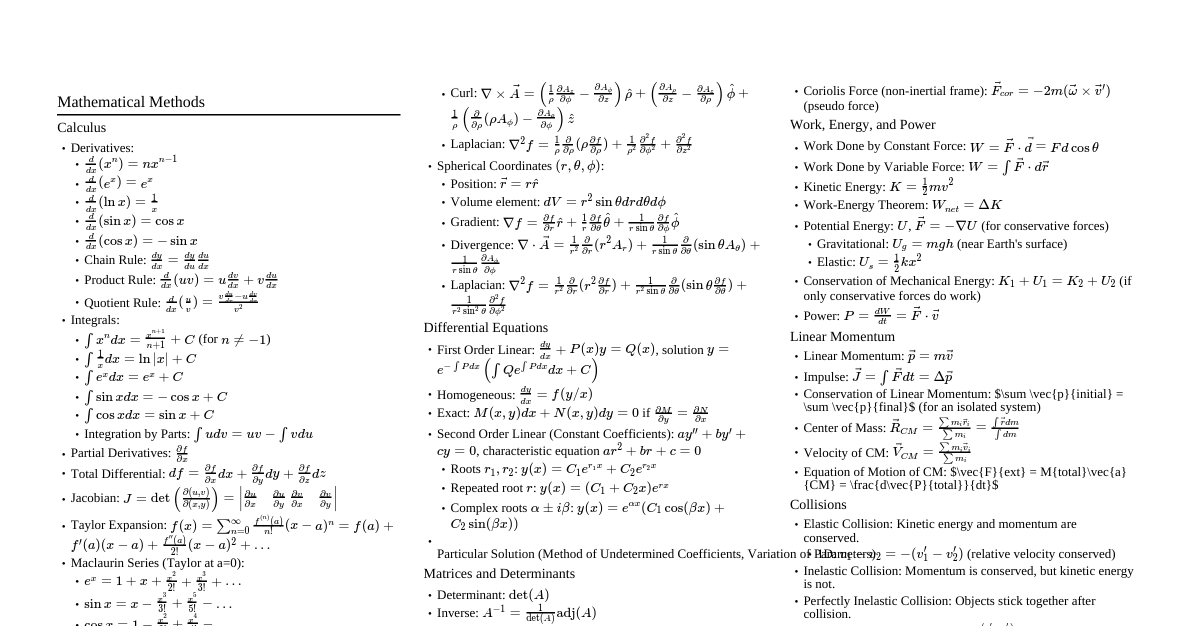
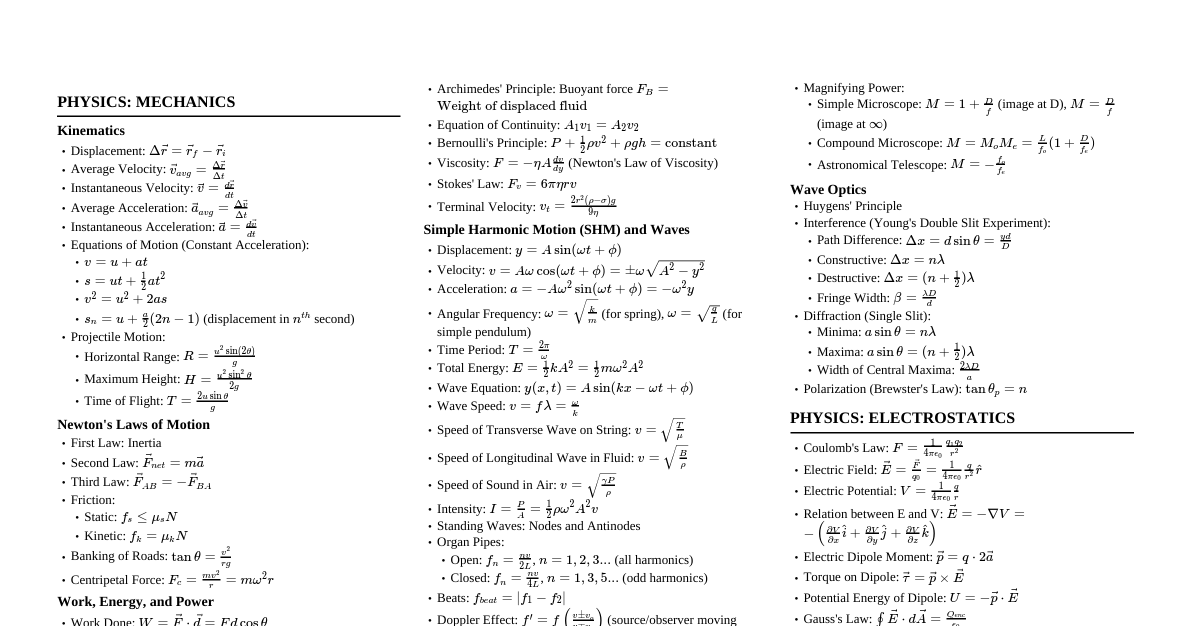
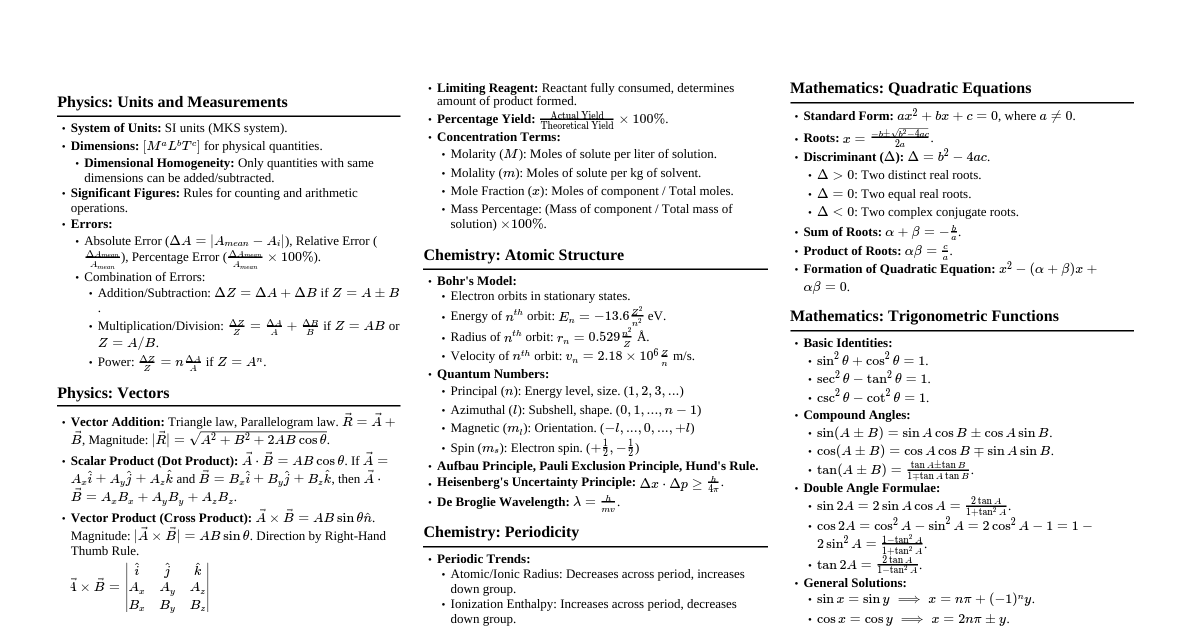
NEET 2026 Physics & Chemistry
Cheatsheet Content
### Physics: Units & Dimensions This section covers the fundamental concepts of measurement in Physics. - **Units:** A unit is a precisely defined and internationally accepted reference standard for measurement. - **SI System (International System of Units):** The most widely used system. It defines seven base units: - Length: meter (m) - Mass: kilogram (kg) - Time: second (s) - Electric Current: ampere (A) - Temperature: Kelvin (K) - Amount of Substance: mole (mol) - Luminous Intensity: candela (cd) - **Derived Units:** Units formed by combining base units (e.g., Newton for force, Joule for energy). - **Dimensions:** The powers to which the fundamental units must be raised to represent the unit of a physical quantity. - Represented using square brackets (e.g., $[L]$ for length, $[M]$ for mass, $[T]$ for time). - **Example:** Force has dimensions $[M^1L^1T^{-2}]$ as $F=ma$ (mass $\times$ length/time$^2$). - **Dimensional Analysis:** - **Homogeneity Principle:** An equation is dimensionally correct if the dimensions of all terms on both sides of the equation are the same. This is a necessary, but not sufficient, condition for correctness. - **Uses:** - Checking the dimensional correctness of an equation. - Deriving relations between physical quantities. - Converting units from one system to another. - **Significant Figures:** The reliable digits plus the first uncertain digit in a measurement. - **Rules for counting:** 1. All non-zero digits are significant. 2. Zeros between two non-zero digits are significant. 3. Leading zeros (before non-zero digits) are not significant. 4. Trailing zeros (at the end of the number) are significant if the number contains a decimal point. - **Rules for arithmetic operations:** - **Addition/Subtraction:** The result should have the same number of decimal places as the number with the fewest decimal places. - **Multiplication/Division:** The result should have the same number of significant figures as the number with the fewest significant figures. - **Errors in Measurement:** - **Systematic Errors:** Arise due to faulty instrument, experimental procedure, or personal bias. Can be minimized. - **Random Errors:** Arise due to unpredictable fluctuations. Cannot be eliminated, only reduced by repeated measurements. - **Absolute Error ($\Delta A$):** Magnitude of the difference between true value and measured value. - **Relative Error:** $\Delta A / A_{mean}$. - **Percentage Error:** $(\Delta A / A_{mean}) \times 100\%$. ### Physics: Kinematics Kinematics describes motion without considering its causes (forces). - **Scalar vs. Vector Quantities:** - **Scalar:** Magnitude only (e.g., distance, speed, time, mass). - **Vector:** Magnitude and direction (e.g., displacement, velocity, acceleration, force). - **Distance vs. Displacement:** - **Distance:** Total path length covered (scalar). - **Displacement ($\vec{s}$):** Shortest straight-line distance from initial to final position (vector). - **Speed vs. Velocity:** - **Speed:** Rate of change of distance (scalar). Average speed = Total distance / Total time. - **Velocity ($\vec{v}$):** Rate of change of displacement (vector). $\vec{v} = \frac{d\vec{s}}{dt}$. Average velocity = Total displacement / Total time. - **Acceleration ($\vec{a}$):** Rate of change of velocity (vector). $\vec{a} = \frac{d\vec{v}}{dt}$. - **Equations of Motion (for uniformly accelerated rectilinear motion):** 1. $v = u + at$ (Final velocity = Initial velocity + acceleration $\times$ time) 2. $s = ut + \frac{1}{2}at^2$ (Displacement = Initial velocity $\times$ time + $\frac{1}{2}$ acceleration $\times$ time$^2$) 3. $v^2 = u^2 + 2as$ (Final velocity$^2$ = Initial velocity$^2$ + 2 $\times$ acceleration $\times$ displacement) 4. $s_n = u + \frac{a}{2}(2n-1)$ (Displacement in the $n^{th}$ second) *Where $u$ = initial velocity, $v$ = final velocity, $a$ = constant acceleration, $t$ = time, $s$ = displacement.* - **Motion Under Gravity:** A special case where $a = g$ (acceleration due to gravity, approximately $9.8 \text{ m/s}^2$ downwards). - **Projectile Motion:** The motion of an object thrown or projected into the air, subject only to the acceleration of gravity. It's a 2D motion. - **Key assumption:** Air resistance is negligible. - **Independent motions:** Horizontal motion (constant velocity, $a_x = 0$) and Vertical motion (constant acceleration, $a_y = -g$). - **Important Formulas:** - **Time of Flight ($T$):** The total time the projectile remains in the air. $T = \frac{2u \sin\theta}{g}$ - **Maximum Height ($H$):** The highest vertical position reached. $H = \frac{u^2 \sin^2\theta}{2g}$ - **Horizontal Range ($R$):** The total horizontal distance covered. $R = \frac{u^2 \sin(2\theta)}{g}$ - Maximum range occurs at $\theta = 45^\circ$. - For a given range, there are two angles of projection: $\theta$ and $(90^\circ - \theta)$. ### Physics: Laws of Motion This section deals with the relationship between forces and the motion of objects. - **Force:** An external agent capable of changing the state of rest or motion of a body. It's a vector quantity. - **Inertia:** The inherent property of a body by virtue of which it resists any change in its state of rest or uniform motion. - **Newton's Laws of Motion:** 1. **First Law (Law of Inertia):** An object at rest stays at rest, and an object in motion stays in motion with the same speed and in the same direction unless acted upon by an unbalanced external force. 2. **Second Law:** The rate of change of momentum of a body is directly proportional to the applied external force and takes place in the direction in which the force acts. - $\vec{F} = \frac{d\vec{p}}{dt} = \frac{d(m\vec{v})}{dt}$. If mass is constant, $\vec{F} = m\vec{a}$. - **Momentum ($\vec{p}$):** Product of mass and velocity. $\vec{p} = m\vec{v}$. - **Impulse ($\vec{J}$):** Change in momentum. $\vec{J} = \Delta\vec{p} = \int \vec{F} dt$. For constant force, $\vec{J} = \vec{F}\Delta t$. 3. **Third Law:** To every action, there is always an equal and opposite reaction. - Action and reaction forces act on *different* bodies. - **Conservation of Linear Momentum:** In the absence of an external force, the total linear momentum of a system remains constant. - $m_1u_1 + m_2u_2 = m_1v_1 + m_2v_2$ (for two bodies) - **Friction:** A force that opposes relative motion or tendency of relative motion between two surfaces in contact. - **Static Friction ($f_s$):** Acts when there is no relative motion. $f_s \le \mu_s N$, where $\mu_s$ is the coefficient of static friction and $N$ is the normal force. - **Kinetic (Dynamic) Friction ($f_k$):** Acts when there is relative motion. $f_k = \mu_k N$, where $\mu_k$ is the coefficient of kinetic friction. - Generally, $\mu_s > \mu_k$. - **Circular Motion:** - **Centripetal Force ($F_c$):** The force required to keep an object moving in a circular path, directed towards the center. - $F_c = \frac{mv^2}{r} = m\omega^2 r$. - **Centrifugal Force:** A pseudo force observed in a rotating frame of reference, equal in magnitude and opposite in direction to centripetal force. - **Banking of Roads:** To safely negotiate a turn, roads are banked (outer edge raised). - Ideal banking angle: $\tan\theta = \frac{v^2}{rg}$. - With friction: $v_{max} = \sqrt{rg \frac{\mu_s + \tan\theta}{1 - \mu_s \tan\theta}}$. ### Physics: Work, Energy & Power This section introduces concepts related to energy transformation and transfer. - **Work ($W$):** Work is done when a force causes displacement. - $W = \vec{F} \cdot \vec{s} = Fs \cos\theta$, where $\theta$ is the angle between force and displacement. - If force is variable, $W = \int \vec{F} \cdot d\vec{s}$. - Units: Joule (J). - **Energy:** The capacity to do work. Units: Joule (J). - **Kinetic Energy ($KE$):** Energy possessed by a body due to its motion. - $KE = \frac{1}{2}mv^2$. - Relation with momentum: $KE = \frac{p^2}{2m}$. - **Potential Energy ($PE$):** Energy possessed by a body due to its position or configuration. - **Gravitational Potential Energy:** $PE = mgh$ (near Earth's surface). - **Elastic Potential Energy:** $PE = \frac{1}{2}kx^2$ (for a spring compressed/stretched by $x$, where $k$ is spring constant). - **Work-Energy Theorem:** The net work done on an object is equal to the change in its kinetic energy. - $W_{net} = \Delta KE = KE_f - KE_i$. - **Conservative and Non-Conservative Forces:** - **Conservative Force:** Work done by or against this force depends only on initial and final positions, not on the path taken (e.g., gravity, elastic spring force). The total mechanical energy is conserved. - **Non-Conservative Force:** Work done depends on the path taken (e.g., friction, air resistance). Mechanical energy is not conserved, some energy is dissipated (often as heat). - **Law of Conservation of Mechanical Energy:** For a system under conservative forces, the total mechanical energy (sum of kinetic and potential energy) remains constant. - $KE + PE = \text{constant}$. - **Power ($P$):** The rate at which work is done or energy is transferred. - $P = \frac{dW}{dt}$. - For constant force and velocity, $P = \vec{F} \cdot \vec{v}$. - Units: Watt (W). $1 \text{ W} = 1 \text{ J/s}$. - **Collisions:** - **Elastic Collision:** Both momentum and kinetic energy are conserved. - **Inelastic Collision:** Momentum is conserved, but kinetic energy is *not* conserved (some is lost as heat, sound, etc.). - **Perfectly Inelastic Collision:** The colliding bodies stick together after collision. ### Physics: Rotational Motion This section extends kinematics and dynamics to rotating bodies. - **Angular Displacement ($\theta$):** The angle swept by the radius vector of a particle in circular motion (radians). - **Angular Velocity ($\omega$):** Rate of change of angular displacement. $\omega = \frac{d\theta}{dt}$. Units: rad/s. - Relation with linear velocity: $v = r\omega$. - **Angular Acceleration ($\alpha$):** Rate of change of angular velocity. $\alpha = \frac{d\omega}{dt}$. Units: rad/s$^2$. - Relation with tangential acceleration: $a_t = r\alpha$. - **Moment of Inertia ($I$):** The rotational analogue of mass. It's a measure of an object's resistance to angular acceleration. - For a system of particles: $I = \sum mr^2$. - For a continuous body: $I = \int r^2 dm$. - Units: kg m$^2$. - **Theorems of Moment of Inertia:** - **Parallel Axes Theorem:** $I = I_{CM} + Md^2$ (where $I_{CM}$ is MOI about an axis through center of mass, $M$ is total mass, $d$ is distance between parallel axes). - **Perpendicular Axes Theorem:** For a planar body, $I_z = I_x + I_y$ (where $I_x, I_y, I_z$ are MOI about perpendicular axes lying in the plane and perpendicular to the plane, respectively, intersecting at a common point). - **Torque ($\vec{\tau}$):** The rotational analogue of force. It causes angular acceleration. - $\vec{\tau} = \vec{r} \times \vec{F}$. Magnitude $\tau = rF \sin\theta$. - Relation with moment of inertia: $\vec{\tau} = I\vec{\alpha}$. - Units: N m. - **Angular Momentum ($\vec{L}$):** The rotational analogue of linear momentum. - $\vec{L} = \vec{r} \times \vec{p} = \vec{r} \times (m\vec{v})$. - For a rigid body rotating about a fixed axis: $\vec{L} = I\vec{\omega}$. - Units: kg m$^2$/s or J s. - **Conservation of Angular Momentum:** If the net external torque acting on a system is zero, its total angular momentum remains constant. - If $\vec{\tau}_{ext} = 0$, then $\vec{L} = \text{constant}$ (i.e., $I_1\omega_1 = I_2\omega_2$). - **Rotational Kinetic Energy:** $KE_{rot} = \frac{1}{2}I\omega^2$. - **Rolling Motion:** A combination of translational and rotational motion. - **Condition for pure rolling:** $v_{CM} = R\omega$ (where $v_{CM}$ is velocity of center of mass, $R$ is radius, $\omega$ is angular velocity). - Total kinetic energy of a rolling body: $KE_{total} = KE_{trans} + KE_{rot} = \frac{1}{2}Mv_{CM}^2 + \frac{1}{2}I_{CM}\omega^2$. ### Physics: Gravitation This section explores the universal force of attraction between masses. - **Newton's Law of Universal Gravitation:** Every particle in the universe attracts every other particle with a force that is directly proportional to the product of their masses and inversely proportional to the square of the distance between their centers. - $F = \frac{Gm_1m_2}{r^2}$, where $G$ is the universal gravitational constant ($6.67 \times 10^{-11} \text{ Nm}^2/\text{kg}^2$). - This force is always attractive and acts along the line joining the centers of the two masses. - **Acceleration due to Gravity ($g$):** The acceleration experienced by an object due to Earth's gravitational pull. - $g = \frac{GM}{R^2}$ (at Earth's surface, where $M$ is Earth's mass, $R$ is Earth's radius). - **Variation of $g$:** - **With Altitude ($h$):** $g' = g (1 - \frac{2h}{R})$ for $h \ll R$. More generally, $g' = \frac{GM}{(R+h)^2}$. - **With Depth ($d$):** $g' = g (1 - \frac{d}{R})$. At Earth's center, $g'=0$. - **With Latitude ($\lambda$):** $g' = g - R\omega^2 \cos^2\lambda$ (due to Earth's rotation). $g$ is maximum at poles ($\lambda=90^\circ$) and minimum at equator ($\lambda=0^\circ$). - **Gravitational Potential Energy ($U$):** The potential energy of a mass $m$ at a distance $r$ from another mass $M$. - $U = -\frac{GMm}{r}$. (The negative sign indicates that the force is attractive and potential energy is zero at infinite separation). - **Gravitational Potential ($V$):** The gravitational potential energy per unit mass. - $V = -\frac{GM}{r}$. - **Escape Velocity ($v_e$):** The minimum velocity required for an object to escape the gravitational pull of a planet and not return. - $v_e = \sqrt{\frac{2GM}{R}} = \sqrt{2gR}$. For Earth, $v_e \approx 11.2 \text{ km/s}$. - **Orbital Velocity ($v_o$):** The velocity required for an object to maintain a stable orbit around a planet at a given radius $r$. - $v_o = \sqrt{\frac{GM}{r}}$. - Note: $v_e = \sqrt{2} v_o$. - **Kepler's Laws of Planetary Motion:** 1. **Law of Orbits:** All planets move in elliptical orbits with the Sun at one of the foci. 2. **Law of Areas:** The line joining a planet to the Sun sweeps out equal areas in equal intervals of time (implies conservation of angular momentum). 3. **Law of Periods:** The square of the orbital period ($T$) of any planet is proportional to the cube of the semi-major axis ($a$) of its orbit. $T^2 \propto a^3$. For circular orbits, $T^2 \propto r^3$. ### Physics: Properties of Solids & Fluids This section covers the mechanical properties of matter in solid and fluid states. #### Solids (Elasticity) - **Deforming Force:** A force that changes the size or shape of a body. - **Restoring Force:** An internal force developed in a deformed body that tends to restore it to its original shape and size. - **Elasticity:** The property of a body by virtue of which it regains its original configuration after the removal of deforming forces. - **Stress ($\sigma$):** Restoring force per unit area. $\sigma = F/A$. Units: N/m$^2$ (Pascal, Pa). - **Tensile/Compressive Stress:** Force perpendicular to area. - **Shear Stress:** Force tangential to area. - **Strain ($\epsilon$):** Fractional change in configuration. It's a dimensionless quantity. - **Longitudinal Strain:** $\Delta L/L$ (change in length / original length). - **Volume Strain:** $\Delta V/V$ (change in volume / original volume). - **Shear Strain:** $\phi = x/h$ (relative displacement / height). - **Hooke's Law:** Within the elastic limit, stress is directly proportional to strain. $\text{Stress} \propto \text{Strain} \Rightarrow \text{Stress} = E \times \text{Strain}$, where $E$ is the modulus of elasticity. - **Moduli of Elasticity:** - **Young's Modulus ($Y$):** For longitudinal stress and strain. $Y = \frac{\text{Longitudinal Stress}}{\text{Longitudinal Strain}} = \frac{F/A}{\Delta L/L}$. - **Bulk Modulus ($B$):** For volume stress and strain. $B = \frac{\text{Normal Stress (Pressure)}}{\text{Volume Strain}} = \frac{-P}{\Delta V/V}$. (Negative sign because increase in pressure decreases volume). - **Shear Modulus (Rigidity Modulus, $G$):** For shear stress and strain. $G = \frac{\text{Shear Stress}}{\text{Shear Strain}} = \frac{F/A}{\phi}$. - **Poisson's Ratio ($\nu$):** Ratio of lateral strain to longitudinal strain. $\nu = -\frac{\Delta D/D}{\Delta L/L}$. - **Elastic Potential Energy:** Energy stored per unit volume in a stretched wire: $U = \frac{1}{2} \text{Stress} \times \text{Strain} = \frac{1}{2} Y (\text{Strain})^2$. #### Fluids (Fluid Mechanics) - **Fluids:** Substances that can flow (liquids and gases). - **Density ($\rho$):** Mass per unit volume. $\rho = m/V$. - **Pressure ($P$):** Force per unit area. $P = F/A$. Units: N/m$^2$ (Pascal, Pa). - **Pressure at a depth $h$ in a fluid:** $P = P_0 + \rho gh$ (where $P_0$ is atmospheric pressure, $\rho$ is fluid density). - **Pascal's Law:** Pressure applied to an enclosed incompressible fluid is transmitted undiminished to every portion of the fluid and the walls of the containing vessel. - Basis of hydraulic systems (e.g., hydraulic lift, brakes). - **Archimedes' Principle:** When a body is wholly or partially immersed in a fluid, it experiences an upward buoyant force equal to the weight of the fluid displaced by it. - **Buoyant Force ($F_B$):** $F_B = \rho_{fluid} V_{submerged} g$. - **Streamline Flow:** Smooth, orderly flow where fluid particles follow paths that do not cross each other. - **Turbulent Flow:** Irregular, chaotic flow with eddies and vortices. - **Equation of Continuity:** For an incompressible, non-viscous fluid in streamline flow, the product of the area of cross-section and the fluid speed is constant. - $A_1v_1 = A_2v_2 = \text{constant}$. (Implies fluid speed increases where area decreases). - **Bernoulli's Principle:** For an ideal fluid in streamline flow, the sum of pressure energy, kinetic energy, and potential energy per unit volume is constant along a streamline. - $P + \frac{1}{2}\rho v^2 + \rho gh = \text{constant}$. - **Viscosity:** The property of a fluid by virtue of which it opposes the relative motion between its different layers. It's internal friction. - **Newton's Law of Viscosity:** $F = -\eta A \frac{dv}{dz}$, where $\eta$ is coefficient of viscosity. - **Stokes' Law:** Drag force on a spherical object moving through a viscous fluid: $F_D = 6\pi\eta rv$. - **Terminal Velocity:** Constant velocity attained by a body falling through a viscous fluid when drag force equals gravitational force minus buoyant force. - **Surface Tension ($S$):** The property of a liquid surface at rest to behave like a stretched elastic membrane, tending to minimize its surface area. - Force per unit length acting perpendicular to an imaginary line on the surface. $S = F/L$. Units: N/m. - **Surface Energy:** Work done to increase the surface area. $E_s = S \times \Delta A$. - **Angle of Contact:** Angle between the tangent to the liquid surface and the solid surface inside the liquid. Determines wetting. - **Capillarity:** Rise or fall of a liquid in a narrow tube. $h = \frac{2S \cos\theta}{\rho rg}$. ### Physics: Heat & Thermodynamics This section covers the concepts of heat, temperature, and energy transformations. - **Heat:** A form of energy transferred between systems or objects with different temperatures. Units: Joule (J). - **Temperature:** A measure of the average kinetic energy of the particles in a substance. Units: Kelvin (K), Celsius ($^\circ$C), Fahrenheit ($^\circ$F). - $T(K) = T(^\circ C) + 273.15$. - **Thermal Expansion:** The tendency of matter to change in volume in response to a change in temperature. - **Linear Expansion:** $\Delta L = L_0 \alpha \Delta T$, where $\alpha$ is the coefficient of linear expansion. - **Area Expansion:** $\Delta A = A_0 \beta \Delta T$, where $\beta = 2\alpha$. - **Volume Expansion:** $\Delta V = V_0 \gamma \Delta T$, where $\gamma = 3\alpha$. - **Anomalous Expansion of Water:** Water contracts on heating from $0^\circ C$ to $4^\circ C$, and then expands. Density is maximum at $4^\circ C$. - **Heat Transfer:** - **Conduction:** Transfer of heat through direct contact, without actual movement of matter (prevalent in solids). - Rate of heat flow: $\frac{Q}{t} = \frac{kA\Delta T}{L}$, where $k$ is thermal conductivity. - **Convection:** Transfer of heat by the actual movement of fluid particles (liquids and gases). - **Radiation:** Transfer of heat via electromagnetic waves, without any medium. - **Stefan-Boltzmann Law:** Power radiated by a black body: $P = \sigma AT^4$. For a real body, $P = e\sigma AT^4$, where $e$ is emissivity. - **Wien's Displacement Law:** $\lambda_m T = b$ (constant), where $\lambda_m$ is wavelength of maximum emission. - **Newton's Law of Cooling:** Rate of cooling is proportional to the temperature difference between the body and its surroundings, for small differences. - **Thermodynamics:** The study of heat and its relation to other forms of energy and work. - **Thermodynamic System:** The part of the universe under consideration. - **Surroundings:** Everything outside the system. - **Types of Systems:** Open, Closed, Isolated. - **Laws of Thermodynamics:** - **Zeroth Law:** If two systems are each in thermal equilibrium with a third system, then they are in thermal equilibrium with each other. (Establishes temperature as a fundamental property). - **First Law:** The change in internal energy ($\Delta U$) of a system is equal to the heat ($Q$) added to the system minus the work ($W$) done by the system. - $\Delta U = Q - W$. (A statement of energy conservation). - Internal energy is a state function. $Q$ and $W$ are path functions. - **Second Law:** - **Clausius Statement:** Heat cannot spontaneously flow from a colder body to a hotter body. - **Kelvin-Planck Statement:** It is impossible to construct a device that operates in a cycle and produces no effect other than the absorption of heat from a single reservoir and the performance of an equivalent amount of work. (No heat engine can have 100% efficiency). - **Entropy ($S$):** A measure of the disorder or randomness of a system. For a spontaneous process, the total entropy of the universe always increases ($\Delta S_{total} > 0$). - **Thermodynamic Processes:** - **Isothermal:** Constant temperature ($\Delta T = 0, \Delta U = 0$). $PV = \text{constant}$. $W = nRT \ln(V_f/V_i)$. - **Adiabatic:** No heat exchange ($Q=0$). $PV^\gamma = \text{constant}$. $W = -\Delta U = \frac{nR(T_i - T_f)}{\gamma - 1}$. - **Isobaric:** Constant pressure. $W = P\Delta V$. - **Isochoric:** Constant volume ($W=0$). $\Delta U = Q$. - **Specific Heat Capacity ($c$):** The amount of heat required to raise the temperature of a unit mass of a substance by one degree Celsius (or Kelvin). - $Q = mc\Delta T$. - **Molar Specific Heat:** Heat capacity per mole. - $C_P$ (at constant pressure), $C_V$ (at constant volume). - **Mayer's Relation:** $C_P - C_V = R$ (for ideal gas). - Ratio of specific heats: $\gamma = C_P/C_V$. - **Latent Heat ($L$):** The heat required to change the state of a substance without changing its temperature. - $Q = mL$. $L_f$ for fusion, $L_v$ for vaporization. - **Ideal Gas Equation:** $PV = nRT$ (where $n$ is moles, $R$ is universal gas constant). - **Kinetic Theory of Gases:** - Assumptions: Gas consists of tiny particles in random motion, elastic collisions, negligible volume of particles, no intermolecular forces. - Pressure $P = \frac{1}{3}\frac{nm\bar{v}^2}{V}$. - Average kinetic energy per molecule: $\bar{KE} = \frac{3}{2}kT$ (where $k$ is Boltzmann constant). - Root mean square speed: $v_{rms} = \sqrt{\frac{3RT}{M}}$. - **Heat Engine:** Converts heat energy into mechanical work. - Efficiency $\eta = \frac{W}{Q_H} = 1 - \frac{Q_C}{Q_H}$. - **Carnot Engine:** Ideal, reversible engine with maximum possible efficiency between two temperatures. - $\eta_{Carnot} = 1 - \frac{T_C}{T_H}$ (where $T_C, T_H$ are absolute temperatures of cold and hot reservoirs). - **Refrigerator/Heat Pump:** Moves heat from a colder to a hotter reservoir, requiring work input. - **Coefficient of Performance (COP):** $\text{COP} = \frac{Q_C}{W}$ (for refrigerator), $\text{COP} = \frac{Q_H}{W}$ (for heat pump). ### Physics: Waves This section covers the properties and behavior of waves. - **Wave:** A disturbance that propagates through a medium (or space) transferring energy without transferring matter. - **Types of Waves:** - **Mechanical Waves:** Require a material medium for propagation (e.g., sound waves, water waves). - **Electromagnetic Waves:** Do not require a medium for propagation (e.g., light, radio waves). - **Transverse Waves:** Particles of the medium oscillate perpendicular to the direction of wave propagation (e.g., light, waves on a string). - **Longitudinal Waves:** Particles of the medium oscillate parallel to the direction of wave propagation (e.g., sound waves). - **Wave Characteristics:** - **Wavelength ($\lambda$):** Distance between two consecutive crests or troughs (or any two corresponding points). - **Amplitude ($A$):** Maximum displacement of a particle from its equilibrium position. - **Frequency ($f$ or $\nu$):** Number of oscillations per second. Units: Hz. - **Time Period ($T$):** Time taken for one complete oscillation. $T = 1/f$. - **Wave Speed ($v$):** $v = f\lambda$. Also depends on the medium. - Speed of sound in a medium: $v = \sqrt{B/\rho}$ (solids/liquids, $B$ is bulk modulus), $v = \sqrt{\gamma RT/M}$ (gases). - **Principle of Superposition of Waves:** When two or more waves overlap, the resultant displacement at any point and at any instant is the vector sum of the displacements due to individual waves. - **Interference:** The phenomenon of two waves superposing to form a resultant wave of greater, lower, or the same amplitude. - **Constructive Interference:** When crests/troughs align, resulting in increased amplitude. Path difference = $n\lambda$. Phase difference = $2n\pi$. - **Destructive Interference:** When a crest aligns with a trough, resulting in decreased amplitude. Path difference = $(n+\frac{1}{2})\lambda$. Phase difference = $(2n+1)\pi$. - **Standing Waves (Stationary Waves):** Formed when two identical waves travelling in opposite directions superpose. - **Nodes:** Points of zero displacement. - **Antinodes:** Points of maximum displacement. - **Waves on a string (fixed at both ends):** Frequencies $f_n = \frac{nv}{2L}$, where $n=1, 2, 3, ...$. Fundamental frequency $f_1 = v/2L$. - **Organ Pipes:** - **Open at both ends:** Frequencies $f_n = \frac{nv}{2L}$, where $n=1, 2, 3, ...$. - **Closed at one end:** Frequencies $f_n = \frac{nv}{4L}$, where $n=1, 3, 5, ...$ (only odd harmonics). - **Beats:** The periodic variation in intensity of sound caused by the superposition of two sound waves of slightly different frequencies. - Beat frequency = $|f_1 - f_2|$. - **Doppler Effect (for Sound):** The apparent change in frequency of a sound wave due to the relative motion between the source and the observer. - $f' = f \left( \frac{v \pm v_o}{v \mp v_s} \right)$, where $v$ is speed of sound, $v_o$ is observer speed, $v_s$ is source speed. - Use + for $v_o$ if observer moves towards source, - if away. - Use - for $v_s$ if source moves towards observer, + if away. ### Physics: Ray Optics & Optical Instruments This section deals with light propagation in terms of rays and its interaction with optical elements. - **Light:** An electromagnetic wave, but for ray optics, it's considered to travel in straight lines (rays). - **Reflection:** The bouncing back of light when it strikes a surface. - **Laws of Reflection:** 1. The incident ray, the reflected ray, and the normal to the surface at the point of incidence all lie in the same plane. 2. The angle of incidence ($i$) is equal to the angle of reflection ($r$). $\angle i = \angle r$. - **Plane Mirrors:** Form virtual, erect, laterally inverted images of the same size as the object, located as far behind the mirror as the object is in front. - **Spherical Mirrors (Concave & Convex):** - **Mirror Formula:** $\frac{1}{f} = \frac{1}{v} + \frac{1}{u}$ (where $f$ is focal length, $v$ is image distance, $u$ is object distance). - **Magnification ($m$):** $m = \frac{h_i}{h_o} = -\frac{v}{u}$. - **Sign Convention (Cartesian):** Origin at pole, incident light from left. Distances measured in direction of light are positive, opposite are negative. Above principal axis is positive, below is negative. - **Refraction:** The bending of light as it passes from one medium to another due to a change in speed. - **Snell's Law:** $\frac{\sin i}{\sin r} = \frac{n_2}{n_1} = \frac{v_1}{v_2}$. (where $n$ is refractive index). - **Refractive Index ($n$):** Ratio of speed of light in vacuum to speed of light in the medium ($n = c/v$). - **Total Internal Reflection (TIR):** When light travels from a denser medium to a rarer medium, and the angle of incidence exceeds a critical angle ($\theta_c$), the light is entirely reflected back into the denser medium. - $\sin\theta_c = \frac{n_2}{n_1}$ (where $n_1 > n_2$). - Applications: Optical fibers, sparkling of diamonds, mirage. - **Refraction through a Prism:** - Angle of deviation $\delta = (i_1 + i_2) - A$, where $A$ is prism angle. - Minimum deviation occurs when $i_1 = i_2$ and $r_1 = r_2 = A/2$. - At minimum deviation: $n = \frac{\sin((A+\delta_m)/2)}{\sin(A/2)}$. - **Lenses (Convex & Concave):** - **Lens Maker's Formula:** $\frac{1}{f} = (n-1)\left(\frac{1}{R_1} - \frac{1}{R_2}\right)$. - **Lens Formula:** $\frac{1}{f} = \frac{1}{v} - \frac{1}{u}$. - **Magnification ($m$):** $m = \frac{h_i}{h_o} = \frac{v}{u}$. - **Power of a Lens ($P$):** $P = 1/f$ (f in meters). Units: Dioptre (D). - **Combination of Thin Lenses:** For lenses in contact, $P_{eq} = P_1 + P_2 + ...$ and $\frac{1}{f_{eq}} = \frac{1}{f_1} + \frac{1}{f_2} + ...$. - **Optical Instruments:** - **Human Eye:** Lens system focuses light on retina. - **Defects:** Myopia (nearsightedness - corrected by concave lens), Hypermetropia (farsightedness - corrected by convex lens), Presbyopia, Astigmatism. - **Simple Microscope (Magnifying Glass):** Convex lens. Angular magnification $M = 1 + D/f$ (when image at near point), $M = D/f$ (when image at infinity). - **Compound Microscope:** Uses two convex lenses (objective and eyepiece). Magnification $M = M_o \times M_e = \frac{L}{f_o} \left(1 + \frac{D}{f_e}\right)$. - **Astronomical Telescope:** Used to view distant objects. Angular magnification $M = -\frac{f_o}{f_e}$. Length $L = f_o + f_e$. ### Physics: Wave Optics This section explores the wave nature of light, including phenomena like interference, diffraction, and polarization. - **Huygens' Principle:** 1. Every point on a primary wavefront acts as a source of secondary wavelets, which spread out in all directions with the speed of light in the medium. 2. The new wavefront at any later instant is the forward envelope of these secondary wavelets. - **Interference of Light:** The phenomenon of redistribution of light energy due to the superposition of two coherent light waves. - **Coherent Sources:** Sources that emit light waves of the same frequency, same amplitude, and constant phase difference. - **Young's Double Slit Experiment (YDSE):** Demonstrates interference. - **Fringe Width ($\beta$):** The distance between two consecutive bright or dark fringes. $\beta = \frac{\lambda D}{d}$, where $\lambda$ is wavelength, $D$ is distance to screen, $d$ is distance between slits. - **Conditions for Constructive Interference (Bright Fringes):** Path difference $\Delta x = n\lambda$. Position $y_n = \frac{n\lambda D}{d}$. - **Conditions for Destructive Interference (Dark Fringes):** Path difference $\Delta x = (n+\frac{1}{2})\lambda$. Position $y_n = \frac{(n+\frac{1}{2})\lambda D}{d}$. - **Diffraction:** The bending of waves around obstacles or through small openings. - **Single Slit Diffraction:** - **Minima (Dark Fringes):** Occur at $a \sin\theta = n\lambda$, where $a$ is slit width, $n = \pm 1, \pm 2, ...$. - **Maxima (Bright Fringes):** Occur at $a \sin\theta = (n+\frac{1}{2})\lambda$, where $n = \pm 1, \pm 2, ...$. The central maximum is at $\theta = 0$. - The central maximum is twice as wide as other maxima. - **Polarization:** The phenomenon of restricting the vibrations of a transverse wave to a single plane. - **Unpolarized Light:** Vibrates in all possible planes perpendicular to the direction of propagation. - **Polarized Light:** Vibrates in a single plane. - **Polarizer:** A device that produces polarized light from unpolarized light. - **Analyzer:** Used to detect polarized light. - **Brewster's Law:** When unpolarized light is incident on a transparent medium at the polarizing angle ($i_p$), the reflected light is completely plane polarized perpendicular to the plane of incidence, and the refracted light is partially polarized. - $\tan i_p = n$ (where $n$ is refractive index of the medium). - At $i_p$, reflected and refracted rays are perpendicular to each other. - **Malus' Law:** If polarized light of intensity $I_0$ passes through an analyzer, the intensity of transmitted light is $I = I_0 \cos^2\theta$, where $\theta$ is the angle between the transmission axes of the polarizer and analyzer. ### Physics: Electrostatics This section covers electric charges at rest and the forces and fields they produce. - **Electric Charge:** An intrinsic property of matter that causes it to experience a force when placed in an electromagnetic field. - Quantized: $q = \pm ne$, where $e$ is elementary charge ($1.6 \times 10^{-19}$ C). - Conserved: Total charge in an isolated system remains constant. - **Coulomb's Law:** The electrostatic force between two point charges is directly proportional to the product of the charges and inversely proportional to the square of the distance between them. - $F = \frac{1}{4\pi\epsilon_0} \frac{q_1q_2}{r^2}$, where $\epsilon_0$ is the permittivity of free space ($8.85 \times 10^{-12} \text{ C}^2/\text{Nm}^2$). - In a medium, $\epsilon = K\epsilon_0$, where $K$ is the dielectric constant. - **Electric Field ($\vec{E}$):** The region around a charged object where another charged object experiences an electrostatic force. - $\vec{E} = \vec{F}/q_0$ (force per unit test charge). Units: N/C or V/m. - For a point charge $q$: $E = \frac{1}{4\pi\epsilon_0} \frac{q}{r^2}$. - Electric field lines originate from positive charges and terminate on negative charges. They never intersect. - **Electric Potential ($V$):** The work done per unit positive test charge in bringing it from infinity to a point in the electric field. - $V = W/q_0$. Units: Volt (V). - For a point charge $q$: $V = \frac{1}{4\pi\epsilon_0} \frac{q}{r}$. - Relation between E and V: $E = -\frac{dV}{dr}$ (electric field is the negative gradient of potential). - **Equipotential Surfaces:** Surfaces where the electric potential is constant. Electric field lines are always perpendicular to equipotential surfaces. - **Electric Dipole:** A pair of equal and opposite charges ($+q$ and $-q$) separated by a small distance ($2a$). - **Electric Dipole Moment ($\vec{p}$):** $\vec{p} = q(2\vec{a})$, directed from $-q$ to $+q$. - **Torque on a dipole in uniform E-field:** $\vec{\tau} = \vec{p} \times \vec{E}$. - **Potential Energy of a dipole:** $U = -\vec{p} \cdot \vec{E}$. - **Gauss's Law:** The total electric flux ($\Phi_E$) through any closed surface (Gaussian surface) is equal to $1/\epsilon_0$ times the net charge enclosed within the surface. - $\oint \vec{E} \cdot d\vec{A} = \frac{Q_{enc}}{\epsilon_0}$. - Used to calculate electric fields for symmetric charge distributions (e.g., infinite line charge, infinite plane sheet, spherical shell). - **Capacitance ($C$):** The ability of a conductor to store electric charge. - $C = Q/V$. Units: Farad (F). - **Parallel Plate Capacitor:** $C = \frac{\epsilon A}{d} = \frac{K\epsilon_0 A}{d}$ (where $A$ is plate area, $d$ is separation, $K$ is dielectric constant). - **Capacitors in Series:** $\frac{1}{C_{eq}} = \frac{1}{C_1} + \frac{1}{C_2} + ...$. Charge is same, voltage divides. - **Capacitors in Parallel:** $C_{eq} = C_1 + C_2 + ...$. Voltage is same, charge divides. - **Energy Stored in a Capacitor:** - $U = \frac{1}{2}CV^2 = \frac{1}{2}QV = \frac{Q^2}{2C}$. - Energy density: $u = \frac{1}{2}\epsilon_0 E^2$. - **Dielectrics:** Insulating materials that get polarized when placed in an electric field, reducing the net electric field and increasing capacitance. ### Physics: Current Electricity This section focuses on the flow of electric charges. - **Electric Current ($I$):** The rate of flow of electric charge. - $I = \frac{dQ}{dt}$. Units: Ampere (A). - Conventional current flows from positive to negative. Electron flow is opposite. - **Drift Velocity ($v_d$):** The average velocity with which free electrons drift in a conductor under the influence of an electric field. - Relation: $I = nAve_d$, where $n$ is number density of free electrons, $A$ is cross-sectional area, $e$ is charge of electron. - **Ohm's Law:** At constant temperature, the current flowing through a conductor is directly proportional to the potential difference across its ends. - $V = IR$. - **Resistance ($R$):** Opposition to the flow of current. Units: Ohm ($\Omega$). - Dependence of Resistance: $R = \rho \frac{L}{A}$, where $\rho$ is resistivity, $L$ is length, $A$ is cross-sectional area. - **Resistivity ($\rho$):** Intrinsic property of material. Inverse of conductivity ($\sigma$). - **Temperature Dependence of Resistance:** $R_T = R_0(1 + \alpha(T-T_0))$, where $\alpha$ is temperature coefficient of resistance. - **Kirchhoff's Laws:** 1. **Junction Rule (KCL - Kirchhoff's Current Law):** The algebraic sum of currents entering a junction is equal to the algebraic sum of currents leaving the junction. (Based on conservation of charge). $\sum I = 0$. 2. **Loop Rule (KVL - Kirchhoff's Voltage Law):** The algebraic sum of potential differences around any closed loop in a circuit is zero. (Based on conservation of energy). $\sum \Delta V = 0$. - **Resistors in Series:** - $R_{eq} = R_1 + R_2 + ...$. - Current is same through each resistor. Voltage divides. - **Resistors in Parallel:** - $\frac{1}{R_{eq}} = \frac{1}{R_1} + \frac{1}{R_2} + ...$. - Voltage is same across each resistor. Current divides. - **Cells (EMF and Internal Resistance):** - **Electromotive Force (EMF, $\mathcal{E}$):** The maximum potential difference between the terminals of a cell when no current is drawn from it. - **Internal Resistance ($r$):** Resistance offered by the electrolyte of the cell. - Terminal voltage: $V = \mathcal{E} - Ir$. If charging, $V = \mathcal{E} + Ir$. - **Cells in Series:** $\mathcal{E}_{eq} = \sum \mathcal{E}_i$, $r_{eq} = \sum r_i$. - **Cells in Parallel:** $\frac{1}{\mathcal{E}_{eq}} = \sum \frac{1}{\mathcal{E}_i}$ for identical cells connected to a common point. For identical cells, $\mathcal{E}_{eq} = \mathcal{E}$, $\frac{1}{r_{eq}} = \sum \frac{1}{r_i}$. - **Wheatstone Bridge:** A circuit used to measure an unknown resistance. - Balanced condition: $\frac{P}{Q} = \frac{R}{S}$. - **Meter Bridge:** Practical application of Wheatstone bridge. - **Potentiometer:** A device used to measure unknown EMF, compare EMFs of two cells, and determine the internal resistance of a cell. (Works on the principle that potential drop across a wire is proportional to its length for uniform wire and constant current). - **Electric Power ($P$):** The rate at which electrical energy is consumed or dissipated. - $P = VI = I^2R = V^2/R$. Units: Watt (W). - **Joule's Law of Heating:** Heat produced $H = I^2Rt$. ### Physics: Magnetic Effects of Current & Magnetism This section explores the magnetic fields produced by electric currents and the forces they exert. - **Magnetic Field ($\vec{B}$):** A region around a magnet or a current-carrying conductor where magnetic forces can be observed. Units: Tesla (T) or Gauss (G). ($1 \text{ T} = 10^4 \text{ G}$). - **Oersted's Experiment:** Showed that electric current produces a magnetic field. - **Biot-Savart Law:** Gives the magnetic field ($d\vec{B}$) produced by a small current element ($I d\vec{l}$). - $d\vec{B} = \frac{\mu_0}{4\pi} \frac{I d\vec{l} \times \hat{r}}{r^2}$, where $\mu_0$ is permeability of free space ($4\pi \times 10^{-7} \text{ T m/A}$). - **Magnetic Field due to various configurations:** - **Long Straight Wire:** $B = \frac{\mu_0 I}{2\pi r}$. - **Circular Loop (at center):** $B = \frac{\mu_0 I}{2R}$. - **Solenoid:** $B = \mu_0 n I$ (inside, $n$ is turns per unit length). - **Toroid:** $B = \frac{\mu_0 NI}{2\pi r}$ (inside). - **Ampere's Circuital Law:** The line integral of the magnetic field $\vec{B}$ around any closed loop is equal to $\mu_0$ times the total current enclosed by the loop. - $\oint \vec{B} \cdot d\vec{l} = \mu_0 I_{enc}$. - Used for symmetric current distributions. - **Lorentz Force:** The total force experienced by a charged particle moving in both electric and magnetic fields. - $\vec{F} = q(\vec{E} + \vec{v} \times \vec{B})$. - **Magnetic Force on a moving charge:** $\vec{F}_m = q(\vec{v} \times \vec{B})$. If $\vec{v} \perp \vec{B}$, the particle moves in a circular path with radius $r = \frac{mv}{qB}$. - **Force on a Current-Carrying Conductor:** - $\vec{F} = I(\vec{L} \times \vec{B})$. Magnitude $F = BIL\sin\theta$. - **Force between two parallel current-carrying wires:** Attractive if currents are in same direction, repulsive if opposite. $F/L = \frac{\mu_0 I_1 I_2}{2\pi d}$. - **Torque on a Current Loop in a Magnetic Field:** - $\vec{\tau} = \vec{M} \times \vec{B}$, where $\vec{M}$ is the magnetic dipole moment of the loop. - **Magnetic Dipole Moment ($\vec{M}$):** $\vec{M} = NIA\hat{n}$ (where $N$ is number of turns, $I$ is current, $A$ is area, $\hat{n}$ is unit vector normal to loop). - **Moving Coil Galvanometer:** Device used to detect and measure small electric currents. - Principle: Torque on a current loop in a magnetic field. - **Conversion to Ammeter:** Connect a low resistance shunt in parallel. - **Conversion to Voltmeter:** Connect a high resistance in series. - **Magnetism in Matter:** - **Diamagnetic Materials:** Weakly repelled by magnetic fields. Have no permanent magnetic dipoles. (e.g., Cu, Zn, Bi, water). - **Paramagnetic Materials:** Weakly attracted by magnetic fields. Have permanent magnetic dipoles that align with external field. (e.g., Al, Na, Ca, O$_2$). - **Ferromagnetic Materials:** Strongly attracted by magnetic fields. Have domains that align strongly. Exhibit hysteresis. (e.g., Fe, Co, Ni). - **Curie Temperature:** The temperature above which a ferromagnetic material becomes paramagnetic. - **Earth's Magnetism:** - **Magnetic Declination:** Angle between magnetic meridian and geographic meridian. - **Magnetic Dip (Inclination):** Angle that the Earth's total magnetic field vector makes with the horizontal. - **Horizontal Component of Earth's Magnetic Field:** $B_H = B_E \cos\delta$. ### Physics: EMI & AC This section covers electromagnetic induction and alternating current circuits. #### Electromagnetic Induction (EMI) - **Magnetic Flux ($\Phi_B$):** The number of magnetic field lines passing through a given area. - $\Phi_B = \vec{B} \cdot \vec{A} = BA \cos\theta$. Units: Weber (Wb). - **Faraday's Laws of EMI:** 1. Whenever the magnetic flux linked with a coil changes, an EMF is induced in the coil. 2. The magnitude of the induced EMF is directly proportional to the rate of change of magnetic flux linked with the coil. - $\mathcal{E} = -\frac{d\Phi_B}{dt}$. (For $N$ turns, $\mathcal{E} = -N\frac{d\Phi_B}{dt}$). - **Lenz's Law:** The direction of the induced current (or EMF) is such that it opposes the cause producing it (i.e., the change in magnetic flux). This is a consequence of conservation of energy. - **Motional EMF:** EMF induced across a conductor moving in a magnetic field. - $\mathcal{E} = Blv$ (if $\vec{B}, \vec{l}, \vec{v}$ are mutually perpendicular). - **Self-Induction:** The phenomenon of induction of EMF in a coil due to the change in current in the same coil. - **Self-Inductance ($L$):** $\Phi_B = LI$. Units: Henry (H). - Induced EMF: $\mathcal{E} = -L\frac{dI}{dt}$. - Energy stored in an inductor: $U = \frac{1}{2}LI^2$. - **Mutual Induction:** The phenomenon of induction of EMF in a coil due to the change in current in a *neighboring* coil. - **Mutual Inductance ($M$):** $\Phi_{B2} = M I_1$. Units: Henry (H). - Induced EMF: $\mathcal{E}_2 = -M\frac{dI_1}{dt}$. - **AC Generator (Dynamo):** Converts mechanical energy into electrical energy. Principle: EMI. - **Eddy Currents:** Circulating currents induced in a bulk conductor when subjected to changing magnetic flux. Used in induction furnaces, electromagnetic damping. #### Alternating Current (AC) - **Alternating Current/Voltage:** Current/voltage that periodically reverses direction and changes magnitude with time. - $V = V_0 \sin(\omega t)$, $I = I_0 \sin(\omega t + \phi)$. - **Peak Value ($V_0, I_0$):** Maximum value. - **RMS Value (Root Mean Square):** Effective value of AC. $V_{rms} = V_0/\sqrt{2}$, $I_{rms} = I_0/\sqrt{2}$. - **Average Value:** Average over a full cycle is zero. Over half cycle: $I_{avg} = 2I_0/\pi$. - **AC Circuits:** - **Resistor (R) only:** Current and voltage are in phase ($\phi=0$). $I_R = V_R/R$. - **Inductor (L) only:** Current lags voltage by $90^\circ$ ($\phi = -\pi/2$). - **Inductive Reactance ($X_L$):** $X_L = \omega L = 2\pi f L$. Units: $\Omega$. - $I_L = V_L/X_L$. - **Capacitor (C) only:** Current leads voltage by $90^\circ$ ($\phi = \pi/2$). - **Capacitive Reactance ($X_C$):** $X_C = \frac{1}{\omega C} = \frac{1}{2\pi f C}$. Units: $\Omega$. - $I_C = V_C/X_C$. - **LCR Series Circuit:** - **Impedance ($Z$):** Total effective opposition to AC flow. $Z = \sqrt{R^2 + (X_L - X_C)^2}$. - Phase angle: $\tan\phi = \frac{X_L - X_C}{R}$. - **Resonance:** Occurs when $X_L = X_C$. At resonance, impedance is minimum ($Z=R$), current is maximum. - Resonant frequency: $f_0 = \frac{1}{2\pi\sqrt{LC}}$. - **Quality Factor ($Q$-factor):** Measure of sharpness of resonance. $Q = \frac{\omega_0 L}{R} = \frac{1}{\omega_0 CR}$. - **Power in AC Circuits:** - **Average Power:** $P_{avg} = V_{rms} I_{rms} \cos\phi$. - **Power Factor ($\cos\phi$):** $\cos\phi = R/Z$. - **Wattless Current:** The component of current ($I_{rms}\sin\phi$) that dissipates no power. - **Transformers:** Devices used to change AC voltage levels. - Principle: Mutual Induction. - $\frac{V_s}{V_p} = \frac{N_s}{N_p} = \frac{I_p}{I_s}$ (for ideal transformer). - Step-up transformer: $N_s > N_p$, $V_s > V_p$. Step-down transformer: $N_s ### Physics: Electromagnetic Waves This section describes the nature and spectrum of electromagnetic radiation. - **Electromagnetic Waves (EM Waves):** Waves that are created as a result of vibrations between an electric field and a magnetic field. They do not require a medium to propagate and can travel through a vacuum. - **Properties of EM Waves:** 1. They are transverse waves. 2. Electric ($\vec{E}$) and magnetic ($\vec{B}$) fields oscillate perpendicular to each other and perpendicular to the direction of propagation. 3. They travel at the speed of light ($c$) in vacuum. $c = \frac{1}{\sqrt{\mu_0\epsilon_0}} \approx 3 \times 10^8 \text{ m/s}$. 4. The ratio of the magnitudes of electric and magnetic fields is constant: $E_0/B_0 = c$. 5. They carry energy and momentum. 6. They are not deflected by electric or magnetic fields. - **Electromagnetic Spectrum:** The entire range of electromagnetic waves, arranged in order of increasing frequency (decreasing wavelength). - **Radio Waves:** Longest wavelength, lowest frequency. Used in communication (radio, TV). - **Microwaves:** Used in radar, microwave ovens, satellite communication. - **Infrared (IR) Waves:** Heat radiation. Used in remote controls, night vision. - **Visible Light:** The portion of the spectrum visible to the human eye (ROYGBIV). - **Ultraviolet (UV) Waves:** Can cause skin damage. Used in sterilization, water purification. - **X-rays:** High energy. Used in medical imaging, security screening. - **Gamma Rays ($\gamma$ rays):** Highest energy, shortest wavelength. Produced in nuclear reactions, used in cancer therapy. - **Energy Density of EM Waves:** - Due to electric field: $u_E = \frac{1}{2}\epsilon_0 E^2$. - Due to magnetic field: $u_B = \frac{B^2}{2\mu_0}$. - Total energy density: $u = u_E + u_B = \epsilon_0 E^2 = \frac{B^2}{\mu_0}$. - **Intensity of EM Waves:** Average power per unit area. $I = \frac{1}{2}\epsilon_0 E_0^2 c$. - **Momentum of EM Waves:** $p = E/c$ (for a photon). Radiation pressure is exerted when EM waves are absorbed or reflected. ### Physics: Dual Nature of Radiation & Matter This section explores the particle nature of light and the wave nature of matter. - **Particle Nature of Light (Photon Concept):** - **Photoelectric Effect:** The phenomenon of emission of electrons from a metal surface when light of a suitable frequency falls on it. - **Key Observations:** 1. Instantaneous emission of electrons. 2. Threshold frequency ($f_0$): Below this, no emission, regardless of intensity. 3. Kinetic energy of emitted electrons depends on frequency, not intensity. 4. Number of emitted electrons depends on intensity, not frequency. - **Einstein's Photoelectric Equation:** $KE_{max} = hf - \phi_0$, where $h$ is Planck's constant ($6.626 \times 10^{-34} \text{ J s}$), $f$ is frequency of incident light, and $\phi_0$ is the work function. - **Work Function ($\phi_0$):** The minimum energy required to eject an electron from a metal surface. $\phi_0 = hf_0$. - **Stopping Potential ($V_0$):** The minimum negative potential applied to the anode required to stop the photoelectric current. $KE_{max} = eV_0$. - **Photon:** A quantum of light energy. - Energy of a photon: $E = hf = hc/\lambda$. - Momentum of a photon: $p = h/\lambda = E/c$. - **Wave Nature of Matter (De Broglie Hypothesis):** - De Broglie proposed that matter (like electrons, protons, etc.) also exhibits wave-like properties. - **De Broglie Wavelength ($\lambda$):** $\lambda = h/p = h/mv$, where $p$ is momentum, $m$ is mass, $v$ is velocity. - For an electron accelerated through a potential difference $V$: $\lambda = \frac{1.227}{\sqrt{V}} \text{ nm}$. - **Davisson-Germer Experiment:** Experimentally confirmed the wave nature of electrons by observing the diffraction pattern of electrons scattered from a nickel crystal. - **Heisenberg's Uncertainty Principle:** It is impossible to simultaneously determine with perfect accuracy both the position and momentum of a particle. - $\Delta x \Delta p \ge \frac{h}{4\pi}$. - Similarly for energy and time: $\Delta E \Delta t \ge \frac{h}{4\pi}$. ### Physics: Atoms & Nuclei This section delves into the structure of atoms and the properties of atomic nuclei. #### Atoms - **Early Models:** - **Thomson's Plum Pudding Model:** Positive sphere with embedded electrons. (Failed to explain large angle scattering). - **Rutherford's Nuclear Model:** Based on $\alpha$-particle scattering experiment. - Most of the mass and all positive charge concentrated in a tiny nucleus. - Electrons orbit the nucleus. (Failed to explain stability of atom and line spectra). - **Bohr's Model of Hydrogen Atom:** - **Postulates:** 1. Electrons revolve around the nucleus in certain stable (non-radiating) orbits. 2. Electrons can only revolve in orbits where their angular momentum is an integral multiple of $h/(2\pi)$ (quantization of angular momentum). $L = n\frac{h}{2\pi}$. 3. Electrons radiate energy only when they jump from a higher energy orbit to a lower energy orbit, emitting a photon. $E_2 - E_1 = hf$. - **Quantized Energy Levels:** $E_n = -\frac{13.6}{n^2}$ eV (for Hydrogen atom). - **Radius of Orbits:** $r_n = n^2 a_0$, where $a_0 = 0.529 \text{ Å}$ (Bohr radius). - **Velocity of Electron:** $v_n \propto 1/n$. - **Spectral Series of Hydrogen:** When electrons de-excite to lower energy levels, they emit photons corresponding to different series: - **Lyman Series:** Transitions to $n=1$ (UV region). - **Balmer Series:** Transitions to $n=2$ (Visible region). - **Paschen Series:** Transitions to $n=3$ (Infrared region). - **Brackett Series:** Transitions to $n=4$ (Infrared region). - **Pfund Series:** Transitions to $n=5$ (Infrared region). - **Rydberg Formula:** $\frac{1}{\lambda} = R_H \left(\frac{1}{n_f^2} - \frac{1}{n_i^2}\right)$, where $R_H$ is Rydberg constant. - **X-rays:** High-energy electromagnetic radiation. - **Continuous X-rays (Bremsstrahlung):** Produced when fast-moving electrons are decelerated by a target nucleus. Minimum wavelength (cutoff wavelength) depends on accelerating voltage. - **Characteristic X-rays:** Produced when an electron knocks out an inner-shell electron, and an outer-shell electron fills the vacancy. Energy (and wavelength) is characteristic of the target material. - **Moseley's Law:** $\sqrt{f} = a(Z-b)$, relates frequency of characteristic X-rays to atomic number. #### Nuclei - **Atomic Nucleus:** Composed of protons (positive charge) and neutrons (no charge). Collectively called nucleons. - **Atomic Number ($Z$):** Number of protons. Determines the element. - **Mass Number ($A$):** Total number of nucleons ($A = Z + N$, where $N$ is number of neutrons). - **Nuclide:** A specific type of nucleus characterized by $Z$ and $A$. - **Isotopes:** Same $Z$, different $A$ (same element, different number of neutrons). - **Isobars:** Same $A$, different $Z$. - **Isotones:** Same $N$, different $Z$ and $A$. - **Nuclear Size:** Radius $R = R_0 A^{1/3}$, where $R_0 \approx 1.2 \times 10^{-15} \text{ m}$ (femto-meter or Fermi). - **Mass-Energy Equivalence (Einstein):** $E = mc^2$. - **Mass Defect ($\Delta m$):** The difference between the mass of a nucleus and the sum of the masses of its constituent nucleons. - $\Delta m = (Z m_p + N m_n) - M_{nucleus}$. - **Binding Energy ($BE$):** The energy equivalent of the mass defect. It is the energy required to break a nucleus into its constituent nucleons. - $BE = \Delta m c^2$. - **Binding Energy per Nucleon:** $\frac{BE}{A}$. Higher BE/nucleon indicates greater stability. - Peaks around Fe (Iron), indicating it's the most stable nucleus. - **Nuclear Forces:** Strong, short-range, attractive forces that hold nucleons together in the nucleus. They are independent of charge. - **Radioactivity:** The spontaneous disintegration of unstable atomic nuclei, accompanied by the emission of radiation. - **Types of Decay:** - **Alpha ($\alpha$) Decay:** Emission of an alpha particle ($_2^4\text{He}$ nucleus). Atomic number decreases by 2, mass number by 4. - **Beta ($\beta$) Decay:** - $\beta^-$ Decay: Neutron converts to proton, electron, and antineutrino. Atomic number increases by 1, mass number unchanged. - $\beta^+$ Decay: Proton converts to neutron, positron, and neutrino. Atomic number decreases by 1, mass number unchanged. - **Gamma ($\gamma$) Decay:** Emission of high-energy photons from an excited nucleus. No change in $Z$ or $A$. - **Law of Radioactive Decay:** The rate of disintegration is proportional to the number of undecayed nuclei present. - $\frac{dN}{dt} = -\lambda N$. - $N = N_0 e^{-\lambda t}$, where $\lambda$ is the decay constant. - **Half-life ($T_{1/2}$):** Time taken for half of the radioactive nuclei to decay. $T_{1/2} = \frac{\ln 2}{\lambda} = \frac{0.693}{\lambda}$. - **Mean Life ($\tau$):** Average lifetime of a radioactive nucleus. $\tau = 1/\lambda$. $T_{1/2} = 0.693\tau$. - **Nuclear Fission:** The process in which a heavy nucleus splits into two or more smaller nuclei, releasing a large amount of energy. (e.g., Uranium-235 fission by neutron bombardment). Basis of nuclear power reactors and atomic bombs. - **Nuclear Fusion:** The process in which two or more light nuclei combine to form a heavier nucleus, releasing a huge amount of energy. (e.g., fusion of hydrogen isotopes in the Sun). Basis of hydrogen bombs. Requires extremely high temperatures. ### Physics: Semiconductor Devices This section covers the properties of semiconductors and their applications in electronic devices. - **Conductors:** Materials with high conductivity (e.g., metals). Valence and conduction bands overlap. - **Insulators:** Materials with very low conductivity (e.g., wood, glass). Large energy gap between valence and conduction bands ($>3 \text{ eV}$). - **Semiconductors:** Materials with conductivity between conductors and insulators. Small energy gap ($ ### Chemistry: Some Basic Concepts This section forms the foundation of quantitative chemistry. - **Matter:** Anything that has mass and occupies space. - **Classification:** - **Mixtures:** Homogeneous (uniform composition, e.g., salt solution) or Heterogeneous (non-uniform, e.g., sand and sugar). - **Pure Substances:** Elements (cannot be broken down, e.g., O, H) or Compounds (fixed composition, can be broken down, e.g., H$_2$O). - **Laws of Chemical Combination:** 1. **Law of Conservation of Mass (Lavoisier):** Mass is neither created nor destroyed in a chemical reaction. 2. **Law of Definite Proportions (Proust):** A given chemical compound always contains the same elements in the same proportion by mass. 3. **Law of Multiple Proportions (Dalton):** If two elements combine to form more than one compound, the masses of one element that combine with a fixed mass of the other element are in ratios of small whole numbers. 4. **Gay-Lussac's Law of Gaseous Volumes:** When gases combine or are produced in a chemical reaction, they do so in a simple ratio by volume, provided all gases are at the same temperature and pressure. 5. **Avogadro's Law:** Equal volumes of all gases at the same temperature and pressure contain an equal number of molecules. - **Dalton's Atomic Theory:** - Elements are made of indivisible atoms. - Atoms of a given element are identical. - Compounds are formed when atoms of different elements combine in fixed simple whole-number ratios. - Atoms are rearranged in chemical reactions. - **Atomic Mass:** The average relative mass of an atom compared to 1/12th the mass of a carbon-12 atom. - **Molecular Mass:** The sum of the atomic masses of all atoms in a molecule. - **Formula Mass:** Used for ionic compounds, calculated as the sum of atomic masses of atoms in the formula unit. - **Mole Concept:** A mole is the amount of substance that contains as many elementary entities (atoms, molecules, ions, etc.) as there are atoms in exactly 12 grams of the carbon-12 isotope. - **Avogadro's Number ($N_A$):** $6.022 \times 10^{23}$ entities per mole. - **Molar Mass:** The mass of one mole of a substance (in grams/mol). Numerically equal to atomic/molecular/formula mass in amu. - **Molar Volume:** One mole of any ideal gas at STP (Standard Temperature and Pressure: $0^\circ C$ or 273.15 K and 1 atm pressure) occupies $22.4 \text{ L}$ volume. - **Stoichiometry:** The calculation of reactants and products in chemical reactions based on balanced chemical equations. - **Limiting Reagent:** The reactant that is completely consumed in a reaction, thereby limiting the amount of product formed. - **Excess Reagent:** The reactant not completely consumed. - **Concentration Terms:** - **Mass Percent (w/w %):** $\frac{\text{Mass of solute}}{\text{Mass of solution}} \times 100$. - **Volume Percent (v/v %):** $\frac{\text{Volume of solute}}{\text{Volume of solution}} \times 100$. - **Molarity ($M$):** Moles of solute per liter of solution. $M = \frac{\text{Moles of solute}}{\text{Volume of solution (L)}}$. Units: mol/L. (Temperature dependent). - **Molality ($m$):** Moles of solute per kilogram of solvent. $m = \frac{\text{Moles of solute}}{\text{Mass of solvent (kg)}}$. Units: mol/kg. (Temperature independent). - **Mole Fraction ($x$):** $\frac{\text{Moles of component}}{\text{Total moles of all components}}$. Dimensionless. Sum of mole fractions in a mixture is 1. - **Parts Per Million (ppm):** $\frac{\text{Mass of solute}}{\text{Mass of solution}} \times 10^6$. Used for very dilute solutions. ### Chemistry: Atomic Structure This section describes the internal structure of atoms and the arrangement of electrons. - **Discovery of Subatomic Particles:** - **Electron (J.J. Thomson):** Cathode ray experiments. Charge-to-mass ratio ($e/m$). - **Proton (Goldstein/Rutherford):** Anode ray experiments. - **Neutron (James Chadwick):** Bombardment of beryllium with alpha particles. - **Atomic Models:** - **Thomson's Model (Plum Pudding Model):** Atom is a uniform sphere of positive charge with electrons embedded in it. (Failed to explain Rutherford's experiment). - **Rutherford's Model (Nuclear Model):** Based on $\alpha$-particle scattering experiment. - Most of the mass and all positive charge concentrated in a tiny nucleus. - Electrons revolve around the nucleus in circular orbits. - **Drawbacks:** Could not explain the stability of the atom (accelerating electrons should radiate energy and spiral into nucleus) and the line spectra of elements. - **Bohr's Model (for Hydrogen-like atoms):** See Physics: Atoms & Nuclei. - **Quantum Mechanical Model of Atom:** - **Wave-Particle Duality (de Broglie):** Matter has both wave and particle properties. $\lambda = h/p$. - **Heisenberg's Uncertainty Principle:** It is impossible to determine simultaneously the exact position and exact momentum of an electron. $\Delta x \Delta p \ge h/4\pi$. - **Schrödinger Wave Equation:** A mathematical equation that describes the wave-like behavior of electrons in atoms. Solutions are wave functions ($\psi$), which describe the probability of finding an electron in a specific region of space. - $|\psi|^2$ represents probability density. - **Quantum Numbers:** A set of four numbers that completely describe the state of an electron in an atom. 1. **Principal Quantum Number ($n$):** - Determines the main energy level (shell). $n = 1, 2, 3, ...$ (K, L, M, ... shells). - Determines the size and energy of the orbit. 2. **Azimuthal (Angular Momentum) Quantum Number ($l$):** - Determines the shape of the subshell (orbital). $l = 0, 1, 2, ..., (n-1)$. - $l=0 \Rightarrow s$ orbital (spherical) - $l=1 \Rightarrow p$ orbital (dumbbell) - $l=2 \Rightarrow d$ orbital (cloverleaf) - $l=3 \Rightarrow f$ orbital (complex) 3. **Magnetic Quantum Number ($m_l$):** - Determines the orientation of the orbital in space. $m_l = -l, ..., 0, ..., +l$. - For a given $l$, there are $(2l+1)$ values of $m_l$. 4. **Spin Quantum Number ($m_s$):** - Describes the intrinsic angular momentum (spin) of the electron. $m_s = +1/2$ (spin up) or $-1/2$ (spin down). - **Rules for Filling Orbitals:** 1. **Aufbau Principle:** Orbitals are filled in order of increasing energy. (Follows $(n+l)$ rule: lower $(n+l)$ fills first; if $(n+l)$ same, lower $n$ fills first). 2. **Pauli's Exclusion Principle:** No two electrons in an atom can have the same set of all four quantum numbers. (An orbital can hold a maximum of two electrons, and they must have opposite spins). 3. **Hund's Rule of Maximum Multiplicity:** For degenerate orbitals (orbitals of the same energy), electrons will first singly occupy each orbital with parallel spins before pairing up. - **Electronic Configuration:** Distribution of electrons in atomic orbitals. - **Exceptions:** Cr ($[Ar]3d^54s^1$) and Cu ($[Ar]3d^{10}4s^1$) due to extra stability of half-filled and fully-filled subshells. ### Chemistry: Classification of Elements & Periodicity This section covers the organization of elements based on their properties and recurring trends. - **Need for Classification:** To systematize the vast knowledge of elements and predict their properties. - **Early Attempts:** - **Dobereiner's Triads:** Groups of three elements with similar properties, where the atomic mass of the middle element was approximately the average of the other two. - **Newlands' Law of Octaves:** Elements arranged by increasing atomic weight, every eighth element had similar properties (like musical octaves). (Only valid up to Calcium). - **Mendeleev's Periodic Law:** The physical and chemical properties of elements are a periodic function of their atomic weights. - **Achievements:** Predicted properties of undiscovered elements (e.g., Eka-Aluminium (Gallium), Eka-Silicon (Germanium)). Left gaps for them. - **Limitations:** Position of hydrogen, anomalous pairs, isotopes. - **Modern Periodic Law (Moseley):** The physical and chemical properties of elements are a periodic function of their atomic numbers. - **Modern Periodic Table:** Elements are arranged in increasing order of atomic number. - **Periods (Horizontal Rows):** 7 periods. Indicate the principal quantum number ($n$) of the outermost shell. - **Groups (Vertical Columns):** 18 groups. Elements in the same group have similar outermost electronic configuration and thus similar chemical properties. - **Blocks:** Based on the orbital being filled by the last electron. - **s-block:** Groups 1 & 2. (Alkali and Alkaline Earth metals). - **p-block:** Groups 13 to 18. (Non-metals, metalloids, and some metals). - **d-block:** Groups 3 to 12. (Transition elements). - **f-block:** Lanthanoids and Actinoids (Inner transition elements). - **Periodic Trends in Properties:** - **Atomic Radius:** - **Across a Period (left to right):** Generally **decreases**. Due to increasing nuclear charge pulling electrons closer. - **Down a Group (top to bottom):** Generally **increases**. Due to addition of new shells, increasing distance from nucleus. - **Ionic Radius:** - **Cations** are smaller than their parent atoms (loss of electron(s), increased effective nuclear charge). - **Anions** are larger than their parent atoms (gain of electron(s), decreased effective nuclear charge). - **Isoelectronic Species:** Ions with the same number of electrons. Ionic radius decreases with increasing nuclear charge (e.g., O$^{2-}$ > F$^{-}$ > Na$^{+}$ > Mg$^{2+}$). - **Ionization Enthalpy (IE$_1$):** Minimum energy required to remove the most loosely bound electron from an isolated gaseous atom in its ground state. - **Across a Period:** Generally **increases**. Due to increasing nuclear charge and decreasing atomic size. - **Down a Group:** Generally **decreases**. Due to increasing atomic size and screening effect. - **Exceptions:** Group 13 has lower IE than Group 2 (due to p-orbital electron being easier to remove). Group 16 has lower IE than Group 15 (due to pairing energy in p-orbitals). - **Electron Gain Enthalpy ($\Delta H_{eg}$):** The energy released when an electron is added to an isolated gaseous atom. (Can be positive, negative, or zero). - **Across a Period:** Generally becomes more negative (more energy released). Due to increasing nuclear charge. - **Down a Group:** Generally becomes less negative (less energy released). Due to increasing atomic size. - **Exceptions:** Halogens have very high negative electron gain enthalpies. Noble gases have positive values. Oxygen and Fluorine have less negative values than Sulfur and Chlorine respectively due to small size and interelectronic repulsions. Chlorine has the highest negative electron gain enthalpy. - **Electronegativity:** The tendency of an atom in a chemical compound to attract shared pairs of electrons towards itself. (No units). - **Across a Period:** Generally **increases**. Due to increasing nuclear charge. - **Down a Group:** Generally **decreases**. Due to increasing atomic size. - **Fluorine (F)** is the most electronegative element. - **Valency:** Combining capacity of an element. For main group elements, it's often equal to the number of valence electrons or 8 minus the number of valence electrons. - **Metallic Character:** Tendency to lose electrons. - **Across a Period:** **Decreases**. - **Down a Group:** **Increases**. - **Non-metallic Character:** Tendency to gain electrons. - **Across a Period:** **Increases**. - **Down a Group:** **Decreases**. - **Chemical Reactivity:** - **Metals:** Increases down a group, decreases across a period. - **Non-metals:** Decreases down a group, increases across a period. - **Nature of Oxides:** - **Metallic Oxides:** Basic (e.g., Na$_2$O). - **Non-metallic Oxides:** Acidic (e.g., CO$_2$). - **Amphoteric Oxides:** React with both acids and bases (e.g., Al$_2$O$_3$, ZnO). ### Chemistry: Chemical Bonding & Molecular Structure This section explains how atoms combine to form molecules and their resulting structures. - **Chemical Bond:** The attractive force that holds constituent atoms or ions together in different chemical species. - **Kossel-Lewis Approach to Chemical Bonding:** - **Octet Rule:** Atoms tend to achieve a stable electronic configuration of eight electrons in their outermost shell by gaining, losing, or sharing electrons. - **Lewis Symbols:** Represent valence electrons as dots around the atomic symbol. - **Lewis Structures:** Diagrams showing the bonding between atoms of a molecule and the lone pairs of electrons that may exist in the molecule. - **Types of Chemical Bonds:** 1. **Ionic Bond (Electrovalent Bond):** Formed by the complete transfer of one or more electrons from one atom (typically metal) to another atom (typically non-metal). - Results in the formation of positively charged cations and negatively charged anions, which are held together by electrostatic forces. - **Factors favoring ionic bond:** Low ionization enthalpy of metal, high electron gain enthalpy of non-metal, high lattice enthalpy of the ionic compound. - **Properties:** High melting/boiling points, soluble in polar solvents, conduct electricity in molten or aqueous state. 2. **Covalent Bond:** Formed by the mutual sharing of one or more pairs of electrons between two atoms (typically non-metals). - **Single, Double, Triple Bonds:** Sharing 1, 2, or 3 pairs of electrons. - **Polar Covalent Bond:** Formed between atoms with different electronegativities, leading to partial charges and a dipole moment. - **Non-polar Covalent Bond:** Formed between atoms with similar or identical electronegativities. - **Coordinate (Dative) Bond:** A type of covalent bond where both shared electrons are contributed by one atom (donor) to another atom (acceptor). - **Properties:** Lower melting/boiling points than ionic compounds, often insoluble in water, poor conductors of electricity. - **Valence Shell Electron Pair Repulsion (VSEPR) Theory:** Predicts the geometry of molecules based on the repulsion between electron pairs (both bonding and non-bonding) in the valence shell of the central atom. - Electron pairs repel each other and try to occupy positions that minimize repulsion. - Lone pair-lone pair repulsion > lone pair-bond pair repulsion > bond pair-bond pair repulsion. - **Examples:** BeCl$_2$ (linear), BF$_3$ (trigonal planar), CH$_4$ (tetrahedral), NH$_3$ (pyramidal), H$_2$O (bent/V-shaped). - **Valence Bond Theory (VBT):** Explains covalent bond formation as the overlap of atomic orbitals. - Greater the overlap, stronger the bond. - **Hybridization:** The process of mixing atomic orbitals of slightly different energies to form a new set of equivalent hybrid orbitals with equivalent energy and identical shapes. - **$sp$ hybridization:** Linear geometry (e.g., C$_2$H$_2$, BeCl$_2$). - **$sp^2$ hybridization:** Trigonal planar geometry (e.g., C$_2$H$_4$, BF$_3$). - **$sp^3$ hybridization:** Tetrahedral geometry (e.g., CH$_4$, NH$_3$, H$_2$O). - **$sp^3d$ hybridization:** Trigonal bipyramidal geometry (e.g., PCl$_5$). - **$sp^3d^2$ hybridization:** Octahedral geometry (e.g., SF$_6$). - **Sigma ($\sigma$) Bond:** Formed by head-on (axial) overlap of orbitals. Stronger. - **Pi ($\pi$) Bond:** Formed by sideway (lateral) overlap of p-orbitals. Weaker, always present with a sigma bond. - **Molecular Orbital Theory (MOT):** Explains bonding by forming new molecular orbitals (MOs) from atomic orbitals (AOs). - **Linear Combination of Atomic Orbitals (LCAO):** AOs combine to form bonding molecular orbitals (BMOs, lower energy, stabilizing) and antibonding molecular orbitals (ABMOs, higher energy, destabilizing). - **Bond Order:** $\text{Bond Order} = \frac{1}{2} (\text{Number of electrons in BMOs} - \text{Number of electrons in ABMOs})$. - Bond order > 0 implies a stable molecule. - Higher bond order means greater bond strength and shorter bond length. - **Magnetic Properties:** - **Paramagnetic:** Molecules with unpaired electrons (attracted to magnetic field). (e.g., O$_2$ has two unpaired electrons in $\pi^*$ MOs). - **Diamagnetic:** Molecules with all electrons paired (repelled by magnetic field). - **Hydrogen Bonding:** A special type of dipole-dipole interaction that occurs when hydrogen is bonded to a highly electronegative atom (F, O, or N). - **Intermolecular H-bonding:** Between different molecules (e.g., H$_2$O). Increases boiling point, viscosity. - **Intramolecular H-bonding:** Within the same molecule (e.g., o-nitrophenol). Decreases boiling point, increases volatility. ### Chemistry: States of Matter This section explores the properties of gases, liquids, and solids based on intermolecular forces. #### Gases - **Kinetic Molecular Theory of Gases:** - Gases consist of large number of identical, tiny particles (atoms/molecules) that are in constant, random motion. - Volume of gas particles is negligible compared to total volume of gas. - No intermolecular forces of attraction/repulsion between gas particles. - Collisions between particles and with container walls are perfectly elastic. - Average kinetic energy of gas particles is directly proportional to absolute temperature. - **Gas Laws:** - **Boyle's Law:** At constant temperature, $P \propto 1/V$ or $P_1V_1 = P_2V_2$. - **Charles' Law:** At constant pressure, $V \propto T$ or $V_1/T_1 = V_2/T_2$. - **Gay-Lussac's Law:** At constant volume, $P \propto T$ or $P_1/T_1 = P_2/T_2$. - **Avogadro's Law:** At constant temperature and pressure, $V \propto n$. - **Ideal Gas Equation:** Combines all gas laws: $PV = nRT$. - $R$ is the ideal gas constant ($0.0821 \text{ L atm K}^{-1} \text{mol}^{-1}$ or $8.314 \text{ J K}^{-1} \text{mol}^{-1}$). - **Dalton's Law of Partial Pressures:** The total pressure exerted by a mixture of non-reacting gases is the sum of the partial pressures of the individual gases. - $P_{total} = P_1 + P_2 + P_3 + ...$. - Partial pressure of a gas $P_i = x_i P_{total}$ (where $x_i$ is mole fraction). - **Graham's Law of Diffusion/Effusion:** The rate of diffusion or effusion of a gas is inversely proportional to the square root of its molar mass. - $\frac{\text{Rate}_1}{\text{Rate}_2} = \sqrt{\frac{M_2}{M_1}}$. - **Real Gases (Deviations from Ideal Behavior):** - Real gases deviate from ideal behavior at high pressure and low temperature. - **Van der Waals Equation:** $(P + \frac{an^2}{V^2})(V - nb) = nRT$. - 'a' accounts for intermolecular forces, 'b' accounts for finite volume of gas molecules. - **Compressibility Factor ($Z$):** $Z = PV/nRT$. - For ideal gas, $Z=1$. - For real gases, $Z 1$ (repulsive forces dominate). #### Liquids - **Intermolecular Forces:** Stronger than in gases, but weaker than in solids. - Dipole-dipole, London dispersion, Hydrogen bonding. - **Vapor Pressure:** The pressure exerted by the vapor in equilibrium with its liquid at a given temperature. Increases with temperature. - **Boiling Point:** The temperature at which the vapor pressure of the liquid becomes equal to the external atmospheric pressure. - **Surface Tension:** The cohesive forces between liquid molecules cause the surface to contract to the smallest possible area. (See Physics: Solids & Fluids). - **Viscosity:** Resistance to flow due to internal friction between liquid layers. (See Physics: Solids & Fluids). - **Capillary Action:** Rise or fall of a liquid in a narrow tube. (See Physics: Solids & Fluids). #### Solids - **Classification:** - **Crystalline Solids:** Ordered, regular arrangement of constituent particles (atoms, ions, molecules) in a 3D lattice. Have sharp melting points. (e.g., NaCl, quartz). - **Amorphous Solids:** Disordered, irregular arrangement. Soften over a range of temperatures (supercooled liquids). (e.g., glass, rubber). - **Types of Crystalline Solids:** - **Ionic Solids:** Ions at lattice points, held by electrostatic forces (e.g., NaCl). High MP, brittle, conductors in molten/aqueous state. - **Molecular Solids:** Molecules at lattice points, held by weak intermolecular forces (e.g., ice, sugar). Low MP, soft, non-conductors. - **Covalent (Network) Solids:** Atoms held by strong covalent bonds throughout the crystal (e.g., diamond, graphite, SiO$_2$). Very high MP, hard, usually non-conductors (except graphite). - **Metallic Solids:** Metal ions at lattice points, surrounded by a 'sea' of delocalized electrons (e.g., Cu, Fe). Good conductors, malleable, ductile. - **Crystal Lattice and Unit Cell:** - **Crystal Lattice:** A 3D arrangement of constituent particles. - **Unit Cell:** The smallest repeating structural unit of a crystal lattice. - **Types of Unit Cells:** - **Primitive (Simple) Cubic (SC):** Particles only at corners. $Z=1$. - **Body-Centered Cubic (BCC):** Particles at corners and body center. $Z=2$. - **Face-Centered Cubic (FCC):** Particles at corners and face centers. $Z=4$. - **Packing Efficiency:** The percentage of total space filled by the particles. - SC: 52.4% - BCC: 68% - FCC (and HCP): 74% (closest packing). - **Voids:** Empty spaces in close-packed structures. - **Tetrahedral Voids:** Surrounded by 4 spheres. - **Octahedral Voids:** Surrounded by 6 spheres. - Number of tetrahedral voids = $2 \times$ Number of spheres. - Number of octahedral voids = Number of spheres. - **Crystal Defects (Imperfections):** - **Point Defects:** Deviations from ideal arrangement around a point. - **Stoichiometric Defects:** Don't disturb stoichiometry. - **Vacancy Defect:** Missing particles from lattice sites. - **Interstitial Defect:** Particles occupy interstitial sites. - **Frenkel Defect:** Cation leaves lattice site and occupies interstitial site (e.g., AgCl). - **Schottky Defect:** Equal number of cations and anions missing from lattice sites (e.g., NaCl, AgBr). - **Non-Stoichiometric Defects:** Disturb stoichiometry. - Metal excess (e.g., F-centers in NaCl). - Metal deficiency. - **Line Defects:** Irregularities along rows of particles. ### Chemistry: Thermodynamics This section deals with the relationship between heat, work, and other forms of energy in chemical reactions. - **Thermodynamic Terms:** - **System:** Part of the universe under observation. - **Surroundings:** Everything else. - **Boundary:** Separates system and surroundings. - **Types of Systems:** - **Open System:** Exchanges both matter and energy with surroundings. - **Closed System:** Exchanges energy but not matter with surroundings. - **Isolated System:** Exchanges neither matter nor energy with surroundings. - **State Functions:** Properties that depend only on the initial and final states of the system, not on the path taken (e.g., $P, V, T, U, H, S, G$). - **Path Functions:** Properties that depend on the path taken (e.g., Heat ($Q$), Work ($W$)). - **First Law of Thermodynamics:** Energy can neither be created nor destroyed, but it can be converted from one form to another. - $\Delta U = Q + W$ (where $W$ is work done *on* the system). - If $W$ is work done *by* the system, then $\Delta U = Q - W$. - **Internal Energy ($U$):** Sum of all forms of energy (kinetic, potential, electronic, etc.) within a system. A state function. - **Work ($W$):** Work done by expansion or compression (PV work) is $W = -P_{ext} \Delta V$. - **Enthalpy ($H$):** Heat content of a system at constant pressure. - $H = U + PV$. - $\Delta H = \Delta U + P\Delta V$ (at constant pressure). - For reactions involving gases, $\Delta H = \Delta U + \Delta n_g RT$, where $\Delta n_g$ is change in moles of gaseous products - gaseous reactants. - **Exothermic Reaction:** $\Delta H 0$ (heat absorbed). - **Standard Enthalpies:** - **Standard Enthalpy of Formation ($\Delta H_f^\circ$):** Enthalpy change when one mole of a compound is formed from its elements in their standard states. (For elements in std state, $\Delta H_f^\circ = 0$). - **Standard Enthalpy of Reaction ($\Delta H_r^\circ$):** $\sum \Delta H_f^\circ (\text{products}) - \sum \Delta H_f^\circ (\text{reactants})$. - **Standard Enthalpy of Combustion ($\Delta H_c^\circ$):** Enthalpy change when one mole of a substance undergoes complete combustion. - **Standard Enthalpy of Neutralization:** Enthalpy change when one gram equivalent of an acid is completely neutralized by one gram equivalent of a base in dilute solution. - **Hess's Law of Constant Heat Summation:** If a reaction takes place in several steps, then its standard reaction enthalpy is the sum of the standard enthalpies of the intermediate reactions. (Because enthalpy is a state function). - **Bond Enthalpy:** The average energy required to break one mole of a particular type of bond in gaseous molecules. - $\Delta H_r^\circ = \sum \text{Bond Enthalpies}(\text{reactants}) - \sum \text{Bond Enthalpies}(\text{products})$. - **Second Law of Thermodynamics:** For any spontaneous process, the total entropy of the universe always increases. - **Entropy ($S$):** A measure of the randomness or disorder of a system. - $\Delta S_{total} = \Delta S_{system} + \Delta S_{surroundings} > 0$ for spontaneous process. - $\Delta S = Q_{rev}/T$. - **Third Law of Thermodynamics:** The entropy of a perfectly crystalline substance at absolute zero (0 K) is taken to be zero. - **Gibbs Free Energy ($G$):** A thermodynamic potential that measures the "useful" or process-initiating work obtainable from an isothermal, isobaric thermodynamic system. - $G = H - TS$. - $\Delta G = \Delta H - T\Delta S$ (Gibbs-Helmholtz Equation). - **Predicting Spontaneity (at constant T and P):** - $\Delta G 0$: Process is non-spontaneous (reverse is spontaneous). - $\Delta G = 0$: System is at equilibrium. - **Relationship between $\Delta G^\circ$ and Equilibrium Constant ($K$):** - $\Delta G^\circ = -RT \ln K$. - If $K > 1$, $\Delta G^\circ 0$ (reactants favored). - If $K = 1$, $\Delta G^\circ = 0$ (equilibrium). ### Chemistry: Equilibrium This section discusses the state where forward and reverse reaction rates are equal, and the factors affecting it. #### Chemical Equilibrium - **Reversible Reactions:** Reactions that can proceed in both forward and reverse directions. - **Dynamic Equilibrium:** A state where the rates of forward and reverse reactions are equal, and the concentrations of reactants and products remain constant over time, but the reactions are still occurring. - **Law of Mass Action:** For a reversible reaction $aA + bB \rightleftharpoons cC + dD$, the rate of a reaction is proportional to the product of the active masses (molar concentrations) of the reactants raised to their stoichiometric coefficients. - **Equilibrium Constant ($K_c$ or $K_p$):** A constant value for a given reaction at a specific temperature, representing the ratio of products to reactants at equilibrium. - For $aA(g) + bB(g) \rightleftharpoons cC(g) + dD(g)$: - $K_c = \frac{[C]^c[D]^d}{[A]^a[B]^b}$ (in terms of molar concentrations). - $K_p = \frac{(P_C)^c(P_D)^d}{(P_A)^a(P_B)^b}$ (in terms of partial pressures). - **Relationship between $K_p$ and $K_c$:** $K_p = K_c (RT)^{\Delta n_g}$, where $\Delta n_g = (\text{moles of gaseous products}) - (\text{moles of gaseous reactants})$. - Convention: Pure solids and pure liquids are not included in the equilibrium constant expression. - **Reaction Quotient ($Q_c$ or $Q_p$):** Calculated using non-equilibrium concentrations/pressures. - If $Q K$, reaction proceeds in reverse direction. - If $Q = K$, system is at equilibrium. - **Le Chatelier's Principle:** If a system at equilibrium is subjected to a change in temperature, pressure, or concentration, the system will shift in a direction that tends to counteract the change. - **Effect of Concentration:** Adding reactant shifts equilibrium forward; adding product shifts it backward. - **Effect of Pressure (for gaseous reactions):** - Increasing pressure shifts equilibrium towards side with fewer moles of gas. - Decreasing pressure shifts equilibrium towards side with more moles of gas. - If $\Delta n_g = 0$, pressure has no effect. - **Effect of Temperature:** - For **endothermic** reaction ($\Delta H > 0$): Increasing temperature shifts equilibrium forward. - For **exothermic** reaction ($\Delta H 7$: Basic, $pH = 7$: Neutral. - **Hydrolysis of Salts:** Reaction of ions of a salt with water to produce acidity or basicity. - Salt of strong acid + strong base: Neutral (e.g., NaCl). - Salt of strong acid + weak base: Acidic (e.g., NH$_4$Cl). - Salt of weak acid + strong base: Basic (e.g., CH$_3$COONa). - Salt of weak acid + weak base: Depends on $K_a$ and $K_b$. - **Buffer Solutions:** Solutions that resist changes in pH upon addition of small amounts of acid or base. - **Acidic Buffer:** Weak acid + its conjugate base salt (e.g., CH$_3$COOH + CH$_3$COONa). - **Basic Buffer:** Weak base + its conjugate acid salt (e.g., NH$_4$OH + NH$_4$Cl). - **Henderson-Hasselbalch Equation:** - For acidic buffer: $pH = pK_a + \log \frac{[\text{Salt}]}{[\text{Acid}]}$. - For basic buffer: $pOH = pK_b + \log \frac{[\text{Salt}]}{[\text{Base}]}$. - **Solubility Product ($K_{sp}$):** For a sparingly soluble salt, the product of the molar concentrations of its ions in a saturated solution, each raised to the power of its stoichiometric coefficient. - For $A_x B_y (s) \rightleftharpoons xA^{y+} (aq) + yB^{x-} (aq)$, $K_{sp} = [A^{y+}]^x [B^{x-}]^y$. - If $Q_{sp} K_{sp}$, solution is supersaturated, precipitation occurs. - If $Q_{sp} = K_{sp}$, solution is saturated, equilibrium. - **Common Ion Effect:** The decrease in the solubility of a sparingly soluble salt when a soluble salt containing a common ion is added to the solution. (Shifts equilibrium backward). ### Chemistry: Redox Reactions This section defines and explains reactions involving changes in oxidation states. - **Redox Reactions:** Reactions that involve both oxidation and reduction processes simultaneously. - **Classical Concept:** - **Oxidation:** Addition of oxygen, removal of hydrogen, addition of electronegative element, removal of electropositive element. - **Reduction:** Removal of oxygen, addition of hydrogen, removal of electronegative element, addition of electropositive element. - **Electronic Concept:** - **Oxidation:** Loss of electrons. - **Reduction:** Gain of electrons. - **Oxidation State (or Oxidation Number):** The charge an atom would have if all its bonds were ionic. - **Rules for Assigning Oxidation Numbers:** 1. For elements in their free state, oxidation number is 0. 2. For monatomic ions, it's equal to the charge on the ion. 3. Oxygen is usually -2 (except in peroxides (-1), superoxides (-1/2), OF$_2$ (+2)). 4. Hydrogen is usually +1 (except in metal hydrides (-1)). 5. Halogens are usually -1 (Fluorine always -1). 6. Alkali metals are always +1. Alkaline earth metals are always +2. 7. The sum of oxidation numbers in a neutral compound is 0. 8. The sum of oxidation numbers in a polyatomic ion is equal to the charge on the ion. - **Oxidation and Reduction in terms of Oxidation Number:** - **Oxidation:** Increase in oxidation number. - **Reduction:** Decrease in oxidation number. - **Oxidizing Agent (Oxidant):** A substance that oxidizes another substance and itself gets reduced. (Accepts electrons, its oxidation number decreases). - **Reducing Agent (Reductant):** A substance that reduces another substance and itself gets oxidized. (Donates electrons, its oxidation number increases). - **Redox Couple:** The oxidized and reduced forms of a substance involved in a redox half-reaction (e.g., Zn$^{2+}$/Zn, Cu$^{2+}$/Cu). - **Types of Redox Reactions:** - **Combination Reactions:** A + B $\rightarrow$ C. (e.g., C + O$_2$ $\rightarrow$ CO$_2$). - **Decomposition Reactions:** A $\rightarrow$ B + C. (e.g., KClO$_3$ $\rightarrow$ KCl + O$_2$). - **Displacement Reactions:** - Metal displacement (more reactive metal displaces less reactive metal). - Non-metal displacement. - **Disproportionation Reactions:** A single substance is simultaneously oxidized and reduced (e.g., Cl$_2$ + NaOH $\rightarrow$ NaCl + NaClO + H$_2$O). - **Balancing Redox Reactions:** - **Oxidation Number Method:** 1. Assign oxidation numbers to all atoms. 2. Identify atoms undergoing oxidation and reduction. 3. Calculate change in oxidation number per atom and for the whole species. 4. Balance the changes in oxidation numbers by multiplying with suitable coefficients. 5. Balance other atoms (except H and O). 6. Balance O atoms by adding H$_2$O. 7. Balance H atoms by adding H$^+$ (in acidic medium) or H$_2$O/OH$^-$ (in basic medium). - **Half-Reaction (Ion-Electron) Method:** 1. Separate the reaction into two half-reactions (oxidation and reduction). 2. Balance atoms (except H and O) in each half-reaction. 3. Balance O atoms by adding H$_2$O. 4. Balance H atoms by adding H$^+$ (acidic medium) or H$_2$O/OH$^-$ (basic medium). 5. Balance charge by adding electrons. 6. Multiply half-reactions by suitable integers to equalize electrons. 7. Add the two balanced half-reactions and simplify. ### Chemistry: Hydrogen This section covers the properties, preparation, and compounds of the lightest element. - **Position in Periodic Table:** Unique position. Resembles both alkali metals (group 1) and halogens (group 17). - **Isotopes of Hydrogen:** 1. **Protium ($_1^1H$):** Most common. No neutrons. 2. **Deuterium ($_1^2H$ or D):** One neutron. Used in heavy water ($D_2O$). 3. **Tritium ($_1^3H$ or T):** Two neutrons. Radioactive. - **Preparation of Dihydrogen (H$_2$):** - **Laboratory:** - From active metals with acids: Zn + 2HCl $\rightarrow$ ZnCl$_2$ + H$_2$. - From active metals with water: 2Na + 2H$_2$O $\rightarrow$ 2NaOH + H$_2$. - From amphoteric metals with alkali: 2Al + 2NaOH + 6H$_2$O $\rightarrow$ 2Na[Al(OH)$_4$] + 3H$_2$. - **Industrial:** - **Electrolysis of acidified water:** 2H$_2$O(l) $\xrightarrow{electrolysis}$ 2H$_2$(g) + O$_2$(g). - **Bosch Process (from steam and coke):** C(s) + H$_2$O(g) $\xrightarrow{1270K}$ CO(g) + H$_2$(g) (water gas). - **Water-gas shift reaction:** CO(g) + H$_2$O(g) $\xrightarrow{catalyst}$ CO$_2$(g) + H$_2$(g). - **Properties of Dihydrogen:** - **Physical:** Colorless, odorless, tasteless gas. Very light. - **Chemical:** - **Reducing Agent:** Reduces metal oxides, organic compounds. - **Reaction with Halogens:** H$_2$ + X$_2$ $\rightarrow$ 2HX. Reactivity: F$_2$ > Cl$_2$ > Br$_2$ > I$_2$. - **Reaction with Oxygen:** 2H$_2$ + O$_2$ $\rightarrow$ 2H$_2$O (exothermic, explosive). - **Reaction with Metals:** Forms metal hydrides (ionic). 2Na + H$_2$ $\rightarrow$ 2NaH. - **Reaction with Organic Compounds:** Hydrogenation (e.g., vegetable oils to ghee). - **Hydrides:** Compounds of hydrogen with other elements. - **Ionic (Saline) Hydrides:** Formed with s-block elements (e.g., NaH, CaH$_2$). Solid, high MP, react with water to produce H$_2$. - **Covalent (Molecular) Hydrides:** Formed with p-block elements (e.g., CH$_4$, NH$_3$, H$_2$O, HF). Volatile, varying acidity/basicity. - **Metallic (Interstitial) Hydrides:** Formed with d- and f-block elements. Non-stoichiometric, hydrogen occupies interstitial sites. - **Water (H$_2$O):** - **Structure:** Bent, V-shaped due to two lone pairs on oxygen. Bond angle $\approx 104.5^\circ$. - **Properties:** High boiling point, high specific heat, high heat of vaporization due to extensive hydrogen bonding. Universal solvent. - **Hard Water:** Contains dissolved mineral salts (Ca$^{2+}$, Mg$^{2+}$). - **Temporary Hardness:** Due to bicarbonates of Ca and Mg. Can be removed by boiling (calcium bicarbonate $\rightarrow$ calcium carbonate (precipitate)). - **Permanent Hardness:** Due to chlorides and sulfates of Ca and Mg. Cannot be removed by boiling. - **Removal of Permanent Hardness:** - **Washing Soda Method:** Na$_2$CO$_3$ addition. - **Calgon's Method:** Sodium hexametaphosphate. - **Ion-Exchange Method (Zeolite/Permutit process):** Na-zeolite exchanges Na$^+$ for Ca$^{2+}$/Mg$^{2+}$. - **Synthetic Resins Method:** Most efficient. - **Heavy Water ($D_2O$):** Water containing deuterium instead of protium. Used as a moderator in nuclear reactors. - **Hydrogen Peroxide ($H_2O_2$):** - **Structure:** Non-planar, open book structure. - **Preparation:** Electrolysis of $50\%$ H$_2$SO$_4$ or from barium peroxide. - **Properties:** - **Oxidizing Agent:** In acidic, basic, or neutral medium. (e.g., oxidizes PbS to PbSO$_4$). - **Reducing Agent:** In the presence of strong oxidizing agents (e.g., KMnO$_4$). - **Bleaching Agent:** Due to nascent oxygen. - Storage: Stored in dark plastic bottles, away from light and dust, with a small amount of urea (stabilizer). - **Hydrogen as Fuel:** - High calorific value. - Clean fuel (combustion byproduct is water). - Challenges: Storage, transportation. ### Chemistry: s-Block Elements This section focuses on Group 1 (Alkali Metals) and Group 2 (Alkaline Earth Metals). #### Group 1 Elements: Alkali Metals (Li, Na, K, Rb, Cs, Fr) - **Electronic Configuration:** $[Noble \ gas] ns^1$. Readily lose the single s-electron to form M$^+$ ions. - **Atomic and Ionic Radii:** Largest in their respective periods. Increase down the group. - **Ionization Enthalpy:** Lowest in each period. Decreases down the group. - **Hydration Enthalpy:** Decreases down the group (Li$^+$ has highest hydration enthalpy due to small size). - **Electronegativity:** Very low. Decreases down the group. - **Oxidation State:** Always +1. - **Flame Coloration:** Impart characteristic colors to flame (Li-crimson red, Na-golden yellow, K-lilac). Used for qualitative analysis. - **Reactivity:** Highly reactive. React with water, oxygen, halogens. Reactivity increases down the group. - $2M + 2H_2O \rightarrow 2MOH + H_2$. - $4M + O_2 \rightarrow 2M_2O$ (Li forms monoxide, Na forms peroxide, K, Rb, Cs form superoxides). - **Reducing Nature:** Strong reducing agents. Li is the strongest reducing agent in aqueous solution. - **Important Compounds:** - **Sodium Carbonate (Washing Soda, Na$_2$CO$_3 \cdot 10H_2O$):** Prepared by Solvay process. Used in glass, soap, paper industries. - **Sodium Hydroxide (Caustic Soda, NaOH):** Prepared by Castner-Kellner process (electrolysis of brine). - **Sodium Bicarbonate (Baking Soda, NaHCO$_3$):** Used in baking, antacid. #### Group 2 Elements: Alkaline Earth Metals (Be, Mg, Ca, Sr, Ba, Ra) - **Electronic Configuration:** $[Noble \ gas] ns^2$. Readily lose two s-electrons to form M$^{2+}$ ions. - **Atomic and Ionic Radii:** Smaller than corresponding alkali metals. Increase down the group. - **Ionization Enthalpy:** Higher than alkali metals, but still relatively low. Decreases down the group. - **Hydration Enthalpy:** Decreases down the group. (Be$^{2+}$ has highest hydration enthalpy). - **Electronegativity:** Low. Decreases down the group. - **Oxidation State:** Always +2. - **Flame Coloration:** Impart characteristic colors to flame (Ca-brick red, Sr-crimson, Ba-apple green). - **Reactivity:** Less reactive than alkali metals. Reactivity increases down the group. - Be is somewhat covalent. - **Reducing Nature:** Strong reducing agents. - **Anomalous Behavior of Lithium and Beryllium:** - Due to small size, high polarizing power. - **Diagonal Relationship:** - Li resembles Mg (form nitrides, react slowly with water, form monoxides, similar solubility of salts). - Be resembles Al (form covalent compounds, resistant to acids, form complex ions). - **Important Compounds:** - **Calcium Oxide (Quicklime, CaO):** Used in cement, steel. - **Calcium Hydroxide (Slaked Lime, Ca(OH)$_2$):** Used in white wash, neutralizes acidic soils. - **Calcium Carbonate (Limestone, CaCO$_3$):** Found as marble, chalk. - **Plaster of Paris (POP, CaSO$_4 \cdot \frac{1}{2}H_2O$):** Prepared by heating gypsum ($CaSO_4 \cdot 2H_2O$). Used in casts, sculptures. - **Magnesium Hydroxide (Milk of Magnesia, Mg(OH)$_2$):** Antacid. ### Chemistry: p-Block Elements (Groups 13 & 14) This section covers the properties and compounds of the first two p-block groups. #### Group 13 Elements: The Boron Family (B, Al, Ga, In, Tl) - **Electronic Configuration:** $ns^2 np^1$. - **Oxidation States:** Primarily +3. Also +1 for heavier elements (due to inert pair effect, e.g., Tl$^+$ is more stable than Tl$^{3+}$). - **Atomic Radius:** Increases down the group, but Ga is slightly smaller than Al (due to poor shielding by d-electrons). - **Ionization Enthalpy:** Decreases irregularly down the group. - **Electronegativity:** Decreases from B to Al, then increases slightly. - **Metallic Character:** Increases down the group (B is non-metal, Al is metal, Ga, In, Tl are metals). - **Boron (B):** Non-metal, forms covalent compounds. - **Borax (Na$_2$B$_4$O$_7 \cdot 10H_2O$):** Used in glass, ceramics, borax bead test. - **Diborane (B$_2$H$_6$):** Electron deficient molecule with 3-center-2-electron bonds (banana bonds). - **Boric Acid (H$_3$BO$_3$):** Weak monobasic acid, acts as Lewis acid by accepting OH$^-$ from water. - **Aluminum (Al):** Metal, highly reactive but forms a protective oxide layer. - **Amphoteric Nature:** Reacts with both acids and bases. - 2Al + 6HCl $\rightarrow$ 2AlCl$_3$ + 3H$_2$. - 2Al + 2NaOH + 6H$_2$O $\rightarrow$ 2Na[Al(OH)$_4$] + 3H$_2$. - **AlCl$_3$:** Lewis acid, used as catalyst in Friedel-Crafts reactions. - **Anomalous Behavior of Boron:** - Smallest size, highest IE, highest electronegativity. - Forms only covalent compounds. - Absence of d-orbitals. - Diagonal relationship with Silicon. #### Group 14 Elements: The Carbon Family (C, Si, Ge, Sn, Pb) - **Electronic Configuration:** $ns^2 np^2$. - **Oxidation States:** Primarily +4 and +2. +2 stability increases down the group (Pb$^{2+}$ more stable than Pb$^{4+}$ due to inert pair effect). - **Atomic Radius:** Increases down the group. - **Ionization Enthalpy:** Decreases down the group. - **Electronegativity:** Fairly constant from Si to Pb. - **Metallic Character:** Increases down the group (C is non-metal, Si, Ge are metalloids, Sn, Pb are metals). - **Carbon (C):** Non-metal. - **Allotropy:** Different structural forms of the same element. - **Crystalline:** Diamond (hardest natural substance, insulator, $sp^3$), Graphite (soft, lubricant, conductor, $sp^2$), Fullerene (cage-like structure). - **Amorphous:** Coal, charcoal, coke, lampblack. - **Catenation:** Ability to form long chains/rings with itself. Strongest in Carbon. - **Silicon (Si):** Metalloid. - **Silica (SiO$_2$):** Found as quartz. Network solid, very stable. - **Silicones:** Organosilicon polymers containing Si-O-Si linkages. Hydrophobic, thermally stable. - **Silicates:** Compounds containing silicon and oxygen (e.g., feldspar, mica). Basic unit is SiO$_4^{4-}$. - **Tin (Sn) and Lead (Pb):** Metals. - **SnCl$_2$:** Reducing agent. - **PbO$_2$:** Oxidizing agent. ### Chemistry: p-Block Elements (Groups 15 to 18) This section covers the properties and compounds of the remaining p-block groups. #### Group 15 Elements: The Nitrogen Family (N, P, As, Sb, Bi) - **Electronic Configuration:** $ns^2 np^3$. - **Oxidation States:** Ranges from -3 to +5. - -3 (N, P, As) - +3, +5 (common for all, +3 stability increases down the group due to inert pair effect). - **Atomic Size:** Increases down the group. - **Ionization Enthalpy:** Decreases down the group. - **Electronegativity:** Decreases down the group. - **Metallic Character:** N, P (non-metals), As, Sb (metalloids), Bi (metal). - **Nitrogen (N):** - **Dinitrogen (N$_2$):** Highly unreactive due to strong triple bond. - **Ammonia (NH$_3$):** Prepared by Haber's process. Basic, forms H-bonds. - **Nitric Acid (HNO$_3$):** Strong oxidizing acid. Prepared by Ostwald's process. - **Oxides of Nitrogen:** N$_2$O (laughing gas), NO, N$_2$O$_3$, NO$_2$, N$_2$O$_4$, N$_2$O$_5$. - **Phosphorus (P):** - **Allotropes:** White (highly reactive, poisonous), Red (less reactive, non-poisonous), Black. - **Phosphine (PH$_3$):** Highly poisonous gas. - **Phosphorus Halides:** PCl$_3$, PCl$_5$. - **Oxoacids of Phosphorus:** H$_3$PO$_2$, H$_3$PO$_3$, H$_3$PO$_4$. - **Anomalous behavior of Nitrogen:** Smallest size, high electronegativity, absence of d-orbitals, tendency to form p$\pi$-p$\pi$ multiple bonds. #### Group 16 Elements: The Oxygen Family (Chalcogens) (O, S, Se, Te, Po) - **Electronic Configuration:** $ns^2 np^4$. - **Oxidation States:** -2, +2, +4, +6. - -2 is common for O, S. - Oxygen generally shows -2 (except in OF$_2$ (+2), peroxides (-1)). - +4, +6 common for S, Se, Te. (+4 stability increases down the group). - **Atomic Size:** Increases down the group. - **Ionization Enthalpy:** Decreases down the group. - **Electronegativity:** Decreases down the group. Oxygen is second most electronegative. - **Metallic Character:** O, S (non-metals), Se, Te (metalloids), Po (metal). - **Oxygen (O):** - **Dioxygen (O$_2$):** Paramagnetic. - **Ozone (O$_3$):** Allotrope of oxygen. Powerful oxidizing agent. - **Sulphur (S):** - **Allotropes:** Rhombic (stable at room temp), Monoclinic. - **Sulphuric Acid (H$_2$SO$_4$):** King of chemicals. Prepared by Contact process. Strong oxidizing and dehydrating agent. - **Sulphur Dioxide (SO$_2$):** Reducing agent (in presence of strong oxidizers), oxidizing agent (in presence of strong reducers). - **Anomalous behavior of Oxygen:** Smallest size, high electronegativity, absence of d-orbitals, forms H-bonds. #### Group 17 Elements: The Halogens (F, Cl, Br, I, At) - **Electronic Configuration:** $ns^2 np^5$. Readily accept one electron to form X$^-$ ions. - **Atomic Size:** Increases down the group. - **Ionization Enthalpy:** High, decreases down the group. - **Electronegativity:** Highest in respective periods. Fluorine is the most electronegative element. Decreases down the group. - **Oxidation States:** -1 (most common). Also +1, +3, +5, +7 (for Cl, Br, I in interhalogen compounds and oxoacids). Fluorine always -1. - **Physical State:** F$_2$, Cl$_2$ (gases), Br$_2$ (liquid), I$_2$ (solid). - **Reactivity:** Highly reactive non-metals. Reactivity decreases down the group. F$_2$ is the most reactive. - **Oxidizing Power:** Strong oxidizing agents. Decreases down the group. F$_2$ > Cl$_2$ > Br$_2$ > I$_2$. - **Bond Dissociation Enthalpy:** Cl$_2$ > Br$_2$ > F$_2$ > I$_2$. (F$_2$ is unusually low due to strong interelectronic repulsion in small F atom). - **Hydrogen Halides (HX):** Acidic strength increases down the group (HF ### Chemistry: d- and f-Block Elements This section covers the transition and inner transition elements. #### d-Block Elements (Transition Elements) - **Definition:** Elements that have incompletely filled d-orbitals in their ground state or in any of their common oxidation states. (Groups 3-12). - **Electronic Configuration:** $(n-1)d^{1-10} ns^{0-2}$. - Exceptions: Cr ($3d^5 4s^1$), Cu ($3d^{10} 4s^1$). - **General Characteristics:** 1. **Metallic Character:** All are metals. High tensile strength, ductility, malleability. 2. **High Melting and Boiling Points:** Due to strong metallic bonding (involving d-electrons). 3. **Variable Oxidation States:** Due to participation of both $(n-1)d$ and $ns$ electrons in bonding. (e.g., Mn shows +2 to +7). 4. **Formation of Colored Ions:** Due to d-d transitions (absorption of certain wavelengths of visible light, remaining light transmitted/reflected appears colored). 5. **Paramagnetism:** Many transition metal ions are paramagnetic due to the presence of unpaired electrons. 6. **Catalytic Properties:** Many transition metals and their compounds act as catalysts (e.g., Fe in Haber process, Ni in hydrogenation). Due to variable oxidation states and ability to form unstable intermediates. 7. **Formation of Complex Compounds (Coordination Compounds):** Due to small size, high charge, and availability of empty d-orbitals to accept lone pairs from ligands. 8. **Formation of Interstitial Compounds:** Small atoms (H, C, N) get trapped in the interstitial sites of the crystal lattice. They are hard, have high MP, and retain metallic conductivity. 9. **Alloy Formation:** Form alloys readily with other transition metals due to similar atomic sizes. - **Trends:** - **Atomic Radii:** Generally decrease across a period, but increase down a group. (Lanthanoid contraction affects 4d and 5d series). - **Ionization Enthalpy:** Generally increases across a period. - **Standard Electrode Potentials:** Generally negative, indicating reducing nature. - **Important Compounds:** - **Potassium Dichromate (K$_2$Cr$_2$O$_7$):** Strong oxidizing agent in acidic medium. Orange color. - **Potassium Permanganate (KMnO$_4$):** Strong oxidizing agent (purple color). - In acidic medium: MnO$_4^-$ $\rightarrow$ Mn$^{2+}$ (oxidation state changes from +7 to +2). - In neutral/faintly alkaline medium: MnO$_4^-$ $\rightarrow$ MnO$_2$. - In strongly alkaline medium: MnO$_4^-$ $\rightarrow$ MnO$_4^{2-}$. #### f-Block Elements (Inner Transition Elements) - **Definition:** Elements in which the differentiating electron enters the $(n-2)f$ subshell. Divided into Lanthanoids and Actinoids. - **Lanthanoids (4f Series):** Ce (58) to Lu (71). - **Electronic Configuration:** $[Xe] 4f^{1-14} 5d^{0-1} 6s^2$. - **Oxidation State:** Predominantly +3. Some show +2 (Eu, Yb) and +4 (Ce, Tb) for stability (empty, half-filled, or fully-filled f-orbitals). - **Lanthanoid Contraction:** Gradual decrease in atomic and ionic radii (M$^{3+}$) across the series. Due to poor shielding effect of 4f electrons. - **Consequences:** Similar size of 4d and 5d series elements (e.g., Zr and Hf), similar properties. - **Properties:** Silvery-white soft metals, high MP, good conductors. Form colored ions (except La$^{3+}$, Lu$^{3+}$ which have empty or full f-subshells). - **Actinoids (5f Series):** Th (90) to Lr (103). - **Electronic Configuration:** $[Rn] 5f^{1-14} 6d^{0-1} 7s^2$. - **Oxidation States:** Exhibit a wider range of oxidation states (e.g., U, Np, Pu show +3, +4, +5, +6). +3 state is most common. - **Actinoid Contraction:** Gradual decrease in atomic and ionic radii. More pronounced than lanthanoid contraction due to even poorer shielding by 5f electrons. - **Properties:** All are radioactive. Most are synthetic elements. Form colored ions. - **Differences between Lanthanoids and Actinoids:** - Lanthanoids mainly show +3 OS, Actinoids show wider range. - Lanthanoids are non-radioactive (except Pm), Actinoids are all radioactive. - Lanthanoids have less tendency to form complexes than Actinoids. - Lanthanoids have less tendency for disproportionation than Actinoids. ### Chemistry: Coordination Compounds This section deals with compounds containing complex ions, which play crucial roles in biology and industry. - **Coordination Compound:** A compound that contains a central metal atom or ion (usually a d-block metal) bonded to a cluster of atoms or molecules called ligands. - **Key Terms:** - **Central Metal Atom/Ion:** The Lewis acid that accepts electron pairs from ligands. - **Ligand:** A molecule or ion (Lewis base) that donates one or more electron pairs to the central metal atom/ion to form a coordinate bond. - **Monodentate:** Donates one electron pair (e.g., H$_2$O, NH$_3$, Cl$^-$). - **Polydentate (Chelating Ligands):** Donates multiple electron pairs (e.g., ethylenediamine (en), oxalate (ox), EDTA). Chelating ligands form more stable complexes (chelate effect). - **Coordination Number:** The number of donor atoms of the ligands that are directly bonded to the central metal atom/ion. - **Coordination Sphere:** The central metal ion and the ligands directly attached to it, enclosed in square brackets [ ]. - **Counter Ions:** Ions outside the coordination sphere. - **Homoleptic Complex:** Only one type of ligand (e.g., [Co(NH$_3$)$_6$]$^{3+}$). - **Heteroleptic Complex:** More than one type of ligand (e.g., [Co(NH$_3$)$_4$Cl$_2$]$^+$). - **Nomenclature of Coordination Compounds (IUPAC Rules):** 1. Cation is named first, then anion. 2. Ligands are named before the metal ion. 3. Ligands are listed alphabetically. 4. Prefixes (di, tri, tetra, etc.) indicate number of simple ligands. Prefixes (bis, tris, tetrakis) for complex ligands. 5. Anionic ligands end in '-o' (e.g., chloro, hydroxo). Neutral ligands have common names (e.g., aqua, ammine, carbonyl, nitrosyl). 6. Oxidation state of the metal is indicated by Roman numeral in parentheses. 7. If the complex is an anion, the metal name ends in '-ate' (e.g., ferrate, cuprate). If cation/neutral, no suffix. - **Isomerism in Coordination Compounds:** - **Structural Isomerism:** Same molecular formula, different structural arrangements. 1. **Ionization Isomerism:** Exchange of ligands between coordination sphere and counter ions (e.g., [Co(NH$_3$)$_5$Br]SO$_4$ and [Co(NH$_3$)$_5$SO$_4$]Br). 2. **Hydrate Isomerism:** Different number of water molecules inside vs. outside coordination sphere (e.g., [Cr(H$_2$O)$_6$]Cl$_3$ and [Cr(H$_2$O)$_5$Cl]Cl$_2 \cdot$H$_2$O). 3. **Linkage Isomerism:** Ligand capable of bonding through two different atoms (ambidentate ligand) (e.g., SCN$^-$ (thiocyanato-S) vs. NCS$^-$ (thiocyanato-N)). 4. **Coordination Isomerism:** Exchange of ligands between cationic and anionic complex entities (e.g., [Co(NH$_3$)$_6$][Cr(CN)$_6$] and [Cr(NH$_3$)$_6$][Co(CN)$_6$]). - **Stereoisomerism:** Same connectivity, different spatial arrangement. 1. **Geometrical Isomerism (cis-trans):** Different arrangement of ligands around the central metal ion (common in square planar and octahedral complexes). - **cis:** Identical ligands adjacent. - **trans:** Identical ligands opposite. - Not possible for tetrahedral geometry. 2. **Optical Isomerism (Enantiomerism):** Non-superimposable mirror images (chiral complexes). Rotate plane-polarized light. - **Bonding in Coordination Compounds:** - **Werner's Theory:** Proposed primary (ionizable, oxidation state) and secondary (non-ionizable, coordination number) valencies. - **Valence Bond Theory (VBT):** Explains bonding in terms of hybridization of metal orbitals and overlap with ligand orbitals to form coordinate bonds. - Predicts geometry and magnetic properties. - **Inner Orbital Complexes:** Use $(n-1)d$ orbitals (strong field ligands, low spin). - **Outer Orbital Complexes:** Use $nd$ orbitals (weak field ligands, high spin). - **Crystal Field Theory (CFT):** Explains bonding by considering electrostatic interactions between metal ion and ligands. - Ligands create an electric field that splits the degenerate d-orbitals into different energy levels (crystal field splitting). - **Octahedral Splitting:** $d_{xy}, d_{yz}, d_{zx}$ (t$_{2g}$) lower energy, $d_{x^2-y^2}, d_{z^2}$ (e$_g$) higher energy. - **Tetrahedral Splitting:** Opposite of octahedral, smaller splitting. - **Crystal Field Stabilization Energy (CFSE):** Energy gain due to splitting. - Explains color (d-d transitions) and magnetic properties. - **Spectrochemical Series:** Ligands arranged in order of increasing strength of crystal field splitting (e.g., I$^-$ ### Chemistry: Organic Chemistry - Basic Principles This section lays the groundwork for understanding organic compounds and reactions. - **Organic Chemistry:** The branch of chemistry dealing with compounds of carbon, mainly with hydrogen, oxygen, nitrogen, sulfur, and halogens. - **Importance of Carbon:** - **Catenation:** Ability to form strong covalent bonds with other carbon atoms, forming long chains, branched chains, and rings. - **Tetravalency:** Forms four bonds. - **Multiple Bond Formation:** Forms single, double, and triple bonds. - **Classification of Organic Compounds:** - **Acyclic/Open Chain:** Alkanes, alkenes, alkynes. - **Alicyclic:** Cyclic but not aromatic (e.g., cyclopropane). - **Aromatic:** Contain benzene ring or similar delocalized $\pi$ electron systems (e.g., benzene, naphthalene). - **Heterocyclic:** Cyclic compounds where the ring contains atoms other than carbon (e.g., furan, pyridine). - **Functional Groups:** An atom or group of atoms responsible for the characteristic chemical properties of an organic compound. (e.g., -OH (alcohol), -COOH (carboxylic acid), -CHO (aldehyde)). - **Nomenclature (IUPAC System):** 1. **Longest Chain Rule:** Select the longest continuous carbon chain (parent chain). 2. **Lowest Locant Rule:** Number the chain so that substituents or functional groups get the lowest possible numbers. Functional groups take precedence over multiple bonds, which take precedence over substituents. 3. **Alphabetical Order:** If multiple substituents, list them alphabetically. 4. **Prefixes:** Di, tri, tetra for multiple identical groups. 5. **Suffixes:** Indicate functional group (e.g., -ane, -ene, -yne, -ol, -al, -oic acid). - **Isomerism:** Compounds having the same molecular formula but different structural or spatial arrangements of atoms. - **Structural Isomerism:** Different connectivity of atoms. 1. **Chain Isomerism:** Different carbon skeleton (e.g., n-butane and isobutane). 2. **Position Isomerism:** Different position of functional group or substituent (e.g., 1-chloropropane and 2-chloropropane). 3. **Functional Group Isomerism:** Different functional groups (e.g., ethanol and dimethyl ether). 4. **Metamerism:** Different alkyl groups attached to the same functional group (e.g., diethyl ether and methyl propyl ether). 5. **Tautomerism:** Rapid interconversion between two structural isomers (keto-enol tautomerism). - **Stereoisomerism:** Same connectivity, different spatial arrangement. 1. **Geometrical Isomerism (cis-trans):** Due to restricted rotation around a double bond or in cyclic compounds. - **cis:** Similar groups on the same side. - **trans:** Similar groups on opposite sides. 2. **Optical Isomerism (Enantiomerism):** Due to presence of a chiral center (carbon atom bonded to four different groups). - **Chiral Molecule:** Non-superimposable on its mirror image. - **Enantiomers:** Pair of non-superimposable mirror images. Rotate plane-polarized light in opposite directions. - **Diastereomers:** Stereoisomers that are not mirror images. - **Racemic Mixture:** An equimolar mixture of enantiomers, optically inactive. - **Meso Compound:** Has chiral centers but is optically inactive due to internal plane of symmetry. - **Fission of Covalent Bonds:** - **Homolytic Fission:** Bond breaks symmetrically, each atom takes one electron, forming **free radicals**. (Favored by non-polar solvents, high temperature, UV light). - **Heterolytic Fission:** Bond breaks asymmetrically, one atom takes both electrons, forming a **carbocation** (positive charge on carbon) or a **carbanion** (negative charge on carbon). (Favored by polar solvents). - **Electron Displacement Effects in Covalent Bonds:** 1. **Inductive Effect:** Permanent displacement of $\sigma$-electron pair towards a more electronegative atom in a chain. - **-I effect:** Electron-withdrawing groups (e.g., -NO$_2$, -COOH, -X). - **+I effect:** Electron-donating groups (e.g., alkyl groups). - Decreases with distance. Affects acidity/basicity. 2. **Resonance Effect (Mesomeric Effect):** Delocalization of $\pi$-electrons or lone pairs through a conjugated system. - **+R effect:** Electron-donating groups (e.g., -OH, -NH$_2$, -OR). Increases electron density at ortho and para positions. - **-R effect:** Electron-withdrawing groups (e.g., -NO$_2$, -COOH, -CHO). Decreases electron density at ortho and para positions. 3. **Hyperconjugation (No bond resonance):** Delocalization of $\sigma$-electrons of a C-H bond of an alkyl group directly attached to an unsaturated system or an atom with an unshared p-orbital. Stabilizes carbocations, free radicals, and alkenes. - **Reaction Intermediates:** Highly reactive, short-lived species formed during a reaction. - **Carbocations:** Positively charged carbon with 6 valence electrons. Stability: $3^\circ > 2^\circ > 1^\circ > \text{methyl}$. Stabilized by +I, +R, hyperconjugation. - **Carbanions:** Negatively charged carbon with 8 valence electrons. Stability: $\text{methyl} > 1^\circ > 2^\circ > 3^\circ$. Stabilized by -I, -R. - **Free Radicals:** Carbon atom with an unpaired electron. Stability: $3^\circ > 2^\circ > 1^\circ > \text{methyl}$. Stabilized by +I, +R, hyperconjugation. - **Types of Organic Reactions:** 1. **Substitution Reactions:** An atom or group is replaced by another atom or group. - **Free Radical Substitution:** (e.g., halogenation of alkanes). - **Electrophilic Substitution:** (e.g., nitration of benzene). - **Nucleophilic Substitution:** (e.g., hydrolysis of alkyl halides). 2. **Addition Reactions:** Molecules add across a multiple bond. (e.g., hydrogenation of alkenes). 3. **Elimination Reactions:** Atoms or groups are removed from adjacent carbon atoms, forming a multiple bond. (e.g., dehydrohalogenation of alkyl halides). 4. **Rearrangement Reactions:** Atoms or groups within a molecule rearrange to form an isomer. ### Chemistry: Hydrocarbons This section covers compounds made only of carbon and hydrogen, classified by their bonding. - **Hydrocarbons:** Organic compounds containing only carbon and hydrogen. - **Saturated:** Contain only C-C single bonds (Alkanes). - **Unsaturated:** Contain C=C double bonds (Alkenes) or C$\equiv$C triple bonds (Alkynes). - **Aromatic:** Contain benzene ring or similar cyclic delocalized systems. #### Alkanes (C$_nH_{2n+2}$) - **Structure:** Saturated, tetrahedral geometry around each carbon ($sp^3$ hybridized). - **Preparation:** 1. **Hydrogenation of Unsaturated Hydrocarbons:** Alkene/Alkyne + H$_2$ $\xrightarrow{Ni, Pt, or Pd}$ Alkane. 2. **Wurtz Reaction:** 2RX + 2Na $\xrightarrow{dry ether}$ R-R + 2NaX (forms symmetrical alkanes, for unsymmetrical, mixture of products). 3. **Decarboxylation of Carboxylic Acids:** RCOONa + NaOH $\xrightarrow{CaO, heat}$ RH + Na$_2$CO$_3$. (One carbon less). 4. **Kolbe's Electrolytic Method:** Electrolysis of sodium or potassium salts of carboxylic acids. Forms symmetrical alkanes. 5. **Reduction of Alkyl Halides:** RX + Zn + H$^+$ $\rightarrow$ RH + HX. - **Reactions:** Primarily undergo **free radical substitution reactions**. 1. **Halogenation:** RH + X$_2$ $\xrightarrow{UV light or heat}$ RX + HX. (Reactivity: F$_2$ > Cl$_2$ > Br$_2$ > I$_2$). (Selectivity: $3^\circ > 2^\circ > 1^\circ$ H for Cl, even more for Br). 2. **Combustion:** Complete combustion gives CO$_2$ and H$_2$O. 3. **Nitration, Sulphonation:** At high temperature. 4. **Isomerization:** In presence of anhydrous AlCl$_3$/HCl. 5. **Aromatization:** Hexane $\xrightarrow{Cr_2O_3/Al_2O_3, 773K, 10-20 atm}$ Benzene. #### Alkenes (C$_nH_{2n}$) - **Structure:** Unsaturated, contain at least one C=C double bond ($sp^2$ hybridized carbons). Planar geometry around double bond. - **Preparation:** 1. **From Alkynes:** Alkyne + H$_2$ $\xrightarrow{Lindlar's catalyst (Pd/BaSO_4 + quinoline)}$ cis-Alkene. Alkyne + Na/Li in liquid NH$_3$ $\rightarrow$ trans-Alkene. 2. **Dehydration of Alcohols:** R-CH(OH)-CH$_2$-R' $\xrightarrow{conc. H_2SO_4, heat}$ Alkene + H$_2$O. (Follows Saytzeff's rule: more substituted alkene is major product). 3. **Dehydrohalogenation of Alkyl Halides:** R-CHX-CH$_2$-R' + alc. KOH $\rightarrow$ Alkene + KX + H$_2$O. (Follows Saytzeff's rule). 4. **Dehalogenation of Vicinal Dihalides:** R-CHX-CHX-R' + Zn $\rightarrow$ Alkene + ZnX$_2$. - **Reactions:** Primarily undergo **electrophilic addition reactions** across the double bond. 1. **Addition of H$_2$ (Hydrogenation):** Alkene + H$_2$ $\xrightarrow{Ni, Pt, or Pd}$ Alkane. 2. **Addition of Halogens (Halogenation):** Alkene + X$_2$ $\rightarrow$ Vicinal Dihalide. (Test for unsaturation, decolorizes Br$_2$ water). 3. **Addition of HX (Hydrohalogenation):** Alkene + HX $\rightarrow$ Alkyl Halide. - **Markownikoff's Rule:** In the addition of an unsymmetrical reagent to an unsymmetrical alkene, the negative part of the reagent adds to the carbon atom of the double bond which has fewer hydrogen atoms. - **Anti-Markownikoff's Rule (Peroxide Effect):** In presence of peroxides, HBr adds to unsymmetrical alkenes opposite to Markownikoff's rule. (Free radical mechanism). 4. **Addition of Water (Hydration):** Alkene + H$_2$O $\xrightarrow{H_2SO_4}$ Alcohol. (Markownikoff's addition). 5. **Ozonolysis:** Alkene + O$_3$ $\xrightarrow{Zn/H_2O}$ Aldehyde/Ketone. (Cleaves double bond). 6. **Oxidation:** - **Baeyer's Reagent (cold, dilute, alkaline KMnO$_4$):** Forms diols (vicinal). Decolorizes Baeyer's reagent (test for unsaturation). - Hot acidic KMnO$_4$: Cleaves double bond, forms carboxylic acids/ketones/CO$_2$. 7. **Polymerization:** Forms polymers (e.g., ethene $\rightarrow$ polyethene). #### Alkynes (C$_nH_{2n-2}$) - **Structure:** Unsaturated, contain at least one C$\equiv$C triple bond ($sp$ hybridized carbons). Linear geometry around triple bond. - **Preparation:** 1. **From Calcium Carbide:** CaC$_2$ + 2H$_2$O $\rightarrow$ Ca(OH)$_2$ + C$_2$H$_2$ (ethyne). 2. **Dehydrohalogenation of Vicinal/Geminal Dihalides:** R-CHX-CHX-R' + 2NaNH$_2$ $\rightarrow$ Alkyne + 2NaX + 2NH$_3$. (Requires strong base). - **Reactions:** Similar to alkenes, undergo **electrophilic addition reactions**, but two molecules of reagent can add. 1. **Addition of H$_2$ (Hydrogenation):** Alkyne + H$_2$ $\xrightarrow{Ni, Pt, or Pd}$ Alkane. (Partial hydrogenation to alkene: see preparation of alkenes). 2. **Addition of Halogens:** Alkyne + X$_2$ $\rightarrow$ Dihaloalkene $\rightarrow$ Tetrahaloalkane. 3. **Addition of HX:** Alkyne + HX $\rightarrow$ Vinyl halide $\rightarrow$ Geminal dihalide. (Follows Markownikoff's rule). 4. **Addition of Water (Hydration):** Alkyne + H$_2$O $\xrightarrow{HgSO_4/H_2SO_4}$ Ketone (except ethyne $\rightarrow$ ethanal). 5. **Ozonolysis:** Alkyne + O$_3$ $\xrightarrow{Zn/H_2O}$ Carboxylic acids. 6. **Acidity of Terminal Alkynes:** Terminal alkynes (C$\equiv$C-H) are weakly acidic due to $sp$ hybridized carbon, which is more electronegative. - React with strong bases (Na, NaNH$_2$) to form metal acetylides. - R-C$\equiv$C-H + Na $\rightarrow$ R-C$\equiv$C$^-$Na$^+$ + $\frac{1}{2}$H$_2$. - Used to distinguish terminal from non-terminal alkynes (Tollens' reagent, Fehling's solution). 7. **Cyclic Polymerization:** 3C$_2$H$_2$ $\xrightarrow{red hot iron tube, 873K}$ Benzene. #### Aromatic Hydrocarbons (Benzene and its derivatives) - **Aromaticity (Hückel's Rule):** A compound is aromatic if it is cyclic, planar, has complete conjugation, and contains $(4n+2)\pi$ electrons (where $n=0, 1, 2, ...$). - **Benzene (C$_6$H$_6$):** Planar, cyclic, 6 $\pi$ electrons (n=1). - **Preparation of Benzene:** 1. **Cyclic Polymerization of Ethyne:** (See alkynes). 2. **Decarboxylation of Benzoic Acid:** C$_6$H$_5$COONa + NaOH $\xrightarrow{CaO, heat}$ C$_6$H$_6$ + Na$_2$CO$_3$. 3. **Reduction of Phenol:** C$_6$H$_5$OH + Zn $\xrightarrow{heat}$ C$_6$H$_6$ + ZnO. - **Reactions:** Primarily undergo **electrophilic substitution reactions**. 1. **Nitration:** Benzene + conc. HNO$_3$ $\xrightarrow{conc. H_2SO_4, heat}$ Nitrobenzene. ($\text{NO}_2^+$ is electrophile). 2. **Halogenation:** Benzene + X$_2$ $\xrightarrow{FeX_3}$ Halobenzene. (X$^+$ is electrophile). 3. **Sulfonation:** Benzene + conc. H$_2$SO$_4$ $\xrightarrow{heat}$ Benzenesulfonic acid. ($\text{SO}_3$ is electrophile). 4. **Friedel-Crafts Alkylation:** Benzene + R-X $\xrightarrow{anhyd. AlCl_3}$ Alkylbenzene. (R$^+$ is electrophile). 5. **Friedel-Crafts Acylation:** Benzene + RCOCl $\xrightarrow{anhyd. AlCl_3}$ Acylbenzene. (RCO$^+$ is electrophile). - **Directing Groups in Substituted Benzene:** - **Ortho-Para Directors & Activating Groups:** (-OH, -NH$_2$, -OR, -R, -X (halogens are deactivating but o,p-directing)). Increase electron density at ortho and para positions, making ring more reactive. - **Meta Directors & Deactivating Groups:** (-NO$_2$, -COOH, -CHO, -CN, -SO$_3$H). Decrease electron density at ortho and para positions, making ring less reactive, and directing incoming electrophile to meta position. - **Side Chain Oxidation:** Alkylbenzenes can be oxidized to benzoic acid by strong oxidizing agents (KMnO$_4$). ### Chemistry: Haloalkanes & Haloarenes This section deals with organic compounds containing halogen atoms. #### Haloalkanes (Alkyl Halides, R-X) - **Structure:** Halogen atom bonded to an $sp^3$ hybridized carbon atom of an alkyl group. - **Classification:** $1^\circ, 2^\circ, 3^\circ$ based on the carbon atom to which halogen is attached. - **Nature of C-X bond:** Polar (C is partially positive, X is partially negative) and strong. - **Preparation:** 1. **From Alcohols:** - ROH + HX $\xrightarrow{anhyd. ZnCl_2}$ RX + H$_2$O (Lucas Reagent, for $1^\circ, 2^\circ, 3^\circ$ alcohols). - ROH + PCl$_5$ $\rightarrow$ RCl + POCl$_3$ + HCl. - ROH + SOCl$_2$ $\rightarrow$ RCl + SO$_2$ + HCl (Thionyl chloride, best method as byproducts are gases). 2. **From Alkenes:** - Addition of HX: Alkene + HX $\rightarrow$ Alkyl Halide (Markownikoff's rule). - Addition of X$_2$: Alkene + X$_2$ $\rightarrow$ Vicinal Dihalide. 3. **From Alkanes:** Free radical halogenation (less selective, forms mixtures). 4. **Halogen Exchange Reactions:** - **Finkelstein Reaction:** R-X + NaI $\xrightarrow{acetone}$ R-I + NaX (preparation of alkyl iodides). - **Swarts Reaction:** Alkyl fluoride synthesis (e.g., CH$_3$Br + AgF $\rightarrow$ CH$_3$F + AgBr). - **Reactions:** 1. **Nucleophilic Substitution Reactions (S$_N$1 and S$_N$2):** Halogen is replaced by a nucleophile. - **S$_N$2 Reaction:** Bimolecular nucleophilic substitution. - One-step, concerted mechanism. - Inversion of configuration (Walden inversion). - Rate = $k$[RX][Nu$^-$]. - Reactivity: $\text{methyl} > 1^\circ > 2^\circ > 3^\circ$. - Favored by strong nucleophiles, aprotic polar solvents. - **S$_N$1 Reaction:** Unimolecular nucleophilic substitution. - Two-step mechanism: Carbocation formation (slow, rate-determining) then nucleophilic attack. - Racemization (loss of stereochemistry) occurs if chiral center is involved. - Rate = $k$[RX]. - Reactivity: $3^\circ > 2^\circ > 1^\circ > \text{methyl}$. - Favored by weak nucleophiles, protic polar solvents. - **Reactivity of Alkyl Halides:** R-I > R-Br > R-Cl > R-F (due to C-X bond strength). 2. **Elimination Reactions (E1 and E2):** Removal of HX to form an alkene. - **Dehydrohalogenation:** Alkyl halide + alc. KOH $\rightarrow$ Alkene. - **Saytzeff's Rule:** In dehydrohalogenation, the more substituted alkene is the major product. - **E1:** Two steps (carbocation formation), similar to S$_N$1. - **E2:** One step, concerted, anti-elimination. - S$_N$1/E1 and S$_N$2/E2 often compete. High temperature favors elimination. 3. **Reaction with Metals:** - **Wurtz Reaction:** 2RX + 2Na $\xrightarrow{dry ether}$ R-R + 2NaX. - **Grignard Reagent (RMgX):** RX + Mg $\xrightarrow{dry ether}$ RMgX. Highly reactive, strong nucleophile and base. - **Polyhalogen Compounds:** - **Dichloromethane (CH$_2$Cl$_2$):** Solvent. - **Chloroform (CHCl$_3$):** Solvent, anesthetic (now obsolete). Oxidizes to poisonous phosgene (COCl$_2$) in presence of light/air. - **Iodoform (CHI$_3$):** Antiseptic. - **Carbon Tetrachloride (CCl$_4$):** Solvent, fire extinguisher (now restricted due to ozone depletion). - **Freons (CFCs):** Refrigerants, propellants. (Cause ozone depletion). - **DDT (Dichlorodiphenyltrichloroethane):** Insecticide (now banned due to environmental persistence). #### Haloarenes (Aryl Halides, Ar-X) - **Structure:** Halogen atom directly bonded to an $sp^2$ hybridized carbon atom of an aromatic ring. - **Preparation:** 1. **Halogenation of Benzene:** Ar-H + X$_2$ $\xrightarrow{FeX_3}$ Ar-X + HX (Electrophilic substitution). 2. **Sandmeyer Reaction:** Ar-N$_2^+$Cl$^-$ $\xrightarrow{Cu_2X_2/HX}$ Ar-X + N$_2$. 3. **Gattermann Reaction:** Ar-N$_2^+$Cl$^-$ $\xrightarrow{Cu/HX}$ Ar-X + N$_2$. - **Reactions:** 1. **Nucleophilic Substitution Reactions:** Haloarenes are much less reactive towards nucleophilic substitution than haloalkanes. - Reason: Resonance stabilization of C-X bond (partial double bond character), $sp^2$ carbon is more electronegative (stronger bond), instability of aryl carbocation. - Can occur under harsh conditions (high T, P) or with strong electron-withdrawing groups at ortho/para positions (e.g., $p$-nitrobromobenzene undergoes S$_N$Ar with NaOH). 2. **Electrophilic Substitution Reactions:** Halogen is a deactivating but ortho-para directing group. - Nitration, Halogenation, Sulfonation, Friedel-Crafts. 3. **Reaction with Metals:** - **Wurtz-Fittig Reaction:** Alkyl halide + Aryl halide + 2Na $\xrightarrow{dry ether}$ Alkylarene + 2NaX. - **Fittig Reaction:** 2Ar-X + 2Na $\xrightarrow{dry ether}$ Ar-Ar + 2NaX (forms diaryl). ### Chemistry: Alcohols, Phenols & Ethers This section covers oxygen-containing organic compounds with an -OH group or an ether linkage. #### Alcohols (R-OH) - **Structure:** Hydroxyl (-OH) group bonded to an alkyl group. - **Classification:** $1^\circ, 2^\circ, 3^\circ$ based on the carbon atom to which -OH is attached. - **Preparation:** 1. **From Alkenes:** - **Acid-catalyzed hydration:** Alkene + H$_2$O $\xrightarrow{H_2SO_4}$ Alcohol (Markownikoff's addition). - **Hydroboration-oxidation:** Alkene + BH$_3 \rightarrow$ Alkylborane $\xrightarrow{H_2O_2/OH^-}$ Alcohol (Anti-Markownikoff's addition). 2. **From Carbonyl Compounds (Aldehydes, Ketones) and Carboxylic Acids:** - **Reduction:** R-CHO $\xrightarrow{LiAlH_4 \text{ or } NaBH_4}$ $1^\circ$ Alcohol. R-CO-R' $\xrightarrow{LiAlH_4 \text{ or } NaBH_4}$ $2^\circ$ Alcohol. R-COOH $\xrightarrow{LiAlH_4}$ $1^\circ$ Alcohol. 3. **From Grignard Reagents:** - HCHO (formaldehyde) + RMgX $\rightarrow$ $1^\circ$ Alcohol. - Aldehyde + RMgX $\rightarrow$ $2^\circ$ Alcohol. - Ketone + RMgX $\rightarrow$ $3^\circ$ Alcohol. - **Properties:** - **Physical:** High boiling points (due to H-bonding), lower alcohols are soluble in water. - **Acidity:** Weakly acidic. Acidity: $1^\circ > 2^\circ > 3^\circ$ (due to +I effect of alkyl groups). - **Reactions:** 1. **Cleavage of O-H bond (Acidic nature):** - Reaction with active metals: 2ROH + 2Na $\rightarrow$ 2RONa + H$_2$. - Esterification: ROH + R'COOH $\xrightarrow{H^+}$ R'COOR + H$_2$O. 2. **Cleavage of C-O bond:** - Reaction with HX: ROH + HX $\rightarrow$ RX + H$_2$O (Lucas Test: $3^\circ > 2^\circ > 1^\circ$). - Reaction with PCl$_5$, SOCl$_2$: Forms alkyl halides. - Dehydration: ROH $\xrightarrow{conc. H_2SO_4, heat}$ Alkene (at high T) or Ether (at low T). 3. **Oxidation:** - $1^\circ$ Alcohol $\xrightarrow{PCC}$ Aldehyde $\xrightarrow{KMnO_4}$ Carboxylic Acid. - $2^\circ$ Alcohol $\xrightarrow{CrO_3}$ Ketone. - $3^\circ$ Alcohols are resistant to oxidation under mild conditions. 4. **Dehydrogenation:** ROH $\xrightarrow{Cu, 573K}$ Aldehyde/Ketone. 5. **Iodoform Test:** Ethanol and secondary alcohols with CH$_3$-CH(OH)- group give yellow precipitate of iodoform with I$_2$/NaOH. #### Phenols (Ar-OH) - **Structure:** Hydroxyl group directly attached to an aromatic ring. - **Preparation:** 1. **From Haloarenes:** Chlorobenzene + NaOH $\xrightarrow{623K, 300 atm}$ Sodium phenoxide $\xrightarrow{H^+}$ Phenol (Dow's process). 2. **From Benzene Sulphonic Acid:** C$_6$H$_5$SO$_3$Na + NaOH $\xrightarrow{fusion}$ Sodium phenoxide $\xrightarrow{H^+}$ Phenol. 3. **From Diazonium Salts:** Ar-N$_2^+$Cl$^-$ + H$_2$O $\xrightarrow{warm}$ Ar-OH + N$_2$ + HCl. 4. **From Cumene (Isopropylbenzene):** Cumene $\xrightarrow{O_2}$ Cumene hydroperoxide $\xrightarrow{H^+/H_2O}$ Phenol + Acetone. - **Properties:** - **Acidity:** More acidic than alcohols, less acidic than carboxylic acids. Acidity due to resonance stabilization of phenoxide ion. - Effect of substituents: Electron-withdrawing groups (e.g., -NO$_2$) increase acidity, electron-donating groups (e.g., -CH$_3$) decrease acidity. - **Reactions:** 1. **Acidic Reactions:** Reacts with NaOH to form sodium phenoxide, but not with NaHCO$_3$. 2. **Electrophilic Aromatic Substitution:** -OH is an activating and ortho-para directing group. - **Nitration:** With dil. HNO$_3$ gives o- and p-nitrophenol. With conc. HNO$_3$ gives 2,4,6-trinitrophenol (picric acid). - **Halogenation:** With Br$_2$ water gives 2,4,6-tribromophenol (white precipitate). With Br$_2$/CS$_2$ gives monobromo products. - **Reimer-Tiemann Reaction:** Phenol + CHCl$_3$ + NaOH $\rightarrow$ Salicylaldehyde (o-hydroxybenzaldehyde). - **Kolbe's Reaction:** Phenol + NaOH $\rightarrow$ Sodium phenoxide $\xrightarrow{CO_2, H^+}$ Salicylic acid. 3. **Reaction with Zinc Dust:** Phenol + Zn $\xrightarrow{heat}$ Benzene + ZnO. 4. **Oxidation:** With K$_2$Cr$_2$O$_7$/H$_2$SO$_4$ gives benzoquinone. #### Ethers (R-O-R') - **Structure:** Oxygen atom bonded to two alkyl or aryl groups. - **Classification:** Symmetric (R-O-R) or Asymmetric (R-O-R'). - **Preparation:** 1. **Williamson Synthesis:** Alkyl halide + Sodium alkoxide (or phenoxide) $\rightarrow$ Ether. - R-X + R'-ONa $\rightarrow$ R-O-R' + NaX. - Best for $1^\circ$ alkyl halides. For $2^\circ$/$3^\circ$ alkyl halides, elimination competes. 2. **Dehydration of Alcohols:** 2ROH $\xrightarrow{conc. H_2SO_4, 413K}$ R-O-R + H$_2$O (for $1^\circ$ alcohols). - **Properties:** - **Physical:** Low boiling points (no H-bonding), sparingly soluble in water. - **Reactions:** 1. **Cleavage by Hot Concentrated HI/HBr:** - R-O-R + HX $\xrightarrow{heat}$ R-X + R-OH. - Then R-OH + HX $\rightarrow$ R-X + H$_2$O. - Order of reactivity: HI > HBr > HCl. - If one alkyl group is $3^\circ$, it forms $3^\circ$ halide. If both are $1^\circ$/$2^\circ$, forms $1^\circ$/$2^\circ$ halide via S$_N$2. 2. **Electrophilic Substitution (for anisole, an aromatic ether):** -OCH$_3$ is activating and ortho-para directing. ### Chemistry: Aldehydes, Ketones & Carboxylic Acids This section covers organic compounds containing the carbonyl group (C=O). #### Aldehydes (R-CHO) and Ketones (R-CO-R') - **Structure:** Both contain the carbonyl group (C=O). Aldehydes have at least one hydrogen attached to the carbonyl carbon; ketones have two alkyl/aryl groups. - Carbonyl carbon is $sp^2$ hybridized, planar geometry. - C=O bond is polar (oxygen more electronegative). - **Preparation (Common Methods):** 1. **Oxidation of Alcohols:** - $1^\circ$ Alcohol $\xrightarrow{PCC \text{ (Pyridinium Chlorochromate)}}$ Aldehyde. - $2^\circ$ Alcohol $\xrightarrow{CrO_3}$ Ketone. 2. **Ozonolysis of Alkenes:** Alkene + O$_3$ $\xrightarrow{Zn/H_2O}$ Aldehyde/Ketone. 3. **Hydration of Alkynes:** Alkyne + H$_2$O $\xrightarrow{HgSO_4/H_2SO_4}$ Ketone (ethyne gives ethanal). 4. **From Acyl Chlorides (RCOCl):** - **Rosenmund Reduction:** RCOCl + H$_2$ $\xrightarrow{Pd/BaSO_4}$ RCHO (for aldehydes). - RCOCl + dialkylcadmium $\rightarrow$ Ketone. 5. **From Nitriles:** R-CN $\xrightarrow{DIBAL-H \text{ (Diisobutylaluminium hydride)}}$ Aldehyde. R-CN + Grignard $\rightarrow$ Ketone. - **Specific for Aldehydes:** - **Etard Reaction:** Toluene $\xrightarrow{CrO_2Cl_2}$ Benzaldehyde. - **Gattermann-Koch Reaction:** Benzene + CO + HCl $\xrightarrow{anhyd. AlCl_3}$ Benzaldehyde. - **Specific for Ketones:** - **From Nitriles:** R-CN + R'MgX $\xrightarrow{H_3O^+}$ Ketone. - **From Benzene (Friedel-Crafts Acylation):** Benzene + RCOCl $\xrightarrow{anhyd. AlCl_3}$ Ketone. - **Reactions (Nucleophilic Addition Reactions are characteristic):** 1. **Addition of HCN:** Forms cyanohydrins. 2. **Addition of NaHSO$_3$ (Sodium Bisulphite):** Forms crystalline bisulphite addition product (useful for separation). 3. **Addition of Grignard Reagents:** Forms alcohols (see Alcohols). 4. **Addition of Alcohols:** Forms hemiacetals and acetals (from aldehydes), hemiketals and ketals (from ketones). 5. **Addition of Ammonia Derivatives:** Forms imines, oximes, hydrazones, 2,4-DNP derivatives (used for identification). - **Reduction Reactions:** 1. **Reduction to Alcohols:** $\xrightarrow{LiAlH_4 \text{ or } NaBH_4}$ Alcohols. 2. **Reduction to Hydrocarbons:** - **Clemmensen Reduction:** $\xrightarrow{Zn-Hg/conc. HCl}$ Alkane. - **Wolff-Kishner Reduction:** $\xrightarrow{NH_2NH_2/KOH \text{ or } NaOCH_2CH_2OH \text{ (ethylene glycol)}}$ Alkane. - **Oxidation Reactions:** Aldehydes are easily oxidized to carboxylic acids; ketones are resistant to oxidation under mild conditions. 1. **Tollens' Test (Silver Mirror Test):** Aldehydes reduce Tollens' reagent ([Ag(NH$_3$)$_2$]$^+$OH$^-$) to metallic silver. (Ketones don't). 2. **Fehling's Test:** Aldehydes reduce Fehling's solution (Cu$^{2+}$ complex) to red precipitate of Cu$_2$O. (Ketones don't). 3. **Benedict's Test:** Similar to Fehling's. - **Reactions involving $\alpha$-hydrogens:** 1. **Aldol Condensation:** Aldehydes/ketones with $\alpha$-hydrogens react in presence of dilute alkali to form $\beta$-hydroxy aldehydes/ketones, which on heating lose water to form $\alpha,\beta$-unsaturated aldehydes/ketones. 2. **Cross Aldol Condensation:** Between two different aldehydes/ketones (or one with $\alpha$-H and one without). 3. **Haloform Reaction:** Aldehydes (ethanal) and ketones (methyl ketones, R-CO-CH$_3$) form yellow precipitate of iodoform (CHI$_3$) with X$_2$/NaOH. - **Cannizzaro Reaction:** Aldehydes *without* $\alpha$-hydrogens (e.g., HCHO, C$_6$H$_5$CHO) undergo disproportionation in presence of strong alkali, forming an alcohol and a carboxylic acid salt. - **Electrophilic Substitution (for Aromatic Aldehydes/Ketones):** Carbonyl group is deactivating and meta-directing. #### Carboxylic Acids (R-COOH) - **Structure:** Contains the carboxyl group (-COOH). Carbonyl carbon is $sp^2$ hybridized. - **Preparation:** 1. **From Primary Alcohols/Aldehydes:** R-CH$_2$OH $\xrightarrow{KMnO_4 \text{ or } K_2Cr_2O_7}$ R-COOH. R-CHO $\xrightarrow{Tollens' \text{ or } Fehling's}$ R-COOH. 2. **From Alkylbenzenes:** Alkylbenzene $\xrightarrow{KMnO_4}$ Benzoic acid. 3. **From Nitriles and Amides:** R-CN $\xrightarrow{H_2O/H^+} \text{ or } \xrightarrow{H_2O/OH^-}$ R-COOH. R-CONH$_2$ $\xrightarrow{H_2O/H^+}$ R-COOH. 4. **From Grignard Reagents:** R-MgX + CO$_2$ $\xrightarrow{ether} \text{adduct} \xrightarrow{H_3O^+}$ R-COOH. - **Properties:** - **Physical:** High boiling points (due to dimer formation via H-bonding), lower members are soluble in water. - **Acidity:** Acidic due to resonance stabilization of carboxylate ion. - **Effect of Substituents on Acidity:** - Electron-withdrawing groups (-I, -R) increase acidity (e.g., FCH$_2$COOH > ClCH$_2$COOH > BrCH$_2$COOH). - Electron-donating groups (+I, +R) decrease acidity. - **Reactions:** 1. **Reactions involving Cleavage of O-H bond (Acidic nature):** - React with active metals, alkalies, carbonates, bicarbonates to produce H$_2$ or CO$_2$. - Esterification: R-COOH + R'-OH $\xrightarrow{H^+}$ R-COOR' + H$_2$O. 2. **Reactions involving Cleavage of C-OH bond (Formation of Derivatives):** - Formation of Anhydrides: 2R-COOH $\xrightarrow{H^+}$ (R-CO)$_2$O + H$_2$O. - Formation of Acyl Chlorides: R-COOH + PCl$_5$ $\rightarrow$ RCOCl + POCl$_3$ + HCl. - Formation of Amides: R-COOH + NH$_3$ $\xrightarrow{heat}$ RCONH$_2$. 3. **Reduction:** R-COOH $\xrightarrow{LiAlH_4}$ $1^\circ$ Alcohol. 4. **Decarboxylation:** R-COOH $\xrightarrow{NaOH/CaO, heat}$ Alkane (one carbon less). 5. **Hell-Volhard-Zelinsky (HVZ) Reaction:** Carboxylic acids with $\alpha$-hydrogens react with Cl$_2$/Br$_2$ in presence of red P to give $\alpha$-halo carboxylic acids. - **Derivatives of Carboxylic Acids:** Esters (RCOOR'), Acid Anhydrides ((RCO)$_2$O), Acyl Halides (RCOX), Amides (RCONH$_2$). All can be hydrolyzed to carboxylic acids. ### Chemistry: Amines This section covers organic compounds derived from ammonia, characterized by a nitrogen atom bearing alkyl/aryl groups. - **Structure:** Derivatives of ammonia (NH$_3$) where one or more hydrogen atoms are replaced by alkyl or aryl groups. - **Classification:** - **Primary (1$^\circ$) Amine:** One alkyl/aryl group attached to nitrogen (e.g., CH$_3$NH$_2$, C$_6$H$_5$NH$_2$). - **Secondary (2$^\circ$) Amine:** Two alkyl/aryl groups attached to nitrogen (e.g., (CH$_3$)$_2$NH). - **Tertiary (3$^\circ$) Amine:** Three alkyl/aryl groups attached to nitrogen (e.g., (CH$_3$)$_3$N). - **Preparation:** 1. **Reduction of Nitro Compounds:** R-NO$_2$ $\xrightarrow{Sn/HCl \text{ or } Fe/HCl \text{ or } H_2/Pd}$ R-NH$_2$. (Good for aromatic amines). 2. **Ammonolysis of Alkyl Halides:** R-X + NH$_3 \rightarrow$ R-NH$_2$ + HX. (Gives mixture of $1^\circ, 2^\circ, 3^\circ$ amines and quaternary ammonium salt). 3. **Reduction of Nitriles:** R-C$\equiv$N $\xrightarrow{LiAlH_4 \text{ or } H_2/Ni}$ R-CH$_2$NH$_2$ ($1^\circ$ amine). 4. **Reduction of Amides:** R-CONH$_2$ $\xrightarrow{LiAlH_4}$ R-CH$_2$NH$_2$ ($1^\circ$ amine). 5. **Gabriel Phthalimide Synthesis:** Used to prepare pure primary aliphatic amines. Phthalimide $\xrightarrow{KOH}$ Potassium phthalimide $\xrightarrow{R-X}$ N-Alkylphthalimide $\xrightarrow{H_2O/H^+} \text{ or } \xrightarrow{NH_2NH_2}$ R-NH$_2$. 6. **Hofmann Bromamide Degradation Reaction:** R-CONH$_2$ + Br$_2$ + 4NaOH $\rightarrow$ R-NH$_2$ + Na$_2$CO$_3$ + 2NaBr + 2H$_2$O. (Amide is degraded to an amine with one carbon atom less). - **Properties:** - **Physical:** Lower aliphatic amines are gases or low boiling liquids. Aniline is a colorless liquid. - **Basicity:** Amines are basic due to the lone pair of electrons on nitrogen. - **Order of Basicity (in aqueous solution):** - **Aliphatic Amines:** $2^\circ > 1^\circ > 3^\circ > \text{NH}_3$ (in aqueous solution, due to combined effect of +I effect, steric hindrance, and solvation). In gaseous phase, $3^\circ > 2^\circ > 1^\circ > \text{NH}_3$. - **Aromatic Amines:** Less basic than aliphatic amines and ammonia. Aniline is less basic than NH$_3$ due to resonance stabilization of the lone pair on nitrogen with the benzene ring. - Electron-donating groups increase basicity of aromatic amines; electron-withdrawing groups decrease basicity. - **Reactions:** 1. **Alkylation:** R-NH$_2$ + R'X $\rightarrow$ $2^\circ$ amine $\rightarrow$ $3^\circ$ amine $\rightarrow$ Quaternary ammonium salt. 2. **Acylation:** Reaction with acyl chlorides, anhydrides, or esters to form amides. - R-NH$_2$ + R'COCl $\rightarrow$ R-NHCOR' + HCl. 3. **Carbylamine Reaction (Isocyanide Test):** $1^\circ$ amines (aliphatic and aromatic) react with chloroform (CHCl$_3$) and alcoholic KOH to form foul-smelling isocyanides (carbylamines). ($2^\circ$ and $3^\circ$ amines do not give this test). 4. **Reaction with Nitrous Acid (HNO$_2$):** - **Aliphatic $1^\circ$ Amines:** R-NH$_2$ + HNO$_2$ $\rightarrow$ R-OH + N$_2$ + H$_2$O. (Forms unstable diazonium salt, which rapidly decomposes). - **Aromatic $1^\circ$ Amines (Diazotization):** Ar-NH$_2$ + NaNO$_2$ + HCl $\xrightarrow{0-5^\circ C}$ Ar-N$_2^+$Cl$^-$ (arenediazonium salt). Stable at low temperature. - **$2^\circ$ Amines:** Form N-nitrosoamines (yellow oily compounds). - **$3^\circ$ Amines:** Form soluble salts. 5. **Hinsberg's Test:** Used to distinguish between $1^\circ, 2^\circ, 3^\circ$ amines using benzenesulfonyl chloride (C$_6$H$_5$SO$_2$Cl). - $1^\circ$ amine: Forms N-alkylbenzenesulphonamide, which is soluble in KOH. - $2^\circ$ amine: Forms N,N-dialkylbenzenesulphonamide, which is insoluble in KOH. - $3^\circ$ amine: Does not react. 6. **Electrophilic Substitution (for Aromatic Amines):** -NH$_2$ is a strong activating and ortho-para directing group. - **Bromination:** Aniline $\xrightarrow{Br_2/H_2O}$ 2,4,6-tribromoaniline (white precipitate). To get monosubstituted product, -NH$_2$ group is first acetylated to -NHCOCH$_3$ (to reduce its activating effect). - **Nitration:** Direct nitration of aniline gives tarry products and meta-derivative due to oxidation and formation of anilinium ion in strongly acidic medium. Acetylation is used. - **Sulfonation:** Aniline reacts with H$_2$SO$_4$ to form anilinium hydrogen sulphate, which on heating gives sulphanilic acid (a zwitterion). - **Diazonium Salts (Ar-N$_2^+$X$^-$):** Highly versatile in organic synthesis. - **Reactions:** - **Replacement of N$_2$ by X, CN, OH, H, I:** Sandmeyer reaction, Gattermann reaction, reaction with KI, H$_3$PO$_2$, H$_2$O. - **Coupling Reactions:** With phenols or aromatic amines to form azo dyes (brightly colored compounds). ### Chemistry: Biomolecules This section covers the organic molecules essential for life processes. - **Biomolecules:** Complex organic molecules that are involved in the maintenance and metabolic processes of living organisms. - **Carbohydrates:** Polyhydroxy aldehydes or ketones, or compounds which produce them on hydrolysis. Energy source. - **Classification:** 1. **Monosaccharides:** Simplest carbohydrates, cannot be hydrolyzed further. (e.g., Glucose, Fructose, Ribose). - **Glucose (Aldohexose):** D-Glucose is the most common. Exists in open chain and two cyclic (pyranose) forms ($\alpha$- and $\beta$-D-glucopyranose). - **Fructose (Ketohexose):** Sweetest sugar. Exists in open chain and two cyclic (furanose) forms ($\alpha$- and $\beta$-D-fructofuranose). 2. **Oligosaccharides:** Yield 2-10 monosaccharide units on hydrolysis. - **Disaccharides:** Yield two monosaccharides. - **Sucrose (Cane Sugar):** Glucose + Fructose (non-reducing sugar, no free aldehyde/ketone group). - **Maltose (Malt Sugar):** Glucose + Glucose (reducing sugar). - **Lactose (Milk Sugar):** Glucose + Galactose (reducing sugar). 3. **Polysaccharides:** Yield a large number of monosaccharide units on hydrolysis. (e.g., Starch, Cellulose, Glycogen). - **Starch:** Storage carbohydrate in plants. Polymer of $\alpha$-glucose. Composed of Amylose (linear) and Amylopectin (branched). - **Cellulose:** Structural component of plant cell walls. Polymer of $\beta$-glucose. Linear polymer. - **Glycogen:** Storage carbohydrate in animals. Highly branched polymer of $\alpha$-glucose. - **Proteins:** Polymers of $\alpha$-amino acids linked by peptide bonds. Essential for structure, function, regulation of body tissues and organs. - **Amino Acids:** Organic compounds containing both an amino group (-NH$_2$) and a carboxyl group (-COOH). - **$\alpha$-Amino Acids:** Amino group is attached to the $\alpha$-carbon (carbon adjacent to -COOH). - **Zwitterionic Form:** In aqueous solution, amino acids exist as dipolar ions (zwitterions) with both positive (-NH$_3^+$) and negative (-COO$^-$) charges. - **Isoelectric Point:** The pH at which an amino acid exists predominantly as a zwitterion and has no net charge. - **Essential Amino Acids:** Cannot be synthesized by the body and must be obtained from diet. - **Peptide Bond:** An amide linkage formed between the carboxyl group of one amino acid and the amino group of another, with the elimination of a water molecule. - **Structure of Proteins:** 1. **Primary Structure:** The specific sequence of amino acids in a polypeptide chain. 2. **Secondary Structure:** Local folding of the polypeptide chain into regular repeating structures (e.g., $\alpha$-helix, $\beta$-pleated sheet) due to hydrogen bonding. 3. **Tertiary Structure:** The overall 3D folding of the polypeptide chain, stabilized by various interactions (H-bonds, disulfide linkages, ionic bonds, hydrophobic interactions). 4. **Quaternary Structure:** The arrangement of multiple polypeptide subunits in a protein. - **Denaturation of Proteins:** The process that disrupts the native 3D structure of a protein (secondary, tertiary, quaternary) without breaking peptide bonds. Caused by heat, pH changes, heavy metal salts. Leads to loss of biological activity. - **Enzymes:** Biological catalysts (mostly proteins) that accelerate biochemical reactions. Highly specific. - **Vitamins:** Organic compounds required in small amounts for normal growth and health. - **Fat-soluble Vitamins:** A, D, E, K. Stored in adipose tissue and liver. - **Water-soluble Vitamins:** B-complex (B1, B2, B6, B12, Niacin, Folic acid, Pantothenic acid, Biotin) and C. Cannot be stored, must be supplied regularly. - **Nucleic Acids:** Polymers of nucleotides, responsible for storage and transmission of genetic information. - **Nucleotide:** Composed of a pentose sugar (ribose for RNA, deoxyribose for DNA), a nitrogenous base, and a phosphate group. - **Nitrogenous Bases:** - **Purines:** Adenine (A), Guanine (G). - **Pyrimidines:** Cytosine (C), Thymine (T, in DNA), Uracil (U, in RNA). - **DNA (Deoxyribonucleic Acid):** Double helix structure (Watson-Crick model). Contains genetic information. Bases: A, T, G, C. A pairs with T, G pairs with C. - **RNA (Ribonucleic Acid):** Single-stranded. Involved in protein synthesis. Bases: A, U, G, C. A pairs with U, G pairs with C. - **Hormones:** Chemical messengers produced by endocrine glands, regulate various physiological processes. ### Chemistry: Polymers This section covers large molecules formed by the joining of many small repeating units. - **Polymers:** High molecular mass substances formed by the repeated linking of small molecules (monomers). - **Monomer:** The basic repeating unit from which a polymer is formed. - **Polymerization:** The process of forming a polymer from monomers. - **Classification of Polymers:** 1. **Based on Source:** - **Natural Polymers:** Found in nature (e.g., starch, cellulose, proteins, natural rubber). - **Synthetic Polymers:** Man-made (e.g., polythene, nylon, PVC). - **Semi-synthetic Polymers:** Derived from natural polymers (e.g., cellulose nitrate, rayon). 2. **Based on Structure:** - **Linear Polymers:** Long straight chains (e.g., HDPE, PVC). - **Branched Polymers:** Linear chains with branches (e.g., LDPE). - **Cross-linked (Network) Polymers:** Monomers are linked together to form a 3D network (e.g., bakelite, melamine-formaldehyde resin). 3. **Based on Mode of Polymerization:** - **Addition Polymers:** Formed by the direct addition of monomers (usually unsaturated compounds with double/triple bonds) without the elimination of any small molecules. The empirical formula of the polymer is the same as the monomer. - **Homopolymers:** Formed from a single type of monomer (e.g., polythene from ethene). - **Copolymers:** Formed from two or more different monomers (e.g., Buna-S from butadiene and styrene). - **Examples:** Polythene (LDPE, HDPE), Polypropylene, PVC, Teflon, Polyacrylonitrile, Natural Rubber. - **Condensation Polymers:** Formed by the condensation reaction between two or more bifunctional or polyfunctional monomers with the elimination of small molecules like H$_2$O, HCl, NH$_3$, etc. - **Examples:** Nylon-6,6, Nylon-6, Polyesters (terylene/dacron), Bakelite, Melamine-formaldehyde resin. 4. **Based on Molecular Forces:** - **Elastomers:** Rubber-like solids with weak intermolecular forces. Can be stretched and return to original shape (e.g., Buna-S, Buna-N, Neoprene). - **Fibers:** Thread-like solids with strong intermolecular forces (H-bonds, dipole-dipole). High tensile strength, high modulus (e.g., Nylons, Polyesters, Silk). - **Thermoplastic Polymers:** Soften on heating and harden on cooling. Can be remolded. Intermolecular forces are intermediate (e.g., Polythene, PVC, Polystyrene). - **Thermosetting Polymers:** Undergo extensive cross-linking on heating and become infusible and insoluble. Cannot be remolded (e.g., Bakelite, Urea-formaldehyde resin). - **Important Polymers and their Monomers/Uses:** - **Polythene:** Ethene. Bags, bottles. - **PVC (Polyvinyl Chloride):** Vinyl chloride. Pipes, insulation. - **Teflon (Polytetrafluoroethene):** Tetrafluoroethene. Non-stick coatings. - **Polyacrylonitrile (PAN):** Acrylonitrile. Orlon, acrylic fibers. - **Natural Rubber:** Isoprene (cis-1,4-polyisoprene). Elasticity improved by vulcanization (heating with sulfur). - **Buna-S:** 1,3-Butadiene + Styrene. Synthetic rubber. - **Buna-N:** 1,3-Butadiene + Acrylonitrile. Resistant to oils. - **Nylon-6,6:** Hexamethylenediamine + Adipic acid. Fibers, sheets. - **Nylon-6:** Caprolactam. Tire cords, fabrics. - **Polyesters (Terylene/Dacron):** Ethylene glycol + Terephthalic acid. Fabrics, films. - **Bakelite:** Phenol + Formaldehyde. Thermosetting plastic, electrical switches. - **Melamine-Formaldehyde Resin:** Melamine + Formaldehyde. Unbreakable crockery. - **Biodegradable Polymers:** Polymers that can be decomposed by microorganisms. - **PHBV (Poly-$\beta$-hydroxybutyrate-co-$\beta$-hydroxyvalerate):** A copolymer of 3-hydroxybutanoic acid and 3-hydroxypentanoic acid. - **Nylon 2-nylon 6:** A copolymer of glycine and aminocaproic acid. ### Chemistry: Chemistry in Everyday Life This section covers the chemical principles behind commonly used substances. - **Drugs and Medicines:** Chemicals used for diagnosis, prevention, and treatment of diseases. - **Chemotherapy:** The use of chemicals for therapeutic effect. - **Classification of Drugs:** 1. **Antacids:** Neutralize excess acid in the stomach (e.g., Mg(OH)$_2$, Al(OH)$_3$, Ranitidine, Cimetidine). 2. **Antihistamines:** Counteract the effect of histamine (causes allergies). Treat allergies, cold (e.g., Brompheniramine, Terfenadine). 3. **Tranquilizers (Psychotherapeutic Drugs):** Reduce anxiety, stress, and promote a sense of well-being (e.g., Equanil, Barbiturates, Valium). 4. **Analgesics:** Reduce pain without causing unconsciousness (e.g., Aspirin, Paracetamol). - **Non-narcotic (Non-addictive):** Aspirin (antipyretic, anti-inflammatory), Paracetamol. - **Narcotic (Addictive):** Morphine, Codeine, Heroin (used for severe pain). 5. **Antimicrobials:** Destroy or prevent the growth of microbes. - **Antibiotics:** Treat bacterial infections (e.g., Penicillin, Ampicillin, Chloramphenicol, Ofloxacin). - **Antiseptics:** Applied to living tissues (skin, wounds) to kill or prevent microbial growth (e.g., Dettol, Savlon, tincture of iodine, boric acid). - **Disinfectants:** Applied to inanimate objects (floors, instruments) to kill microorganisms (e.g., Chlorine, SO$_2$, 1% phenol solution). 6. **Antifertility Drugs:** Control birth rate (e.g., Norethindrone, Ethynylestradiol). - **Food Additives:** Substances added to food to preserve flavor or enhance taste, appearance, or other qualities. 1. **Artificial Sweetening Agents:** Sugar substitutes. (e.g., Saccharin, Aspartame, Sucralose, Alitame). 2. **Food Preservatives:** Prevent spoilage due to microbial growth (e.g., Sodium benzoate, common salt, sugar, vegetable oils). 3. **Antioxidants:** Prevent oxidation of food (e.g., BHT, BHA). - **Cleansing Agents:** 1. **Soaps:** Sodium or potassium salts of long-chain fatty acids. - Biodegradable. - Do not work well in hard water (form scum with Ca$^{2+}$, Mg$^{2+}$). 2. **Detergents (Synthetic Detergents):** Cleansing agents that have all the properties of soaps but do not contain soap. Work well in hard water. - **Anionic Detergents:** Sodium alkyl sulphates, sodium alkylbenzenesulphonates. Used in toothpastes, household cleaners. - **Cationic Detergents:** Quaternary ammonium salts with long alkyl chains. Used in hair conditioners, germicides. - **Non-ionic Detergents:** Esters of polyethylene glycol. Used in liquid dishwashing detergents. - **Biodegradability:** Branched-chain detergents are non-biodegradable and cause pollution. Straight-chain detergents are biodegradable.