JEE Mains Physics - Magnetism
Cheatsheet Content
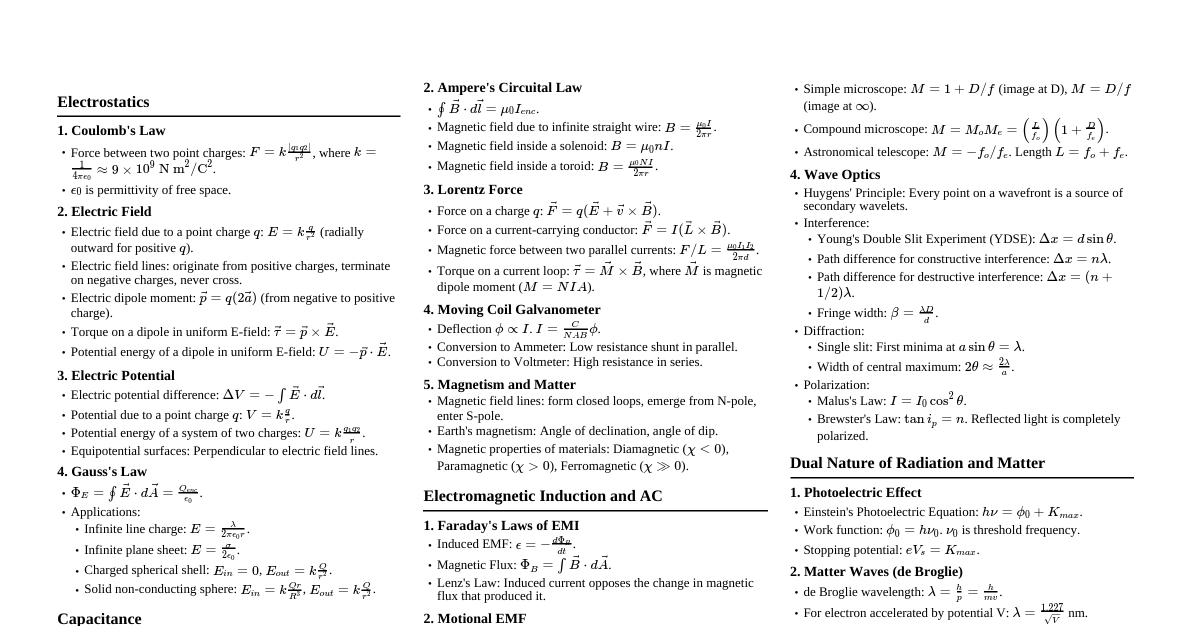
### Magnetic Effects of Current #### 1. Biot-Savart Law - Magnetic field due to a current element $d\vec{l}$: $$d\vec{B} = \frac{\mu_0}{4\pi} \frac{I (d\vec{l} \times \vec{r})}{r^3}$$ where $\mu_0 = 4\pi \times 10^{-7} \text{ T m/A}$ (permeability of free space). - **Direction:** Given by right-hand thumb rule. - **Applications:** - **Straight current-carrying wire:** $B = \frac{\mu_0 I}{2\pi r}$ (infinite length) - **Circular loop at center:** $B = \frac{\mu_0 NI}{2R}$ (N turns) - **Circular loop on axis:** $B = \frac{\mu_0 I R^2}{2(R^2 + x^2)^{3/2}}$ #### 2. Ampere's Circuital Law - $\oint \vec{B} \cdot d\vec{l} = \mu_0 I_{\text{enclosed}}$ - **Applications:** - **Infinite straight wire:** $B = \frac{\mu_0 I}{2\pi r}$ - **Solenoid:** $B = \mu_0 n I$ (inside, where $n = N/L$ is turns per unit length) - **Toroid:** $B = \frac{\mu_0 N I}{2\pi r}$ (inside) #### 3. Lorentz Force - Force on a charge $q$ moving with velocity $\vec{v}$ in magnetic field $\vec{B}$: $$\vec{F}_m = q (\vec{v} \times \vec{B})$$ - Force on a charge $q$ in combined electric $\vec{E}$ and magnetic $\vec{B}$ fields: $$\vec{F} = q\vec{E} + q (\vec{v} \times \vec{B})$$ - **Direction:** Perpendicular to both $\vec{v}$ and $\vec{B}$ (right-hand rule for positive charge). - **Motion of charge in B field:** - If $\vec{v} \perp \vec{B}$: Circular path. Radius $r = \frac{mv}{qB}$, Time period $T = \frac{2\pi m}{qB}$. - If $\vec{v}$ at angle $\theta$ with $\vec{B}$: Helical path. Pitch $p = (v \cos\theta) T$. #### 4. Force on Current-Carrying Conductor - Force on a straight conductor of length $\vec{l}$ carrying current $I$ in magnetic field $\vec{B}$: $$\vec{F} = I (\vec{l} \times \vec{B})$$ - **Force between two parallel current-carrying conductors:** - Force per unit length: $F/L = \frac{\mu_0 I_1 I_2}{2\pi d}$ - **Attraction** if currents are in the same direction. - **Repulsion** if currents are in opposite directions. #### 5. Torque on a Current Loop - Torque on a rectangular loop of area $A$ carrying current $I$ in magnetic field $\vec{B}$: $$\vec{\tau} = \vec{M} \times \vec{B} = NIAB \sin\theta$$ where $\vec{M} = NI\vec{A}$ is the magnetic dipole moment. $\theta$ is angle between $\vec{M}$ and $\vec{B}$. - **Potential Energy:** $U = -\vec{M} \cdot \vec{B}$ #### 6. Moving Coil Galvanometer (MCG) - **Principle:** Torque on current loop in magnetic field. - **Deflection:** $\phi = \left(\frac{NAB}{k}\right) I$ where $k$ is torsional constant. - **Current Sensitivity:** $S_I = \frac{\phi}{I} = \frac{NAB}{k}$ - **Voltage Sensitivity:** $S_V = \frac{\phi}{V} = \frac{NAB}{kR_g}$ - **Conversion to Ammeter:** Low resistance shunt ($R_s$) in parallel. $R_s = \frac{I_g R_g}{I - I_g}$ - **Conversion to Voltmeter:** High resistance ($R_s$) in series. $R_s = \frac{V}{I_g} - R_g$ #### 7. Magnetic Dipole - **Current loop as magnetic dipole:** Magnetic moment $\vec{M} = NI\vec{A}$ - **Bar Magnet:** - **Axial field:** $B_a = \frac{\mu_0}{4\pi} \frac{2M}{r^3}$ (for short magnet, $r \gg l$) - **Equatorial field:** $B_e = \frac{\mu_0}{4\pi} \frac{M}{r^3}$ (for short magnet, $r \gg l$) #### 8. Magnetic Properties of Materials - **Magnetic Intensity (H):** $H = B/\mu_0 - M$ - **Magnetization (M):** Magnetic moment per unit volume. - **Magnetic Susceptibility ($\chi_m$):** $\chi_m = M/H$ - **Relative Permeability ($\mu_r$):** $\mu_r = 1 + \chi_m$ - **Permeability ($\mu$):** $\mu = \mu_0 \mu_r$ - **Classification:** | Material Type | $\chi_m$ | $\mu_r$ | Behavior | Example | | :------------ | :------- | :------ | :------- | :------ | | **Diamagnetic** | Small, negative | Slightly 1 | Weak attraction | Al, Na, O$_2$ | | **Ferromagnetic** | Large, positive | Much > 1 | Strong attraction | Fe, Ni, Co | - **Curie's Law (Paramagnetism):** $\chi_m \propto 1/T$ - **Curie Temperature ($T_c$):** Temperature above which ferromagnetic materials become paramagnetic. ### Electromagnetic Induction (EMI) #### 1. Faraday's Laws of EMI - **First Law:** Whenever magnetic flux linked with a circuit changes, an EMF is induced. - **Second Law:** The magnitude of the induced EMF is directly proportional to the rate of change of magnetic flux. $$\mathcal{E} = -\frac{d\Phi_B}{dt}$$ - **Magnetic Flux:** $\Phi_B = \int \vec{B} \cdot d\vec{A} = BA \cos\theta$ (for uniform B and planar area A) - **SI Unit:** Weber (Wb) for flux, Volt (V) for EMF. #### 2. Lenz's Law - The direction of the induced EMF or current is such that it opposes the cause producing it. (The negative sign in Faraday's law represents Lenz's Law). - **Conservation of Energy:** Lenz's law is a consequence of conservation of energy. #### 3. Motional EMF - EMF induced across a conductor of length $l$ moving with velocity $\vec{v}$ in a uniform magnetic field $\vec{B}$: $$\mathcal{E} = (\vec{v} \times \vec{B}) \cdot \vec{l}$$ - If $\vec{v}$, $\vec{B}$, and $\vec{l}$ are mutually perpendicular: $\mathcal{E} = Blv$ - **Induced current:** $I = \mathcal{E}/R = Blv/R$ - **Force required to maintain motion:** $F = I l B = \frac{B^2 l^2 v}{R}$ - **Power dissipated:** $P = \mathcal{E} I = \frac{B^2 l^2 v^2}{R}$ #### 4. Eddy Currents - Circulating currents induced in bulk conductors when magnetic flux through them changes. - **Applications:** Magnetic braking, induction furnaces, electromagnetic damping. - **Disadvantages:** Energy loss as heat. Minimized by laminating cores. #### 5. Self-Inductance (L) - Property of a coil that opposes the change in current flowing through it. - **Induced EMF:** $\mathcal{E} = -L \frac{dI}{dt}$ - **Magnetic flux linked:** $\Phi_B = LI$ - **SI Unit:** Henry (H) - **Self-inductance of a solenoid:** $L = \frac{\mu_0 N^2 A}{l}$ (for air core) - **Energy stored in an inductor:** $U = \frac{1}{2} L I^2$ #### 6. LR Circuit - **Growth of current:** $I = I_0 (1 - e^{-t/\tau})$ where $I_0 = \mathcal{E}/R$ and $\tau = L/R$ (time constant). - **Decay of current:** $I = I_0 e^{-t/\tau}$ #### 7. Mutual Inductance (M) - Phenomenon where a changing current in one coil induces an EMF in an adjacent coil. - **Induced EMF in coil 2:** $\mathcal{E}_2 = -M \frac{dI_1}{dt}$ - **Magnetic flux linked with coil 2 due to coil 1:** $\Phi_{B2} = M I_1$ - **SI Unit:** Henry (H) - **Coefficient of coupling (k):** $M = k \sqrt{L_1 L_2}$ ($0 \le k \le 1$) ### AC Circuits #### 1. AC Fundamentals - **Alternating Voltage:** $V = V_0 \sin(\omega t + \phi_V)$ - **Alternating Current:** $I = I_0 \sin(\omega t + \phi_I)$ - $V_0, I_0$: Peak values. - **RMS Value:** $V_{rms} = V_0/\sqrt{2}$, $I_{rms} = I_0/\sqrt{2}$ - **Average Value:** - For full cycle: $V_{avg} = I_{avg} = 0$ - For half cycle: $V_{avg} = 2V_0/\pi$, $I_{avg} = 2I_0/\pi$ #### 2. AC Circuits with R, L, C | Component | Reactance/Impedance | Phase Relationship | Power Factor | | :-------- | :------------------ | :----------------- | :----------- | | **Resistor (R)** | $Z = R$ | $V$ and $I$ are in phase | $\cos\phi = 1$ | | **Inductor (L)** | $X_L = \omega L = 2\pi f L$ | $V$ leads $I$ by $\pi/2$ | $\cos\phi = 0$ | | **Capacitor (C)** | $X_C = \frac{1}{\omega C} = \frac{1}{2\pi f C}$ | $I$ leads $V$ by $\pi/2$ | $\cos\phi = 0$ | - **Phasor Diagrams:** Visual representation of phase relationships. #### 3. Series LCR Circuit - **Impedance (Z):** $Z = \sqrt{R^2 + (X_L - X_C)^2}$ - **Current:** $I_{rms} = V_{rms}/Z$ - **Phase Angle ($\phi$):** $\tan\phi = \frac{X_L - X_C}{R}$ - $V$ leads $I$ if $X_L > X_C$ (inductive circuit). - $I$ leads $V$ if $X_C > X_L$ (capacitive circuit). #### 4. Resonance in Series LCR Circuit - **Condition:** $X_L = X_C \implies \omega L = \frac{1}{\omega C}$ - **Resonant Frequency ($\omega_0$):** $\omega_0 = \frac{1}{\sqrt{LC}} \implies f_0 = \frac{1}{2\pi\sqrt{LC}}$ - **At Resonance:** - $Z = R$ (minimum impedance) - $I_{rms}$ is maximum ($I_{max} = V_{rms}/R$) - $\phi = 0$, circuit behaves purely resistive. - **Quality Factor (Q-factor):** $Q = \frac{\omega_0 L}{R} = \frac{1}{R}\sqrt{\frac{L}{C}}$ - Represents sharpness of resonance. Higher Q, sharper resonance. #### 5. Power in AC Circuits - **Instantaneous Power:** $P = V I = V_0 I_0 \sin(\omega t + \phi_V) \sin(\omega t + \phi_I)$ - **Average Power:** $P_{avg} = V_{rms} I_{rms} \cos\phi$ - **Power Factor ($\cos\phi$):** $\cos\phi = R/Z$ - **Wattless Current (Reactive Current):** $I_0 \sin\phi$ (component of current not contributing to power) #### 6. AC Generator - **Principle:** EMI. Mechanical energy to electrical energy. - **Induced EMF:** $\mathcal{E} = NBA\omega \sin(\omega t)$ - **Peak EMF:** $\mathcal{E}_0 = NBA\omega$ #### 7. Transformer - **Principle:** Mutual Inductance. - **Turns Ratio:** $\frac{V_s}{V_p} = \frac{N_s}{N_p} = \frac{I_p}{I_s}$ (for ideal transformer) - **Step-up transformer:** $N_s > N_p \implies V_s > V_p, I_s I_p$ - **Efficiency ($\eta$):** $\eta = \frac{\text{Output Power}}{\text{Input Power}} = \frac{V_s I_s}{V_p I_p}$ - **Energy Losses:** Flux leakage, resistance of windings (copper loss), eddy currents, hysteresis loss.