Magnetism & AC Circuits
Cheatsheet Content
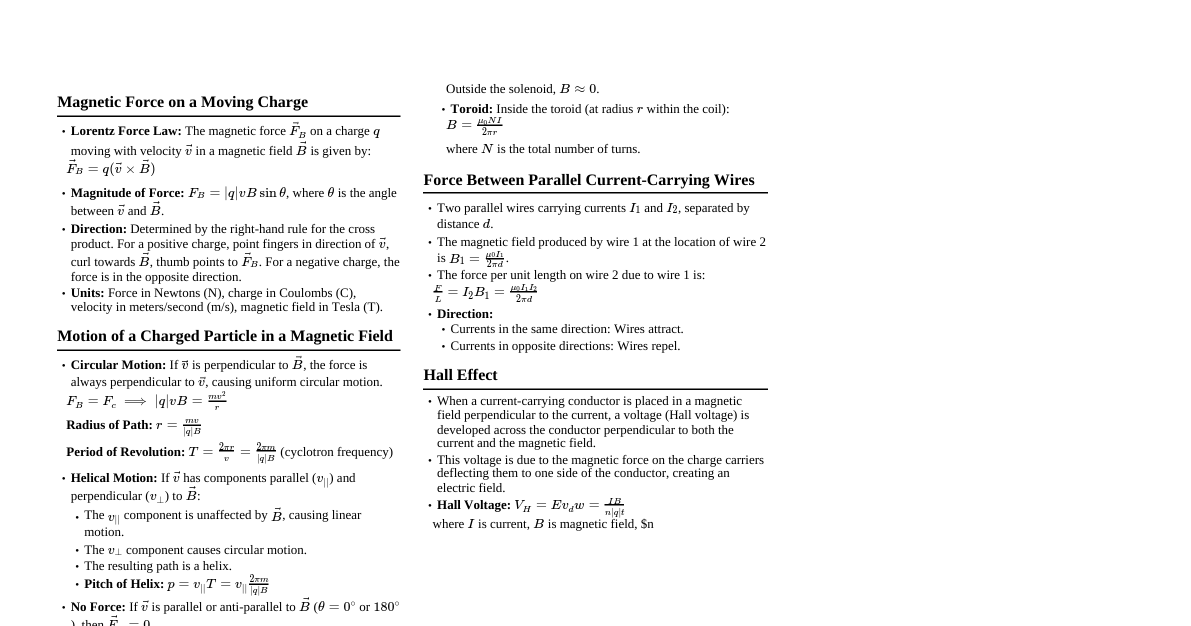
### Magnetic Fields Due to Current - **Biot-Savart Law:** $d\vec{B} = \frac{\mu_0}{4\pi} \frac{I d\vec{l} \times \vec{r}}{r^3}$ - $\mu_0 = 4\pi \times 10^{-7} \text{ T}\cdot\text{m/A}$ (permeability of free space) - **Magnetic field due to a straight current-carrying wire:** $B = \frac{\mu_0 I}{2\pi r}$ - Direction: Right-hand thumb rule. - **Magnetic field at the center of a circular loop:** $B = \frac{\mu_0 I}{2R}$ - **Magnetic field on the axis of a circular loop:** $B = \frac{\mu_0 I R^2}{2(R^2 + x^2)^{3/2}}$ - **Magnetic field inside a solenoid:** $B = \mu_0 n I$ (where $n$ is turns per unit length) - **Magnetic field inside a toroid:** $B = \frac{\mu_0 N I}{2\pi r}$ (where $N$ is total turns) ### Ampere's Circuital Law - **Statement:** $\oint \vec{B} \cdot d\vec{l} = \mu_0 I_{\text{enclosed}}$ - **Applications:** - **Straight wire:** $B(2\pi r) = \mu_0 I \Rightarrow B = \frac{\mu_0 I}{2\pi r}$ - **Solenoid (ideal):** $BL = \mu_0 N I \Rightarrow B = \mu_0 n I$ - **Toroid:** $B(2\pi r) = \mu_0 N I \Rightarrow B = \frac{\mu_0 N I}{2\pi r}$ ### Lorentz Force - **Force on a charge in magnetic field:** $\vec{F}_m = q(\vec{v} \times \vec{B})$ - Direction: Right-hand rule for positive charge, left-hand for negative. - Magnitude: $F_m = qvB\sin\theta$ - **Circular motion of charge in uniform B-field:** - Radius: $r = \frac{mv}{qB}$ - Angular frequency (cyclotron frequency): $\omega = \frac{qB}{m}$ - Period: $T = \frac{2\pi m}{qB}$ - **Force on a current-carrying conductor:** $\vec{F} = I(\vec{L} \times \vec{B})$ - Magnitude: $F = ILB\sin\theta$ - **Force between two parallel current-carrying wires:** $F/L = \frac{\mu_0 I_1 I_2}{2\pi d}$ - Attractive if currents are in the same direction, repulsive if opposite. ### Magnetic Dipole - **Magnetic dipole moment of a current loop:** $\vec{\mu} = I\vec{A}$ - Direction: Right-hand rule (fingers curl with current, thumb points to $\vec{\mu}$). - **Torque on a magnetic dipole in a uniform B-field:** $\vec{\tau} = \vec{\mu} \times \vec{B}$ - Magnitude: $\tau = \mu B \sin\theta$ - **Potential energy of a magnetic dipole:** $U = -\vec{\mu} \cdot \vec{B} = -\mu B \cos\theta$ - **Moving coil galvanometer:** - Principle: Torque on a current loop in B-field. - Deflection $\phi \propto I$ - Current sensitivity: $\frac{\phi}{I} = \frac{NAB}{k}$ ($k$ is torsional constant) - Voltage sensitivity: $\frac{\phi}{V} = \frac{NAB}{kR}$ ### Earth's Magnetism - **Magnetic elements of Earth:** - **Declination ($\alpha$):** Angle between geographic meridian and magnetic meridian. - **Dip or Inclination ($\delta$):** Angle made by the Earth's total magnetic field $\vec{B}_E$ with the horizontal plane. - **Horizontal component ($B_H$):** $B_H = B_E \cos\delta$ - **Vertical component ($B_V$):** $B_V = B_E \sin\delta$ - $\tan\delta = \frac{B_V}{B_H}$ - **Neutral points:** Where the net magnetic field is zero. ### Magnetic Properties of Materials - **Magnetic Intensity ($\vec{H}$):** $\vec{H} = \frac{\vec{B}}{\mu_0} - \vec{M}$ (in a material) - For solenoid: $H = nI$ - **Magnetization ($\vec{M}$):** Magnetic dipole moment per unit volume. - **Magnetic Susceptibility ($\chi_m$):** $\chi_m = \frac{M}{H}$ - **Relative Permeability ($\mu_r$):** $\mu_r = 1 + \chi_m$ - **Absolute Permeability ($\mu$):** $\mu = \mu_0 \mu_r$ - **Types of magnetic materials:** - **Diamagnetic:** $\chi_m$ is small, negative. Repelled by magnetic fields. Ex: Cu, Bi, H2O. - **Paramagnetic:** $\chi_m$ is small, positive. Weakly attracted by magnetic fields. Ex: Al, Na, O2. - **Ferromagnetic:** $\chi_m$ is large, positive. Strongly attracted by magnetic fields. Show hysteresis. Ex: Fe, Ni, Co. - **Curie Temperature:** Temperature above which ferromagnetic materials become paramagnetic. ### Electromagnetic Induction (EMI) - **Magnetic Flux ($\Phi_B$):** $\Phi_B = \int \vec{B} \cdot d\vec{A} = BA\cos\theta$ - Unit: Weber (Wb) or Tesla-meter$^2$ (T m$^2$). - **Faraday's Laws of EMI:** 1. Whenever magnetic flux linked with a circuit changes, an emf is induced. 2. The magnitude of induced emf is directly proportional to the rate of change of magnetic flux. $\mathcal{E} = -\frac{d\Phi_B}{dt}$ - **Lenz's Law:** The direction of induced emf (and current) is such that it opposes the cause producing it. (The negative sign in Faraday's law). - **Motional EMF:** $\mathcal{E} = Blv$ (for a conductor of length $l$ moving with velocity $v$ perpendicular to B-field) - Induced current: $I = \frac{Blv}{R}$ - Power dissipated: $P = I^2 R = \frac{(Blv)^2}{R}$ - Power supplied by external agent: $P = Fv = (IlB)v = (\frac{Blv}{R}lB)v = \frac{B^2l^2v^2}{R}$ ### Self and Mutual Induction - **Self-Induction:** - Magnetic flux $\Phi_B \propto I \Rightarrow \Phi_B = LI$ - **Self-inductance (L):** $L = \frac{\Phi_B}{I}$ (Unit: Henry (H)) - Induced emf: $\mathcal{E} = -L\frac{dI}{dt}$ - Energy stored in an inductor: $U = \frac{1}{2}LI^2$ - Energy density in magnetic field: $u_B = \frac{B^2}{2\mu_0}$ - **Mutual Induction:** - Magnetic flux in coil 2 due to current in coil 1: $\Phi_{B2} \propto I_1 \Rightarrow \Phi_{B2} = M_{21}I_1$ - **Mutual inductance (M):** $M_{21} = \frac{\Phi_{B2}}{I_1}$ (Unit: Henry (H)) - Induced emf in coil 2: $\mathcal{E}_2 = -M_{21}\frac{dI_1}{dt}$ - Reciprocity theorem: $M_{12} = M_{21} = M$ - Coefficient of coupling ($k$): $M = k\sqrt{L_1 L_2}$ ($0 \le k \le 1$) ### Alternating Current (AC) Basics - **Alternating emf/voltage:** $V = V_0 \sin(\omega t + \phi)$ - **Alternating current:** $I = I_0 \sin(\omega t + \phi')$ - $V_0, I_0$: Peak/maximum values - $\omega = 2\pi f = \frac{2\pi}{T}$: Angular frequency - $f$: Frequency (Hz), $T$: Period (s) - **RMS (Root Mean Square) values:** - $I_{rms} = \frac{I_0}{\sqrt{2}} \approx 0.707 I_0$ - $V_{rms} = \frac{V_0}{\sqrt{2}} \approx 0.707 V_0$ - AC meters read RMS values. - **Average values (over a full cycle):** - $\langle V \rangle = 0$, $\langle I \rangle = 0$ - Average power is non-zero. ### AC Circuits: Components - **Resistor (R) in AC circuit:** - $V = V_R = V_0 \sin\omega t$ - $I = I_R = \frac{V_0}{R} \sin\omega t = I_0 \sin\omega t$ - Current and voltage are in phase. - Power factor: $\cos\phi = 1$ - **Inductor (L) in AC circuit:** - $V = V_L = V_0 \sin\omega t$ - $I = I_L = I_0 \sin(\omega t - \pi/2)$ - Current lags voltage by $\pi/2$ (90 degrees). - **Inductive Reactance:** $X_L = \omega L = 2\pi f L$ (Unit: Ohm) - $I_0 = V_0/X_L$ - Power factor: $\cos\phi = 0$ (Average power consumed is zero) - **Capacitor (C) in AC circuit:** - $V = V_C = V_0 \sin\omega t$ - $I = I_C = I_0 \sin(\omega t + \pi/2)$ - Current leads voltage by $\pi/2$ (90 degrees). - **Capacitive Reactance:** $X_C = \frac{1}{\omega C} = \frac{1}{2\pi f C}$ (Unit: Ohm) - $I_0 = V_0/X_C$ - Power factor: $\cos\phi = 0$ (Average power consumed is zero) ### AC Circuits: Series RLC - **Impedance (Z):** The effective resistance of an AC circuit. - $Z = \sqrt{R^2 + (X_L - X_C)^2}$ (Unit: Ohm) - $I_{rms} = V_{rms}/Z$ - **Phase Angle ($\phi$):** Angle between voltage and current. - $\tan\phi = \frac{X_L - X_C}{R}$ - If $X_L > X_C$, circuit is inductive, current lags voltage ($\phi > 0$). - If $X_C > X_L$, circuit is capacitive, current leads voltage ($\phi ### Power in AC Circuits - **Instantaneous power:** $P = VI = V_0 I_0 \sin(\omega t + \phi_V) \sin(\omega t + \phi_I)$ - **Average power (Real Power):** $P_{avg} = V_{rms} I_{rms} \cos\phi$ - Unit: Watt (W) - $\cos\phi$ is the **power factor**. - **Reactive power:** $P_Q = V_{rms} I_{rms} \sin\phi$ (Unit: Volt-Ampere Reactive, VAR) - **Apparent power:** $P_A = V_{rms} I_{rms}$ (Unit: Volt-Ampere, VA) - **Wattless current:** Current component that does not contribute to average power ($I_{rms}\sin\phi$). ### Transformers - **Principle:** Mutual induction. - **Ideal Transformer:** No energy losses. - $\frac{V_S}{V_P} = \frac{N_S}{N_P} = \frac{I_P}{I_S}$ - $V_P I_P = V_S I_S$ (Input power = Output power) - $N_S/N_P$: Turns ratio - **Types:** - **Step-up transformer:** $N_S > N_P \Rightarrow V_S > V_P, I_S I_P$ - **Efficiency ($\eta$):** $\eta = \frac{\text{Output Power}}{\text{Input Power}} = \frac{V_S I_S}{V_P I_P} \times 100\%$ - **Energy losses:** - **Copper loss:** Due to resistance of windings ($I^2 R$). Minimized by thick wires. - **Eddy current loss:** Induced currents in the core. Minimized by laminated core. - **Hysteresis loss:** Energy loss due to repeated magnetization and demagnetization of core. Minimized by soft iron core. - **Flux leakage:** Not all flux from primary links to secondary. Minimized by winding coils one over other. ### LC Oscillations - **Energy transfer:** Capacitor stores electrical energy ($U_E = \frac{1}{2}CV^2$), inductor stores magnetic energy ($U_B = \frac{1}{2}LI^2$). - **Total energy:** $U = U_E + U_B = \frac{1}{2}CV^2 + \frac{1}{2}LI^2 = \text{constant}$ - **Equation of oscillation:** - $L\frac{d^2Q}{dt^2} + \frac{Q}{C} = 0$ (analogous to simple harmonic motion $m\frac{d^2x}{dt^2} + kx = 0$) - **Angular frequency of oscillation:** $\omega = \frac{1}{\sqrt{LC}}$ - **Natural frequency:** $f = \frac{1}{2\pi\sqrt{LC}}$