NEET Physics Formulas
Shared 3/28/2026•233 views
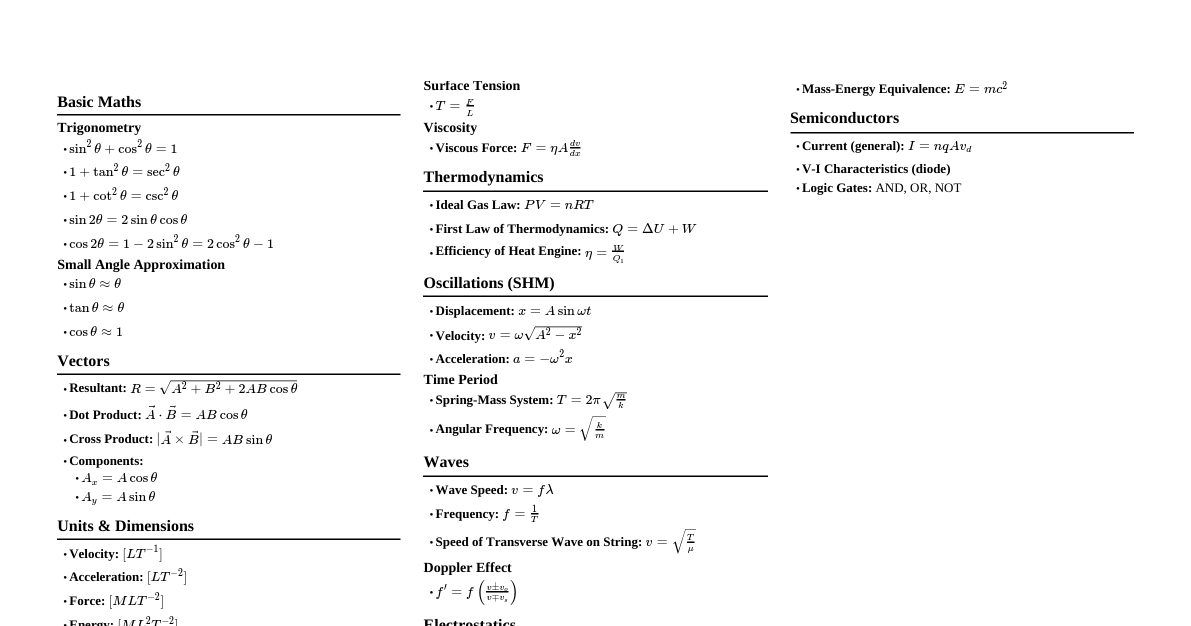
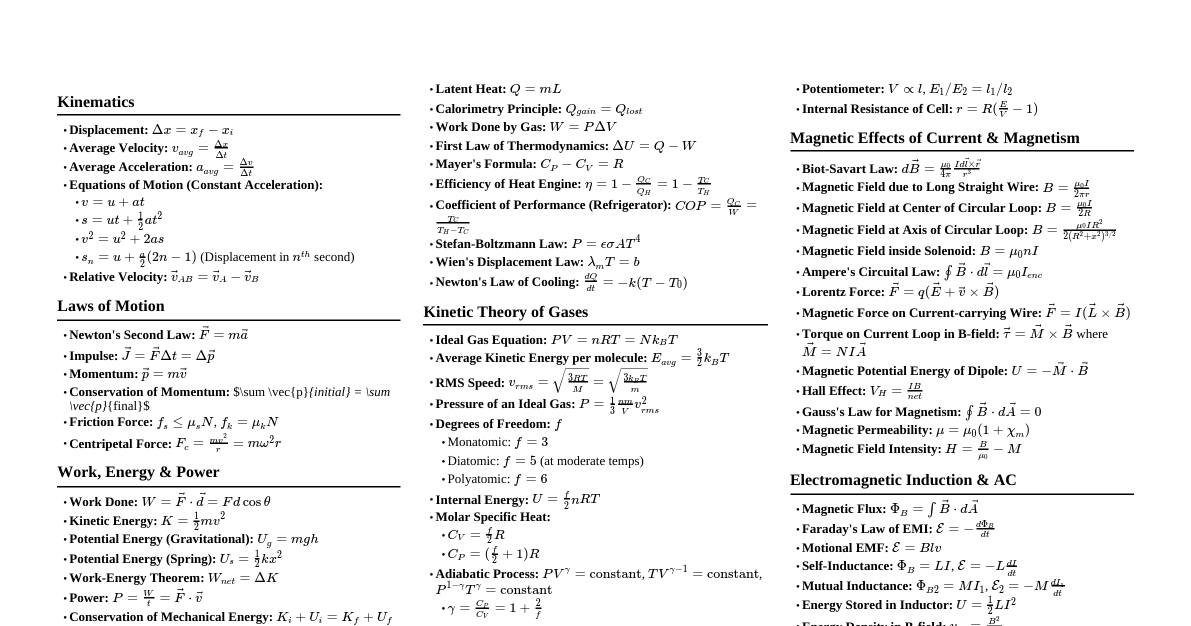
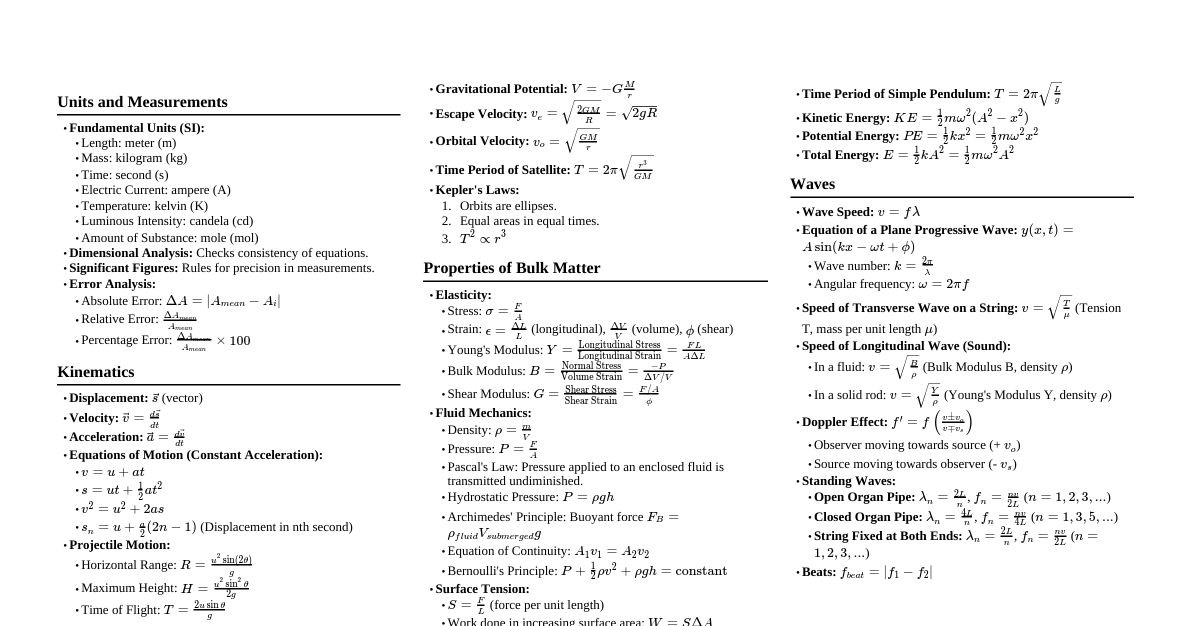
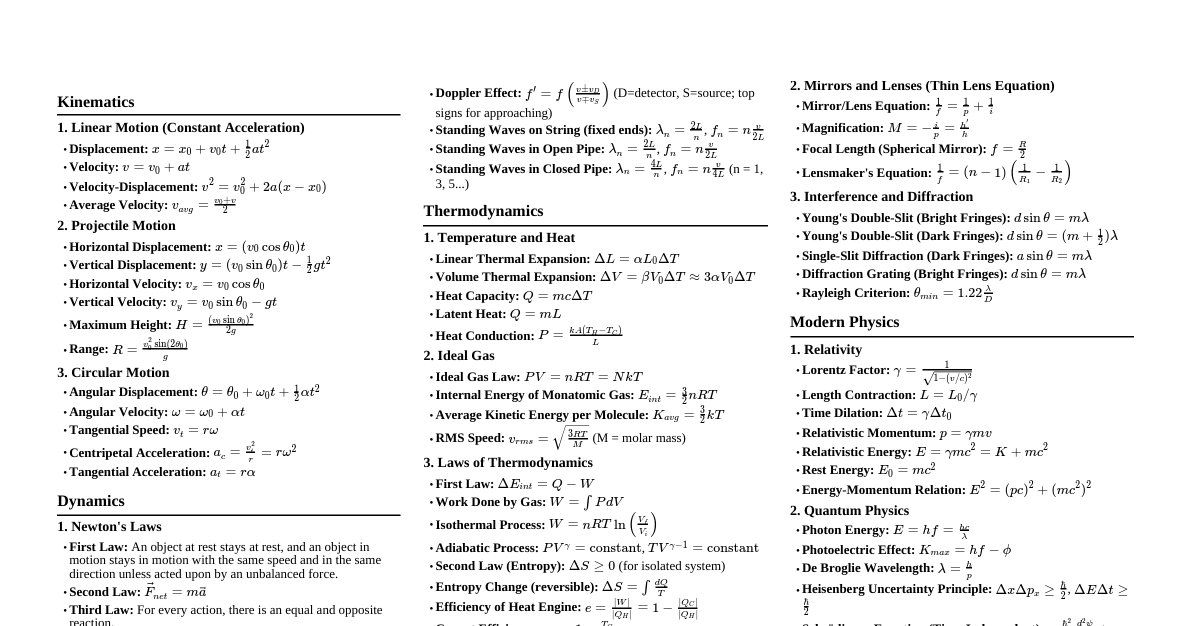
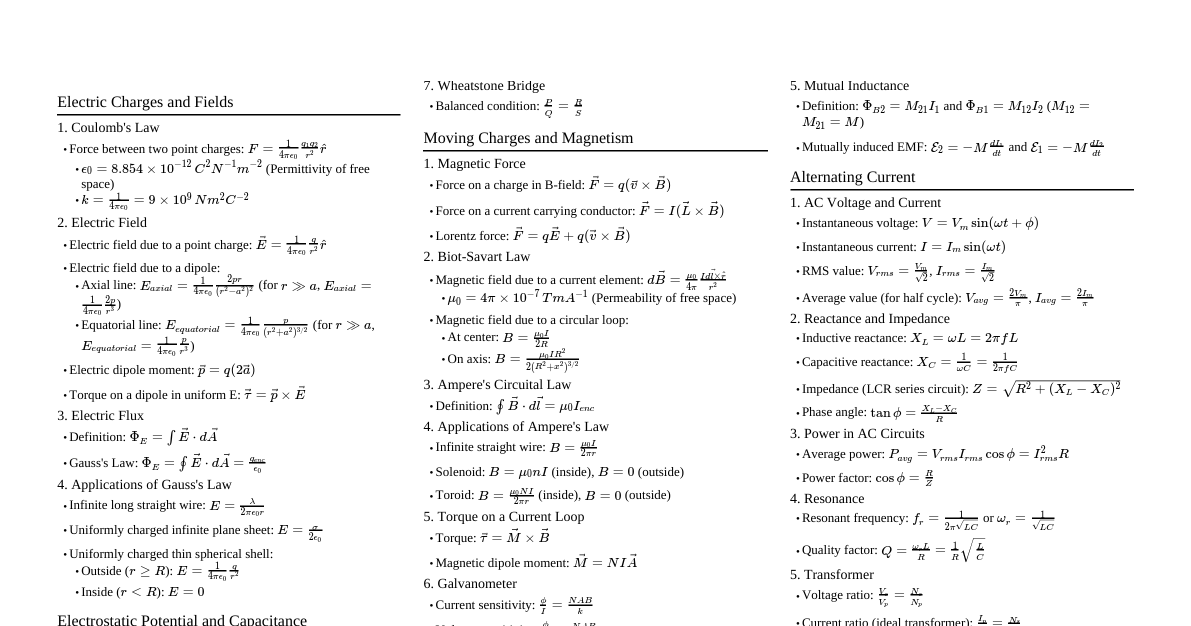
### Mechanics #### Basic Concepts - **Distance:** Total path length covered. - **Displacement:** Change in position (vector). - **Speed:** $\text{Distance} / \text{Time}$ (scalar). - **Velocity:** $\text{Displacement} / \text{Time}$ (vector). - **Acceleration:** Change in velocity / Time (vector). - **Mass:** Measure of inertia. - **Force:** Push or pull. #### Kinematics - **Displacement:** $\Delta x = x_f - x_i$ - **Average Velocity:** $v_{avg} = \frac{\Delta x}{\Delta t}$ - **Average Acceleration:** $a_{avg} = \frac{\Delta v}{\Delta t}$ - **Equations of Motion (constant acceleration):** - $v = u + at$ - $s = ut + \frac{1}{2}at^2$ - $v^2 = u^2 + 2as$ - $s_n = u + \frac{a}{2}(2n-1)$ (displacement in n-th second) #### Newton's Laws of Motion - **Newton's First Law:** Law of Inertia - **Newton's Second Law:** $F = ma$ - **Newton's Third Law:** $F_{AB} = -F_{BA}$ - **Impulse:** $J = F \Delta t = \Delta p$ - **Momentum:** $p = mv$ - **Conservation of Momentum:** $m_1u_1 + m_2u_2 = m_1v_1 + m_2v_2$ #### Work, Energy & Power - **Work Done:** $W = F \cdot d \cos\theta$ - **Kinetic Energy:** $K = \frac{1}{2}mv^2$ - **Potential Energy (gravitational):** $U_g = mgh$ - **Potential Energy (spring):** $U_s = \frac{1}{2}kx^2$ - **Work-Energy Theorem:** $W_{net} = \Delta K$ - **Power:** $P = \frac{W}{\Delta t} = F \cdot v$ - **Conservation of Mechanical Energy:** $K_i + U_i = K_f + U_f$ #### Rotational Motion - **Angular Displacement:** $\Delta\theta$ - **Angular Velocity:** $\omega = \frac{\Delta\theta}{\Delta t}$ - **Angular Acceleration:** $\alpha = \frac{\Delta\omega}{\Delta t}$ - **Relation between Linear and Angular:** $v = r\omega$, $a_t = r\alpha$, $a_c = r\omega^2 = \frac{v^2}{r}$ - **Torque:** $\tau = rF\sin\theta = I\alpha$ - **Moment of Inertia:** $I = \sum mr^2$ - **Rotational Kinetic Energy:** $K_r = \frac{1}{2}I\omega^2$ - **Angular Momentum:** $L = I\omega = rp\sin\theta$ - **Conservation of Angular Momentum:** $I_1\omega_1 = I_2\omega_2$ #### Gravitation - **Newton's Law of Gravitation:** $F = G \frac{m_1m_2}{r^2}$ - **Gravitational Potential Energy:** $U = -G \frac{m_1m_2}{r}$ - **Gravitational Potential:** $V = -\frac{GM}{r}$ - **Escape Velocity:** $v_e = \sqrt{\frac{2GM}{R}} = \sqrt{2gR}$ - **Orbital Velocity:** $v_o = \sqrt{\frac{GM}{R+h}}$ - **Kepler's Third Law:** $T^2 \propto R^3$ #### Properties of Matter - **Young's Modulus:** $Y = \frac{\text{stress}}{\text{strain}} = \frac{F/A}{\Delta L/L}$ - **Bulk Modulus:** $B = \frac{\text{stress}}{\text{volume strain}} = \frac{-P}{\Delta V/V}$ - **Shear Modulus:** $G = \frac{\text{shear stress}}{\text{shear strain}}$ - **Pressure:** $P = \frac{F}{A}$ - **Pressure in fluid at depth h:** $P = P_0 + \rho gh$ - **Pascal's Law:** Pressure applied to an enclosed fluid is transmitted undiminished. - **Archimedes' Principle:** Buoyant force $F_B = \rho_{fluid} V_{sub} g$ - **Bernoulli's Principle:** $P + \frac{1}{2}\rho v^2 + \rho gh = \text{constant}$ - **Equation of Continuity:** $A_1v_1 = A_2v_2$ - **Viscosity:** Stokes' Law $F = 6\pi\eta rv$ - **Surface Tension:** $T = \frac{F}{L}$ - **Capillary Rise:** $h = \frac{2T\cos\theta}{\rho rg}$ ### Thermodynamics - **Heat Capacity:** $C = \frac{\Delta Q}{\Delta T}$ - **Specific Heat Capacity:** $c = \frac{C}{m}$ - **Latent Heat:** $Q = mL$ - **Thermal Expansion:** - **Linear:** $\Delta L = L_0 \alpha \Delta T$ - **Area:** $\Delta A = A_0 \beta \Delta T$ ($\beta = 2\alpha$) - **Volume:** $\Delta V = V_0 \gamma \Delta T$ ($\gamma = 3\alpha$) - **Heat Transfer:** - **Conduction:** $\frac{dQ}{dt} = -kA \frac{dT}{dx}$ - **Convection:** $\frac{dQ}{dt} = hA \Delta T$ - **Radiation (Stefan-Boltzmann Law):** $P = e\sigma A T^4$ - **Ideal Gas Law:** $PV = nRT = NkT$ - **First Law of Thermodynamics:** $\Delta U = Q - W$ - **Work Done by Gas:** $W = P\Delta V$ (for isobaric process) - **Carnot Engine Efficiency:** $\eta = 1 - \frac{T_C}{T_H}$ - **Coefficient of Performance (Refrigerator):** $COP = \frac{Q_C}{W} = \frac{T_C}{T_H - T_C}$ ### Oscillations and Waves #### Simple Harmonic Motion (SHM) - **Displacement:** $x = A\sin(\omega t + \phi)$ - **Velocity:** $v = A\omega\cos(\omega t + \phi) = \pm\omega\sqrt{A^2 - x^2}$ - **Acceleration:** $a = -A\omega^2\sin(\omega t + \phi) = -\omega^2 x$ - **Angular Frequency:** $\omega = \sqrt{\frac{k}{m}}$ (spring), $\omega = \sqrt{\frac{g}{L}}$ (simple pendulum) - **Time Period:** $T = \frac{2\pi}{\omega}$ - **Frequency:** $f = \frac{1}{T}$ #### Waves - **Wave Speed:** $v = f\lambda$ - **Speed of sound in a medium:** $v = \sqrt{\frac{B}{\rho}}$ (liquid), $v = \sqrt{\frac{Y}{\rho}}$ (solid) - **Speed of transverse wave on string:** $v = \sqrt{\frac{T}{\mu}}$ - **Intensity:** $I = \frac{P}{A} \propto A^2 f^2$ - **Doppler Effect:** $f' = f \left(\frac{v \pm v_o}{v \mp v_s}\right)$ - **Standing Waves (String fixed at both ends):** $\lambda_n = \frac{2L}{n}$, $f_n = \frac{nv}{2L}$ - **Standing Waves (Open organ pipe):** $\lambda_n = \frac{2L}{n}$, $f_n = \frac{nv}{2L}$ - **Standing Waves (Closed organ pipe):** $\lambda_n = \frac{4L}{(2n-1)}$, $f_n = \frac{(2n-1)v}{4L}$ - **Beats:** $f_{beat} = |f_1 - f_2|$ ### Electrostatics - **Coulomb's Law:** $F = k \frac{|q_1q_2|}{r^2}$, where $k = \frac{1}{4\pi\epsilon_0}$ - **Electric Field:** $E = \frac{F}{q_0} = k \frac{q}{r^2}$ - **Electric Potential:** $V = \frac{U}{q_0} = k \frac{q}{r}$ - **Potential Difference:** $\Delta V = V_B - V_A = -\int_A^B \vec{E} \cdot d\vec{l}$ - **Electric Dipole Moment:** $p = q(2a)$ - **Torque on a dipole in E-field:** $\vec{\tau} = \vec{p} \times \vec{E}$ - **Potential Energy of a dipole:** $U = -\vec{p} \cdot \vec{E}$ - **Gauss's Law:** $\oint \vec{E} \cdot d\vec{A} = \frac{Q_{enc}}{\epsilon_0}$ - **Capacitance:** $C = \frac{Q}{V}$ - **Parallel Plate Capacitor:** $C = \frac{\epsilon_0 A}{d}$ - **Capacitors in Series:** $\frac{1}{C_{eq}} = \frac{1}{C_1} + \frac{1}{C_2} + \dots$ - **Capacitors in Parallel:** $C_{eq} = C_1 + C_2 + \dots$ - **Energy Stored in Capacitor:** $U = \frac{1}{2}CV^2 = \frac{1}{2}\frac{Q^2}{C} = \frac{1}{2}QV$ ### Current Electricity - **Electric Current:** $I = \frac{dQ}{dt}$ - **Ohm's Law:** $V = IR$ - **Resistance:** $R = \rho \frac{L}{A}$ - **Resistors in Series:** $R_{eq} = R_1 + R_2 + \dots$ - **Resistors in Parallel:** $\frac{1}{R_{eq}} = \frac{1}{R_1} + \frac{1}{R_2} + \dots$ - **Electric Power:** $P = VI = I^2R = \frac{V^2}{R}$ - **Kirchhoff's Laws:** - **Junction Rule:** $\sum I_{in} = \sum I_{out}$ - **Loop Rule:** $\sum \Delta V = 0$ - **Wheatstone Bridge (balanced):** $\frac{R_1}{R_2} = \frac{R_3}{R_4}$ - **Meter Bridge:** $\frac{R}{S} = \frac{l}{(100-l)}$ - **Potentiometer:** Comparing EMFs $\frac{E_1}{E_2} = \frac{l_1}{l_2}$ ### Magnetism - **Biot-Savart Law:** $d\vec{B} = \frac{\mu_0}{4\pi} \frac{I d\vec{l} \times \vec{r}}{r^3}$ - **Magnetic Field (straight wire):** $B = \frac{\mu_0 I}{2\pi r}$ - **Magnetic Field (circular loop at center):** $B = \frac{\mu_0 I}{2R}$ - **Magnetic Field (solenoid):** $B = \mu_0 n I$ - **Ampere's Circuital Law:** $\oint \vec{B} \cdot d\vec{l} = \mu_0 I_{enc}$ - **Lorentz Force:** $\vec{F} = q(\vec{E} + \vec{v} \times \vec{B})$ - **Magnetic Force on current-carrying wire:** $\vec{F} = I(\vec{l} \times \vec{B})$ - **Torque on current loop:** $\vec{\tau} = \vec{M} \times \vec{B}$, where $\vec{M} = NI\vec{A}$ (magnetic dipole moment) - **Hall Effect:** $V_H = \frac{IB}{net}$ ### Electromagnetic Induction & AC - **Magnetic Flux:** $\Phi_B = \vec{B} \cdot \vec{A} = BA\cos\theta$ - **Faraday's Law of Induction:** $\mathcal{E} = -\frac{d\Phi_B}{dt}$ - **Motional EMF:** $\mathcal{E} = Blv$ - **Lenz's Law:** Induced current opposes the change in magnetic flux. - **Self Inductance:** $\Phi_B = LI$, $\mathcal{E} = -L \frac{dI}{dt}$ - **Mutual Inductance:** $\Phi_{21} = M_{21}I_1$, $\mathcal{E}_2 = -M_{21} \frac{dI_1}{dt}$ - **Energy Stored in an Inductor:** $U = \frac{1}{2}LI^2$ - **AC Circuits:** - **RMS Values:** $V_{rms} = \frac{V_0}{\sqrt{2}}$, $I_{rms} = \frac{I_0}{\sqrt{2}}$ - **Inductive Reactance:** $X_L = \omega L$ - **Capacitive Reactance:** $X_C = \frac{1}{\omega C}$ - **Impedance (RLC Series):** $Z = \sqrt{R^2 + (X_L - X_C)^2}$ - **Phase Angle:** $\tan\phi = \frac{X_L - X_C}{R}$ - **Resonant Frequency:** $\omega_0 = \frac{1}{\sqrt{LC}}$ - **Power Factor:** $\cos\phi = \frac{R}{Z}$ - **Average Power:** $P_{avg} = V_{rms} I_{rms} \cos\phi$ - **Transformer:** $\frac{V_s}{V_p} = \frac{N_s}{N_p} = \frac{I_p}{I_s}$ (ideal) ### Electromagnetic Waves - **Speed of EM waves in vacuum:** $c = \frac{1}{\sqrt{\mu_0\epsilon_0}}$ - **Speed of EM waves in medium:** $v = \frac{1}{\sqrt{\mu\epsilon}}$ - **Relation between E and B field:** $E = cB$ - **Poynting Vector:** $\vec{S} = \frac{1}{\mu_0}(\vec{E} \times \vec{B})$ (direction of energy flow) - **Intensity:** $I = \frac{1}{2}\epsilon_0 E_0^2 c = \frac{1}{2\mu_0} B_0^2 c$ ### Optics #### Ray Optics - **Mirror Formula:** $\frac{1}{f} = \frac{1}{v} + \frac{1}{u}$ (f is focal length, u is object distance, v is image distance) - **Magnification:** $m = -\frac{v}{u} = \frac{h_i}{h_o}$ - **Refraction (Snell's Law):** $n_1 \sin\theta_1 = n_2 \sin\theta_2$ - **Refractive Index:** $n = \frac{c}{v}$ - **Critical Angle:** $\sin C = \frac{n_2}{n_1}$ (for $n_1 > n_2$) - **Lens Formula:** $\frac{1}{f} = \frac{1}{v} - \frac{1}{u}$ - **Lens Maker's Formula:** $\frac{1}{f} = (n-1)\left(\frac{1}{R_1} - \frac{1}{R_2}\right)$ - **Power of Lens:** $P = \frac{1}{f}$ (in diopters, f in meters) - **Combination of Lenses:** $P_{eq} = P_1 + P_2 + \dots$, $\frac{1}{f_{eq}} = \frac{1}{f_1} + \frac{1}{f_2} + \dots$ #### Wave Optics - **Young's Double Slit Experiment (YDSE):** - **Fringe Width:** $\beta = \frac{\lambda D}{d}$ - **Path Difference:** $\Delta x = d\sin\theta$ - **Constructive Interference:** $\Delta x = n\lambda$ - **Destructive Interference:** $\Delta x = (n + \frac{1}{2})\lambda$ - **Diffraction (Single Slit):** - **Minima:** $a\sin\theta = n\lambda$ - **Width of central maximum:** $\frac{2\lambda D}{a}$ - **Malus's Law:** $I = I_0 \cos^2\theta$ (for polarizer) ### Modern Physics #### Dual Nature of Radiation and Matter - **Planck's Quantum Theory:** $E = hf = \frac{hc}{\lambda}$ - **Photoelectric Effect:** $K_{max} = hf - \phi_0$, where $\phi_0$ is work function - **Einstein's Photoelectric Equation:** $hf = \phi_0 + K_{max}$ - **De Broglie Wavelength:** $\lambda = \frac{h}{p} = \frac{h}{mv}$ - **De Broglie Wavelength for electron accelerated through V:** $\lambda = \frac{h}{\sqrt{2meV}}$ #### Atomic Physics - **Bohr's Postulates:** - Quantized orbits: $L = mvr = n\frac{h}{2\pi}$ - Energy levels: $E_n = -\frac{13.6}{n^2}$ eV - Hydrogen spectrum: $\frac{1}{\lambda} = R\left(\frac{1}{n_1^2} - \frac{1}{n_2^2}\right)$ (Rydberg formula) - **Radius of n-th orbit:** $r_n = 0.529 n^2$ Å #### Nuclear Physics - **Mass Defect:** $\Delta m = (Zm_p + Nm_n) - M_{nucleus}$ - **Binding Energy:** $BE = \Delta m c^2$ - **Radioactive Decay Law:** $N = N_0 e^{-\lambda t}$ - **Half-life:** $T_{1/2} = \frac{\ln 2}{\lambda} = \frac{0.693}{\lambda}$ - **Mean Life:** $\tau = \frac{1}{\lambda}$ - **Activity:** $A = -\frac{dN}{dt} = \lambda N$ - **Einstein's Mass-Energy Equivalence:** $E = mc^2$ #### Semiconductors - **Diode Current (Ideal):** $I = I_0 (e^{eV/k_BT} - 1)$ - **Transistor (Common Emitter):** $I_C = \beta I_B$, $I_E = I_B + I_C = (1+\beta) I_B$ - **Logic Gates:** AND, OR, NOT, NAND, NOR, XOR, XNOR (Truth tables and symbols) ### Experimental Physics - **Least Count:** Smallest measurement by an instrument. - **Vernier Calipers:** Reading = Main Scale Reading + (Vernier Scale Division $\times$ Least Count) - **Screw Gauge:** Reading = Main Scale Reading + (Circular Scale Division $\times$ Least Count) - **Error Analysis:** - **Absolute Error:** $|\Delta A| = |A_{mean} - A_i|$ - **Mean Absolute Error:** $\overline{\Delta A} = \frac{\sum |\Delta A_i|}{N}$ - **Relative Error:** $\frac{\overline{\Delta A}}{A_{mean}}$ - **Percentage Error:** $\frac{\overline{\Delta A}}{A_{mean}} \times 100\%$ - **Combination of Errors:** - **Sum/Difference:** If $Z = A \pm B$, then $\Delta Z = \Delta A + \Delta B$ - **Product/Quotient:** If $Z = AB$ or $Z = A/B$, then $\frac{\Delta Z}{Z} = \frac{\Delta A}{A} + \frac{\Delta B}{B}$ - **Powers:** If $Z = A^x B^y / C^z$, then $\frac{\Delta Z}{Z} = x\frac{\Delta A}{A} + y\frac{\Delta B}{B} + z\frac{\Delta C}{C}$