Organic Chemistry Tests (JEE)
Cheatsheet Content
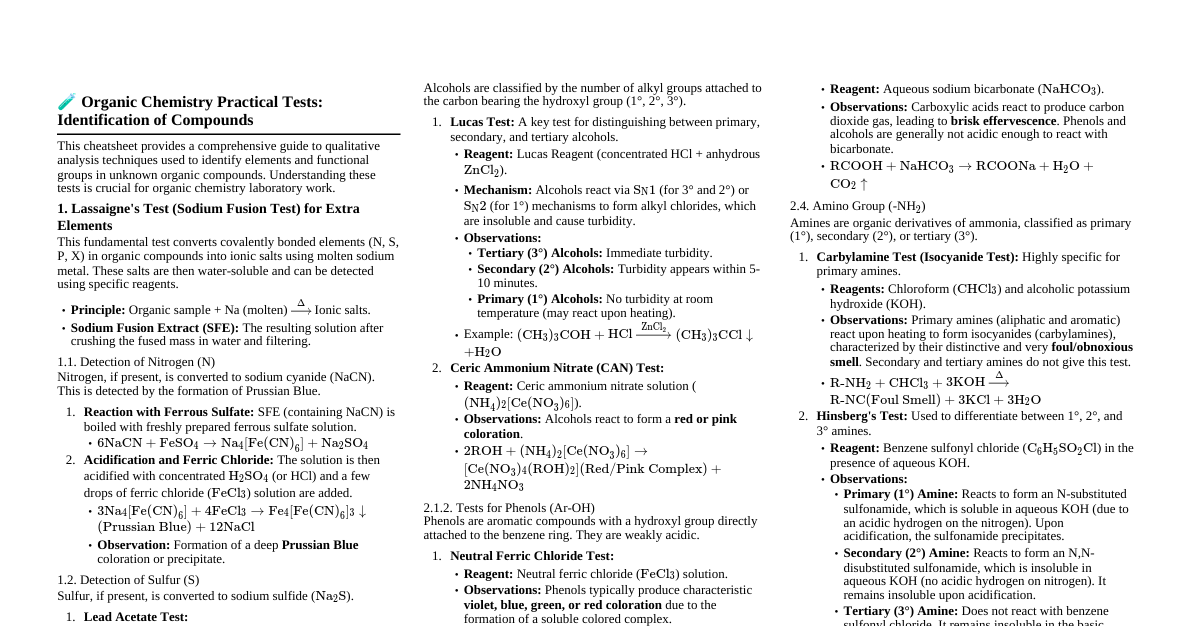
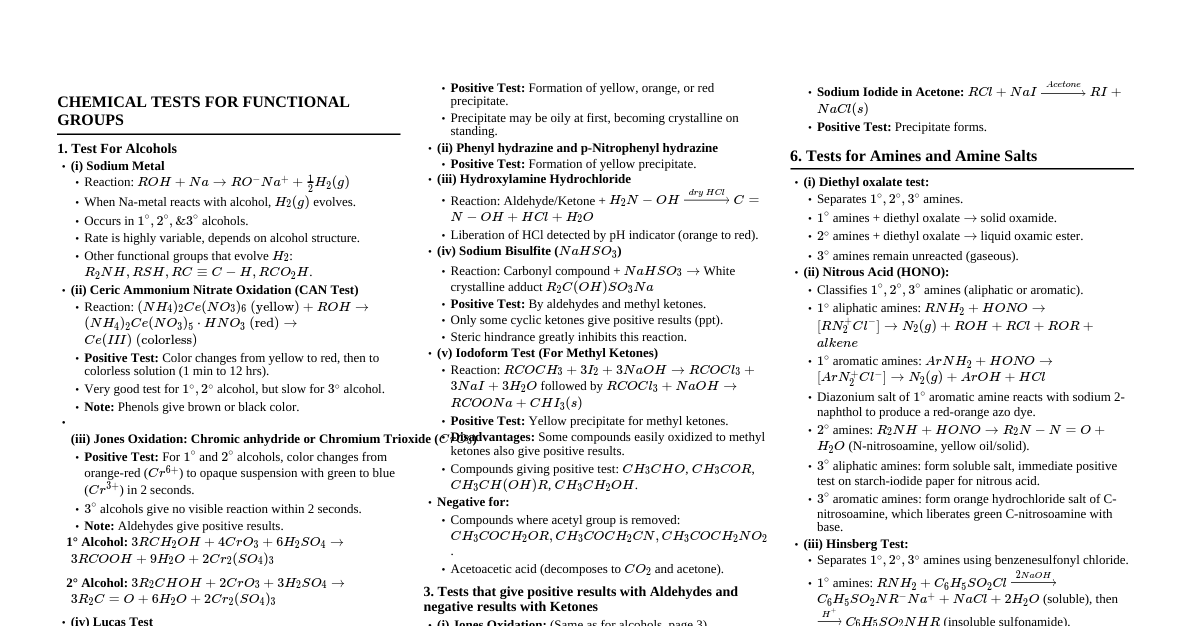
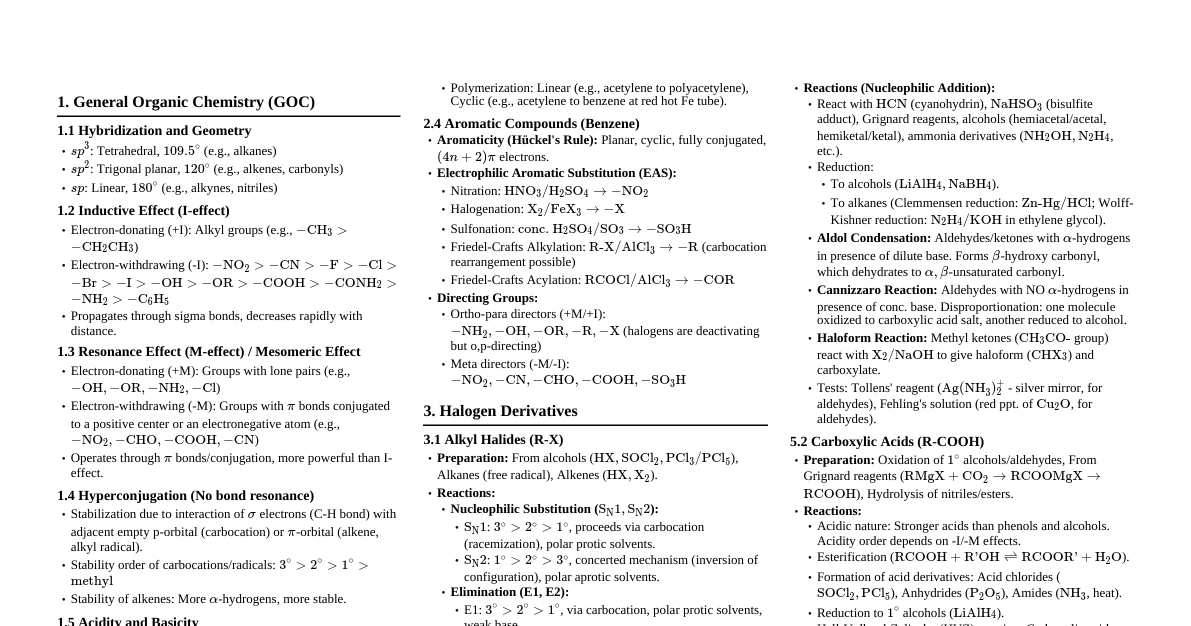
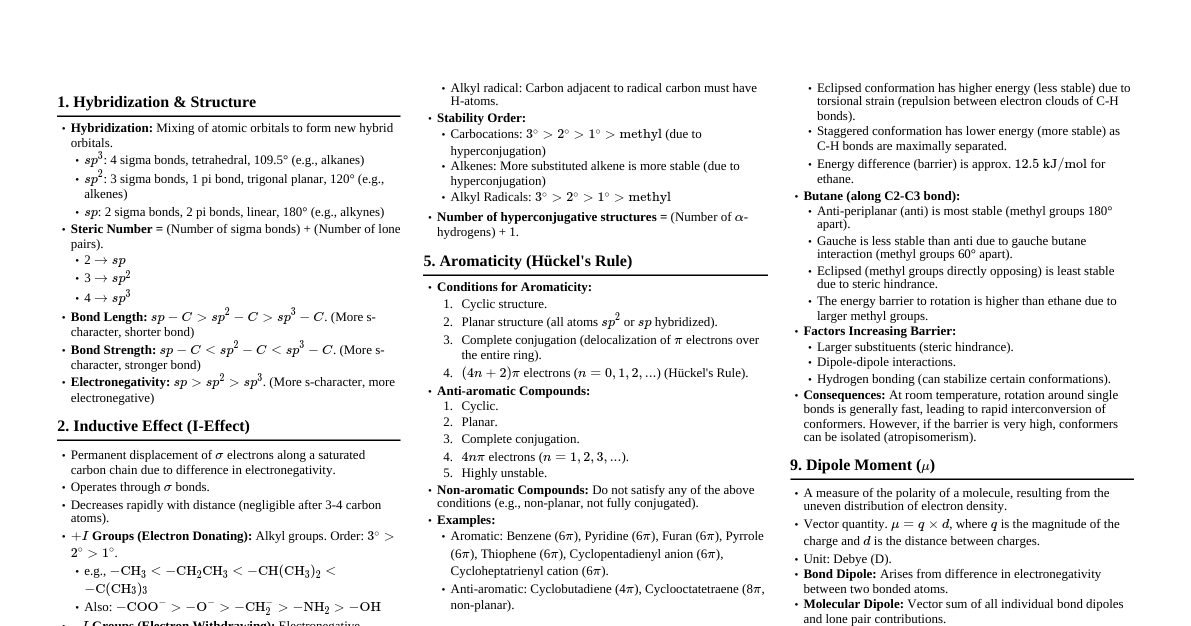
1. Tests for Unsaturation (Alkenes/Alkynes) 1.1. Baeyer's Test Reagent: Cold, dilute, alkaline $\text{KMnO}_4$ (Baeyer's reagent) Reaction: Alkenes/Alkynes $\xrightarrow{\text{Baeyer's Reagent}}$ Vicinal diols (for alkenes) / Tetrols (for alkynes) Observation: Purple color of $\text{KMnO}_4$ disappears, and a brown precipitate of $\text{MnO}_2$ forms. Implication: Presence of C=C or C$\equiv$C bonds. 1.2. Bromine Water Test Reagent: Bromine water ($\text{Br}_2$ in $\text{H}_2\text{O}$) Reaction: Alkenes/Alkynes $+\text{Br}_2 \rightarrow$ Dibromo/Tetrabromo derivatives Observation: Reddish-brown color of bromine water disappears. Implication: Presence of C=C or C$\equiv$C bonds. 2. Tests for Alcohols and Phenols 2.1. Lucas Test (for Alcohols) Reagent: Anhydrous $\text{ZnCl}_2$ and concentrated $\text{HCl}$ (Lucas reagent) Reaction: Alcohol $+\text{HCl} \xrightarrow{\text{ZnCl}_2}$ Alkyl chloride Observation: $3^\circ$ Alcohol: Turbidity appears immediately. $2^\circ$ Alcohol: Turbidity appears within 5-10 minutes. $1^\circ$ Alcohol: No turbidity at room temperature. Implication: Distinguishes between $1^\circ$, $2^\circ$, and $3^\circ$ alcohols. 2.2. Ferric Chloride Test (for Phenols) Reagent: Neutral $\text{FeCl}_3$ solution Reaction: Phenol reacts with $\text{FeCl}_3$ to form colored complexes. Observation: Violet, green, or blue coloration (depending on the phenol). Implication: Presence of phenolic -OH group. 2.3. Ceric Ammonium Nitrate Test (CAN Test for Alcohols) Reagent: Ceric ammonium nitrate, $(\text{NH}_4)_2\text{Ce}(\text{NO}_3)_6$ Reaction: Alcohols react with CAN. Observation: Red color or red precipitate forms. Implication: Presence of an alcohol group. 3. Tests for Carbonyl Compounds (Aldehydes & Ketones) 3.1. 2,4-Dinitrophenylhydrazine (2,4-DNP) Test Reagent: 2,4-Dinitrophenylhydrazine solution Reaction: Carbonyl compound $+\text{2,4-DNP} \rightarrow$ 2,4-Dinitrophenylhydrazone (precipitate) Observation: Formation of yellow, orange, or red precipitate. Implication: Presence of a carbonyl group (aldehyde or ketone). 3.2. Tollens' Test (Silver Mirror Test) Reagent: Ammoniacal silver nitrate solution ($\text{Ag(NH}_3)_2^+$ $\text{OH}^-$) Reaction: Aldehyde $\xrightarrow{\text{Tollens' reagent}}$ Carboxylic acid salt $+\text{Ag(s)}$ Observation: Formation of a silver mirror on the inner wall of the test tube. Ketones generally do not react. Implication: Presence of an aldehyde group. 3.3. Fehling's Test Reagent: Fehling's solution A ($\text{CuSO}_4$) and Fehling's solution B (Rochelle salt + $\text{NaOH}$) Reaction: Aldehyde $+\text{Cu}^{2+} \xrightarrow{\text{heat}}$ Carboxylic acid salt $+\text{Cu}_2\text{O(s)}$ Observation: Red precipitate of cuprous oxide ($\text{Cu}_2\text{O}$) forms. Ketones generally do not react. Implication: Presence of an aldehyde group (aliphatic aldehydes give positive test, aromatic aldehydes may not always). 3.4. Benedict's Test Reagent: Benedict's solution ($\text{CuSO}_4$, sodium citrate, $\text{Na}_2\text{CO}_3$) Reaction: Similar to Fehling's test. Observation: Red precipitate of cuprous oxide ($\text{Cu}_2\text{O}$) forms. Implication: Presence of an aldehyde group (aliphatic aldehydes, $\alpha$-hydroxy ketones, reducing sugars). 3.5. Iodoform Test (Methyl Ketones & Methyl Carbinols) Reagent: $\text{I}_2$ and $\text{NaOH}$ (or $\text{NaOI}$) Reaction: $\text{R-CO-CH}_3$ or $\text{R-CH(OH)-CH}_3 \xrightarrow{\text{I}_2/\text{NaOH}}$ $\text{CHI}_3$ (iodoform) Observation: Formation of yellow precipitate of iodoform ($\text{CHI}_3$) with characteristic smell. Implication: Presence of a methyl ketone ($\text{R-CO-CH}_3$) or a methyl carbinol ($\text{R-CH(OH)-CH}_3$) group. 3.6. Schiff's Test (for Aldehydes) Reagent: Schiff's reagent (rosaniline hydrochloride decolorized by $\text{SO}_2$) Reaction: Aldehyde reacts with Schiff's reagent. Observation: Pink or magenta color is restored. Ketones do not react. Implication: Presence of an aldehyde group. 4. Tests for Carboxylic Acids 4.1. Litmus Test Reagent: Blue litmus paper Reaction: Carboxylic acids are acidic. Observation: Blue litmus paper turns red. Implication: Presence of an acidic group. 4.2. Sodium Bicarbonate Test Reagent: $\text{NaHCO}_3$ solution Reaction: $\text{R-COOH} + \text{NaHCO}_3 \rightarrow \text{R-COONa} + \text{H}_2\text{O} + \text{CO}_2$ Observation: Brisk effervescence (due to $\text{CO}_2$ evolution). Implication: Presence of a carboxylic acid group (stronger acids like phenols do not give this test). 4.3. Esterification Test Reagent: Alcohol (e.g., Ethanol) and concentrated $\text{H}_2\text{SO}_4$ Reaction: $\text{R-COOH} + \text{R'-OH} \xrightarrow{\text{H}_2\text{SO}_4}$ $\text{R-COOR'} + \text{H}_2\text{O}$ Observation: Sweet fruity smell (of the ester). Implication: Presence of a carboxylic acid group. 5. Tests for Amines 5.1. Hinsberg Test (for $1^\circ, 2^\circ, 3^\circ$ Amines) Reagent: Benzene sulfonyl chloride ($\text{C}_6\text{H}_5\text{SO}_2\text{Cl}$) and $\text{KOH}$ Reaction & Observation: $1^\circ$ Amine: Forms N-alkylbenzenesulfonamide, which is soluble in $\text{KOH}$ (due to acidic H). Acidification regenerates insoluble sulfonamide. $2^\circ$ Amine: Forms N,N-dialkylbenzenesulfonamide, which is insoluble in $\text{KOH}$ (no acidic H). $3^\circ$ Amine: Does not react with benzenesulfonyl chloride. Remains insoluble in $\text{KOH}$. Implication: Distinguishes between $1^\circ$, $2^\circ$, and $3^\circ$ amines. 5.2. Carbylamine Test (Isocyanide Test - for $1^\circ$ Amines) Reagent: Chloroform ($\text{CHCl}_3$) and alcoholic $\text{KOH}$ Reaction: $\text{R-NH}_2 + \text{CHCl}_3 + 3\text{KOH} \xrightarrow{\text{heat}}$ $\text{R-NC} + 3\text{KCl} + 3\text{H}_2\text{O}$ Observation: Formation of an offensive (foul) smelling substance (isocyanide). Implication: Presence of a primary amine (aliphatic or aromatic). 5.3. Azo Dye Test (for Aromatic $1^\circ$ Amines) Reagent: $\text{NaNO}_2/\text{HCl}$ (at $0-5^\circ\text{C}$) followed by $\beta$-naphthol in $\text{NaOH}$ Reaction: Aromatic $1^\circ$ amine $\xrightarrow{\text{diazotization}}$ Diazonium salt $\xrightarrow{\beta\text{-naphthol}}$ Azo dye Observation: Formation of a bright orange or red dye. Implication: Presence of an aromatic primary amine. 6. Tests for Alkyl Halides 6.1. Silver Nitrate Test Reagent: Alcoholic $\text{AgNO}_3$ solution Reaction: $\text{R-X} + \text{AgNO}_3 \rightarrow \text{AgX(s)} + \text{R-NO}_3$ Observation: Formation of a precipitate of silver halide ($\text{AgCl}$ white, $\text{AgBr}$ pale yellow, $\text{AgI}$ yellow). $3^\circ$ Alkyl halide: Immediate precipitate. $2^\circ$ Alkyl halide: Precipitate forms slowly on heating. $1^\circ$ Alkyl halide: Precipitate forms only on prolonged heating. Implication: Presence of an alkyl halide and distinction between $1^\circ$, $2^\circ$, $3^\circ$. 7. Elemental Analysis (Lassaigne's Test) 7.1. Detection of Nitrogen, Sulfur, Halogens Principle: Organic compounds are fused with sodium metal to convert elements (N, S, X) into ionic compounds (e.g., $\text{NaCN}$, $\text{Na}_2\text{S}$, $\text{NaX}$), which are then detected. Procedure: Fuse organic compound with Na, extract with water (Lassaigne's extract). Detection of Nitrogen: Reagent: $\text{FeSO}_4$, $\text{NaOH}$, $\text{FeCl}_3$, conc. $\text{HCl}$ Reaction: $\text{NaCN} + \text{FeSO}_4 \rightarrow \text{Na}_4[\text{Fe(CN)}_6]$ $\xrightarrow{\text{FeCl}_3}$ Prussian blue ($\text{Fe}_4[\text{Fe(CN)}_6]_3$) Observation: Formation of Prussian blue color or precipitate. Implication: Presence of Nitrogen. Detection of Sulfur: Reagent: Sodium nitroprusside ($\text{Na}_2[\text{Fe(CN)}_5\text{NO}]$) or Lead acetate Reaction: $\text{Na}_2\text{S} + \text{Na}_2[\text{Fe(CN)}_5\text{NO}] \rightarrow \text{Na}_4[\text{Fe(CN)}_5\text{NOS}]$ (violet color) or $\text{Na}_2\text{S} + (\text{CH}_3\text{COO})_2\text{Pb} \rightarrow \text{PbS(s)}$ (black ppt) Observation: Violet coloration (nitroprusside) or black precipitate (lead acetate). Implication: Presence of Sulfur. Detection of Halogens (Cl, Br, I): Reagent: $\text{HNO}_3$, $\text{AgNO}_3$ solution Reaction: $\text{NaX} + \text{AgNO}_3 \rightarrow \text{AgX(s)} + \text{NaNO}_3$ Observation: $\text{AgCl}$: White precipitate, soluble in $\text{NH}_4\text{OH}$. $\text{AgBr}$: Pale yellow precipitate, sparingly soluble in $\text{NH}_4\text{OH}$. $\text{AgI}$: Yellow precipitate, insoluble in $\text{NH}_4\text{OH}$. Implication: Presence of Halogen (Cl, Br, or I). 8. Distinction Tests Summary Functional Group Test Positive Result Alkenes/Alkynes Baeyer's Test Purple $\text{KMnO}_4$ decolorizes, brown $\text{MnO}_2$ ppt. Alkenes/Alkynes Bromine Water Test Reddish-brown $\text{Br}_2$ water decolorizes. $1^\circ, 2^\circ, 3^\circ$ Alcohols Lucas Test Turbidity: $3^\circ$ immediate, $2^\circ$ 5-10 min, $1^\circ$ no. Phenols Ferric Chloride Test Violet, green, or blue coloration. Aldehydes/Ketones 2,4-DNP Test Yellow/orange/red precipitate. Aldehydes Tollens' Test Silver mirror. Aldehydes Fehling's/Benedict's Test Red precipitate of $\text{Cu}_2\text{O}$. Methyl Ketones / Methyl Carbinols Iodoform Test Yellow precipitate of $\text{CHI}_3$. Carboxylic Acids $\text{NaHCO}_3$ Test Brisk effervescence. $1^\circ$ Amines Carbylamine Test Foul smelling isocyanide. Aromatic $1^\circ$ Amines Azo Dye Test Bright orange/red dye. $1^\circ, 2^\circ, 3^\circ$ Amines Hinsberg Test Solubility in $\text{KOH}$ (for $1^\circ$), insolubility (for $2^\circ$), no reaction (for $3^\circ$). Alkyl Halides Alcoholic $\text{AgNO}_3$ Test Precipitate of $\text{AgX}$ (rate depends on $1^\circ, 2^\circ, 3^\circ$).