Organic Chemistry Practical Tests
Cheatsheet Content
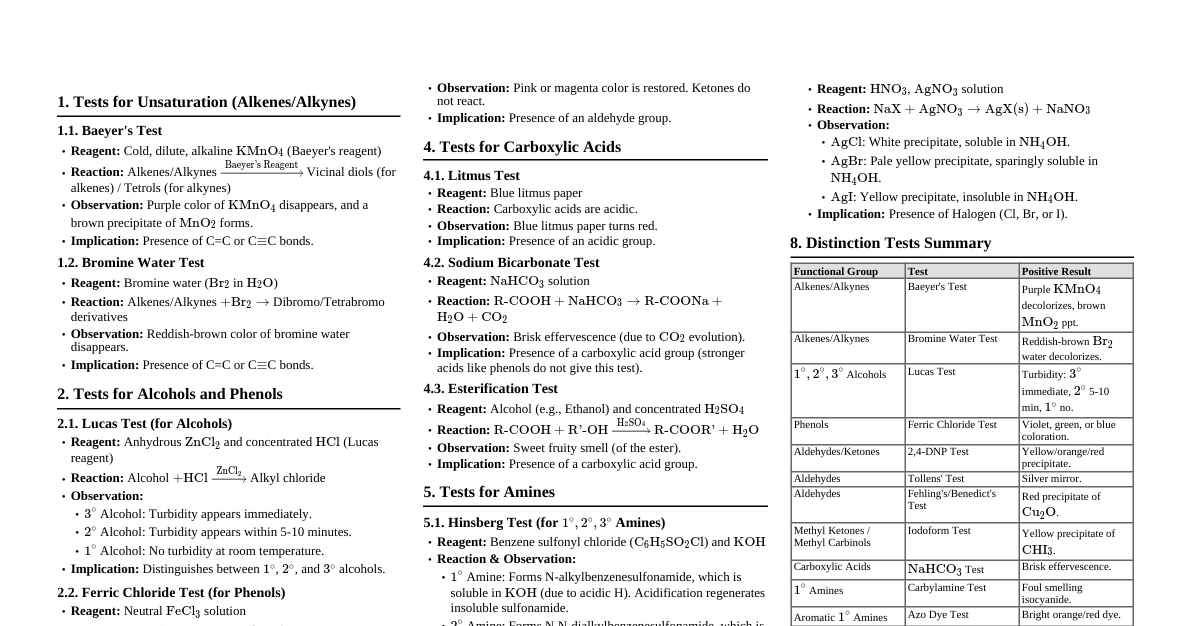
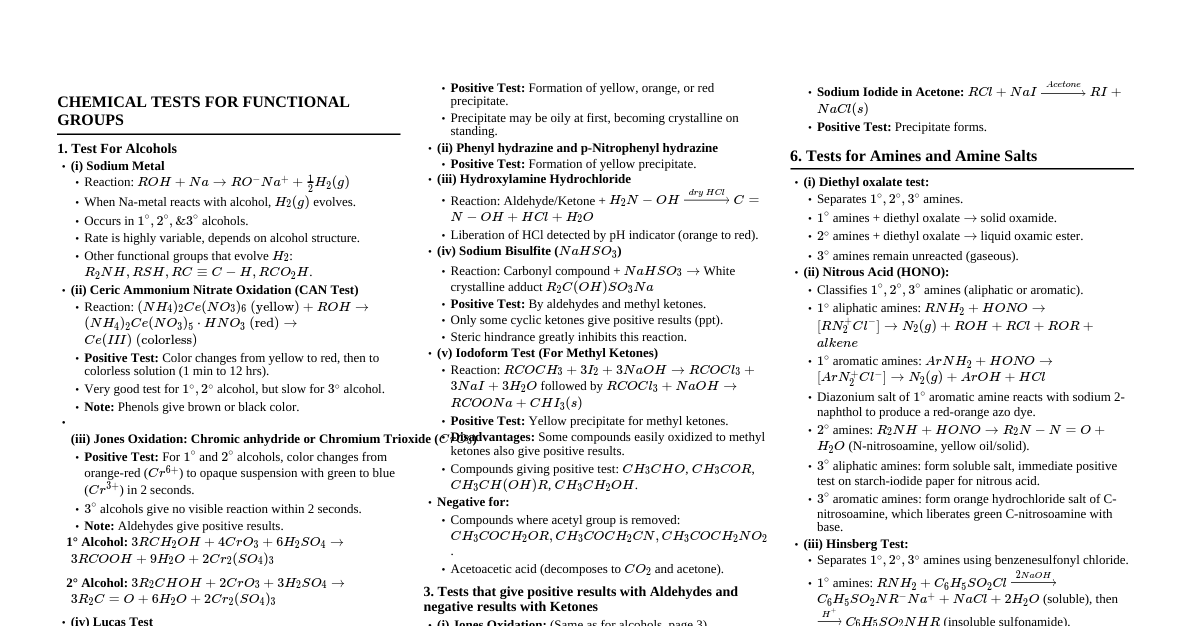
🧪 Organic Chemistry Practical Tests: Identification of Compounds This cheatsheet provides a comprehensive guide to qualitative analysis techniques used to identify elements and functional groups in unknown organic compounds. Understanding these tests is crucial for organic chemistry laboratory work. 1. Lassaigne's Test (Sodium Fusion Test) for Extra Elements This fundamental test converts covalently bonded elements (N, S, P, X) in organic compounds into ionic salts using molten sodium metal. These salts are then water-soluble and can be detected using specific reagents. Principle: Organic sample + Na (molten) $\xrightarrow{\Delta}$ Ionic salts. Sodium Fusion Extract (SFE): The resulting solution after crushing the fused mass in water and filtering. 1.1. Detection of Nitrogen (N) Nitrogen, if present, is converted to sodium cyanide (NaCN). This is detected by the formation of Prussian Blue. Reaction with Ferrous Sulfate: SFE (containing NaCN) is boiled with freshly prepared ferrous sulfate solution. $6\text{NaCN} + \text{FeSO}_4 \rightarrow \text{Na}_4[\text{Fe(CN)}_6] + \text{Na}_2\text{SO}_4$ Acidification and Ferric Chloride: The solution is then acidified with concentrated $\text{H}_2\text{SO}_4$ (or HCl) and a few drops of ferric chloride ($\text{FeCl}_3$) solution are added. $3\text{Na}_4[\text{Fe(CN)}_6] + 4\text{FeCl}_3 \rightarrow \text{Fe}_4[\text{Fe(CN)}_6]_3 \downarrow (\text{Prussian Blue}) + 12\text{NaCl}$ Observation: Formation of a deep Prussian Blue coloration or precipitate. 1.2. Detection of Sulfur (S) Sulfur, if present, is converted to sodium sulfide ($\text{Na}_2\text{S}$). Lead Acetate Test: Add lead acetate solution to a portion of the SFE. Observation: A black precipitate of lead sulfide ($\text{PbS}$) confirms sulfur. $\text{Na}_2\text{S} + (\text{CH}_3\text{COO})_2\text{Pb} \rightarrow \text{PbS} \downarrow (\text{Black}) + 2\text{CH}_3\text{COONa}$ Sodium Nitroprusside Test: Add a few drops of sodium nitroprusside solution to another portion of the SFE. Observation: A transient violet or purple color indicates sulfur. $\text{Na}_2\text{S} + \text{Na}_2[\text{Fe(CN)}_5\text{NO}] \rightarrow \text{Na}_4[\text{Fe(CN)}_5\text{NOS}] (\text{Violet})$ 1.3. Detection of Nitrogen & Sulfur (Simultaneously Present) If both elements are present, they can combine to form sodium thiocyanate (NaSCN) during fusion. $\text{Na} + \text{C} + \text{N} + \text{S} \xrightarrow{\Delta} \text{NaSCN}$ Test: Add a few drops of ferric chloride ($\text{FeCl}_3$) to the SFE. Observation: A distinct blood-red coloration appears due to the formation of ferric thiocyanate. $\text{NaSCN} + \text{FeCl}_3 \rightarrow [\text{Fe(SCN)}]^{2+} (\text{Blood Red}) + \text{NaCl}$ Note: If an excess of sodium is used during fusion, NaSCN might decompose into NaCN and $\text{Na}_2\text{S}$, leading to separate tests for N and S. 1.4. Detection of Halogens (Cl, Br, I) Halogens (X) are converted to sodium halides (NaX). The test for halogens requires careful preparation to avoid interference. Elimination of N and S: Boil a portion of the SFE with concentrated nitric acid ($\text{HNO}_3$). This decomposes any NaCN or $\text{Na}_2\text{S}$ present, which would otherwise precipitate as AgCN or $\text{Ag}_2\text{S}$ with silver nitrate. $\text{NaCN} + \text{HNO}_3 \rightarrow \text{HCN} \uparrow + \text{NaNO}_3$ $\text{Na}_2\text{S} + 2\text{HNO}_3 \rightarrow \text{H}_2\text{S} \uparrow + 2\text{NaNO}_3$ Silver Nitrate Test: Cool the solution and add silver nitrate ($\text{AgNO}_3$) solution. $\text{NaX} + \text{AgNO}_3 \rightarrow \text{AgX} \downarrow + \text{NaNO}_3$ Observations: Chloride (Cl): Forms a white precipitate of AgCl, which is readily soluble in aqueous ammonia ($\text{NH}_4\text{OH}$). Bromide (Br): Forms a pale yellow precipitate of AgBr, which is sparingly soluble in aqueous ammonia. Iodide (I): Forms a yellow precipitate of AgI, which is insoluble in aqueous ammonia. 1.5. Detection of Phosphorus (P) Phosphorus, if present, is oxidized to sodium phosphate ($\text{Na}_3\text{PO}_4$). Oxidation: Fuse the organic compound with sodium peroxide ($\text{Na}_2\text{O}_2$) or boil the SFE with conc. $\text{HNO}_3$. Ammonium Molybdate Test: Acidify the resulting solution with $\text{HNO}_3$ and add ammonium molybdate solution. Observation: Formation of a canary yellow precipitate of ammonium phosphomolybdate upon heating. $\text{Na}_3\text{PO}_4 + 12(\text{NH}_4)_2\text{MoO}_4 + 21\text{HNO}_3 \rightarrow (\text{NH}_4)_3\text{PO}_4 \cdot 12\text{MoO}_3 \downarrow (\text{Canary Yellow}) + 21\text{NH}_4\text{NO}_3 + 3\text{NaNO}_3 + 12\text{H}_2\text{O}$ 2. Detection of Functional Groups These tests help identify specific chemical functionalities within the organic molecule. 2.1. Hydroxyl Group (-OH) 2.1.1. Tests for Alcohols (R-OH) Alcohols are classified by the number of alkyl groups attached to the carbon bearing the hydroxyl group (1°, 2°, 3°). Lucas Test: A key test for distinguishing between primary, secondary, and tertiary alcohols. Reagent: Lucas Reagent (concentrated HCl + anhydrous $\text{ZnCl}_2$). Mechanism: Alcohols react via $\text{S}_{\text{N}}1$ (for 3° and 2°) or $\text{S}_{\text{N}}2$ (for 1°) mechanisms to form alkyl chlorides, which are insoluble and cause turbidity. Observations: Tertiary (3°) Alcohols: Immediate turbidity. Secondary (2°) Alcohols: Turbidity appears within 5-10 minutes. Primary (1°) Alcohols: No turbidity at room temperature (may react upon heating). Example: $(\text{CH}_3)_3\text{COH} + \text{HCl} \xrightarrow{\text{ZnCl}_2} (\text{CH}_3)_3\text{CCl} \downarrow + \text{H}_2\text{O}$ Ceric Ammonium Nitrate (CAN) Test: Reagent: Ceric ammonium nitrate solution ($\text{(NH}_4)_2[\text{Ce(NO}_3)_6]$). Observations: Alcohols react to form a red or pink coloration . $2\text{ROH} + (\text{NH}_4)_2[\text{Ce(NO}_3)_6] \rightarrow [\text{Ce(NO}_3)_4(\text{ROH})_2] (\text{Red/Pink Complex}) + 2\text{NH}_4\text{NO}_3$ 2.1.2. Tests for Phenols (Ar-OH) Phenols are aromatic compounds with a hydroxyl group directly attached to the benzene ring. They are weakly acidic. Neutral Ferric Chloride Test: Reagent: Neutral ferric chloride ($\text{FeCl}_3$) solution. Observations: Phenols typically produce characteristic violet, blue, green, or red coloration due to the formation of a soluble colored complex. $6\text{C}_6\text{H}_5\text{OH} + \text{FeCl}_3 \rightarrow [\text{Fe}(\text{OC}_6\text{H}_5)_6]^{3-} (\text{Violet Complex}) + 3\text{HCl} + 3\text{H}^+$ Bromine Water Test: Reagent: Saturated bromine water ($\text{Br}_2/\text{H}_2\text{O}$). Observations: Phenols, being highly activated, readily undergo electrophilic substitution. The bromine water is decolorized, and a white precipitate of a polybrominated phenol is formed. $\text{C}_6\text{H}_5\text{OH} + 3\text{Br}_2 \rightarrow \text{C}_6\text{H}_2\text{Br}_3\text{OH} \downarrow (\text{2,4,6-Tribromophenol, White ppt}) + 3\text{HBr}$ Azo Dye Test (for Phenol): Reagents: Benzenediazonium chloride ($\text{PhN}_2^+\text{Cl}^-$) and alkaline solution. Observations: Phenols couple with diazonium salts in alkaline medium to form a brightly colored azo dye (e.g., orange or red). 2.2. Carbonyl Group ($>\text{C=O}$) Present in aldehydes (R-CHO) and ketones (R-CO-R'). 2,4-Dinitrophenylhydrazine (2,4-DNP) Test: A general test for all aldehydes and ketones. Reagent: 2,4-Dinitrophenylhydrazine solution. Observations: Formation of a yellow, orange, or red precipitate (a hydrazone derivative). $\text{RCHO} + \text{NH}_2\text{NHC}_6\text{H}_3(\text{NO}_2)_2 \rightarrow \text{RCH=NNHC}_6\text{H}_3(\text{NO}_2)_2 \downarrow (\text{Hydrazone})$ Tollen's Test (Silver Mirror Test): Distinguishes aldehydes from most ketones. Reagent: Tollen's reagent (ammoniacal silver nitrate, $[\text{Ag(NH}_3)_2]^+$). Observations: Aldehydes are oxidized, reducing $\text{Ag}^+$ to metallic silver, which deposits as a silver mirror on the test tube walls. Ketones do not react. $\text{RCHO} + 2[\text{Ag(NH}_3)_2]^+ + 3\text{OH}^- \rightarrow \text{RCOO}^- + 2\text{Ag} \downarrow (\text{Silver Mirror}) + 4\text{NH}_3 + 2\text{H}_2\text{O}$ Fehling's Test: Another test to differentiate aldehydes from ketones. Reagents: Fehling's A (aqueous $\text{CuSO}_4$) and Fehling's B (alkaline sodium potassium tartrate). Observations: Aldehydes reduce $\text{Cu}^{2+}$ (blue) to $\text{Cu}_2\text{O}$ (cuprous oxide), forming a reddish-brown precipitate . Ketones generally do not react. $\text{RCHO} + 2\text{Cu}^{2+} + 5\text{OH}^- \rightarrow \text{RCOO}^- + \text{Cu}_2\text{O} \downarrow (\text{Red-brown ppt}) + 3\text{H}_2\text{O}$ Schiff's Test: Reagent: Schiff's reagent (decolorized fuchsine solution). Observations: Aldehydes restore the magenta (pink-purple) color of the reagent. Ketones typically do not. Iodoform Test: Specific for compounds with a $\text{CH}_3\text{CO-}$ group or a $\text{CH}_3\text{CH(OH)-}$ group. Reagents: Sodium hydroxide (NaOH) and iodine ($\text{I}_2$). Observations: Formation of a characteristic yellow precipitate of iodoform ($\text{CHI}_3$). Example (aldehyde): $\text{CH}_3\text{CHO} + 3\text{I}_2 + 4\text{NaOH} \rightarrow \text{CHI}_3 \downarrow (\text{Yellow ppt}) + \text{HCOONa} + 3\text{NaI} + 3\text{H}_2\text{O}$ Example (alcohol): $\text{CH}_3\text{CH(OH)R} + 4\text{I}_2 + 6\text{NaOH} \rightarrow \text{CHI}_3 \downarrow (\text{Yellow ppt}) + \text{RCOONa} + 5\text{NaI} + 5\text{H}_2\text{O}$ 2.3. Carboxyl Group (-COOH) Characteristic of carboxylic acids, which are acidic due to the resonance stabilization of the carboxylate ion. Sodium Bicarbonate Test: Reagent: Aqueous sodium bicarbonate ($\text{NaHCO}_3$). Observations: Carboxylic acids react to produce carbon dioxide gas, leading to brisk effervescence . Phenols and alcohols are generally not acidic enough to react with bicarbonate. $\text{RCOOH} + \text{NaHCO}_3 \rightarrow \text{RCOONa} + \text{H}_2\text{O} + \text{CO}_2 \uparrow$ 2.4. Amino Group (-NH$_2$) Amines are organic derivatives of ammonia, classified as primary (1°), secondary (2°), or tertiary (3°). Carbylamine Test (Isocyanide Test): Highly specific for primary amines. Reagents: Chloroform ($\text{CHCl}_3$) and alcoholic potassium hydroxide (KOH). Observations: Primary amines (aliphatic and aromatic) react upon heating to form isocyanides (carbylamines), characterized by their distinctive and very foul/obnoxious smell . Secondary and tertiary amines do not give this test. $\text{R-NH}_2 + \text{CHCl}_3 + 3\text{KOH} \xrightarrow{\Delta} \text{R-NC} (\text{Foul Smell}) + 3\text{KCl} + 3\text{H}_2\text{O}$ Hinsberg's Test: Used to differentiate between 1°, 2°, and 3° amines. Reagent: Benzene sulfonyl chloride ($\text{C}_6\text{H}_5\text{SO}_2\text{Cl}$) in the presence of aqueous KOH. Observations: Primary (1°) Amine: Reacts to form an N-substituted sulfonamide, which is soluble in aqueous KOH (due to an acidic hydrogen on the nitrogen). Upon acidification, the sulfonamide precipitates. Secondary (2°) Amine: Reacts to form an N,N-disubstituted sulfonamide, which is insoluble in aqueous KOH (no acidic hydrogen on nitrogen). It remains insoluble upon acidification. Tertiary (3°) Amine: Does not react with benzene sulfonyl chloride. It remains insoluble in the basic solution but dissolves upon acidification (forming a salt). Azo Dye Test (for Aromatic Primary Amines): Reagents: Sodium nitrite ($\text{NaNO}_2$) and HCl (to form nitrous acid for diazotization), followed by coupling with an alkaline solution of $\beta$-naphthol. Observations: Aromatic primary amines undergo diazotization to form diazonium salts, which then couple with $\beta$-naphthol to produce a vivid orange or red azo dye .