JEE Physics Optics
Shared 3/27/2026•89 views
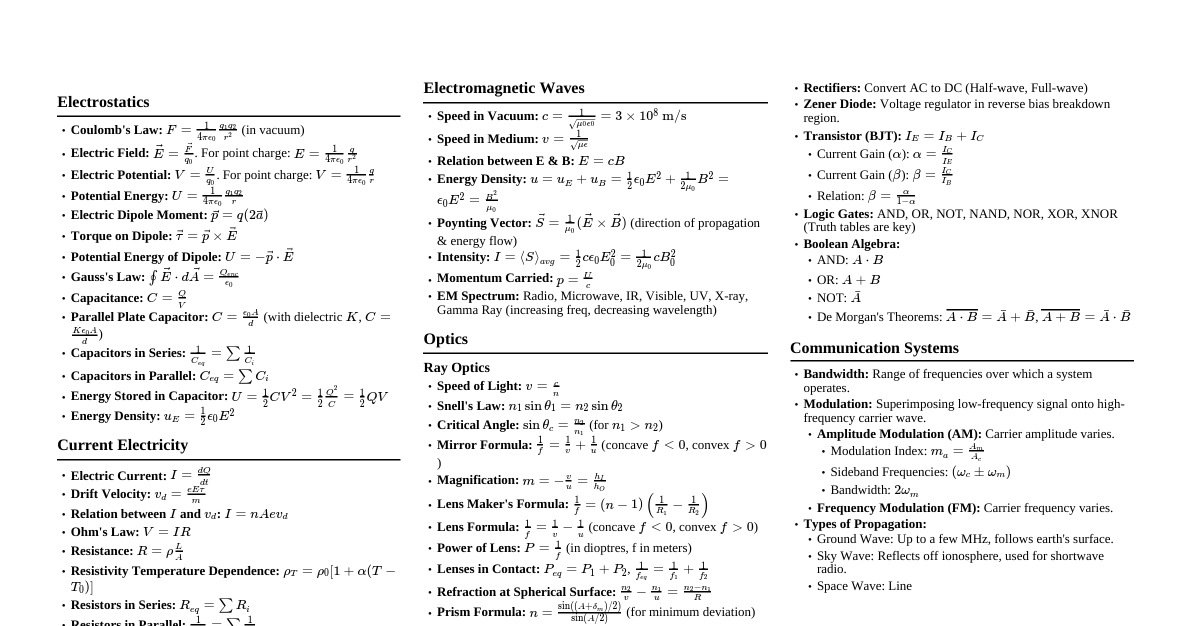
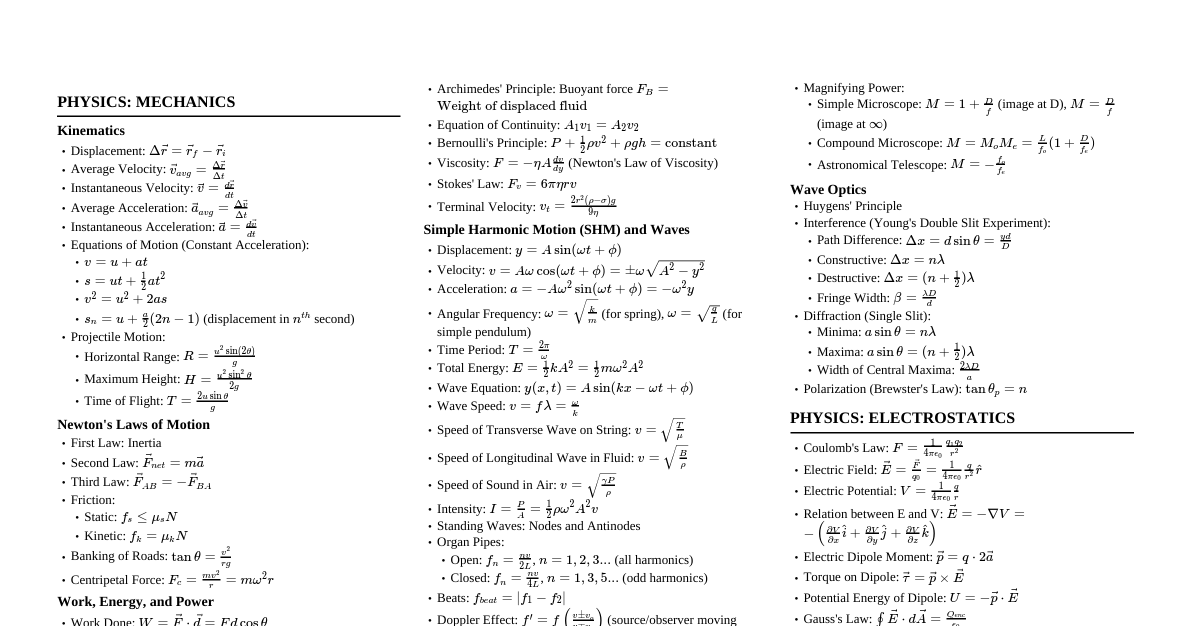
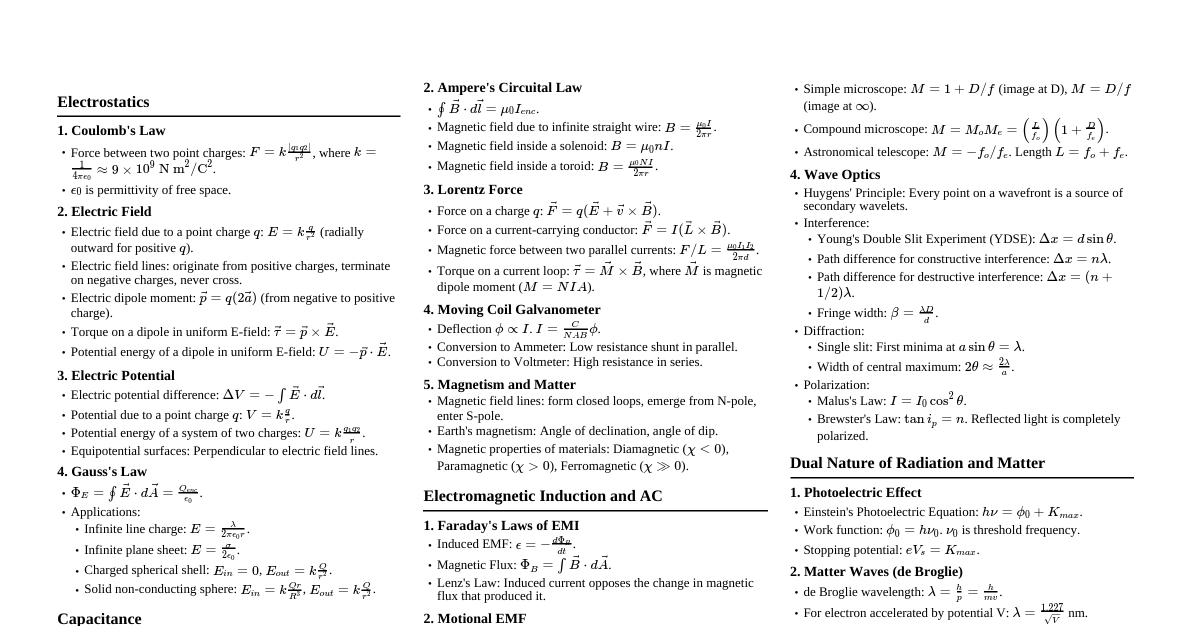
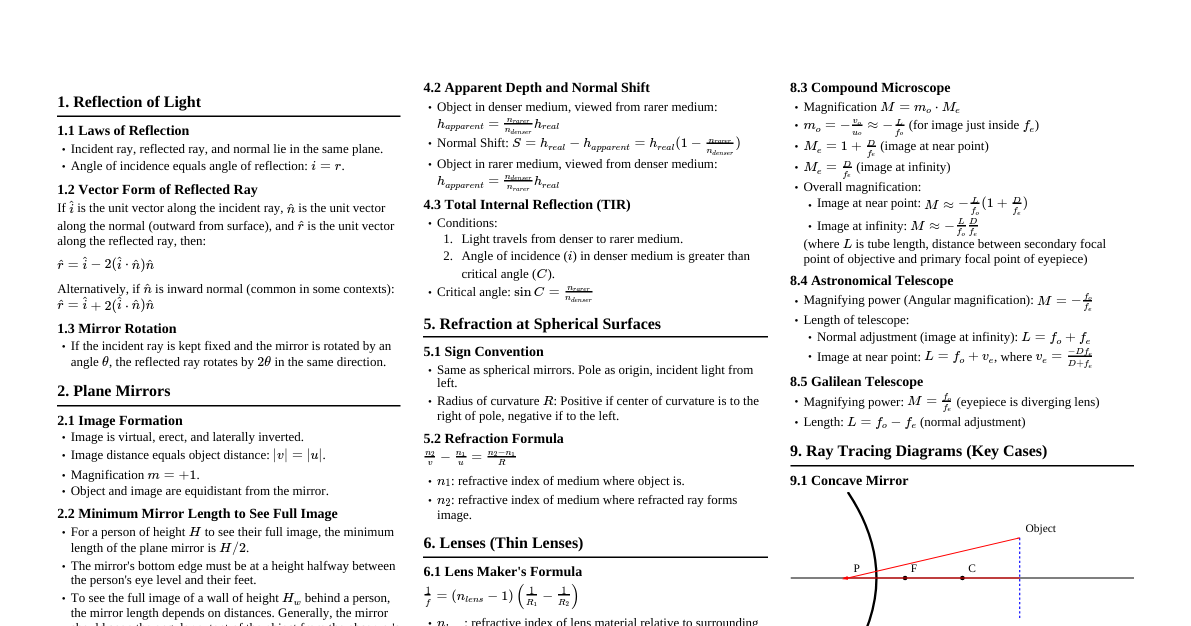
### Reflection - Plane Mirrors - **Angle of Incidence = Angle of Reflection:** $\angle i = \angle r$ - **Image Characteristics:** Virtual, erect, laterally inverted, same size, same distance behind mirror as object in front. - **Number of Images (Two inclined mirrors):** - If $\frac{360^\circ}{\theta}$ is even, $N = \frac{360^\circ}{\theta} - 1$ - If $\frac{360^\circ}{\theta}$ is odd, $N = \frac{360^\circ}{\theta} - 1$ (if object is on bisector) or $N = \frac{360^\circ}{\theta}$ (if object is not on bisector) - **Minimum height of mirror to see full image:** Half the height of the person. ### Reflection - Spherical Mirrors - **Mirror Formula:** $\frac{1}{f} = \frac{1}{v} + \frac{1}{u}$ - $f$: focal length, $v$: image distance, $u$: object distance - **Concave Mirror:** $f 0$ - **Magnification:** $m = \frac{h_i}{h_o} = -\frac{v}{u}$ - $h_i$: image height, $h_o$: object height - $m > 0$: erect image, $m 1$: magnified, $|m| ### Refraction - Plane Surfaces - **Snell's Law:** $n_1 \sin\theta_1 = n_2 \sin\theta_2$ - $n_1, n_2$: refractive indices, $\theta_1, \theta_2$: angles with normal - **Apparent Depth:** $D_{app} = \frac{D_{real}}{n_{relative}} = \frac{D_{real}}{n_2/n_1}$ - $n_1$: medium of object, $n_2$: medium of observer - **Total Internal Reflection (TIR):** Occurs when light travels from denser to rarer medium and angle of incidence $\ge$ critical angle. - **Critical Angle:** $\sin\theta_c = \frac{n_2}{n_1}$ (where $n_1 > n_2$) - **Lateral Shift:** $x = t \sin(\theta_1 - \theta_2) / \cos\theta_2$ (for slab of thickness $t$) - **Normal Shift:** $\Delta x = t (1 - 1/n)$ ### Refraction - Spherical Surfaces - **Refraction Formula:** $\frac{n_2}{v} - \frac{n_1}{u} = \frac{n_2 - n_1}{R}$ - $n_1$: refractive index of medium where object is - $n_2$: refractive index of medium where image is formed - $R$: radius of curvature (positive if convex, negative if concave when viewed from incident side) ### Lenses - **Lens Maker's Formula:** $\frac{1}{f} = (n_{rel} - 1) (\frac{1}{R_1} - \frac{1}{R_2})$ - $n_{rel} = n_{lens}/n_{medium}$ - $R_1, R_2$: radii of curvature of surfaces - **Lens Formula:** $\frac{1}{f} = \frac{1}{v} - \frac{1}{u}$ - **Magnification:** $m = \frac{h_i}{h_o} = \frac{v}{u}$ - **Power of Lens:** $P = \frac{1}{f}$ (in dioptres if $f$ in meters) - **Converging (Convex) Lens:** $P > 0$ - **Diverging (Concave) Lens:** $P ### Prism - **Angle of Deviation:** $\delta = (n-1)A$ (for small angle prism) - $A$: angle of prism - **Minimum Deviation:** $\delta_{min} = (n-1)A$ (approximately for small $A$) - For general prism: $n = \frac{\sin((A+\delta_m)/2)}{\sin(A/2)}$ - **Dispersion:** Splitting of white light into constituent colors. - **Angular Dispersion:** $(\delta_v - \delta_r) = (n_v - n_r)A$ - **Dispersive Power:** $\omega = \frac{n_v - n_r}{n_y - 1} = \frac{\delta_v - \delta_r}{\delta_y}$ - $n_y$: refractive index for yellow (mean) light ### Optical Instruments - **Human Eye:** - **Near Point:** 25 cm (for normal eye) - **Far Point:** Infinity - **Simple Microscope (Magnifying Glass):** - **Magnification (Image at near point):** $M = 1 + \frac{D}{f}$ - **Magnification (Image at infinity):** $M = \frac{D}{f}$ - $D$: distance of distinct vision (25 cm) - **Compound Microscope:** - **Magnification:** $M = m_o \times m_e = (\frac{v_o}{u_o})(1 + \frac{D}{f_e})$ (image at near point) - **Length of tube:** $L = |v_o| + |u_e|$ - **Astronomical Telescope:** - **Magnification (Normal adjustment, image at infinity):** $M = -\frac{f_o}{f_e}$ - **Length of tube:** $L = f_o + f_e$ - **Magnification (Image at near point):** $M = -\frac{f_o}{f_e}(1 + \frac{f_e}{D})$ - **Resolving Power:** - **Microscope:** R.P. $= \frac{2n \sin\theta}{\lambda}$ (n sin $\theta$ is numerical aperture) - **Telescope:** R.P. $= \frac{D}{1.22\lambda}$ ### Wave Optics - Interference - **Principle of Superposition:** $y = y_1 + y_2$ - **Path Difference:** $\Delta x = x_2 - x_1$ - **Phase Difference:** $\Delta \phi = \frac{2\pi}{\lambda}\Delta x$ - **Conditions for Constructive Interference (Bright Fringes):** - $\Delta x = n\lambda$ - $\Delta \phi = 2n\pi$ - **Conditions for Destructive Interference (Dark Fringes):** - $\Delta x = (2n+1)\frac{\lambda}{2}$ - $\Delta \phi = (2n+1)\pi$ - **Intensity:** $I = I_1 + I_2 + 2\sqrt{I_1 I_2}\cos(\Delta \phi)$ - If $I_1 = I_2 = I_0$, then $I = 4I_0 \cos^2(\Delta \phi/2)$ - $I_{max} = (\sqrt{I_1} + \sqrt{I_2})^2$, $I_{min} = (\sqrt{I_1} - \sqrt{I_2})^2$ - **Young's Double Slit Experiment (YDSE):** - **Fringe Width:** $\beta = \frac{\lambda D}{d}$ - $D$: distance between slits and screen - $d$: distance between slits - **Position of Bright Fringes:** $y_n = \frac{n\lambda D}{d}$ - **Position of Dark Fringes:** $y_n = (2n+1)\frac{\lambda D}{2d}$ ### Wave Optics - Diffraction - **Single Slit Diffraction:** - **Minima condition:** $a \sin\theta = n\lambda$ - $a$: slit width - **Maxima condition (approx):** $a \sin\theta = (2n+1)\frac{\lambda}{2}$ - **Width of Central Maxima:** $W = \frac{2\lambda D}{a}$ - **Fresnel Distance:** $Z_F = \frac{a^2}{\lambda}$ (distance up to which ray optics holds) ### Polarization - **Brewster's Law:** $\tan\theta_p = n$ - $\theta_p$: polarizing angle - Reflected light is completely polarized when reflected and refracted rays are perpendicular. - **Malus's Law:** $I = I_0 \cos^2\theta$ - $I_0$: intensity of polarized light incident on analyzer - $\theta$: angle between transmission axes of polarizer and analyzer