JEE Physics, Chemistry, Maths Cheatsheet
Cheatsheet Content
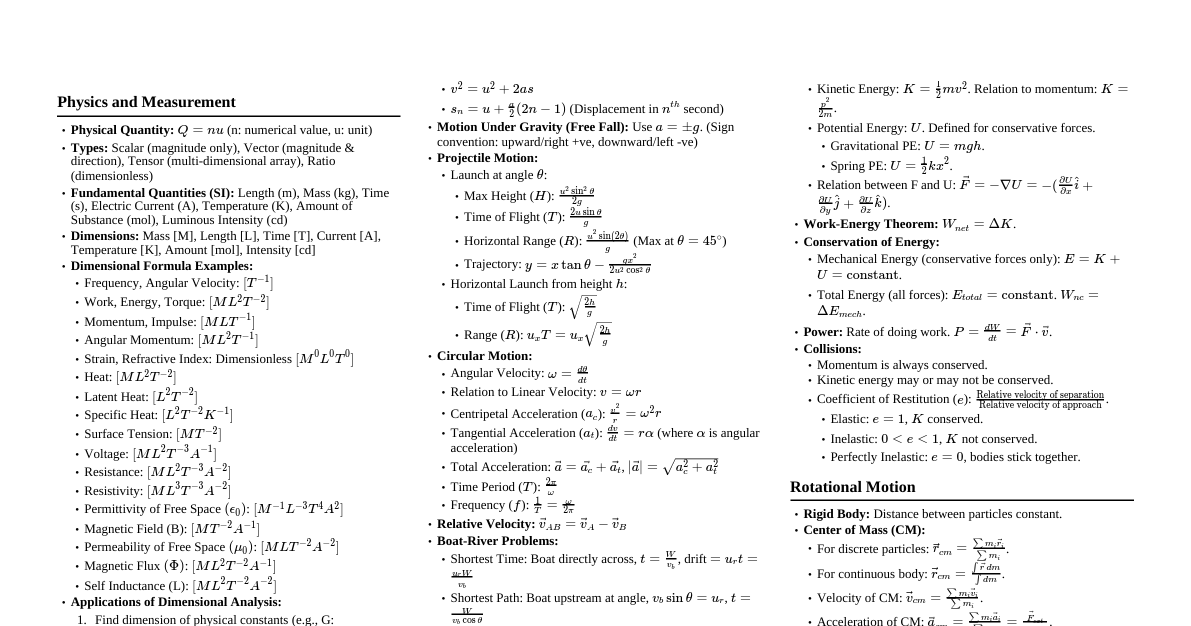
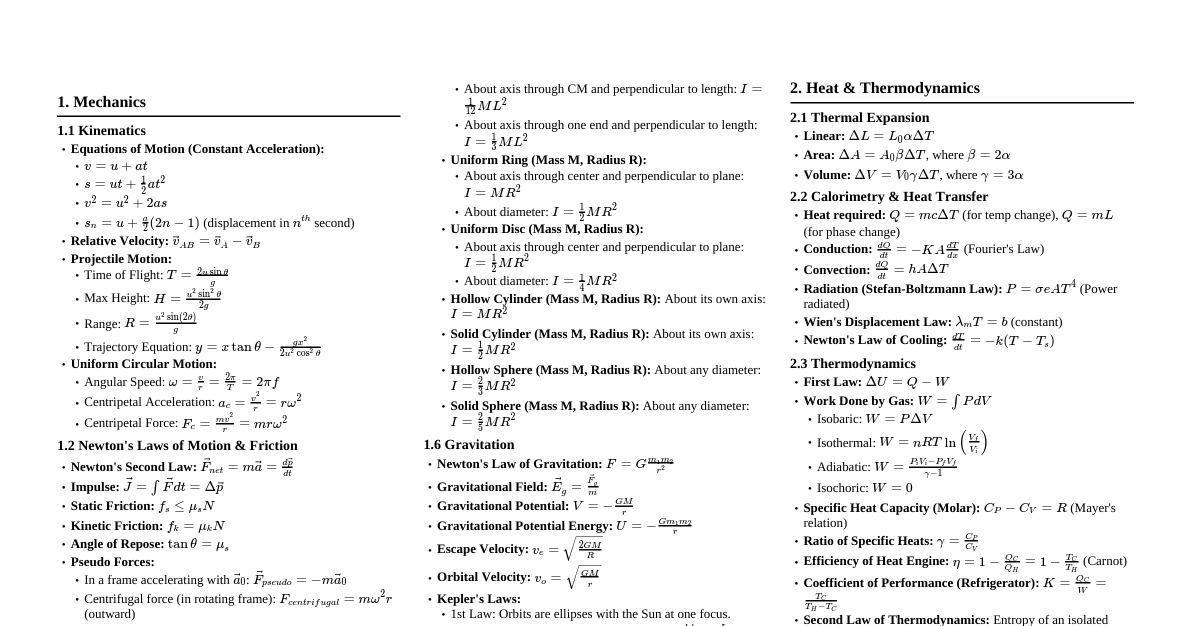
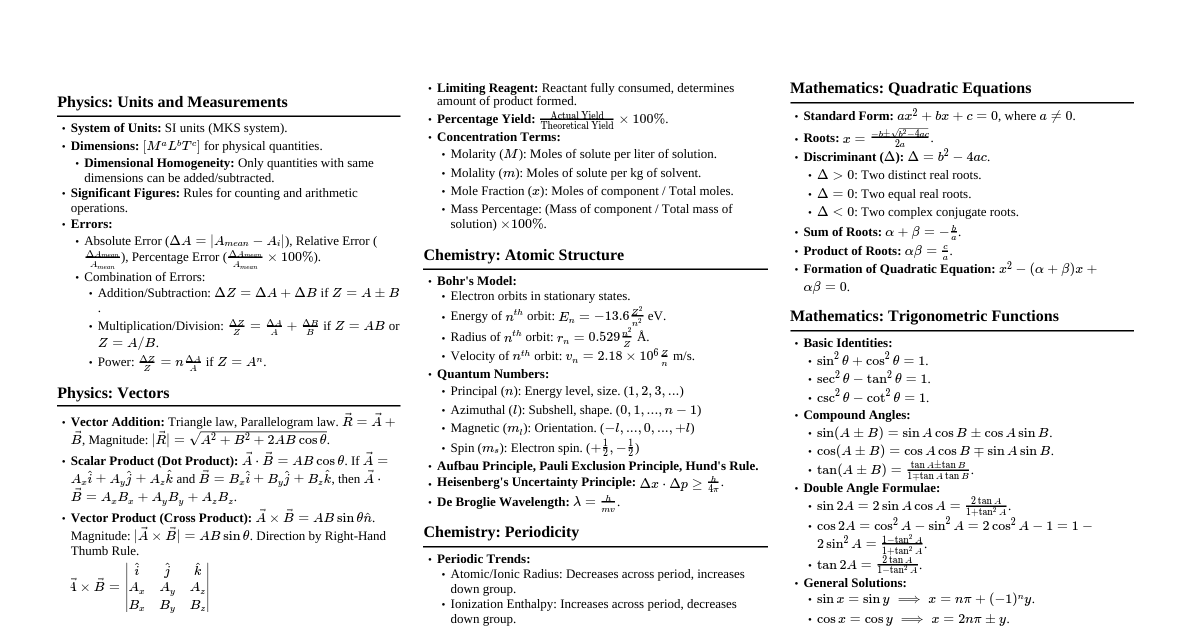
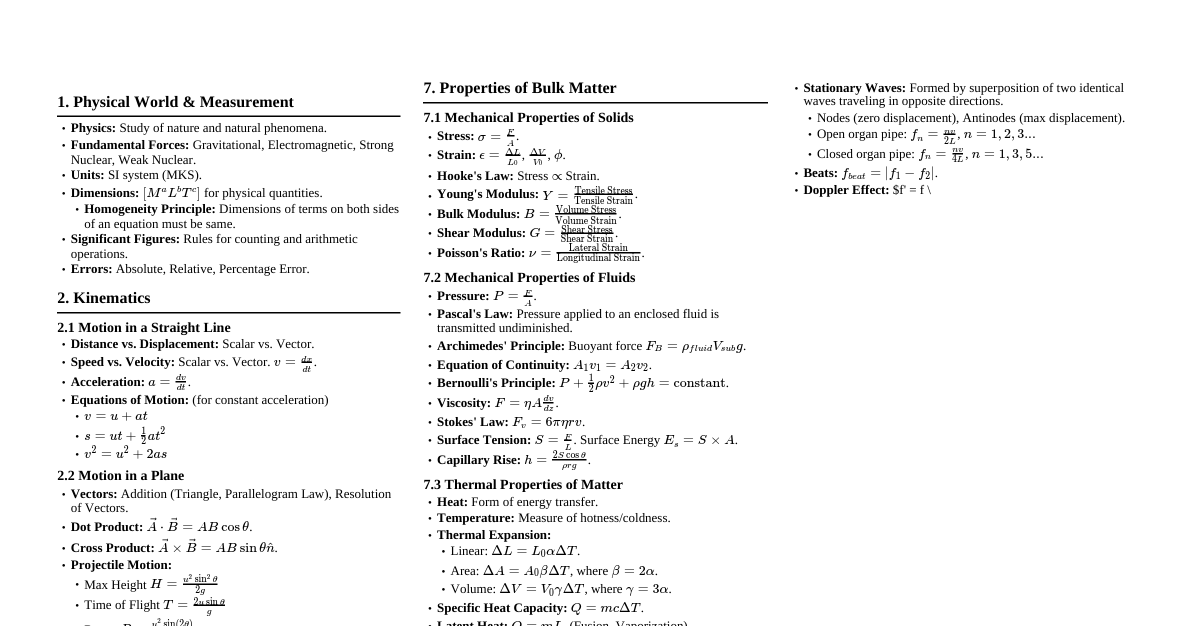
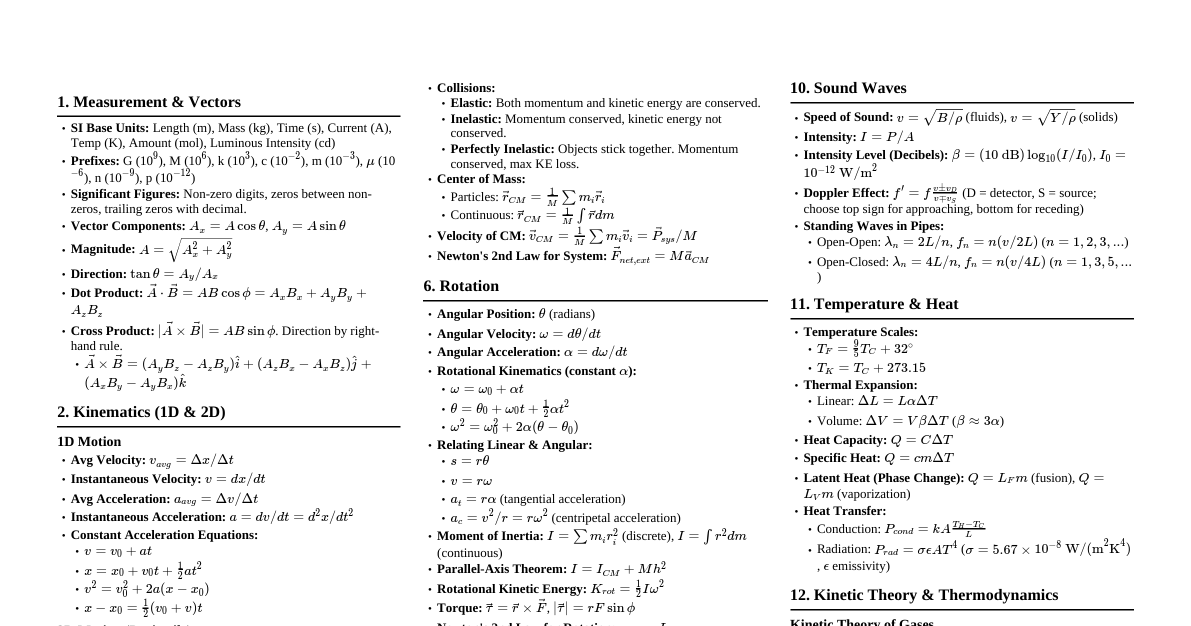
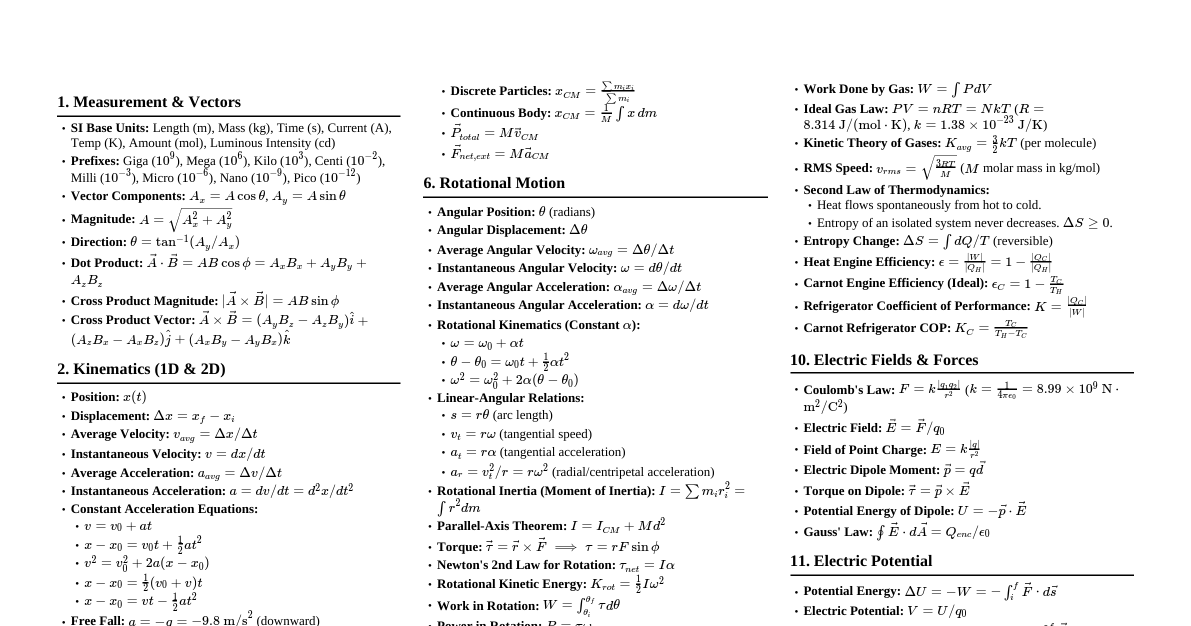
PHYSICS: MECHANICS Kinematics Displacement: $\Delta \vec{r} = \vec{r}_f - \vec{r}_i$ Average Velocity: $\vec{v}_{avg} = \frac{\Delta \vec{r}}{\Delta t}$ Instantaneous Velocity: $\vec{v} = \frac{d\vec{r}}{dt}$ Average Acceleration: $\vec{a}_{avg} = \frac{\Delta \vec{v}}{\Delta t}$ Instantaneous Acceleration: $\vec{a} = \frac{d\vec{v}}{dt}$ Equations of Motion (Constant Acceleration): $v = u + at$ $s = ut + \frac{1}{2}at^2$ $v^2 = u^2 + 2as$ $s_n = u + \frac{a}{2}(2n-1)$ (displacement in $n^{th}$ second) Projectile Motion: Horizontal Range: $R = \frac{u^2 \sin(2\theta)}{g}$ Maximum Height: $H = \frac{u^2 \sin^2\theta}{2g}$ Time of Flight: $T = \frac{2u \sin\theta}{g}$ Newton's Laws of Motion First Law: Inertia Second Law: $\vec{F}_{net} = m\vec{a}$ Third Law: $\vec{F}_{AB} = -\vec{F}_{BA}$ Friction: Static: $f_s \le \mu_s N$ Kinetic: $f_k = \mu_k N$ Banking of Roads: $\tan\theta = \frac{v^2}{rg}$ Centripetal Force: $F_c = \frac{mv^2}{r} = m\omega^2 r$ Work, Energy, and Power Work Done: $W = \vec{F} \cdot \vec{d} = Fd\cos\theta$ Kinetic Energy: $K = \frac{1}{2}mv^2$ Potential Energy: Gravitational: $U_g = mgh$ Elastic: $U_e = \frac{1}{2}kx^2$ Work-Energy Theorem: $W_{net} = \Delta K$ Power: $P = \frac{dW}{dt} = \vec{F} \cdot \vec{v}$ Conservation of Mechanical Energy: $E = K + U = \text{constant}$ (for conservative forces) Rotational Motion Angular Displacement: $\Delta\theta$ Angular Velocity: $\omega = \frac{d\theta}{dt}$ Angular Acceleration: $\alpha = \frac{d\omega}{dt}$ Relation between Linear and Angular: $v = r\omega$, $a_t = r\alpha$, $a_c = r\omega^2 = \frac{v^2}{r}$ Moment of Inertia: $I = \sum m_i r_i^2$ (discrete), $I = \int r^2 dm$ (continuous) Radius of Gyration: $k = \sqrt{\frac{I}{M}}$ Parallel Axis Theorem: $I = I_{cm} + Md^2$ Perpendicular Axis Theorem: $I_z = I_x + I_y$ (for planar body) Torque: $\vec{\tau} = \vec{r} \times \vec{F}$, $\tau = I\alpha$ Angular Momentum: $\vec{L} = \vec{r} \times \vec{p} = I\vec{\omega}$ Conservation of Angular Momentum: If $\vec{\tau}_{ext} = 0$, then $\vec{L} = \text{constant}$ Rotational Kinetic Energy: $K_R = \frac{1}{2}I\omega^2$ Rolling Motion: $K = \frac{1}{2}Mv_{cm}^2 + \frac{1}{2}I_{cm}\omega^2$ Gravitation Newton's Law of Gravitation: $F = \frac{Gm_1 m_2}{r^2}$ Gravitational Field Intensity: $E_g = \frac{GM}{r^2}$ Gravitational Potential: $V_g = -\frac{GM}{r}$ Gravitational Potential Energy: $U = -\frac{Gm_1 m_2}{r}$ Variation of $g$: Altitude: $g_h = g(1 - \frac{2h}{R})$ (for $h \ll R$) Depth: $g_d = g(1 - \frac{d}{R})$ Escape Velocity: $v_e = \sqrt{\frac{2GM}{R}} = \sqrt{2gR}$ Orbital Velocity: $v_o = \sqrt{\frac{GM}{r}}$ Kepler's Laws: 1st: Orbits are ellipses. 2nd: Equal areas in equal times. 3rd: $T^2 \propto r^3$ Properties of Matter Young's Modulus: $Y = \frac{\text{Stress}}{\text{Strain}} = \frac{F/A}{\Delta L/L}$ Bulk Modulus: $B = \frac{\text{Stress}}{\text{Volume Strain}} = \frac{-P}{\Delta V/V}$ Shear Modulus: $G = \frac{\text{Shear Stress}}{\text{Shear Strain}} = \frac{F/A}{\Delta x/h}$ Poisson's Ratio: $\sigma = -\frac{\text{Lateral Strain}}{\text{Longitudinal Strain}}$ Surface Tension: $T = F/L$ Surface Energy: $E = T \cdot A$ Excess Pressure in Bubble: Liquid drop: $\Delta P = \frac{2T}{R}$ Soap bubble: $\Delta P = \frac{4T}{R}$ Capillary Rise: $h = \frac{2T\cos\theta}{r\rho g}$ Pascal's Law: Pressure applied to an enclosed fluid is transmitted undiminished. Archimedes' Principle: Buoyant force $F_B = \text{Weight of displaced fluid}$ Equation of Continuity: $A_1 v_1 = A_2 v_2$ Bernoulli's Principle: $P + \frac{1}{2}\rho v^2 + \rho gh = \text{constant}$ Viscosity: $F = -\eta A \frac{dv}{dy}$ (Newton's Law of Viscosity) Stokes' Law: $F_v = 6\pi\eta rv$ Terminal Velocity: $v_t = \frac{2r^2(\rho - \sigma)g}{9\eta}$ Simple Harmonic Motion (SHM) and Waves Displacement: $y = A\sin(\omega t + \phi)$ Velocity: $v = A\omega\cos(\omega t + \phi) = \pm\omega\sqrt{A^2 - y^2}$ Acceleration: $a = -A\omega^2\sin(\omega t + \phi) = -\omega^2 y$ Angular Frequency: $\omega = \sqrt{\frac{k}{m}}$ (for spring), $\omega = \sqrt{\frac{g}{L}}$ (for simple pendulum) Time Period: $T = \frac{2\pi}{\omega}$ Total Energy: $E = \frac{1}{2}kA^2 = \frac{1}{2}m\omega^2 A^2$ Wave Equation: $y(x,t) = A\sin(kx - \omega t + \phi)$ Wave Speed: $v = f\lambda = \frac{\omega}{k}$ Speed of Transverse Wave on String: $v = \sqrt{\frac{T}{\mu}}$ Speed of Longitudinal Wave in Fluid: $v = \sqrt{\frac{B}{\rho}}$ Speed of Sound in Air: $v = \sqrt{\frac{\gamma P}{\rho}}$ Intensity: $I = \frac{P}{A} = \frac{1}{2}\rho \omega^2 A^2 v$ Standing Waves: Nodes and Antinodes Organ Pipes: Open: $f_n = \frac{nv}{2L}$, $n=1,2,3...$ (all harmonics) Closed: $f_n = \frac{nv}{4L}$, $n=1,3,5...$ (odd harmonics) Beats: $f_{beat} = |f_1 - f_2|$ Doppler Effect: $f' = f \left(\frac{v \pm v_o}{v \mp v_s}\right)$ (source/observer moving towards/away) PHYSICS: THERMAL PHYSICS Thermal Properties of Matter Coefficient of Linear Expansion: $\alpha = \frac{\Delta L}{L_0 \Delta T}$ Coefficient of Area Expansion: $\beta = 2\alpha$ Coefficient of Volume Expansion: $\gamma = 3\alpha$ Heat Capacity: $C = \frac{\Delta Q}{\Delta T}$ Specific Heat Capacity: $c = \frac{C}{m}$ Latent Heat: $Q = mL$ Heat Transfer: Conduction: $\frac{dQ}{dt} = -KA\frac{dT}{dx}$ Convection: $\frac{dQ}{dt} = hA\Delta T$ Radiation (Stefan-Boltzmann): $P = \epsilon \sigma A T^4$ Newton's Law of Cooling: $\frac{dT}{dt} = -k(T - T_s)$ Thermodynamics First Law: $\Delta U = Q - W$ Work Done by Gas: $W = \int P dV$ Specific Heats of Gas: $C_P = C_V + R$ (Mayer's relation) Ratio of Specific Heats: $\gamma = \frac{C_P}{C_V}$ Processes: Isothermal: $PV = \text{constant}$, $W = nRT \ln(\frac{V_f}{V_i})$, $\Delta U = 0$ Adiabatic: $PV^\gamma = \text{constant}$, $T V^{\gamma-1} = \text{constant}$, $W = \frac{P_i V_i - P_f V_f}{\gamma - 1}$ Isobaric: $P = \text{constant}$, $W = P\Delta V$ Isochoric: $V = \text{constant}$, $W = 0$, $\Delta U = Q = nC_V\Delta T$ Efficiency of Heat Engine: $\eta = 1 - \frac{Q_C}{Q_H} = 1 - \frac{T_C}{T_H}$ (Carnot) Coefficient of Performance (Refrigerator): $K = \frac{Q_C}{W} = \frac{T_C}{T_H - T_C}$ Entropy: $\Delta S = \int \frac{dQ}{T}$ Kinetic Theory of Gases Ideal Gas Equation: $PV = nRT = NkT$ Average Kinetic Energy per Molecule: $E_{avg} = \frac{3}{2}kT$ Root Mean Square Speed: $v_{rms} = \sqrt{\frac{3RT}{M}} = \sqrt{\frac{3kT}{m}}$ Degrees of Freedom: $f$ Internal Energy: $U = \frac{f}{2}nRT$ Molar Specific Heat: $C_V = \frac{f}{2}R$, $C_P = (\frac{f}{2}+1)R$ PHYSICS: OPTICS Ray Optics Reflection: $\angle i = \angle r$ Mirror Formula: $\frac{1}{f} = \frac{1}{v} + \frac{1}{u}$ (Cartesian sign convention) Magnification: $m = -\frac{v}{u} = \frac{h_i}{h_o}$ Refraction (Snell's Law): $n_1 \sin\theta_1 = n_2 \sin\theta_2$ Critical Angle: $\sin\theta_c = \frac{n_2}{n_1}$ (for $n_1 > n_2$) Lens Maker's Formula: $\frac{1}{f} = (n-1)(\frac{1}{R_1} - \frac{1}{R_2})$ Lens Formula: $\frac{1}{f} = \frac{1}{v} - \frac{1}{u}$ Power of Lens: $P = \frac{1}{f}$ (in diopters, $f$ in meters) Combination of Lenses: $P_{eq} = P_1 + P_2$, $\frac{1}{f_{eq}} = \frac{1}{f_1} + \frac{1}{f_2}$ Prism: $\delta = (n-1)A$ (for small angle prism) Dispersion: Angular dispersion $\theta = (\delta_v - \delta_r) = (n_v - n_r)A$ Magnifying Power: Simple Microscope: $M = 1 + \frac{D}{f}$ (image at D), $M = \frac{D}{f}$ (image at $\infty$) Compound Microscope: $M = M_o M_e = \frac{L}{f_o}(1 + \frac{D}{f_e})$ Astronomical Telescope: $M = -\frac{f_o}{f_e}$ Wave Optics Huygens' Principle Interference (Young's Double Slit Experiment): Path Difference: $\Delta x = d\sin\theta = \frac{yd}{D}$ Constructive: $\Delta x = n\lambda$ Destructive: $\Delta x = (n + \frac{1}{2})\lambda$ Fringe Width: $\beta = \frac{\lambda D}{d}$ Diffraction (Single Slit): Minima: $a\sin\theta = n\lambda$ Maxima: $a\sin\theta = (n + \frac{1}{2})\lambda$ Width of Central Maxima: $\frac{2\lambda D}{a}$ Polarization (Brewster's Law): $\tan\theta_p = n$ PHYSICS: ELECTROSTATICS Coulomb's Law: $F = \frac{1}{4\pi\epsilon_0} \frac{q_1 q_2}{r^2}$ Electric Field: $\vec{E} = \frac{\vec{F}}{q_0} = \frac{1}{4\pi\epsilon_0} \frac{q}{r^2}\hat{r}$ Electric Potential: $V = \frac{1}{4\pi\epsilon_0} \frac{q}{r}$ Relation between E and V: $\vec{E} = -\nabla V = -\left(\frac{\partial V}{\partial x}\hat{i} + \frac{\partial V}{\partial y}\hat{j} + \frac{\partial V}{\partial z}\hat{k}\right)$ Electric Dipole Moment: $\vec{p} = q\cdot 2\vec{a}$ Torque on Dipole: $\vec{\tau} = \vec{p} \times \vec{E}$ Potential Energy of Dipole: $U = -\vec{p} \cdot \vec{E}$ Gauss's Law: $\oint \vec{E} \cdot d\vec{A} = \frac{Q_{enc}}{\epsilon_0}$ Capacitance: $C = \frac{Q}{V}$ Parallel Plate Capacitor: $C = \frac{\epsilon_0 A}{d}$ (with dielectric $C = \frac{K\epsilon_0 A}{d}$) Capacitors in Series: $\frac{1}{C_{eq}} = \frac{1}{C_1} + \frac{1}{C_2} + ...$ Capacitors in Parallel: $C_{eq} = C_1 + C_2 + ...$ Energy Stored in Capacitor: $U = \frac{1}{2}CV^2 = \frac{Q^2}{2C} = \frac{1}{2}QV$ Energy Density: $u = \frac{1}{2}\epsilon_0 E^2$ PHYSICS: CURRENT ELECTRICITY Ohm's Law: $V = IR$ Resistance: $R = \rho \frac{L}{A}$ Temperature dependence of Resistance: $R_T = R_0(1 + \alpha \Delta T)$ Current Density: $\vec{J} = n e \vec{v}_d$ Drift Velocity: $v_d = \frac{eE\tau}{m}$ Resistors in Series: $R_{eq} = R_1 + R_2 + ...$ Resistors in Parallel: $\frac{1}{R_{eq}} = \frac{1}{R_1} + \frac{1}{R_2} + ...$ Kirchhoff's Laws: Junction Rule: $\sum I = 0$ Loop Rule: $\sum \Delta V = 0$ Wheatstone Bridge (balanced): $\frac{R_1}{R_2} = \frac{R_3}{R_4}$ Potentiometer: Compares EMFs, measures internal resistance. Electrical Power: $P = VI = I^2R = \frac{V^2}{R}$ Cells in Series/Parallel PHYSICS: MAGNETISM Biot-Savart Law: $d\vec{B} = \frac{\mu_0}{4\pi} \frac{I d\vec{l} \times \vec{r}}{r^3}$ Magnetic Field: Long Straight Wire: $B = \frac{\mu_0 I}{2\pi r}$ Circular Loop (center): $B = \frac{\mu_0 I}{2R}$ Solenoid: $B = \mu_0 n I$ Toroid: $B = \frac{\mu_0 N I}{2\pi r}$ Ampere's Circuital Law: $\oint \vec{B} \cdot d\vec{l} = \mu_0 I_{enc}$ Lorentz Force: $\vec{F} = q(\vec{E} + \vec{v} \times \vec{B})$ Magnetic Force on Current Carrying Wire: $\vec{F} = I(\vec{L} \times \vec{B})$ Torque on Current Loop: $\vec{\tau} = \vec{M} \times \vec{B}$, where $\vec{M} = NI\vec{A}$ (magnetic dipole moment) Moving Coil Galvanometer: $\tau = NIAB\sin\theta$ Conversion of Galvanometer to Ammeter/Voltmeter Magnetic Properties of Materials: Diamagnetic, Paramagnetic, Ferromagnetic Magnetic Susceptibility: $\chi_m = \frac{\mu_r - 1}{1}$ Curie's Law: $\chi_m \propto \frac{1}{T}$ PHYSICS: ELECTROMAGNETIC INDUCTION (EMI) & AC Magnetic Flux: $\Phi_B = \int \vec{B} \cdot d\vec{A} = BA\cos\theta$ Faraday's Law: $\mathcal{E} = -\frac{d\Phi_B}{dt}$ Motional EMF: $\mathcal{E} = Blv$ Lenz's Law: Induced current opposes the change in magnetic flux. Self-Inductance: $\Phi_B = LI$, $\mathcal{E} = -L\frac{dI}{dt}$ Mutual Inductance: $\Phi_2 = M I_1$, $\mathcal{E}_2 = -M\frac{dI_1}{dt}$ Energy Stored in Inductor: $U = \frac{1}{2}LI^2$ AC Circuits: RMS Value: $I_{rms} = \frac{I_0}{\sqrt{2}}$, $V_{rms} = \frac{V_0}{\sqrt{2}}$ Inductive Reactance: $X_L = \omega L$ Capacitive Reactance: $X_C = \frac{1}{\omega C}$ Impedance (RLC Series): $Z = \sqrt{R^2 + (X_L - X_C)^2}$ Phase Angle: $\tan\phi = \frac{X_L - X_C}{R}$ Resonance: $X_L = X_C \implies \omega_0 = \frac{1}{\sqrt{LC}}$ Power in AC Circuit: $P = V_{rms}I_{rms}\cos\phi$ ($\cos\phi$ is power factor) Transformer: $\frac{V_s}{V_p} = \frac{N_s}{N_p} = \frac{I_p}{I_s}$ (ideal) PHYSICS: ELECTROMAGNETIC WAVES Maxwell's Equations (Qualitative Understanding) Displacement Current: $I_d = \epsilon_0 \frac{d\Phi_E}{dt}$ Speed of EM Waves in Vacuum: $c = \frac{1}{\sqrt{\mu_0 \epsilon_0}}$ Energy Density: $u = \frac{1}{2}\epsilon_0 E^2 + \frac{1}{2\mu_0} B^2$ Poynting Vector: $\vec{S} = \frac{1}{\mu_0}(\vec{E} \times \vec{B})$ EM Spectrum: Radio, Microwave, Infrared, Visible, UV, X-ray, Gamma Ray PHYSICS: MODERN PHYSICS Dual Nature of Matter and Radiation Photon Energy: $E = hf = \frac{hc}{\lambda}$ Photoelectric Effect: $h\nu = \phi_0 + K_{max}$ ($K_{max} = eV_s$) de Broglie Wavelength: $\lambda = \frac{h}{p} = \frac{h}{mv}$ Davisson-Germer Experiment (Electron Diffraction) Atomic & Nuclear Physics Bohr's Model of Hydrogen Atom: Radius: $r_n = \frac{n^2 h^2 \epsilon_0}{\pi m e^2} = 0.529 n^2 \text{ Å}$ Energy: $E_n = -\frac{me^4}{8\epsilon_0^2 h^2 n^2} = -\frac{13.6}{n^2} \text{ eV}$ Frequency of emitted photon: $h\nu = E_f - E_i$ Hydrogen Spectrum (Lyman, Balmer, Paschen, Brackett, Pfund series) Nuclear Size: $R = R_0 A^{1/3}$ Mass Defect: $\Delta m = [Z m_p + (A-Z)m_n] - M_{nucleus}$ Binding Energy: $E_b = \Delta m c^2$ Radioactive Decay Law: $N = N_0 e^{-\lambda t}$ Half-life: $T_{1/2} = \frac{\ln 2}{\lambda} = \frac{0.693}{\lambda}$ Activity: $A = \lambda N$ Nuclear Fission and Fusion Semiconductor Devices Intrinsic vs Extrinsic Semiconductors (P-type, N-type) P-N Junction Diode: Forward and Reverse Bias characteristics Rectifiers (Half-wave, Full-wave) Zener Diode (Voltage Regulator) Transistors (BJT): Common Emitter configuration, $\alpha, \beta$ relations Logic Gates: AND, OR, NOT, NAND, NOR, XOR, XNOR CHEMISTRY: PHYSICAL CHEMISTRY Some Basic Concepts of Chemistry Mole Concept: 1 mole = $6.022 \times 10^{23}$ particles = Gram Atomic/Molecular Mass Molar Mass, Equivalent Mass Percentage Composition, Empirical and Molecular Formula Stoichiometry, Limiting Reagent Concentration Terms: Molarity (M): moles/L Molality (m): moles/kg solvent Normality (N): equivalents/L Mole Fraction ($\chi$): moles component / total moles Mass %: (mass component / total mass) $\times 100$ Atomic Structure Bohr's Model (as in Physics) Quantum Numbers: $n, l, m_l, m_s$ Aufbau Principle, Pauli Exclusion Principle, Hund's Rule Heisenberg's Uncertainty Principle: $\Delta x \cdot \Delta p \ge \frac{h}{4\pi}$ de Broglie Equation: $\lambda = \frac{h}{p}$ Chemical Bonding and Molecular Structure Ionic Bond, Covalent Bond, Coordinate Bond Lewis Structures, Formal Charge VSEPR Theory (predicting shapes) Hybridization: $sp, sp^2, sp^3, sp^3d, sp^3d^2$ Molecular Orbital Theory (MOT): Bond order, magnetic properties Hydrogen Bonding, Van der Waals Forces States of Matter Gas Laws: Boyle's ($PV=k$), Charles's ($V/T=k$), Gay-Lussac's ($P/T=k$), Avogadro's ($V/n=k$) Ideal Gas Equation: $PV = nRT$ Dalton's Law of Partial Pressures: $P_{total} = P_1 + P_2 + ...$ Graham's Law of Diffusion: $r_1/r_2 = \sqrt{M_2/M_1}$ Kinetic Theory of Gases (postulates, $v_{rms}, v_{avg}, v_{mp}$) Real Gases: Van der Waals equation $(P + \frac{an^2}{V^2})(V - nb) = nRT$ Liquefaction of Gases: Critical temperature and pressure Liquid State: Vapour pressure, surface tension, viscosity Solid State: Crystalline vs Amorphous, Unit Cells (SC, BCC, FCC) Packing Efficiency: SC (52.4%), BCC (68%), FCC (74%) Defects in Solids: Stoichiometric (Vacancy, Interstitial), Non-Stoichiometric (Metal excess/deficiency) Chemical Thermodynamics System and Surroundings, Intensive and Extensive Properties State Functions vs Path Functions First Law of Thermodynamics: $\Delta U = Q + W$ Enthalpy: $H = U + PV$, $\Delta H = Q_p$ Standard Enthalpies of Formation, Combustion, Neutralization Hess's Law: Enthalpy change is independent of path. Bond Enthalpy Second Law of Thermodynamics: $\Delta S_{total} \ge 0$ Entropy: $\Delta S = \frac{Q_{rev}}{T}$ Gibbs Free Energy: $G = H - TS$, $\Delta G = \Delta H - T\Delta S$ Spontaneity: $\Delta G 0$ (non-spontaneous) $\Delta G^\circ = -RT \ln K_{eq}$ Equilibrium Law of Mass Action Equilibrium Constant: $K_c, K_p$, Relation $K_p = K_c (RT)^{\Delta n_g}$ Le Chatelier's Principle Ionic Equilibrium: Acids and Bases (Arrhenius, Bronsted-Lowry, Lewis) pH Scale: $pH = -\log[H^+]$ Ionization of Weak Acids/Bases: $K_a, K_b$ Common Ion Effect, Buffer Solutions Hydrolysis of Salts Solubility Product: $K_{sp}$ Redox Reactions and Electrochemistry Oxidation Numbers, Balancing Redox Reactions Electrochemical Cells (Galvanic/Voltaic Cells) Electrode Potential, Standard Electrode Potential ($E^\circ$) Nernst Equation: $E = E^\circ - \frac{RT}{nF} \ln Q$ Relation between $E^\circ$ and $\Delta G^\circ$: $\Delta G^\circ = -nFE^\circ$ Electrolytic Cells, Faraday's Laws of Electrolysis Conductance, Conductivity, Molar Conductivity Kohlrausch's Law Chemical Kinetics Rate of Reaction, Rate Law, Order of Reaction Molecularity vs Order Integrated Rate Laws: Zero Order: $[A]_t = [A]_0 - kt$ First Order: $\ln[A]_t = \ln[A]_0 - kt$, $t_{1/2} = \frac{0.693}{k}$ Second Order: $\frac{1}{[A]_t} = \frac{1}{[A]_0} + kt$ Activation Energy, Arrhenius Equation: $k = A e^{-E_a/RT}$ Effect of Catalyst Solutions Types of Solutions, Solubility Colligative Properties: Relative Lowering of Vapour Pressure: $\frac{P^\circ - P_s}{P^\circ} = \chi_{solute}$ Elevation in Boiling Point: $\Delta T_b = K_b m$ Depression in Freezing Point: $\Delta T_f = K_f m$ Osmotic Pressure: $\Pi = iCRT$ Van't Hoff Factor ($i$): for dissociation/association Surface Chemistry Adsorption: Physisorption vs Chemisorption Freundlich Adsorption Isotherm: $x/m = k P^{1/n}$ Catalysis: Homogeneous, Heterogeneous, Enzyme Catalysis Colloidal State: Lyophilic vs Lyophobic, Preparation, Purification, Properties (Tyndall effect, Brownian motion, Electrophoresis, Coagulation) Emulsions, Gels MATHEMATICS: TRIGONOMETRY Trigonometric Ratios and Identities $\sin^2\theta + \cos^2\theta = 1$, $1 + \tan^2\theta = \sec^2\theta$, $1 + \cot^2\theta = \csc^2\theta$ Sum and Difference Formulas: $\sin(A \pm B) = \sin A \cos B \pm \cos A \sin B$ $\cos(A \pm B) = \cos A \cos B \mp \sin A \sin B$ $\tan(A \pm B) = \frac{\tan A \pm \tan B}{1 \mp \tan A \tan B}$ Double Angle Formulas: $\sin 2A = 2\sin A \cos A = \frac{2\tan A}{1+\tan^2 A}$ $\cos 2A = \cos^2 A - \sin^2 A = 2\cos^2 A - 1 = 1 - 2\sin^2 A = \frac{1-\tan^2 A}{1+\tan^2 A}$ $\tan 2A = \frac{2\tan A}{1-\tan^2 A}$ Half Angle Formulas: $\sin A = 2\sin(A/2)\cos(A/2)$, etc. Triple Angle Formulas: $\sin 3A = 3\sin A - 4\sin^3 A$ $\cos 3A = 4\cos^3 A - 3\cos A$ $\tan 3A = \frac{3\tan A - \tan^3 A}{1 - 3\tan^2 A}$ Product to Sum/Difference Formulas Sum/Difference to Product Formulas Trigonometric Equations $\sin x = \sin \alpha \implies x = n\pi + (-1)^n \alpha$ $\cos x = \cos \alpha \implies x = 2n\pi \pm \alpha$ $\tan x = \tan \alpha \implies x = n\pi + \alpha$ Inverse Trigonometric Functions Principal Value Branches Properties: $\sin^{-1} x + \cos^{-1} x = \pi/2$, etc. $\tan^{-1} x + \tan^{-1} y = \tan^{-1}(\frac{x+y}{1-xy})$ Properties of Triangles Sine Rule: $\frac{a}{\sin A} = \frac{b}{\sin B} = \frac{c}{\sin C} = 2R$ Cosine Rule: $a^2 = b^2 + c^2 - 2bc \cos A$ Area of Triangle: $\Delta = \frac{1}{2}bc \sin A = \sqrt{s(s-a)(s-b)(s-c)}$ MATHEMATICS: ALGEBRA Complex Numbers Definition: $z = x + iy$, $i = \sqrt{-1}$ Modulus: $|z| = \sqrt{x^2+y^2}$ Argument: $\arg(z) = \theta$ where $x = r\cos\theta, y = r\sin\theta$ Polar Form: $z = r(\cos\theta + i\sin\theta)$ Euler Form: $z = re^{i\theta}$ De Moivre's Theorem: $(cos\theta + i\sin\theta)^n = \cos(n\theta) + i\sin(n\theta)$ Cube Roots of Unity: $1, \omega, \omega^2$ where $\omega = e^{i2\pi/3}$ Quadratic Equations Roots: $x = \frac{-b \pm \sqrt{b^2 - 4ac}}{2a}$ Discriminant: $D = b^2 - 4ac$ Nature of Roots Sum of Roots: $\alpha + \beta = -b/a$ Product of Roots: $\alpha \beta = c/a$ Formation of Quadratic Equation: $x^2 - (\alpha + \beta)x + \alpha\beta = 0$ Sequences and Series Arithmetic Progression (AP): $a_n = a + (n-1)d$, $S_n = \frac{n}{2}(2a + (n-1)d)$ Geometric Progression (GP): $a_n = ar^{n-1}$, $S_n = \frac{a(r^n-1)}{r-1}$, $S_\infty = \frac{a}{1-r}$ ($|r| Harmonic Progression (HP): Reciprocals are in AP. Arithmetic Mean (AM), Geometric Mean (GM), Harmonic Mean (HM) AM $\ge$ GM $\ge$ HM Special Series: $\sum n, \sum n^2, \sum n^3$ Permutations and Combinations Factorial: $n!$ Permutation: $P(n,r) = \frac{n!}{(n-r)!}$ Combination: $C(n,r) = \frac{n!}{r!(n-r)!}$ Circular Permutations Arrangement with Repetition Binomial Theorem $(x+a)^n = \sum_{k=0}^{n} C(n,k) x^{n-k} a^k$ General Term: $T_{k+1} = C(n,k) x^{n-k} a^k$ Properties of Binomial Coefficients $(1+x)^n = 1 + nx + \frac{n(n-1)}{2!}x^2 + ...$ (for any real n) Matrices and Determinants Types of Matrices: Square, Diagonal, Identity, Scalar, Symmetric, Skew-symmetric Matrix Operations: Addition, Subtraction, Multiplication Transpose of a Matrix: $(A^T)^T = A$, $(AB)^T = B^T A^T$ Determinant: $|A|$ Properties of Determinants Adjoint of a Matrix: $adj(A)$ Inverse of a Matrix: $A^{-1} = \frac{1}{|A|} adj(A)$ (if $|A| \ne 0$) Solving System of Linear Equations: Cramer's Rule, Matrix Method Mathematical Reasoning Statements, Truth Tables (AND, OR, NOT, IMPLICATION, BICONDITIONAL) Tautology, Contradiction, Contingency Converse, Inverse, Contrapositive Statistics and Probability Measures of Central Tendency: Mean, Median, Mode Measures of Dispersion: Variance, Standard Deviation, Mean Deviation Probability: $P(E) = \frac{\text{No. of favorable outcomes}}{\text{Total no. of outcomes}}$ Addition Rule: $P(A \cup B) = P(A) + P(B) - P(A \cap B)$ Conditional Probability: $P(A|B) = \frac{P(A \cap B)}{P(B)}$ Multiplication Rule: $P(A \cap B) = P(A) P(B|A)$ Independent Events: $P(A \cap B) = P(A) P(B)$ Bayes' Theorem: $P(A_i|B) = \frac{P(B|A_i)P(A_i)}{\sum_j P(B|A_j)P(A_j)}$ Random Variables, Probability Distributions (Binomial, Poisson, Normal) Mean, Variance of a random variable MATHEMATICS: COORDINATE GEOMETRY Straight Lines Distance Formula: $\sqrt{(x_2-x_1)^2 + (y_2-y_1)^2}$ Section Formula: $(x,y) = (\frac{m x_2 + n x_1}{m+n}, \frac{m y_2 + n y_1}{m+n})$ Slope: $m = \tan\theta = \frac{y_2-y_1}{x_2-x_1}$ Equation of Line: Slope-intercept: $y = mx + c$ Point-slope: $y - y_1 = m(x - x_1)$ Two-point: $\frac{y-y_1}{x-x_1} = \frac{y_2-y_1}{x_2-x_1}$ Intercept form: $\frac{x}{a} + \frac{y}{b} = 1$ Normal form: $x\cos\alpha + y\sin\alpha = p$ General form: $Ax + By + C = 0$ Angle between two lines: $\tan\theta = |\frac{m_1-m_2}{1+m_1m_2}|$ Distance of a point from a line: $d = \frac{|Ax_1 + By_1 + C|}{\sqrt{A^2+B^2}}$ Family of Lines: $L_1 + \lambda L_2 = 0$ Circles Equation: $(x-h)^2 + (y-k)^2 = r^2$ (center $(h,k)$, radius $r$) General Equation: $x^2 + y^2 + 2gx + 2fy + c = 0$ (center $(-g,-f)$, radius $\sqrt{g^2+f^2-c}$) Condition for tangency Length of tangent from a point Equation of tangent, normal Family of circles Parabola Standard Equation: $y^2 = 4ax$ (vertex $(0,0)$, focus $(a,0)$, directrix $x=-a$) Parametric Equations: $(at^2, 2at)$ Equation of tangent, normal Ellipse Standard Equation: $\frac{x^2}{a^2} + \frac{y^2}{b^2} = 1$ (for $a>b$) Foci: $(\pm ae, 0)$, Vertices: $(\pm a, 0)$, Co-vertices: $(0, \pm b)$ Eccentricity: $e = \sqrt{1 - \frac{b^2}{a^2}}$ Latus Rectum: $\frac{2b^2}{a}$ Parametric Equations: $(a\cos\theta, b\sin\theta)$ Hyperbola Standard Equation: $\frac{x^2}{a^2} - \frac{y^2}{b^2} = 1$ Foci: $(\pm ae, 0)$, Vertices: $(\pm a, 0)$ Eccentricity: $e = \sqrt{1 + \frac{b^2}{a^2}}$ Latus Rectum: $\frac{2b^2}{a}$ Asymptotes: $y = \pm \frac{b}{a}x$ MATHEMATICS: VECTORS AND 3D GEOMETRY Vectors Vector Algebra: Addition, Scalar Multiplication Dot Product: $\vec{a} \cdot \vec{b} = |\vec{a}| |\vec{b}| \cos\theta$ Cross Product: $\vec{a} \times \vec{b} = |\vec{a}| |\vec{b}| \sin\theta \hat{n}$ Scalar Triple Product: $[\vec{a} \vec{b} \vec{c}] = \vec{a} \cdot (\vec{b} \times \vec{c})$ (volume of parallelepiped) Vector Triple Product: $\vec{a} \times (\vec{b} \times \vec{c}) = (\vec{a} \cdot \vec{c})\vec{b} - (\vec{a} \cdot \vec{b})\vec{c}$ Direction Cosines and Direction Ratios 3D Geometry Distance Formula in 3D Section Formula in 3D Equation of a Line: Cartesian: $\frac{x-x_1}{l} = \frac{y-y_1}{m} = \frac{z-z_1}{n}$ Vector: $\vec{r} = \vec{a} + \lambda \vec{b}$ Angle between two lines Shortest distance between two skew lines Equation of a Plane: Normal form: $\vec{r} \cdot \hat{n} = p$ Cartesian: $Ax + By + Cz + D = 0$ Intercept form: $\frac{x}{a} + \frac{y}{b} + \frac{z}{c} = 1$ Angle between two planes, line and plane Distance of a point from a plane MATHEMATICS: DIFFERENTIAL CALCULUS Functions, Limits, Continuity, Differentiability Types of Functions: One-one, Onto, Even, Odd, Periodic Limits: $\lim_{x \to a} f(x)$ Standard Limits: $\lim_{x \to 0} \frac{\sin x}{x} = 1$, $\lim_{x \to 0} \frac{e^x-1}{x} = 1$, $\lim_{x \to 0} \frac{a^x-1}{x} = \ln a$ L'Hopital's Rule Continuity: $\lim_{x \to a^-} f(x) = \lim_{x \to a^+} f(x) = f(a)$ Differentiability: Left Hand Derivative = Right Hand Derivative Differentiation Basic Derivatives: $x^n, \sin x, \cos x, e^x, \ln x$, etc. Chain Rule: $\frac{dy}{dx} = \frac{dy}{du} \cdot \frac{du}{dx}$ Product Rule: $(uv)' = u'v + uv'$ Quotient Rule: $(\frac{u}{v})' = \frac{u'v - uv'}{v^2}$ Implicit Differentiation Higher Order Derivatives Derivatives of Inverse Trigonometric Functions Applications of Derivatives Rate of Change: $\frac{dy}{dx}$ Tangents and Normals: Slope of tangent $m = \frac{dy}{dx}$ Increasing/Decreasing Functions: $f'(x) > 0$ (increasing), $f'(x) Maxima and Minima: First and Second Derivative Test Mean Value Theorems: Rolle's Theorem, Lagrange's Mean Value Theorem MATHEMATICS: INTEGRAL CALCULUS Indefinite Integration Basic Integration Formulas: $\int x^n dx = \frac{x^{n+1}}{n+1} + C$, $\int \sin x dx = -\cos x + C$, etc. Methods of Integration: Substitution Integration by Parts: $\int u dv = uv - \int v du$ Partial Fractions Integration of Rational and Irrational Functions Trigonometric Integrals Definite Integration Fundamental Theorem of Calculus: $\int_a^b f(x) dx = F(b) - F(a)$ Properties of Definite Integrals: $\int_a^b f(x) dx = \int_a^b f(a+b-x) dx$, $\int_0^a f(x) dx = \int_0^a f(a-x) dx$ Walli's Formula Applications of Integrals Area Under Curves: $A = \int_a^b y dx$ Area between two curves: $A = \int_a^b (y_2 - y_1) dx$ Volume of Revolution (Disk/Washer method) Differential Equations: Order and Degree Formation of Differential Equations Methods of Solving: Variables Separable, Homogeneous, Linear Differential Equation ($\frac{dy}{dx} + Py = Q$), Exact Differential Equations