JEE Mains Physics, Chemistry, Math
Cheatsheet Content
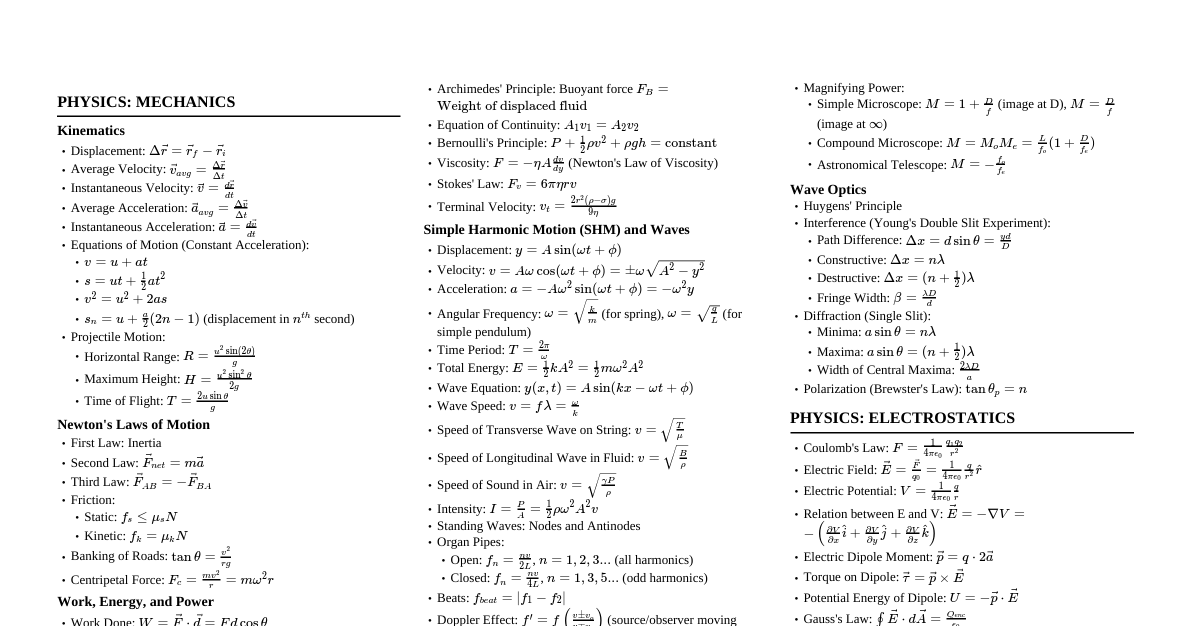
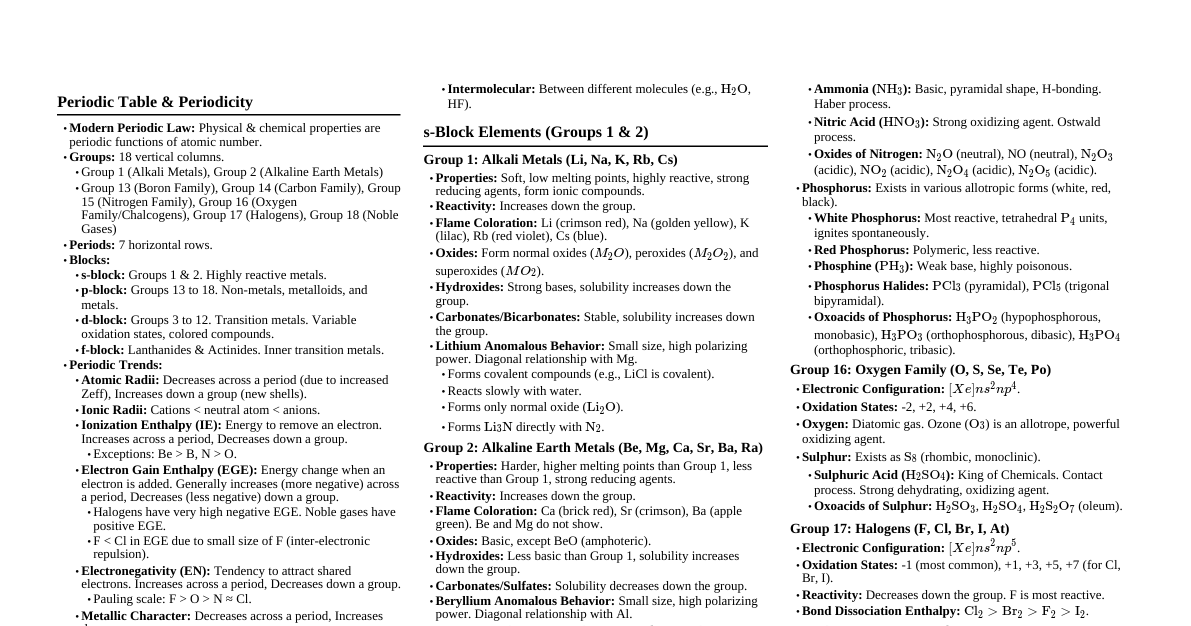
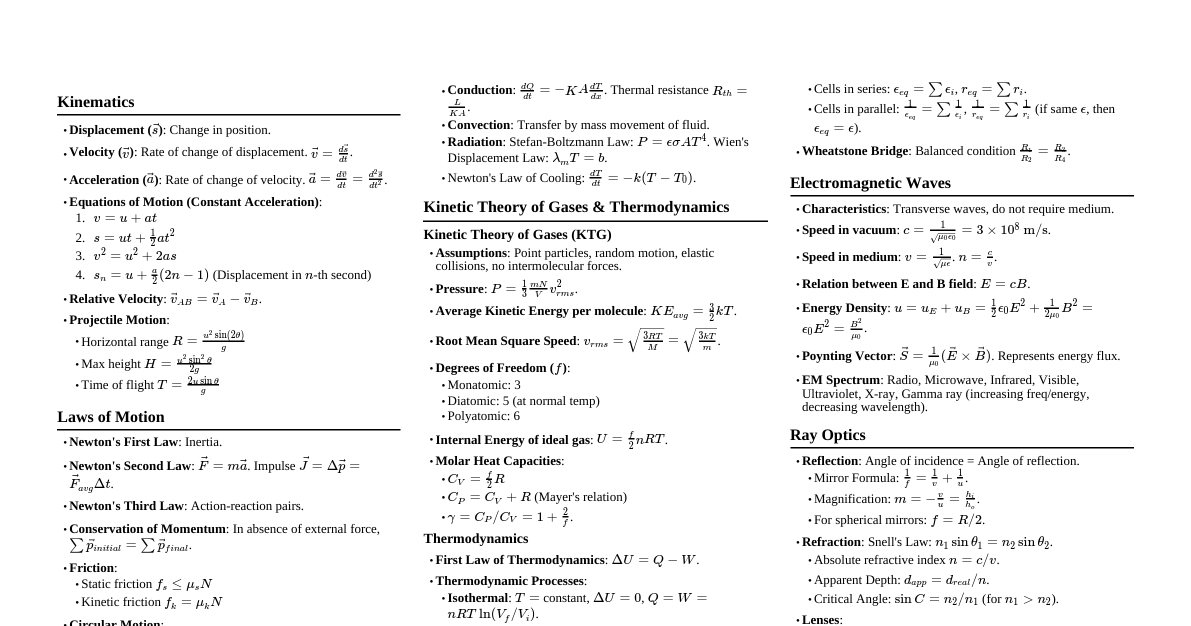
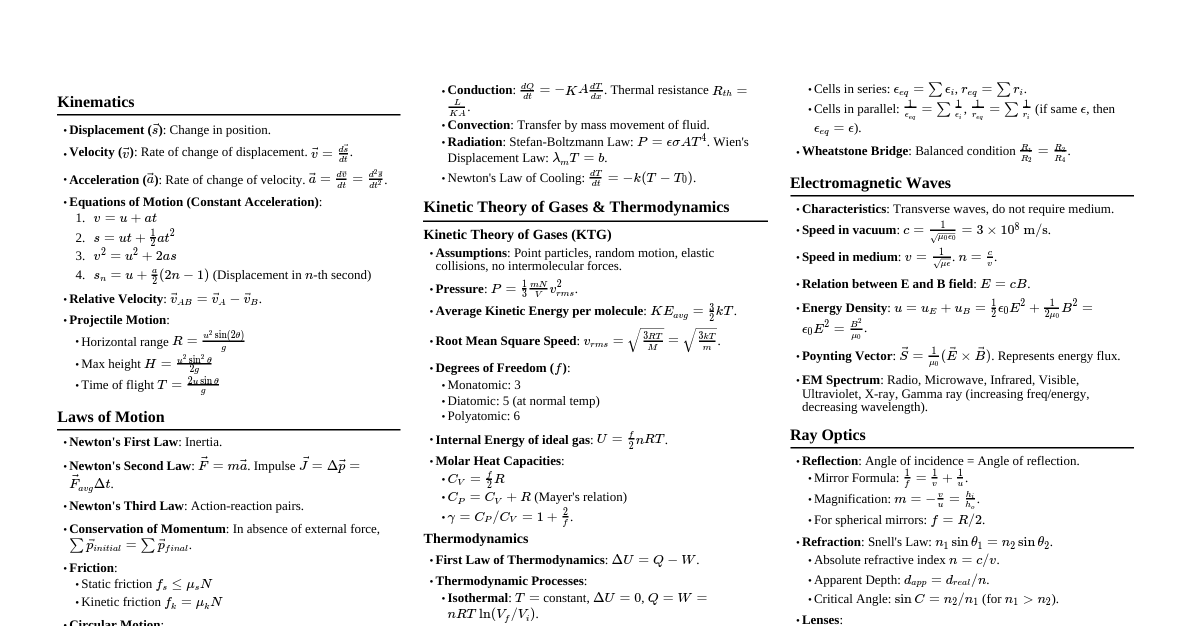
Physics: Units and Measurements System of Units: SI units (MKS system). Dimensions: $[M^a L^b T^c]$ for physical quantities. Dimensional Homogeneity: Only quantities with same dimensions can be added/subtracted. Significant Figures: Rules for counting and arithmetic operations. Errors: Absolute Error ($\Delta A = |A_{mean} - A_i|$), Relative Error ($\frac{\Delta A_{mean}}{A_{mean}}$), Percentage Error ($\frac{\Delta A_{mean}}{A_{mean}} \times 100\%$). Combination of Errors: Addition/Subtraction: $\Delta Z = \Delta A + \Delta B$ if $Z = A \pm B$. Multiplication/Division: $\frac{\Delta Z}{Z} = \frac{\Delta A}{A} + \frac{\Delta B}{B}$ if $Z = AB$ or $Z = A/B$. Power: $\frac{\Delta Z}{Z} = n \frac{\Delta A}{A}$ if $Z = A^n$. Physics: Vectors Vector Addition: Triangle law, Parallelogram law. $\vec{R} = \vec{A} + \vec{B}$, Magnitude: $|\vec{R}| = \sqrt{A^2 + B^2 + 2AB \cos\theta}$. Scalar Product (Dot Product): $\vec{A} \cdot \vec{B} = AB \cos\theta$. If $\vec{A} = A_x\hat{i} + A_y\hat{j} + A_z\hat{k}$ and $\vec{B} = B_x\hat{i} + B_y\hat{j} + B_z\hat{k}$, then $\vec{A} \cdot \vec{B} = A_x B_x + A_y B_y + A_z B_z$. Vector Product (Cross Product): $\vec{A} \times \vec{B} = AB \sin\theta \hat{n}$. Magnitude: $|\vec{A} \times \vec{B}| = AB \sin\theta$. Direction by Right-Hand Thumb Rule. $$ \vec{A} \times \vec{B} = \begin{vmatrix} \hat{i} & \hat{j} & \hat{k} \\ A_x & A_y & A_z \\ B_x & B_y & B_z \end{vmatrix} $$ Physics: Kinematics of a Particle & Motion in Two Dimensions Equations of Motion (Constant Acceleration): $v = u + at$ $s = ut + \frac{1}{2}at^2$ $v^2 = u^2 + 2as$ $s_n = u + \frac{a}{2}(2n-1)$ (distance in $n^{th}$ second) Projectile Motion: Trajectory: $y = x \tan\theta - \frac{gx^2}{2u^2 \cos^2\theta}$ Time of Flight ($T$): $T = \frac{2u \sin\theta}{g}$ Maximum Height ($H$): $H = \frac{u^2 \sin^2\theta}{2g}$ Horizontal Range ($R$): $R = \frac{u^2 \sin(2\theta)}{g}$ Relative Velocity: $\vec{v}_{AB} = \vec{v}_A - \vec{v}_B$. Physics: Dynamics of a Particle Newton's Laws of Motion: 1st Law: Law of Inertia. 2nd Law: $\vec{F} = m\vec{a}$ (Net force equals mass times acceleration). 3rd Law: To every action, there is an equal and opposite reaction. Momentum: $\vec{p} = m\vec{v}$. Impulse: $\vec{I} = \vec{F}_{avg} \Delta t = \Delta \vec{p}$. Conservation of Linear Momentum: If $\vec{F}_{ext} = 0$, then $\sum \vec{p} = \text{constant}$. Friction: Static friction ($f_s \le \mu_s N$), Kinetic friction ($f_k = \mu_k N$). $\mu_s > \mu_k$. Circular Motion: Centripetal Acceleration: $a_c = \frac{v^2}{r} = \omega^2 r$. Centripetal Force: $F_c = \frac{mv^2}{r} = m\omega^2 r$. Physics: Energy and Momentum Work: $W = \vec{F} \cdot \vec{d} = Fd \cos\theta$. For variable force: $W = \int \vec{F} \cdot d\vec{r}$. Kinetic Energy: $KE = \frac{1}{2}mv^2$. Potential Energy: Gravitational PE: $U_g = mgh$. Elastic PE: $U_s = \frac{1}{2}kx^2$. Work-Energy Theorem: $W_{net} = \Delta KE$. Conservation of Mechanical Energy: If only conservative forces act, $KE + PE = \text{constant}$. Power: $P = \frac{dW}{dt} = \vec{F} \cdot \vec{v}$. Collisions: Elastic Collision: KE and momentum conserved. Inelastic Collision: Only momentum conserved. KE is not conserved. Coefficient of Restitution ($e$): $e = \frac{\text{relative velocity after collision}}{\text{relative velocity before collision}}$. For elastic collisions, $e=1$. For perfectly inelastic collisions, $e=0$. Chemistry: Stoichiometry Mole Concept: 1 mole = $6.022 \times 10^{23}$ particles (Avogadro's number). Molar Mass: Mass of one mole of a substance. Limiting Reagent: Reactant fully consumed, determines amount of product formed. Percentage Yield: $\frac{\text{Actual Yield}}{\text{Theoretical Yield}} \times 100\%$. Concentration Terms: Molarity ($M$): Moles of solute per liter of solution. Molality ($m$): Moles of solute per kg of solvent. Mole Fraction ($x$): Moles of component / Total moles. Mass Percentage: (Mass of component / Total mass of solution) $\times 100\%$. Chemistry: Atomic Structure Bohr's Model: Electron orbits in stationary states. Energy of $n^{th}$ orbit: $E_n = -13.6 \frac{Z^2}{n^2}$ eV. Radius of $n^{th}$ orbit: $r_n = 0.529 \frac{n^2}{Z}$ Å. Velocity of $n^{th}$ orbit: $v_n = 2.18 \times 10^6 \frac{Z}{n}$ m/s. Quantum Numbers: Principal ($n$): Energy level, size. ($1, 2, 3, ...$) Azimuthal ($l$): Subshell, shape. ($0, 1, ..., n-1$) Magnetic ($m_l$): Orientation. ($-l, ..., 0, ..., +l$) Spin ($m_s$): Electron spin. ($+\frac{1}{2}, -\frac{1}{2}$) Aufbau Principle, Pauli Exclusion Principle, Hund's Rule. Heisenberg's Uncertainty Principle: $\Delta x \cdot \Delta p \ge \frac{h}{4\pi}$. De Broglie Wavelength: $\lambda = \frac{h}{mv}$. Chemistry: Periodicity Periodic Trends: Atomic/Ionic Radius: Decreases across period, increases down group. Ionization Enthalpy: Increases across period, decreases down group. Electron Gain Enthalpy: Generally increases across period (more negative), decreases down group. Electronegativity: Increases across period, decreases down group. Shielding Effect and Effective Nuclear Charge ($Z_{eff}$). Metallic and Non-metallic Character. Chemistry: Chemical Bonding Ionic Bond: Transfer of electrons, electrostatic attraction. Lattice Energy. Covalent Bond: Sharing of electrons. Lewis Structures. VSEPR Theory: Predicts molecular geometry (e.g., linear, trigonal planar, tetrahedral). Hybridization: $sp, sp^2, sp^3, sp^3d, sp^3d^2$. Molecular Orbital Theory (MOT): Bonding and anti-bonding orbitals, bond order, magnetic properties. Hydrogen Bonding: Strong dipole-dipole interaction involving H and highly electronegative atom (N, O, F). Metallic Bonding. Dipole Moment: $\mu = q \times d$. Chemistry: Thermochemistry and Thermodynamics First Law of Thermodynamics: $\Delta U = Q + W$. $Q$: Heat absorbed by system (+ve), $W$: Work done on system (+ve). Work done by gas: $W = -P\Delta V$. Enthalpy ($H$): $H = U + PV$. $\Delta H = Q_p$ (at constant pressure). Heat Capacity: $C = \frac{Q}{\Delta T}$. Molar heat capacities $C_p$ and $C_v$. $C_p - C_v = R$. Bond Enthalpy: Energy required to break one mole of a bond. Hess's Law: Enthalpy change of a reaction is independent of path. Second Law of Thermodynamics: Entropy of universe increases for spontaneous processes. $\Delta S_{univ} = \Delta S_{sys} + \Delta S_{surr} > 0$. Gibbs Free Energy ($G$): $G = H - TS$. $\Delta G = \Delta H - T\Delta S$. Spontaneity: $\Delta G 0$ (non-spontaneous), $\Delta G = 0$ (equilibrium). Relationship with Equilibrium Constant: $\Delta G^\circ = -RT \ln K$. Mathematics: Sets, Relations, Functions Sets: Union ($\cup$), Intersection ($\cap$), Complement ($A'$), Difference ($A-B$). De Morgan's Laws: $(A \cup B)' = A' \cap B'$, $(A \cap B)' = A' \cup B'$. Number of elements: $n(A \cup B) = n(A) + n(B) - n(A \cap B)$. Relations: Reflexive, Symmetric, Transitive, Equivalence Relation. Functions: Domain, Codomain, Range. One-one (injective), Onto (surjective), Bijective. Composition of functions: $(f \circ g)(x) = f(g(x))$. Inverse function: $f^{-1}(x)$. Mathematics: Quadratic Equations Standard Form: $ax^2 + bx + c = 0$, where $a \ne 0$. Roots: $x = \frac{-b \pm \sqrt{b^2 - 4ac}}{2a}$. Discriminant ($\Delta$): $\Delta = b^2 - 4ac$. $\Delta > 0$: Two distinct real roots. $\Delta = 0$: Two equal real roots. $\Delta Sum of Roots: $\alpha + \beta = -\frac{b}{a}$. Product of Roots: $\alpha \beta = \frac{c}{a}$. Formation of Quadratic Equation: $x^2 - (\alpha + \beta)x + \alpha\beta = 0$. Mathematics: Trigonometric Functions Basic Identities: $\sin^2\theta + \cos^2\theta = 1$. $\sec^2\theta - \tan^2\theta = 1$. $\csc^2\theta - \cot^2\theta = 1$. Compound Angles: $\sin(A \pm B) = \sin A \cos B \pm \cos A \sin B$. $\cos(A \pm B) = \cos A \cos B \mp \sin A \sin B$. $\tan(A \pm B) = \frac{\tan A \pm \tan B}{1 \mp \tan A \tan B}$. Double Angle Formulae: $\sin 2A = 2 \sin A \cos A = \frac{2 \tan A}{1+\tan^2 A}$. $\cos 2A = \cos^2 A - \sin^2 A = 2\cos^2 A - 1 = 1 - 2\sin^2 A = \frac{1-\tan^2 A}{1+\tan^2 A}$. $\tan 2A = \frac{2 \tan A}{1-\tan^2 A}$. General Solutions: $\sin x = \sin y \implies x = n\pi + (-1)^n y$. $\cos x = \cos y \implies x = 2n\pi \pm y$. $\tan x = \tan y \implies x = n\pi + y$. Mathematics: Sequence and Series Arithmetic Progression (AP): $a, a+d, a+2d, ...$ $n^{th}$ term: $a_n = a + (n-1)d$. Sum of $n$ terms: $S_n = \frac{n}{2}(2a + (n-1)d) = \frac{n}{2}(a + a_n)$. Geometric Progression (GP): $a, ar, ar^2, ...$ $n^{th}$ term: $a_n = ar^{n-1}$. Sum of $n$ terms: $S_n = \frac{a(r^n - 1)}{r-1}$ (for $r \ne 1$). Sum to infinity: $S_\infty = \frac{a}{1-r}$ (for $|r| Harmonic Progression (HP): Reciprocals are in AP. Arithmetic-Geometric Progression (AGP). Special Series: $\sum n = \frac{n(n+1)}{2}$. $\sum n^2 = \frac{n(n+1)(2n+1)}{6}$. $\sum n^3 = \left(\frac{n(n+1)}{2}\right)^2$. Mathematics: Complex Numbers Form: $z = x + iy$, where $i = \sqrt{-1}$. Conjugate: $\bar{z} = x - iy$. Modulus: $|z| = \sqrt{x^2 + y^2}$. Argument (Amplitude): $\arg(z) = \theta$, where $\tan\theta = \frac{y}{x}$. Polar Form: $z = r(\cos\theta + i\sin\theta) = re^{i\theta}$. De Moivre's Theorem: $(\cos\theta + i\sin\theta)^n = \cos n\theta + i\sin n\theta$. Cube Roots of Unity: $1, \omega, \omega^2$. $1 + \omega + \omega^2 = 0$, $\omega^3 = 1$. Mathematics: Permutation and Combination Factorial: $n! = n \times (n-1) \times ... \times 1$. $0! = 1$. Permutations: Arrangement of objects. $P(n, r) = {}^n P_r = \frac{n!}{(n-r)!}$. Permutations with repetition: $\frac{n!}{p!q!r!...}$. Combinations: Selection of objects. $C(n, r) = {}^n C_r = \frac{n!}{r!(n-r)!}$. Properties: ${}^n C_r = {}^n C_{n-r}$, ${}^n C_r + {}^n C_{r-1} = {}^{n+1} C_r$. Mathematics: Binomial Theorem Expansion: $(a+b)^n = \sum_{r=0}^{n} {}^n C_r a^{n-r} b^r$. General Term: $T_{r+1} = {}^n C_r a^{n-r} b^r$. Middle Term: If $n$ is even, $(n/2 + 1)^{th}$ term. If $n$ is odd, $(\frac{n+1}{2})^{th}$ and $(\frac{n+3}{2})^{th}$ terms. Binomial Coefficients Properties: $\sum_{r=0}^{n} {}^n C_r = 2^n$. $\sum_{r=0}^{n} (-1)^r {}^n C_r = 0$. Binomial Theorem for any Index: $(1+x)^n = 1 + nx + \frac{n(n-1)}{2!}x^2 + ...$ (for $|x|