Work, Energy and Power Essentials
Cheatsheet Content
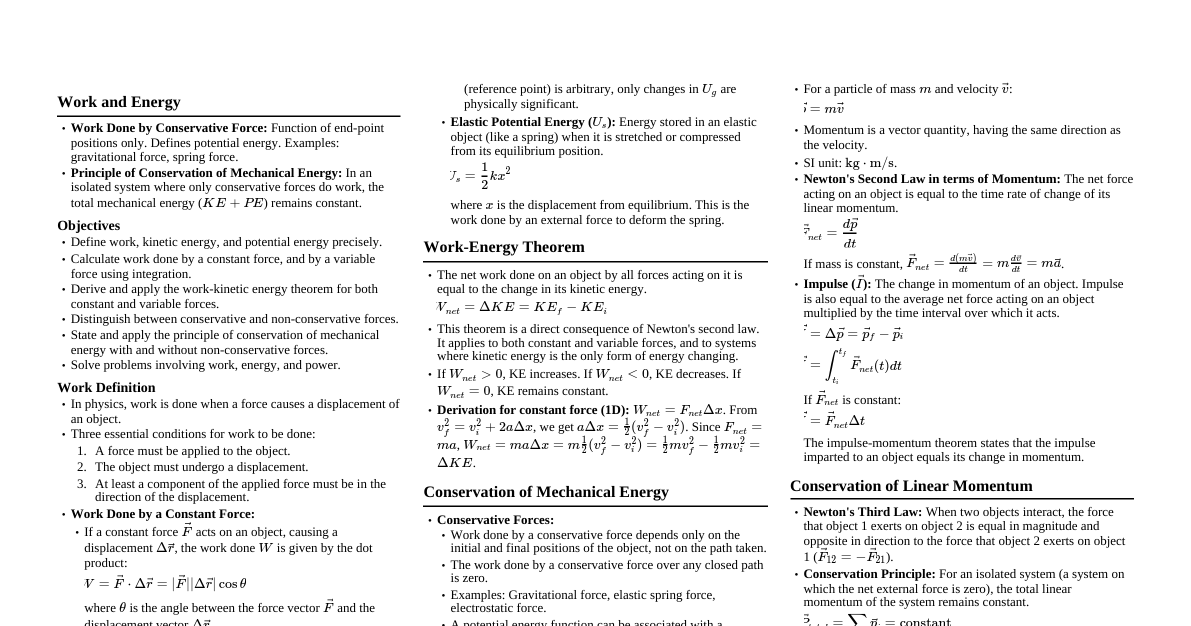
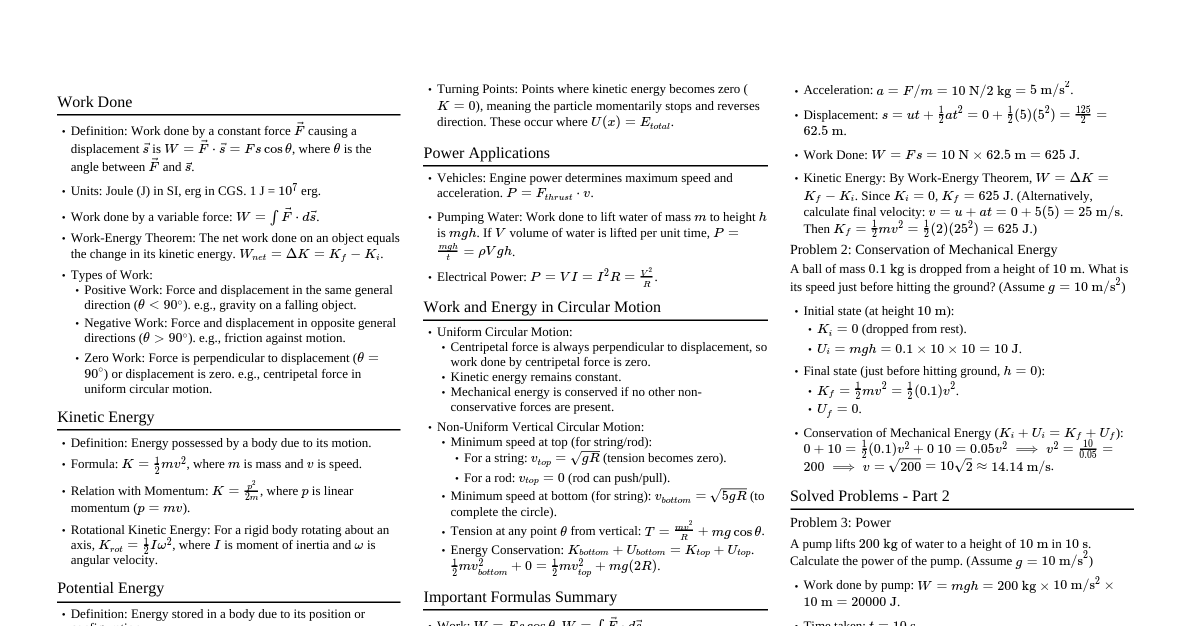
1. Vector Products Scalar Product (Dot Product): Definition: $\vec{A} \cdot \vec{B} = |\vec{A}| |\vec{B}| \cos\theta = AB \cos\theta$ Cartesian Coordinates: If $\vec{A} = A_x \hat{i} + A_y \hat{j} + A_z \hat{k}$ and $\vec{B} = B_x \hat{i} + B_y \hat{j} + B_z \hat{k}$, then $\vec{A} \cdot \vec{B} = A_x B_x + A_y B_y + A_z B_z$. Unit Vectors: $\hat{i} \cdot \hat{i} = \hat{j} \cdot \hat{j} = \hat{k} \cdot \hat{k} = 1$, and $\hat{i} \cdot \hat{j} = \hat{j} \cdot \hat{k} = \hat{k} \cdot \hat{i} = 0$. Angle between Vectors: $\cos\theta = \frac{\vec{A} \cdot \vec{B}}{|\vec{A}| |\vec{B}|}$ Projection of $\vec{A}$ on $\vec{B}$: $A \cos\theta = \frac{\vec{A} \cdot \vec{B}}{|\vec{B}|}$ Vector Product (Cross Product): Definition: $\vec{A} \times \vec{B} = |\vec{A}| |\vec{B}| \sin\theta \hat{n} = AB \sin\theta \hat{n}$ Magnitude: $|\vec{A} \times \vec{B}| = AB \sin\theta$ Direction: $\hat{n}$ is a unit vector perpendicular to the plane formed by $\vec{A}$ and $\vec{B}$, given by the right-hand rule. Properties: $\vec{A} \times \vec{B} = -\vec{B} \times \vec{A}$ (not commutative). Distributive law: $\vec{A} \times (\vec{B} + \vec{C}) = \vec{A} \times \vec{B} + \vec{A} \times \vec{C}$. Unit Vectors: $\hat{i} \times \hat{i} = \hat{j} \times \hat{j} = \hat{k} \times \hat{k} = 0$. $\hat{i} \times \hat{j} = \hat{k}$, $\hat{j} \times \hat{k} = \hat{i}$, $\hat{k} \times \hat{i} = \hat{j}$. $\hat{j} \times \hat{i} = -\hat{k}$, $\hat{k} \times \hat{j} = -\hat{i}$, $\hat{i} \times \hat{k} = -\hat{j}$. Cartesian Coordinates: $$ \vec{A} \times \vec{B} = \begin{vmatrix} \hat{i} & \hat{j} & \hat{k} \\ A_x & A_y & A_z \\ B_x & B_y & B_z \end{vmatrix} $$ Geometric interpretation: $|\vec{A} \times \vec{B}|$ is the area of the parallelogram formed by $\vec{A}$ and $\vec{B}$. 2. Work Done Definition: Work is done when a force causes displacement. Constant Force: $W = \vec{F} \cdot \vec{d} = Fd \cos\theta$ $\theta = 0^\circ \implies W = Fd$ (maximum positive work) $\theta = 90^\circ \implies W = 0$ (e.g., centripetal force) $\theta = 180^\circ \implies W = -Fd$ (maximum negative work) For $0 \le \theta For $90^\circ Units and Dimensions: SI Unit: Joule (J), $1 \, \text{J} = 1 \, \text{Nm}$ Dimensional Formula: $[M^1 L^2 T^{-2}]$ Other Units: erg ($10^{-7}$ J), electron volt (eV, $1.6 \times 10^{-19}$ J), calorie (cal, $4.186$ J), kilowatt-hour (kWh, $3.6 \times 10^6$ J). Variable Force: $W = \int_A^B \vec{F} \cdot d\vec{l}$ For 1D motion along x-axis: $W = \int_{x_1}^{x_2} F(x) dx$. Graphically, work done by a variable force is the area under the Force-displacement ($F-x$) curve. 3. Energy Kinetic Energy (K): Energy due to motion. Definition: $K = \frac{1}{2}mv^2$ Relation with Momentum (p): $K = \frac{p^2}{2m}$ Work-Energy Theorem: The net work done on an object equals the change in its kinetic energy. $W_{net} = \Delta K = K_f - K_i$. This applies to both constant and variable forces. Potential Energy (U): Energy due to position or configuration. Gravitational Potential Energy: $U_g = mgh$ (relative to a reference level). Elastic Potential Energy (Spring): $U_e = \frac{1}{2}kx^2$, where $k$ is the spring constant and $x$ is displacement from equilibrium. Relationship between Force and Potential Energy: For conservative forces, $F_x = -\frac{dU}{dx}$. In 3D, $\vec{F} = -\nabla U$. Conservative and Non-Conservative Forces: Conservative Forces: Work done is path-independent and depends only on initial and final positions. Work done in a closed loop is zero. Potential energy can be defined for these forces (e.g., gravity, spring force, electrostatic force). Non-Conservative Forces: Work done is path-dependent. Work done in a closed loop is generally non-zero. Mechanical energy is not conserved (e.g., friction, air resistance). Conservation of Mechanical Energy: If only conservative forces do work, total mechanical energy ($E = K + U$) is conserved. $K_i + U_i = K_f + U_f$. If non-conservative forces are present, $W_{nc} = \Delta E = (K_f + U_f) - (K_i + U_i)$. 4. Power (P) Definition: The rate at which work is done or energy is transferred. Average Power: $P_{avg} = \frac{\Delta W}{\Delta t}$ Instantaneous Power: $P = \frac{dW}{dt} = \vec{F} \cdot \vec{v}$ Units and Dimensions: SI Unit: Watt (W), $1 \, \text{W} = 1 \, \text{J/s}$ Dimensional Formula: $[M^1 L^2 T^{-3}]$ Other Units: horsepower (hp), $1 \, \text{hp} \approx 746 \, \text{W}$. 5. Collisions General Principles: Total linear momentum is always conserved in any collision (if no net external force). Total energy is always conserved (including heat, sound, deformation). Elastic Collisions: Kinetic energy is conserved ($K_i = K_f$). Coefficient of restitution ($e=1$). Relative speed of approach equals relative speed of separation. In 1D, if $m_1 = m_2$, particles exchange velocities. Inelastic Collisions: Kinetic energy is NOT conserved ($K_i \ne K_f$). Some kinetic energy is converted to other forms (heat, sound, deformation). Coefficient of restitution ($0 \le e Completely Inelastic Collision: Particles stick together after collision. Maximum loss of kinetic energy. Coefficient of restitution ($e=0$). One-Dimensional Elastic Collision: Momentum Conservation: $m_1 v_{1i} + m_2 v_{2i} = m_1 v_{1f} + m_2 v_{2f}$ Kinetic Energy Conservation: $\frac{1}{2} m_1 v_{1i}^2 + \frac{1}{2} m_2 v_{2i}^2 = \frac{1}{2} m_1 v_{1f}^2 + \frac{1}{2} m_2 v_{2f}^2$ Simplified relation: $v_{1i} - v_{2i} = -(v_{1f} - v_{2f})$ Final velocities: $$ v_{1f} = \left(\frac{m_1-m_2}{m_1+m_2}\right) v_{1i} + \left(\frac{2m_2}{m_1+m_2}\right) v_{2i} $$ $$ v_{2f} = \left(\frac{2m_1}{m_1+m_2}\right) v_{1i} + \left(\frac{m_2-m_1}{m_1+m_2}\right) v_{2i} $$ Two-Dimensional Elastic Collision: Momentum conservation applied separately for x and y components. $m_1 \vec{v}_{1i} + m_2 \vec{v}_{2i} = m_1 \vec{v}_{1f} + m_2 \vec{v}_{2f}$ Kinetic energy conservation: $\frac{1}{2} m_1 v_{1i}^2 + \frac{1}{2} m_2 v_{2i}^2 = \frac{1}{2} m_1 v_{1f}^2 + \frac{1}{2} m_2 v_{2f}^2$ Often involves solving a system of equations with angles. Special case: If two equal masses collide elastically, with one initially at rest, they move off at $90^\circ$ to each other after the collision. 6. Important Concepts & Formulas Work done by gravity on a falling chain: If a chain of length $L$ and mass $M$ has a length $y$ hanging over the edge of a table, the work done to pull it onto the table is $W = \frac{1}{2} \frac{M}{L} y^2$. Kinetic energy transfer in collisions: In a head-on elastic collision, the fractional kinetic energy transferred depends on the mass ratio. For a neutron ($m_1$) colliding with a nucleus ($m_2$) at rest, the fractional energy lost by the neutron is $f_1 = \frac{4 m_1 m_2}{(m_1+m_2)^2}$. Power-Time-Velocity relation for constant power: If power $P$ is constant, $W = Pt$. Since $W = \Delta K = \frac{1}{2}mv^2$, then $v \propto t^{1/2}$. Since $v = \frac{dx}{dt}$, then $x \propto t^{3/2}$.