Power Electronics Essentials (BUET EEE)
Cheatsheet Content
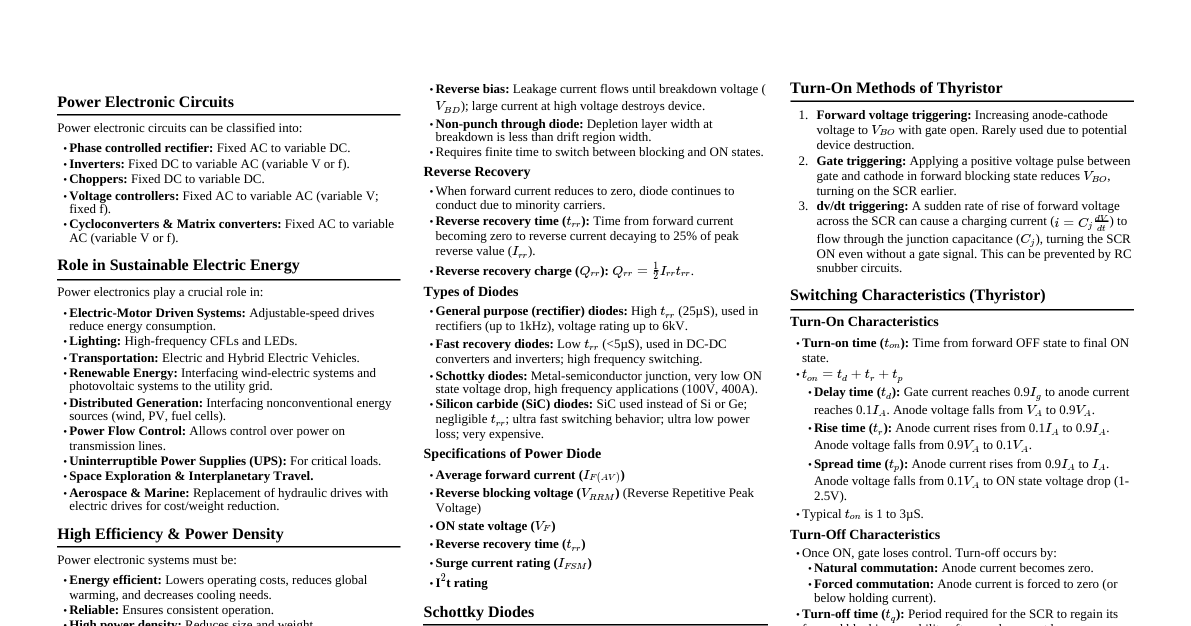
1. Introduction to Power Electronics Definition: Application of solid-state electronics to control and convert electric power efficiently. Scope: Power conversion (AC-DC, DC-DC, DC-AC, AC-AC), control, and conditioning. Applications: Motor drives, power supplies, renewable energy, HVDC, FACTS. Comparison with Linear Regulators: Power Electronics: Achieves high efficiency (up to 98%) due to devices operating as switches (low conduction losses, low switching losses at ideal). Linear Regulators: Low efficiency (e.g., 30-60%) as devices operate in active region, dissipating power. 2. Power Semiconductor Devices Power Diodes PN Diode: Basic rectifier. $V_F \approx 0.7-1.2V$. Reverse Recovery Time ($t_{rr}$): Time for current to go from forward to reverse blocking. Fast Recovery Diode: Reduced $t_{rr}$ for high-frequency applications. Schottky Diode: Metal-semiconductor junction. Very low $V_F$ (e.g., $0.3-0.5V$), very fast switching ($t_{rr} \approx 0$), low reverse voltage blocking. Thyristors (SCR - Silicon Controlled Rectifier) Structure: 4-layer p-n-p-n device with Anode (A), Cathode (K), Gate (G). Operation: Blocks in forward/reverse. Turns ON when anode is positive w.r.t. cathode AND gate pulse is applied. Stays ON until anode current ($I_A$) drops below Holding Current ($I_H$). V-I Characteristics: Forward Blocking: $I_A \approx 0$ until $V_{AK} > V_{BO}$ (Breakover Voltage). Forward Conduction: Low $V_{AK}$ (e.g., $1-2V$), high $I_A$. Reverse Blocking: $I_A \approx 0$ until $V_{AK} Gate Triggering: Applying a short positive pulse to Gate-Cathode when $V_{AK} > 0$. Protection: $dv/dt$ Protection: Snubber circuit (RC in parallel with SCR) limits rate of voltage rise to prevent false turn-on. $C \frac{dv}{dt} = I$. $di/dt$ Protection: Series inductor limits rate of current rise to prevent localized heating. $L \frac{di}{dt} = V$. Power Transistors Power BJT: Current-controlled. Requires continuous base current. Slower switching. Power MOSFET: Voltage-controlled (gate-source voltage). Very fast switching. Low ON-state resistance ($R_{DS(on)}$) for low conduction losses. $P_{cond} = I_D^2 R_{DS(on)}$. IGBT: Voltage-controlled. Combines MOSFET gate with BJT output characteristics. High voltage/current capability, medium switching speed. $V_{CE(sat)}$ is important. Switching Characteristics: Turn-on ($t_{on}$): Delay time ($t_d$) + Rise time ($t_r$). Turn-off ($t_{off}$): Storage time ($t_s$) + Fall time ($t_f$). Losses: Conduction Losses ($P_C$): Due to ON-state voltage drop/resistance. $P_C = V_{CE(sat)} I_C$ (BJT/IGBT) or $I_D^2 R_{DS(on)}$ (MOSFET). Switching Losses ($P_{SW}$): Occur during turn-on/off transitions. $P_{SW} = f_{SW} \int_{0}^{T_{SW}} v(t)i(t)dt$. Increase with switching frequency ($f_{SW}$). Blocking Losses: Due to leakage current during OFF-state, usually negligible. Thermal Management: Junction temperature ($T_j$) must be kept below maximum. $P_D = \frac{T_j - T_A}{R_{\theta JA}} = \frac{T_j - T_C}{R_{\theta JC}}$ (where $P_D$ is total power dissipated). $R_{\theta JA} = R_{\theta JC} + R_{\theta CS} + R_{\theta SA}$ (Junction-to-Ambient thermal resistance). 3. Thyristor Commutation Natural (Line) Commutation: Occurs in AC circuits when AC supply voltage reverses, forcing anode current below $I_H$. No external components needed. Forced Commutation: Required for DC circuits or when natural commutation is not possible. External circuit forces anode current to zero. Class A (Load Commutation): Resonant LC circuit in series with SCR/load. SCR -- L -- C -- Load Class B (Resonant-Pulse Commutation): Resonant LC circuit in parallel with SCR. SCR -- Load | | L C Class C (Complementary Commutation): Two SCRs in series, turning one ON commutates the other. Class D (Auxiliary Commutation): Auxiliary SCR and LC circuit used to commutate main SCR. Class E (External Pulse Commutation): External pulse source to reverse-bias SCR. 4. Phase-Controlled Rectifiers Convert AC to variable DC by controlling firing angle ($\alpha$). Single-Phase Half-wave Controlled Rectifier (R-Load): Average Output Voltage: $V_{dc} = \frac{V_m}{2\pi}(1 + \cos\alpha)$ RMS Output Voltage: $V_{o,rms} = \frac{V_m}{2}\sqrt{1 - \frac{\alpha}{\pi} + \frac{\sin(2\alpha)}{2\pi}}$ Full-wave Bridge Controlled Rectifier (R-Load): Average Output Voltage: $V_{dc} = \frac{2V_m}{\pi}\cos\alpha$ RMS Output Voltage: $V_{o,rms} = \frac{V_m}{\sqrt{2}}\sqrt{1 - \frac{\alpha}{\pi} + \frac{\sin(2\alpha)}{2\pi}}$ Full-wave Bridge Controlled Rectifier (RL-Load, Continuous Conduction): Assumes large inductance. Average Output Voltage: $V_{dc} = \frac{2V_m}{\pi}\cos\alpha$ (same as R-load) Output current is smoother. Current may flow even when instantaneous source voltage is negative. Three-Phase (Continuous Conduction, assuming large inductance) Three-Phase Half-wave Converter (R-Load): (Not common due to DC current in AC source) Average Output Voltage: $V_{dc} = \frac{3V_{mL}}{2\pi}(1 + \cos\alpha)$ $V_{mL}$ is peak line-to-neutral voltage. Three-Phase Full Converter (Bridge, R/RL-Load): Average Output Voltage: $V_{dc} = \frac{3V_{mLL}}{\pi}\cos\alpha$ (where $V_{mLL}$ is peak line-to-line voltage) Can operate as an inverter for $\alpha > 90^\circ$ (requires DC source and grid connection). Firing Angle ($\alpha$): Delay from natural commutation point. $0 \le \alpha \le \pi$. Load Types: R, RL, RLE (e.g., DC motor with back EMF $E_b$). Performance Parameters: Ripple Factor (RF): Measures AC content in DC output. $RF = \frac{V_{o,ac}}{V_{o,dc}} = \frac{\sqrt{V_{o,rms}^2 - V_{o,dc}^2}}{V_{o,dc}}$. Efficiency ($\eta$): $\eta = \frac{P_{out,dc}}{P_{in,ac}}$. Input Power Factor (PF): $PF = \frac{P_{in,ac}}{V_{s,rms} I_{s,rms}} = \frac{\text{Displacement Factor} \times \text{Distortion Factor}}{1}$. Displacement Factor (DPF) $= \cos\phi_1$ ($\phi_1$ is phase angle of fundamental current). Distortion Factor (DF) $= \frac{I_{s1,rms}}{I_{s,rms}}$ ($I_{s1,rms}$ is fundamental component of source current). PF decreases significantly with increasing $\alpha$. 5. AC Voltage Controllers Convert fixed AC to variable AC (same frequency) using phase control. Single-phase AC Voltage Controller: Typically two anti-parallel SCRs or a TRIAC. Phase Control Technique: Controls RMS output voltage by varying conduction angle. RMS Output Voltage (R-Load): $V_{o,rms} = V_{in,rms} \sqrt{1 - \frac{\alpha}{\pi} + \frac{\sin(2\alpha)}{2\pi}}$ Input Power Factor: Typically poor due to high harmonic content. Integral Cycle Control: Switches AC source ON/OFF for integer number of cycles. Less harmonic distortion than phase control for slow varying loads, but slower response. Harmonics: Output voltage and current are non-sinusoidal, rich in odd harmonics. Total Harmonic Distortion (THD) is a key concern. 6. DC–DC Converters (Choppers) Convert fixed DC to variable DC voltage (or current). Assumptions: Ideal components, continuous conduction mode (CCM). Step-down (Buck) Chopper: Output voltage lower than input. $V_o = D V_{in}$ (where $D = t_{on}/T$ is duty cycle) Average Inductor Current: $I_L = I_o$. Inductor Current Ripple: $\Delta I_L = \frac{V_{in}D(1-D)}{f_s L}$ Output Voltage Ripple: $\Delta V_o = \frac{V_{in}D(1-D)}{8 f_s^2 L C}$ Step-up (Boost) Chopper: Output voltage higher than input. $V_o = \frac{1}{1-D} V_{in}$ Inductor Current Ripple: $\Delta I_L = \frac{V_{in}D}{f_s L}$ Buck–Boost Chopper: Output voltage can be higher or lower, and is inverted. $V_o = -\frac{D}{1-D} V_{in}$ Inductor Current Ripple: $\Delta I_L = \frac{V_{in}D}{f_s L}$ Continuous vs. Discontinuous Conduction: CCM: Inductor current never drops to zero. Simpler analysis, lower ripple. DCM: Inductor current drops to zero. Occurs at light loads or low inductance. Output voltage equations change. PWM Control: Varying the duty cycle ($D$) of the switch to control the output voltage. 7. Inverters Convert DC power to AC power (variable voltage/frequency). Single-Phase Inverters Half-bridge: Two switches, two capacitors. Output voltage $\pm V_{dc}/2$. Full-bridge: Four switches. Output voltage $\pm V_{dc}$. Square Wave Output (Full-bridge): $V_{o,rms} = V_{dc}$. THD is high (48.4%). Harmonic content: $V_n = \frac{4V_{dc}}{n\pi}$ for odd $n$. Three-Phase Inverters Voltage Source Inverter (VSI): Most common. DC link is a voltage source (capacitor). Six-step mode: Each switch conducts for $120^\circ$. Output voltage is quasi-square wave. Current Source Inverter (CSI): DC link is a current source (inductor). PWM Techniques Sinusoidal PWM (SPWM): Comparing a sinusoidal reference ($V_{ref}$) with a high-frequency triangular carrier ($V_{carrier}$). Amplitude Modulation Ratio ($M_a$): $M_a = V_{ref,peak} / V_{carrier,peak}$. Controls fundamental output voltage. Frequency Modulation Ratio ($M_f$): $M_f = f_{carrier} / f_{ref}$. Higher $M_f$ reduces lower-order harmonics. Fundamental RMS Output Voltage: $V_{o1,rms} = M_a \frac{V_{dc}}{2\sqrt{2}}$ (for single-phase full-bridge). Harmonic Analysis: Inverter output is typically non-sinusoidal. Filters (LC) are used to extract fundamental component. Total Harmonic Distortion (THD): $THD = \frac{\sqrt{\sum_{n=2}^{\infty} V_n^2}}{V_1}$. Lower THD is desirable. 8. Protection and Auxiliary Circuits Snubber Circuits: Limit $dv/dt$ and $di/dt$ to protect switches and reduce switching losses. RC Snubber (for $dv/dt$): $C_s$ limits $dv/dt$. $R_s$ limits discharge current. RL Snubber (for $di/dt$): $L_s$ in series to limit $di/dt$. Over-voltage Protection: Varistors (MOV), Zener diodes, clamp circuits to absorb voltage spikes. Over-current Protection: Fuses, circuit breakers, current limiting, gate drive shutdown. Gate Drive Isolation: Optocouplers or pulse transformers provide galvanic isolation between low-power control and high-power switching circuits. Thermal Management: Heat sinks, fans, liquid cooling to dissipate heat. Maximizing heat transfer: proper contact, thermal paste. 9. Power Electronics Applications DC Motor Speed Control: Choppers (for armature voltage control) or controlled rectifiers. AC Motor Drive Basics: Variable Frequency Drives (VFDs) use inverters to control both frequency and voltage (V/f control) of induction/synchronous motors. Industrial Power Supplies: Switched-Mode Power Supplies (SMPS) for high efficiency, compact size. Renewable Energy Interfacing: Solar PV: DC-DC converters for Maximum Power Point Tracking (MPPT), inverters for grid connection. Wind Turbines: Rectifiers and inverters for variable speed operation and grid integration.