Work & Heat Transfer Essentials
Cheatsheet Content
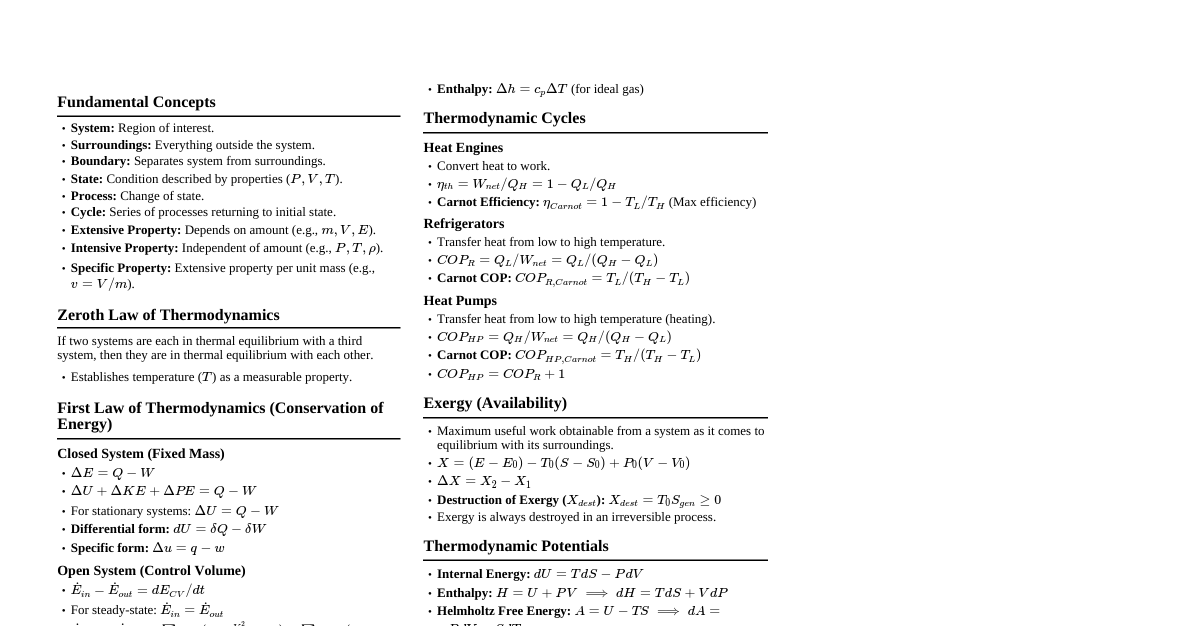
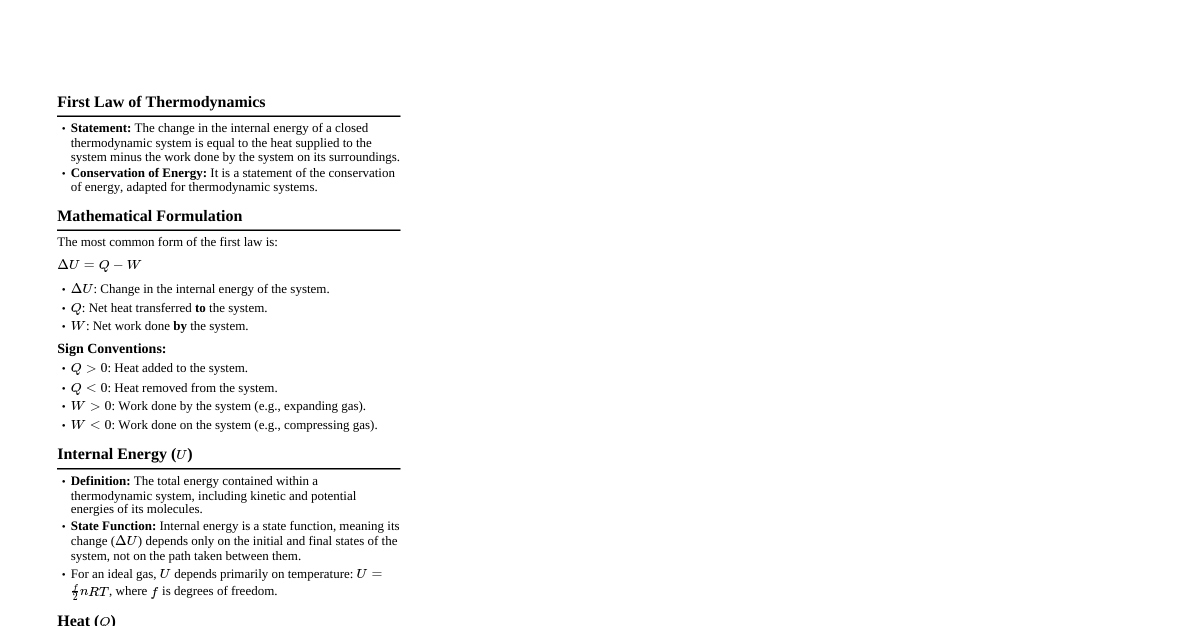
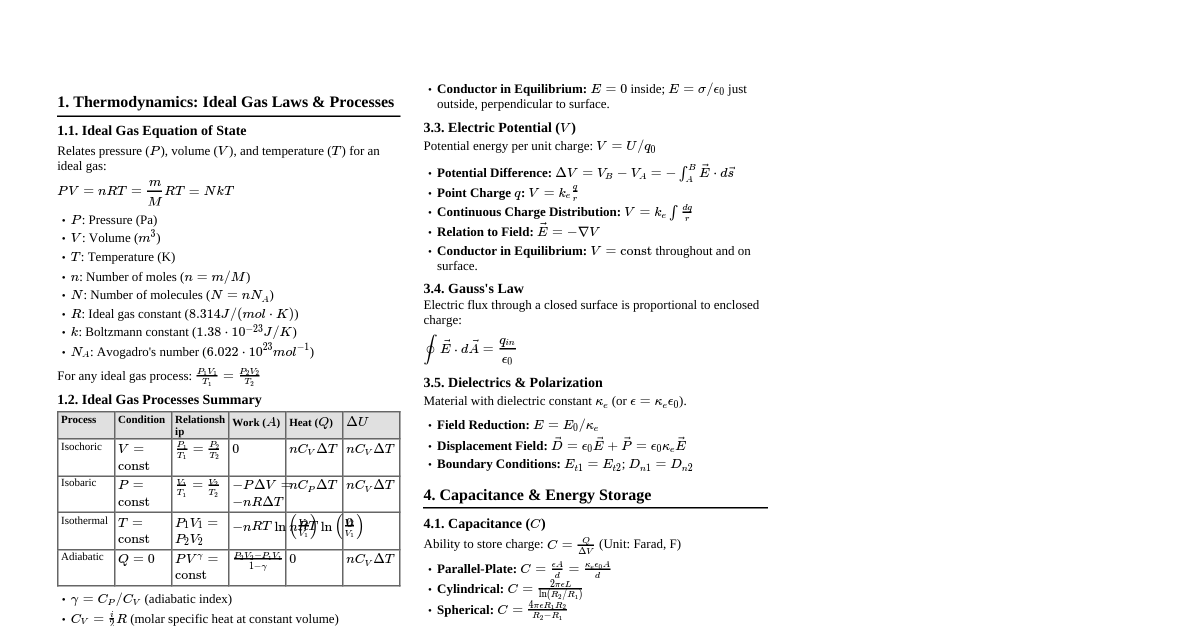
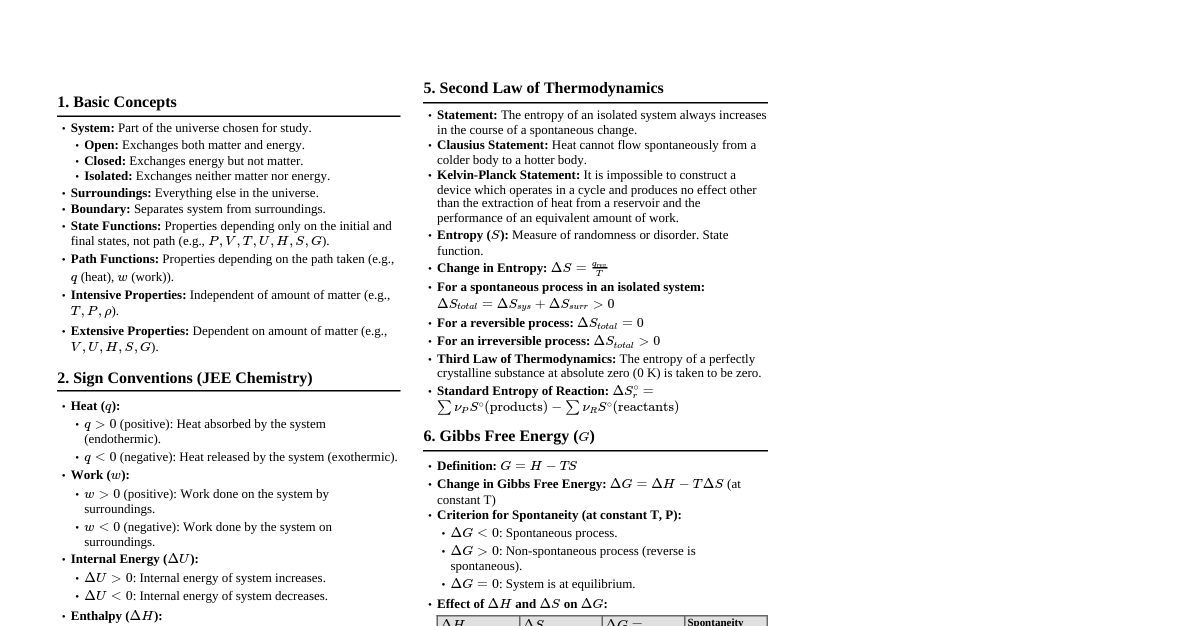
1. First Law of Thermodynamics Energy Conservation: $\Delta U = Q - W$ $\Delta U$: Change in internal energy of the system $Q$: Heat added to the system $W$: Work done *by* the system Differential Form: $dU = \delta Q - \delta W$ For a Cycle: $\oint dU = 0 \implies Q_{net} = W_{net}$ 2. Work ($W$) Definition: Energy transfer associated with a force acting through a distance. Boundary Work (P-V Work): For a quasi-equilibrium process: $W_b = \int_{V_1}^{V_2} P \, dV$ Units: Joules (J) or kiloJoules (kJ) Specific Processes: Constant Pressure: $W_b = P_0 (V_2 - V_1)$ Constant Volume: $W_b = 0$ Isothermal (Ideal Gas): $W_b = mRT \ln\left(\frac{V_2}{V_1}\right) = mRT \ln\left(\frac{P_1}{P_2}\right)$ Polytropic Process ($PV^n = C$): For $n \neq 1$: $W_b = \frac{P_2V_2 - P_1V_1}{1-n}$ For ideal gas: $W_b = \frac{mR(T_2 - T_1)}{1-n}$ Shaft Work: $W_{shaft} = 2\pi N T_{torque}$ ($N$: revolutions, $T_{torque}$: torque) Spring Work: $W_{spring} = \frac{1}{2}k(x_2^2 - x_1^2)$ Electrical Work: $W_e = VI \Delta t$ 3. Heat ($Q$) Definition: Energy transfer due to a temperature difference. Modes of Heat Transfer: Conduction: Heat transfer through direct contact. Fourier's Law: $\dot{Q}_{cond} = -kA \frac{dT}{dx}$ Steady 1D through a wall: $\dot{Q}_{cond} = \frac{kA(T_1 - T_2)}{L}$ Thermal resistance: $R_{th} = \frac{L}{kA}$ Convection: Heat transfer between a solid surface and an adjacent fluid in motion. Newton's Law of Cooling: $\dot{Q}_{conv} = hA(T_s - T_\infty)$ $h$: Convection heat transfer coefficient Radiation: Heat transfer via electromagnetic waves. Stefan-Boltzmann Law: $\dot{Q}_{rad} = \epsilon \sigma A (T_s^4 - T_{surr}^4)$ $\epsilon$: Emissivity (0 to 1) $\sigma$: Stefan-Boltzmann constant ($5.67 \times 10^{-8} \frac{W}{m^2 K^4}$) Heat Capacity ($C$) and Specific Heat ($c$): $Q = C \Delta T = mc \Delta T$ Specific heat at constant volume ($c_v$): $c_v = \left(\frac{\partial u}{\partial T}\right)_v$ Specific heat at constant pressure ($c_p$): $c_p = \left(\frac{\partial h}{\partial T}\right)_p$ For ideal gases: $c_p - c_v = R$, $k = \frac{c_p}{c_v}$ 4. Enthalpy ($H$) Definition: $H = U + PV$ Specific Enthalpy: $h = u + Pv$ In terms of heat: Constant pressure process: $\Delta H = Q_p$ For ideal gases: $\Delta h = c_p \Delta T$ 5. Energy Balance for Control Volumes Steady-Flow Energy Equation (SFEE): $\dot{Q}_{in} + \dot{W}_{in} + \sum_{in} \dot{m}(h + \frac{V^2}{2} + gz) = \dot{Q}_{out} + \dot{W}_{out} + \sum_{out} \dot{m}(h + \frac{V^2}{2} + gz)$ $\dot{m}$: Mass flow rate $h$: Specific enthalpy $\frac{V^2}{2}$: Kinetic energy per unit mass $gz$: Potential energy per unit mass Common Devices: Nozzle/Diffuser: $\dot{Q} \approx 0, \dot{W} \approx 0, \Delta PE \approx 0$. Nozzle: $\Delta KE > 0$. Diffuser: $\Delta KE Turbine: $\dot{Q} \approx 0, \Delta KE \approx 0, \Delta PE \approx 0$. Produces work: $\dot{W}_{out} = \dot{m}(h_1 - h_2)$. Compressor/Pump: $\dot{Q} \approx 0, \Delta KE \approx 0, \Delta PE \approx 0$. Requires work: $\dot{W}_{in} = \dot{m}(h_2 - h_1)$. Throttling Valve: $\dot{Q} \approx 0, \dot{W} \approx 0, \Delta KE \approx 0, \Delta PE \approx 0$. Isenthalpic: $h_1 = h_2$. Heat Exchanger: $\dot{W} \approx 0$. Energy transfer between two fluids. 6. Second Law of Thermodynamics (Entropy) Definition: Measure of disorder or randomness. $dS = \left(\frac{\delta Q}{T}\right)_{rev}$ Entropy Change: $\Delta S \ge \int \frac{\delta Q}{T} + S_{gen}$ Increase of Entropy Principle: $S_{gen} \ge 0$ for an isolated system. Isentropic Process: Reversible adiabatic process ($\Delta S = 0$).