Work, Power, Energy (Class 11)
Cheatsheet Content
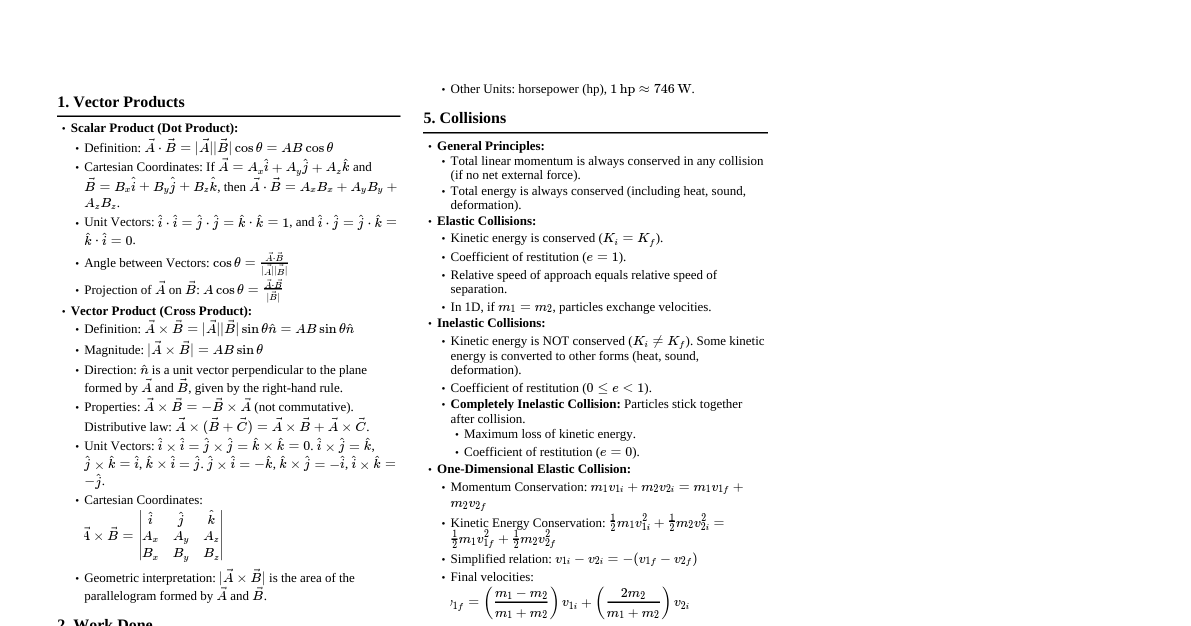
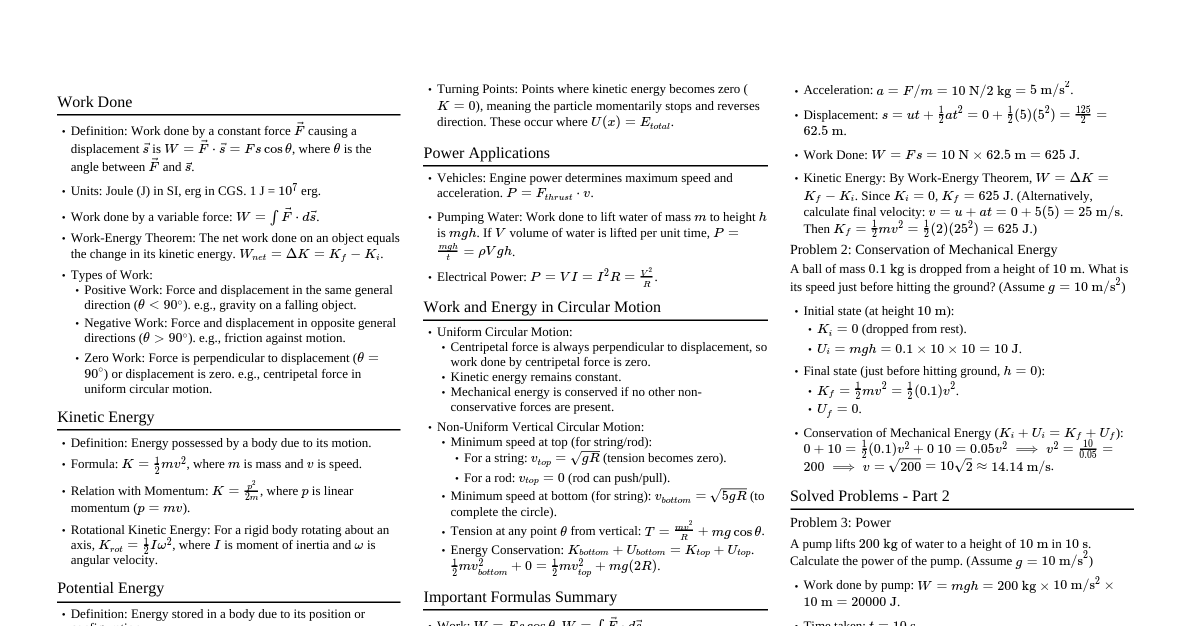
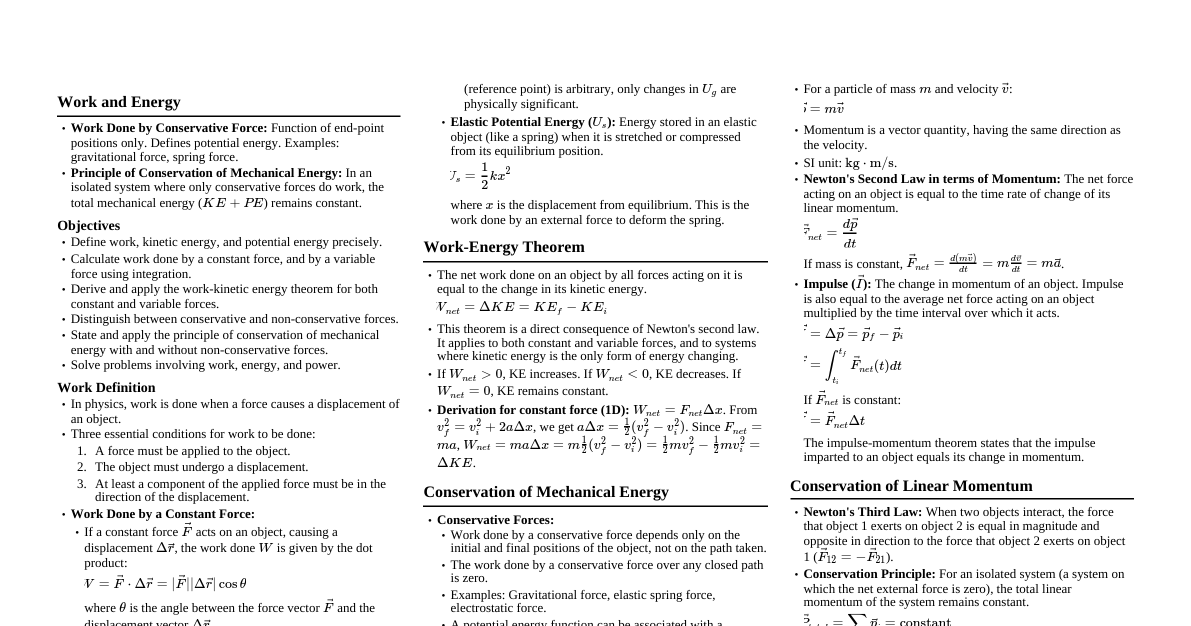
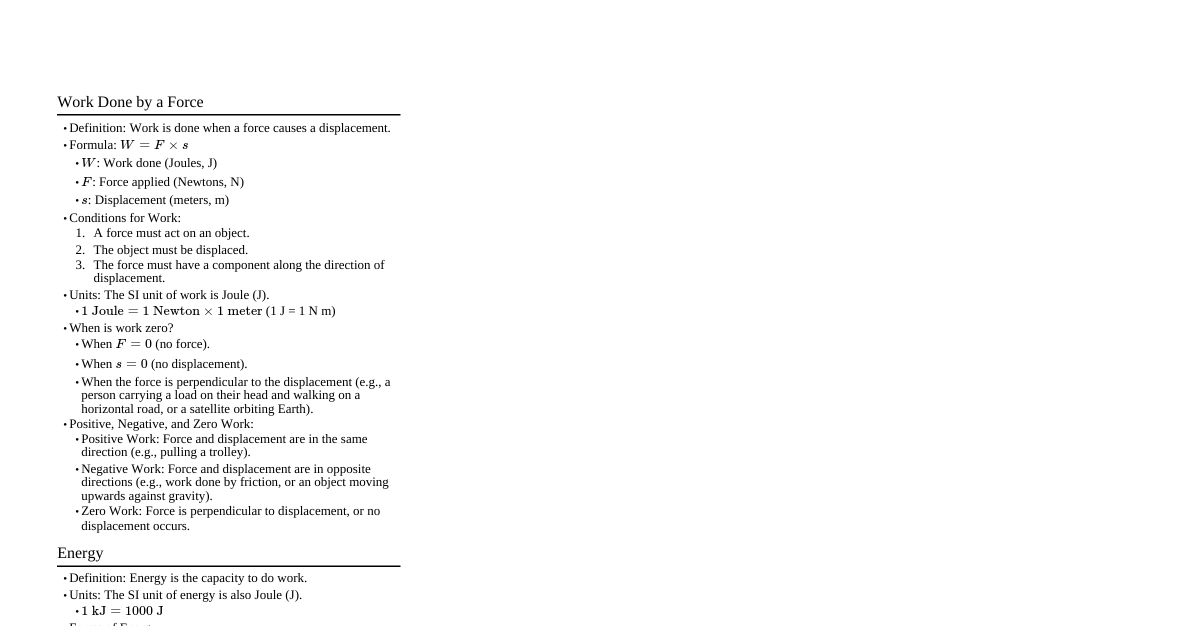
### Work: Definition and Types - **Definition:** Work is done when a force causes a displacement. It is a scalar quantity. - **Formula:** $W = \vec{F} \cdot \vec{d} = Fd \cos\theta$ - $F$: magnitude of force - $d$: magnitude of displacement - $\theta$: angle between $\vec{F}$ and $\vec{d}$ - **Units:** Joule (J) in SI, erg in CGS ($1 \text{ J} = 10^7 \text{ erg}$) - **Types of Work:** - **Positive Work:** $\theta 90^\circ$ (e.g., friction, work done by gravity when lifting an object) - **Zero Work:** $\theta = 90^\circ$ (e.g., centripetal force in circular motion, force of gravity on a horizontally moving object) or $F=0$ or $d=0$. ### Work Done by a Variable Force - When the force is not constant, work done is calculated by integration. - **Formula:** $W = \int_{x_1}^{x_2} \vec{F}(x) \cdot d\vec{x}$ - **Graphical Method:** Area under the Force-Displacement graph. ### Kinetic Energy - **Definition:** Energy possessed by a body due to its motion. - **Formula:** $K = \frac{1}{2}mv^2$ - $m$: mass of the body - $v$: speed of the body - **Units:** Joule (J) - **Relation with Momentum:** $K = \frac{p^2}{2m}$ where $p$ is linear momentum ($p=mv$). ### Work-Energy Theorem - **Statement:** The net work done on an object is equal to the change in its kinetic energy. - **Formula:** $W_{net} = \Delta K = K_f - K_i = \frac{1}{2}mv_f^2 - \frac{1}{2}mv_i^2$ - **Applications:** Useful for solving problems involving force, displacement, and velocity without explicitly using acceleration. ### Potential Energy - **Definition:** Energy stored in a body due to its position or configuration. - **Gravitational Potential Energy:** - **Formula:** $U_g = mgh$ - $m$: mass - $g$: acceleration due to gravity - $h$: height above a reference level - **Units:** Joule (J) - **Elastic Potential Energy (Spring):** - **Formula:** $U_s = \frac{1}{2}kx^2$ - $k$: spring constant - $x$: extension or compression from equilibrium position - **Units:** Joule (J) ### Conservation of Mechanical Energy - **Statement:** For conservative forces, the total mechanical energy (sum of kinetic and potential energy) of a system remains constant. - **Formula:** $E = K + U = \text{constant}$ - $K_i + U_i = K_f + U_f$ - **Conservative Forces:** Forces for which work done is independent of the path taken and depends only on initial and final positions (e.g., gravitational force, elastic spring force). - **Non-Conservative Forces:** Forces for which work done depends on the path taken (e.g., friction, air resistance). Mechanical energy is not conserved in their presence. ### Power - **Definition:** The rate at which work is done or energy is transferred. - **Average Power:** $P_{avg} = \frac{\Delta W}{\Delta t}$ - **Instantaneous Power:** $P = \frac{dW}{dt} = \vec{F} \cdot \vec{v}$ - $F$: force - $v$: velocity - **Units:** Watt (W) in SI ($1 \text{ W} = 1 \text{ J/s}$). Other units: horsepower (hp) ($1 \text{ hp} = 746 \text{ W}$). ### Collisions - **Definition:** An event in which two or more bodies exert forces on each other for a short time. - **Momentum Conservation:** Total linear momentum is always conserved in any type of collision, provided no external forces act on the system. - $m_1u_1 + m_2u_2 = m_1v_1 + m_2v_2$ - **Types of Collisions:** - **Elastic Collision:** Both kinetic energy and momentum are conserved. - Coefficient of restitution, $e=1$. - Relative velocity of approach = Relative velocity of separation. - **Inelastic Collision:** Momentum is conserved, but kinetic energy is NOT conserved (some energy is lost as heat, sound, etc.). - Coefficient of restitution, $0 \le e