Physics Essentials
Cheatsheet Content
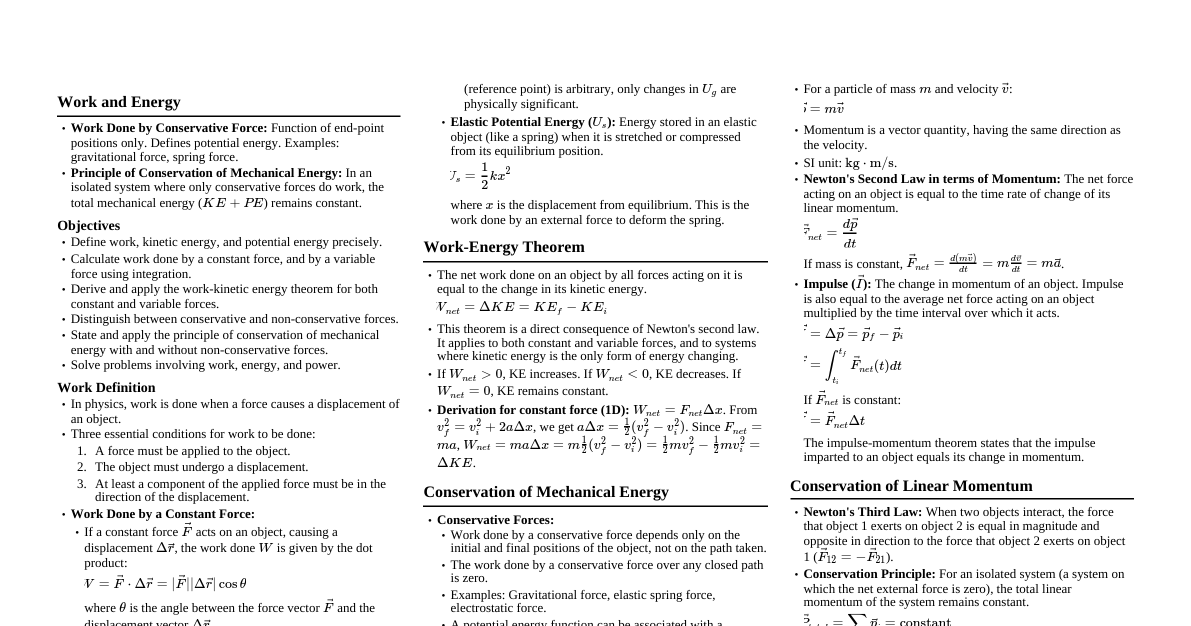
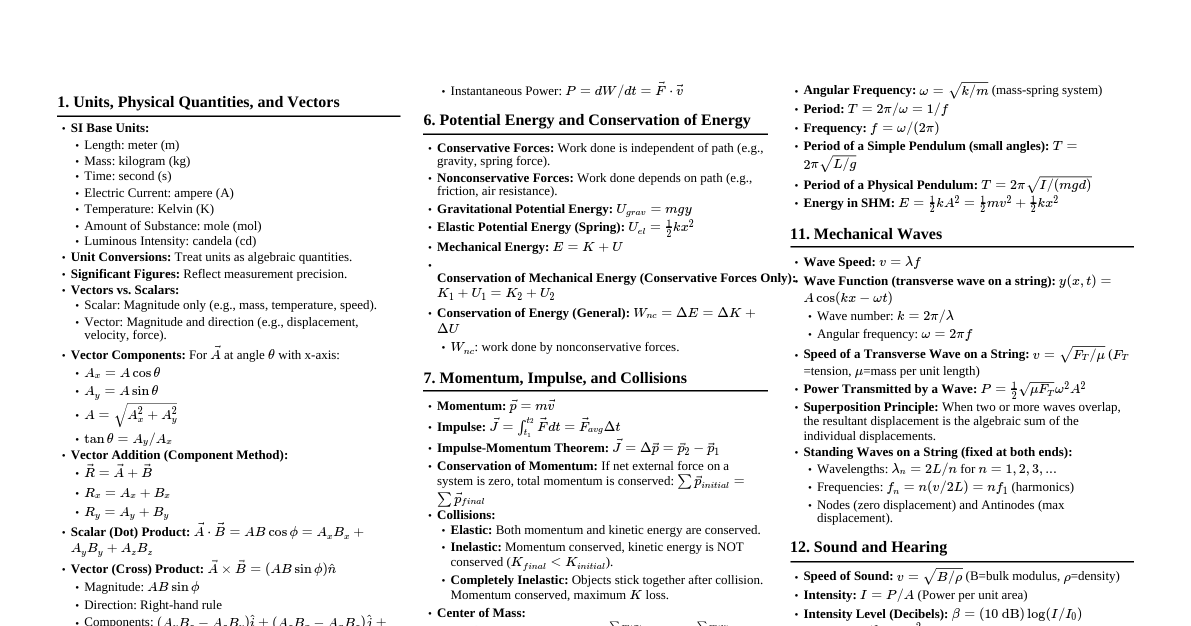
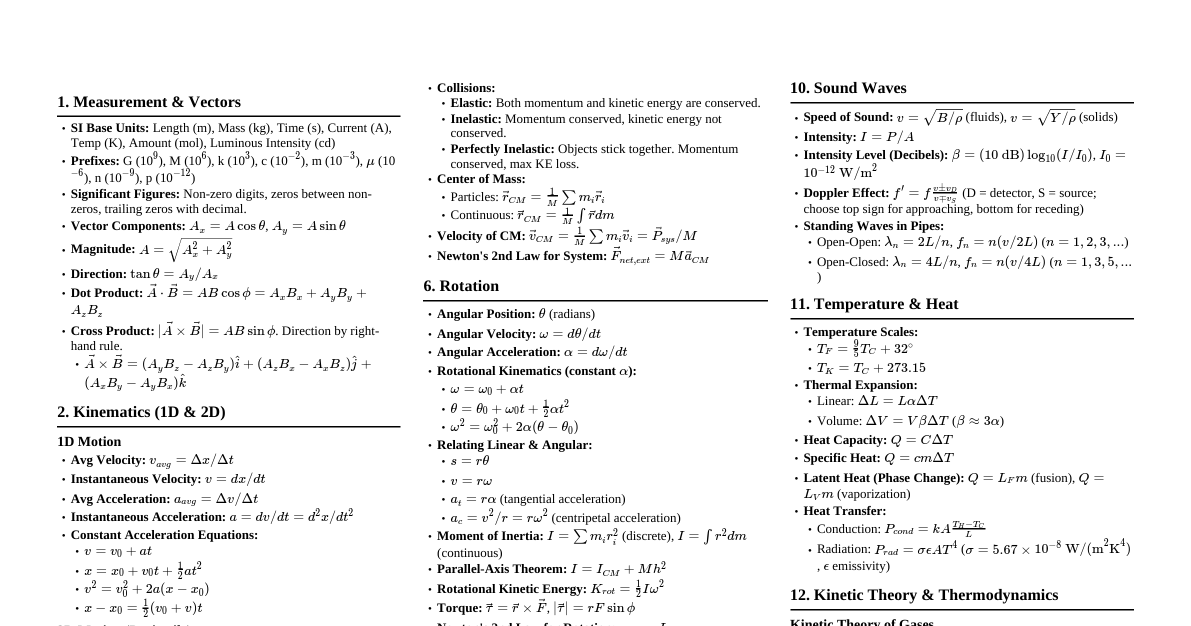
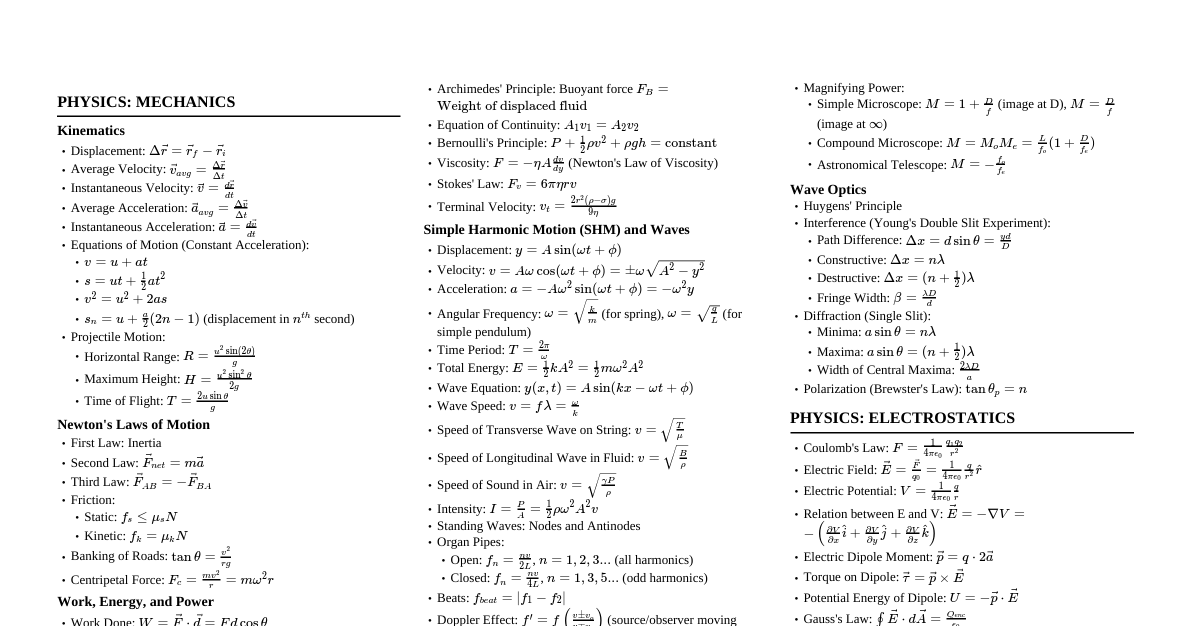
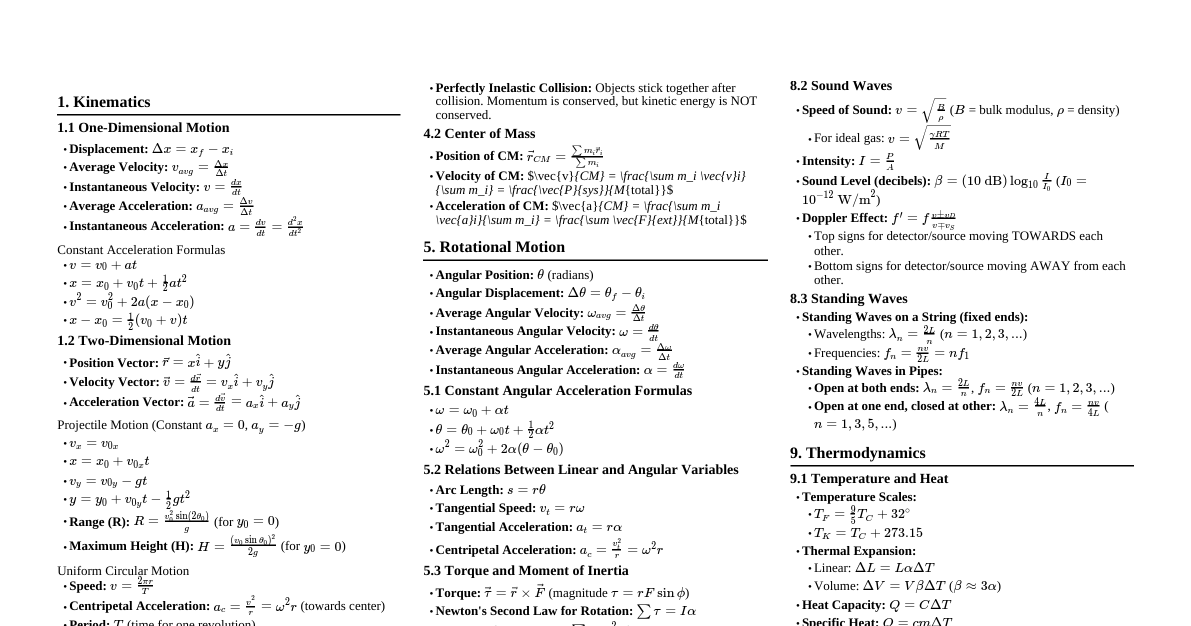
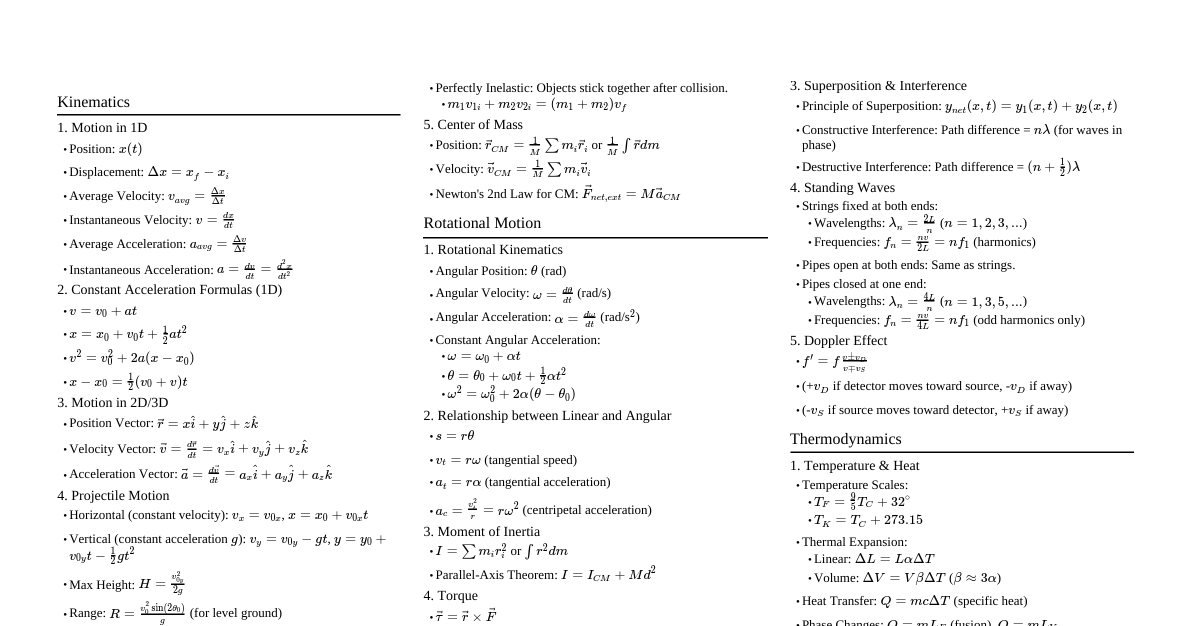
1. Definitions Friction: A force that opposes motion between two surfaces in contact. It can be static (preventing motion) or kinetic (opposing existing motion). Impulse ($J$): The change in momentum of an object. It is equal to the average net force acting on the object multiplied by the time interval over which the force acts. $J = F_{avg} \Delta t = \Delta p$. Escape Velocity ($v_e$): The minimum speed an object must have to break free from the gravitational attraction of a massive body without further propulsion. For a spherical body of mass $M$ and radius $R$, $v_e = \sqrt{\frac{2GM}{R}}$. Gravitation: The universal force of attraction between all matter. It is the force that causes objects to have weight and keeps planets in orbit. Power ($P$): The rate at which work is done or energy is transferred. $P = \frac{W}{t} = F \cdot v$. Acceleration ($a$): The rate of change of velocity of an object. It is a vector quantity. $a = \frac{\Delta v}{\Delta t}$. 2. Distinctions Speed vs. Velocity: Speed: A scalar quantity that describes how fast an object is moving (magnitude only). $Speed = \frac{Distance}{Time}$. Velocity: A vector quantity that describes both the speed and direction of an object's motion. $Velocity = \frac{Displacement}{Time}$. Power vs. Energy: Power: The rate at which work is done or energy is transferred (energy per unit time). Unit: Watt (W). Energy: The capacity to do work. It can exist in many forms (kinetic, potential, thermal, etc.). Unit: Joule (J). $g$ vs. $G$: $g$ (acceleration due to gravity): The acceleration experienced by an object due to the gravitational pull of a celestial body (e.g., Earth). Its value varies with location and altitude. On Earth's surface, $g \approx 9.8 \text{ m/s}^2$. $G$ (Universal Gravitational Constant): A fundamental physical constant that quantifies the strength of the gravitational force. $G \approx 6.674 \times 10^{-11} \text{ N m}^2/\text{kg}^2$. 3. Newton's Laws of Motion Newton's First Law (Law of Inertia): An object at rest stays at rest, and an object in motion stays in motion with the same speed and in the same direction unless acted upon by an unbalanced force. Newton's Second Law: The acceleration of an object is directly proportional to the net force acting on it and inversely proportional to its mass. The direction of the acceleration is in the direction of the net force. $F_{net} = ma$. Newton's Third Law: For every action, there is an equal and opposite reaction. When one object exerts a force on a second object, the second object simultaneously exerts a force equal in magnitude and opposite in direction on the first object. 4. Work-Energy Theorem The net work done on an object is equal to the change in its kinetic energy. $W_{net} = \Delta K = K_f - K_i = \frac{1}{2}mv_f^2 - \frac{1}{2}mv_i^2$ 5. Vector Products 5.1. Dot Product (Scalar Product) Definition: $A \cdot B = |A||B|\cos\theta$ Component Form: For $\vec{A} = (A_x, A_y, A_z)$ and $\vec{B} = (B_x, B_y, B_z)$, then $A \cdot B = A_x B_x + A_y B_y + A_z B_z$. Numerical Example: If $\vec{A} = (2, 3, -1)$ and $\vec{B} = (1, -2, 4)$, then $A \cdot B = (2)(1) + (3)(-2) + (-1)(4) = 2 - 6 - 4 = -8$. 5.2. Cross Product (Vector Product) Definition: $A \times B = (|A||B|\sin\theta)\hat{n}$, where $\hat{n}$ is a unit vector perpendicular to both $A$ and $B$ (right-hand rule). Component Form: $$ \vec{A} \times \vec{B} = \begin{vmatrix} \hat{i} & \hat{j} & \hat{k} \\ A_x & A_y & A_z \\ B_x & B_y & B_z \end{vmatrix} = (A_y B_z - A_z B_y)\hat{i} - (A_x B_z - A_z B_x)\hat{j} + (A_x B_y - A_y B_x)\hat{k} $$ Numerical Example: If $\vec{A} = (2, 3, -1)$ and $\vec{B} = (1, -2, 4)$, then: $A \times B = ((3)(4) - (-1)(-2))\hat{i} - ((2)(4) - (-1)(1))\hat{j} + ((2)(-2) - (3)(1))\hat{k}$ $A \times B = (12 - 2)\hat{i} - (8 + 1)\hat{j} + (-4 - 3)\hat{k}$ $A \times B = 10\hat{i} - 9\hat{j} - 7\hat{k}$ 6. Acceleration due to Gravity ($g$) 6.1. Value of $g$ on Earth's Surface On Earth's surface, $g \approx 9.8 \text{ m/s}^2$. This value can vary slightly due to altitude, latitude, and local geological features. 6.2. Variation of $g$ with Height At a height $h$ above the Earth's surface (radius $R_e$, mass $M_e$): $g(h) = \frac{GM_e}{(R_e + h)^2}$ If $h \ll R_e$, we can approximate: $g(h) \approx g(1 - \frac{2h}{R_e})$ This shows that $g$ decreases as height increases. 7. Kinematics Numericals 7.1. Average Velocity and Average Speed Average Speed: Total distance traveled divided by the total time taken. Average Velocity: Total displacement divided by the total time taken. Numerical Example: A car travels 100 km east in 2 hours, then 50 km west in 1 hour. Total Distance = $100 \text{ km} + 50 \text{ km} = 150 \text{ km}$ Total Time = $2 \text{ h} + 1 \text{ h} = 3 \text{ h}$ Average Speed = $\frac{150 \text{ km}}{3 \text{ h}} = 50 \text{ km/h}$ Total Displacement = $100 \text{ km (east)} - 50 \text{ km (west)} = 50 \text{ km (east)}$ Average Velocity = $\frac{50 \text{ km (east)}}{3 \text{ h}} \approx 16.67 \text{ km/h (east)}$