Work, Energy & Power (JEE/NEET
Cheatsheet Content
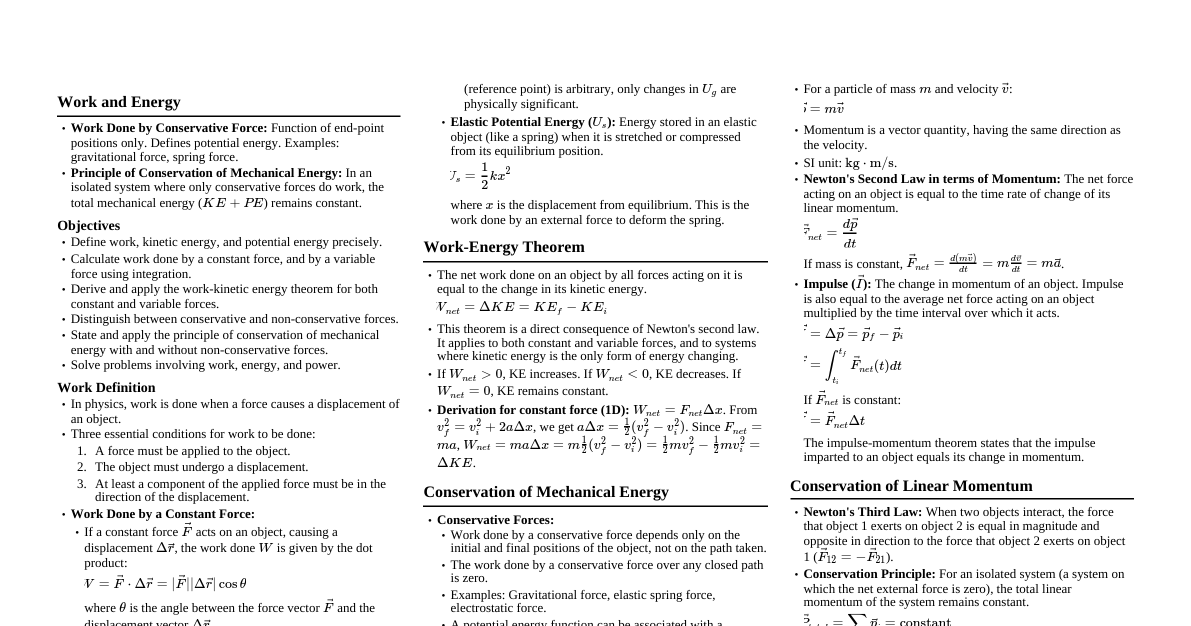
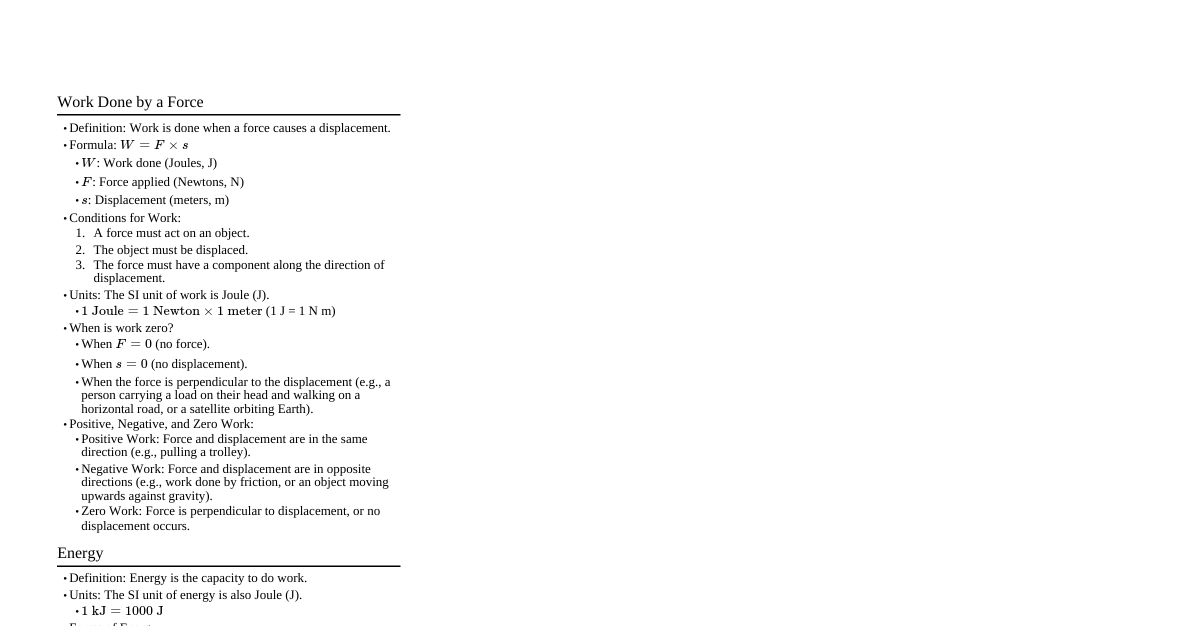
### Work Done - **Definition:** Work done by a constant force $\vec{F}$ causing a displacement $\vec{s}$ is $W = \vec{F} \cdot \vec{s} = Fs \cos\theta$, where $\theta$ is the angle between $\vec{F}$ and $\vec{s}$. - **Units:** Joule (J) in SI, erg in CGS. 1 J = $10^7$ erg. - **Work done by a variable force:** $W = \int \vec{F} \cdot d\vec{s}$. - **Work-Energy Theorem:** The net work done on an object equals the change in its kinetic energy. $W_{net} = \Delta K = K_f - K_i$. - **Types of Work:** - **Positive Work:** Force and displacement in the same general direction ($\theta 90^\circ$). e.g., friction against motion. - **Zero Work:** Force is perpendicular to displacement ($\theta = 90^\circ$) or displacement is zero. e.g., centripetal force in uniform circular motion. ### Kinetic Energy - **Definition:** Energy possessed by a body due to its motion. - **Formula:** $K = \frac{1}{2}mv^2$, where $m$ is mass and $v$ is speed. - **Relation with Momentum:** $K = \frac{p^2}{2m}$, where $p$ is linear momentum ($p=mv$). - **Rotational Kinetic Energy:** For a rigid body rotating about an axis, $K_{rot} = \frac{1}{2}I\omega^2$, where $I$ is moment of inertia and $\omega$ is angular velocity. ### Potential Energy - **Definition:** Energy stored in a body due to its position or configuration. - **Types:** - **Gravitational Potential Energy:** $U_g = mgh$, where $m$ is mass, $g$ is acceleration due to gravity, and $h$ is height above a reference level. - **Elastic Potential Energy:** $U_e = \frac{1}{2}kx^2$, where $k$ is the spring constant and $x$ is the extension/compression from equilibrium. - **Conservative Forces:** Forces for which the work done is independent of the path taken and depends only on the initial and final positions (e.g., gravity, elastic force). Work done by a conservative force is $W_c = -\Delta U$. - **Non-Conservative Forces:** Forces for which the work done depends on the path taken (e.g., friction, air resistance). Work done by non-conservative forces is $W_{nc}$. ### Conservation of Mechanical Energy - **Principle:** For conservative forces, the total mechanical energy (sum of kinetic and potential energy) of a system remains constant. - **Formula:** $E = K + U = \text{constant}$. - **Implication:** $K_i + U_i = K_f + U_f$. - **When non-conservative forces are present:** $W_{nc} = \Delta E = E_f - E_i = (K_f + U_f) - (K_i + U_i)$. ### Power - **Definition:** The rate at which work is done or energy is transferred. - **Average Power:** $P_{avg} = \frac{\Delta W}{\Delta t}$. - **Instantaneous Power:** $P = \frac{dW}{dt} = \vec{F} \cdot \vec{v}$, where $\vec{F}$ is force and $\vec{v}$ is instantaneous velocity. - **Units:** Watt (W) in SI. 1 W = 1 J/s. Other units: horsepower (hp), 1 hp = 746 W. - **Efficiency:** $\eta = \frac{\text{Output Power}}{\text{Input Power}} \times 100\%$. ### Work-Energy Theorem Details - **Scalar quantity:** Work is a scalar, but can be positive, negative, or zero. - **Work by multiple forces:** $W_{net} = \sum W_i = W_1 + W_2 + \dots$ - **Variable Force in 2D/3D:** If $\vec{F} = F_x \hat{i} + F_y \hat{j} + F_z \hat{k}$ and $d\vec{s} = dx \hat{i} + dy \hat{j} + dz \hat{k}$, then $W = \int (F_x dx + F_y dy + F_z dz)$. - **Work done by a spring:** $W_{spring} = -\frac{1}{2}kx^2$. This is the work done *by* the spring. Work done *on* the spring is positive. ### Potential Energy Curves - **Relation between Force and Potential Energy:** For a conservative force, $F = -\frac{dU}{dx}$ (in 1D). - **Equilibrium:** At equilibrium points, $F=0$, so $\frac{dU}{dx}=0$. - **Stable Equilibrium:** Minimum potential energy, $\frac{d^2U}{dx^2} > 0$. If displaced, the system returns to equilibrium. - **Unstable Equilibrium:** Maximum potential energy, $\frac{d^2U}{dx^2} ### Power Applications - **Vehicles:** Engine power determines maximum speed and acceleration. $P = F_{thrust} \cdot v$. - **Pumping Water:** Work done to lift water of mass $m$ to height $h$ is $mgh$. If $V$ volume of water is lifted per unit time, $P = \frac{mgh}{t} = \rho V g h$. - **Electrical Power:** $P = VI = I^2R = \frac{V^2}{R}$. ### Work and Energy in Circular Motion - **Uniform Circular Motion:** - Centripetal force is always perpendicular to displacement, so **work done by centripetal force is zero.** - Kinetic energy remains constant. - Mechanical energy is conserved if no other non-conservative forces are present. - **Non-Uniform Vertical Circular Motion:** - **Minimum speed at top (for string/rod):** - For a string: $v_{top} = \sqrt{gR}$ (tension becomes zero). - For a rod: $v_{top} = 0$ (rod can push/pull). - **Minimum speed at bottom (for string):** $v_{bottom} = \sqrt{5gR}$ (to complete the circle). - **Tension at any point $\theta$ from vertical:** $T = \frac{mv^2}{R} + mg \cos\theta$. - **Energy Conservation:** $K_{bottom} + U_{bottom} = K_{top} + U_{top}$. $\frac{1}{2}mv_{bottom}^2 + 0 = \frac{1}{2}mv_{top}^2 + mg(2R)$. ### Important Formulas Summary - **Work:** $W = Fs \cos\theta$, $W = \int \vec{F} \cdot d\vec{s}$ - **Kinetic Energy:** $K = \frac{1}{2}mv^2$, $K = \frac{p^2}{2m}$ - **Gravitational Potential Energy:** $U_g = mgh$ - **Elastic Potential Energy:** $U_e = \frac{1}{2}kx^2$ - **Work-Energy Theorem:** $W_{net} = \Delta K$ - **Conservation of Mechanical Energy (Conservative forces only):** $K_i + U_i = K_f + U_f$ - **With Non-Conservative forces:** $W_{nc} = \Delta E$ - **Power:** $P = \frac{dW}{dt} = \vec{F} \cdot \vec{v}$ - **Vertical Circular Motion (string):** - $v_{bottom} = \sqrt{5gR}$ - $v_{top} = \sqrt{gR}$ ### JEE/NEET Tips - **Identify forces:** Always draw a free-body diagram to identify all forces acting on the system. - **Choose reference level:** For potential energy, choose a convenient reference level (e.g., ground) where $U=0$. - **Conservative vs. Non-conservative:** Distinguish between conservative and non-conservative forces as this dictates the approach (conservation of mechanical energy vs. work-energy theorem). - **Variable force integration:** Practice integration for variable forces (e.g., spring force, gravitational force for large distances). - **Power calculation:** Remember $P = Fv$ for instantaneous power and $P = W/t$ for average power. - **Units and Dimensions:** Always check units and dimensions for consistency. - **Problem-Solving Strategy:** 1. Define the system and initial/final states. 2. Identify all forces doing work. 3. Apply Work-Energy Theorem or Conservation of Mechanical Energy. 4. Solve for the unknown. ### Common Misconceptions - **Work done by gravity is always $mgh$:** It's $mgh$ only if the displacement is vertical and downwards. More generally, $W_g = - \Delta U_g = mg(h_i - h_f)$. - **Energy is always conserved:** Total energy of the universe is conserved, but mechanical energy is conserved only if non-conservative forces do no work. - **Power is only force times velocity:** This is instantaneous power. Average power is total work divided by total time. - **Centripetal force does work:** Centripetal force is always perpendicular to displacement, hence it does no work. - **Kinetic energy is always positive:** Yes, $K = \frac{1}{2}mv^2$ is always positive or zero. ### Solved Problems - Part 1 #### Problem 1: Work-Energy Theorem A block of mass 2 kg is initially at rest. A force of $10\text{ N}$ acts on it horizontally for $5\text{ s}$. Calculate the kinetic energy of the block after $5\text{ s}$. - **Acceleration:** $a = F/m = 10\text{ N}/2\text{ kg} = 5\text{ m/s}^2$. - **Displacement:** $s = ut + \frac{1}{2}at^2 = 0 + \frac{1}{2}(5)(5^2) = \frac{125}{2} = 62.5\text{ m}$. - **Work Done:** $W = Fs = 10\text{ N} \times 62.5\text{ m} = 625\text{ J}$. - **Kinetic Energy:** By Work-Energy Theorem, $W = \Delta K = K_f - K_i$. Since $K_i = 0$, $K_f = 625\text{ J}$. *(Alternatively, calculate final velocity: $v = u + at = 0 + 5(5) = 25\text{ m/s}$. Then $K_f = \frac{1}{2}mv^2 = \frac{1}{2}(2)(25^2) = 625\text{ J}$.)* #### Problem 2: Conservation of Mechanical Energy A ball of mass $0.1\text{ kg}$ is dropped from a height of $10\text{ m}$. What is its speed just before hitting the ground? (Assume $g = 10\text{ m/s}^2$) - **Initial state (at height $10\text{ m}$):** - $K_i = 0$ (dropped from rest). - $U_i = mgh = 0.1 \times 10 \times 10 = 10\text{ J}$. - **Final state (just before hitting ground, $h=0$):** - $K_f = \frac{1}{2}mv^2 = \frac{1}{2}(0.1)v^2$. - $U_f = 0$. - **Conservation of Mechanical Energy ($K_i + U_i = K_f + U_f$):** $0 + 10 = \frac{1}{2}(0.1)v^2 + 0$ $10 = 0.05v^2 \implies v^2 = \frac{10}{0.05} = 200 \implies v = \sqrt{200} = 10\sqrt{2} \approx 14.14\text{ m/s}$. ### Solved Problems - Part 2 #### Problem 3: Power A pump lifts $200\text{ kg}$ of water to a height of $10\text{ m}$ in $10\text{ s}$. Calculate the power of the pump. (Assume $g = 10\text{ m/s}^2$) - **Work done by pump:** $W = mgh = 200\text{ kg} \times 10\text{ m/s}^2 \times 10\text{ m} = 20000\text{ J}$. - **Time taken:** $t = 10\text{ s}$. - **Power:** $P = \frac{W}{t} = \frac{20000\text{ J}}{10\text{ s}} = 2000\text{ W} = 2\text{ kW}$. #### Problem 4: Vertical Circular Motion A particle of mass $m$ is attached to a string of length $L$ and is given a horizontal velocity $v_0$ at the lowest point. Find the minimum $v_0$ for the particle to complete the vertical circle. - **Condition for completing the circle:** The tension in the string must be at least zero at the highest point, i.e., $T_{top} \geq 0$. - **At the highest point:** - Forces: Gravity ($mg$) downwards, Tension ($T_{top}$) downwards. - Equation of motion: $T_{top} + mg = \frac{mv_{top}^2}{L}$. - For minimum $v_0$, $T_{top} = 0 \implies mg = \frac{mv_{top}^2}{L} \implies v_{top} = \sqrt{gL}$. - **Conservation of Mechanical Energy (Lowest to Highest Point):** - $K_{bottom} + U_{bottom} = K_{top} + U_{top}$ - $\frac{1}{2}mv_0^2 + 0 = \frac{1}{2}mv_{top}^2 + mg(2L)$ - Substitute $v_{top} = \sqrt{gL}$: $\frac{1}{2}mv_0^2 = \frac{1}{2}m(gL) + 2mgL$ $\frac{1}{2}mv_0^2 = \frac{5}{2}mgL$ $v_0^2 = 5gL \implies v_0 = \sqrt{5gL}$. ### Additional Concepts - **Work-Energy in Non-Inertial Frames:** If the frame is accelerating, pseudo forces also do work, and they must be included in the net work calculation. - **Potential Energy of a System of Particles:** The total potential energy is the sum of potential energies of all pairs of particles. For gravity, $U = -\frac{GMm}{r}$. - **Variable Mass Systems:** For rockets or systems where mass changes, the standard work-energy theorem needs modification or a direct application of Newton's second law. - **Collision - Coefficient of Restitution ($e$):** - $e = \frac{\text{relative velocity after collision}}{\text{relative velocity before collision}}$ - For elastic collision, $e=1$ (kinetic energy conserved). - For inelastic collision, $0 ### JEE/NEET Exam Strategy - **Conceptual Clarity:** Understand the definitions and conditions for applying each principle (e.g., when is mechanical energy conserved?). - **Problem Type Recognition:** Quickly identify if a problem involves work-energy theorem, conservation of mechanical energy, or power calculation. - **Diagrams:** Always draw clear diagrams, especially for forces and displacements. - **Vector Nature:** Pay attention to the vector nature of force and displacement for work calculation, and velocity/momentum for kinetic energy and power. - **Practice Numerical Problems:** Solve a wide variety of problems, including those with variable forces, inclined planes, and circular motion. - **Time Management:** In multi-concept problems (e.g., friction and springs), break down the problem into smaller, manageable parts.