Physics Essentials: Work, Energy, Moment
Cheatsheet Content
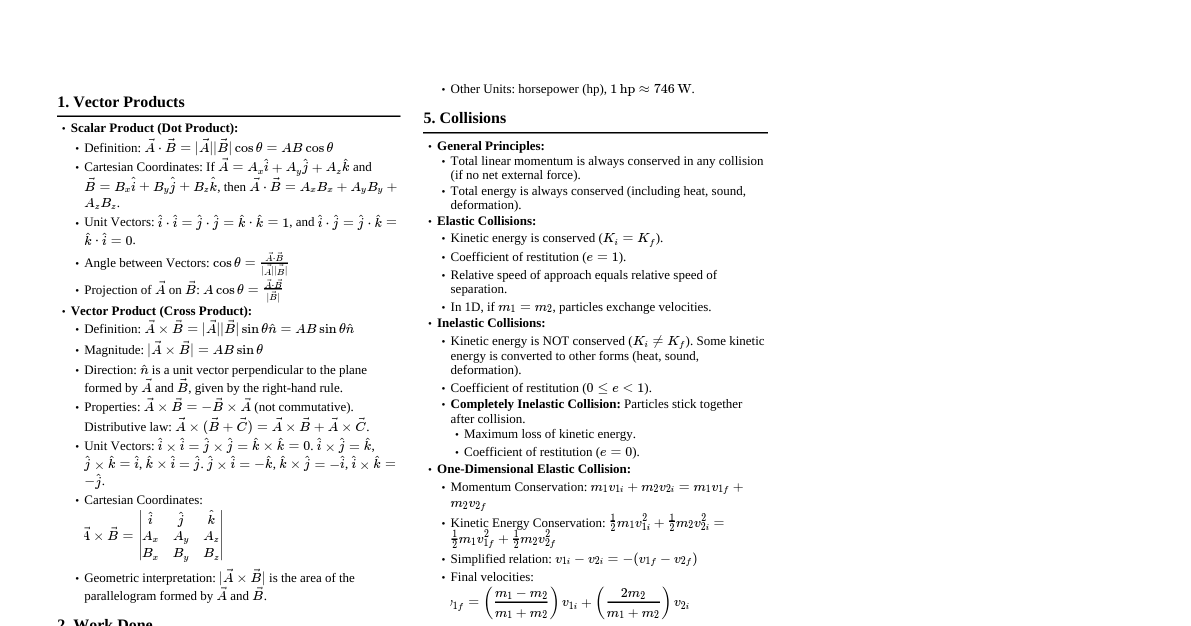
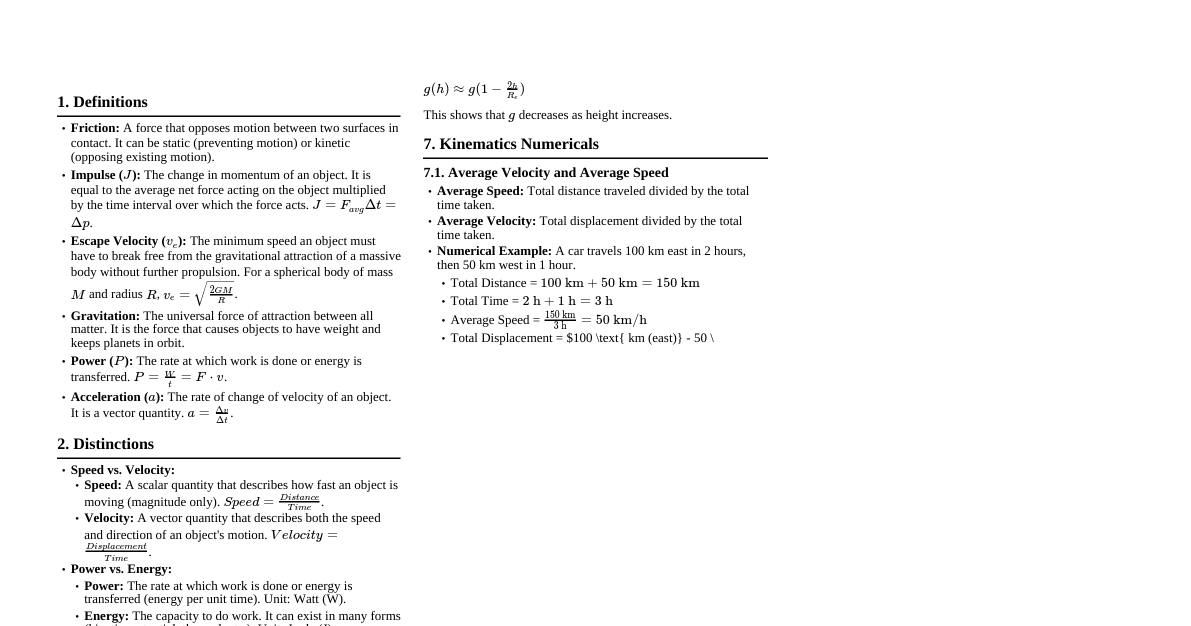
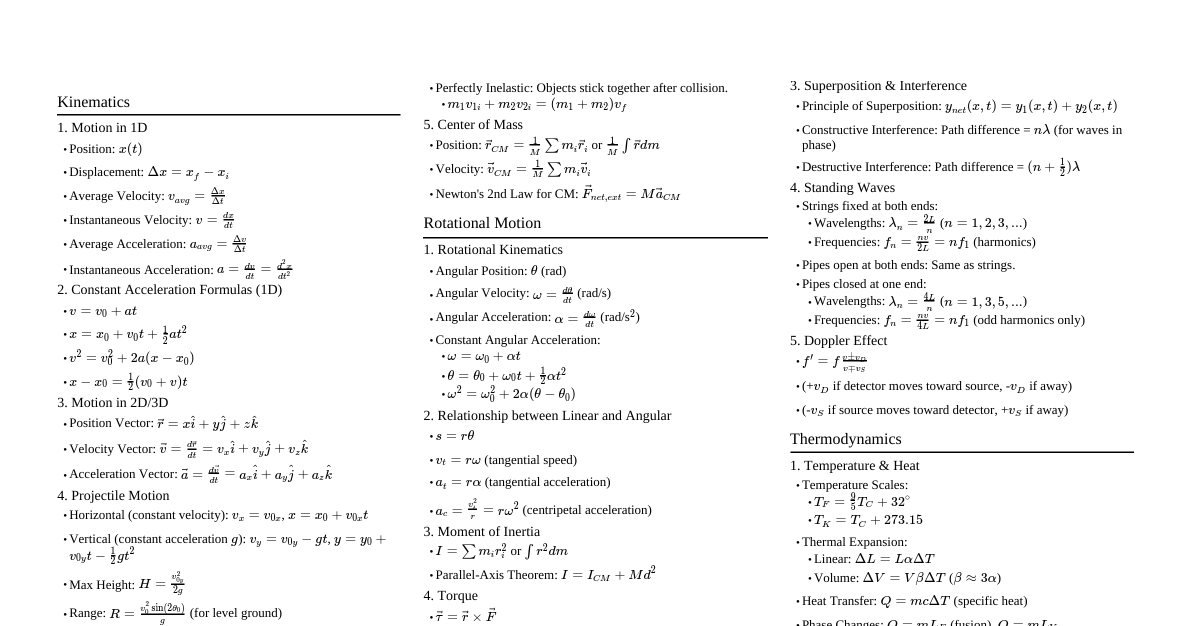
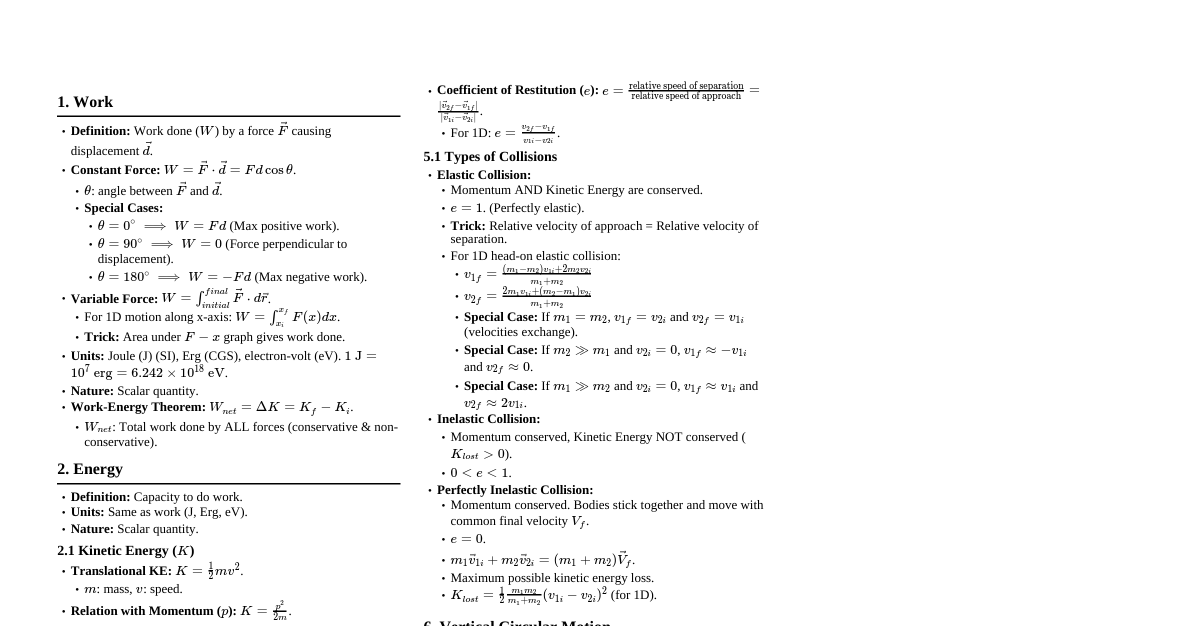
Work and Energy Work Done by Conservative Force: Function of end-point positions only. Defines potential energy. Examples: gravitational force, spring force. Principle of Conservation of Mechanical Energy: In an isolated system where only conservative forces do work, the total mechanical energy ($KE + PE$) remains constant. Objectives Define work, kinetic energy, and potential energy precisely. Calculate work done by a constant force, and by a variable force using integration. Derive and apply the work-kinetic energy theorem for both constant and variable forces. Distinguish between conservative and non-conservative forces. State and apply the principle of conservation of mechanical energy with and without non-conservative forces. Solve problems involving work, energy, and power. Work Definition In physics, work is done when a force causes a displacement of an object. Three essential conditions for work to be done: A force must be applied to the object. The object must undergo a displacement. At least a component of the applied force must be in the direction of the displacement. Work Done by a Constant Force: If a constant force $\vec{F}$ acts on an object, causing a displacement $\Delta\vec{r}$, the work done $W$ is given by the dot product: $$W = \vec{F} \cdot \Delta\vec{r} = |\vec{F}| |\Delta\vec{r}| \cos\theta$$ where $\theta$ is the angle between the force vector $\vec{F}$ and the displacement vector $\Delta\vec{r}$. Work is a scalar quantity. SI unit for work is the Joule (J). $1 \text{ J} = 1 \text{ N} \cdot \text{m}$. Important cases for $\theta$: $\theta = 0^\circ$ ($\vec{F}$ parallel to $\Delta\vec{r}$): $W = F \Delta r$ (maximum positive work). $\theta = 90^\circ$ ($\vec{F}$ perpendicular to $\Delta\vec{r}$): $W = 0$ (no work done, e.g., centripetal force). $\theta = 180^\circ$ ($\vec{F}$ anti-parallel to $\Delta\vec{r}$): $W = -F \Delta r$ (negative work, e.g., friction). Work Done by a Variable Force: If the force varies with position, work must be calculated using integration. $W = \int_{x_i}^{x_f} \vec{F}(x) \cdot d\vec{x}$. In one dimension: $W = \int_{x_i}^{x_f} F_x(x) dx$. Graphically, work done is the area under the force-displacement curve. Varying Force - Mass-Spring System Hooke's Law: Describes the force exerted by an ideal spring. $$F_s = -kx$$ $x$: displacement of the spring from its equilibrium position ($x=0$). Positive $x$ for stretching, negative $x$ for compression. $k$: spring constant (force constant), a measure of the spring's stiffness. Units: N/m. The negative sign indicates that the spring force is a restoring force, always acting to return the spring to equilibrium. Work done BY the restoring spring force: When a spring is stretched or compressed from an initial position $x_i$ to a final position $x_f$: $$W_{spring} = \int_{x_i}^{x_f} (-kx) dx = \left[ -\frac{1}{2}kx^2 \right]_{x_i}^{x_f} = \frac{1}{2}kx_i^2 - \frac{1}{2}kx_f^2$$ Work done BY an external applied force: To stretch or compress a spring, an external force $F_{app} = kx$ must be applied (equal in magnitude and opposite to $F_s$). $$W_{F_{app}} = \int_{x_i}^{x_f} (kx) dx = \left[ \frac{1}{2}kx^2 \right]_{x_i}^{x_f} = \frac{1}{2}kx_f^2 - \frac{1}{2}kx_i^2$$ This work is stored as elastic potential energy. Energy Definition: Energy is the capacity of a physical system to perform work. It is a conserved scalar quantity. Exists in many forms (kinetic, potential, thermal, chemical, nuclear, electromagnetic). SI unit: Joule (J). Kinetic Energy (KE): Energy an object possesses due to its motion. For an object of mass $m$ moving with speed $v$: $$KE = \frac{1}{2}mv^2$$ Kinetic energy is always non-negative. Potential Energy (PE or U): Energy stored in a system due to the configuration of its parts or its position in a force field. Potential energy is only defined for conservative forces. Gravitational Potential Energy ($U_g$): Energy stored due to an object's position in a gravitational field. Near Earth's surface (constant $g$): $$\Delta U_g = mg\Delta y$$ where $\Delta y$ is the change in height. The choice of $y=0$ (reference point) is arbitrary, only changes in $U_g$ are physically significant. Elastic Potential Energy ($U_s$): Energy stored in an elastic object (like a spring) when it is stretched or compressed from its equilibrium position. $$U_s = \frac{1}{2}kx^2$$ where $x$ is the displacement from equilibrium. This is the work done by an external force to deform the spring. Work-Energy Theorem The net work done on an object by all forces acting on it is equal to the change in its kinetic energy. $$W_{net} = \Delta KE = KE_f - KE_i$$ This theorem is a direct consequence of Newton's second law. It applies to both constant and variable forces, and to systems where kinetic energy is the only form of energy changing. If $W_{net} > 0$, KE increases. If $W_{net} Derivation for constant force (1D): $W_{net} = F_{net} \Delta x$. From $v_f^2 = v_i^2 + 2a \Delta x$, we get $a \Delta x = \frac{1}{2}(v_f^2 - v_i^2)$. Since $F_{net} = ma$, $W_{net} = ma \Delta x = m \frac{1}{2}(v_f^2 - v_i^2) = \frac{1}{2}mv_f^2 - \frac{1}{2}mv_i^2 = \Delta KE$. Conservation of Mechanical Energy Conservative Forces: Work done by a conservative force depends only on the initial and final positions of the object, not on the path taken. The work done by a conservative force over any closed path is zero. Examples: Gravitational force, elastic spring force, electrostatic force. A potential energy function can be associated with a conservative force. Non-Conservative Forces: Work done by a non-conservative force depends on the path taken. Work done by a non-conservative force over a closed path is not zero. Examples: Friction, air resistance, tension, applied push/pull (if not part of the system). These forces typically dissipate mechanical energy (e.g., into thermal energy). Principle of Conservation of Mechanical Energy: If only conservative forces do work within a system, the total mechanical energy $ME = KE + U$ of the system remains constant. $$KE_i + U_i = KE_f + U_f$$ $$\frac{1}{2}mv_i^2 + U_i = \frac{1}{2}mv_f^2 + U_f$$ This means $\Delta ME = \Delta KE + \Delta U = 0$. Work Done by Non-Conservative Forces: If non-conservative forces ($W_{nc}$) also do work, the total mechanical energy is not conserved. Instead, the change in mechanical energy is equal to the work done by the non-conservative forces: $$W_{nc} = \Delta ME = ME_f - ME_i = (KE_f + U_f) - (KE_i + U_i)$$ or $W_{nc} = \Delta KE + \Delta U$. For example, if friction acts, $W_{friction} Power Definition: Power is the rate at which work is done or energy is transferred. It indicates how quickly energy is being used or supplied. Average Power ($P_{av}$): $$P_{av} = \frac{W}{\Delta t} = \frac{\Delta E}{\Delta t}$$ where $W$ is the work done or $\Delta E$ is the energy transferred over a time interval $\Delta t$. Instantaneous Power ($P$): The rate at which work is done at a particular instant in time. $$P = \frac{dW}{dt}$$ Power in terms of Force and Velocity: For a force $\vec{F}$ acting on an object moving with velocity $\vec{v}$: $$P = \vec{F} \cdot \vec{v}$$ This is particularly useful when power is supplied by a motor or engine. SI unit for power is the Watt (W). $1 \text{ W} = 1 \text{ J/s}$. Other common units: Horsepower (hp): $1 \text{ hp} \approx 746 \text{ W}$. Kilowatt-hour (kWh): A unit of energy (not power). $1 \text{ kWh} = (1000 \text{ J/s})(3600 \text{ s}) = 3.6 \times 10^6 \text{ J}$. This is typically used for billing electricity consumption. Linear Momentum Definition: Linear momentum ($\vec{p}$) is a measure of the "quantity of motion" of an object. It is the product of an object's mass and its velocity. For a particle of mass $m$ and velocity $\vec{v}$: $$\vec{p} = m\vec{v}$$ Momentum is a vector quantity, having the same direction as the velocity. SI unit: $\text{kg} \cdot \text{m/s}$. Newton's Second Law in terms of Momentum: The net force acting on an object is equal to the time rate of change of its linear momentum. $$\vec{F}_{net} = \frac{d\vec{p}}{dt}$$ If mass is constant, $\vec{F}_{net} = \frac{d(m\vec{v})}{dt} = m\frac{d\vec{v}}{dt} = m\vec{a}$. Impulse ($\vec{I}$): The change in momentum of an object. Impulse is also equal to the average net force acting on an object multiplied by the time interval over which it acts. $$\vec{I} = \Delta \vec{p} = \vec{p}_f - \vec{p}_i$$ $$\vec{I} = \int_{t_i}^{t_f} \vec{F}_{net}(t) dt$$ If $\vec{F}_{net}$ is constant: $$\vec{I} = \vec{F}_{net} \Delta t$$ The impulse-momentum theorem states that the impulse imparted to an object equals its change in momentum. Conservation of Linear Momentum Newton's Third Law: When two objects interact, the force that object 1 exerts on object 2 is equal in magnitude and opposite in direction to the force that object 2 exerts on object 1 ($\vec{F}_{12} = -\vec{F}_{21}$). Conservation Principle: For an isolated system (a system on which the net external force is zero), the total linear momentum of the system remains constant. $$\vec{P}_{total} = \sum \vec{p}_i = \text{constant}$$ This means $\Delta \vec{P}_{total} = 0$. For a system of two interacting particles ($m_1, m_2$): $$m_1\vec{v}_{1i} + m_2\vec{v}_{2i} = m_1\vec{v}_{1f} + m_2\vec{v}_{2f}$$ This principle is fundamental and applies to all types of collisions and explosions, regardless of whether kinetic energy is conserved. Collisions A collision is an event in which two or more bodies exert forces on each other for a relatively short time. During a collision, the internal forces are typically much greater than any external forces, so momentum is approximately conserved for the system. Collisions are classified based on whether kinetic energy is conserved. Elastic Collision: Both total linear momentum and total kinetic energy are conserved. This type of collision often occurs at the atomic and subatomic levels, or in macroscopic objects where deformation is minimal (e.g., billiard balls). For a head-on elastic collision between two masses $m_1$ and $m_2$: Momentum Conservation: $m_1v_{1i} + m_2v_{2i} = m_1v_{1f} + m_2v_{2f}$ Kinetic Energy Conservation: $\frac{1}{2}m_1v_{1i}^2 + \frac{1}{2}m_2v_{2i}^2 = \frac{1}{2}m_1v_{1f}^2 + \frac{1}{2}m_2v_{2f}^2$ A useful derived relation for 1D elastic collisions: $v_{1i} - v_{2i} = -(v_{1f} - v_{2f})$ (relative speed of approach equals relative speed of separation). Inelastic Collision: Total linear momentum is conserved, but total kinetic energy is NOT conserved (some kinetic energy is converted to other forms like heat, sound, or deformation). Most macroscopic collisions are inelastic. Momentum Conservation: $m_1v_{1i} + m_2v_{2i} = m_1v_{1f} + m_2v_{2f}$ Kinetic Energy: $\frac{1}{2}m_1v_{1i}^2 + \frac{1}{2}m_2v_{2i}^2 \neq \frac{1}{2}m_1v_{1f}^2 + \frac{1}{2}m_2v_{2f}^2$ Perfectly Inelastic Collision: An extreme type of inelastic collision where the colliding objects stick together after impact and move as a single combined mass with a common final velocity. Maximum possible kinetic energy loss (consistent with momentum conservation). Momentum Conservation: $m_1v_{1i} + m_2v_{2i} = (m_1 + m_2)v_f$ Center of Mass Definition: The center of mass (CM) is a unique point representing the average position of all the mass in a system. For many purposes, a system of particles can be treated as if all its mass were concentrated at its center of mass. The center of mass of a system moves as if all the external forces were applied at that point. For a system of discrete particles with masses $m_i$ and position vectors $\vec{r}_i = (x_i, y_i, z_i)$: $$\vec{r}_{CM} = \frac{\sum m_i \vec{r}_i}{\sum m_i} = \frac{1}{M_{total}} \sum m_i \vec{r}_i$$ where $M_{total} = \sum m_i$ is the total mass of the system. In component form: $$x_{CM} = \frac{\sum m_i x_i}{M_{total}}$$ $$y_{CM} = \frac{\sum m_i y_i}{M_{total}}$$ $$z_{CM} = \frac{\sum m_i z_i}{M_{total}}$$ Velocity of the Center of Mass: $$\vec{v}_{CM} = \frac{d\vec{r}_{CM}}{dt} = \frac{1}{M_{total}} \sum m_i \vec{v}_i = \frac{\vec{P}_{total}}{M_{total}}$$ The total momentum of a system is equal to the total mass of the system multiplied by the velocity of its center of mass. Acceleration of the Center of Mass: $$\vec{a}_{CM} = \frac{d\vec{v}_{CM}}{dt} = \frac{1}{M_{total}} \sum m_i \vec{a}_i = \frac{\vec{F}_{net, ext}}{M_{total}}$$ This is Newton's Second Law for a system of particles: the net external force on a system equals the total mass of the system times the acceleration of its center of mass. This means the CM moves as if it were a single particle with mass $M_{total}$ acted on by $\vec{F}_{net, ext}$. Properties of Bulk Matter (Fluid Mechanics) Elastic Behavior: The property of a material to return to its original shape and size after deforming forces are removed. Elastic Materials: Materials that exhibit elastic behavior. Elastic Deformation: A temporary, reversible change in shape or size of a material that disappears when the deforming force is removed. Occurs within the material's elastic limit. Plastic Deformation: A permanent, irreversible change in shape or size of a material that remains even after the deforming force is removed. Occurs when the deforming force exceeds the material's elastic limit. Plastic Materials: Materials that undergo plastic deformation readily or do not fully recover their original shape. Stress and Strain Stress ($\sigma$): A measure of the internal forces acting within a deformable body. It is defined as the force per unit cross-sectional area over which the force acts. $$\sigma = \frac{F}{A}$$ SI unit: Pascal (Pa), where $1 \text{ Pa} = 1 \text{ N/m}^2$. Other units include psi ($\text{lb/in}^2$). Stress can be tensile (pulling), compressive (pushing), or shear (twisting/sliding). Strain ($\epsilon$): A measure of the deformation of a material, representing the relative change in shape or size due to applied stress. It is a dimensionless quantity. $$\epsilon = \frac{\text{Change in dimension}}{\text{Original dimension}}$$ Strain is unitless. Types of Strain 1. Tensile/Compressive Stress and Strain: Tensile Stress: Occurs when forces are perpendicular to the cross-sectional area and pull the material apart (stretching). $\sigma_T = \frac{F_\perp}{A}$. Compressive Stress: Occurs when forces are perpendicular to the cross-sectional area and push the material together (compressing). $\sigma_C = \frac{F_\perp}{A}$. Tensile/Compressive Strain: The fractional change in length. $$\epsilon_L = \frac{\Delta l}{l_0}$$ where $\Delta l$ is the change in length and $l_0$ is the original length. 2. Shear Stress and Strain: Shear Stress: Occurs when forces are parallel or tangential to the cross-sectional area, causing layers of the material to slide past each other. $\tau = \frac{F_\parallel}{A}$. Shear Strain: The angular deformation, defined as the ratio of the horizontal displacement $x$ to the height $h$ of the object. $$\gamma = \frac{x}{h} = \tan\phi \approx \phi \text{ (for small angles)}$$ where $\phi$ is the angle of shear deformation in radians. 3. Volume (Bulk) Stress and Strain: Volume Stress (Hydrostatic Pressure): Occurs when a material is subjected to uniform pressure from all sides, causing a change in its volume. $\Delta P$. Volume Strain: The fractional change in volume. $$\epsilon_V = \frac{\Delta V}{V_0}$$ where $\Delta V$ is the change in volume and $V_0$ is the original volume. Elasticity Moduli Hooke's Law for Solids: For small deformations, stress is directly proportional to strain. The constant of proportionality is called the elastic modulus. $$\text{Elastic Modulus} = \frac{\text{Stress}}{\text{Strain}}$$ These moduli are measures of a material's stiffness or resistance to deformation. 1. Young's Modulus (Y): Measures the resistance of a solid to a change in its length under tensile or compressive stress. $$Y = \frac{\text{Tensile/Compressive Stress}}{\text{Tensile/Compressive Strain}} = \frac{F_\perp/A}{\Delta l/l_0}$$ Units: Pa ($\text{N/m}^2$). A higher Y means a stiffer material. 2. Shear Modulus (S or G): Measures the resistance of a solid to shape change (deformation by shearing forces). $$S = \frac{\text{Shear Stress}}{\text{Shear Strain}} = \frac{F_\parallel/A}{x/h}$$ Units: Pa ($\text{N/m}^2$). Also known as the modulus of rigidity. 3. Bulk Modulus (B): Measures the resistance of a material (solid or fluid) to a change in its volume under uniform pressure. $$B = -\frac{\text{Volume Stress}}{\text{Volume Strain}} = -\frac{\Delta P}{\Delta V/V_0}$$ Units: Pa ($\text{N/m}^2$). The negative sign ensures B is positive, as an increase in pressure ($\Delta P > 0$) leads to a decrease in volume ($\Delta V Strain Energy (Elastic Potential Energy): The potential energy stored in a deformable body when it is stressed. For a stretched or compressed wire/rod: $$U_{strain} = \frac{1}{2} \left( \frac{Y A}{l_0} \right) (\Delta l)^2 = \frac{1}{2} (\text{force constant equivalent}) (\text{deformation})^2$$ Density and Pressure in Static Fluids Fluid: A substance that flows and deforms continuously under an applied shear stress (liquids and gases). Density ($\rho$): Mass per unit volume. $$\rho = \frac{m}{V}$$ SI unit: $\text{kg/m}^3$. Density of water at $4^\circ\text{C}$ is approximately $1000 \text{ kg/m}^3$ or $1 \text{ g/cm}^3$. Specific Gravity (SG): The ratio of the density of a substance to the density of a reference substance (usually water at $4^\circ\text{C}$). $$SG = \frac{\rho_{substance}}{\rho_{water}}$$ SG is a dimensionless quantity. If SG > 1, the substance is denser than water; if SG Pressure (P): Force exerted perpendicularly on a surface per unit area. $$P = \frac{F_\perp}{A}$$ SI unit: Pascal (Pa). $1 \text{ Pa} = 1 \text{ N/m}^2$. Other common units: atmosphere (atm), torr (mmHg), bar, psi ($\text{lb/in}^2$). $1 \text{ atm} = 1.013 \times 10^5 \text{ Pa} = 760 \text{ mmHg} = 760 \text{ torr}$. Pressure in a Fluid at Rest (Hydrostatic Pressure): Pressure increases with depth in a fluid. The pressure at a depth $h$ below the surface of a fluid with density $\rho$ is: $$P = P_0 + \rho gh$$ where $P_0$ is the pressure at the surface (e.g., atmospheric pressure). This equation assumes the fluid is incompressible and of uniform density. Key properties of pressure in static fluids: Pressure acts equally in all directions at any given point within the fluid. Pressure is the same at all points at the same horizontal level within a continuous fluid. Pressure does not depend on the shape or volume of the container, only on the depth and the fluid's density. Atmospheric Pressure: The pressure exerted by the weight of the Earth's atmosphere. It decreases with increasing altitude. Gauge Pressure: The difference between the absolute pressure and the local atmospheric pressure. It is what most pressure gauges measure. $$P_{gauge} = P_{absolute} - P_{atmospheric}$$ Absolute Pressure: The total pressure at a point, including atmospheric pressure. $$P_{absolute} = P_{gauge} + P_{atmospheric}$$ Buoyant Force and Archimedes' Principles Pascal's Principle: Pressure applied to an enclosed, incompressible fluid is transmitted undiminished to every portion of the fluid and to the walls of the container. This principle is the basis for hydraulic systems (e.g., hydraulic lifts, brakes). $$\frac{F_1}{A_1} = \frac{F_2}{A_2}$$ A small force $F_1$ applied over a small area $A_1$ can generate a large force $F_2$ over a large area $A_2$. Archimedes' Principle: A body wholly or partially immersed in a fluid experiences an upward buoyant force equal in magnitude to the weight of the fluid displaced by the body. $$F_b = W_{fluid displaced} = \rho_{fluid} V_{displaced} g$$ $\rho_{fluid}$: density of the fluid. $V_{displaced}$: volume of the fluid displaced by the immersed part of the object. $g$: acceleration due to gravity. Floating: If $F_b = W_{object}$, the object floats. This occurs when $\rho_{object} Sinking: If $F_b \rho_{fluid}$. Suspended: If $F_b = W_{object}$ and the object is fully submerged, it remains suspended at any depth. This occurs when $\rho_{object} = \rho_{fluid}$. Moving Fluids and Bernoulli's Equation (Fluid Dynamics) Fluid Dynamics: The study of fluids in motion. Ideal Fluid Assumptions: For simplified analysis, an "ideal fluid" is often assumed, which has the following properties: Incompressible: Density is constant ($\rho = \text{constant}$). Non-viscous: No internal friction (viscosity = 0). Laminar (Streamline) Flow: Fluid moves in smooth, orderly layers, without turbulence. Fluid particles follow definite paths called streamlines that do not cross. Irrotational: No angular momentum about any point; fluid elements do not rotate. Types of Fluid Flow: Steady vs. Unsteady: In steady flow, the velocity of the fluid at any point in space remains constant over time. Compressible vs. Incompressible: Relates to whether the fluid's density changes significantly under pressure. Liquids are generally incompressible; gases are compressible. Viscous vs. Non-viscous: Viscosity is a measure of a fluid's internal resistance to flow. Non-viscous means zero viscosity. Laminar vs. Turbulent: Laminar flow is smooth and orderly. Turbulent flow is chaotic, with eddies and swirls. Equation of Continuity This principle is a statement of the conservation of mass for an incompressible fluid in steady flow. For an incompressible fluid flowing through a pipe of varying cross-sectional area, the volume flow rate ($Q$) is constant. $$Q = A_1v_1 = A_2v_2 = \text{constant}$$ where $A$ is the cross-sectional area and $v$ is the average fluid speed perpendicular to the area. This means that where the pipe is narrower ($A$ is smaller), the fluid speed ($v$) must be greater. Volume flow rate units: $\text{m}^3/\text{s}$. Mass flow rate: $\rho Q = \rho Av$. Bernoulli's Equation Bernoulli's equation is a statement of the conservation of energy for an ideal (incompressible, non-viscous, laminar) fluid in steady flow. It relates the pressure, fluid speed, and height at two points along a streamline. $$P + \frac{1}{2}\rho v^2 + \rho gy = \text{constant}$$ where: $P$: absolute pressure of the fluid. $\frac{1}{2}\rho v^2$: kinetic energy per unit volume (dynamic pressure). $\rho gy$: potential energy per unit volume (hydrostatic pressure relative to a reference height). For any two points (1 and 2) along a streamline: $$P_1 + \frac{1}{2}\rho v_1^2 + \rho gy_1 = P_2 + \frac{1}{2}\rho v_2^2 + \rho gy_2$$ Key implications: Where fluid speed is high, pressure is low (e.g., airplane wing lift). Where fluid speed is low, pressure is high. If the fluid is static ($v_1 = v_2 = 0$), Bernoulli's equation reduces to the hydrostatic pressure equation: $P_1 + \rho gy_1 = P_2 + \rho gy_2$, or $P_2 - P_1 = \rho g (y_1 - y_2)$.