Optics & Nanotechnology Essentials
Cheatsheet Content
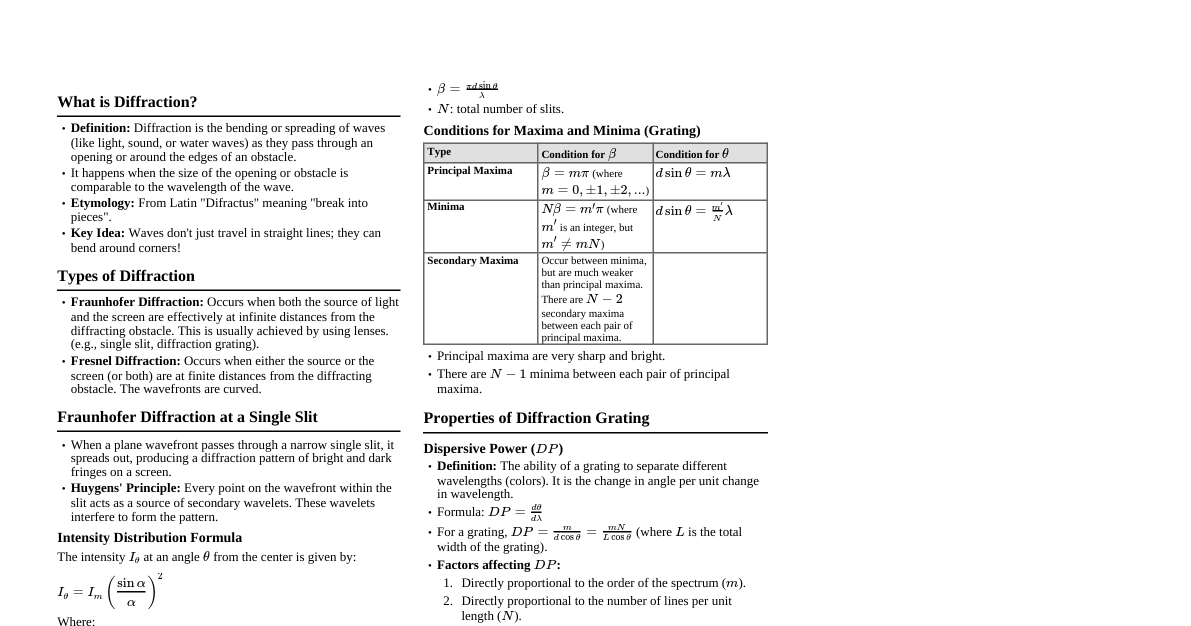
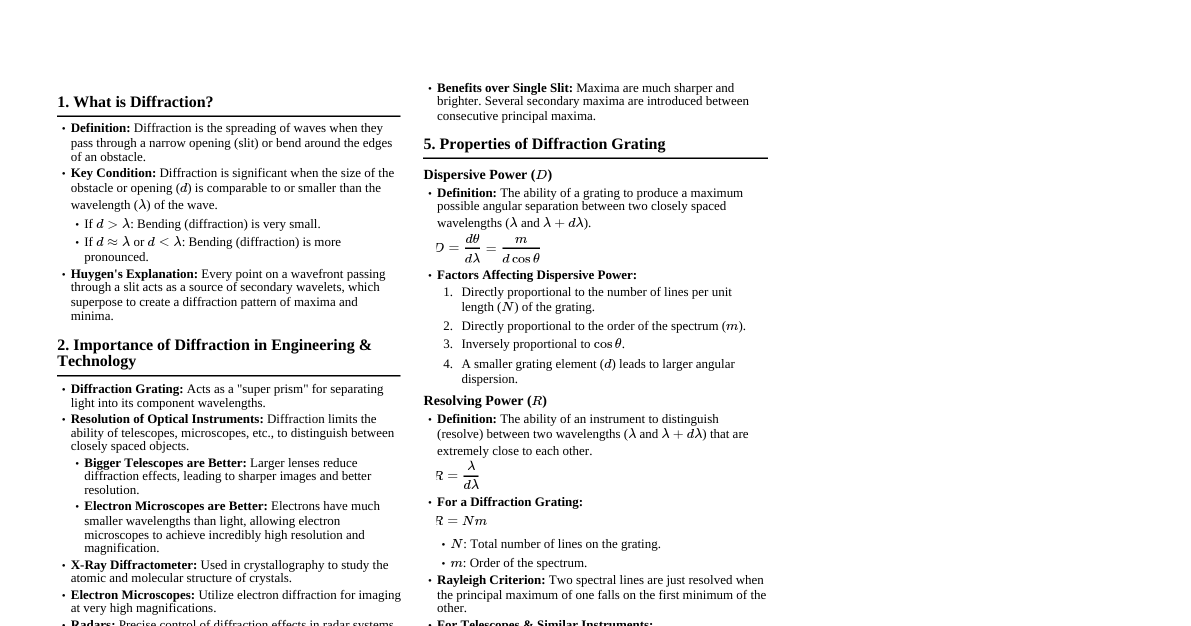
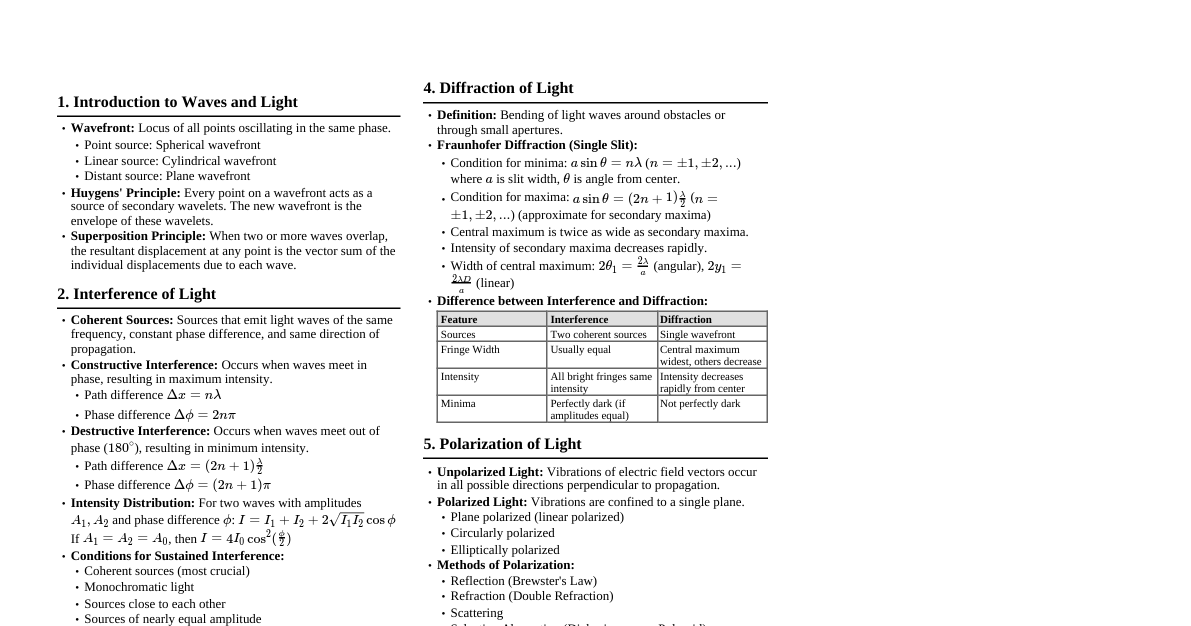
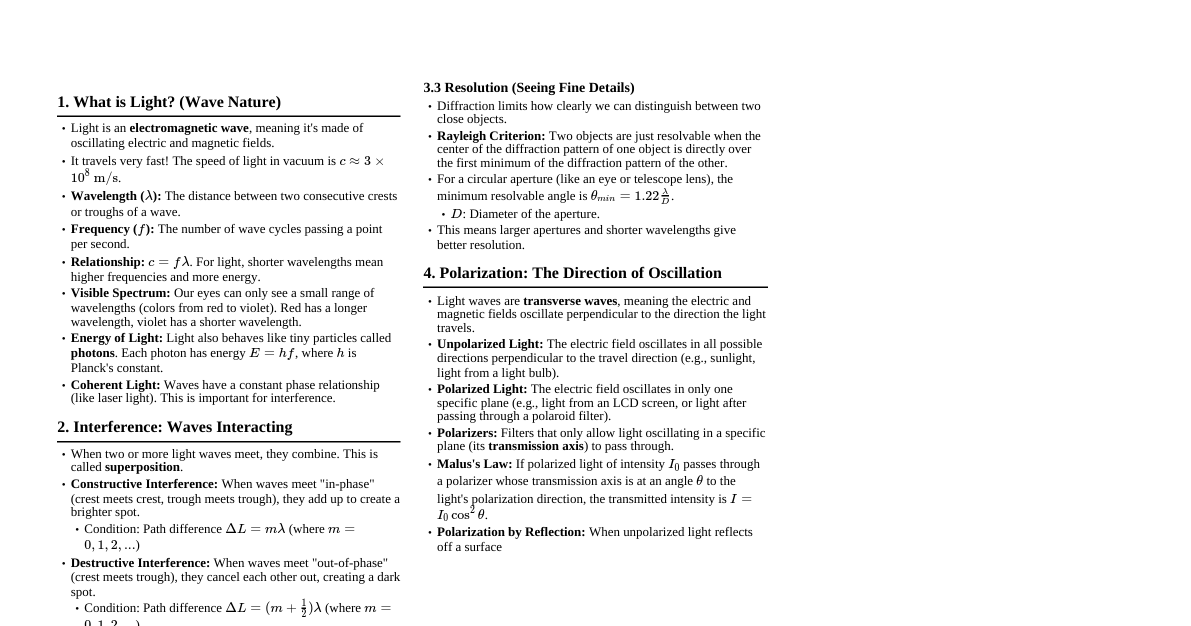
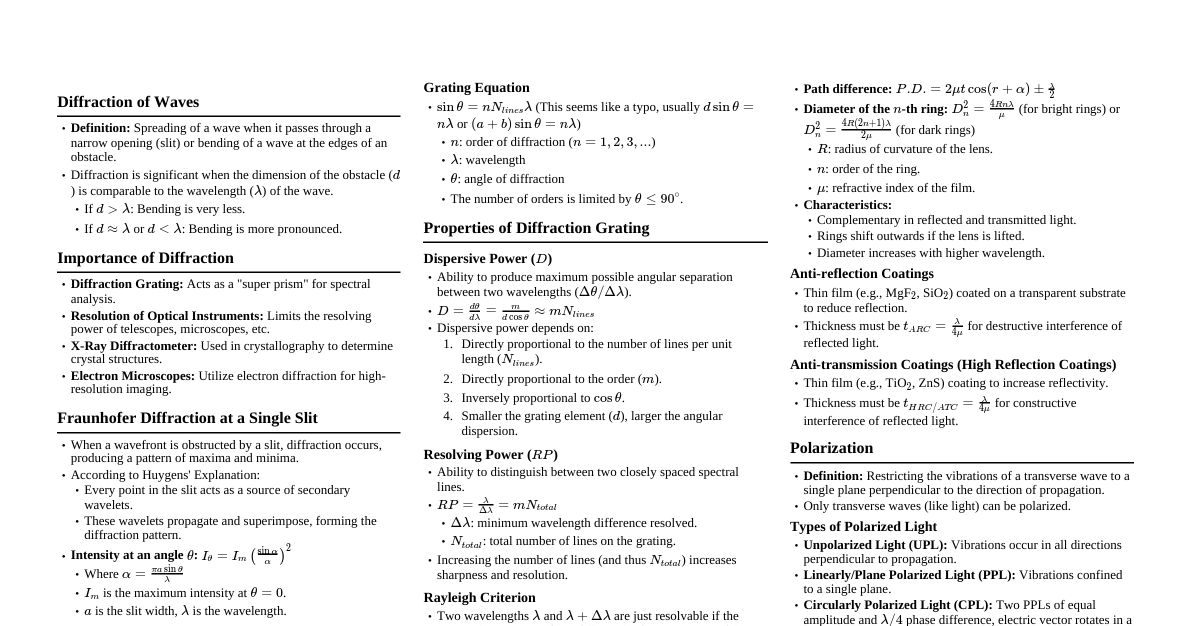
Diffraction Definition: Diffraction is the bending of waves (light, sound, etc.) as they pass around obstacles or through an aperture, resulting in the spreading of the wave. Conditions for Secondary Maxima: For a single slit, secondary maxima occur when $a \sin \theta = (m + \frac{1}{2})\lambda$, where $m = \pm 1, \pm 2, \dots$, $a$ is the slit width, $\theta$ is the diffraction angle, and $\lambda$ is the wavelength. Conditions for Minima (Dark Fringes): For a single slit, minima occur when $a \sin \theta = m\lambda$, where $m = \pm 1, \pm 2, \dots$. Types of Diffraction: Fresnel Diffraction (near-field diffraction) Fraunhofer Diffraction (far-field diffraction) Fresnel Diffraction: Occurs when either the source or the screen (or both) are at a finite distance from the diffracting obstacle/aperture. The wavefronts are spherical or cylindrical. Fraunhofer Diffraction: Occurs when both the source and the screen are effectively at infinite distances from the diffracting obstacle/aperture. This is achieved by using lenses to make the wavefronts plane. Fresnel vs. Fraunhofer Diffraction Feature Fresnel Diffraction Fraunhofer Diffraction Distance Finite distance from source/screen to aperture. Infinite distance from source/screen to aperture. Wavefront Spherical or cylindrical. Plane. Lenses Not required. Required to achieve plane wavefronts. Pattern Complex, depends on distance. Sharp, well-defined, independent of distance. Examples of Fresnel Diffraction: Diffraction at a straight edge. Diffraction by a small hole or opaque disc (e.g., Poisson's spot). Examples of Fraunhofer Diffraction: Single-slit diffraction pattern seen on a distant screen. Diffraction grating patterns. Polarization of Light Definition: Polarization of light refers to the restriction of the vibration of light waves to a single plane. Explanation & Proof of Transverse Wave: Light is an electromagnetic wave with electric ($\vec{E}$) and magnetic ($\vec{B}$) fields oscillating perpendicular to each other and to the direction of propagation. When light passes through a polarizer, only components of the $\vec{E}$ field oscillating in a specific direction are transmitted, proving its transverse nature. If light were longitudinal, it couldn't be polarized. Types of Polarization: Linear (Plane) Polarization Circular Polarization Elliptical Polarization Partial Polarization Linear Polarization: The electric field vector oscillates consistently in a single plane perpendicular to the direction of propagation. Example: Light passing through a Polaroid filter. Circular Polarization: The tip of the electric field vector traces out a circle in a plane perpendicular to the direction of propagation. This can be left-handed or right-handed. Example: Light transmitted through a quarter-wave plate from linearly polarized light at $45^\circ$ to its fast/slow axes. Elliptical Polarization: The tip of the electric field vector traces out an ellipse in a plane perpendicular to the direction of propagation. This is the most general state of polarization. Example: Light reflected from a metallic surface, or light passing through a quarter-wave plate from linearly polarized light at an angle other than $0^\circ$, $45^\circ$, or $90^\circ$. Partial Polarization: A state where light is a mixture of unpolarized and polarized light. The electric field vector has a preferred plane of oscillation but also vibrates randomly in other planes. Example: Light scattered from the sky (partially polarized blue light), or light reflected from non-metallic surfaces at angles other than Brewster's angle. Plane Polarization: Synonymous with linear polarization. Applications of Polarization: Polaroid sunglasses to reduce glare. LCD displays. 3D cinema. Stress analysis in materials (photoelasticity). Optical activity in chemistry (e.g., sugar solutions). Microscopy (polarizing microscopes). Diffraction Grating Resolving Power of a Diffraction Grating: The ability of a grating to separate two closely spaced wavelengths. It is defined as $R = \frac{\lambda}{\Delta \lambda}$, where $\lambda$ is the mean wavelength and $\Delta \lambda$ is the smallest resolvable wavelength difference. Expression for Resolving Power: For a grating with $N$ total rulings and order $m$, the resolving power is $R = Nm$. Dispersive Power of a Diffraction Grating: The ability of a grating to separate different wavelengths by dispersing them into different angles. It is defined as $D = \frac{d\theta}{d\lambda}$, the angular separation per unit change in wavelength. Expression for Dispersive Power: From the grating equation $d \sin \theta = m\lambda$, differentiating with respect to $\lambda$ gives $d \cos \theta \frac{d\theta}{d\lambda} = m$. So, $D = \frac{d\theta}{d\lambda} = \frac{m}{d \cos \theta}$. Retardation Plates / Wave Plates What is a Retardation Plate? An optical device made of a birefringent material that introduces a phase difference between two orthogonal components of light (ordinary and extraordinary rays) passing through it. Principle of Retardation Plate: When linearly polarized light enters a birefringent crystal, it splits into two components (ordinary and extraordinary rays) that travel at different speeds, leading to a phase difference between them upon exiting the crystal. Types of Retardation Plates: Quarter-Wave Plate ($\lambda/4$ plate) Half-Wave Plate ($\lambda/2$ plate) Full-Wave Plate ($\lambda$ plate) Half-Wave Plate ($\lambda/2$ plate): Introduces a phase difference of $\pi$ (or $180^\circ$) between the ordinary and extraordinary rays. It changes the orientation of linearly polarized light by an angle $2\phi$, where $\phi$ is the angle between the incident polarization and the fast axis. Thickness: $d = \frac{\lambda}{2(n_e - n_o)}$. Quarter-Wave Plate ($\lambda/4$ plate): Introduces a phase difference of $\pi/2$ (or $90^\circ$) between the ordinary and extraordinary rays. It can convert linearly polarized light into circularly polarized light (if incident at $45^\circ$ to the fast/slow axes) or elliptically polarized light. Thickness: $d = \frac{\lambda}{4(n_e - n_o)}$. Applications of Half-Wave Plate: Rotating the plane of polarization of linearly polarized light. Used in optical isolators. Compensating for unwanted polarization rotation. Applications of Quarter-Wave Plate: Converting linearly polarized light to circularly or elliptically polarized light. Converting circularly or elliptically polarized light back to linearly polarized light. Used in optical sensors and modulators. Used in 3D glasses for circularly polarized cinema. Nanotechnology Explanation of Nanotechnology: The manipulation of matter on an atomic, molecular, and supramolecular scale, typically in the size range of 1 to 100 nanometers. It involves understanding and controlling properties of materials at this scale, which often differ significantly from bulk materials. Applications of Nanotechnology in Daily Life: Self-cleaning windows and fabrics (nanocoatings). Scratch-resistant coatings for eyeglasses and cars. UV-blocking sunscreens (nano-TiO$_2$, nano-ZnO). Longer-lasting tennis balls and golf clubs. Improved fuel efficiency in cars (nanocomposite tires). Applications of Nanotechnology in Cosmetics: Enhanced delivery of active ingredients (e.g., vitamins, anti-aging compounds) into the skin using liposomes or nanoparticles. Improved UV protection in sunscreens (transparent nano-TiO$_2$, nano-ZnO). Long-lasting makeup (nanopigments). Anti-microbial properties in deodorants (nanosilver). Applications of Nanotechnology in Textile Industry: Stain-resistant and water-repellent fabrics (nanocoatings). Wrinkle-free and anti-crease textiles. UV-protective clothing. Anti-bacterial and anti-odor fabrics (nanosilver, nano-TiO$_2$). Smart textiles with integrated sensors or electronics. Applications of Nanotechnology in Medical Industry: Targeted drug delivery systems (nanoparticles carrying drugs to specific cells). Improved imaging and diagnostics (quantum dots, magnetic nanoparticles). Tissue engineering and regenerative medicine (nanofibers for scaffolds). Advanced wound dressings (nanofiber mats with antimicrobial agents). Biosensors for early disease detection. Applications of Nanotechnology in Automotive Industry: Lighter and stronger materials for vehicle bodies (nanocomposites). Improved fuel efficiency and reduced emissions (nanocatalysts). Scratch-resistant paints and coatings. Advanced sensors for safety and performance (nanosensors). Longer-lasting tires with better grip (nanofillers). Applications of Nanotechnology in Electronics: Smaller, faster, and more energy-efficient transistors (nanotransistors). High-density data storage (nanomagnetic materials). Flexible and transparent displays (nanomaterials like graphene). Improved batteries and supercapacitors (nanostructured electrodes). Quantum computing components. Applications of Nanotechnology in Photonics: Enhanced light emission and detection (quantum dots for LEDs, solar cells). Plasmonics for manipulating light at the nanoscale. Metamaterials for negative refractive index and perfect lenses. Optical sensors with higher sensitivity. Miniaturized optical circuits and waveguides.