Acids, Bases, Salts, Metals, Non-metals
Cheatsheet Content
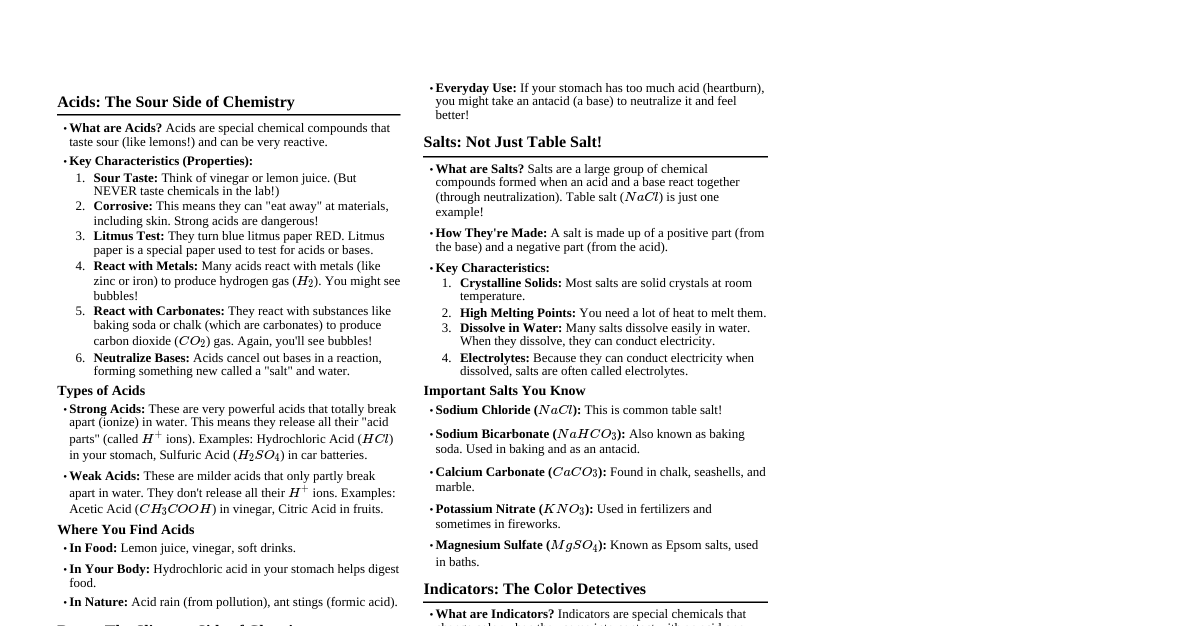
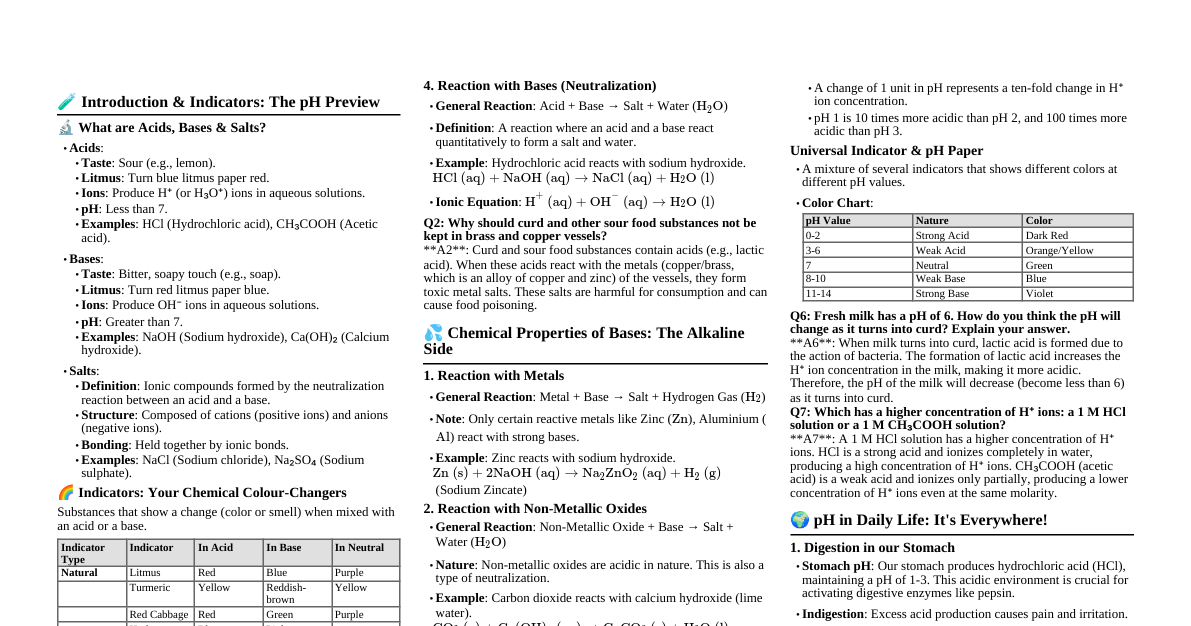
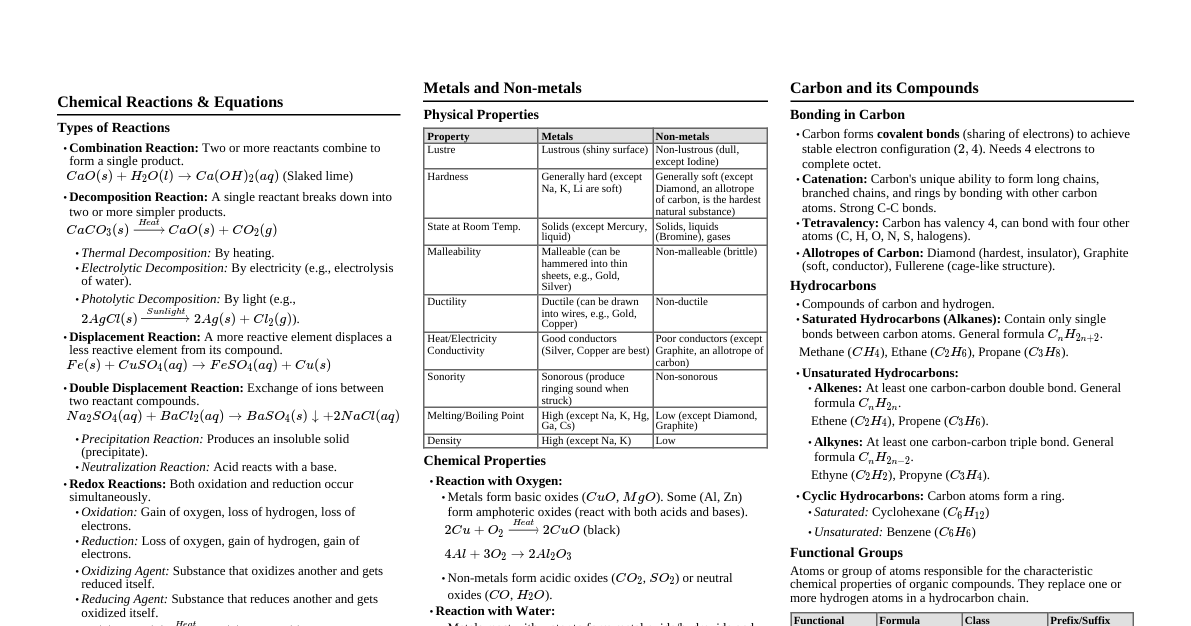
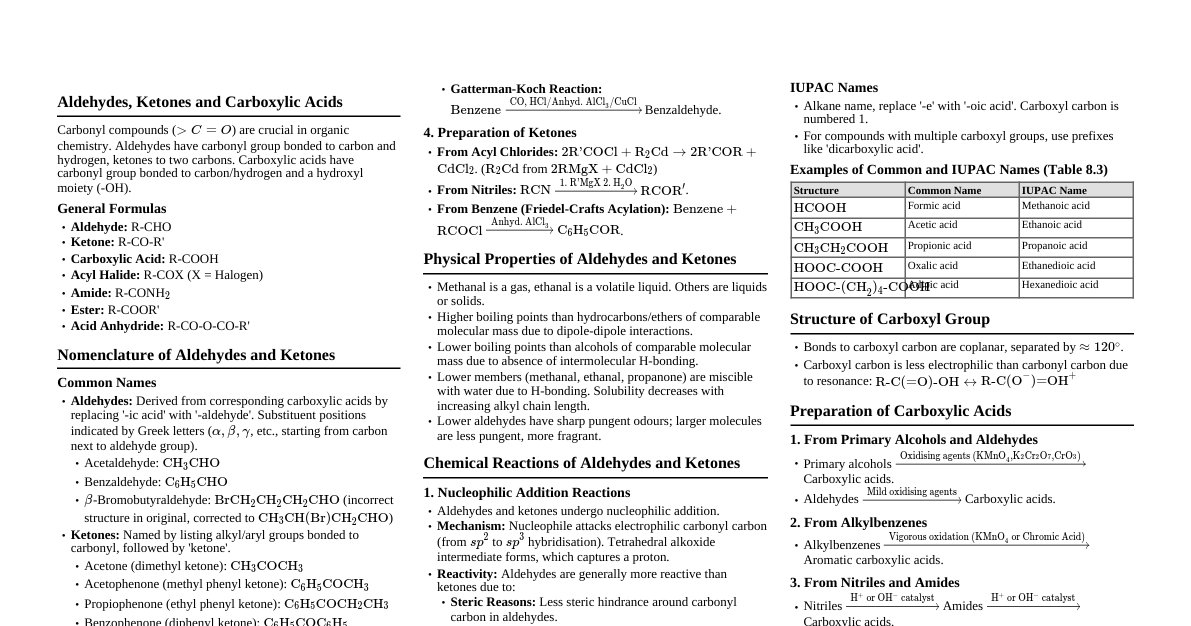
Acids, Bases and Salts Indicators Litmus: Natural indicator. Acids turn blue litmus red. Bases turn red litmus blue. Purple when neither acidic nor basic. Turmeric: Natural indicator. Reddish-brown in basic solutions (e.g., soap), turns yellow again with water. Synthetic Indicators: Methyl orange, phenolphthalein. Olfactory Indicators: Substances whose odour changes in acidic or basic media (e.g., onion, vanilla essence, clove oil). Reactions of Acids and Bases 1. With Metals Acid + Metal $\rightarrow$ Salt + Hydrogen gas Example: $2\text{HCl}(\text{aq}) + \text{Zn}(\text{s}) \rightarrow \text{ZnCl}_2(\text{aq}) + \text{H}_2(\text{g})$ Hydrogen gas is tested by the "pop" sound when a burning candle is brought near it. Base + Metal (some metals) $\rightarrow$ Salt + Hydrogen gas Example: $2\text{NaOH}(\text{aq}) + \text{Zn}(\text{s}) \rightarrow \text{Na}_2\text{ZnO}_2(\text{s}) + \text{H}_2(\text{g})$ (Sodium zincate) 2. With Metal Carbonates and Metal Hydrogencarbonates Metal Carbonate/Hydrogencarbonate + Acid $\rightarrow$ Salt + Carbon dioxide + Water Example (Carbonate): $\text{Na}_2\text{CO}_3(\text{s}) + 2\text{HCl}(\text{aq}) \rightarrow 2\text{NaCl}(\text{aq}) + \text{H}_2\text{O}(\text{l}) + \text{CO}_2(\text{g})$ Example (Hydrogencarbonate): $\text{NaHCO}_3(\text{s}) + \text{HCl}(\text{aq}) \rightarrow \text{NaCl}(\text{aq}) + \text{H}_2\text{O}(\text{l}) + \text{CO}_2(\text{g})$ $\text{CO}_2$ gas turns lime water ($\text{Ca}(\text{OH})_2$) milky: $\text{Ca}(\text{OH})_2(\text{aq}) + \text{CO}_2(\text{g}) \rightarrow \text{CaCO}_3(\text{s}) + \text{H}_2\text{O}(\text{l})$ Excess $\text{CO}_2$ makes it soluble again: $\text{CaCO}_3(\text{s}) + \text{H}_2\text{O}(\text{l}) + \text{CO}_2(\text{g}) \rightarrow \text{Ca}(\text{HCO}_3)_2(\text{aq})$ 3. With Each Other (Neutralisation) Acid + Base $\rightarrow$ Salt + Water Example: $\text{NaOH}(\text{aq}) + \text{HCl}(\text{aq}) \rightarrow \text{NaCl}(\text{aq}) + \text{H}_2\text{O}(\text{l})$ This is an exothermic reaction. 4. With Metal Oxides and Non-metallic Oxides Metal Oxide + Acid $\rightarrow$ Salt + Water (Metal oxides are basic oxides) Example: $\text{CuO}(\text{s}) + 2\text{HCl}(\text{aq}) \rightarrow \text{CuCl}_2(\text{aq}) + \text{H}_2\text{O}(\text{l})$ Non-metallic Oxide + Base $\rightarrow$ Salt + Water (Non-metallic oxides are acidic oxides) Example: $\text{Ca}(\text{OH})_2(\text{aq}) + \text{CO}_2(\text{g}) \rightarrow \text{CaCO}_3(\text{s}) + \text{H}_2\text{O}(\text{l})$ Acids and Bases in Water Acids: Produce $\text{H}^+$ ions ($\text{H}_3\text{O}^+$ hydronium ions) in water. $\text{HCl} + \text{H}_2\text{O} \rightarrow \text{H}_3\text{O}^+ + \text{Cl}^-$ Aqueous solutions of acids conduct electricity. Bases: Produce $\text{OH}^-$ ions in water. $\text{NaOH}(\text{s}) \xrightarrow{\text{H}_2\text{O}} \text{Na}^+(\text{aq}) + \text{OH}^-(\text{aq})$ Bases soluble in water are called alkalis (soapy, bitter, corrosive). Dilution: Mixing acid/base with water decreases concentration of $\text{H}_3\text{O}^+/\text{OH}^-$ per unit volume. Highly exothermic process; always add acid to water slowly. pH Scale Measures hydrogen ion concentration. 'p' in pH stands for 'potenz' (power). Range: 0 (very acidic) to 14 (very alkaline). Neutral solution: pH = 7. Acidic solutions: pH Basic solutions: pH > 7 (higher $\text{OH}^-$ concentration). Strong acids/bases: Produce more $\text{H}^+/\text{OH}^-$ ions. Weak acids/bases: Produce less $\text{H}^+/\text{OH}^-$ ions. Importance of pH in Everyday Life Living Organisms: Work within narrow pH range (7.0-7.8). Acid Rain: pH Soil pH: Plants require specific pH range for healthy growth. Digestive System: Stomach produces $\text{HCl}$ for digestion. Excess acid causes pain; antacids (mild bases like $\text{Mg}(\text{OH})_2$) neutralize it. Tooth Decay: Starts when mouth pH Self-defence: Bee sting (acidic); baking soda gives relief. Nettle leaves (methanoic acid); dock plant leaf gives relief. Salts Formed from reactions of acids and bases. Family of Salts: Salts with common positive or negative radicals (e.g., $\text{NaCl}$ and $\text{Na}_2\text{SO}_4$ are sodium salts). pH of Salts: Strong acid + Strong base $\rightarrow$ Neutral salt (pH=7) Strong acid + Weak base $\rightarrow$ Acidic salt (pH Weak acid + Strong base $\rightarrow$ Basic salt (pH > 7) Chemicals from Common Salt ($\text{NaCl}$) Sodium Hydroxide ($\text{NaOH}$): Produced by chlor-alkali process (electrolysis of brine). $2\text{NaCl}(\text{aq}) + 2\text{H}_2\text{O}(\text{l}) \rightarrow 2\text{NaOH}(\text{aq}) + \text{Cl}_2(\text{g}) + \text{H}_2(\text{g})$ $\text{Cl}_2$ (anode), $\text{H}_2$ (cathode), $\text{NaOH}$ (near cathode). Uses: $\text{H}_2$ (fuels, margarine), $\text{Cl}_2$ (water treatment, PVC), $\text{NaOH}$ (degreasing metals, soaps, paper making). Bleaching Powder ($\text{Ca}(\text{ClO})_2$): Produced by action of $\text{Cl}_2$ on dry slaked lime ($\text{Ca}(\text{OH})_2$). $\text{Ca}(\text{OH})_2 + \text{Cl}_2 \rightarrow \text{Ca}(\text{ClO})_2 + \text{H}_2\text{O}$ Uses: Bleaching cotton/wood pulp, oxidising agent, disinfectant for drinking water. Baking Soda ($\text{NaHCO}_3$ - Sodium hydrogencarbonate): $\text{NaCl} + \text{H}_2\text{O} + \text{CO}_2 + \text{NH}_3 \rightarrow \text{NH}_4\text{Cl} + \text{NaHCO}_3$ Mild non-corrosive basic salt. Uses: Cooking (heated $\rightarrow$ $\text{Na}_2\text{CO}_3 + \text{H}_2\text{O} + \text{CO}_2$) Baking powder (mix with mild edible acid): $\text{NaHCO}_3 + \text{H}^+ \rightarrow \text{CO}_2 + \text{H}_2\text{O} + \text{Sodium salt of acid}$ ($\text{CO}_2$ makes bread/cake soft). Antacid (alkaline, neutralizes excess stomach acid). Soda-acid fire extinguishers. Washing Soda ($\text{Na}_2\text{CO}_3 \cdot 10\text{H}_2\text{O}$ - Sodium carbonate decahydrate): Obtained by recrystallization of sodium carbonate (from heating baking soda). $\text{Na}_2\text{CO}_3 + 10\text{H}_2\text{O} \rightarrow \text{Na}_2\text{CO}_3 \cdot 10\text{H}_2\text{O}$ Uses: Glass, soap, paper industries, borax manufacture, cleaning agent, removing permanent hardness of water. Plaster of Paris ($\text{CaSO}_4 \cdot \frac{1}{2}\text{H}_2\text{O}$ - Calcium sulphate hemihydrate): From heating gypsum ($\text{CaSO}_4 \cdot 2\text{H}_2\text{O}$) at 373 K. $\text{CaSO}_4 \cdot 2\text{H}_2\text{O} \xrightarrow{373\text{K}} \text{CaSO}_4 \cdot \frac{1}{2}\text{H}_2\text{O} + \frac{3}{2}\text{H}_2\text{O}$ White powder, mixes with water to form gypsum (hard solid mass). Uses: Supporting fractured bones, toys, decorative materials, smoothing surfaces. Crystals of Salts and Water of Crystallisation Some salts contain a fixed number of water molecules as part of their crystal structure (e.g., $\text{CuSO}_4 \cdot 5\text{H}_2\text{O}$). Heating removes this water, changing colour and properties. Adding water restores them. Metals and Non-metals Physical Properties Property Metals Non-metals Lustre Shiny surface (metallic lustre) Dull (except iodine) Hardness Generally hard (except Na, K, Li - soft, cut with knife) Generally soft (except diamond - allotrope of carbon, hardest natural substance) State (Room Temp) Solids (except mercury - liquid) Solids or gases (except bromine - liquid) Malleability Can be beaten into thin sheets (e.g., gold, silver) Non-malleable, brittle Ductility Can be drawn into thin wires (e.g., gold) Non-ductile Heat Conduction Good conductors (silver, copper are best; lead, mercury are poor) Poor conductors Electrical Conduction Good conductors Poor conductors (except graphite - allotrope of carbon) Sonority Sonorous (produce sound when struck) Non-sonorous Melting/Boiling Points High (except gallium, caesium - low) Low (except diamond) Chemical Properties of Metals 1. Reaction with Air (Oxygen) Most metals combine with oxygen to form metal oxides. $\text{Metal} + \text{Oxygen} \rightarrow \text{Metal oxide}$ Example: $2\text{Cu} + \text{O}_2 \rightarrow 2\text{CuO}$ (black copper(II) oxide) $\text{Na}$ and $\text{K}$ react vigorously, stored in kerosene oil. $\text{Mg}, \text{Al}, \text{Zn}, \text{Pb}$ surfaces covered by thin oxide layer, preventing further oxidation. $\text{Fe}$ does not burn, but $\text{Fe}$ filings burn vigorously. $\text{Ag}, \text{Au}$ do not react with oxygen even at high temperatures. Metal Oxides: Generally basic in nature. Some are Amphoteric Oxides (react with both acids and bases to produce salt and water) e.g., $\text{Al}_2\text{O}_3, \text{ZnO}$. $\text{Al}_2\text{O}_3 + 6\text{HCl} \rightarrow 2\text{AlCl}_3 + 3\text{H}_2\text{O}$ $\text{Al}_2\text{O}_3 + 2\text{NaOH} \rightarrow 2\text{NaAlO}_2 + \text{H}_2\text{O}$ (Sodium aluminate) Some are soluble in water forming alkalis (e.g., $\text{Na}_2\text{O}, \text{K}_2\text{O}$). $\text{Na}_2\text{O}(\text{s}) + \text{H}_2\text{O}(\text{l}) \rightarrow 2\text{NaOH}(\text{aq})$ 2. Reaction with Water $\text{Metal} + \text{Water} \rightarrow \text{Metal oxide/hydroxide} + \text{Hydrogen gas}$ $\text{K}, \text{Na}$: React violently with cold water, exothermic, $\text{H}_2$ catches fire. $2\text{K}(\text{s}) + 2\text{H}_2\text{O}(\text{l}) \rightarrow 2\text{KOH}(\text{aq}) + \text{H}_2(\text{g}) + \text{heat energy}$ $\text{Ca}$: Reacts less violently with cold water, $\text{H}_2$ does not catch fire, $\text{Ca}$ floats due to $\text{H}_2$ bubbles. $\text{Ca}(\text{s}) + 2\text{H}_2\text{O}(\text{l}) \rightarrow \text{Ca}(\text{OH})_2(\text{aq}) + \text{H}_2(\text{g})$ $\text{Mg}$: Reacts with hot water, floats due to $\text{H}_2$ bubbles. $\text{Al}, \text{Fe}, \text{Zn}$: Do not react with cold/hot water, but react with steam to form oxide and $\text{H}_2$. $2\text{Al}(\text{s}) + 3\text{H}_2\text{O}(\text{g}) \rightarrow \text{Al}_2\text{O}_3(\text{s}) + 3\text{H}_2(\text{g})$ $\text{Pb}, \text{Cu}, \text{Ag}, \text{Au}$: Do not react with water. 3. Reaction with Acids $\text{Metal} + \text{Dilute Acid} \rightarrow \text{Salt} + \text{Hydrogen gas}$ (except with $\text{HNO}_3$) $\text{Mg}, \text{Al}, \text{Zn}, \text{Fe}$: React with dilute $\text{HCl}$. Reactivity order: $\text{Mg} > \text{Al} > \text{Zn} > \text{Fe}$. $\text{HNO}_3$ is a strong oxidizing agent, oxidizes $\text{H}_2$ to water, reduced to $\text{N}$ oxides (except very dilute $\text{HNO}_3$ with $\text{Mg}, \text{Mn}$). $\text{Cu}$: Does not react with dilute $\text{HCl}$. Aqua Regia: $3:1$ mixture of conc. $\text{HCl}$ and conc. $\text{HNO}_3$, dissolves gold and platinum. 4. Reaction with Solutions of Other Metal Salts (Displacement) More reactive metal displaces less reactive metal from its salt solution. $\text{Metal A} + \text{Salt solution of B} \rightarrow \text{Salt solution of A} + \text{Metal B}$ Example: $\text{Fe}(\text{s}) + \text{CuSO}_4(\text{aq}) \rightarrow \text{FeSO}_4(\text{aq}) + \text{Cu}(\text{s})$ Reactivity Series (Activity Series) List of metals arranged in decreasing order of reactivity: Most Reactive: $\text{K}, \text{Na}, \text{Ca}, \text{Mg}, \text{Al}, \text{Zn}, \text{Fe}, \text{Pb}$ $\text{H}$ (reference point) Least Reactive: $\text{Cu}, \text{Hg}, \text{Ag}, \text{Au}$ How Metals and Non-metals React Elements react to achieve stable electron configurations (like noble gases). Metals: Lose electrons to form positive ions (cations). Non-metals: Gain electrons to form negative ions (anions). Ionic Compounds (Electrovalent Compounds): Formed by transfer of electrons between a metal and a non-metal. Example: $\text{Na} + \text{Cl} \rightarrow \text{Na}^+ + \text{Cl}^-$ (NaCl) Example: $\text{Mg} + \text{Cl}_2 \rightarrow \text{Mg}^{2+} + 2\text{Cl}^-$ ($\text{MgCl}_2$) Properties of Ionic Compounds Physical Nature: Solids, somewhat hard, brittle. Melting/Boiling Points: High (strong inter-ionic attraction). Solubility: Generally soluble in water, insoluble in organic solvents (kerosene, petrol). Conduction of Electricity: Do not conduct in solid state (rigid structure prevents ion movement). Conduct in molten state or aqueous solution (ions are free to move). Occurrence and Extraction of Metals Minerals: Elements/compounds occurring naturally in Earth's crust. Ores: Minerals from which metals can be profitably extracted. Gangue: Impurities (soil, sand) in ores. Metallurgy Steps: Concentration of Ore (Removal of gangue). Conversion to Metal Oxide: Metals low in reactivity series ($\text{Hg}, \text{Cu}$): Oxides reduced by heating alone. $2\text{HgS}(\text{s}) + 3\text{O}_2(\text{g}) \xrightarrow{\text{Heat}} 2\text{HgO}(\text{s}) + 2\text{SO}_2(\text{g})$ $2\text{HgO}(\text{s}) \xrightarrow{\text{Heat}} 2\text{Hg}(\text{l}) + \text{O}_2(\text{g})$ Metals in middle of reactivity series ($\text{Zn}, \text{Fe}, \text{Pb}$): Carbonates/sulphides converted to oxides. Roasting: Heating sulphide ore in excess air. $2\text{ZnS}(\text{s}) + 3\text{O}_2(\text{g}) \xrightarrow{\text{Heat}} 2\text{ZnO}(\text{s}) + 2\text{SO}_2(\text{g})$ Calcination: Heating carbonate ore in limited air. $\text{ZnCO}_3(\text{s}) \xrightarrow{\text{Heat}} \text{ZnO}(\text{s}) + \text{CO}_2(\text{g})$ Metals high in reactivity series ($\text{K}, \text{Na}, \text{Ca}, \text{Mg}, \text{Al}$): Cannot be reduced by carbon due to higher affinity for oxygen. Extracted by electrolytic reduction of molten chlorides. At cathode: $\text{Na}^+ + \text{e}^- \rightarrow \text{Na}$ At anode: $2\text{Cl}^- \rightarrow \text{Cl}_2 + 2\text{e}^-$ Reduction to Metal: Using reducing agents like carbon: $\text{ZnO}(\text{s}) + \text{C}(\text{s}) \rightarrow \text{Zn}(\text{s}) + \text{CO}(\text{g})$ Using displacement reactions with highly reactive metals (e.g., $\text{Al}$). Highly exothermic. $3\text{MnO}_2(\text{s}) + 4\text{Al}(\text{s}) \rightarrow 3\text{Mn}(\text{l}) + 2\text{Al}_2\text{O}_3(\text{s}) + \text{Heat}$ Thermit reaction: $\text{Fe}_2\text{O}_3(\text{s}) + 2\text{Al}(\text{s}) \rightarrow 2\text{Fe}(\text{l}) + \text{Al}_2\text{O}_3(\text{s}) + \text{Heat}$ (used to join railway tracks). Refining of Metals (Purification): Electrolytic Refining: Impure metal as anode, thin strip of pure metal as cathode, metal salt solution as electrolyte. Pure metal from anode dissolves into electrolyte and deposits on cathode. Soluble impurities go into solution, insoluble impurities settle as anode mud. Corrosion Metal reacts with substances in atmosphere (moisture, acids) to form undesirable compounds. Rusting of Iron: Reddish-brown flaky substance ($\text{Fe}_2\text{O}_3 \cdot \text{xH}_2\text{O}$). Requires both oxygen and water. Black coating on Silver: Due to $\text{Ag}_2\text{S}$ (reaction with sulphur in air). Green coating on Copper: Due to basic copper carbonate ($\text{CuCO}_3 \cdot \text{Cu}(\text{OH})_2$). Prevention: Painting, oiling, greasing, galvanising (zinc coating), chrome plating, anodising, making alloys. Alloys Homogeneous mixture of two or more metals, or a metal and a non-metal. Prepared by melting primary metal and dissolving other elements, then cooling. Improve properties of metals (e.g., iron is soft, but steel (iron + carbon) is hard and strong). Amalgam: Alloy where one metal is mercury. Electrical conductivity and melting point are generally lower than pure metals. Example: Brass ($\text{Cu} + \text{Zn}$), Bronze ($\text{Cu} + \text{Sn}$), Solder ($\text{Pb} + \text{Sn}$). Gold Purity: 24 carat is pure gold (very soft). 22 carat gold (22 parts gold, 2 parts Cu/Ag) used for jewellery. Non-metals Form negatively charged ions by gaining electrons when reacting with metals. Form oxides which are either acidic or neutral. Do not displace hydrogen from dilute acids. React with hydrogen to form hydrides.