Metals and Non-metals (CBSE Class 10)
Cheatsheet Content
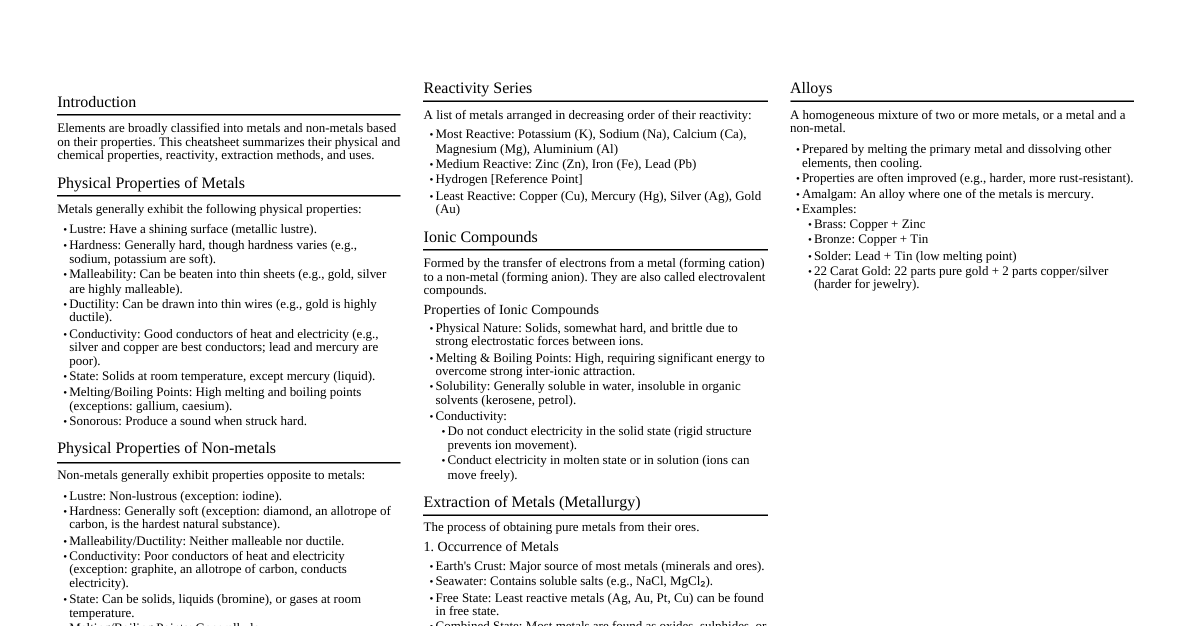
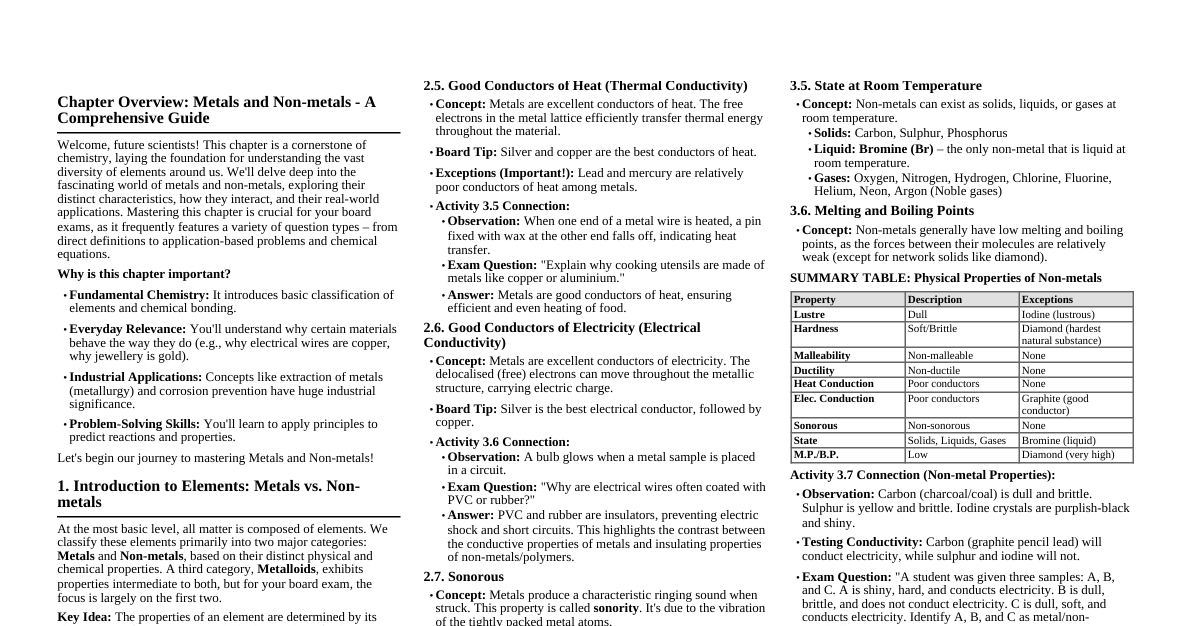
1. Introduction to Metals and Non-metals Elements are classified based on their properties into Metals, Non-metals, and Metalloids. Metals: Elements that readily lose electrons to form positive ions (cations). E.g., Fe, Cu, Al. Non-metals: Elements that readily gain electrons to form negative ions (anions) or share electrons. E.g., O, N, S. Metalloids: Elements showing properties of both metals and non-metals. E.g., Si, Ge, As. 2. Physical Properties 2.1. Metals Lustre: Shiny surface (metallic lustre). Hardness: Generally hard (except Na, K, Li which are soft and can be cut with a knife). State: Solid at room temperature (except Mercury, which is liquid). Malleability: Can be beaten into thin sheets (e.g., gold, silver). Ductility: Can be drawn into thin wires (e.g., gold, silver, copper). Conductivity: Good conductors of heat and electricity (Ag is the best, then Cu). Melting and Boiling Points: Generally high (except Na, K, Ga, Cs). Sonorous: Produce a ringing sound when struck. Density: Generally high. 2.2. Non-metals Lustre: Non-lustrous (dull), except Iodine. Hardness: Generally soft, except Diamond (an allotrope of Carbon), which is the hardest natural substance. State: Can be solid, liquid, or gas at room temperature. Solids: Carbon, Sulphur, Phosphorus Liquid: Bromine Gases: Oxygen, Nitrogen, Hydrogen Malleability & Ductility: Neither malleable nor ductile (brittle). Conductivity: Poor conductors of heat and electricity (insulators). Except Graphite (an allotrope of Carbon), which is a good conductor of electricity. Melting and Boiling Points: Generally low. Sonorous: Non-sonorous. Density: Generally low. 3. Chemical Properties 3.1. Reaction with Oxygen Metals: Form basic oxides. Some form amphoteric oxides. $4\text{Na} + \text{O}_2 \rightarrow 2\text{Na}_2\text{O}$ (Sodium oxide, basic) $2\text{Mg} + \text{O}_2 \rightarrow 2\text{MgO}$ (Magnesium oxide, basic) $4\text{Al} + 3\text{O}_2 \rightarrow 2\text{Al}_2\text{O}_3$ (Aluminium oxide, amphoteric) Amphoteric oxides react with both acids and bases. E.g., $\text{Al}_2\text{O}_3 + 6\text{HCl} \rightarrow 2\text{AlCl}_3 + 3\text{H}_2\text{O}$ and $\text{Al}_2\text{O}_3 + 2\text{NaOH} \rightarrow 2\text{NaAlO}_2 + \text{H}_2\text{O}$ (Sodium aluminate) Most metal oxides are insoluble in water, but some dissolve to form alkalis (e.g., $\text{Na}_2\text{O} + \text{H}_2\text{O} \rightarrow 2\text{NaOH}$). Different metals react with oxygen at different rates (Na, K are highly reactive; Ag, Au are least reactive). Non-metals: Form acidic or neutral oxides. $\text{C} + \text{O}_2 \rightarrow \text{CO}_2$ (Carbon dioxide, acidic) $\text{S} + \text{O}_2 \rightarrow \text{SO}_2$ (Sulphur dioxide, acidic) Non-metal oxides dissolve in water to form acids (e.g., $\text{CO}_2 + \text{H}_2\text{O} \rightarrow \text{H}_2\text{CO}_3$). Neutral oxides: $\text{CO}$, $\text{H}_2\text{O}$, $\text{N}_2\text{O}$. 3.2. Reaction with Water Metals: React with water/steam to form metal oxides/hydroxides and hydrogen gas. Cold water: Na, K, Ca (e.g., $2\text{Na} + 2\text{H}_2\text{O} \rightarrow 2\text{NaOH} + \text{H}_2$). Reaction is vigorous and exothermic. Hot water: Mg (e.g., $\text{Mg} + 2\text{H}_2\text{O} \rightarrow \text{Mg(OH)}_2 + \text{H}_2$). Steam: Al, Zn, Fe (e.g., $2\text{Al} + 3\text{H}_2\text{O (steam)} \rightarrow \text{Al}_2\text{O}_3 + 3\text{H}_2$). No reaction: Pb, Cu, Ag, Au. Non-metals: Generally do not react with water or steam. 3.3. Reaction with Acids Metals: React with dilute acids to form salt and hydrogen gas (according to reactivity series). $\text{Metal} + \text{Dilute Acid} \rightarrow \text{Salt} + \text{Hydrogen}$ E.g., $\text{Zn} + 2\text{HCl} \rightarrow \text{ZnCl}_2 + \text{H}_2$. Cu, Ag, Au do not react with dilute acids to liberate hydrogen. Nitric acid is an oxidizing agent and oxidizes $\text{H}_2$ produced to $\text{H}_2\text{O}$. Non-metals: Do not react with dilute acids. 3.4. Reaction with Bases Metals: Some metals (amphoteric metals like Al, Zn, Pb) react with strong bases to produce hydrogen gas. $2\text{Al} + 2\text{NaOH} + 6\text{H}_2\text{O} \rightarrow 2\text{Na}_3\text{AlO}_3 + 3\text{H}_2$ (Sodium meta-aluminate) $\text{Zn} + 2\text{NaOH} \rightarrow \text{Na}_2\text{ZnO}_2 + \text{H}_2$ (Sodium zincate) Non-metals: Non-metals react with bases in complex reactions. E.g., $\text{Cl}_2 + 2\text{NaOH} \rightarrow \text{NaCl} + \text{NaOCl} + \text{H}_2\text{O}$. 3.5. Reaction with Salt Solutions (Displacement Reactions) A more reactive metal displaces a less reactive metal from its salt solution. $\text{A} + \text{BCl} \rightarrow \text{ACl} + \text{B}$ (if A is more reactive than B) E.g., $\text{Fe} + \text{CuSO}_4 \rightarrow \text{FeSO}_4 + \text{Cu}$. Less reactive metals cannot displace more reactive metals. Non-metals: More reactive non-metals displace less reactive non-metals from their salt solutions. E.g., $\text{Cl}_2 + 2\text{NaBr} \rightarrow 2\text{NaCl} + \text{Br}_2$. 4. Reactivity Series of Metals A series of metals arranged in decreasing order of their reactivity. K (Potassium) - Most reactive Na (Sodium) Ca (Calcium) Mg (Magnesium) Al (Aluminium) Zn (Zinc) Fe (Iron) Pb (Lead) H (Hydrogen) - Reference point Cu (Copper) Hg (Mercury) Ag (Silver) Au (Gold) - Least reactive Metals above Hydrogen can displace Hydrogen from acids. Metals higher in the series can displace metals lower in the series from their salt solutions. 5. How Metals and Non-metals React Ionic Bonds: Formed by the transfer of electrons from a metal to a non-metal. Metals lose electrons to form cations. Non-metals gain electrons to form anions. Oppositely charged ions attract each other to form an ionic compound. E.g., Formation of NaCl: $\text{Na} \rightarrow \text{Na}^+ + \text{e}^-$ and $\text{Cl} + \text{e}^- \rightarrow \text{Cl}^-$. Then $\text{Na}^+ + \text{Cl}^- \rightarrow \text{NaCl}$. Covalent Bonds: Formed by the sharing of electrons between two non-metals. 6. Properties of Ionic Compounds Physical Nature: Solid and hard, due to strong electrostatic forces. Brittle. Melting and Boiling Points: High, due to strong inter-ionic attraction. Solubility: Generally soluble in water, but insoluble in organic solvents (petrol, kerosene). Conductivity: Do not conduct electricity in solid state (ions are fixed). Conduct electricity in molten state or in aqueous solution (ions are free to move). 7. Occurrence of Metals Minerals: Naturally occurring substances from which metals can be extracted. Ores: Minerals from which metals can be profitably extracted. Some metals (Au, Ag, Pt) are found in free state (native state) due to low reactivity. Most metals are found in combined state (oxides, carbonates, sulphides). 8. Metallurgy (Extraction of Metals) The process of extracting metals from their ores and refining them. Steps: Enrichment of Ores: Removal of gangue (impurities like soil, sand) from the ore. Hydraulic washing, magnetic separation, froth flotation, chemical separation. Extraction of Metal from Enriched Ore: Highly Reactive Metals (K, Na, Ca, Mg, Al): Extracted by electrolytic reduction of their molten chlorides or oxides. E.g., at cathode: $\text{Na}^+ + \text{e}^- \rightarrow \text{Na}$. Medium Reactive Metals (Zn, Fe, Pb, Cu): Carbonates are converted to oxides by calcination (heating in limited air). E.g., $\text{ZnCO}_3 \xrightarrow{\text{heat}} \text{ZnO} + \text{CO}_2$. Sulphides are converted to oxides by roasting (heating in excess air). E.g., $2\text{ZnS} + 3\text{O}_2 \xrightarrow{\text{heat}} 2\text{ZnO} + 2\text{SO}_2$. Metal oxides are then reduced to metal using reducing agents like Carbon (coke) or more reactive metals. $\text{ZnO} + \text{C} \xrightarrow{\text{heat}} \text{Zn} + \text{CO}$. Thermite reaction: $2\text{Al} + \text{Fe}_2\text{O}_3 \rightarrow \text{Al}_2\text{O}_3 + 2\text{Fe} + \text{Heat}$. Used for welding railway tracks. Less Reactive Metals (Hg, Cu, Ag): Sulphide ores are heated in air. E.g., $2\text{HgS} + 3\text{O}_2 \xrightarrow{\text{heat}} 2\text{HgO} + 2\text{SO}_2$. Then $2\text{HgO} \xrightarrow{\text{heat}} 2\text{Hg} + \text{O}_2$. Copper from its sulphide ore: $2\text{Cu}_2\text{S} + 3\text{O}_2 \xrightarrow{\text{heat}} 2\text{Cu}_2\text{O} + 2\text{SO}_2$. Then $2\text{Cu}_2\text{O} + \text{Cu}_2\text{S} \xrightarrow{\text{heat}} 6\text{Cu} + \text{SO}_2$. Refining of Metals: Removal of impurities from the crude metal. Most common method: Electrolytic Refining . Anode: Impure metal Cathode: Thin strip of pure metal Electrolyte: Salt solution of the metal Pure metal deposits at cathode, impurities settle as anode mud. E.g., for Copper: Anode: Impure Cu; Cathode: Pure Cu; Electrolyte: $\text{CuSO}_4$ solution. 9. Corrosion The process of slow eating up of metals due to the attack of atmospheric gases (oxygen, moisture, $\text{CO}_2$, etc.) on the surface of the metal. Rusting of Iron: Iron reacts with oxygen and moisture to form hydrated iron(III) oxide (rust). $4\text{Fe} + 3\text{O}_2 + x\text{H}_2\text{O} \rightarrow 2\text{Fe}_2\text{O}_3 \cdot x\text{H}_2\text{O}$ (Hydrated iron(III) oxide). Requires both oxygen and water. Corrosion of Copper: Forms a green layer of basic copper carbonate. $2\text{Cu} + \text{H}_2\text{O} + \text{CO}_2 + \text{O}_2 \rightarrow \text{Cu}(\text{OH})_2 \cdot \text{CuCO}_3$. Corrosion of Silver: Forms black silver sulphide due to reaction with $\text{H}_2\text{S}$ gas in air. $2\text{Ag} + \text{H}_2\text{S} \rightarrow \text{Ag}_2\text{S} + \text{H}_2$. Prevention of Corrosion: Painting/Oiling/Greasing: Prevents contact with air and moisture. Galvanising: Coating iron with a layer of zinc. Zinc is more reactive than iron, so it corrodes preferentially (sacrificial protection). Electroplating: Coating a metal with another non-corrosive metal. Anodising: Forming a thick oxide layer on aluminium (electrolytic process). Making Alloys: Mixing metals to improve properties. 10. Alloys A homogeneous mixture of two or more metals, or a metal and a non-metal. Properties of alloys are different and often superior to their constituent elements. Examples: Steel: Iron + Carbon (hard, strong). Stainless Steel: Iron + Nickel + Chromium (rust-resistant). Brass: Copper + Zinc (more malleable and ductile than copper). Bronze: Copper + Tin (harder and stronger than copper). Solder: Lead + Tin (low melting point, used for welding electrical wires). Amalgam: An alloy of mercury with another metal (e.g., dental amalgam: Hg + Ag + Sn).