Class 10th Science Cheatsheet
Cheatsheet Content
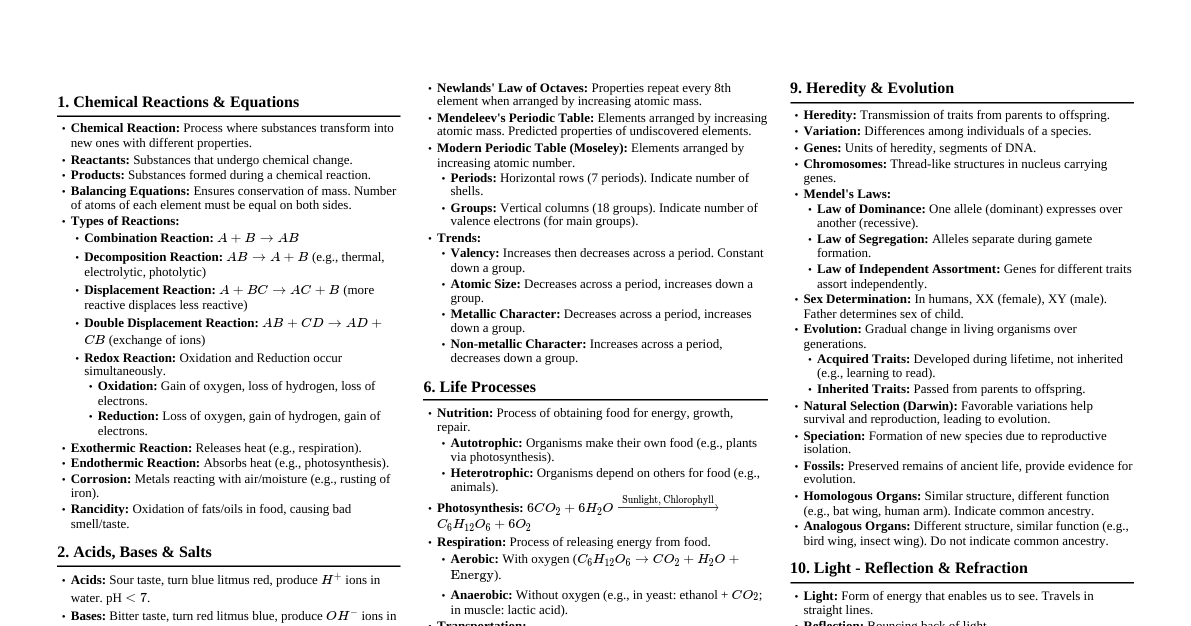
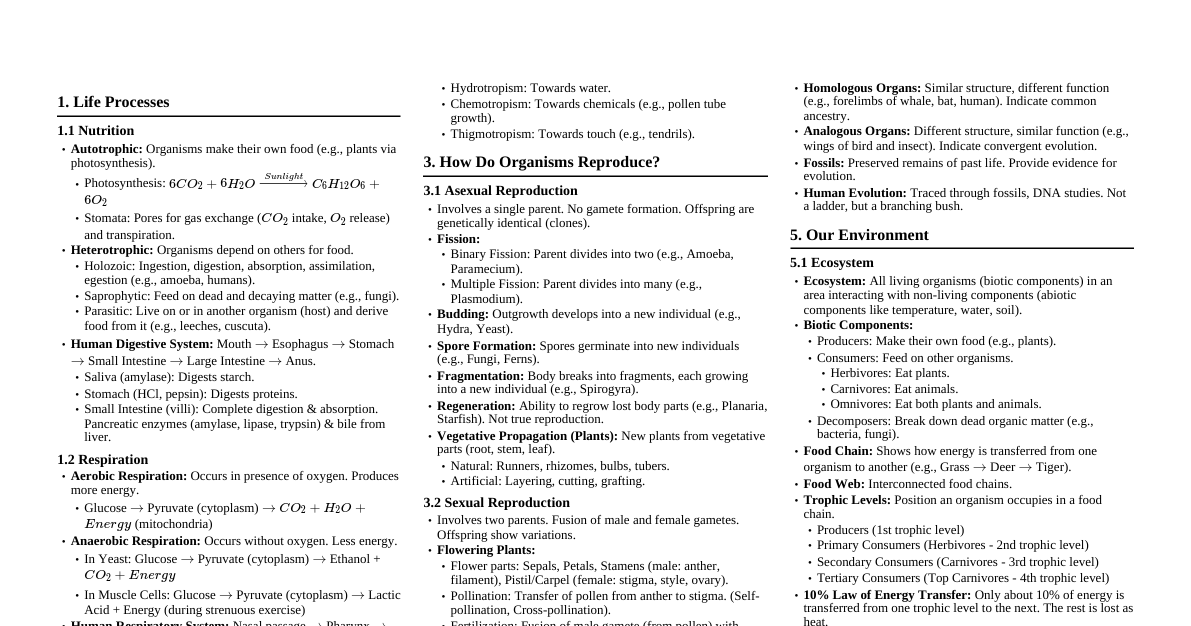
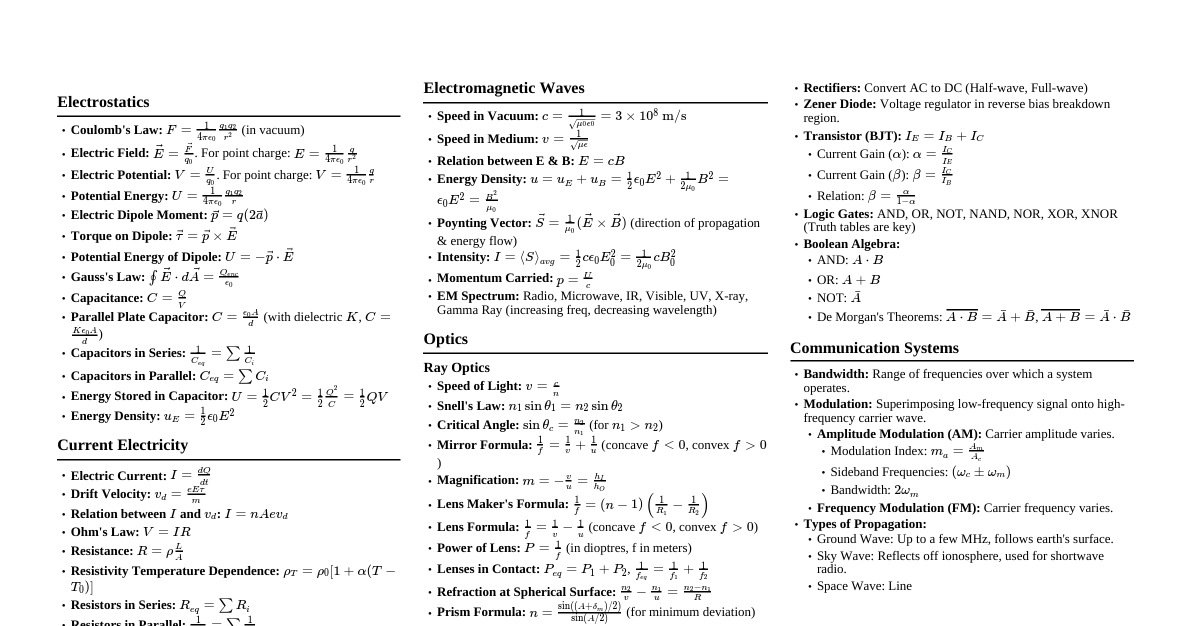
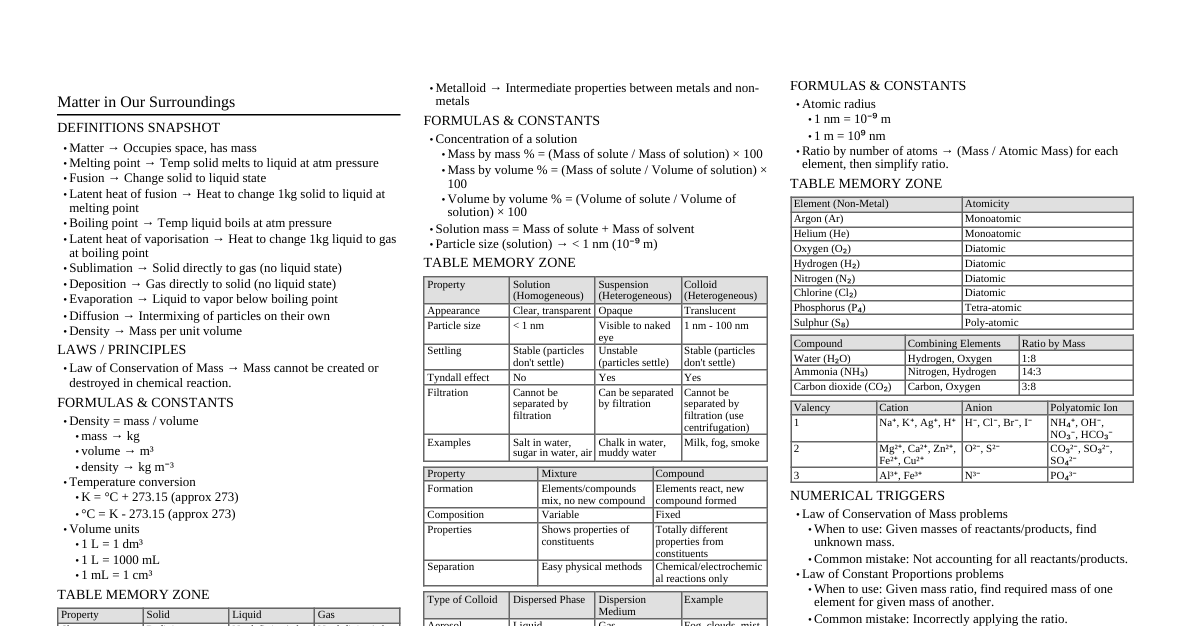
1. Chemical Reactions and Equations Chemical Reaction: Process where reactants transform into products. Example: $Mg + O_2 \to MgO$ (unbalanced) Balancing a Chemical Equation: Ensures conservation of mass. Hit and Trial Method. Example: $2Mg + O_2 \to 2MgO$ (balanced) Types of Reactions: Combination: $A + B \to AB$ (e.g., $CaO(s) + H_2O(l) \to Ca(OH)_2(aq) + Heat$) Decomposition: $AB \to A + B$ (e.g., $CaCO_3(s) \xrightarrow{heat} CaO(s) + CO_2(g)$) Thermal, Electrolytic, Photolytic decomposition. Displacement: $A + BC \to AC + B$ (more reactive displaces less reactive, e.g., $Fe(s) + CuSO_4(aq) \to FeSO_4(aq) + Cu(s)$) Double Displacement: $AB + CD \to AD + CB$ (exchange of ions, e.g., $Na_2SO_4(aq) + BaCl_2(aq) \to BaSO_4(s) \downarrow + 2NaCl(aq)$) Redox: Oxidation and Reduction occur simultaneously. Oxidation: Gain of oxygen, loss of hydrogen, loss of electrons. Reduction: Loss of oxygen, gain of hydrogen, gain of electrons. Example: $CuO(s) + H_2(g) \xrightarrow{heat} Cu(s) + H_2O(l)$ (CuO is reduced, $H_2$ is oxidised) Effects of Oxidation in Daily Life: Corrosion: Rusting of iron ($Fe_2O_3 \cdot xH_2O$), tarnishing of silver, green coating on copper. Rancidity: Oxidation of fats and oils in food, causing bad smell and taste. Prevented by antioxidants, N$_2$ packaging, refrigeration. 2. Acids, Bases and Salts Acids: Sour, turn blue litmus red, release $H^+$ ions in water. Strong acids: $HCl, H_2SO_4, HNO_3$. Weak acids: $CH_3COOH$. Bases: Bitter, soapy, turn red litmus blue, release $OH^-$ ions in water. Strong bases: $NaOH, KOH$. Weak bases: $NH_4OH$. Alkali: Soluble bases. Indicators: Substances that show different colours in acidic/basic media. Litmus (red/blue), Methyl Orange (red/yellow), Phenolphthalein (colourless/pink). Olfactory indicators: Onion, Vanilla essence. Reactions: Acid + Base $\to$ Salt + Water (Neutralisation): $HCl + NaOH \to NaCl + H_2O$ Acid + Metal $\to$ Salt + Hydrogen gas ($H_2$): $Zn(s) + H_2SO_4(aq) \to ZnSO_4(aq) + H_2(g)$ Acid + Metal Carbonate/Bicarbonate $\to$ Salt + Water + Carbon dioxide ($CO_2$): $CaCO_3(s) + 2HCl(aq) \to CaCl_2(aq) + H_2O(l) + CO_2(g)$ $NaHCO_3(s) + HCl(aq) \to NaCl(aq) + H_2O(l) + CO_2(g)$ Base + Metal $\to$ Salt + Hydrogen gas: $2NaOH(aq) + Zn(s) \to Na_2ZnO_2(aq) + H_2(g)$ (Sodium Zincate) Metal Oxides are Basic (e.g., $Na_2O + H_2O \to 2NaOH$), Non-metal Oxides are Acidic (e.g., $CO_2 + H_2O \to H_2CO_3$). pH Scale: Measures $H^+$ ion concentration. $pH = -\log[H^+]$. $pH 7$: Basic. Important Salts: Common Salt ($NaCl$): Raw material for $NaOH, Na_2CO_3, NaHCO_3$. Sodium Hydroxide ($NaOH$): Caustic soda, from Chlor-alkali process: $2NaCl(aq) + 2H_2O(l) \to 2NaOH(aq) + Cl_2(g) + H_2(g)$. Bleaching Powder ($CaOCl_2$): From $Cl_2(g)$ and $Ca(OH)_2(s)$: $Ca(OH)_2 + Cl_2 \to CaOCl_2 + H_2O$. Used for bleaching, disinfectant. Baking Soda ($NaHCO_3$): For baking, antacid. Decomposes on heating: $2NaHCO_3(s) \xrightarrow{heat} Na_2CO_3(s) + H_2O(l) + CO_2(g)$. Washing Soda ($Na_2CO_3 \cdot 10H_2O$): For cleaning, glass, soap, paper industries. Plaster of Paris ($CaSO_4 \cdot \frac{1}{2}H_2O$): From heating Gypsum: $CaSO_4 \cdot 2H_2O \xrightarrow{373K} CaSO_4 \cdot \frac{1}{2}H_2O + 1\frac{1}{2}H_2O$. Sets on mixing with water. 3. Metals and Non-metals Metals: Lustrous, malleable, ductile, sonorous, good conductors of heat and electricity. Examples: $Fe, Cu, Al, Au, Ag$. Exceptions: Mercury (liquid), Sodium/Potassium (soft, low MP). Non-metals: Dull, brittle, non-sonorous, poor conductors (insulators). Examples: $C, S, P, O_2, N_2, Cl_2$. Exceptions: Graphite (conductor), Iodine (lustrous). Chemical Properties: Reaction with Oxygen: Metals form basic oxides (e.g., $2Mg(s) + O_2(g) \to 2MgO(s)$). Amphoteric oxides (react with both acids and bases): $Al_2O_3, ZnO$. $Al_2O_3 + 6HCl \to 2AlCl_3 + 3H_2O$ $Al_2O_3 + 2NaOH \to 2NaAlO_2 + H_2O$ Non-metals form acidic oxides (e.g., $C(s) + O_2(g) \to CO_2(g)$). Reaction with Water: Highly reactive metals (Na, K) react vigorously with cold water: $2Na(s) + 2H_2O(l) \to 2NaOH(aq) + H_2(g) + Heat$. Mg reacts with hot water. Al, Fe, Zn react with steam: $3Fe(s) + 4H_2O(g) \to Fe_3O_4(s) + 4H_2(g)$. Reaction with Acids: Metals above Hydrogen in reactivity series react with dilute acids to produce $H_2$ gas. $Zn(s) + 2HCl(aq) \to ZnCl_2(aq) + H_2(g)$. Reactivity Series: K > Na > Ca > Mg > Al > Zn > Fe > Pb > H > Cu > Hg > Ag > Au > Pt (decreasing reactivity). Ionic Bonds: Formed by transfer of electrons (metal + non-metal). Cations (positive ions) and Anions (negative ions) attract. Example: $Na \to Na^+ + e^-$, $Cl + e^- \to Cl^-$. $Na^+ + Cl^- \to NaCl$. Properties: High MP/BP, soluble in water, conduct electricity in molten/aqueous state. Metallurgy: Extraction of metals from ores. Enrichment of Ores: Removing gangue (impurities). Extraction: Highly reactive (K, Na, Ca, Mg, Al): Electrolytic reduction. E.g., Electrolysis of molten $NaCl \to Na + Cl_2$. Medium reactive (Zn, Fe, Pb, Cu): Calcination (for carbonate ores): $ZnCO_3(s) \xrightarrow{heat} ZnO(s) + CO_2(g)$. Roasting (for sulphide ores): $2ZnS(s) + 3O_2(g) \xrightarrow{heat} 2ZnO(s) + 2SO_2(g)$. Reduction: $ZnO(s) + C(s) \to Zn(s) + CO(g)$. Low reactive (Hg, Ag): Heating sulphide ores (e.g., $2HgS(s) + 3O_2(g) \xrightarrow{heat} 2HgO(s) + 2SO_2(g) \to 2Hg(l) + O_2(g)$). Refining: Electrolytic refining (for Cu, Zn, Sn, Ni, Ag, Au). Corrosion: Gradual eating away of metals by reaction with air, moisture, chemicals. Prevention: Painting, oiling, greasing, galvanizing (Zn coating), anodising, alloying. Alloys: Homogeneous mixtures of two or more metals, or a metal and a non-metal. Improve properties (e.g., Stainless steel: Fe + C + Ni + Cr; Brass: Cu + Zn; Bronze: Cu + Sn). 4. Carbon and its Compounds Carbon: Non-metal, atomic number 6. Forms covalent bonds. Catenation: Ability to form long chains, branches, rings. Tetravalency: Valency of 4, forms 4 bonds. Covalent Bonds: Formed by sharing of electrons. No ions, generally low MP/BP, poor conductors. Example: Formation of $CH_4$. Allotropes of Carbon: Diamond: Hardest natural substance, insulator, tetrahedral structure. Graphite: Soft, good conductor, hexagonal layers, lubricant. Fullerenes: Cage-like molecules, e.g., $C_{60}$ (Buckminsterfullerene). Hydrocarbons: Compounds of Carbon and Hydrogen. Saturated: Alkanes (single bonds, general formula $C_nH_{2n+2}$). Methane ($CH_4$), Ethane ($C_2H_6$), Propane ($C_3H_8$). Unsaturated: Alkenes (double bonds, general formula $C_nH_{2n}$): Ethene ($C_2H_4$, $CH_2=CH_2$). Alkynes (triple bonds, general formula $C_nH_{2n-2}$): Ethyne ($C_2H_2$, $CH \equiv CH$). Functional Groups: Atoms/groups that determine chemical properties. Halo- ($-Cl, -Br$): Chloromethane ($CH_3Cl$) Alcohol ($-OH$): Ethanol ($CH_3CH_2OH$) Aldehyde ($-CHO$): Ethanal ($CH_3CHO$) Ketone ($C=O$): Propanone ($CH_3COCH_3$) Carboxylic Acid ($-COOH$): Ethanoic Acid ($CH_3COOH$) Ester ($-COO-$): Ethyl ethanoate ($CH_3COOCH_2CH_3$) Homologous Series: Series of compounds with same functional group, differing by a $CH_2$ unit. Same general formula, similar chemical properties, gradual change in physical properties. Isomers: Compounds with same molecular formula but different structural formula. Butane ($C_4H_{10}$) has two isomers: n-butane and isobutane. Chemical Properties of Carbon Compounds: Combustion: Burns in oxygen to produce $CO_2$, water, heat, light. $CH_4 + 2O_2 \to CO_2 + 2H_2O + Heat + Light$. Oxidation: Alcohols to carboxylic acids (e.g., $CH_3CH_2OH \xrightarrow{alk. KMnO_4} CH_3COOH$). Addition Reaction: Unsaturated hydrocarbons add $H_2$ in presence of catalysts (Ni, Pd) to form saturated hydrocarbons (Hydrogenation). Used in vegetable oil to ghee. $CH_2=CH_2 + H_2 \xrightarrow{Ni} CH_3-CH_3$. Substitution Reaction: Saturated hydrocarbons react with $Cl_2$ in presence of sunlight (e.g., $CH_4 + Cl_2 \xrightarrow{sunlight} CH_3Cl + HCl$). Ethanol ($C_2H_5OH$): Properties: Colourless liquid, pleasant smell, miscible with water, good solvent. Uses: Alcoholic drinks, solvent, fuel. Reaction with Na: $2Na + 2CH_3CH_2OH \to 2CH_3CH_2ONa + H_2$. Dehydration: $CH_3CH_2OH \xrightarrow{conc. H_2SO_4, 170^\circ C} CH_2=CH_2 + H_2O$. Ethanoic Acid ($CH_3COOH$): Properties: Colourless, sour, vinegar (5-8% solution), weak acid. Esterification: Acid + Alcohol $\xrightarrow{H_2SO_4} $ Ester + Water. (Sweet smelling) $CH_3COOH + CH_3CH_2OH \xrightarrow{H_2SO_4} CH_3COOCH_2CH_3 + H_2O$. Saponification: Ester + Base $\to$ Alcohol + Sodium salt of carboxylic acid (Soap). Soaps and Detergents: Soap: Sodium/Potassium salts of long-chain carboxylic acids. Forms scum with hard water. Detergent: Sodium salts of long-chain benzene sulphonic acids or ammonium salts with chloride/bromide ions. Effective in hard water, no scum. Micelle Formation: Hydrophilic head (water-loving) and hydrophobic tail (oil-loving) arrange to trap dirt. 5. Periodic Classification of Elements Dobereiner's Triads: Elements arranged in groups of three (triads) with similar properties. Middle element's atomic mass was average of other two. (Failed for many elements). Newlands' Law of Octaves: Elements arranged by increasing atomic mass, every eighth element had properties similar to the first (like musical octaves). (Failed after Calcium). Mendeleev's Periodic Table: Elements arranged by increasing atomic mass. Properties of elements are a periodic function of their atomic masses. Left gaps for undiscovered elements (e.g., Eka-Aluminium, Eka-Silicon). Position of isotopes, H, and some elements with higher atomic mass before lower ones were problematic. Modern Periodic Table (Moseley): Elements arranged by increasing atomic number. Properties of elements are a periodic function of their atomic numbers. 18 Groups (vertical columns), 7 Periods (horizontal rows). Groups indicate number of valence electrons (for main group elements). Periods indicate number of shells. Trends in Modern Periodic Table: Valency: Increases from 1 to 4, then decreases to 0 (across a period). Remains same in a group. Atomic Size (Radius): Decreases across a period (due to increased nuclear charge pulling electrons closer). Increases down a group (due to addition of new shells). Metallic Character: Decreases across a period (tendency to lose electrons decreases). Increases down a group (valence electrons farther from nucleus, easier to lose). Non-metallic Character: Increases across a period (tendency to gain electrons increases). Decreases down a group. Electronegativity: Tendency to attract shared electrons. Increases across a period, decreases down a group. Chemical Reactivity: Metals: Increases down a group, decreases across a period. Non-metals: Decreases down a group, increases across a period. 6. Life Processes Life Processes: Basic functions performed by living organisms to maintain life (nutrition, respiration, transport, excretion). Nutrition: Process of taking in food and converting it into energy. Autotrophic: Organisms make their own food (e.g., plants via photosynthesis). Photosynthesis: $6CO_2 + 6H_2O \xrightarrow{sunlight, chlorophyll} C_6H_{12}O_6 + 6O_2$. Stomata: Pores on leaves for gas exchange ($CO_2, O_2$) and transpiration. Guard cells regulate opening/closing. Heterotrophic: Organisms depend on others for food. Holozoic (animals), Saprophytic (fungi), Parasitic (tapeworm). Human Digestion: Mouth (saliva, amylase), Oesophagus, Stomach (HCl, pepsin), Small Intestine (complete digestion and absorption, villi), Large Intestine (water absorption), Anus. Respiration: Process of releasing energy from food. Aerobic: In presence of oxygen. Glucose $\to$ Pyruvate $\to$ $CO_2 + H_2O + Energy (38 ATP)$. Occurs in mitochondria. Anaerobic: In absence of oxygen. In Yeast: Glucose $\to$ Pyruvate $\to$ Ethanol + $CO_2 + Energy (2 ATP)$. In muscle cells: Glucose $\to$ Pyruvate $\to$ Lactic Acid + Energy (2 ATP). Human Respiratory System: Nostrils $\to$ Pharynx $\to$ Larynx $\to$ Trachea $\to$ Bronchi $\to$ Bronchioles $\to$ Alveoli (gas exchange). Diaphragm and rib cage aid breathing. Transportation: Movement of substances within an organism. In Plants: Xylem: Transports water and minerals upwards (root pressure, transpiration pull). Phloem: Transports food (sugars) from leaves to other parts (translocation). In Humans (Circulatory System): Heart: Four-chambered pump. Deoxygenated blood from body $\to$ Right Atrium $\to$ Right Ventricle $\to$ Lungs. Oxygenated blood from Lungs $\to$ Left Atrium $\to$ Left Ventricle $\to$ Body. Blood Vessels: Arteries (away from heart, thick walls), Veins (towards heart, thin walls, valves), Capillaries (exchange of substances). Blood: Plasma, RBCs (oxygen transport), WBCs (immunity), Platelets (clotting). Lymphatic System: Lymph (tissue fluid), transports fats, drains excess tissue fluid. Excretion: Removal of metabolic waste products. In Plants: Oxygen (respiration), $CO_2$ (photosynthesis), excess water (transpiration), waste stored in vacuoles or removed by shedding leaves/bark. In Humans (Excretory System): Kidneys: Filter blood to form urine. Nephrons: Functional units of kidney. Filtration (glomerulus), reabsorption (tubules), secretion. Ureters $\to$ Urinary Bladder $\to$ Urethra. Dialysis: Artificial kidney for kidney failure. 7. Control and Coordination Control and Coordination: Working together of various body parts in an organized manner. In Animals: Nervous System: Neuron: Structural and functional unit. Dendrite $\to$ Cell body $\to$ Axon $\to$ Nerve ending. Synapse: Gap between two neurons where impulse is transmitted via neurotransmitters. Reflex Arc: Rapid, involuntary response. Stimulus $\to$ Receptor $\to$ Sensory Neuron $\to$ Spinal Cord (Relay Neuron) $\to$ Motor Neuron $\to$ Effector. Brain: Forebrain: Cerebrum (thought, memory, voluntary actions), Hypothalamus (hunger, thirst, temperature), Thalamus. Midbrain: Reflexes for sight and hearing. Hindbrain: Cerebellum (balance, posture, voluntary movements), Pons (respiration), Medulla (involuntary actions like heart beat, breathing, BP). Spinal Cord: Connects brain to nerves throughout body, controls reflex actions. Endocrine System (Hormones): Chemical messengers secreted by endocrine glands. Pituitary (master gland): Growth hormone, TSH, FSH, LH. Thyroid: Thyroxine (metabolism). Adrenal: Adrenaline (fight or flight). Pancreas: Insulin (lowers blood sugar), Glucagon (raises blood sugar). Testes (males): Testosterone (secondary sexual characters). Ovaries (females): Estrogen, Progesterone (secondary sexual characters, menstrual cycle). Feedback mechanism: Regulates hormone secretion. In Plants: Plant Hormones (Phytohormones): Auxins: Cell elongation, root growth, phototropism, gravitropism. Gibberellins: Stem elongation, seed germination. Cytokinins: Cell division, breaking dormancy. Abscisic Acid (ABA): Inhibits growth, causes wilting, dormancy. Ethylene: Fruit ripening. Tropic Movements: Directional growth in response to stimuli. Phototropism (light), Geotropism (gravity), Hydrotropism (water), Chemotropism (chemicals), Thigmotropism (touch). Nastic Movements: Non-directional movements (e.g., touch-me-not plant). 8. How do Organisms Reproduce? Reproduction: Process by which organisms produce new individuals of their own kind. Asexual Reproduction: Single parent, offspring genetically identical. Fission: Binary (Amoeba, Leishmania), Multiple (Plasmodium). Fragmentation: Spirogyra. Regeneration: Planaria, Hydra, Starfish. Budding: Hydra, Yeast. Spore Formation: Rhizopus (bread mould). Vegetative Propagation: In plants, new plants from vegetative parts (stem, root, leaf). Natural: Roots (Dahlia), Stems (Potato, Ginger), Leaves (Bryophyllum). Artificial: Cutting, Layering, Grafting. Sexual Reproduction: Two parents, offspring genetically diverse. Involves formation and fusion of gametes. Sexual Reproduction in Flowering Plants: Flower: Reproductive part. Sepals, Petals, Stamens (male part: anther, filament, pollen grains), Pistil/Carpel (female part: stigma, style, ovary with ovules). Pollination: Transfer of pollen from anther to stigma. Self-pollination, Cross-pollination. Fertilisation: Fusion of male gamete (pollen) with female gamete (ovule) in ovary. Ovule $\to$ Seed, Ovary $\to$ Fruit. Sexual Reproduction in Humans: Male Reproductive System: Testes (sperm, testosterone), Scrotum, Vas deferens, Urethra, Penis, Glands (prostate, seminal vesicles). Female Reproductive System: Ovaries (eggs, estrogen, progesterone), Oviducts/Fallopian tubes (fertilisation), Uterus (implantation, development), Vagina, Cervix. Menstrual Cycle: Monthly cycle in females involving ovulation, uterine lining thickening, and shedding if no fertilisation. Fertilisation: Fusion of sperm and egg in fallopian tube. Implantation: Zygote develops into embryo and implants in uterine wall. Gestation: Pregnancy (approx. 9 months). Embryo nourished via placenta. Reproductive Health: Sexually Transmitted Diseases (STDs): Bacterial (gonorrhoea, syphilis), Viral (warts, HIV-AIDS). Contraception: Methods to prevent pregnancy (barrier, oral pills, IUDs, surgical methods). 9. Heredity and Evolution Heredity: Transmission of traits from parents to offspring. Variation: Differences among individuals of a species. Sexual reproduction leads to more variation than asexual. Importance: Adaptation, survival, basis of evolution. Mendel's Laws of Inheritance: Law of Dominance: In a cross between two pure parents, one trait (dominant) expresses, other (recessive) is masked. Law of Segregation: Alleles separate during gamete formation so each gamete receives only one allele. Law of Independent Assortment: Alleles for different traits assort independently during gamete formation. Example (Monohybrid Cross): Parents: TT (Tall) x tt (Dwarf) Gametes: T t F1: Tt (All Tall) F1 x F1: Tt x Tt Gametes: T, t T, t F2: TT, Tt, Tt, tt Phenotypic Ratio: 3 Tall : 1 Dwarf Genotypic Ratio: 1 TT : 2 Tt : 1 tt Terms: Gene: Unit of heredity, segment of DNA. Allele: Alternate forms of a gene (e.g., T/t). Phenotype: Observable trait (e.g., Tall, Dwarf). Genotype: Genetic constitution (e.g., TT, Tt, tt). Homozygous: Identical alleles (TT, tt). Heterozygous: Different alleles (Tt). Sex Determination: In humans, determined by sex chromosomes. Female: XX, Male: XY. Father determines sex of child. Parents: XX (Female) x XY (Male) Gametes: X X, Y Offspring: XX, XY, XX, XY Ratio: 1 Female : 1 Male Evolution: Gradual change in living organisms over generations. Acquired Traits: Developed during lifetime, not inherited (e.g., body building). Inherited Traits: Passed from parents to offspring (e.g., eye colour). Evidence for Evolution: Homologous Organs: Similar structure, different function (e.g., forelimbs of frog, lizard, bird, human). Indicates common ancestry. Analogous Organs: Different structure, similar function (e.g., wings of bird and bat). Indicates convergent evolution. Fossils: Remains of ancient life forms. Provide direct evidence of past life. Embryology, Molecular Biology (DNA). Speciation: Formation of new species due to reproductive isolation, genetic drift, natural selection. Human Evolution: Not a ladder, but a tree. All humans are a single species (Homo sapiens). 10. Light – Reflection and Refraction Light: Form of energy that enables us to see. Travels in straight lines. Reflection: Bouncing back of light. Laws of Reflection: Angle of incidence ($i$) = Angle of reflection ($r$). Incident ray, reflected ray, normal all lie in same plane. Plane Mirror: Forms virtual, erect, same size, laterally inverted image, at same distance behind mirror as object in front. Spherical Mirrors (Concave/Convex): Terms: Pole (P), Centre of Curvature (C), Radius of Curvature (R), Principal Axis, Focus (F), Focal Length (f). $R = 2f$. Concave Mirror: Converging mirror. Forms real/virtual, inverted/erect, magnified/diminished images depending on object position. Used in torches, shaving mirrors, dentists. Convex Mirror: Diverging mirror. Always forms virtual, erect, diminished images. Used as rearview mirrors in vehicles. Mirror Formula: $\frac{1}{v} + \frac{1}{u} = \frac{1}{f}$. Magnification (m): $m = \frac{h'}{h} = -\frac{v}{u}$. $m > 0$: erect, virtual. $m $|m| > 1$: magnified. $|m| Sign Convention: New Cartesian Sign Convention. Pole as origin, principal axis as x-axis. Distances measured from pole. Object left of mirror. Refraction: Bending of light as it passes from one medium to another. Laws of Refraction: Incident ray, refracted ray, normal all lie in same plane. Snell's Law: $\frac{\sin i}{\sin r} = n$ (refractive index). Refractive Index (n): Ratio of speed of light in vacuum to speed of light in medium. $n = \frac{c}{v}$. $n_{21} = \frac{n_2}{n_1} = \frac{v_1}{v_2}$. Denser medium $\to$ light bends towards normal. Rarer medium $\to$ light bends away from normal. Refraction through Rectangular Glass Slab: Incident ray and emergent ray are parallel. Lateral displacement occurs. Spherical Lenses (Convex/Concave): Convex Lens: Converging lens. Forms real/virtual, inverted/erect, magnified/diminished images. Used in magnifying glasses, cameras, telescopes. Concave Lens: Diverging lens. Always forms virtual, erect, diminished images. Lens Formula: $\frac{1}{v} - \frac{1}{u} = \frac{1}{f}$. Magnification (m): $m = \frac{h'}{h} = \frac{v}{u}$. Power of a Lens (P): $P = \frac{1}{f}$ (in metres). Unit: Dioptre (D). Convex lens: positive power. Concave lens: negative power. 11. Human Eye and Colourful World Human Eye: Cornea: Transparent front part, refracts light. Iris: Controls pupil size. Pupil: Regulates amount of light entering. Crystalline Lens: Focuses light on retina. Ciliary Muscles: Change lens curvature (and focal length) for accommodation. Retina: Light-sensitive screen. Rods (intensity of light), Cones (colour vision). Optic Nerve: Transmits signals to brain. Power of Accommodation: Ability of eye lens to adjust its focal length. Near point: 25 cm. Far point: Infinity. Defects of Vision: Myopia (Nearsightedness): Distant objects appear blurred. Light focuses in front of retina. Corrected by concave lens. Hypermetropia (Farsightedness): Near objects appear blurred. Light focuses behind retina. Corrected by convex lens. Presbyopia: Age-related difficulty in seeing near objects. Corrected by bifocal lenses. Cataract: Lens becomes cloudy. Corrected by surgery. Refraction of Light through a Prism: Light bends towards the base of the prism. Angle of deviation ($\delta$) depends on angle of prism, angle of incidence, refractive index. Dispersion of White Light: Splitting of white light into its constituent colours (VIBGYOR) due to different refractive indices for different colours. Red deviates least, violet most. Atmospheric Refraction: Twinkling of stars (due to varying refractive index of atmosphere). Advance sunrise and delayed sunset. Scattering of Light: Tyndall Effect: Scattering by colloidal particles (e.g., light beam visible in smoky room). Why sky is blue: Blue light scatters more than red light (shorter wavelength). Why clouds are white: Large water droplets scatter all colours equally. Why sun appears red at sunrise/sunset: Blue light is scattered away, only red light reaches our eyes. 12. Electricity Electric Current (I): Rate of flow of charge. $I = \frac{Q}{t}$. Unit: Ampere (A). Charge (Q): Unit Coulomb (C). $1C = 6 \times 10^{18}$ electrons. Direction of current: Opposite to flow of electrons. Electric Potential (V): Work done per unit charge to move it from infinity to a point. $V = \frac{W}{Q}$. Unit: Volt (V). Potential Difference ($\Delta V$): Work done per unit charge to move it between two points. Ohm's Law: $V = IR$ (at constant temperature). Resistance (R): Opposition to flow of current. Unit: Ohm ($\Omega$). Factors Affecting Resistance: $R \propto L$ (length), $R \propto \frac{1}{A}$ (cross-sectional area). $R = \rho \frac{L}{A}$. $\rho$ is resistivity (specific resistance). Unit: Ohm-metre ($\Omega m$). Resistivity depends on material, not dimensions. Conductors (low $\rho$), Insulators (high $\rho$), Alloys (higher $\rho$ than metals, less temperature sensitive). Combination of Resistors: Series: $R_{eq} = R_1 + R_2 + R_3 + ...$. Current is same, voltage divides. Parallel: $\frac{1}{R_{eq}} = \frac{1}{R_1} + \frac{1}{R_2} + \frac{1}{R_3} + ...$. Voltage is same, current divides. Heating Effect of Electric Current (Joule's Law of Heating): Heat produced (H): $H = I^2Rt$. Unit: Joule (J). Applications: Electric heater, iron, fuse, bulb filament. Electric Power (P): Rate at which electrical energy is consumed. $P = VI = I^2R = \frac{V^2}{R}$. Unit: Watt (W). Commercial unit of energy: kilowatt-hour (kWh). $1 kWh = 3.6 \times 10^6 J$. Electric Circuit Symbols: Cell, battery, switch (open/closed), wire joint, wire crossing, variable resistor, ammeter, voltmeter, galvanometer, resistor, bulb. 13. Magnetic Effects of Electric Current Magnetic Field: Region around a magnet where its force can be detected. Magnetic Field Lines: Originate from N-pole, end at S-pole (outside magnet). Closed curves. Never intersect. Closer lines indicate stronger field. Magnetic Field due to Current-Carrying Conductor: Straight Conductor: Concentric circles around wire. Direction by Right-Hand Thumb Rule. Circular Loop: Field lines are concentric circles near wire, almost straight lines at centre. Solenoid: Coil of many circular turns. Field inside is uniform and strong, similar to a bar magnet. Electromagnet: Solenoid with a soft iron core. Temporary magnet, strength can be varied. Force on a Current-Carrying Conductor in a Magnetic Field: Direction given by Fleming's Left-Hand Rule (Thumb: motion/force, Forefinger: field, Middle finger: current). Applications: Electric motor, electric generator, loudspeaker. Electric Motor: Converts electrical energy to mechanical energy. Principle: Current-carrying conductor in a magnetic field experiences a force. Components: Armature, field magnet, split ring commutator (reverses current direction), brushes. Electromagnetic Induction: Production of induced current in a conductor due to change in magnetic field lines. Direction of induced current: Fleming's Right-Hand Rule (Thumb: motion, Forefinger: field, Middle finger: induced current). Electric Generator: Converts mechanical energy to electrical energy. Principle: Electromagnetic induction. AC Generator: Uses slip rings. Output current changes direction periodically. DC Generator: Uses split ring commutator. Output current flows in one direction (pulsating DC). Domestic Electric Circuits: Live wire (red, positive potential), Neutral wire (black, zero potential), Earth wire (green, safety). Parallel connection for appliances. Fuse: Safety device, protects circuits from overloading/short-circuiting. Low melting point wire. Overloading: Excessive current drawn due to too many appliances or faulty wiring. Short-circuiting: Live and neutral wires come into direct contact. 14. Sources of Energy Sources of Energy: Conventional: Fossil fuels (coal, petroleum, natural gas), Hydro power. Non-conventional (Renewable): Solar, Wind, Biomass, Ocean Thermal Energy (OTEC), Geothermal, Nuclear. Fossil Fuels: Formed from decomposition of dead organisms over millions of years. Coal, petroleum, natural gas. Advantages: Easy to transport, high energy density. Disadvantages: Non-renewable, pollution (acid rain, greenhouse effect). Thermal Power Plants: Burn fossil fuels to heat water, produce steam, which drives turbines to generate electricity. Hydro Power Plants: Convert potential energy of falling water into kinetic energy, then electrical energy. Advantages: Renewable, no pollution. Disadvantages: Ecological impact (dams), displacement of people. Biomass: Organic matter from plants and animals. Biogas: Produced by anaerobic decomposition of animal dung and plant waste. Methane is main component. Wind Energy: Wind turbines convert kinetic energy of wind into electrical energy. Advantages: Renewable, no pollution. Disadvantages: High initial cost, unreliable wind, noise pollution, specific geographic sites. Solar Energy: Energy from the sun. Solar Cooker: Uses mirrors to concentrate sunlight. Solar Cells (Photovoltaic cells): Convert solar energy directly into electricity. Made of silicon. Solar Panels: Arrays of solar cells. Ocean Energy: Tidal Energy: Harnessing energy from tides. Wave Energy: Harnessing energy from ocean waves. Ocean Thermal Energy Conversion (OTEC): Uses temperature difference between surface and deep water. Geothermal Energy: Heat from Earth's interior drives turbines. Nuclear Energy: Energy released during nuclear fission (splitting of heavy nuclei like Uranium) or fusion. Advantages: Large amount of energy from small mass. Disadvantages: Radioactive waste disposal, high cost, risk of accidents. Environmental Consequences: Burning fossil fuels $\to$ Air pollution ($CO_2$, $SO_2$, $NO_x$), acid rain, global warming. Nuclear waste disposal. Large dams alter ecosystems. Sustainable Energy: Using energy efficiently and promoting renewable sources. 15. Our Environment Environment: Everything that surrounds an organism (living and non-living). Ecosystem: All interacting organisms in an area, together with non-living constituents. Components: Biotic (producers, consumers, decomposers) and Abiotic (temperature, rainfall, soil, light). Types: Natural (forest, pond), Artificial (aquarium, crop field). Food Chain: Sequence of organisms through which energy is transferred. Producer $\to$ Primary Consumer $\to$ Secondary Consumer $\to$ Tertiary Consumer. Only 10% of energy is transferred from one trophic level to the next (10% Law). Biomagnification: Accumulation of harmful chemicals (e.g., DDT) in higher trophic levels. Food Web: Interconnected food chains. Decomposers: Bacteria and fungi that break down dead organic matter, recycling nutrients. Ozone Layer: $O_3$ layer in stratosphere, protects Earth from harmful UV radiation. Depletion by CFCs (Chlorofluorocarbons). $CF_2Cl_2 \xrightarrow{UV} CF_2Cl \cdot + Cl \cdot$ $Cl \cdot + O_3 \to ClO \cdot + O_2$ $ClO \cdot + O \to Cl \cdot + O_2$ (Chlorine acts as catalyst) Consequences of UV: Skin cancer, cataracts, damage to immune system, damage to crops. Waste Management: Biodegradable: Decomposed by microorganisms (e.g., paper, food waste). Non-biodegradable: Not decomposed (e.g., plastic, glass, DDT). Methods: Segregation, composting, recycling, incineration, landfills. 3 R's: Reduce, Reuse, Recycle. 16. Management of Natural Resources Natural Resources: Resources obtained from nature. (Forests, wildlife, water, coal, petroleum). Sustainable Management: Using resources wisely so they last for future generations. Forests and Wildlife: Stakeholders: Local people, forest department, industrialists, wildlife enthusiasts. Conservation: Preventing deforestation, afforestation, protecting wildlife. Chipko Andolan: Movement to protect trees. Water Resources: Rainwater Harvesting: Collecting and storing rainwater for future use. Dams: Advantages (irrigation, electricity, flood control), Disadvantages (social, environmental, economic). Coal and Petroleum: Non-renewable fossil fuels. Need for judicious use. Conservation: Use public transport, carpooling, switch off unnecessary lights/fans. Environmental Protection: Laws and regulations to control pollution. Public participation.