Acids, Bases, Salts & Indicato
Cheatsheet Content
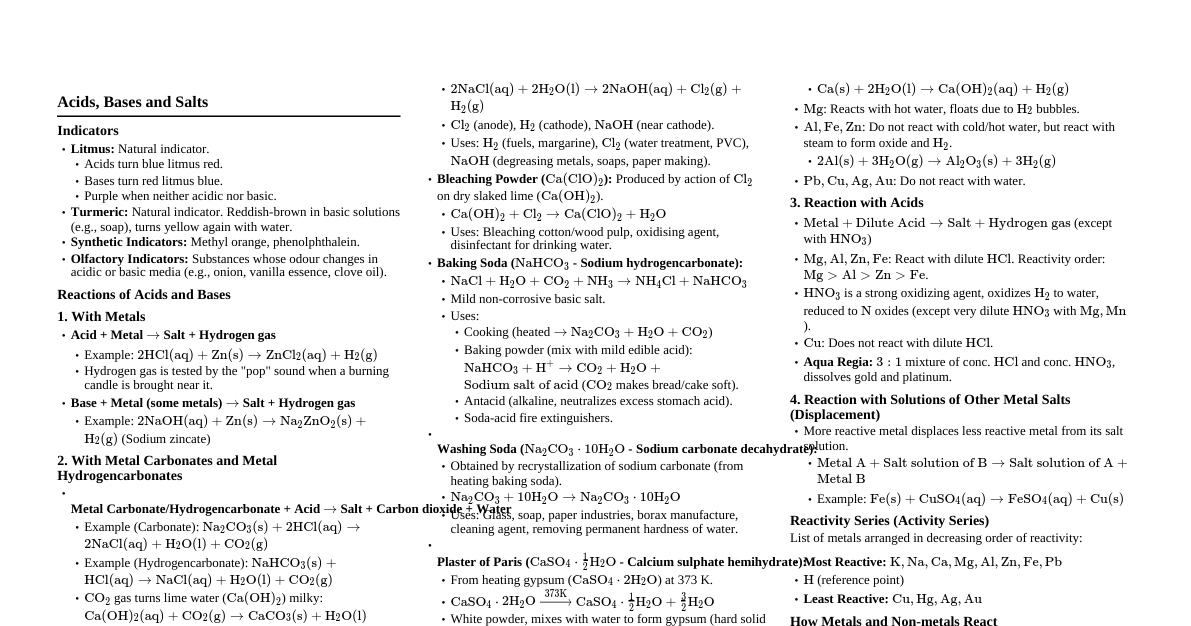
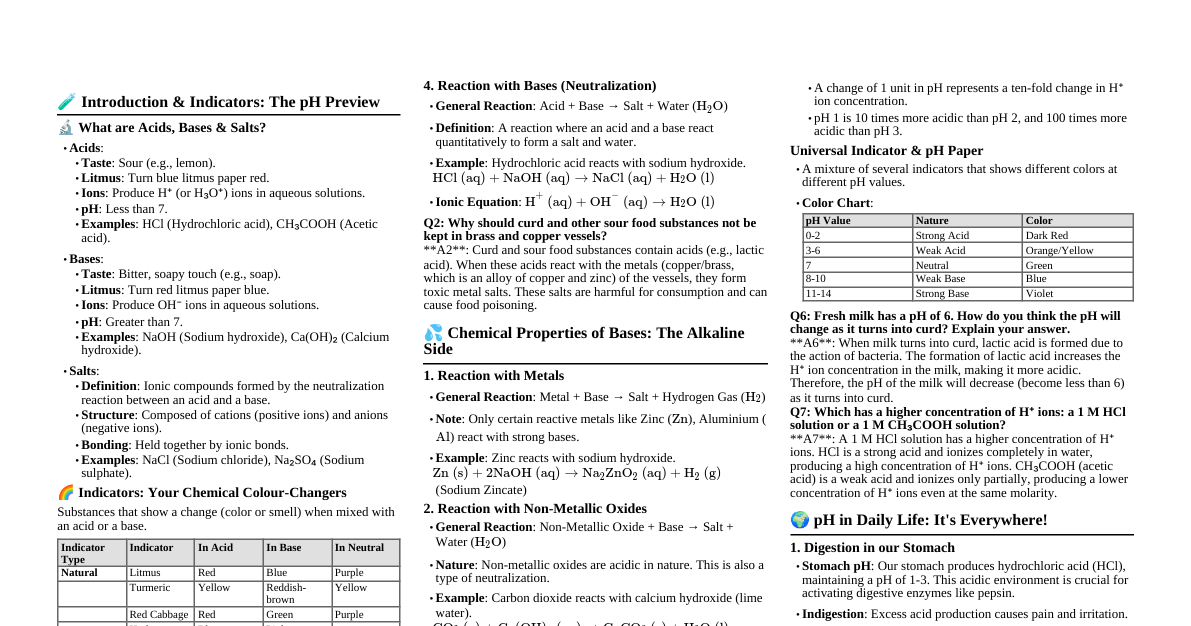
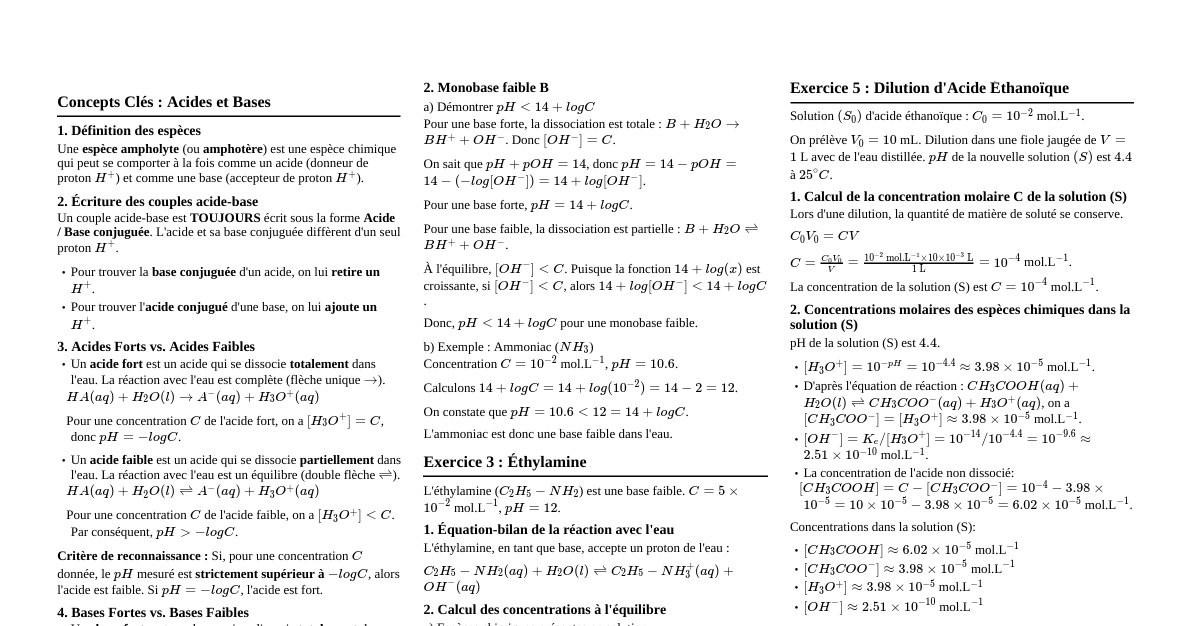
### Acids: The Sour Side of Chemistry - **What are Acids?** Acids are special chemical compounds that taste sour (like lemons!) and can be very reactive. - **Key Characteristics (Properties):** 1. **Sour Taste:** Think of vinegar or lemon juice. (But NEVER taste chemicals in the lab!) 2. **Corrosive:** This means they can "eat away" at materials, including skin. Strong acids are dangerous! 3. **Litmus Test:** They turn blue litmus paper RED. Litmus paper is a special paper used to test for acids or bases. 4. **React with Metals:** Many acids react with metals (like zinc or iron) to produce hydrogen gas ($H_2$). You might see bubbles! 5. **React with Carbonates:** They react with substances like baking soda or chalk (which are carbonates) to produce carbon dioxide ($CO_2$) gas. Again, you'll see bubbles! 6. **Neutralize Bases:** Acids cancel out bases in a reaction, forming something new called a "salt" and water. #### Types of Acids - **Strong Acids:** These are very powerful acids that totally break apart (ionize) in water. This means they release all their "acid parts" (called $H^+$ ions). Examples: Hydrochloric Acid ($HCl$) in your stomach, Sulfuric Acid ($H_2SO_4$) in car batteries. - **Weak Acids:** These are milder acids that only partly break apart in water. They don't release all their $H^+$ ions. Examples: Acetic Acid ($CH_3COOH$) in vinegar, Citric Acid in fruits. #### Where You Find Acids - **In Food:** Lemon juice, vinegar, soft drinks. - **In Your Body:** Hydrochloric acid in your stomach helps digest food. - **In Nature:** Acid rain (from pollution), ant stings (formic acid). ### Bases: The Slippery Side of Chemistry - **What are Bases?** Bases are another type of chemical compound, often feeling slippery and tasting bitter. They are the chemical opposites of acids. - **Key Characteristics (Properties):** 1. **Bitter Taste:** Think of unsweetened chocolate or soap. (Again, NEVER taste chemicals in the lab!) 2. **Slippery/Soapy Feel:** Like washing your hands with soap. 3. **Litmus Test:** They turn RED litmus paper BLUE. 4. **Corrosive:** Strong bases can also "eat away" at materials, just like strong acids. 5. **Neutralize Acids:** Bases cancel out acids, forming salt and water. #### Types of Bases - **Strong Bases:** These are very powerful bases that completely break apart (dissociate) in water, releasing their "base parts" (called $OH^-$ ions). Examples: Sodium Hydroxide ($NaOH$) used in drain cleaner, Potassium Hydroxide ($KOH$). - **Weak Bases:** These are milder bases that only partly break apart in water. Examples: Ammonia ($NH_3$) in cleaning products, Magnesium Hydroxide ($Mg(OH)_2$) in antacids. #### Where You Find Bases - **In Cleaning Products:** Soap, ammonia-based cleaners, bleach. - **In Medicine:** Antacids (like Milk of Magnesia) to calm an upset stomach. - **In Food:** Baking soda. ### The pH Scale: Measuring Acidity and Basicity - **What is pH?** The pH scale is a special number system (from 0 to 14) that tells us how acidic or basic a substance is. It measures the concentration of $H^+$ ions. - **How it Works:** - **pH 0 to less than 7:** These substances are **ACIDIC**. The lower the number, the stronger the acid. - **pH 7:** This is **NEUTRAL**. Pure water has a pH of 7. It's neither acidic nor basic. - **pH greater than 7 to 14:** These substances are **BASIC (or Alkaline)**. The higher the number, the stronger the base. #### pH Examples | pH Value | What it Means | Common Example | |----------|-----------------------|---------------------| | 1 | Very Strong Acid | Battery Acid | | 2 | Strong Acid | Lemon Juice | | 3 | Acid | Vinegar | | 4-5 | Mild Acid | Tomato Juice, Coffee| | 6 | Very Weak Acid | Milk | | 7 | Neutral | Pure Water | | 8 | Very Weak Base | Baking Soda | | 9-10 | Base | Hand Soap, Ammonia | | 11-12 | Strong Base | Bleach | | 13-14 | Very Strong Base | Drain Cleaner | ### Neutralization: When Acids Meet Bases - **What is Neutralization?** It's a special chemical reaction where an acid and a base combine to cancel each other out. - **The Result:** They always produce two new substances: a **salt** and **water**. - **Simple Equation:** Acid + Base $\rightarrow$ Salt + Water - **Example:** When you mix Hydrochloric Acid ($HCl$) with Sodium Hydroxide ($NaOH$), you get Sodium Chloride ($NaCl$, which is table salt!) and Water ($H_2O$). $$HCl + NaOH \rightarrow NaCl + H_2O$$ - **Everyday Use:** If your stomach has too much acid (heartburn), you might take an antacid (a base) to neutralize it and feel better! ### Salts: Not Just Table Salt! - **What are Salts?** Salts are a large group of chemical compounds formed when an acid and a base react together (through neutralization). Table salt ($NaCl$) is just one example! - **How They're Made:** A salt is made up of a positive part (from the base) and a negative part (from the acid). - **Key Characteristics:** 1. **Crystalline Solids:** Most salts are solid crystals at room temperature. 2. **High Melting Points:** You need a lot of heat to melt them. 3. **Dissolve in Water:** Many salts dissolve easily in water. When they dissolve, they can conduct electricity. 4. **Electrolytes:** Because they can conduct electricity when dissolved, salts are often called electrolytes. #### Important Salts You Know - **Sodium Chloride ($NaCl$):** This is common table salt! - **Sodium Bicarbonate ($NaHCO_3$):** Also known as baking soda. Used in baking and as an antacid. - **Calcium Carbonate ($CaCO_3$):** Found in chalk, seashells, and marble. - **Potassium Nitrate ($KNO_3$):** Used in fertilizers and sometimes in fireworks. - **Magnesium Sulfate ($MgSO_4$):** Known as Epsom salts, used in baths. ### Indicators: The Color Detectives - **What are Indicators?** Indicators are special chemicals that change color when they come into contact with an acid or a base. They help us "indicate" whether a substance is acidic, basic, or neutral. - **How They Work:** Indicators are weak acids or bases themselves, and their "acid form" has a different color than their "base form." #### Common Indicators 1. **Litmus Paper/Solution:** - **In Acid:** Turns RED. - **In Base:** Turns BLUE. - **In Neutral:** Stays the same (red litmus stays red, blue litmus stays blue). 2. **Methyl Orange:** - **In Acid:** Turns RED. - **In Base:** Turns YELLOW. 3. **Phenolphthalein:** (Say: Fee-nol-fthal-een) - **In Acid:** Stays COLORLESS (clear). - **In Base:** Turns PINK or MAGENTA. 4. **Universal Indicator:** - This is a special mixture of several indicators. It shows a whole range of colors, which helps us tell not just if it's acid/base, but also roughly how strong it is (its approximate pH). #### Universal Indicator Color Chart | Color | pH Level | What it Tells You | |-----------------------|----------|-----------------------------| | **Red** | 1-2 | Very Strong Acid | | **Orange/Yellow** | 3-6 | Acid | | **Green** | 7 | Neutral (like pure water) | | **Blue** | 8-11 | Base | | **Violet/Purple** | 12-14 | Very Strong Base | #### Why are Indicators Important? - They help scientists and students quickly identify unknown substances. - They are used in **titration**, a process to find out exactly how much acid or base is in a solution. ### Safety First! Handling Acids and Bases - **Always Wear Goggles:** Protect your eyes from splashes. - **Never Taste or Smell:** Do not put chemicals in your mouth or directly sniff them. If you need to smell, gently waft fumes towards your nose with your hand. - **Diluting Acids:** ALWAYS add acid SLOWLY to water, NEVER add water to concentrated acid. Adding water to acid can cause dangerous splattering and heat. - **Handle with Care:** Strong acids and bases can cause severe burns. If you spill them, tell your teacher immediately and wash with plenty of water. - **Wash Hands:** Always wash your hands thoroughly after handling chemicals.