New sheet - 10/11 16:02
Cheatsheet Content
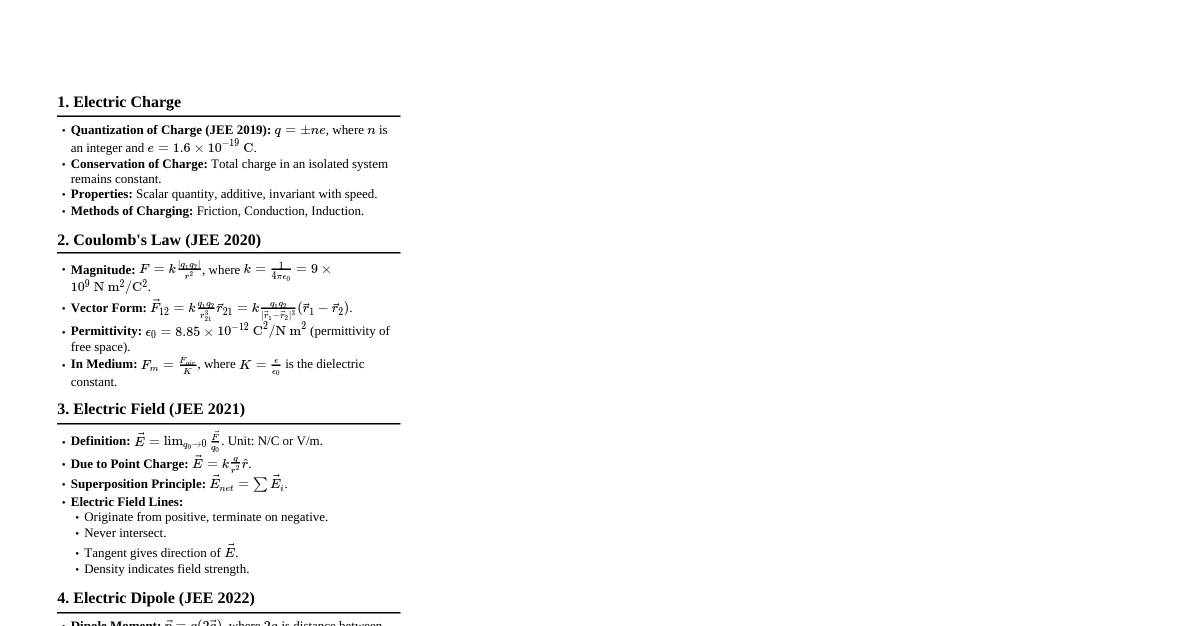
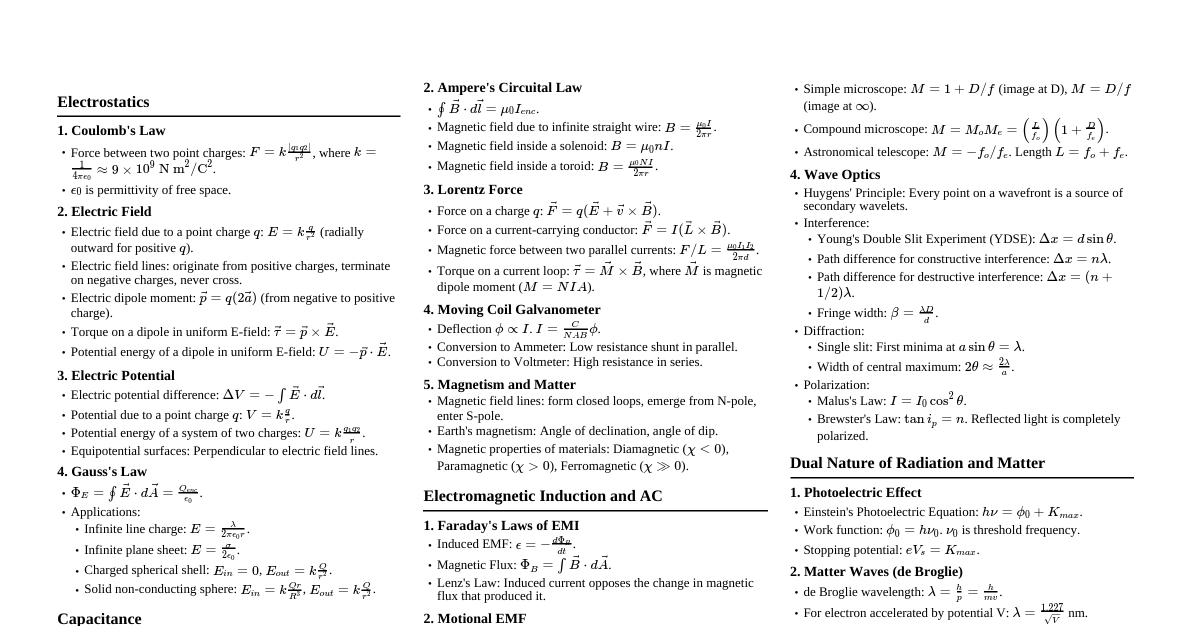
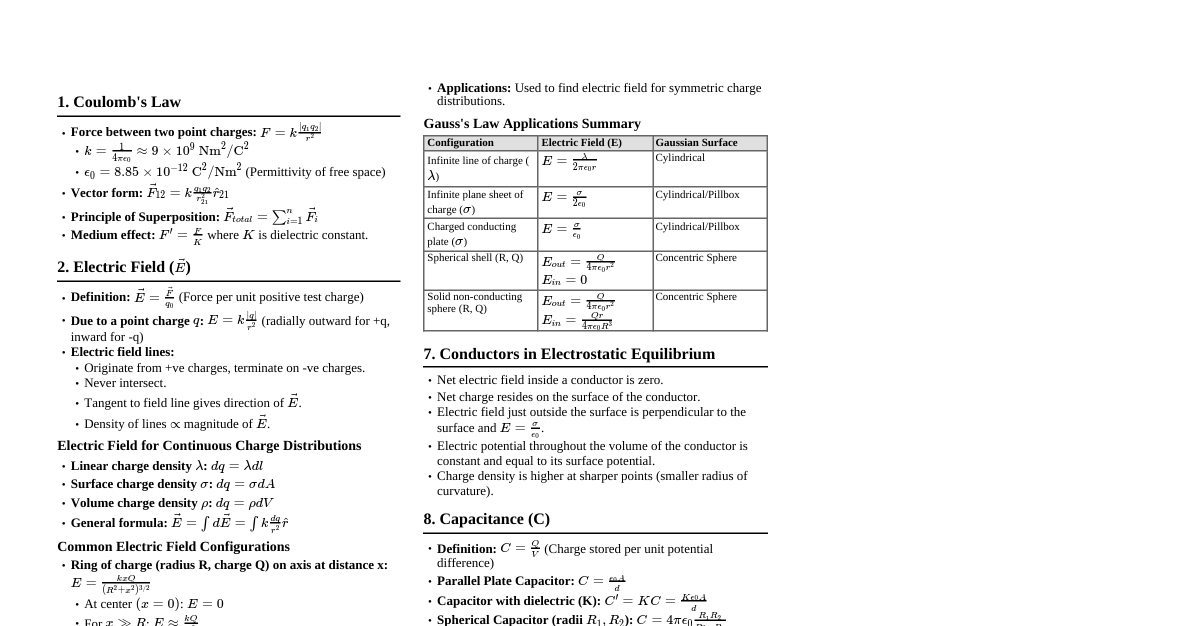
Chapter 1: Electric Charges and Fields Key Concepts Electric Charge (q): Intrinsic property of matter. Scalar quantity. SI unit: Coulomb (C). Quantization of Charge: $q = \pm ne$, where $n$ is an integer and $e = 1.6 \times 10^{-19}$ C (charge of electron/proton). Conservation of Charge: Total charge of an isolated system remains constant. Coulomb's Law: Force between two point charges. Electric Field (E): Region around a charge where its influence is felt. Electric Field Lines: Represent direction and strength of electric field. Never intersect. Electric Dipole: Two equal and opposite charges separated by a small distance. Electric Flux ($\Phi_E$): Number of electric field lines passing through a given area. Gauss's Law: Relates electric flux through a closed surface to the enclosed charge. Formulas & Laws Coulomb's Law: $F = k \frac{|q_1 q_2|}{r^2}$, where $k = \frac{1}{4\pi\epsilon_0} = 9 \times 10^9 \text{ Nm}^2/\text{C}^2$. Vector form: $\vec{F}_{12} = k \frac{q_1 q_2}{r^2} \hat{r}_{21}$. Electric Field due to a point charge: $E = k \frac{|q|}{r^2}$. Vector form: $\vec{E} = k \frac{q}{r^2} \hat{r}$. Electric Field due to a dipole (axial line): $E_{axial} = \frac{2kp}{r^3}$ (for $r \gg a$). Electric Field due to a dipole (equatorial line): $E_{equatorial} = \frac{kp}{r^3}$ (for $r \gg a$). Electric Dipole Moment (p): $\vec{p} = q(2\vec{a})$ (from negative to positive charge). SI unit: C m. Torque on a dipole in uniform E field: $\vec{\tau} = \vec{p} \times \vec{E}$, magnitude $\tau = pE \sin\theta$. Electric Flux: $\Phi_E = \vec{E} \cdot \vec{A} = EA \cos\theta$. Gauss's Law: $\Phi_E = \oint \vec{E} \cdot d\vec{A} = \frac{q_{enclosed}}{\epsilon_0}$. Electric field of an infinite line charge: $E = \frac{\lambda}{2\pi\epsilon_0 r}$. Electric field of an infinite plane sheet of charge: $E = \frac{\sigma}{2\epsilon_0}$. Electric field of a uniformly charged thin spherical shell: Outside ($r > R$): $E = \frac{Q}{4\pi\epsilon_0 r^2}$. On surface ($r = R$): $E = \frac{Q}{4\pi\epsilon_0 R^2}$. Inside ($r Chapter 2: Electrostatic Potential and Capacitance Key Concepts Electric Potential (V): Work done per unit positive test charge to bring it from infinity to a point. Scalar quantity. SI unit: Volt (V) or J/C. Potential Difference ($\Delta V$): Work done per unit charge to move it between two points. Equipotential Surfaces: Surfaces with constant electric potential. Electric field lines are perpendicular to them. Capacitor: Device to store electric charge and energy. Capacitance (C): Ability of a capacitor to store charge. $C = Q/V$. SI unit: Farad (F). Dielectric: Insulating material that can be polarized. Increases capacitance. Formulas & Laws Electric Potential due to a point charge: $V = k \frac{q}{r}$. Potential Energy of two point charges: $U = k \frac{q_1 q_2}{r}$. Relation between E and V: $E = -\frac{dV}{dr}$ (in 1D), $\vec{E} = -\vec{\nabla}V$. Potential due to an electric dipole: $V = \frac{kp \cos\theta}{r^2}$. Potential energy of a dipole in uniform E field: $U = -\vec{p} \cdot \vec{E} = -pE \cos\theta$. Capacitance of a parallel plate capacitor: $C = \frac{\epsilon_0 A}{d}$. Capacitance with dielectric: $C_K = K C_0 = K \frac{\epsilon_0 A}{d}$. Capacitors in series: $\frac{1}{C_{eq}} = \frac{1}{C_1} + \frac{1}{C_2} + \dots$. Capacitors in parallel: $C_{eq} = C_1 + C_2 + \dots$. Energy stored in a capacitor: $U = \frac{1}{2}CV^2 = \frac{Q^2}{2C} = \frac{1}{2}QV$. Energy density in electric field: $u_E = \frac{1}{2}\epsilon_0 E^2$. Van de Graaff Generator: Used to build up high voltages. Chapter 3: Current Electricity Key Concepts Electric Current (I): Rate of flow of charge. $I = \frac{dQ}{dt}$. SI unit: Ampere (A). Current Density (J): Current per unit cross-sectional area. $\vec{J} = n e \vec{v}_d$. SI unit: A/m$^2$. Drift Velocity ($\vec{v}_d$): Average velocity of free electrons in a conductor under electric field. Ohm's Law: $V = IR$. Resistance (R): Opposition to current flow. $R = \rho \frac{L}{A}$. SI unit: Ohm ($\Omega$). Resistivity ($\rho$): Intrinsic property of material. SI unit: Ohm-meter ($\Omega$ m). Reciprocal of conductivity ($\sigma$). EMF (Electromotive Force): Potential difference across terminals of a cell in open circuit. Internal Resistance (r): Resistance offered by the electrolyte of a cell. Kirchhoff's Laws: Junction Rule (KCL): Sum of currents entering a junction equals sum of currents leaving. (Conservation of charge) Loop Rule (KVL): Algebraic sum of potential changes around any closed loop is zero. (Conservation of energy) Wheatstone Bridge: Circuit for precise resistance measurement. Balanced condition: $\frac{P}{Q} = \frac{R}{S}$. Meter Bridge: Practical application of Wheatstone bridge. Potentiometer: Device to measure EMF, potential difference, and compare EMFs. Formulas & Laws Relation between I and $v_d$: $I = nAe v_d$. Drift Velocity: $v_d = \frac{eE\tau}{m}$, where $\tau$ is relaxation time. Ohm's Law (Microscopic form): $\vec{J} = \sigma \vec{E}$. Resistance in series: $R_{eq} = R_1 + R_2 + \dots$. Resistance in parallel: $\frac{1}{R_{eq}} = \frac{1}{R_1} + \frac{1}{R_2} + \dots$. Cell EMF and Terminal Voltage: $V = E - Ir$. Power dissipated in a resistor: $P = VI = I^2R = \frac{V^2}{R}$. Electrical Energy: $W = Pt = VIt = I^2Rt$. Temperature dependence of Resistance: $R_T = R_0[1 + \alpha(T - T_0)]$. Potentiometer: Comparison of EMFs: $\frac{E_1}{E_2} = \frac{l_1}{l_2}$. Internal resistance: $r = R \left(\frac{l_1}{l_2} - 1\right)$. Chapter 4: Moving Charges and Magnetism Key Concepts Magnetic Force: Force experienced by a moving charge or a current-carrying conductor in a magnetic field. Lorentz Force: Combined electric and magnetic force on a charge. $\vec{F} = q(\vec{E} + \vec{v} \times \vec{B})$. Biot-Savart Law: Gives magnetic field due to a current element. Ampere's Circuital Law: Relates magnetic field around a closed loop to the current passing through it. Magnetic Dipole Moment (m): For a current loop, $\vec{m} = I\vec{A}$. SI unit: A m$^2$. Torque on a current loop: $\vec{\tau} = \vec{m} \times \vec{B}$. Galvanometer: Device to detect and measure small currents. Can be converted to Ammeter or Voltmeter. Formulas & Laws Magnetic force on a moving charge: $\vec{F} = q(\vec{v} \times \vec{B})$, magnitude $F = qvB \sin\theta$. Magnetic force on a current-carrying conductor: $\vec{F} = I(\vec{L} \times \vec{B})$, magnitude $F = ILB \sin\theta$. Biot-Savart Law: $d\vec{B} = \frac{\mu_0}{4\pi} \frac{I d\vec{l} \times \hat{r}}{r^2}$. Magnetic field due to a straight current carrying wire: $B = \frac{\mu_0 I}{2\pi r}$. Magnetic field at the center of a circular loop: $B = \frac{\mu_0 I}{2R}$. Magnetic field on the axis of a circular loop: $B = \frac{\mu_0 I R^2}{2(R^2 + x^2)^{3/2}}$. Ampere's Circuital Law: $\oint \vec{B} \cdot d\vec{l} = \mu_0 I_{enclosed}$. Magnetic field inside a long solenoid: $B = \mu_0 n I$, where $n$ is turns per unit length. Magnetic field inside a toroid: $B = \frac{\mu_0 N I}{2\pi r}$. Force between two parallel current-carrying conductors: $F = \frac{\mu_0 I_1 I_2 L}{2\pi d}$. Torque on a current loop in B field: $\vec{\tau} = N I \vec{A} \times \vec{B} = \vec{m} \times \vec{B}$. Moving Coil Galvanometer: $\tau = NIAB \sin\alpha$. For radial field, $\tau = NIAB$. Current sensitivity: $I_s = \frac{\phi}{I} = \frac{NAB}{k}$. Voltage sensitivity: $V_s = \frac{\phi}{V} = \frac{NAB}{kR}$. Conversion of Galvanometer: Ammeter: Shunt resistance $S = \frac{I_g G}{I - I_g}$. Voltmeter: Series resistance $R_{series} = \frac{V}{I_g} - G$. Chapter 5: Magnetism and Matter Key Concepts Bar Magnet: Behaves like an electric dipole, but magnetic monopoles do not exist. Magnetic Field Lines: Form closed loops. Outside magnet, N to S; inside, S to N. Earth's Magnetism: Due to molten core convection. Elements: Magnetic declination, Inclination (dip), Horizontal component of Earth's field. Magnetic Properties of Materials: Diamagnetic: Weakly repelled by magnetic field. Eg: Bismuth, Copper, Water. $\chi Paramagnetic: Weakly attracted by magnetic field. Eg: Aluminum, Sodium, Oxygen. $0 Ferromagnetic: Strongly attracted by magnetic field. Eg: Iron, Nickel, Cobalt. $\chi \gg 1$. Exhibit hysteresis. Curie's Law: For paramagnetic materials, $\chi \propto \frac{1}{T}$. Hysteresis: Lagging of magnetic induction (B) behind magnetizing field (H). Formulas & Laws Magnetic field of a bar magnet (axial): $B = \frac{\mu_0}{4\pi} \frac{2m}{r^3}$ (for $r \gg l$). Magnetic field of a bar magnet (equatorial): $B = \frac{\mu_0}{4\pi} \frac{m}{r^3}$ (for $r \gg l$). Torque on a bar magnet in B field: $\vec{\tau} = \vec{m} \times \vec{B}$. Potential Energy: $U = -\vec{m} \cdot \vec{B}$. Magnetic Intensity (H): $H = \frac{B}{\mu_0} - M$. Magnetization (M): Magnetic dipole moment per unit volume. $M = \chi H$. Magnetic Susceptibility ($\chi$): $\chi = \frac{M}{H}$. Magnetic Permeability ($\mu$): $\mu = \mu_0 (1 + \chi) = \mu_r \mu_0$. Relation between B and H: $B = \mu H$. Chapter 6: Electromagnetic Induction Key Concepts Magnetic Flux ($\Phi_B$): Number of magnetic field lines passing through an area. $\Phi_B = \vec{B} \cdot \vec{A} = BA \cos\theta$. SI unit: Weber (Wb). Faraday's Laws of EMI: Whenever magnetic flux linked with a coil changes, an EMF is induced. Magnitude of induced EMF is proportional to rate of change of magnetic flux. Lenz's Law: Direction of induced EMF/current opposes the cause producing it. (Conservation of Energy). Motional EMF: EMF induced due to motion of a conductor in a magnetic field. Eddy Currents: Circulating currents induced in bulk conductors due to changing magnetic flux. Self-Induction: Phenomenon where change in current in a coil induces an EMF in the same coil. Self-Inductance (L): $\Phi_B = LI$. SI unit: Henry (H). Mutual Induction: Phenomenon where change in current in one coil induces an EMF in a nearby coil. Mutual Inductance (M): $\Phi_{B2} = M I_1$. SI unit: Henry (H). Formulas & Laws Faraday's Law: $E = -N \frac{d\Phi_B}{dt}$. Motional EMF: $E = Blv$. Induced EMF in a rotating coil: $E = NBA\omega \sin(\omega t) = E_0 \sin(\omega t)$. Self-induced EMF: $E = -L \frac{dI}{dt}$. Energy stored in an inductor: $U = \frac{1}{2}LI^2$. Mutual induced EMF: $E_2 = -M \frac{dI_1}{dt}$. Coefficient of coupling (k): $k = \frac{M}{\sqrt{L_1 L_2}}$. Chapter 7: Alternating Current Key Concepts Alternating Current (AC): Current whose magnitude and direction vary periodically with time. $I = I_0 \sin(\omega t + \phi)$. Peak Value ($I_0, V_0$): Maximum value of current/voltage. RMS Value ($I_{rms}, V_{rms}$): Root Mean Square value. $I_{rms} = I_0/\sqrt{2}$, $V_{rms} = V_0/\sqrt{2}$. Reactance ($X_L, X_C$): Opposition offered by inductor/capacitor to AC flow. Impedance (Z): Total opposition offered by an RLC circuit to AC flow. $Z = \sqrt{R^2 + (X_L - X_C)^2}$. Resonance: Condition in RLC circuit where $X_L = X_C$, leading to minimum impedance and maximum current. Power Factor ($\cos\phi$): Ratio of true power to apparent power. $\cos\phi = R/Z$. Transformer: Device to change AC voltage levels. Works on mutual induction. Choke Coil: Inductor used to control AC current without significant power loss. Formulas & Laws Angular frequency: $\omega = 2\pi f = 2\pi/T$. Inductive Reactance: $X_L = \omega L = 2\pi f L$. Capacitive Reactance: $X_C = \frac{1}{\omega C} = \frac{1}{2\pi f C}$. Impedance of LCR series circuit: $Z = \sqrt{R^2 + (X_L - X_C)^2}$. Phase angle: $\tan\phi = \frac{X_L - X_C}{R}$. Resonance frequency: $f_r = \frac{1}{2\pi\sqrt{LC}}$. Q-factor (Quality factor): $Q = \frac{\omega_r L}{R} = \frac{1}{R}\sqrt{\frac{L}{C}}$. Average Power: $P_{avg} = V_{rms} I_{rms} \cos\phi$. Transformer: $\frac{V_s}{V_p} = \frac{N_s}{N_p} = \frac{I_p}{I_s}$. Efficiency $\eta = \frac{P_{out}}{P_{in}} = \frac{V_s I_s}{V_p I_p}$. Chapter 8: Electromagnetic Waves Key Concepts Electromagnetic Waves (EM Waves): Waves that consist of oscillating electric and magnetic fields, perpendicular to each other and to the direction of propagation. Maxwell's Equations: Four fundamental equations describing electric and magnetic fields and their interrelationship. Displacement Current: Term added by Maxwell to Ampere's law, accounts for changing electric flux. $I_d = \epsilon_0 \frac{d\Phi_E}{dt}$. Properties of EM Waves: Transverse nature. Travel at speed of light in vacuum: $c = \frac{1}{\sqrt{\mu_0 \epsilon_0}}$. $E_0/B_0 = c$. Carry energy and momentum. Electromagnetic Spectrum: Arrangement of EM waves in order of increasing wavelength/decreasing frequency (Radio, Micro, IR, Visible, UV, X-rays, Gamma rays). Formulas & Laws Speed of EM waves in vacuum: $c = 3 \times 10^8$ m/s. Speed of EM waves in medium: $v = \frac{1}{\sqrt{\mu \epsilon}}$. Relation between E and B field amplitudes: $E_0 = c B_0$. Energy density of EM wave: $u = \frac{1}{2}\epsilon_0 E^2 + \frac{1}{2\mu_0} B^2 = \epsilon_0 E^2 = \frac{B^2}{\mu_0}$. Poynting Vector (S): Represents energy flux. $\vec{S} = \frac{1}{\mu_0}(\vec{E} \times \vec{B})$. Chapter 9: Ray Optics and Optical Instruments Key Concepts Reflection: Bouncing back of light. Laws of reflection: $\angle i = \angle r$. Incident ray, reflected ray, normal are coplanar. Refraction: Bending of light as it passes from one medium to another. Snell's Law: $\frac{\sin i}{\sin r} = \frac{n_2}{n_1}$. Total Internal Reflection (TIR): Light traveling from denser to rarer medium at angle greater than critical angle. Lens Formula: Relation between object distance (u), image distance (v), and focal length (f). Mirror Formula: Relation between object distance (u), image distance (v), and focal length (f). Magnification (m): Ratio of image height to object height. $m = h_i/h_o = -v/u$. Power of a Lens (P): $P = 1/f$ (in meters). SI unit: Dioptre (D). Dispersion: Splitting of white light into constituent colors. Scattering of Light: Reddish appearance of sun at sunrise/sunset, blue sky. (Rayleigh scattering: intensity $\propto 1/\lambda^4$). Formulas & Laws Refractive Index: $n = c/v$. Also $n = \frac{\sin i}{\sin r}$. Critical Angle: $\sin C = n_r/n_d = 1/n$ (if rarer medium is air). Mirror Formula: $\frac{1}{v} + \frac{1}{u} = \frac{1}{f}$. (Sign convention: Cartesian). Focal length of concave mirror $f 0$. Lens Formula: $\frac{1}{v} - \frac{1}{u} = \frac{1}{f}$. (Sign convention: Cartesian). Focal length of converging lens $f > 0$, diverging lens $f Lens Maker's Formula: $\frac{1}{f} = (n_2/n_1 - 1) \left(\frac{1}{R_1} - \frac{1}{R_2}\right)$. Power of a lens in contact: $P = P_1 + P_2$. Magnification: $m = \frac{h_i}{h_o} = -\frac{v}{u}$. Prism Formula: $n = \frac{\sin((A + \delta_m)/2)}{\sin(A/2)}$. For thin prism: $\delta = (n-1)A$. Microscope: Simple: $M = 1 + D/f$ (final image at D). $M = D/f$ (final image at infinity). Compound: $M = M_o M_e = \frac{v_o}{u_o} (1 + D/f_e)$ (final image at D). $M = \frac{L}{f_o} \frac{D}{f_e}$ (approx for final image at D, $L$ is tube length). Telescope: Refracting (Normal adjustment): $M = -f_o/f_e$, $L = f_o + f_e$. Reflecting: $M = -f_o/f_e$. Chapter 10: Wave Optics Key Concepts Huygens' Principle: Every point on a wavefront is a source of secondary wavelets. Interference: Superposition of two coherent light waves, resulting in a stable pattern of maxima and minima. Coherent Sources: Sources with constant phase difference and same frequency. Young's Double Slit Experiment (YDSE): Demonstrates interference. Diffraction: Bending of light around obstacles or apertures. Fraunhofer Diffraction: Source and screen are far from the obstacle/aperture. (Single slit). Polarization: Restriction of light vibrations to a single plane. (Transverse nature of light). Brewster's Law: $\tan i_p = n$. Reflected light is completely polarized. Formulas & Laws Path difference ($\Delta x$): Constructive interference: $\Delta x = n\lambda$. Destructive interference: $\Delta x = (2n+1)\lambda/2$. Fringe width ($\beta$): $\beta = \frac{\lambda D}{d}$. Position of bright fringes: $y_n = \frac{n\lambda D}{d}$. Position of dark fringes: $y_n = \frac{(2n+1)\lambda D}{2d}$. Single Slit Diffraction (minima): $a \sin\theta = n\lambda$. Width of central maximum: $2\theta_0 = \frac{2\lambda}{a}$. Linear width $= \frac{2\lambda D}{a}$. Malus' Law: $I = I_0 \cos^2\theta$. Chapter 11: Dual Nature of Radiation and Matter Key Concepts Photoelectric Effect: Emission of electrons from a metal surface when light of suitable frequency falls on it. Work Function ($\phi_0$): Minimum energy required to eject an electron from a metal surface. Threshold Frequency ($\nu_0$): Minimum frequency of incident light required for photoelectric emission. Einstein's Photoelectric Equation: $K_{max} = h\nu - \phi_0$. De Broglie Hypothesis: Matter also exhibits wave-like properties. (Wave-particle duality). Davisson-Germer Experiment: Confirmed wave nature of electrons. Formulas & Laws Energy of a photon: $E = h\nu = hc/\lambda$. ($h = 6.626 \times 10^{-34}$ J s). Momentum of a photon: $p = E/c = h/\lambda$. Work Function: $\phi_0 = h\nu_0 = hc/\lambda_0$. Einstein's Photoelectric Equation: $K_{max} = h\nu - h\nu_0 = \frac{1}{2}mv_{max}^2$. Stopping Potential ($V_0$): $eV_0 = K_{max}$. De Broglie wavelength: $\lambda = h/p = h/mv$. De Broglie wavelength for accelerated electron: $\lambda = \frac{h}{\sqrt{2m_e eV}}$. Chapter 12: Atoms Key Concepts Rutherford's Model: Nucleus at center, electrons orbit. Failed to explain stability and line spectra. Bohr's Model: Electrons orbit in stable orbits without radiating energy. Only orbits with quantized angular momentum ($L = n h/2\pi$) are allowed. Electrons radiate/absorb energy only during transitions between orbits. $h\nu = E_f - E_i$. Hydrogen Spectrum: Series of spectral lines (Lyman, Balmer, Paschen, Brackett, Pfund). Formulas & Laws Radius of Bohr's orbit: $r_n = \frac{n^2 a_0}{Z}$, where $a_0 = 0.529 \text{ Å}$ (Bohr radius). Energy of electron in Bohr's orbit: $E_n = -\frac{13.6 Z^2}{n^2}$ eV. Wavelength of emitted/absorbed photon: $\frac{1}{\lambda} = RZ^2 \left(\frac{1}{n_f^2} - \frac{1}{n_i^2}\right)$, where $R = 1.097 \times 10^7 \text{ m}^{-1}$ (Rydberg constant). Lyman Series: $n_f = 1$, $n_i = 2, 3, \dots$ (UV region) Balmer Series: $n_f = 2$, $n_i = 3, 4, \dots$ (Visible region) Paschen Series: $n_f = 3$, $n_i = 4, 5, \dots$ (IR region) Chapter 13: Nuclei Key Concepts Nucleus: Composed of protons and neutrons (nucleons). Atomic Number (Z): Number of protons. Mass Number (A): Number of protons + neutrons. $A = Z + N$. Isotopes: Same Z, different A. Isobars: Same A, different Z. Isotones: Same N, different Z. Nuclear Size: $R = R_0 A^{1/3}$, where $R_0 \approx 1.2 \times 10^{-15}$ m (Fermi). Mass Defect ($\Delta m$): Difference between mass of nucleons and mass of nucleus. $\Delta m = (Zm_p + Nm_n) - M_{nucleus}$. Binding Energy ($E_b$): Energy equivalent to mass defect. $E_b = \Delta m c^2$. Binding Energy Per Nucleon: Indicates nuclear stability. Max for $A \approx 56$ (Iron). Radioactivity: Spontaneous disintegration of unstable nuclei. ($\alpha, \beta, \gamma$ decay). Half-life ($T_{1/2}$): Time for half of radioactive nuclei to decay. Nuclear Fission: Heavy nucleus splits into lighter nuclei. Nuclear Fusion: Lighter nuclei combine to form a heavier nucleus. Formulas & Laws Mass-Energy Equivalence: $E = mc^2$. (1 amu = 931.5 MeV). Binding Energy: $E_b = [(Zm_p + Nm_n) - M_{nucleus}]c^2$. Radioactive Decay Law: $N = N_0 e^{-\lambda t}$. Decay Constant ($\lambda$): $\lambda = \frac{0.693}{T_{1/2}}$. Activity (R): $R = -\frac{dN}{dt} = \lambda N$. SI unit: Becquerel (Bq) or Curie (Ci). Chapter 14: Semiconductor Electronics Key Concepts Conductors, Insulators, Semiconductors: Classified by energy band gap. Conductors: Overlapping valence and conduction bands. Insulators: Large band gap ($>3$ eV). Semiconductors: Small band gap ($\approx 1$ eV). Intrinsic Semiconductor: Pure semiconductor (e.g., Si, Ge). $n_e = n_h = n_i$. Extrinsic Semiconductor: Doped semiconductor. n-type: Doped with pentavalent impurity (e.g., P, As). Majority carriers: electrons. p-type: Doped with trivalent impurity (e.g., Al, B). Majority carriers: holes. p-n Junction Diode: Formed by joining p-type and n-type semiconductors. Depletion Region: Region near junction devoid of free charge carriers. Barrier Potential: Potential difference across depletion region. Forward Bias: p-side positive, n-side negative. Low resistance, current flows. Reverse Bias: p-side negative, n-side positive. High resistance, negligible current. Rectifier: Device converting AC to DC. Half-wave: Uses one diode, rectifies half cycle. Full-wave: Uses two/four diodes, rectifies both cycles. Zener Diode: Heavily doped p-n junction, designed to operate in reverse breakdown region. Used as voltage regulator. LED (Light Emitting Diode): Forward biased p-n junction, emits light. Photodiode: Reverse biased p-n junction, detects light. Solar Cell: Converts solar energy into electrical energy. Transistor (BJT - Bipolar Junction Transistor): PNP or NPN structure. Used as amplifier or switch. Emitter, Base, Collector. Current gain: $\alpha = I_C/I_E$, $\beta = I_C/I_B$. $\beta = \alpha/(1-\alpha)$. Logic Gates: Basic building blocks of digital circuits (AND, OR, NOT, NAND, NOR, XOR, XNOR). Formulas & Laws Conductivity: $\sigma = (n_e \mu_e + n_h \mu_h)e$. Mass action law: $n_e n_h = n_i^2$. Current relation in Transistor: $I_E = I_B + I_C$. Voltage gain of CE amplifier: $A_V = -\beta_{ac} \frac{R_L}{R_{in}}$. Boolean Algebra: AND: $Y = A \cdot B$ OR: $Y = A + B$ NOT: $Y = \bar{A}$ NAND: $Y = \overline{A \cdot B}$ NOR: $Y = \overline{A + B}$ Most Commonly Asked Questions / High-Weightage Topics Electrostatics: Coulomb's Law and Superposition Principle. Gauss's Law and its applications (infinite line, plane sheet, spherical shell). Electric potential due to point charge, dipole. Relation between E and V. Capacitance of parallel plate capacitor, effect of dielectric. Series/Parallel combinations. Energy stored in a capacitor. Current Electricity: Ohm's Law, Resistivity, Temperature dependence. Kirchhoff's Laws and their applications (Wheatstone bridge, complex circuits). Meter Bridge and Potentiometer (derivations and numericals). Internal resistance of a cell, grouping of cells. Magnetism: Biot-Savart Law and its applications (circular loop, straight wire). Ampere's Circuital Law and its applications (solenoid, toroid). Lorentz Force, force on a current carrying conductor. Torque on a current loop, moving coil galvanometer (conversion to Ammeter/Voltmeter). Magnetic properties of materials (dia, para, ferro) with examples. EMI & AC: Faraday's Laws and Lenz's Law (conservation of energy). Motional EMF (derivation). Self and Mutual Induction. Energy stored in inductor. AC circuits: L, C, R, LC, RC, LR, LCR series circuits. Impedance, phase diagrams, resonance frequency. Power in AC circuits, power factor. Transformer (principle, working, efficiency, losses). Optics: Mirror formula and Lens formula (derivations using ray diagrams). Lens Maker's Formula. Prism formula. Dispersion, scattering. Huygens' Principle. YDSE (conditions for interference, fringe width derivation). Single Slit Diffraction (minima condition, central maximum width). Polarization (Malus' Law, Brewster's Law). Optical Instruments: Compound microscope and Astronomical telescope (ray diagrams, magnifying power). Modern Physics: Photoelectric Effect (Einstein's equation, laws of photoelectric emission). De Broglie wavelength. Davisson-Germer experiment. Bohr's Model of Hydrogen atom (postulates, energy levels, radii, spectral series). Mass defect, Binding energy, Binding energy per nucleon. Radioactivity (decay law, half-life, activity). Alpha, Beta, Gamma decay. Nuclear Fission and Fusion. Semiconductors: p-n junction diode (V-I characteristics, forward/reverse bias). Rectifiers (half-wave, full-wave). Zener diode as voltage regulator. Transistors (NPN/PNP, characteristics, amplifier action). Logic Gates (truth tables, symbols).