Ohm
Cheatsheet Content
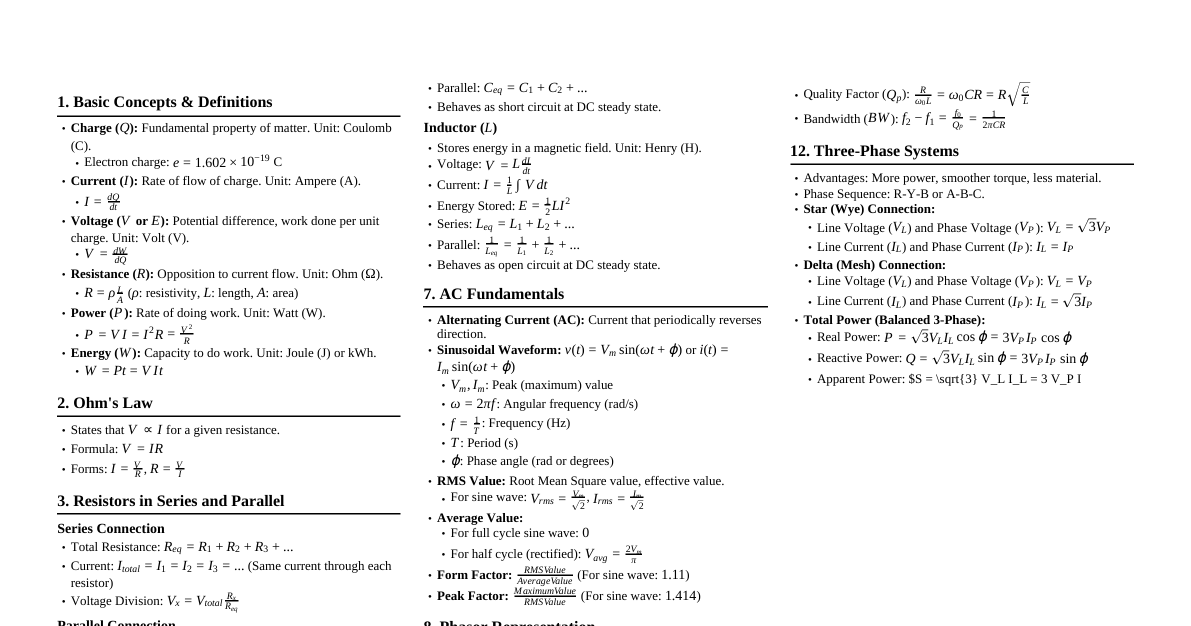
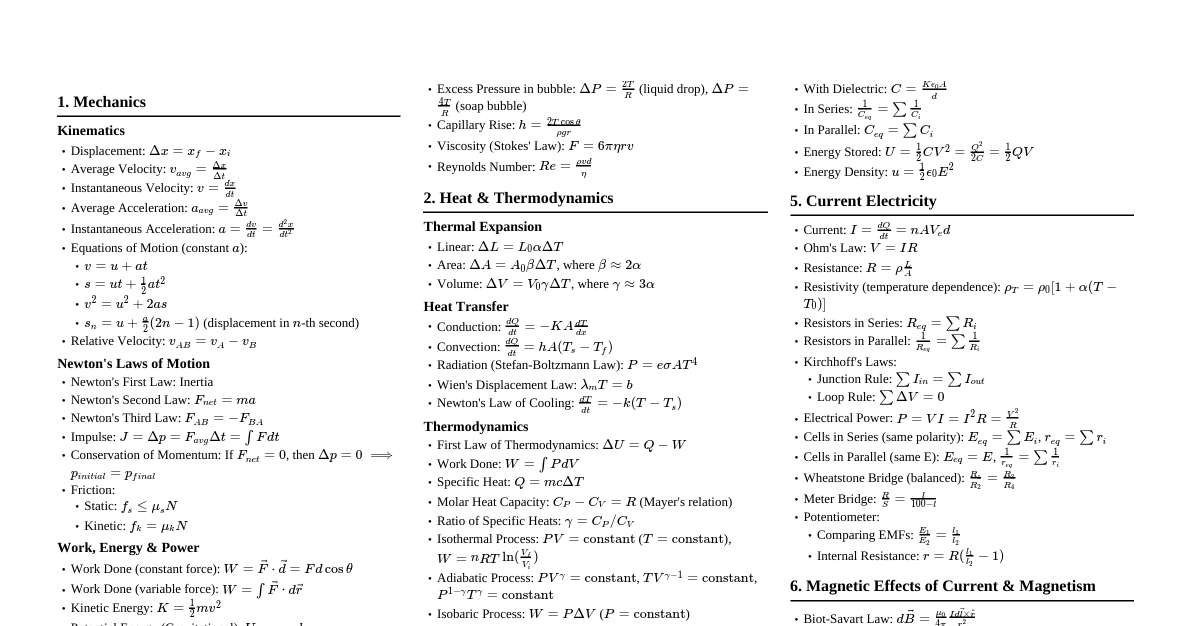
Ohm's Law: Fundamentals of Electrical Circuits Ohm's Law is a fundamental principle in electrical engineering, stating the relationship between voltage, current, and resistance in an electrical circuit. It was formulated by German physicist Georg Simon Ohm. The Formula The core of Ohm's Law is expressed by the following equation: $$V = I \times R$$ $V$ (Voltage): Measured in Volts (V). Represents the electrical potential difference between two points, driving the current. $I$ (Current): Measured in Amperes (A). Represents the flow rate of electric charge. $R$ (Resistance): Measured in Ohms ($\Omega$). Represents the opposition to the flow of electric current. Rearranging the Formula The formula can be rearranged to solve for any of the three variables: To find Current ($I$): $I = \frac{V}{R}$ To find Resistance ($R$): $R = \frac{V}{I}$ Understanding Each Component Voltage ($V$) - The Electrical "Push" Also known as potential difference or electromotive force (EMF). It's the work done per unit charge to move a charge between two points. Think of it as the pressure in a water pipe that pushes the water. Current ($I$) - The Flow of Charge The rate at which electric charge flows past a point in a circuit. Directed from higher potential to lower potential (conventional current). Think of it as the volume of water flowing through a pipe per unit time. Resistance ($R$) - The Opposition to Flow A material's opposition to the flow of electric current. Depends on material properties (resistivity), length, and cross-sectional area of the conductor. Think of it as the narrowness or friction in a water pipe that restricts water flow. Ohm's Law Triangle A helpful mnemonic for remembering the formulas: V I R Cover $V$: You get $I \times R$ Cover $I$: You get $\frac{V}{R}$ Cover $R$: You get $\frac{V}{I}$ Applications of Ohm's Law Circuit Analysis: Calculating unknown voltages, currents, or resistances in simple and complex circuits. Resistor Sizing: Determining the appropriate resistance value for a component to limit current or drop voltage. Power Calculation: Ohm's Law is often combined with the power formula ($P = V \times I$) to calculate power dissipation. $P = I^2 \times R$ $P = \frac{V^2}{R}$ Troubleshooting: Identifying faults in circuits by measuring deviations from expected values. Limitations of Ohm's Law Not Universal: Ohm's Law applies primarily to linear circuits and ohmic materials (e.g., resistors). Non-Ohmic Materials: Materials like semiconductors (diodes, transistors) do not obey Ohm's Law; their resistance changes with voltage or current. Temperature Dependence: Resistance of most materials changes with temperature, so Ohm's Law is often applied under constant temperature conditions. Power Dissipation ($P$) Power is the rate at which energy is consumed or produced. In a resistive circuit, power is dissipated as heat. $$P = V \times I$$ Using Ohm's Law, this can also be written as: $P = I^2 \times R$ (substituting $V = IR$) $P = \frac{V^2}{R}$ (substituting $I = \frac{V}{R}$) Power is measured in Watts (W). Example Calculation Consider a simple circuit with a 12V battery connected to a 4$\Omega$ resistor. Given: $V = 12\,V$, $R = 4\,\Omega$ Find Current ($I$): $I = \frac{V}{R} = \frac{12\,V}{4\,\Omega} = 3\,A$ Find Power Dissipation ($P$): $P = V \times I = 12\,V \times 3\,A = 36\,W$ Alternatively, $P = I^2 \times R = (3\,A)^2 \times 4\,\Omega = 9 \times 4 = 36\,W$ Or, $P = \frac{V^2}{R} = \frac{(12\,V)^2}{4\,\Omega} = \frac{144}{4} = 36\,W$