Magnetic Fields & Forces
Cheatsheet Content
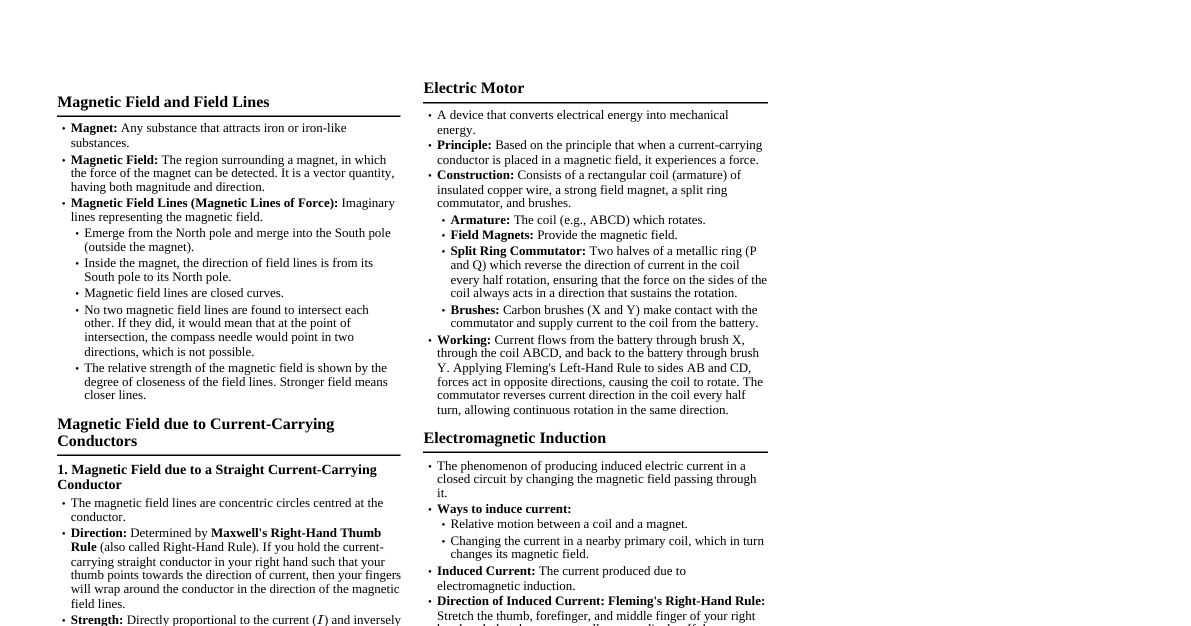
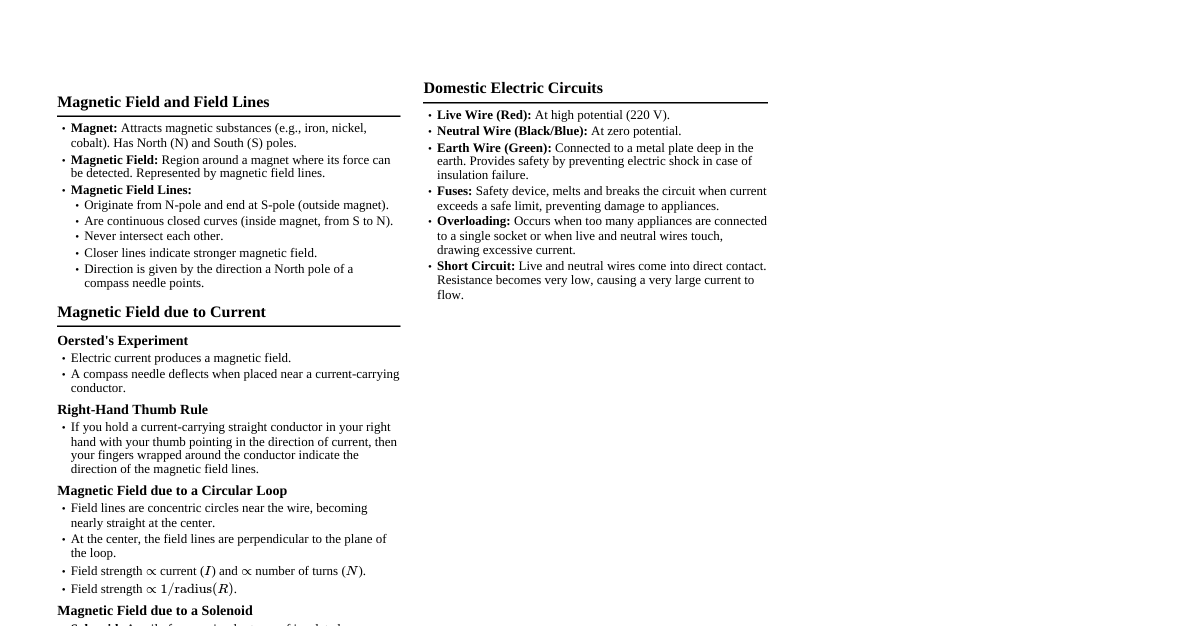
### Magnetic Field Basics - **Definition:** A region around a magnet or a current-carrying conductor where magnetic forces are exerted. - **Symbol:** $\vec{B}$ (Magnetic Field Strength or Magnetic Flux Density) - **Unit:** Tesla (T) or Gauss (G); $1 \text{ T} = 10^4 \text{ G}$ - **Magnetic Field Lines:** - Originate from North (N) pole and terminate at South (S) pole outside the magnet. - Form closed loops, passing through the magnet from S to N. - Density of lines indicates strength of the field. - Never cross each other. #### Bar Magnet Field - Field lines resemble those of an electric dipole. - Strongest near the poles. - Visualized using a magnetic field sensor or iron filings. ### Magnetic Force on a Moving Charge - **Lorentz Force Law:** The force $\vec{F}_B$ experienced by a charge $q$ moving with velocity $\vec{v}$ in a magnetic field $\vec{B}$ is given by: $$\vec{F}_B = q(\vec{v} \times \vec{B})$$ - **Magnitude:** $F_B = |q|vB\sin\theta$, where $\theta$ is the angle between $\vec{v}$ and $\vec{B}$. - **Direction:** Determined by the right-hand rule for cross products: 1. Point fingers in direction of $\vec{v}$. 2. Curl fingers towards direction of $\vec{B}$. 3. Thumb points in direction of $\vec{F}_B$ for positive charge. 4. For negative charge, force is in the opposite direction. - **Key Points:** - No magnetic force if $\vec{v}$ is parallel or anti-parallel to $\vec{B}$ ($\sin\theta = 0$). - Maximum force if $\vec{v}$ is perpendicular to $\vec{B}$ ($\sin\theta = 1$). - Magnetic force is always perpendicular to both $\vec{v}$ and $\vec{B}$. - Magnetic force does no work ($W = \vec{F}_B \cdot \vec{d} = 0$) because it's always perpendicular to displacement. It only changes the direction of velocity, not its magnitude (kinetic energy). #### Cross Product Calculation - For $\vec{A} = (A_x, A_y, A_z)$ and $\vec{B} = (B_x, B_y, B_z)$: $$\vec{A} \times \vec{B} = (A_yB_z - A_zB_y)\hat{i} + (A_zB_x - A_xB_z)\hat{j} + (A_xB_y - A_yB_x)\hat{k}$$ - **Determinant Method:** $$\vec{A} \times \vec{B} = \begin{vmatrix} \hat{i} & \hat{j} & \hat{k} \\ A_x & A_y & A_z \\ B_x & B_y & B_z \end{vmatrix}$$ ### Charged Particle in a Magnetic Field - When a charged particle moves perpendicular to a uniform magnetic field, the magnetic force provides the centripetal force, causing it to move in a circular path. - **Cyclotron Radius (Radius of Circular Path):** $$r = \frac{mv}{|q|B}$$ Where: - $r$: radius of the circular path - $m$: mass of the particle - $v$: speed of the particle - $|q|$: magnitude of the charge - $B$: magnetic field strength - **Cyclotron Frequency (Angular Frequency):** $$\omega = \frac{v}{r} = \frac{|q|B}{m}$$ - **Period of Revolution:** $$T = \frac{2\pi r}{v} = \frac{2\pi m}{|q|B}$$ - **Direction of Circular Motion:** Determined by the right-hand rule. Positive charges curve one way, negative charges the opposite way. #### Example Scenario A particle with mass $m$, velocity $v$, and charge $q$ enters a magnetic field $B$. 1. **Calculate Radius:** $r = \frac{mv}{|q|B}$ 2. **Determine Direction:** Use the right-hand rule. If $\vec{v}$ is to the right and $\vec{B}$ is into the page, a positive charge will experience an upward force, leading to counter-clockwise motion. A negative charge would move clockwise.