Elasticity & Interatomic Forces
Cheatsheet Content
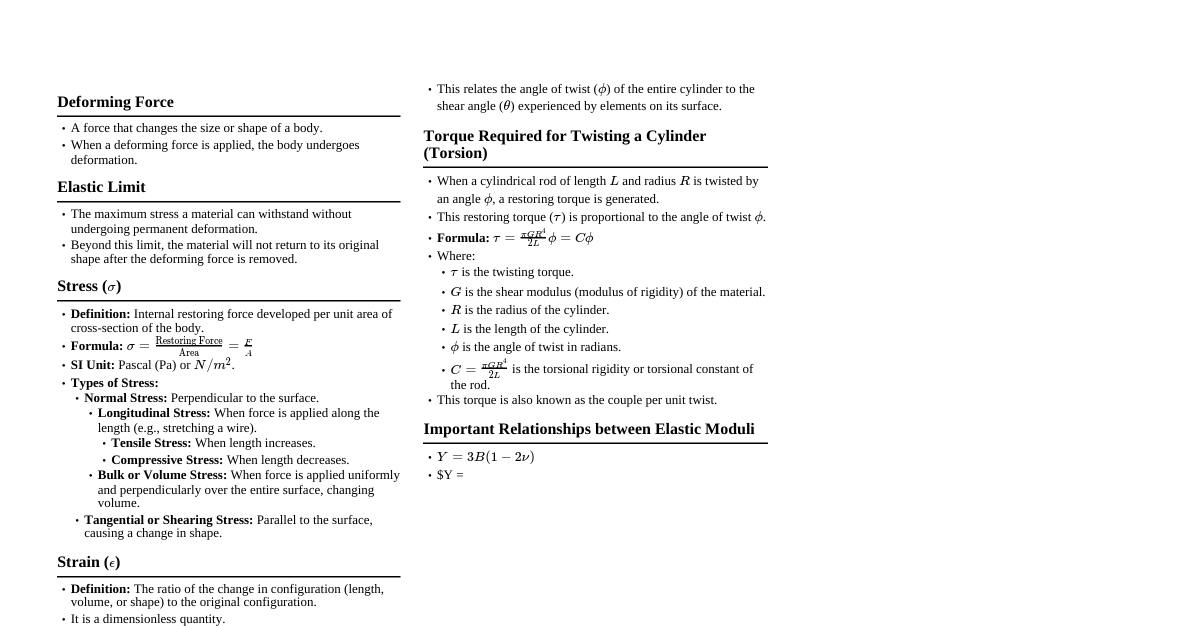
Interatomic Forces Forces due to electrostatic interaction between charges of atoms. Active when distance between atoms is $\approx 10^{-10} m$. Initially attractive, then repulsive at very close distances. Force-Distance Graph F r Attraction Repulsion 0 $r_0$ $r_0$: Equilibrium distance where force $F=0$. $F = -\frac{dU}{dr}$, where $U$ is potential energy. Intermolecular Forces Also called Van der Waals forces. Weaker than interatomic forces. Active when separation between molecules is $\approx 10^{-9} m$. Force $F = -\frac{a}{r^m} + \frac{b}{r^n}$, typically $m=6$, $n=12$. States of Matter Comparison Property Solid Liquid Gas Shape Definite Not definite Not definite Volume Definite Definite Not definite Density Maximum Less than solids, more than gases Minimum Compressibility Incompressible Less than gases, more than solids Compressible Intermolecular Force Strongest Less than solids, more than gases Weakest Freedom of Motion Vibrate about mean position Limited free motion Free to move Types of Solids Crystalline Solids: Atoms arranged in regular, repeated 3D pattern. Sharp melting point. Anisotropic. Long-range order. Amorphous Solids (Glassy): Atoms not arranged in regular pattern. No sharp melting point. Isotropic. No long-range order. Elasticity Elasticity: Property to regain original shape/size after removal of deforming force. Plasticity: Property of not regaining original shape/size after removal of deforming force. Perfectly Elastic Body: Regains original configuration completely (e.g., quartz fiber, phosphor bronze). Perfectly Plastic Body: No tendency to recover original configuration (e.g., paraffin wax, wet clay). Elastic Limit: Maximum deforming force a body can withstand while retaining elasticity. Elastic Fatigue: Temporary loss of elastic properties due to repeated alternating deforming force. Elastic After-Effect: Time delay in regaining original condition. Stress ($\sigma$) Internal restoring force per unit area. $\sigma = \frac{F}{A}$ Unit: $N/m^2$ (SI), $dyne/cm^2$ (CGS). Dimension: $[ML^{-1}T^{-2}]$. Types of Stress Normal Stress: Force applied normal to the surface. Longitudinal Stress: Occurs in solids when length is much greater than other dimensions. Force applied parallel to length. Tensile Stress: Increases length. Compressive Stress: Decreases length. Bulk or Volume Stress: Occurs in solids, liquids, or gases. Force applied normal to all surfaces, causing volume change. Shear or Tangential Stress: Force applied tangential to surface, causing relative displacement of layers (change in shape). Strain ($\epsilon$) Ratio of change in configuration to original configuration. $\epsilon = \frac{\text{Change in configuration}}{\text{Original configuration}}$ Dimensionless and unitless. Types of Strain Linear Strain: Change in length only. $\epsilon_L = \frac{\Delta L}{L}$ Longitudinal Strain: In direction of deforming force. Lateral Strain: Perpendicular to deforming force. Volumetric Strain: Change in volume only. $\epsilon_V = \frac{\Delta V}{V}$ Shearing Strain: Change in shape (angle of twist $\phi$). $\phi = \frac{x}{L}$ (for small angles) Hooke's Law Within the elastic limit, stress is proportional to strain. $\sigma \propto \epsilon \implies \frac{\sigma}{\epsilon} = E$ (Modulus of Elasticity) $E$ depends on material nature and temperature, not dimensions. Moduli of Elasticity Young's Modulus (Y): Ratio of normal stress to longitudinal strain. $Y = \frac{\text{Normal Stress}}{\text{Longitudinal Strain}} = \frac{F/A}{\Delta L/L} = \frac{FL}{A\Delta L}$ Bulk Modulus (K): Ratio of normal stress (pressure) to volumetric strain. $K = \frac{\text{Normal Stress}}{\text{Volumetric Strain}} = \frac{-P}{\Delta V/V}$ Compressibility $C = \frac{1}{K}$. Isothermal Elasticity $E_\theta = P$. Adiabatic Elasticity $E_\phi = \gamma P$ (where $\gamma = C_p/C_v$). Modulus of Rigidity ($\eta$): Ratio of tangential stress to shearing strain. $\eta = \frac{\text{Tangential Stress}}{\text{Shearing Strain}} = \frac{F/A}{\phi}$ Poisson's Ratio ($\sigma$) Ratio of lateral strain to longitudinal strain. $\sigma = -\frac{\text{Lateral Strain}}{\text{Longitudinal Strain}} = -\frac{\Delta r/r}{\Delta L/L}$ Dimensionless. Theoretical range: $-1 Practical range: $0 If $\sigma = 0.5$, material is incompressible (volume constant). If $\sigma = 0$, lateral strain is zero. Relations Between Elastic Constants $Y = 3K(1 - 2\sigma)$ $Y = 2\eta(1 + \sigma)$ $Y = \frac{9K\eta}{3K + \eta}$ $\sigma = \frac{3K - 2\eta}{6K + 2\eta}$ Stress-Strain Curve Stress Strain P (Proportional Limit) E (Elastic Limit) A (Yield Point) B (Ultimate Strength) C (Fracture Point) Elastic Region Plastic Region P (Proportional Limit): Hooke's law holds. $\sigma \propto \epsilon$. E (Elastic Limit/Yield Point): Material returns to original state. Beyond E, permanent deformation occurs. A (Yield Point): Stress at which material starts to deform plastically. B (Ultimate Tensile Strength): Maximum stress material can withstand. C (Fracture Point): Material breaks. Work Done in Stretching a Wire (Elastic Potential Energy) Energy stored per unit volume: $U_V = \frac{1}{2} \sigma \epsilon = \frac{1}{2} Y \epsilon^2 = \frac{1}{2Y} \sigma^2$. Total energy stored: $U = \frac{1}{2} F \Delta L = \frac{1}{2} \frac{Y A (\Delta L)^2}{L}$. Thermal Stress When a rod is fixed and temperature changes, stress is induced. Thermal Strain $\epsilon_T = \alpha \Delta T$ Thermal Stress $\sigma_T = Y \alpha \Delta T$ Thermal Force $F_T = Y A \alpha \Delta T$ Breaking Stress & Force Breaking Stress (Tensile Strength): Maximum stress a material can withstand before breaking (point B on stress-strain curve). Breaking Stress = $\frac{\text{Breaking Force}}{\text{Area}}$ Does not depend on length or area, only material. Breaking Force: Depends on cross-sectional area. Breaking Force $\propto A$. Factors Affecting Elasticity Hammering/Rolling: Increases elasticity (smaller grain size). Annealing: Decreases elasticity (larger grain size). Temperature: Generally decreases elasticity with increasing temperature. Impurities: Can increase or decrease elasticity. Elastic Hysteresis Lagging of strain behind stress when deforming force is applied or removed. Hysteresis Loop: Area of stress-strain curve during loading and unloading. Represents energy lost as heat. Torsion of Cylinder Angle of twist ($\theta$) is directly proportional to distance from fixed end. Shear angle ($\phi$) is directly proportional to radius. Torque $T = \frac{\pi \eta r^4 \theta}{2L}$. Hollow shaft is stronger than solid shaft of same mass and material. Important Notes Gases are most compressible (least elastic), solids are least. Rigid body: $Y, K, \eta \to \infty$. Water is more elastic than air (Bulk modulus). Ivory and steel are more elastic than rubber. Elasticity exists only for solids for $Y$ and $\eta$. $K$ exists for all states.