Magnetic Effects Class 10
Cheatsheet Content
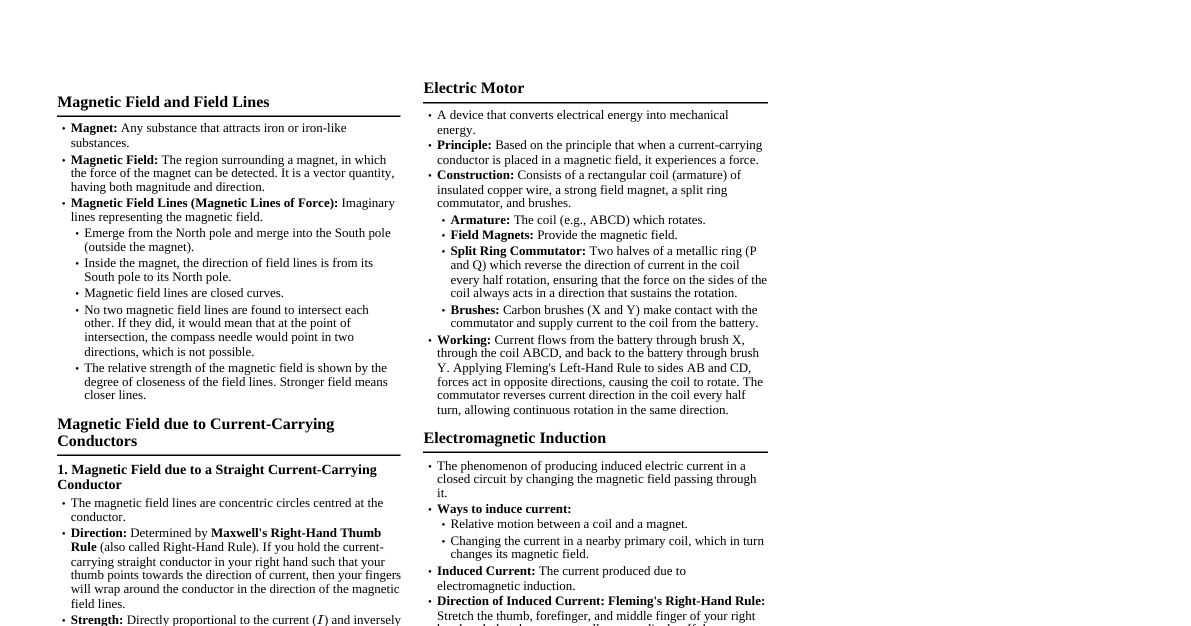
Magnetic Field and Field Lines Magnet: Attracts magnetic substances (e.g., iron, nickel, cobalt). Has North (N) and South (S) poles. Magnetic Field: Region around a magnet where its force can be detected. Represented by magnetic field lines. Magnetic Field Lines: Originate from N-pole and end at S-pole (outside magnet). Are continuous closed curves (inside magnet, from S to N). Never intersect each other. Closer lines indicate stronger magnetic field. Direction is given by the direction a North pole of a compass needle points. Magnetic Field due to Current Oersted's Experiment Electric current produces a magnetic field. A compass needle deflects when placed near a current-carrying conductor. Right-Hand Thumb Rule If you hold a current-carrying straight conductor in your right hand with your thumb pointing in the direction of current, then your fingers wrapped around the conductor indicate the direction of the magnetic field lines. Magnetic Field due to a Circular Loop Field lines are concentric circles near the wire, becoming nearly straight at the center. At the center, the field lines are perpendicular to the plane of the loop. Field strength $\propto$ current ($I$) and $\propto$ number of turns ($N$). Field strength $\propto 1/ \text{radius} (R)$. Magnetic Field due to a Solenoid Solenoid: A coil of many circular turns of insulated copper wire closely wound in the shape of a cylinder. Magnetic field inside a solenoid is uniform and strong, similar to a bar magnet. Field lines are parallel straight lines inside. One end acts as N-pole, other as S-pole. Field strength $\propto$ current ($I$), $\propto$ number of turns per unit length ($n$). Used to make electromagnets (by placing a soft iron core inside). Force on a Current-Carrying Conductor in a Magnetic Field A conductor carrying current placed in a magnetic field experiences a force. Direction of force is perpendicular to both current and magnetic field. Fleming's Left-Hand Rule: Hold thumb, forefinger, and middle finger of the left hand perpendicular to each other. If the forefinger points in the direction of the magnetic field, and the middle finger points in the direction of current, then the thumb will point in the direction of the force (motion) on the conductor. Applications: Electric motor, generator, loudspeakers. Electric Motor Device that converts electrical energy into mechanical energy. Principle: A current-carrying conductor placed in a magnetic field experiences a force. Components: Armature coil, strong field magnet, split ring (commutator), brushes, battery. Working: Current flows through the coil, forces act on its sides, causing it to rotate continuously. Commutator reverses current direction every half rotation to maintain continuous rotation in one direction. Electromagnetic Induction Principle: The production of an induced current in a closed circuit when the magnetic flux through the circuit changes. Discovered by Michael Faraday. Can be achieved by: Moving a magnet relative to a coil. Moving a coil relative to a magnet. Changing the current in an adjacent coil (primary coil). Fleming's Right-Hand Rule (Generator Rule) Hold thumb, forefinger, and middle finger of the right hand perpendicular to each other. If the forefinger points in the direction of the magnetic field, and the thumb points in the direction of motion (force) of the conductor, then the middle finger will point in the direction of the induced current. Applications: Electric generator. Electric Generator Device that converts mechanical energy into electrical energy. Principle: Electromagnetic induction. Types: AC Generator: Produces alternating current. Uses slip rings. Output current changes direction periodically. DC Generator: Produces direct current. Uses a split ring commutator. Output current is unidirectional. Domestic Electric Circuits Live Wire (Red): At high potential (220 V). Neutral Wire (Black/Blue): At zero potential. Earth Wire (Green): Connected to a metal plate deep in the earth. Provides safety by preventing electric shock in case of insulation failure. Fuses: Safety device, melts and breaks the circuit when current exceeds a safe limit, preventing damage to appliances. Overloading: Occurs when too many appliances are connected to a single socket or when live and neutral wires touch, drawing excessive current. Short Circuit: Live and neutral wires come into direct contact. Resistance becomes very low, causing a very large current to flow.