Real Sequences Essentials
Cheatsheet Content
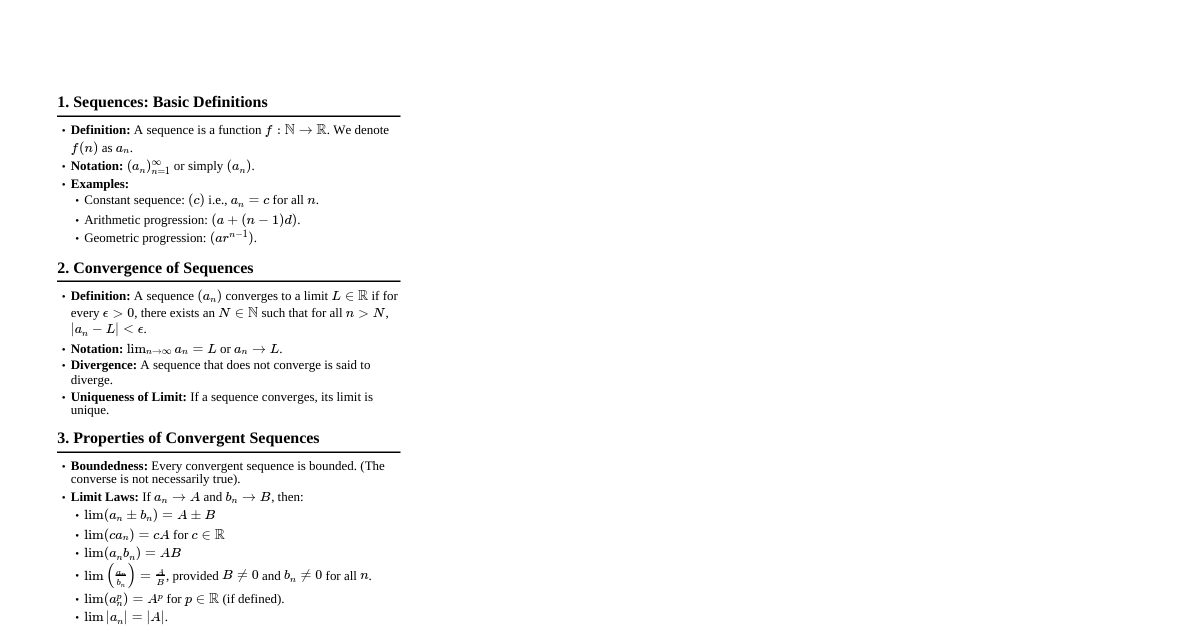
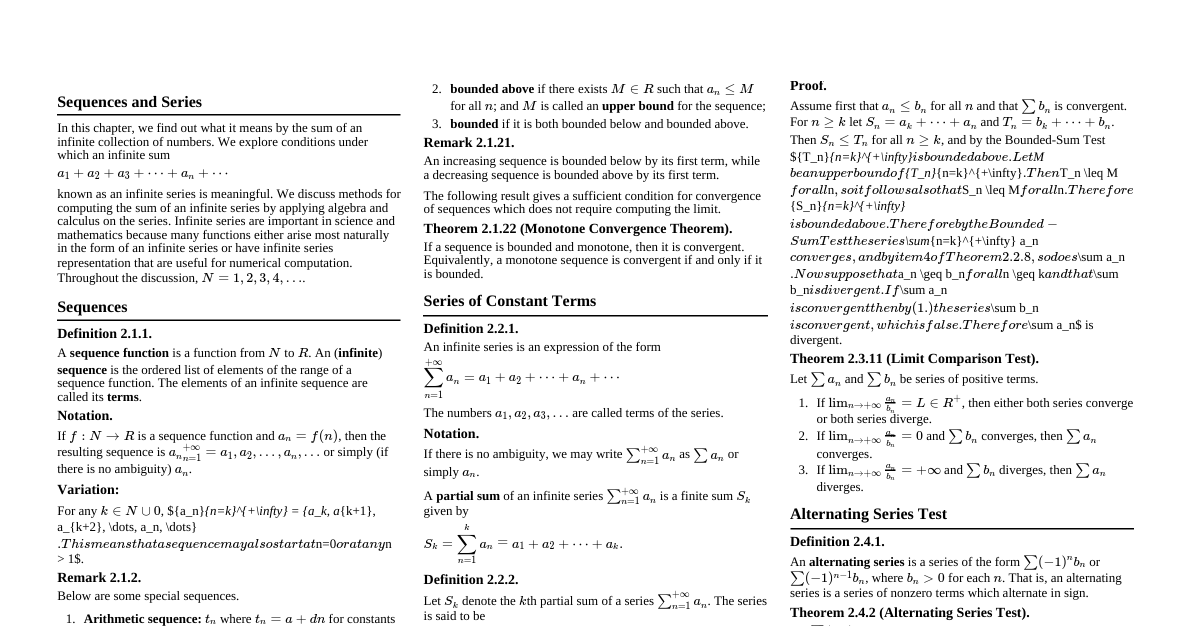
Functions & Sequences Function: A rule associating elements of set A to elements of set B. Domain: Set A (input values). Codomain: Set B (possible output values). Range: Set of actual output values in B, $f(A) = \{f(x) | x \in A\}$. Sequence: A function $S: \mathbb{N} \to \mathbb{R}$, denoted by $S_n$ or $\{S_n\}$. The terms are $S_1, S_2, S_3, \dots$. Ordered Set: A sequence is an ordered set of real numbers. Example: $\{(-1)^n\}$, $n \in \mathbb{N}$ generates $-1, 1, -1, 1, \dots$ Bounded Sequences Bounded above: A sequence $\{S_n\}$ is bounded above if there exists a real number $K$ such that $S_n \le K$ for all $n \in \mathbb{N}$. $K$ is an upper bound. Bounded below: A sequence $\{S_n\}$ is bounded below if there exists a real number $k$ such that $S_n \ge k$ for all $n \in \mathbb{N}$. $k$ is a lower bound. Bounded: A sequence is bounded if it is both bounded above and below. Range of a Sequence: The set of all distinct elements of the sequence. If the range is finite, the sequence is bounded. Convergence of Sequences Definition: A sequence $\{S_n\}$ converges to a real number $L$ if for every $\epsilon > 0$, there exists a positive integer $N$ such that for all $n > N$, $|S_n - L| Properties: If $S_n \to L$, then $L$ is unique. If $S_n \to L$, then $\{S_n\}$ is bounded. If $S_n \to L$ and $T_n \to M$, then $S_n + T_n \to L + M$, $S_n T_n \to LM$, and $S_n/T_n \to L/M$ (if $M \ne 0$). Example: $\lim_{n \to \infty} \frac{1}{n} = 0$. Limit Points of a Sequence Definition: A real number $x$ is a limit point of a sequence $\{S_n\}$ if every neighborhood of $x$ contains an infinite number of members of the sequence. Bolzano-Weierstrass Theorem: Every bounded sequence has at least one limit point. Illustrations: The constant sequence $\{S_n\}$, where $S_n = 1$, has only one limit point: $1$. The sequence $\{(-1)^n\}$ has two limit points: $1$ and $-1$. The sequence $\{S_n\}$ where $S_n = 1 + \frac{(-1)^n}{n}$ has one limit point: $1$. Superior/Inferior Limits: Limit Superior ($\limsup S_n$): The greatest limit point of the sequence. Limit Inferior ($\liminf S_n$): The smallest limit point of the sequence. If $S_n$ is bounded above, $\limsup S_n = \lim_{N \to \infty} \sup\{S_n | n > N\}$. If $S_n$ is bounded below, $\liminf S_n = \lim_{N \to \infty} \inf\{S_n | n > N\}$. A sequence $\{S_n\}$ converges if and only if $\limsup S_n = \liminf S_n$. Convergent Sequences A sequence $\{S_n\}$ is convergent if and only if it is bounded and has a unique limit point. Weierstrass Theorem: Every bounded sequence has a convergent subsequence. Non-Convergent Sequences (Definitions) Divergent: A sequence that does not converge. Oscillate Finitely: A bounded sequence that does not converge, and has at least two limit points, is said to oscillate finitely. Example: $\{(-1)^n\}$. Oscillate Infinitely: An unbounded sequence $\{S_n\}$ is said to oscillate infinitely if there is a limit point of the sequence, and to each positive number $G$, however large, there corresponds a positive integer $M$ such that $S_n > G$ for infinitely many $n$. Example: $\{(-1)^n n\}$. Diverges to $+\infty$: For any $G > 0$, there exists $N$ such that $S_n > G$ for all $n > N$. We write $S_n \to \infty$. Diverges to $-\infty$: For any $G N$. We write $S_n \to -\infty$. Illustrations of Non-Convergence $\{1 + (-1)^n\}$ oscillates finitely. $\{(-1)^n (1 + \frac{1}{n})\}$ oscillates finitely. $\{n^2\}$ diverges to $+\infty$. $\{-n^2\}$ diverges to $-\infty$. $\{n(-1)^n\}$ oscillates infinitely. $\{(-1)^n/n\}$ converges to $0$. Example Problems Example 1: Show that $\lim_{n \to \infty} \frac{3 + 2\sqrt{n}}{\sqrt{n}} = 2$. Let $\epsilon$ be any positive number. We need to find $N$ such that $|\frac{3 + 2\sqrt{n}}{\sqrt{n}} - 2| N$. $|\frac{3 + 2\sqrt{n} - 2\sqrt{n}}{\sqrt{n}}| = |\frac{3}{\sqrt{n}}| = \frac{3}{\sqrt{n}}$. We need $\frac{3}{\sqrt{n}} \frac{3}{\epsilon} \implies n > \frac{9}{\epsilon^2}$. Let $N = \text{ceil}(\frac{9}{\epsilon^2})$. Thus, for $n > N$, the condition holds. Example 2: Show that $\lim_{n \to \infty} \sqrt{n} = \infty$. Let $G$ be any positive number. We need to find $N$ such that $\sqrt{n} > G$ for $n > N$. $\sqrt{n} > G \implies n > G^2$. Let $N = \text{ceil}(G^2)$. Thus, for $n > N$, the condition holds.