Sequences & Series (Class 11)
Cheatsheet Content
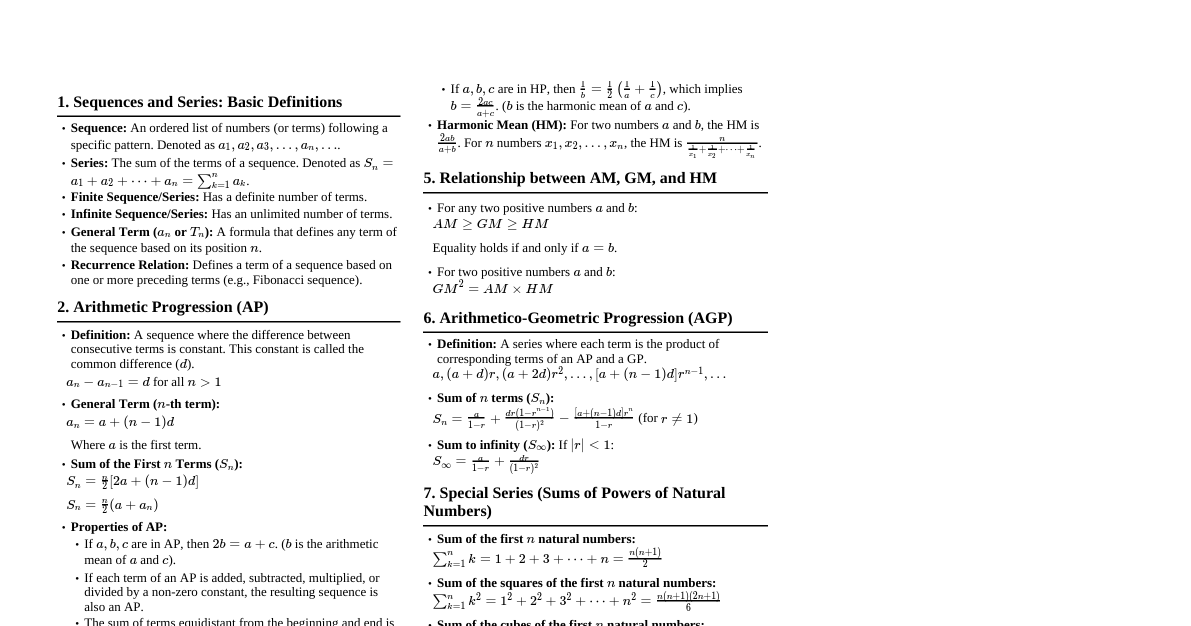
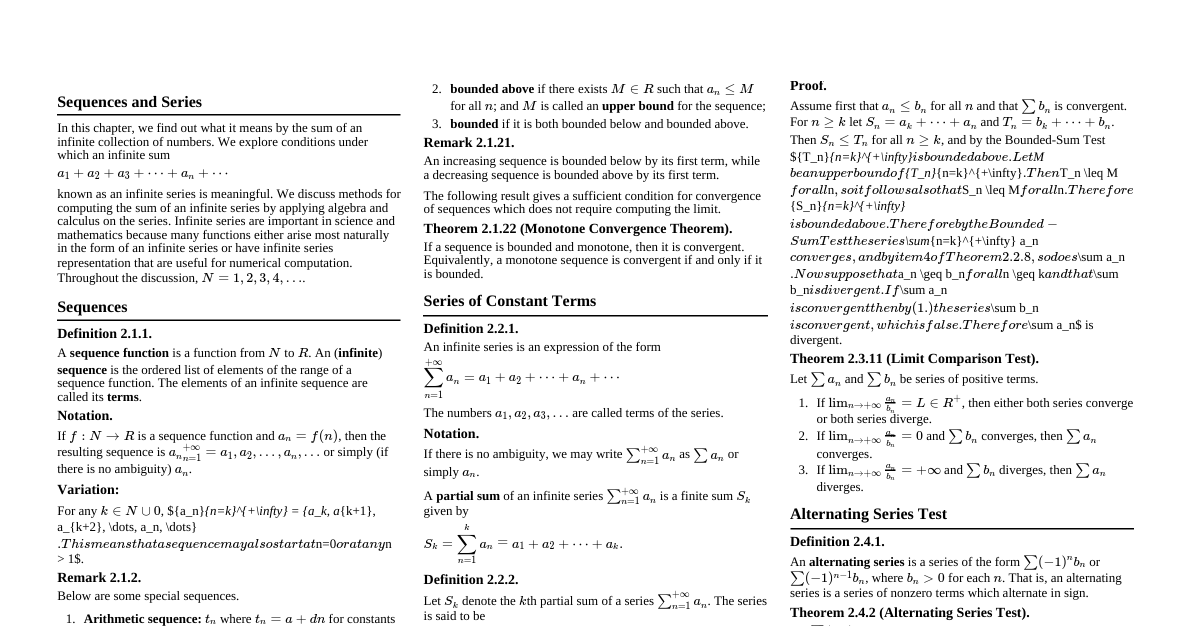
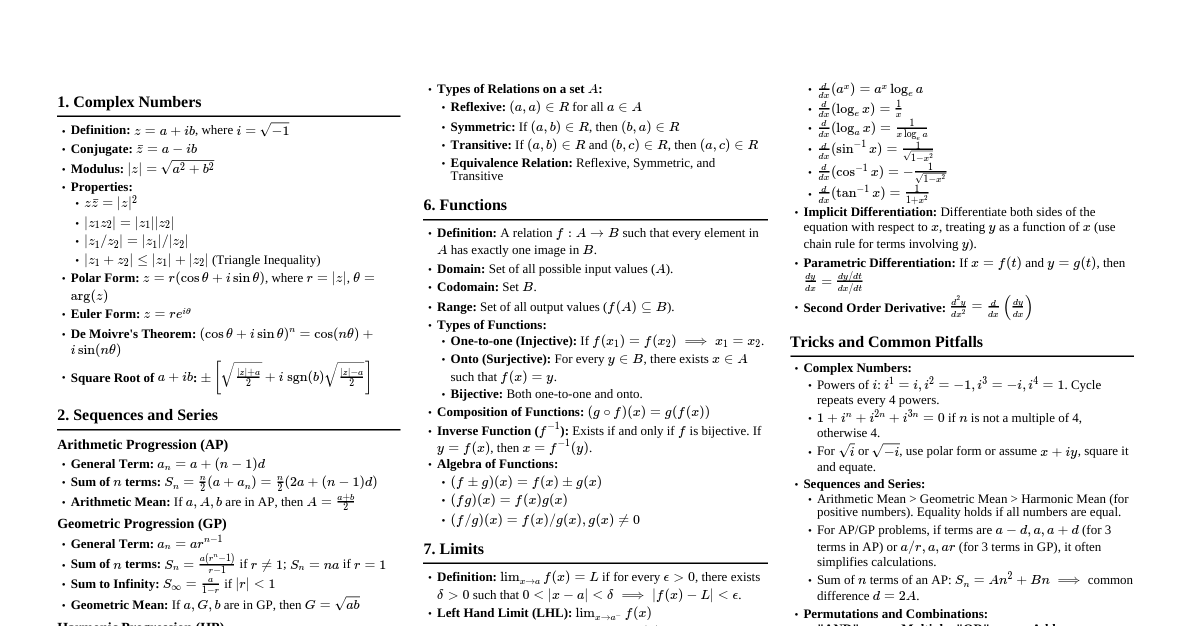
1. Sequences Definition: An ordered list of numbers, $a_1, a_2, a_3, \dots, a_n, \dots$. Finite Sequence: A sequence having a finite number of terms. Infinite Sequence: A sequence having an infinite number of terms. General Term ($n$-th term): A formula that defines any term of the sequence, often denoted as $a_n$. Example: If $a_n = 2n+1$, the sequence is $3, 5, 7, 9, \dots$. 2. Series Definition: The sum of the terms of a sequence. Notation: $S_n = a_1 + a_2 + \dots + a_n = \sum_{k=1}^{n} a_k$. Example: For sequence $3, 5, 7, \dots$, the series is $3+5+7+\dots$. 3. Arithmetic Progression (AP) Definition: A sequence where the difference between consecutive terms is constant. This constant is called the common difference ($d$). General Form: $a, a+d, a+2d, a+3d, \dots$ $n$-th term ($a_n$): $a_n = a + (n-1)d$ $a$: first term $n$: term number $d$: common difference Common Difference ($d$): $d = a_k - a_{k-1}$ for any $k > 1$. Sum of first $n$ terms ($S_n$): $S_n = \frac{n}{2}[2a + (n-1)d]$ $S_n = \frac{n}{2}[a + a_n]$ (if $a_n$ is known) Arithmetic Mean (AM): If $a, B, c$ are in AP, then $B = \frac{a+c}{2}$. 4. Geometric Progression (GP) Definition: A sequence where the ratio between consecutive terms is constant. This constant is called the common ratio ($r$). General Form: $a, ar, ar^2, ar^3, \dots$ $n$-th term ($a_n$): $a_n = ar^{n-1}$ $a$: first term $n$: term number $r$: common ratio Common Ratio ($r$): $r = \frac{a_k}{a_{k-1}}$ for any $k > 1$. Sum of first $n$ terms ($S_n$): If $r=1$: $S_n = na$ If $r \neq 1$: $S_n = \frac{a(r^n - 1)}{r-1}$ or $S_n = \frac{a(1 - r^n)}{1-r}$ Geometric Mean (GM): If $a, G, c$ are in GP, then $G = \sqrt{ac}$ (for positive $a, c$). 5. Relationship between AM and GM For any two positive numbers $a$ and $b$: $AM \ge GM$ i.e., $\frac{a+b}{2} \ge \sqrt{ab}$ Equality holds if and only if $a=b$. 6. Special Series (Sum to $n$ terms) Sum of first $n$ natural numbers: $\sum_{k=1}^{n} k = 1 + 2 + \dots + n = \frac{n(n+1)}{2}$ Sum of squares of first $n$ natural numbers: $\sum_{k=1}^{n} k^2 = 1^2 + 2^2 + \dots + n^2 = \frac{n(n+1)(2n+1)}{6}$ Sum of cubes of first $n$ natural numbers: $\sum_{k=1}^{n} k^3 = 1^3 + 2^3 + \dots + n^3 = \left[\frac{n(n+1)}{2}\right]^2$ 7. Harmonic Progression (HP) - Brief Mention Definition: A sequence is in HP if the reciprocals of its terms are in AP. Example: If $a, b, c$ are in HP, then $\frac{1}{a}, \frac{1}{b}, \frac{1}{c}$ are in AP. There is no general formula for the sum of $n$ terms of an HP. Harmonic Mean (HM): If $a, H, c$ are in HP, then $H = \frac{2ac}{a+c}$. 8. Important Notes & Tips To prove a sequence is AP, show $a_k - a_{k-1}$ is constant. To prove a sequence is GP, show $\frac{a_k}{a_{k-1}}$ is constant. When three numbers are in AP, consider them as $a-d, a, a+d$. When three numbers are in GP, consider them as $\frac{a}{r}, a, ar$. For word problems, identify initial term ($a$), common difference ($d$) or ratio ($r$), and the number of terms ($n$). Carefully distinguish between $n$-th term ($a_n$) and sum of $n$ terms ($S_n$). Remember the conditions for GP sum formulas (especially $r=1$ vs $r \neq 1$).