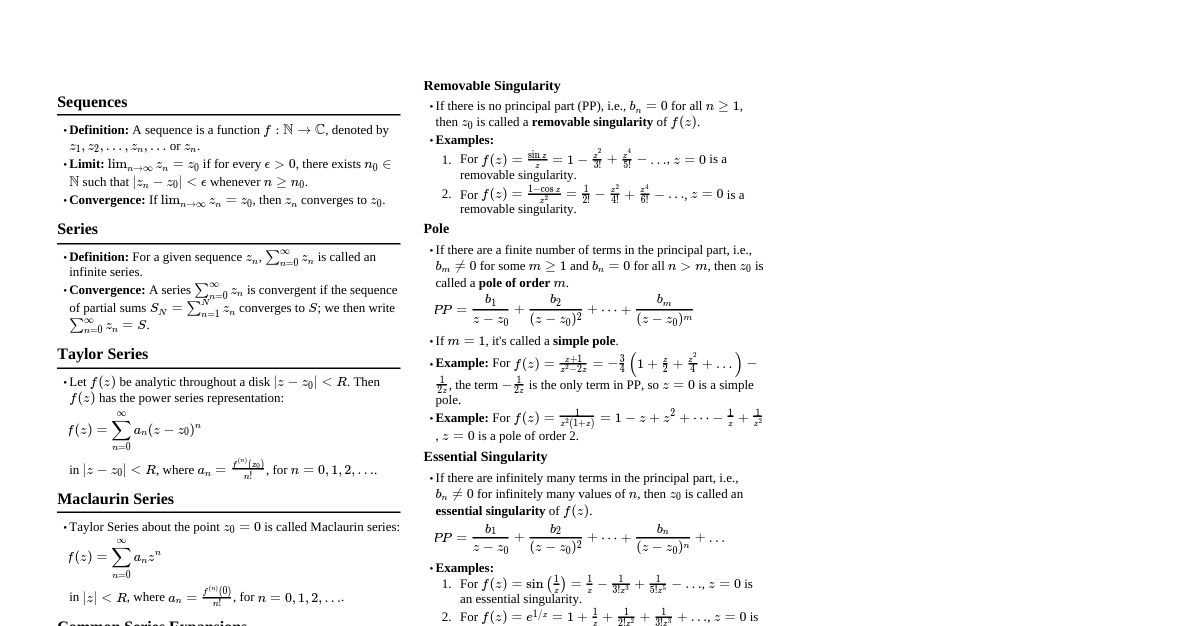
Sequences & Series (KEAM)
Cheatsheet Content
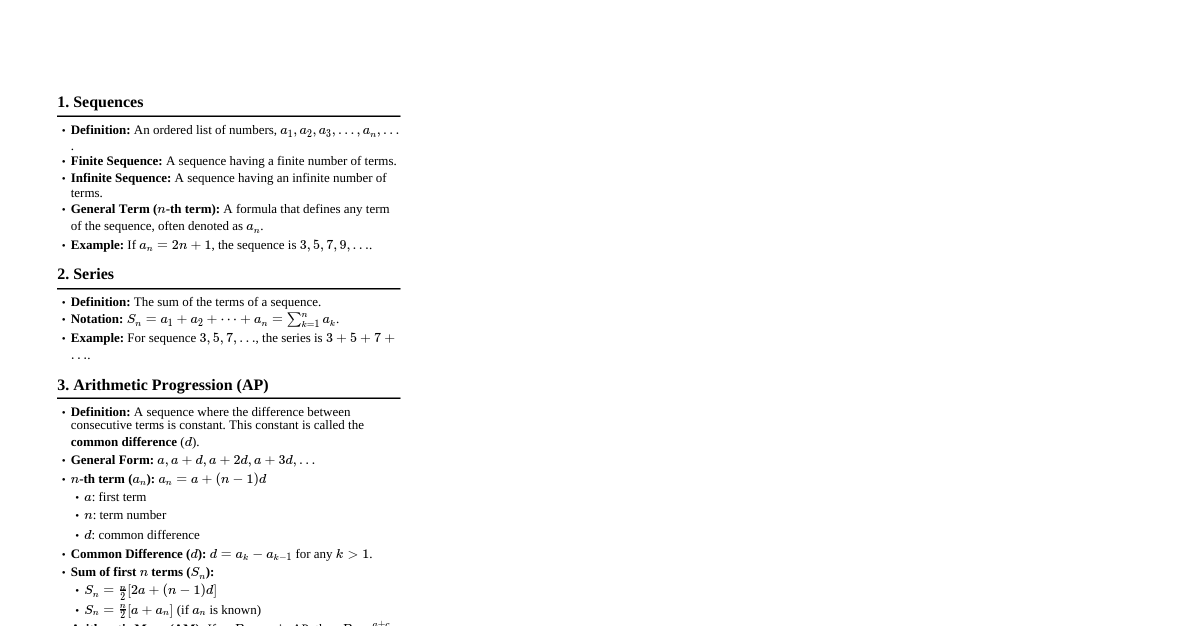
### Arithmetic Progression (AP) - **Definition:** A sequence where the difference between consecutive terms is constant. - $a, a+d, a+2d, \dots$ - **$n^{th}$ term:** $T_n = a + (n-1)d$ - **Sum of $n$ terms:** $S_n = \frac{n}{2}[2a + (n-1)d] = \frac{n}{2}(a + T_n)$ - **Arithmetic Mean (AM):** If a, b, c are in AP, then $b = \frac{a+c}{2}$ - **Properties:** - If each term of an AP is increased, decreased, multiplied or divided by a constant, the resulting sequence is also an AP. - Sum of terms equidistant from start and end is constant: $T_k + T_{n-k+1} = a + T_n$ - There is no sum to infinity for an AP (unless $d=0$ and $a=0$). ### Geometric Progression (GP) - **Definition:** A sequence where the ratio between consecutive terms is constant. - $a, ar, ar^2, \dots$ - **$n^{th}$ term:** $T_n = ar^{n-1}$ - **Sum of $n$ terms:** $S_n = \frac{a(r^n - 1)}{r-1}$ if $r \neq 1$; $S_n = na$ if $r=1$ - **Sum to infinity:** $S_\infty = \frac{a}{1-r}$ if $|r| ### Harmonic Progression (HP) - **Definition:** A sequence is in HP if the reciprocals of its terms are in AP. - $\frac{1}{a}, \frac{1}{a+d}, \frac{1}{a+2d}, \dots$ - **$n^{th}$ term:** $T_n = \frac{1}{a + (n-1)d}$ (where $a$ and $d$ are for the corresponding AP) - **Harmonic Mean (HM):** If a, b, c are in HP, then $b = \frac{2ac}{a+c}$ ### Arithmetic-Geometric Progression (AGP) - **Definition:** A sequence where each term is the product of a term from an AP and a term from a GP. - $a, (a+d)r, (a+2d)r^2, \dots$ - **Sum of $n$ terms:** $S_n = \frac{a - [a+(n-1)d]r^n}{1-r} + \frac{dr(1-r^{n-1})}{(1-r)^2}$ - **Sum to infinity:** $S_\infty = \frac{a}{1-r} + \frac{dr}{(1-r)^2}$ if $|r| ### Special Series - **Sum of first $n$ natural numbers:** $\sum_{k=1}^{n} k = 1 + 2 + \dots + n = \frac{n(n+1)}{2}$ - **Sum of squares of first $n$ natural numbers:** $\sum_{k=1}^{n} k^2 = 1^2 + 2^2 + \dots + n^2 = \frac{n(n+1)(2n+1)}{6}$ - **Sum of cubes of first $n$ natural numbers:** $\sum_{k=1}^{n} k^3 = 1^3 + 2^3 + \dots + n^3 = \left(\frac{n(n+1)}{2}\right)^2$ ### Mean Inequalities - For positive numbers $a_1, a_2, \dots, a_n$: - $AM \ge GM \ge HM$ - Equality holds if and only if $a_1 = a_2 = \dots = a_n$. - For two positive numbers $a, b$: - $AM = \frac{a+b}{2}$ - $GM = \sqrt{ab}$ - $HM = \frac{2ab}{a+b}$ - Also, $GM^2 = AM \cdot HM$ ### Important Notes for KEAM - **Identify the type:** First, determine if the sequence is AP, GP, HP, or AGP. - **Formulas:** Memorize the formulas for $T_n$, $S_n$, and $S_\infty$ for AP and GP. - **HP trick:** Convert HP problems to AP problems by taking reciprocals. - **Properties:** Understand how operations affect AP and GP. - **Problem Solving:** Practice problems involving combinations of these concepts. - **Series Summation:** Be familiar with methods to sum series where terms are in a specific pattern (e.g., using differences, or partial fractions for rational terms). - **Infinite Series:** Understand convergence criteria, especially for GP.