IIT JEE Organic Reactions
Shared 5/3/2026•1 views
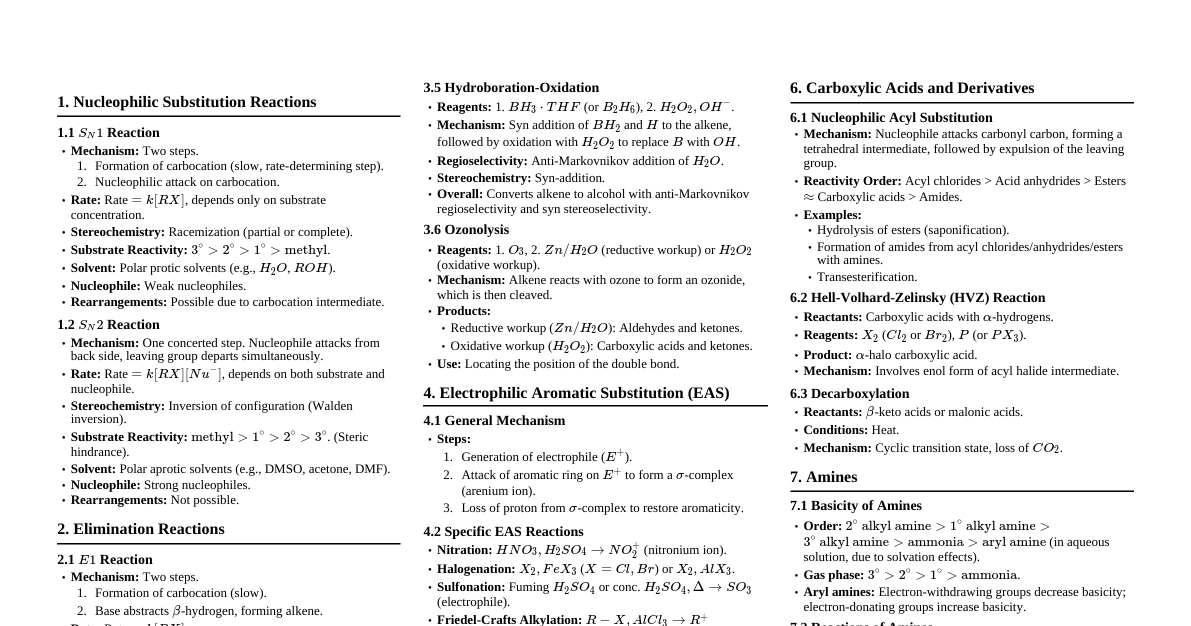
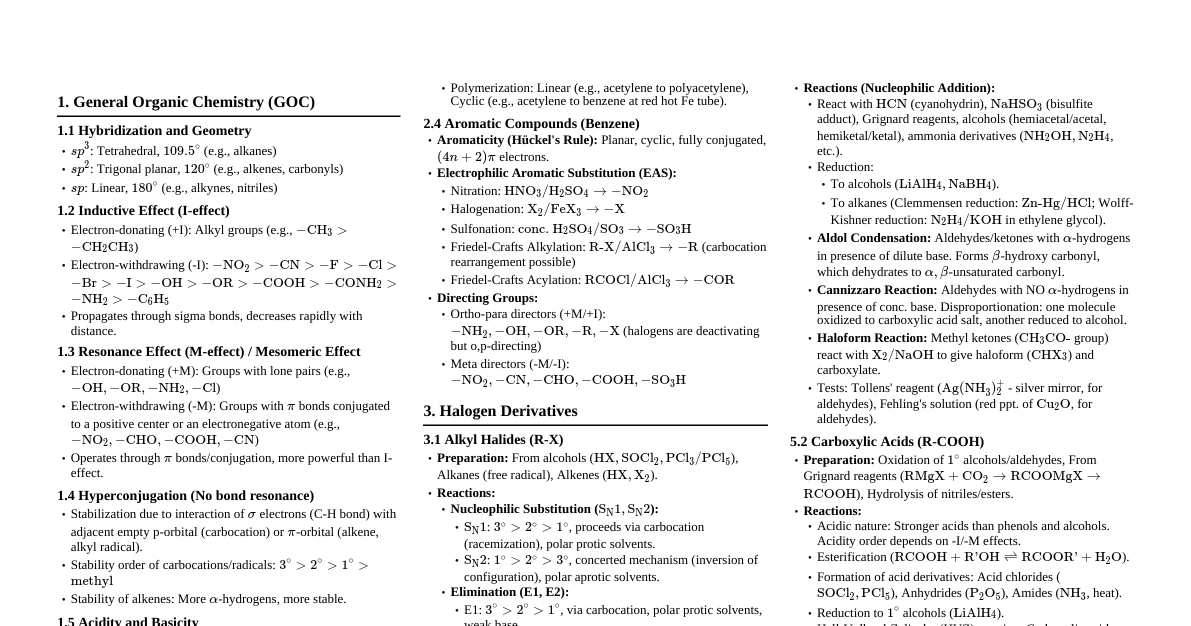
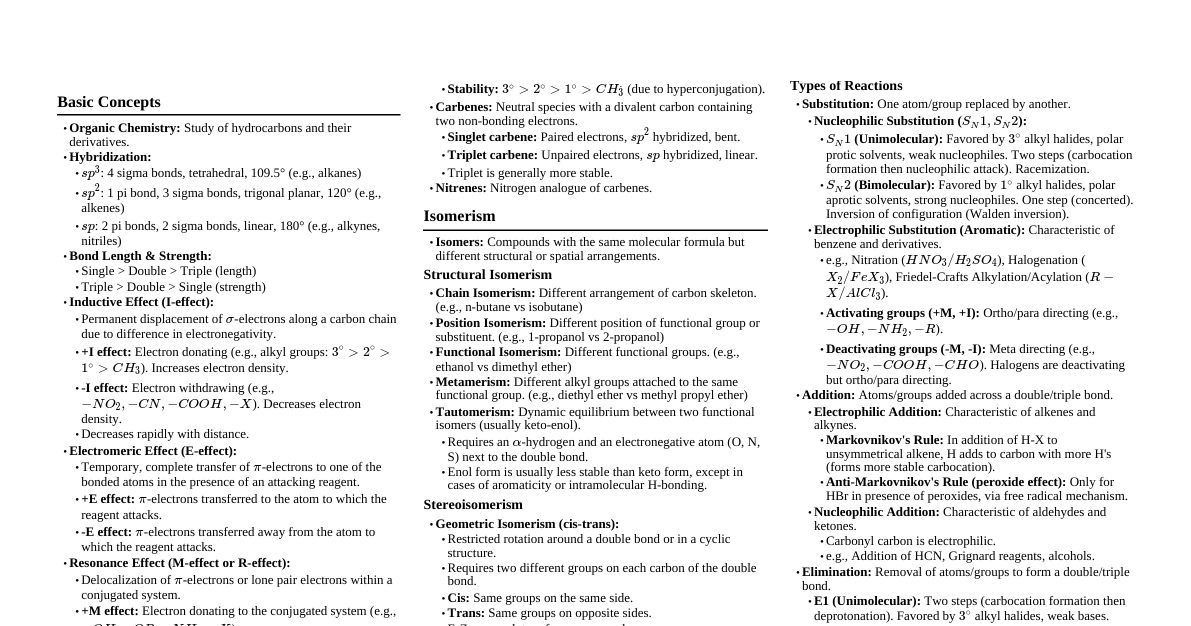
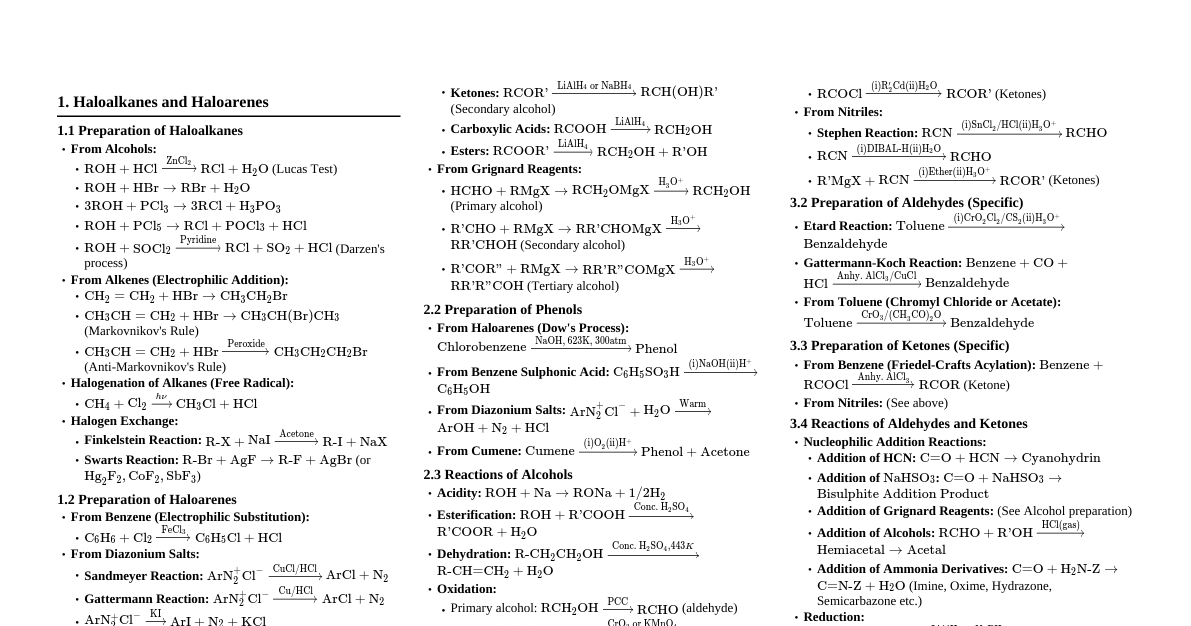
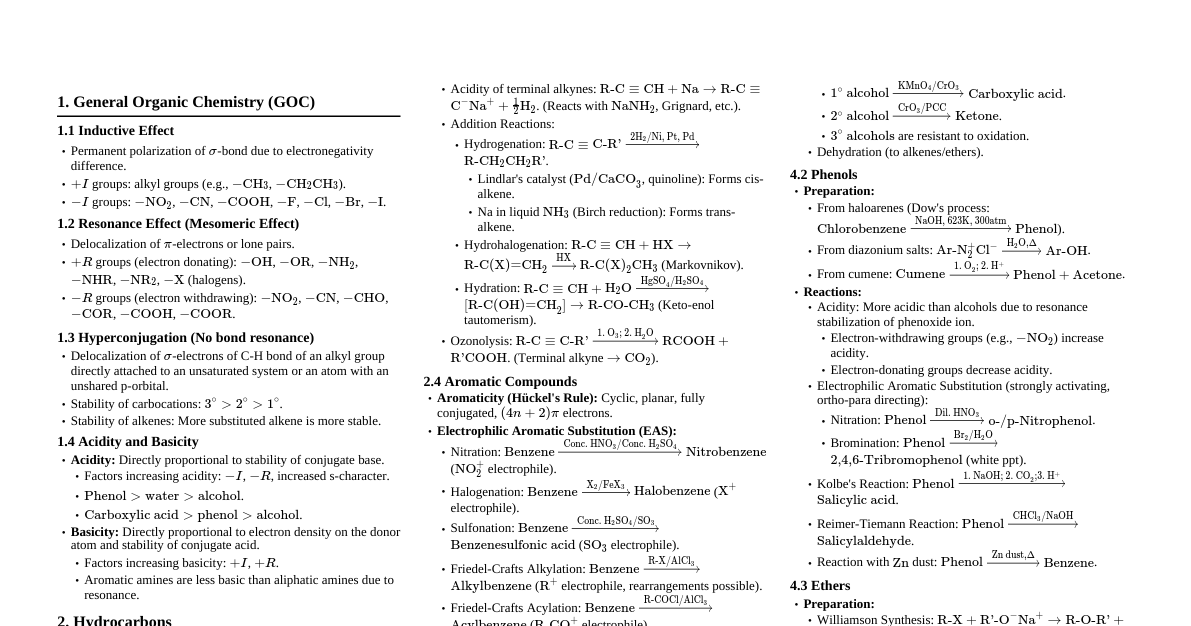
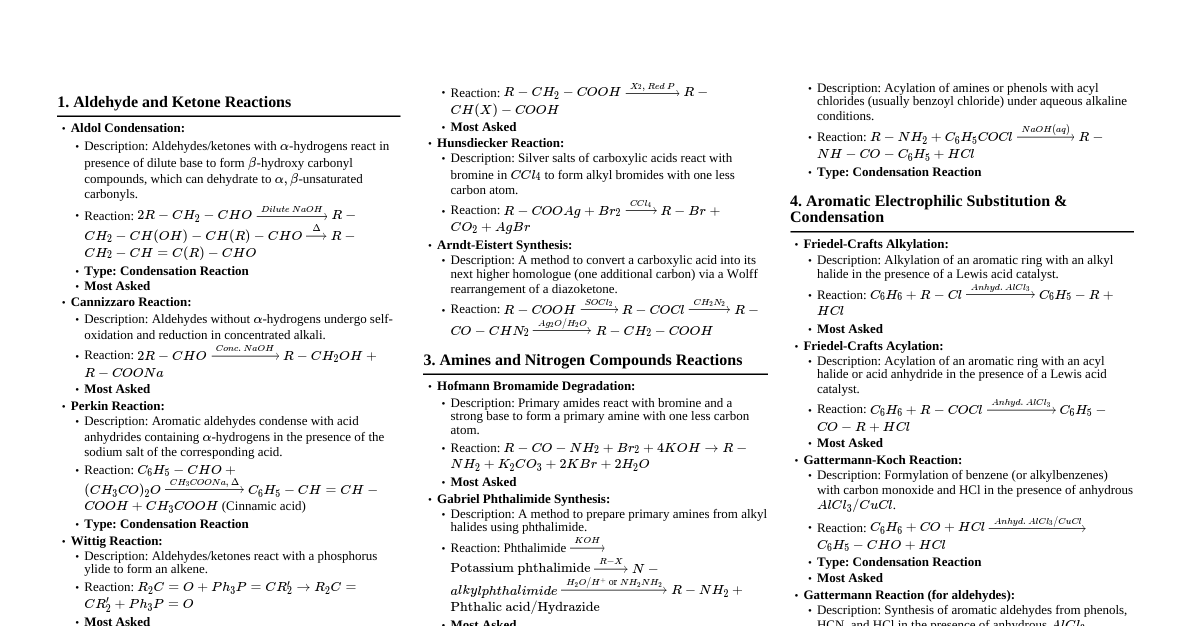
### Aldol Condensation **Word Conversion:** Aldehyde/ketone with α-H → β-hydroxy aldehyde/ketone (aldol/ketol) → α,β-unsaturated aldehyde/ketone **General Expression:** R-CH₂-CHO + R'-CHO $$\xrightarrow{Dil.\,NaOH/\Delta}$$ R-CH₂-CH(OH)-CHR'-CHO $$\rightarrow$$ R-CH=CR'-CHO **Condition:** Dilute base (NaOH, Ba(OH)₂) or acid, then heat for dehydration. **Key Feature (1 line max):** Requires at least one α-hydrogen; forms C-C bond. **Concrete Example:** CH₃CHO + CH₃CHO $$\xrightarrow{Dil.\,NaOH/\Delta}$$ CH₃CH=CHCHO (Crotonaldehyde) ### Cannizzaro Reaction **Word Conversion:** Aldehyde without α-H → Alcohol + Carboxylic acid salt **General Expression:** 2R-CHO $$\xrightarrow{Conc.\,NaOH}$$ R-CH₂OH + R-COONa **Condition:** Concentrated strong base (NaOH, KOH). **Key Feature (1 line max):** Disproportionation reaction; no α-hydrogens required. **Concrete Example:** 2HCHO $$\xrightarrow{Conc.\,KOH}$$ CH₃OH + HCOOK ### Clemmensen Reduction **Word Conversion:** Carbonyl (aldehyde/ketone) → Alkane **General Expression:** R-CO-R' $$\xrightarrow{Zn(Hg)/Conc.\,HCl}$$ R-CH₂-R' **Condition:** Zinc amalgam (Zn/Hg) and concentrated HCl. **Key Feature (1 line max):** Acidic conditions; not suitable for acid-sensitive compounds. **Concrete Example:** CH₃COCH₃ $$\xrightarrow{Zn(Hg)/Conc.\,HCl}$$ CH₃CH₂CH₃ (Propane) ### Wolff–Kishner Reduction **Word Conversion:** Carbonyl (aldehyde/ketone) → Alkane **General Expression:** R-CO-R' $$\xrightarrow{NH_2NH_2/KOH/\Delta}$$ R-CH₂-R' **Condition:** Hydrazine (NH₂NH₂) and strong base (KOH or NaOH) in a high-boiling solvent (e.g., ethylene glycol), heat. **Key Feature (1 line max):** Basic conditions; suitable for acid-sensitive compounds. **Concrete Example:** CH₃COCH₃ $$\xrightarrow{NH_2NH_2/KOH/\Delta}$$ CH₃CH₂CH₃ (Propane) ### Friedel–Crafts Alkylation **Word Conversion:** Aromatic compound → Alkylated aromatic compound **General Expression:** Ar-H + R-X $$\xrightarrow{AlCl_3}$$ Ar-R + HX **Condition:** Lewis acid catalyst (AlCl₃, FeCl₃, BF₃) and alkyl halide. **Key Feature (1 line max):** Carbocation rearrangement possible; polyalkylation and deactivation issues. **Concrete Example:** C₆H₆ + CH₃Cl $$\xrightarrow{AlCl_3}$$ C₆H₅CH₃ (Toluene) ### Friedel–Crafts Acylation **Word Conversion:** Aromatic compound → Acylated aromatic compound (ketone) **General Expression:** Ar-H + R-CO-Cl $$\xrightarrow{AlCl_3}$$ Ar-CO-R + HCl **Condition:** Lewis acid catalyst (AlCl₃) and acyl halide or anhydride. **Key Feature (1 line max):** No rearrangement of acylium ion; deactivates ring, preventing polyacylation. **Concrete Example:** C₆H₆ + CH₃COCl $$\xrightarrow{AlCl_3}$$ C₆H₅COCH₃ (Acetophenone) ### Sandmeyer Reaction **Word Conversion:** Aryl diazonium salt → Aryl halide or Aryl cyanide **General Expression:** Ar-N₂⁺Cl⁻ $$\xrightarrow{CuCl/HCl}$$ Ar-Cl or Ar-N₂⁺Cl⁻ $$\xrightarrow{CuCN/KCN}$$ Ar-CN **Condition:** Copper(I) salt (CuCl, CuBr, CuCN) in corresponding HX acid. **Key Feature (1 line max):** Replaces diazonium group with Cl, Br, or CN. **Concrete Example:** C₆H₅N₂⁺Cl⁻ $$\xrightarrow{CuCl/HCl}$$ C₆H₅Cl (Chlorobenzene) ### Balz–Schiemann Reaction **Word Conversion:** Aryl diazonium salt → Aryl fluoride **General Expression:** Ar-N₂⁺Cl⁻ $$\xrightarrow{HBF_4/\Delta}$$ Ar-F + N₂ + BF₃ **Condition:** Fluoroboric acid (HBF₄) followed by heating. **Key Feature (1 line max):** Exclusive method for preparing aryl fluorides. **Concrete Example:** C₆H₅N₂⁺Cl⁻ $$\xrightarrow{HBF_4/\Delta}$$ C₆H₅F (Fluorobenzene) ### Gattermann Reaction **Word Conversion:** Aryl diazonium salt → Aryl halide **General Expression:** Ar-N₂⁺Cl⁻ $$\xrightarrow{Cu/HCl}$$ Ar-Cl + N₂ **Condition:** Copper powder (not Cu(I) salt) in corresponding HX acid. **Key Feature (1 line max):** Similar to Sandmeyer but uses copper powder; lower yields. **Concrete Example:** C₆H₅N₂⁺Cl⁻ $$\xrightarrow{Cu/HCl}$$ C₆H₅Cl (Chlorobenzene) ### Gomberg–Bachmann Reaction **Word Conversion:** Aryl diazonium salt + Aromatic compound → Biaryl **General Expression:** Ar-N₂⁺X⁻ + Ar'-H $$\xrightarrow{NaOH}$$ Ar-Ar' + N₂ + HX **Condition:** Base (NaOH) and an aromatic compound, often in biphasic system. **Key Feature (1 line max):** Free radical mechanism; couples two aryl groups. **Concrete Example:** C₆H₅N₂⁺Cl⁻ + C₆H₆ $$\xrightarrow{NaOH}$$ C₆H₅-C₆H₅ (Biphenyl) ### Reimer–Tiemann Reaction **Word Conversion:** Phenol → o-Hydroxybenzaldehyde **General Expression:** ArOH + CHCl₃ + NaOH $$\xrightarrow{\Delta}$$ o-HO–C₆H₄–CHO **Condition:** Chloroform (CHCl₃) and strong base (NaOH/KOH), followed by acidification. **Key Feature (1 line max):** Electrophilic substitution by dichlorocarbene at ortho position. **Concrete Example:** Phenol + CHCl₃ + NaOH $$\xrightarrow{\Delta}$$ Salicylaldehyde ### Kolbe’s Reaction **Word Conversion:** Phenoxide ion → o-Hydroxybenzoic acid **General Expression:** ArO⁻Na⁺ + CO₂ $$\xrightarrow{125^\circ C, 4-7\,atm}$$ o-HO–C₆H₄–COONa $$\xrightarrow{H^+}$$ o-HO–C₆H₄–COOH **Condition:** Sodium phenoxide, CO₂ under pressure (4-7 atm) and heat (125°C), then acidification. **Key Feature (1 line max):** Electrophilic aromatic substitution by CO₂ on phenoxide. **Concrete Example:** Sodium phenoxide + CO₂ $$\xrightarrow{\text{conditions}}$$ Salicylic acid ### Williamson Ether Synthesis **Word Conversion:** Alkyl halide + Alkoxide → Ether **General Expression:** R-X + R'-O⁻Na⁺ $$\xrightarrow{S_N2}$$ R-O-R' + NaX **Condition:** Primary alkyl halide and sodium alkoxide (or phenoxide). **Key Feature (1 line max):** SN2 mechanism; best with primary alkyl halides to avoid elimination. **Concrete Example:** CH₃CH₂Br + CH₃O⁻Na⁺ $$\xrightarrow{S_N2}$$ CH₃CH₂OCH₃ (Ethyl methyl ether) ### Fischer Esterification **Word Conversion:** Carboxylic acid + Alcohol → Ester + Water **General Expression:** R-COOH + R'-OH $$\xrightarrow{H_2SO_4/\Delta}$$ R-COOR' + H₂O **Condition:** Acid catalyst (e.g., conc. H₂SO₄) and heat. Reversible. **Key Feature (1 line max):** Acid-catalyzed condensation; requires removal of water for high yield. **Concrete Example:** CH₃COOH + C₂H₅OH $$\xrightarrow{H_2SO_4/\Delta}$$ CH₃COOC₂H₅ (Ethyl acetate) ### Hell–Volhard–Zelinsky Reaction **Word Conversion:** Carboxylic acid with α-H → α-Halo carboxylic acid **General Expression:** R-CH₂-COOH $$\xrightarrow{X_2/Red\,P}$$ R-CH(X)-COOH **Condition:** Halogen (Cl₂ or Br₂) in presence of red phosphorus, followed by water. **Key Feature (1 line max):** Replaces α-hydrogen with halogen, via enol intermediate. **Concrete Example:** CH₃COOH $$\xrightarrow{Cl_2/Red\,P}$$ ClCH₂COOH (Chloroacetic acid) ### Rosenmund Reduction **Word Conversion:** Acyl chloride → Aldehyde **General Expression:** R-COCl $$\xrightarrow{H_2/Pd-BaSO_4}$$ R-CHO + HCl **Condition:** Hydrogen gas (H₂) over palladium on barium sulfate (Pd-BaSO₄), often with sulfur or quinoline as poison. **Key Feature (1 line max):** Selective reduction of acyl chloride to aldehyde; catalyst poisoning prevents over-reduction. **Concrete Example:** CH₃COCl $$\xrightarrow{H_2/Pd-BaSO_4}$$ CH₃CHO (Acetaldehyde) ### Stephen Reaction **Word Conversion:** Nitrile → Aldehyde **General Expression:** R-CN $$\xrightarrow{SnCl_2/HCl/H_2O}$$ R-CHO **Condition:** Stannous chloride (SnCl₂) and HCl, followed by hydrolysis. **Key Feature (1 line max):** Forms an imine intermediate which is then hydrolyzed. **Concrete Example:** CH₃CN $$\xrightarrow{SnCl_2/HCl/H_2O}$$ CH₃CHO (Acetaldehyde) ### Etard Reaction **Word Conversion:** Toluene/methylarene → Benzaldehyde/arenecarbaldehyde **General Expression:** Ar-CH₃ $$\xrightarrow{CrO_2Cl_2/CS_2/H_2O}$$ Ar-CHO **Condition:** Chromyl chloride (CrO₂Cl₂) in CS₂ or CCl₄, followed by hydrolysis. **Key Feature (1 line max):** Selective oxidation of methyl group to aldehyde via chromium complex. **Concrete Example:** C₆H₅CH₃ $$\xrightarrow{CrO_2Cl_2/CS_2/H_2O}$$ C₆H₅CHO (Benzaldehyde) ### Gattermann–Koch Reaction **Word Conversion:** Benzene/alkylbenzene → Benzaldehyde/arenecarbaldehyde **General Expression:** Ar-H + CO + HCl $$\xrightarrow{AlCl_3/CuCl}$$ Ar-CHO **Condition:** Carbon monoxide (CO) and HCl in presence of AlCl₃ and CuCl. **Key Feature (1 line max):** Formylation of aromatic ring using formyl chloride equivalent. **Concrete Example:** C₆H₆ + CO + HCl $$\xrightarrow{AlCl_3/CuCl}$$ C₆H₅CHO (Benzaldehyde) ### Hoffmann Bromamide Reaction **Word Conversion:** Primary amide → Primary amine (with one less carbon) **General Expression:** R-CONH₂ $$\xrightarrow{Br_2/NaOH}$$ R-NH₂ + Na₂CO₃ + NaBr + H₂O **Condition:** Bromine (Br₂) and strong base (NaOH/KOH). **Key Feature (1 line max):** Rearrangement reaction, carbon chain shortening. **Concrete Example:** CH₃CONH₂ $$\xrightarrow{Br_2/NaOH}$$ CH₃NH₂ (Methylamine) ### Gabriel Phthalimide Synthesis **Word Conversion:** Primary alkyl halide → Primary amine **General Expression:** Phthalimide $$\xrightarrow{KOH}$$ Potassium phthalimide $$\xrightarrow{R-X}$$ N-Alkylphthalimide $$\xrightarrow{NaOH/H_2O\,\text{or}\,NH_2NH_2}$$ R-NH₂ **Condition:** Phthalimide with KOH, then primary alkyl halide, followed by hydrolysis (NaOH/H₂O) or hydrazinolysis (NH₂NH₂). **Key Feature (1 line max):** Synthesizes pure primary amines; not suitable for secondary/tertiary amines or aryl amines. **Concrete Example:** Phthalimide $$\xrightarrow{KOH}$$ Potassium phthalimide $$\xrightarrow{CH_3CH_2Br}$$ N-Ethylphthalimide $$\xrightarrow{NH_2NH_2}$$ CH₃CH₂NH₂ (Ethylamine) ### Carbylamine Reaction **Word Conversion:** Primary amine → Isocyanide (foul smelling) **General Expression:** R-NH₂ + CHCl₃ + KOH $$\xrightarrow{\Delta}$$ R-NC + KCl + H₂O **Condition:** Chloroform (CHCl₃) and strong base (KOH), heat. **Key Feature (1 line max):** Test for primary amines; highly toxic and pungent isocyanide formed. **Concrete Example:** CH₃CH₂NH₂ + CHCl₃ + KOH $$\xrightarrow{\Delta}$$ CH₃CH₂NC (Ethyl isocyanide) ### Azo Coupling Reaction **Word Conversion:** Aryl diazonium salt + Phenol/Aniline → Azo dye **General Expression:** Ar-N₂⁺Cl⁻ + Ar'-H $$\xrightarrow{pH\,4-5\,(\text{aniline})/\,pH\,9-10\,(\text{phenol})}$$ Ar-N=N-Ar' **Condition:** Aryl diazonium salt reacts with activated aromatic compounds (phenol, aniline) under specific pH. **Key Feature (1 line max):** Forms colored azo compounds (dyes); electrophilic aromatic substitution. **Concrete Example:** Benzenediazonium chloride + Phenol $$\xrightarrow{NaOH,\,pH\,9-10}$$ p-Hydroxyazobenzene (Orange dye) ### Hinsberg Reaction **Word Conversion:** Distinguishes primary, secondary, and tertiary amines **General Expression:** R-NH₂ $$\xrightarrow{C_6H_5SO_2Cl}$$ R-NH-SO₂C₆H₅ $$\xrightarrow{KOH}$$ Soluble salt **Condition:** Benzene sulfonyl chloride (Hinsberg reagent), followed by aqueous KOH. **Key Feature (1 line max):** Primary amines form soluble sulfonamide, secondary amines form insoluble sulfonamide, tertiary amines do not react. **Concrete Example:** CH₃CH₂NH₂ + C₆H₅SO₂Cl $$\rightarrow$$ N-Ethylbenzenesulfonamide (soluble in KOH) ### Perkin Reaction **Word Conversion:** Aromatic aldehyde + Aliphatic anhydride → α,β-Unsaturated carboxylic acid **General Expression:** Ar-CHO + (RCH₂CO)₂O $$\xrightarrow{RCH_2COONa/\Delta}$$ Ar-CH=CR-COOH **Condition:** Aromatic aldehyde, aliphatic acid anhydride (with α-H), and sodium salt of the acid, heat. **Key Feature (1 line max):** Condensation reaction to form cinnamic acid derivatives. **Concrete Example:** C₆H₅CHO + (CH₃CO)₂O $$\xrightarrow{CH_3COONa/\Delta}$$ C₆H₅CH=CHCOOH (Cinnamic acid) ### Knoevenagel Condensation **Word Conversion:** Aldehyde/ketone + Compound with active methylene group → α,β-Unsaturated compound **General Expression:** R-CHO + CH₂(COOEt)₂ $$\xrightarrow{\text{base}}$$ R-CH=C(COOEt)₂ $$\xrightarrow{\Delta}$$ R-CH=CH-COOH **Condition:** Aldehyde/ketone, active methylene compound (e.g., malonic ester), and a weak base (e.g., pyridine, piperidine). **Key Feature (1 line max):** Forms C-C bond, followed by dehydration and often decarboxylation. **Concrete Example:** C₆H₅CHO + CH₂(COOEt)₂ $$\xrightarrow{\text{piperidine}}$$ C₆H₅CH=C(COOEt)₂ ### Diels–Alder Reaction **Word Conversion:** Diene + Dienophile → Cyclohexene derivative (adduct) **General Expression:** Conjugated Diene + Alkene/Alkyne $$\xrightarrow{\Delta}$$ Cyclohexene **Condition:** Heat (thermal reaction), sometimes pressure. **Key Feature (1 line max):** [4+2] cycloaddition reaction; concerted mechanism, stereospecific. **Concrete Example:** Buta-1,3-diene + Ethene $$\xrightarrow{\Delta}$$ Cyclohexene ### Wittig Reaction **Word Conversion:** Aldehyde/ketone + Phosphonium ylide → Alkene **General Expression:** R-CHO/R₂CO + Ph₃P=CR'R'' $$\rightarrow$$ R-CH=CR'R'' / R₂C=CR'R'' + Ph₃PO **Condition:** Aldehyde or ketone reacts with a phosphonium ylide. **Key Feature (1 line max):** Forms C=C double bond; useful for preparing terminal or internal alkenes. **Concrete Example:** CH₃CHO + Ph₃P=CH₂ $$\rightarrow$$ CH₃CH=CH₂ (Propene) + Ph₃PO ### Baeyer–Villiger Oxidation **Word Conversion:** Ketone → Ester; Aldehyde → Carboxylic acid **General Expression:** R-CO-R' $$\xrightarrow{Peracid}$$ R-CO-O-R' (migration of R' or R) **Condition:** Peroxy acid (e.g., m-CPBA, peracetic acid). **Key Feature (1 line max):** Inserts oxygen atom adjacent to carbonyl; migratory aptitude: tertiary > secondary > primary > methyl > phenyl. **Concrete Example:** Cyclohexanone $$\xrightarrow{m-CPBA}$$ Caprolactone ### Fries Rearrangement **Word Conversion:** Phenyl ester → o- and p-Hydroxyketone **General Expression:** Ar-O-CO-R $$\xrightarrow{Lewis\,acid}$$ o-HO-Ar-CO-R + p-HO-Ar-CO-R **Condition:** Lewis acid (e.g., AlCl₃) and heat. **Key Feature (1 line max):** Intramolecular rearrangement; temperature dependent ortho/para selectivity. **Concrete Example:** Phenyl acetate $$\xrightarrow{AlCl_3}$$ o-Hydroxyacetophenone + p-Hydroxyacetophenone ### Beckmann Rearrangement **Word Conversion:** Ketoxime → N-substituted amide **General Expression:** R₂C=N-OH $$\xrightarrow{acid}$$ R-CO-NH-R (or R'-CO-NH-R) **Condition:** Strong acid (conc. H₂SO₄, PCl₅, SOCl₂). **Key Feature (1 line max):** Anti-migratory group to -OH migrates; stereospecific. **Concrete Example:** Acetone oxime $$\xrightarrow{H_2SO_4}$$ N-Methylacetamide ### Pinacol–Pinacolone Rearrangement **Word Conversion:** 1,2-Diol → Ketone or Aldehyde **General Expression:** R₂C(OH)-C(OH)R₂ $$\xrightarrow{H_2SO_4}$$ R₃C-CO-R (or R₂CH-CHO) **Condition:** Acid catalyst (e.g., H₂SO₄). **Key Feature (1 line max):** Carbocation rearrangement with migration of alkyl/aryl group. **Concrete Example:** Pinacol (2,3-dimethylbutane-2,3-diol) $$\xrightarrow{H_2SO_4}$$ Pinacolone (3,3-dimethylbutan-2-one) ### Favorskii Rearrangement **Word Conversion:** α-Halo ketone → Carboxylic acid derivative (ester/amide) **General Expression:** R₂C(X)-CO-R' $$\xrightarrow{base}$$ Cyclopropanone intermediate $$\rightarrow$$ R₂CH-COOR'' **Condition:** Strong base (NaOH, NaOR', R'₂NH). **Key Feature (1 line max):** Involves cyclopropanone intermediate formed by α-elimination. **Concrete Example:** 2-Chlorocyclohexanone $$\xrightarrow{NaOH}$$ Cyclopentane carboxylic acid ### Claisen Condensation **Word Conversion:** Ester with α-H → β-Keto ester **General Expression:** 2R-CH₂-COOR' $$\xrightarrow{NaOR''}$$ R-CH₂-CO-CH(R)-COOR' **Condition:** Strong base (e.g., sodium ethoxide), then acidification. **Key Feature (1 line max):** Requires α-hydrogens on ester; forms C-C bond. **Concrete Example:** 2CH₃COOEt $$\xrightarrow{NaOEt}$$ CH₃COCH₂COOEt (Ethyl acetoacetate) ### Reformatsky Reaction **Word Conversion:** Aldehyde/ketone + α-Halo ester → β-Hydroxy ester **General Expression:** R-CHO/R₂CO + BrCH₂COOR' $$\xrightarrow{Zn}$$ R-CH(OH)-CH₂COOR' **Condition:** Aldehyde or ketone, α-halo ester, and zinc metal. **Key Feature (1 line max):** Forms C-C bond via organozinc intermediate (Reformatsky enolate). **Concrete Example:** C₆H₅CHO + BrCH₂COOEt $$\xrightarrow{Zn}$$ C₆H₅CH(OH)CH₂COOEt (Ethyl β-hydroxyhydrocinnamate)