JEE Name Reactions Cheatsheet
Cheatsheet Content
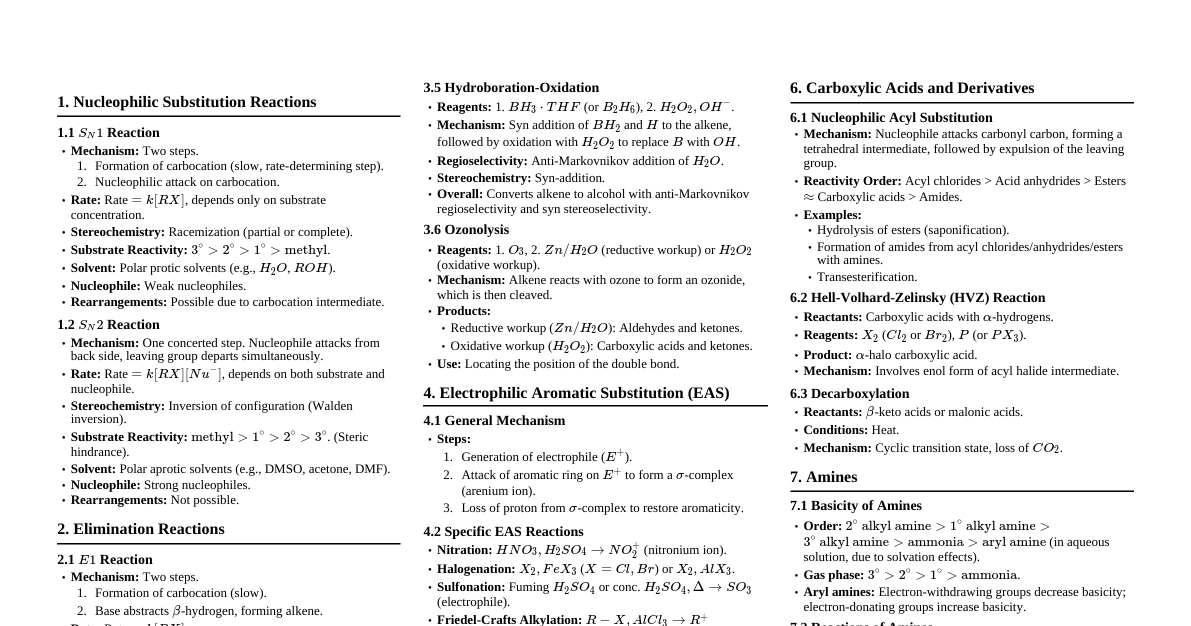
1. Aldehyde and Ketone Reactions Aldol Condensation: Description: Aldehydes/ketones with $\alpha$-hydrogens react in presence of dilute base to form $\beta$-hydroxy carbonyl compounds, which can dehydrate to $\alpha,\beta$-unsaturated carbonyls. Reaction: $2 R-CH_2-CHO \xrightarrow{\text{Dilute NaOH}} R-CH_2-CH(OH)-CH(R)-CHO \xrightarrow{\Delta} R-CH_2-CH=C(R)-CHO$ Type: Condensation Reaction Most Asked Cannizzaro Reaction: Description: Aldehydes without $\alpha$-hydrogens undergo self-oxidation and reduction in concentrated alkali. Reaction: $2 R-CHO \xrightarrow{\text{Conc. NaOH}} R-CH_2OH + R-COONa$ Most Asked Perkin Reaction: Description: Aromatic aldehydes condense with acid anhydrides containing $\alpha$-hydrogens in the presence of the sodium salt of the corresponding acid. Reaction: $C_6H_5-CHO + (CH_3CO)_2O \xrightarrow{CH_3COONa, \Delta} C_6H_5-CH=CH-COOH + CH_3COOH$ (Cinnamic acid) Type: Condensation Reaction Wittig Reaction: Description: Aldehydes/ketones react with a phosphorus ylide to form an alkene. Reaction: $R_2C=O + Ph_3P=CR'_2 \rightarrow R_2C=CR'_2 + Ph_3P=O$ Most Asked Reformatsky Reaction: Description: An aldehyde or ketone reacts with an $\alpha$-halo ester in the presence of zinc to form a $\beta$-hydroxy ester. Reaction: $R_2C=O + Br-CH_2-COOR' \xrightarrow{Zn, \text{ Et}_2O} R_2C(OZnBr)-CH_2-COOR' \xrightarrow{H_3O^+} R_2C(OH)-CH_2-COOR'$ Type: Condensation Reaction Tishchenko Reaction: Description: Aldehydes disproportionate in the presence of an aluminum alkoxide to form an ester. Reaction: $2 R-CHO \xrightarrow{Al(OR')_3} R-COOCH_2R$ Claisen-Schmidt Condensation (Cross Aldol): Description: An aromatic aldehyde (no $\alpha$-H) condenses with an aliphatic aldehyde/ketone (with $\alpha$-H) in the presence of a base. Reaction: $C_6H_5-CHO + CH_3-CO-CH_3 \xrightarrow{\text{Dilute NaOH}} C_6H_5-CH=CH-CO-CH_3 + H_2O$ (Benzalacetone) Type: Condensation Reaction Knoevenagel Condensation: Description: An aldehyde or ketone condenses with a compound containing an active methylene group (e.g., malonic ester) in the presence of a weak base. Reaction: $R_2C=O + CH_2(COOR')_2 \xrightarrow{\text{Base}} R_2C=C(COOR')_2 + H_2O$ Type: Condensation Reaction Benzoin Condensation: Description: Aromatic aldehydes (e.g., benzaldehyde) react in the presence of a cyanide ion catalyst to form an $\alpha$-hydroxy ketone (benzoin). Reaction: $2 C_6H_5-CHO \xrightarrow{KCN/\text{Alcohol}} C_6H_5-CH(OH)-CO-C_6H_5$ Type: Condensation Reaction Darzens Glycidic Ester Condensation: Description: An aldehyde or ketone reacts with an $\alpha$-halo ester in the presence of a base to form a glycidic ester. Reaction: $R_2C=O + Cl-CH_2-COOR' \xrightarrow{\text{Base}} R_2\text{C}\stackrel{\text{O}}{\wedge}\text{CH-COOR'}$ Type: Condensation Reaction Robinson Annulation: Description: A reaction that forms a six-membered ring by combining a Michael addition and an intramolecular aldol condensation. Typically involves an $\alpha,\beta$-unsaturated ketone and a ketone/aldehyde. Reaction: (Ketone/Aldehyde) + (Methyl Vinyl Ketone) --> Michael Adduct --> Cyclization --> Aldol Condensation --> Fused Cyclohexenone Type: Condensation Reaction Most Asked 2. Carboxylic Acid and Derivatives Reactions Hell-Volhard-Zelinsky (HVZ) Reaction: Description: Carboxylic acids with an $\alpha$-hydrogen react with halogen ($X_2$) in the presence of red phosphorus to form $\alpha$-halo carboxylic acids. Reaction: $R-CH_2-COOH \xrightarrow{X_2, \text{ Red P}} R-CH(X)-COOH$ Most Asked Hunsdiecker Reaction: Description: Silver salts of carboxylic acids react with bromine in $CCl_4$ to form alkyl bromides with one less carbon atom. Reaction: $R-COOAg + Br_2 \xrightarrow{CCl_4} R-Br + CO_2 + AgBr$ Arndt-Eistert Synthesis: Description: A method to convert a carboxylic acid into its next higher homologue (one additional carbon) via a Wolff rearrangement of a diazoketone. Reaction: $R-COOH \xrightarrow{SOCl_2} R-COCl \xrightarrow{CH_2N_2} R-CO-CHN_2 \xrightarrow{Ag_2O/H_2O} R-CH_2-COOH$ 3. Amines and Nitrogen Compounds Reactions Hofmann Bromamide Degradation: Description: Primary amides react with bromine and a strong base to form a primary amine with one less carbon atom. Reaction: $R-CO-NH_2 + Br_2 + 4KOH \rightarrow R-NH_2 + K_2CO_3 + 2KBr + 2H_2O$ Most Asked Gabriel Phthalimide Synthesis: Description: A method to prepare primary amines from alkyl halides using phthalimide. Reaction: $\text{Phthalimide} \xrightarrow{KOH} \text{Potassium phthalimide} \xrightarrow{R-X} \text{N-alkylphthalimide} \xrightarrow{H_2O/H^+ \text{ or } NH_2NH_2} R-NH_2 + \text{Phthalic acid/Hydrazide}$ Most Asked Carbylamine Reaction (Isocyanide Test): Description: Primary amines react with chloroform and alcoholic KOH to form foul-smelling isocyanides. Reaction: $R-NH_2 + CHCl_3 + 3KOH(\text{alc.}) \rightarrow R-NC + 3KCl + 3H_2O$ Most Asked Coupling Reaction (Azo Coupling): Description: Arenediazonium salts react with phenols or anilines to form colored azo dyes. Reaction: $Ar-N_2^+Cl^- + C_6H_5OH \xrightarrow{pH \ 9-10} Ar-N=N-C_6H_4-OH(p) + HCl$ Type: Condensation Reaction Most Asked Gattermann Reaction (for aryl halides): Description: Arenediazonium salts react with copper powder and HX to form aryl halides. (Similar to Sandmeyer but uses Cu powder instead of $Cu_2X_2$). Reaction: $Ar-N_2^+Cl^- \xrightarrow{Cu, \ HCl} Ar-Cl + N_2$ Sandmeyer Reaction: Description: Arenediazonium salts react with cuprous halides or cuprous cyanide to form aryl halides or aryl cyanides. Reaction: $Ar-N_2^+Cl^- \xrightarrow{Cu_2Cl_2/HCl} Ar-Cl + N_2$ or $Ar-N_2^+Cl^- \xrightarrow{Cu_2(CN)_2/KCN} Ar-CN + N_2$ Most Asked Balz-Schiemann Reaction: Description: Arenediazonium fluoroborates decompose upon heating to yield aryl fluorides. Reaction: $Ar-N_2^+Cl^- \xrightarrow{HBF_4} Ar-N_2^+BF_4^- \xrightarrow{\Delta} Ar-F + BF_3 + N_2$ Stephen Reduction: Description: Nitriles are reduced to imines with $SnCl_2$/HCl, followed by hydrolysis to aldehydes. Reaction: $R-C \equiv N \xrightarrow{SnCl_2/HCl} R-CH=NH \cdot HCl \xrightarrow{H_3O^+} R-CHO + NH_4Cl$ Most Asked Mendius Reduction: Description: Nitriles are reduced to primary amines using Na/alcohol or $LiAlH_4$. Reaction: $R-C \equiv N \xrightarrow{Na/\text{C}_2H_5OH \text{ or } LiAlH_4} R-CH_2-NH_2$ Hinsberg Test: Description: Primary, secondary, and tertiary amines react differently with benzenesulfonyl chloride, allowing for their distinction. Primary amines form soluble sulfonamides in KOH, secondary form insoluble, tertiary do not react. Reaction (Primary): $R-NH_2 + C_6H_5SO_2Cl \xrightarrow{KOH} C_6H_5SO_2-NRK^+ + H_2O$ (soluble) Reaction (Secondary): $R_2NH + C_6H_5SO_2Cl \xrightarrow{KOH} C_6H_5SO_2-NR_2 + H_2O$ (insoluble) Reaction (Tertiary): $R_3N + C_6H_5SO_2Cl \rightarrow \text{No reaction}$ Most Asked Liebermann Nitroso Reaction: Description: Secondary amines react with nitrous acid ($NaNO_2$/HCl) to form N-nitrosoamines, which can give a characteristic green color with phenol and conc. $H_2SO_4$. Reaction: $R_2NH + HNO_2 \rightarrow R_2N-N=O + H_2O$ Schotten-Baumann Reaction: Description: Acylation of amines or phenols with acyl chlorides (usually benzoyl chloride) under aqueous alkaline conditions. Reaction: $R-NH_2 + C_6H_5COCl \xrightarrow{NaOH(aq)} R-NH-CO-C_6H_5 + HCl$ Type: Condensation Reaction 4. Aromatic Electrophilic Substitution & Condensation Friedel-Crafts Alkylation: Description: Alkylation of an aromatic ring with an alkyl halide in the presence of a Lewis acid catalyst. Reaction: $C_6H_6 + R-Cl \xrightarrow{\text{Anhyd. AlCl}_3} C_6H_5-R + HCl$ Most Asked Friedel-Crafts Acylation: Description: Acylation of an aromatic ring with an acyl halide or acid anhydride in the presence of a Lewis acid catalyst. Reaction: $C_6H_6 + R-COCl \xrightarrow{\text{Anhyd. AlCl}_3} C_6H_5-CO-R + HCl$ Most Asked Gattermann-Koch Reaction: Description: Formylation of benzene (or alkylbenzenes) with carbon monoxide and HCl in the presence of anhydrous $AlCl_3/CuCl$. Reaction: $C_6H_6 + CO + HCl \xrightarrow{\text{Anhyd. AlCl}_3/CuCl} C_6H_5-CHO + HCl$ Type: Condensation Reaction Most Asked Gattermann Reaction (for aldehydes): Description: Synthesis of aromatic aldehydes from phenols, HCN, and HCl in the presence of anhydrous $AlCl_3$. Reaction: $C_6H_5OH \xrightarrow{HCN, \ HCl, \ AlCl_3} \text{Imine intermediate} \xrightarrow{H_2O} C_6H_4(OH)-CHO$ Type: Condensation Reaction Reimer-Tiemann Reaction: Description: Ortho-formylation of phenols using chloroform and a strong base. Reaction: $C_6H_5OH + CHCl_3 + 3NaOH \rightarrow C_6H_4(OH)-CHO(o) + 3NaCl + 2H_2O$ Type: Condensation Reaction Most Asked Kolbe's Reaction (Kolbe-Schmitt Reaction): Description: Carboxylation of phenols with carbon dioxide under alkaline conditions, forming salicylic acid. Reaction: $C_6H_5OH \xrightarrow{NaOH} C_6H_5ONa \xrightarrow{CO_2, \ 125^\circ C, \ 4-7 \text{ atm}} C_6H_4(ONa)-COOH \xrightarrow{H^+} C_6H_4(OH)-COOH$ Type: Condensation Reaction Most Asked Houben-Hoesch Reaction: Description: Acylation of phenols or their derivatives with nitriles in the presence of HCl and a Lewis acid. Reaction: $C_6H_5OH + R-C \equiv N \xrightarrow{HCl, \ AlCl_3} \text{Ketoimine intermediate} \xrightarrow{H_2O} C_6H_4(OH)-CO-R$ Type: Condensation Reaction 5. Alkanes, Alkenes, Alkynes & Halogen Compounds Wurtz Reaction: Description: Two molecules of an alkyl halide react with sodium metal in dry ether to form a symmetrical alkane. Reaction: $2 R-X + 2Na \xrightarrow{\text{Dry Ether}} R-R + 2NaX$ Most Asked Wurtz-Fittig Reaction: Description: An alkyl halide and an aryl halide react with sodium metal in dry ether to form an alkylbenzene. Reaction: $Ar-X + R-X + 2Na \xrightarrow{\text{Dry Ether}} Ar-R + 2NaX$ Most Asked Fittig Reaction: Description: Two molecules of an aryl halide react with sodium metal in dry ether to form a biaryl compound. Reaction: $2 Ar-X + 2Na \xrightarrow{\text{Dry Ether}} Ar-Ar + 2NaX$ Clemmensen Reduction: Description: Reduction of aldehydes or ketones to alkanes using zinc amalgam and concentrated HCl. Reaction: $R-CO-R' \xrightarrow{Zn(Hg), \text{ Conc. HCl}} R-CH_2-R' + H_2O$ Most Asked Wolff-Kishner Reduction: Description: Reduction of aldehydes or ketones to alkanes using hydrazine and a strong base (KOH) in a high-boiling solvent (ethylene glycol). Reaction: $R-CO-R' \xrightarrow{NH_2NH_2, \ KOH, \Delta} R-CH_2-R' + N_2 + H_2O$ Most Asked Rosenmund Reduction: Description: Partial hydrogenation of acyl chlorides to aldehydes using hydrogen gas over a palladium catalyst poisoned with barium sulfate. Reaction: $R-COCl + H_2 \xrightarrow{Pd/BaSO_4} R-CHO + HCl$ Most Asked Diels-Alder Reaction: Description: A [4+2] cycloaddition reaction between a conjugated diene and a dienophile (alkene or alkyne) to form a cyclohexene derivative. Reaction: (Diene) + (Dienophile) --> Cyclohexene Derivative Most Asked Corey-House Synthesis (Gilman Reagents): Description: Coupling of an organocuprate (Gilman reagent) with an alkyl halide to form an alkane. Reaction: $R_2CuLi + R'-X \rightarrow R-R' + R-Cu + LiX$ Swarts Reaction: Description: Preparation of alkyl fluorides by heating alkyl chlorides or bromides with metallic fluorides. Reaction: $R-Cl + AgF \rightarrow R-F + AgCl$ Finkelstein Reaction: Description: Conversion of alkyl chlorides or bromides to alkyl iodides by reaction with NaI in acetone (an $S_N2$ reaction driven by precipitation of NaCl/NaBr). Reaction: $R-Cl + NaI \xrightarrow{\text{Acetone}} R-I + NaCl \downarrow$ Most Asked Saytzeff's Rule (Zaitsev's Rule): Description: In elimination reactions (like dehydrohalogenation of alkyl halides), the major product is the more substituted (more stable) alkene. Reaction (Example): $CH_3-CH_2-CH(Br)-CH_3 \xrightarrow{\text{Alc. KOH}} CH_3-CH=CH-CH_3 \text{ (major)} + CH_3-CH_2-CH=CH_2 \text{ (minor)}$ Most Asked Markownikoff's Rule: Description: In the addition of HX to unsymmetrical alkenes, the hydrogen atom adds to the carbon atom of the double bond that already has more hydrogen atoms. Reaction (Example): $CH_3-CH=CH_2 + HBr \rightarrow CH_3-CH(Br)-CH_3$ Most Asked Anti-Markownikoff's Rule (Peroxide Effect/Kharasch Effect): Description: The addition of HBr (only HBr) to unsymmetrical alkenes in the presence of peroxides occurs in an anti-Markownikoff manner (hydrogen adds to the carbon with fewer hydrogen atoms). Reaction (Example): $CH_3-CH=CH_2 + HBr \xrightarrow{\text{Peroxide}} CH_3-CH_2-CH_2Br$ Most Asked 6. Oxidation and Reduction Etard Reaction: Description: Oxidation of toluene (or methylbenzenes) to benzaldehyde using chromyl chloride ($CrO_2Cl_2$). Reaction: $C_6H_5-CH_3 \xrightarrow{CrO_2Cl_2, \ CS_2} \text{Chromium complex} \xrightarrow{H_3O^+} C_6H_5-CHO$ Most Asked Oppenauer Oxidation: Description: Selective oxidation of secondary alcohols to ketones using aluminium isopropoxide in the presence of an excess of a ketone (e.g., acetone). Reaction: $R_2CH-OH + (CH_3)_2C=O \xrightarrow{Al(O-i-Pr)_3} R_2C=O + (CH_3)_2CH-OH$ Jones Oxidation: Description: Oxidation of primary alcohols to carboxylic acids and secondary alcohols to ketones using chromic acid ($CrO_3$) in aqueous sulfuric acid and acetone. Reaction (Primary): $R-CH_2OH \xrightarrow{CrO_3, \ H_2SO_4, \text{ Acetone}} R-COOH$ Reaction (Secondary): $R_2CH-OH \xrightarrow{CrO_3, \ H_2SO_4, \text{ Acetone}} R_2C=O$ 7. Rearrangements and Miscellaneous Reactions Pinacol-Pinacolone Rearrangement: Description: Acid-catalyzed rearrangement of a 1,2-diol (pinacol) to a ketone (pinacolone). Reaction: $R_2C(OH)-C(OH)R_2 \xrightarrow{H_2SO_4} R_3C-CO-R$ Williamson Synthesis: Description: Synthesis of ethers by the $S_N2$ reaction of an alkyl halide (preferably primary) with a sodium alkoxide. Reaction: $R-ONa + R'-X \rightarrow R-O-R' + NaX$ Most Asked Lucas Test: Description: A test to distinguish primary, secondary, and tertiary alcohols based on their reactivity with Lucas reagent (anhydrous $ZnCl_2$ in concentrated HCl). Tertiary alcohols react immediately, secondary after 5-10 min, primary very slowly or not at all. Reaction (Tertiary): $R_3C-OH + HCl \xrightarrow{\text{Anhyd. ZnCl}_2} R_3C-Cl + H_2O$ (turbidity) Most Asked Claisen Condensation: Description: Two molecules of an ester (at least one with $\alpha$-hydrogens) react in the presence of a strong base to form a $\beta$-keto ester. Reaction: $CH_3COOEt + CH_3COOEt \xrightarrow{NaOEt} CH_3COCH_2COOEt + EtOH$ Type: Condensation Reaction Most Asked Dieckmann Condensation: Description: An intramolecular Claisen condensation of a diester to form a cyclic $\beta$-keto ester. Reaction: $(CH_2)_n(COOEt)_2 \xrightarrow{NaOEt} \text{Cyclic } \beta\text{-keto ester} + EtOH$ Type: Condensation Reaction Michael Addition: Description: A nucleophilic addition of a carbanion (from an active methylene compound) to an $\alpha,\beta$-unsaturated carbonyl compound. Reaction: $R-CH_2-COOR' + CH_2=CH-CO-R'' \xrightarrow{\text{Base}} R-CH(COOR')-CH_2-CH_2-CO-R''$ Type: Conjugate Addition/Condensation-related Most Asked Strecker Synthesis: Description: Synthesis of $\alpha$-amino acids from aldehydes via an imine intermediate. Reaction: $R-CHO + NH_3 + HCN \rightarrow R-CH(NH_2)-CN \xrightarrow{H_3O^+} R-CH(NH_2)-COOH$ Type: Condensation/Addition Curtius Rearrangement: Description: Thermal decomposition of acyl azides to form isocyanates, which upon hydrolysis yield primary amines. Reaction: $R-COCl \xrightarrow{NaN_3} R-CO-N_3 \xrightarrow{\Delta} R-N=C=O \xrightarrow{H_2O} R-NH_2 + CO_2$ Schmidt Reaction: Description: Conversion of carboxylic acids, ketones, or aldehydes into amines or amides using hydrazoic acid ($HN_3$) under acidic conditions. Reaction (Carboxylic acid): $R-COOH + HN_3 \xrightarrow{\text{Conc. H}_2SO_4} R-NH_2 + N_2 + CO_2$ Mukaiyama Aldol Reaction: Description: A Lewis acid-catalyzed aldol reaction between a silyl enol ether and an aldehyde. Reaction: $R_2C=C(OSiR'_3)R'' + R'''CHO \xrightarrow{\text{Lewis Acid}} R'''CH(OH)-C(R'')R_2-CO-R'''$ Type: Condensation Reaction Beckmann Rearrangement: Description: Acid-catalyzed rearrangement of oximes to amides. Reaction: $R_2C=N-OH \xrightarrow{\text{Acid}} R-CO-NH-R$ (or isomer) Hofmann Elimination (Exhaustive Methylation): Description: Conversion of an amine into an alkene by exhaustive methylation followed by heating with silver oxide. The least substituted alkene is typically formed. Reaction: $R-CH_2-CH_2-NH_2 \xrightarrow{\text{Excess CH}_3I} R-CH_2-CH_2-N^+(CH_3)_3 I^- \xrightarrow{Ag_2O, \ H_2O, \Delta} R-CH=CH_2 + (CH_3)_3N + H_2O$ Corey-Fuchs Reaction: Description: A two-step procedure to convert an aldehyde into a terminal alkyne with one additional carbon atom. Reaction: $R-CHO \xrightarrow{CBr_4, \ PPh_3} R-CH=CBr_2 \xrightarrow{n-BuLi} R-C \equiv CH$ Baeyer-Villiger Oxidation: Description: Oxidation of ketones to esters (or cyclic ketones to lactones) using peroxy acids. Reaction: $R-CO-R' \xrightarrow{R''COOOH} R-COO-R'$ (If $R$ is more migratory than $R'$) Birch Reduction: Description: Reduction of aromatic rings to non-conjugated cyclohexadienes using sodium/lithium in liquid ammonia with an alcohol. Reaction: $\text{Arene} \xrightarrow{Na \text{ or } Li, \ NH_3(\text{liq}), \ ROH} \text{1,4-cyclohexadiene}$