JEE Adv. Organic Reactions & Mechanisms
Cheatsheet Content
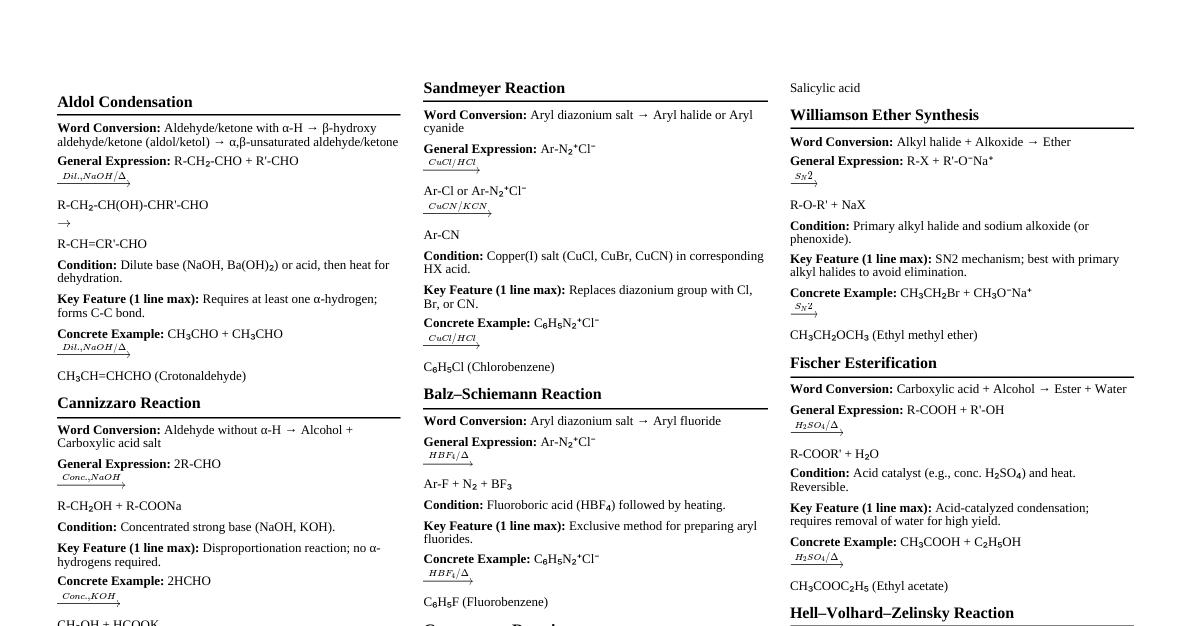
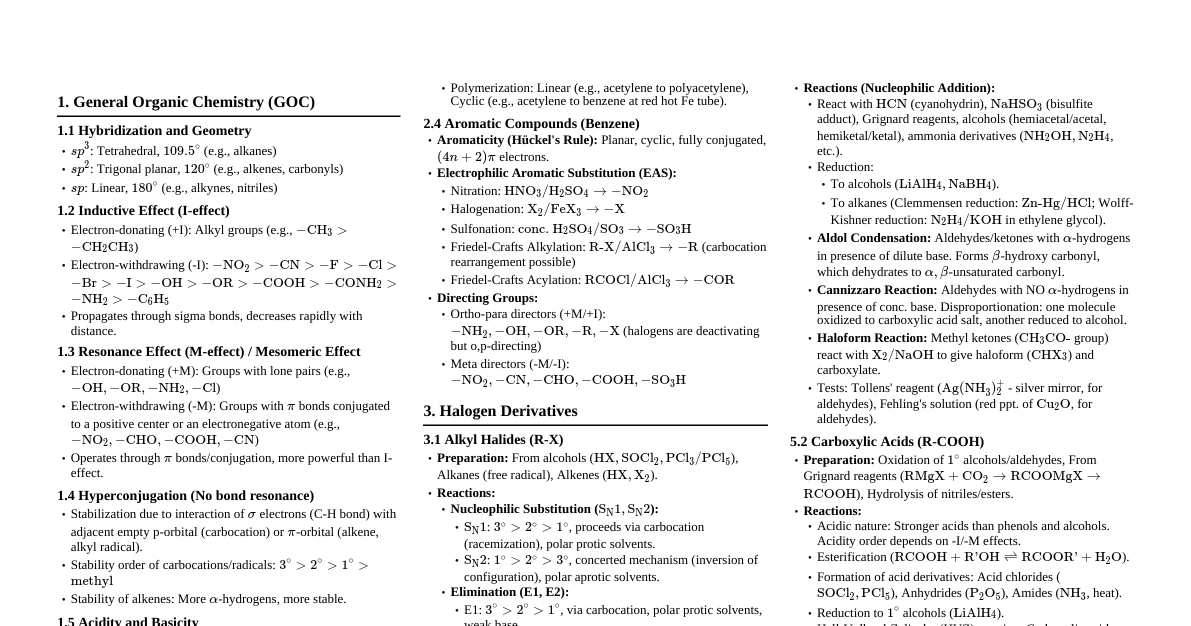
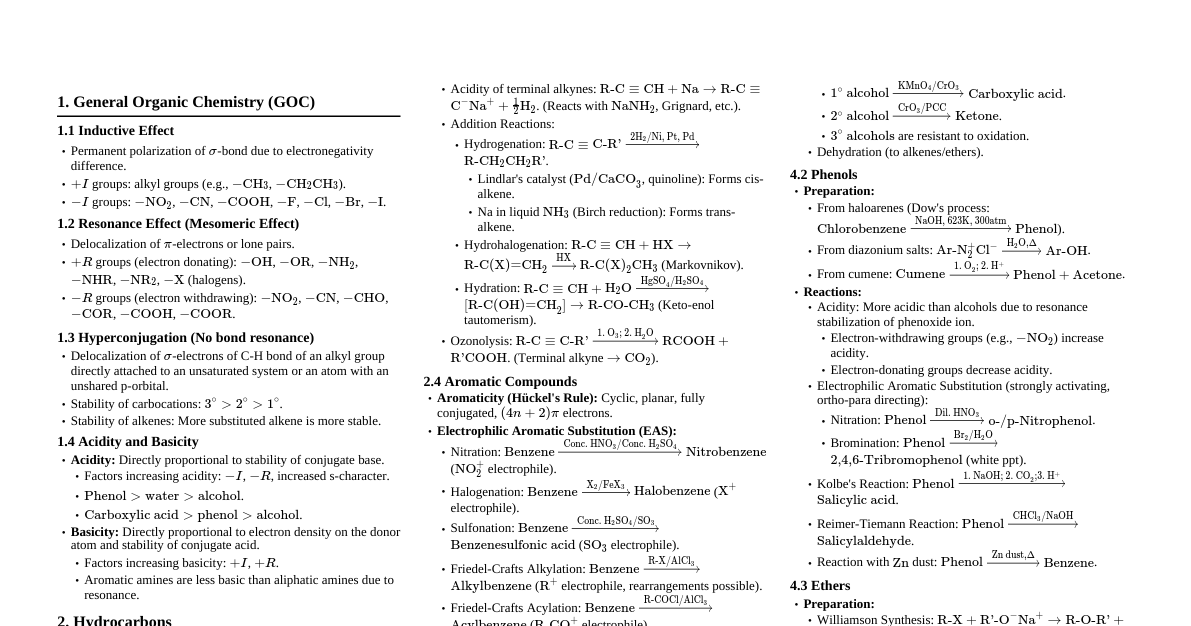
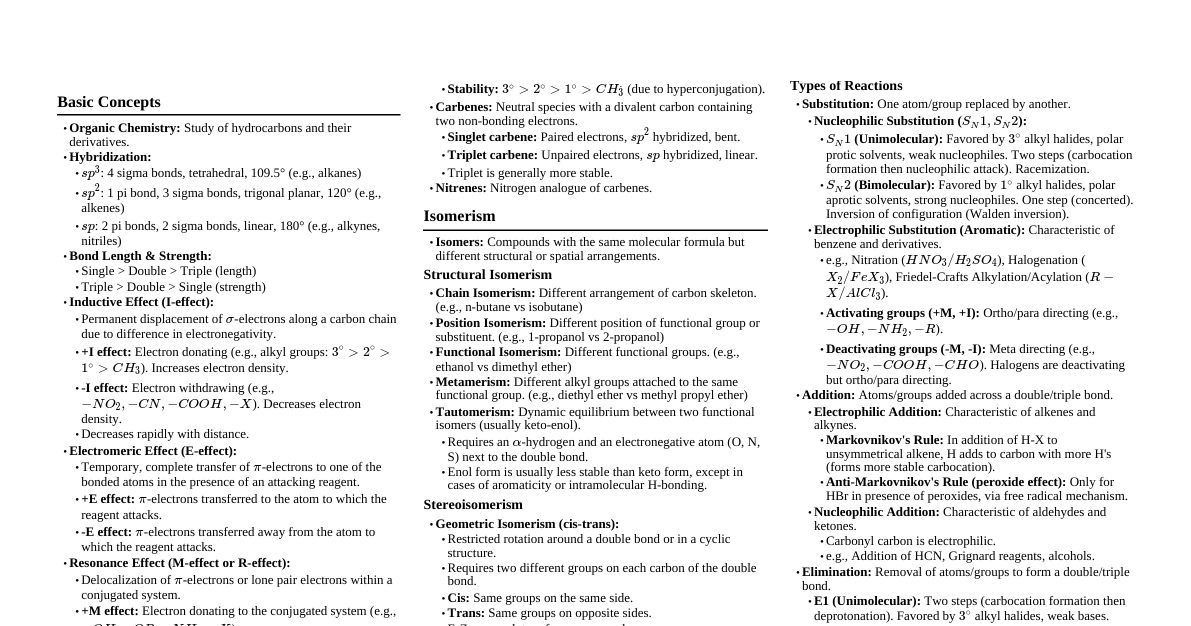
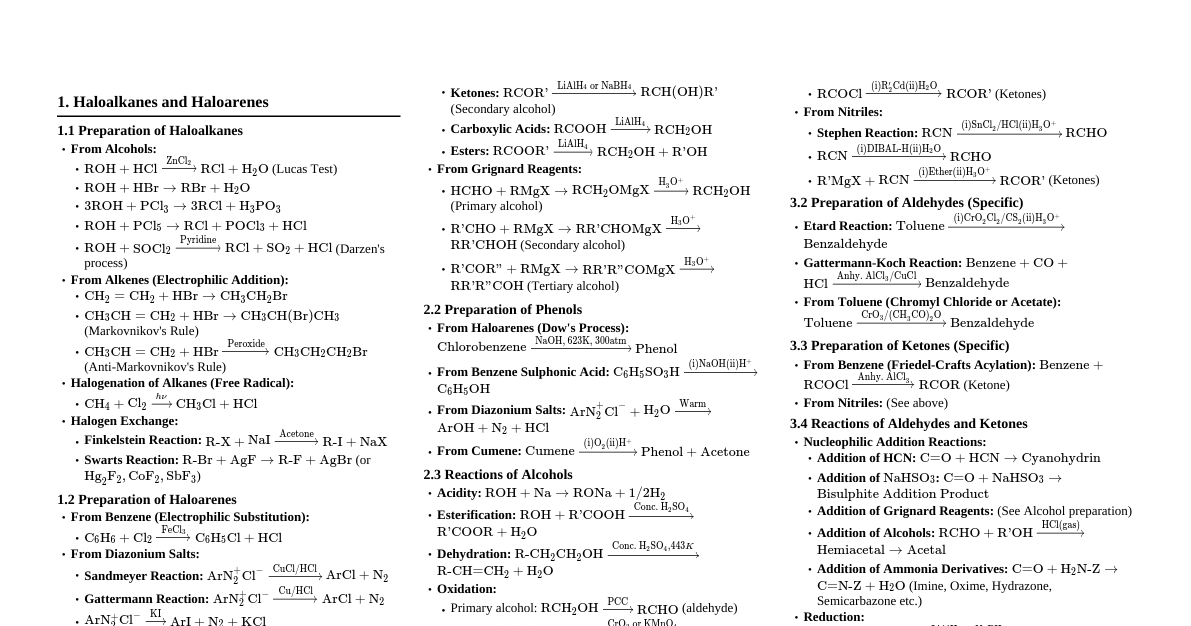
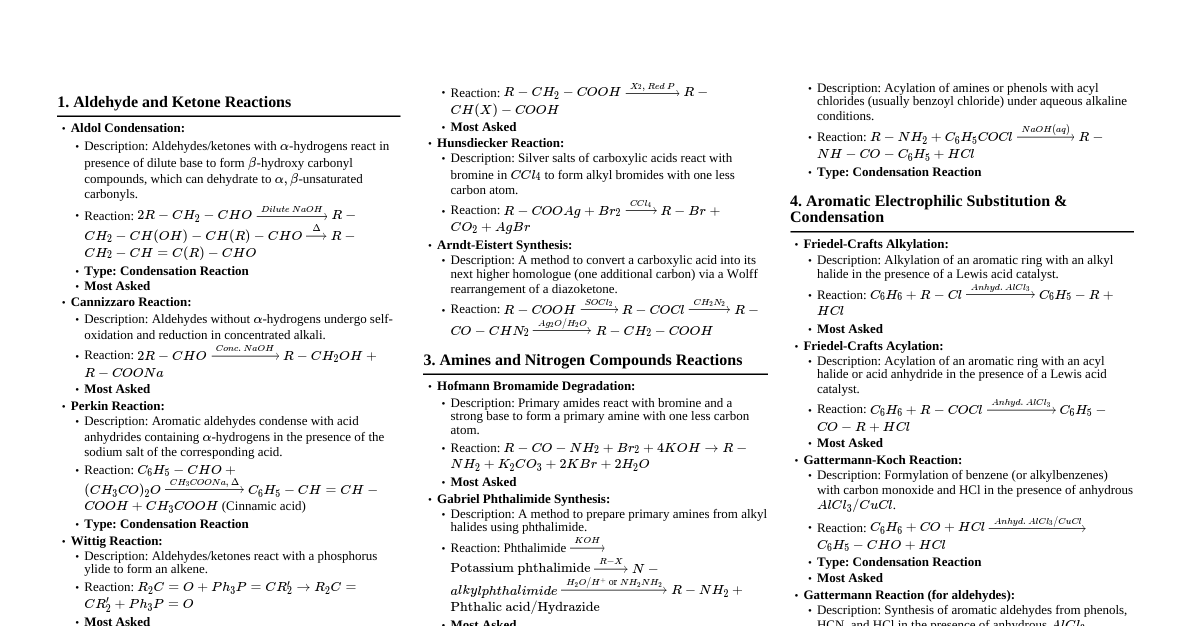
1. Nucleophilic Substitution Reactions 1.1 $S_N1$ Reaction Mechanism: Two steps. Formation of carbocation (slow, rate-determining step). Nucleophilic attack on carbocation. Rate: Rate $= k[RX]$, depends only on substrate concentration. Stereochemistry: Racemization (partial or complete). Substrate Reactivity: $3^\circ > 2^\circ > 1^\circ > \text{methyl}$. Solvent: Polar protic solvents (e.g., $H_2O$, $ROH$). Nucleophile: Weak nucleophiles. Rearrangements: Possible due to carbocation intermediate. 1.2 $S_N2$ Reaction Mechanism: One concerted step. Nucleophile attacks from back side, leaving group departs simultaneously. Rate: Rate $= k[RX][Nu^-]$, depends on both substrate and nucleophile. Stereochemistry: Inversion of configuration (Walden inversion). Substrate Reactivity: $\text{methyl} > 1^\circ > 2^\circ > 3^\circ$. (Steric hindrance). Solvent: Polar aprotic solvents (e.g., DMSO, acetone, DMF). Nucleophile: Strong nucleophiles. Rearrangements: Not possible. 2. Elimination Reactions 2.1 $E1$ Reaction Mechanism: Two steps. Formation of carbocation (slow). Base abstracts $\beta$-hydrogen, forming alkene. Rate: Rate $= k[RX]$. Substrate Reactivity: $3^\circ > 2^\circ > 1^\circ$. Conditions: Weak bases, polar protic solvents, high temperature. Regioselectivity: Favors Zaitsev's product (more substituted alkene). Competition: Often competes with $S_N1$. 2.2 $E2$ Reaction Mechanism: One concerted step. Base abstracts $\beta$-hydrogen, leaving group departs, and double bond forms simultaneously. Requires anti-periplanar geometry. Rate: Rate $= k[RX][\text{Base}]$. Substrate Reactivity: $3^\circ > 2^\circ > 1^\circ$. Conditions: Strong bases, high temperature. Regioselectivity: Favors Zaitsev's product (sterically hindered bases can give Hofmann product). Stereospecificity: Anti-elimination. Competition: Often competes with $S_N2$. 3. Electrophilic Addition Reactions 3.1 Addition of $HX$ to Alkenes (Markovnikov's Rule) Mechanism: Protonation of alkene by $HX$ to form more stable carbocation. Nucleophilic attack by $X^-$ on carbocation. Regioselectivity: Hydrogen adds to the carbon with more hydrogens already; halide adds to the carbon with fewer hydrogens. (Markovnikov). Stereochemistry: Can lead to syn or anti addition. Rearrangements: Possible if carbocation can rearrange to a more stable form. 3.2 Addition of $HBr$ to Alkenes (Anti-Markovnikov, Peroxide Effect) Mechanism: Free radical mechanism (initiation, propagation, termination). Peroxide forms radical ($RO\cdot$). $RO\cdot$ abstracts $H$ from $HBr$ to form $Br\cdot$. $Br\cdot$ adds to alkene to form more stable radical. Radical abstracts $H$ from $HBr$, forming product and regenerating $Br\cdot$. Regioselectivity: Bromine adds to the carbon with more hydrogens (Anti-Markovnikov). Only for $HBr$ in presence of peroxides. 3.3 Addition of $X_2$ to Alkenes Mechanism: Electrophilic attack by $X_2$ to form a cyclic halonium ion. Nucleophilic attack by $X^-$ on the halonium ion from the opposite face. Stereochemistry: Anti-addition. Example: Bromination of cyclohexene gives trans-1,2-dibromocyclohexane. 3.4 Hydration of Alkenes (Acid-catalyzed) Mechanism: Protonation of alkene to form carbocation. Nucleophilic attack by $H_2O$ on carbocation. Deprotonation to form alcohol. Regioselectivity: Markovnikov addition of $H_2O$. Rearrangements: Possible. 3.5 Hydroboration-Oxidation Reagents: 1. $BH_3 \cdot THF$ (or $B_2H_6$), 2. $H_2O_2, OH^-$. Mechanism: Syn addition of $BH_2$ and $H$ to the alkene, followed by oxidation with $H_2O_2$ to replace $B$ with $OH$. Regioselectivity: Anti-Markovnikov addition of $H_2O$. Stereochemistry: Syn-addition. Overall: Converts alkene to alcohol with anti-Markovnikov regioselectivity and syn stereoselectivity. 3.6 Ozonolysis Reagents: 1. $O_3$, 2. $Zn/H_2O$ (reductive workup) or $H_2O_2$ (oxidative workup). Mechanism: Alkene reacts with ozone to form an ozonide, which is then cleaved. Products: Reductive workup ($Zn/H_2O$): Aldehydes and ketones. Oxidative workup ($H_2O_2$): Carboxylic acids and ketones. Use: Locating the position of the double bond. 4. Electrophilic Aromatic Substitution (EAS) 4.1 General Mechanism Steps: Generation of electrophile ($E^+$). Attack of aromatic ring on $E^+$ to form a $\sigma$-complex (arenium ion). Loss of proton from $\sigma$-complex to restore aromaticity. 4.2 Specific EAS Reactions Nitration: $HNO_3, H_2SO_4 \rightarrow NO_2^+$ (nitronium ion). Halogenation: $X_2, FeX_3$ ($X = Cl, Br$) or $X_2, AlX_3$. Sulfonation: Fuming $H_2SO_4$ or conc. $H_2SO_4, \Delta \rightarrow SO_3$ (electrophile). Friedel-Crafts Alkylation: $R-X, AlCl_3 \rightarrow R^+$ (carbocation). Limitations: Rearrangements, polyalkylation, deactivation by meta-directors. Friedel-Crafts Acylation: $RCO-X, AlCl_3 \rightarrow RCO^+$ (acylium ion). No rearrangements, no polyacylation. Acyl group is a deactivating meta-director. 4.3 Directing Groups and Reactivity Ortho/Para Directors (Activating): $-OH, -OR, -NH_2, -NHR, -NR_2, -CH_3, -R$, halogens (deactivating but o/p directing). Meta Directors (Deactivating): $-NO_2, -SO_3H, -CHO, -COR, -COOH, -COOR, -CN$. 5. Carbonyl Chemistry 5.1 Nucleophilic Addition to Aldehydes and Ketones Mechanism: Nucleophile attacks electrophilic carbon of carbonyl, $\pi$-electrons move to oxygen. Protonation of oxygen. Reactivity: Aldehydes > Ketones (steric and electronic reasons). Examples: Addition of $HCN$: Forms cyanohydrins. Addition of Grignard Reagents ($RMgX$): Forms alcohols. Formaldehyde $\rightarrow 1^\circ$ alcohol Other aldehydes $\rightarrow 2^\circ$ alcohol Ketones $\rightarrow 3^\circ$ alcohol Addition of Alcohols (Acid-catalyzed): Forms hemiacetals (unstable) and acetals (stable). Addition of Hydrazine/Hydroxylamine/Primary Amines: Forms imines, oximes, hydrazones (condensation reactions). 5.2 Aldol Condensation Reactants: Aldehydes or ketones with $\alpha$-hydrogens. Conditions: Dilute base ($NaOH, KOH$) or acid. Mechanism (Base-catalyzed): Formation of enolate ion from carbonyl compound. Enolate attacks another carbonyl molecule. Protonation to form $\beta$-hydroxy carbonyl (aldol). Dehydration (condensation) to form $\alpha,\beta$-unsaturated carbonyl (at higher temp or stronger base). Cross-Aldol: Between two different carbonyl compounds. 5.3 Cannizzaro Reaction Reactants: Aldehydes *without* $\alpha$-hydrogens (e.g., formaldehyde, benzaldehyde). Conditions: Concentrated strong base ($NaOH, KOH$). Mechanism: Hydride transfer. One aldehyde is oxidized to carboxylic acid (salt), another is reduced to alcohol. Cross-Cannizzaro: Between two different aldehydes without $\alpha$-hydrogens. 5.4 Wittig Reaction Reagents: Carbonyl compound + Phosphorus ylide ($R_3P=CR_2$). Product: Alkene. Use: Synthesize alkenes without carbocation rearrangements. 6. Carboxylic Acids and Derivatives 6.1 Nucleophilic Acyl Substitution Mechanism: Nucleophile attacks carbonyl carbon, forming a tetrahedral intermediate, followed by expulsion of the leaving group. Reactivity Order: Acyl chlorides > Acid anhydrides > Esters $\approx$ Carboxylic acids > Amides. Examples: Hydrolysis of esters (saponification). Formation of amides from acyl chlorides/anhydrides/esters with amines. Transesterification. 6.2 Hell-Volhard-Zelinsky (HVZ) Reaction Reactants: Carboxylic acids with $\alpha$-hydrogens. Reagents: $X_2$ ($Cl_2$ or $Br_2$), $P$ (or $PX_3$). Product: $\alpha$-halo carboxylic acid. Mechanism: Involves enol form of acyl halide intermediate. 6.3 Decarboxylation Reactants: $\beta$-keto acids or malonic acids. Conditions: Heat. Mechanism: Cyclic transition state, loss of $CO_2$. 7. Amines 7.1 Basicity of Amines Order: $2^\circ \text{ alkyl amine} > 1^\circ \text{ alkyl amine} > 3^\circ \text{ alkyl amine} > \text{ammonia} > \text{aryl amine}$ (in aqueous solution, due to solvation effects). Gas phase: $3^\circ > 2^\circ > 1^\circ > \text{ammonia}$. Aryl amines: Electron-withdrawing groups decrease basicity; electron-donating groups increase basicity. 7.2 Reactions of Amines Acylation: With acyl chlorides, anhydrides, esters to form amides. Carbylamine Reaction (Isocyanide Test): $1^\circ$ amines + $CHCl_3 + KOH \rightarrow$ isocyanide (foul smell). Hinsberg Test: Reaction with benzenesulfonyl chloride to distinguish $1^\circ, 2^\circ, 3^\circ$ amines. $1^\circ \text{ amine}$: Forms sulfonamide, soluble in $KOH$. $2^\circ \text{ amine}$: Forms sulfonamide, insoluble in $KOH$. $3^\circ \text{ amine}$: Does not react. Reaction with Nitrous Acid ($HNO_2$): $1^\circ \text{ aliphatic amine}$: Forms diazonium salt (unstable), evolves $N_2$ gas. $1^\circ \text{ aromatic amine}$: Forms stable arenediazonium salt ($ArN_2^+ X^-$). $2^\circ \text{ amine}$: Forms N-nitrosoamine (yellow oily compound). $3^\circ \text{ aliphatic amine}$: Forms nitrite salt. $3^\circ \text{ aromatic amine}$: Forms p-nitrosoaniline. 7.3 Diazonium Salt Reactions (for Aromatic Amines) Sandmeyer Reaction: $CuCl/HCl \rightarrow ArCl$; $CuBr/HBr \rightarrow ArBr$; $CuCN/KCN \rightarrow ArCN$. Gattermann Reaction: $Cu/HCl \rightarrow ArCl$; $Cu/HBr \rightarrow ArBr$. (Less efficient than Sandmeyer). Balz-Schiemann Reaction: $HBF_4, \Delta \rightarrow ArF$. Reaction with $KI$: $KI, \Delta \rightarrow ArI$. Hydrolysis: $H_2O, \Delta \rightarrow ArOH$ (phenol). Reduction: $H_3PO_2$ or $CH_3CH_2OH \rightarrow ArH$. Coupling Reactions: With phenols or anilines to form azo dyes (e.g., methyl orange). 8. Redox Reactions 8.1 Oxidation of Alcohols $1^\circ \text{ Alcohol}$: PCC (Pyridinium Chlorochromate) $\rightarrow$ Aldehyde. Strong oxidizing agent ($K_2Cr_2O_7/H_2SO_4$, $KMnO_4$) $\rightarrow$ Carboxylic acid. $2^\circ \text{ Alcohol}$: PCC or strong oxidizing agents $\rightarrow$ Ketone. $3^\circ \text{ Alcohol}$: Generally resistant to oxidation under mild conditions. Under strong conditions (high temp, conc. acid), undergo dehydration followed by oxidation. 8.2 Reduction of Carbonyl Compounds Aldehydes: $LiAlH_4$ or $NaBH_4 \rightarrow 1^\circ$ alcohol. Clemmensen Reduction ($Zn-Hg/HCl$) $\rightarrow$ Alkane. Wolff-Kishner Reduction ($NH_2NH_2/KOH, \Delta$) $\rightarrow$ Alkane. Ketones: $LiAlH_4$ or $NaBH_4 \rightarrow 2^\circ$ alcohol. Clemmensen Reduction $\rightarrow$ Alkane. Wolff-Kishner Reduction $\rightarrow$ Alkane. 8.3 Reduction of Carboxylic Acids and Derivatives Carboxylic Acids: $LiAlH_4 \rightarrow 1^\circ$ alcohol. (Not $NaBH_4$). Esters: $LiAlH_4 \rightarrow 1^\circ$ alcohol + alcohol. Amides: $LiAlH_4 \rightarrow$ Amine. 9. Name Reactions & Reagents Summary Rosenmund Reduction: Acyl chloride $\rightarrow$ Aldehyde ($H_2, Pd/BaSO_4, S$ or quinoline). Stephen Reduction: Nitrile $\rightarrow$ Aldehyde ($SnCl_2/HCl$, then $H_3O^+$). DIBAL-H Reduction: Nitrile $\rightarrow$ Aldehyde; Ester $\rightarrow$ Aldehyde (at low temp). Etard Reaction: Toluene $\rightarrow$ Benzaldehyde ($CrO_2Cl_2$, then $H_3O^+$). Gattermann-Koch Reaction: Benzene $\rightarrow$ Benzaldehyde ($CO, HCl, AlCl_3/CuCl$). Reimer-Tiemann Reaction: Phenol $\rightarrow$ Salicylaldehyde ($CHCl_3, NaOH$, then $H_3O^+$). Kolbe's Reaction: Phenol $\rightarrow$ Salicylic acid ($CO_2, NaOH$, then $H_3O^+$). Perkin Reaction: Aromatic aldehyde $\rightarrow$ $\alpha,\beta$-unsaturated carboxylic acid (anhydride, $CH_3COONa, \Delta$). Hofmann Bromamide Degradation: Amide $\rightarrow$ $1^\circ$ Amine (with one less carbon) ($Br_2, NaOH$). Gabriel Phthalimide Synthesis: Alkyl halide $\rightarrow$ $1^\circ$ Amine (Phthalimide, $KOH$, then $R-X$, then $NaOH$ or $H_2N-NH_2$). Clemmensen vs. Wolff-Kishner: Both reduce carbonyl to methylene. Clemmensen is acidic, Wolff-Kishner is basic.