Class 12 Organic Chemistry
Cheatsheet Content
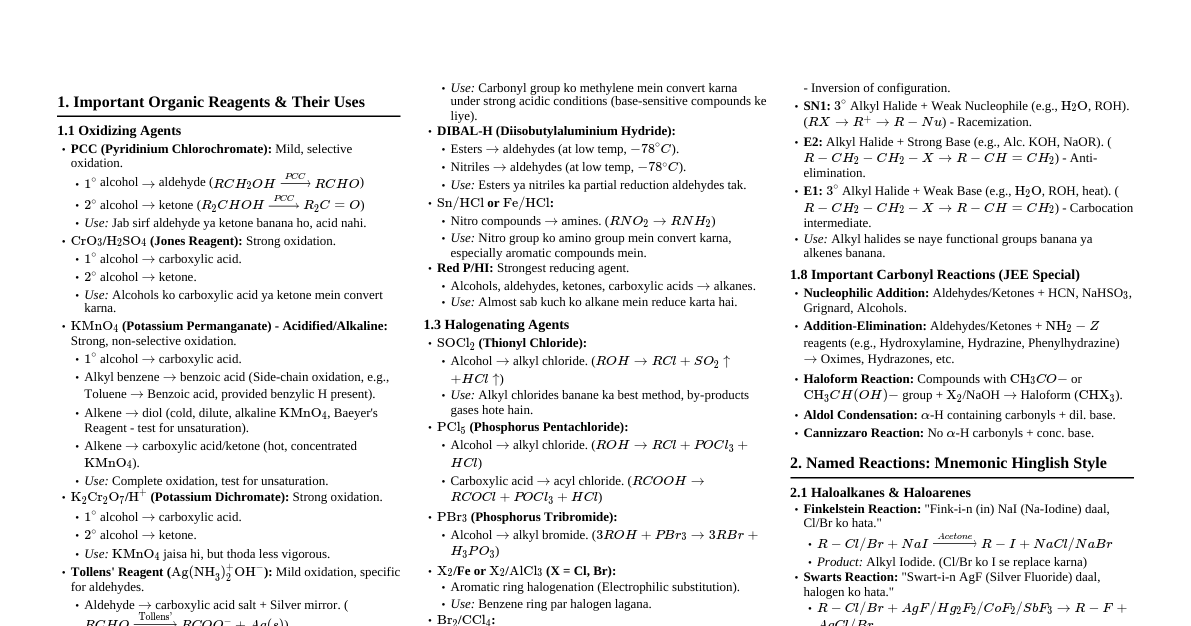
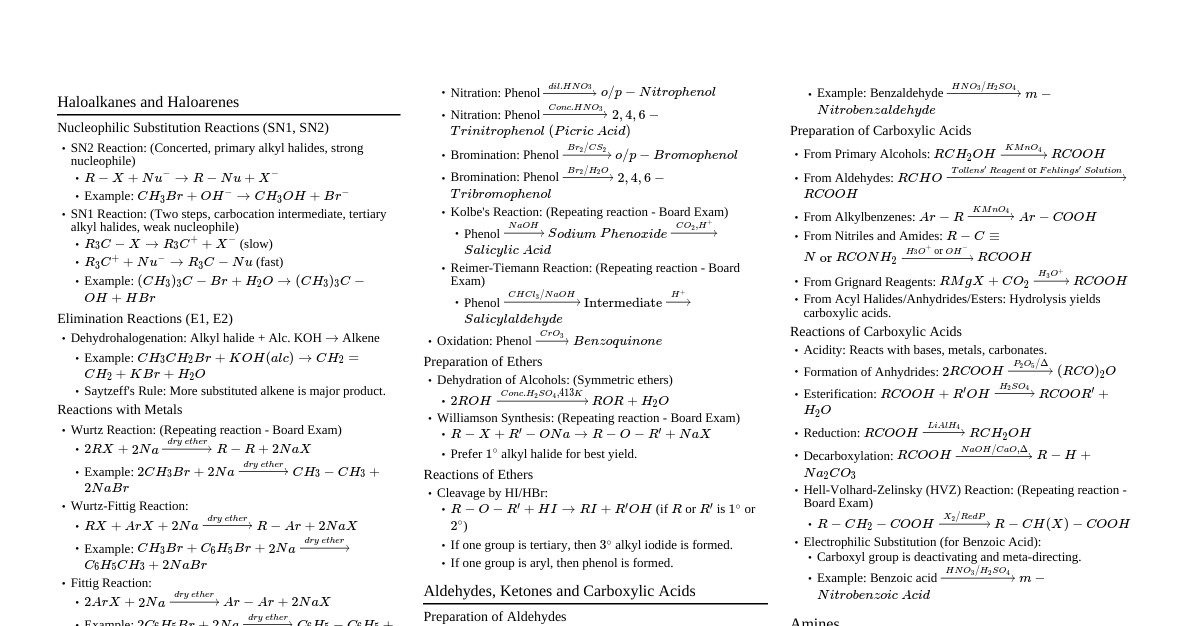
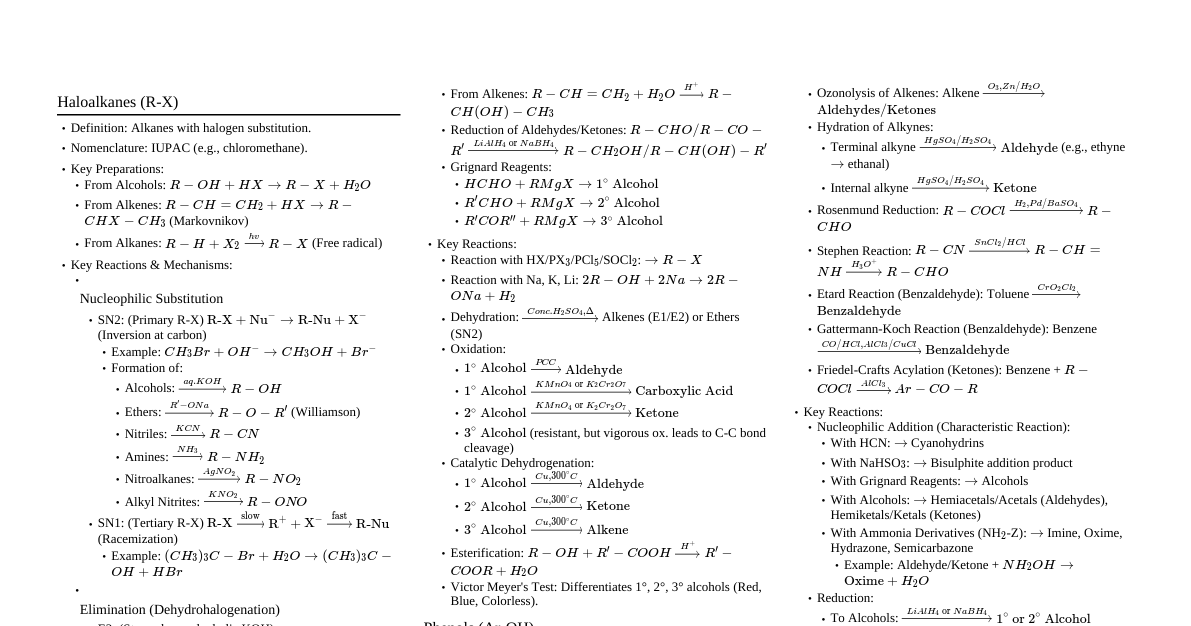
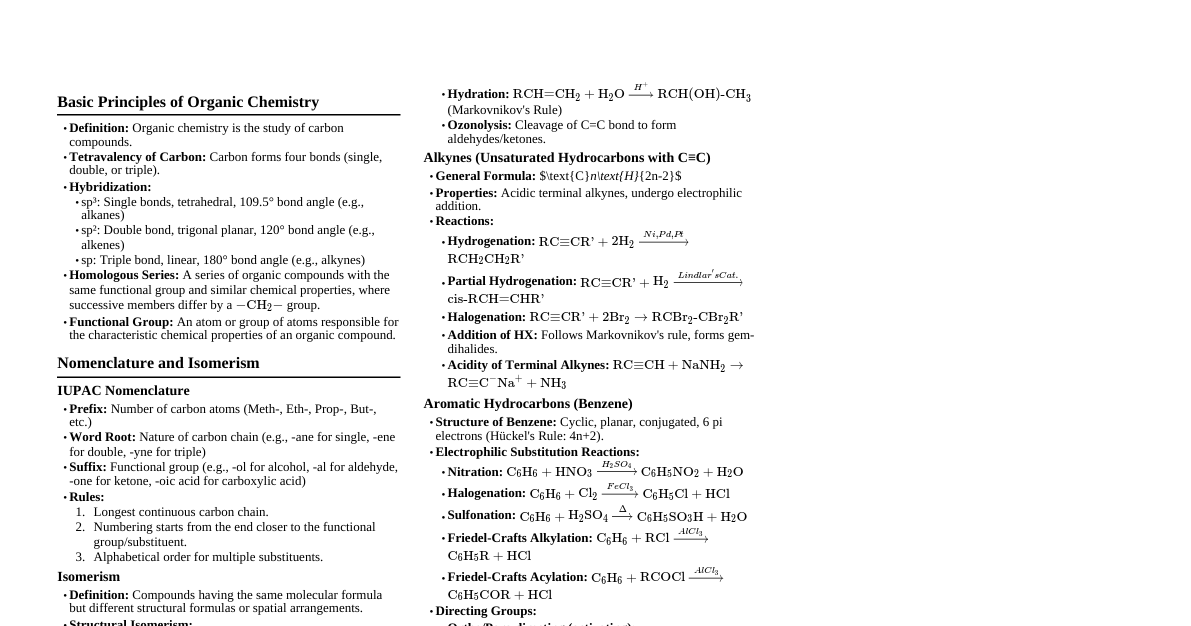
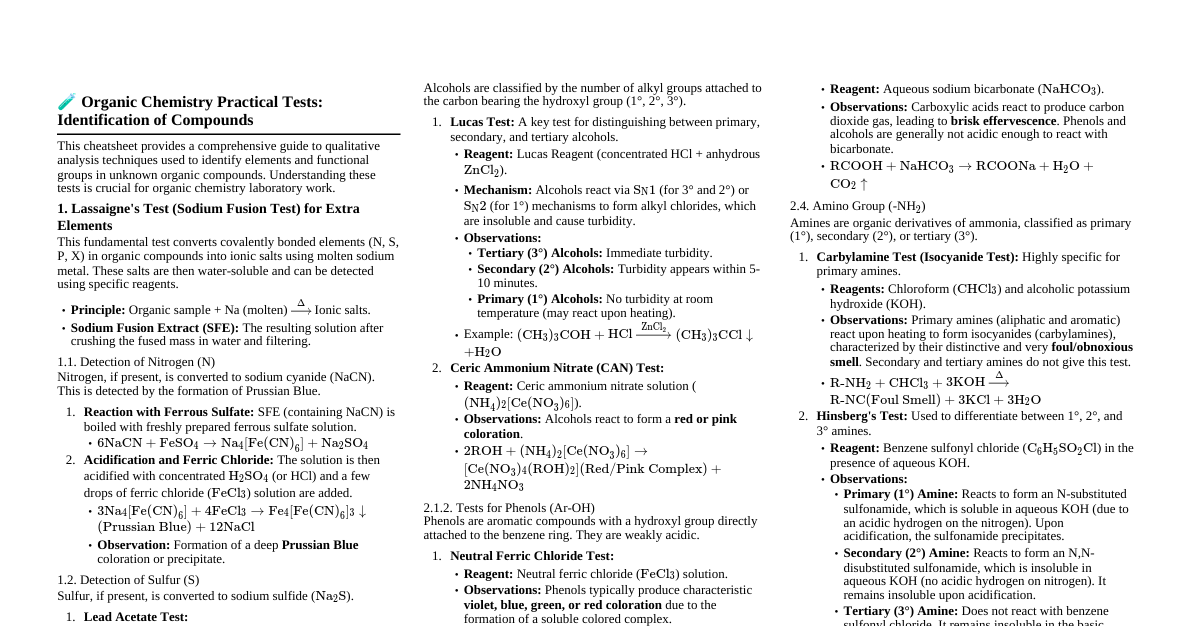
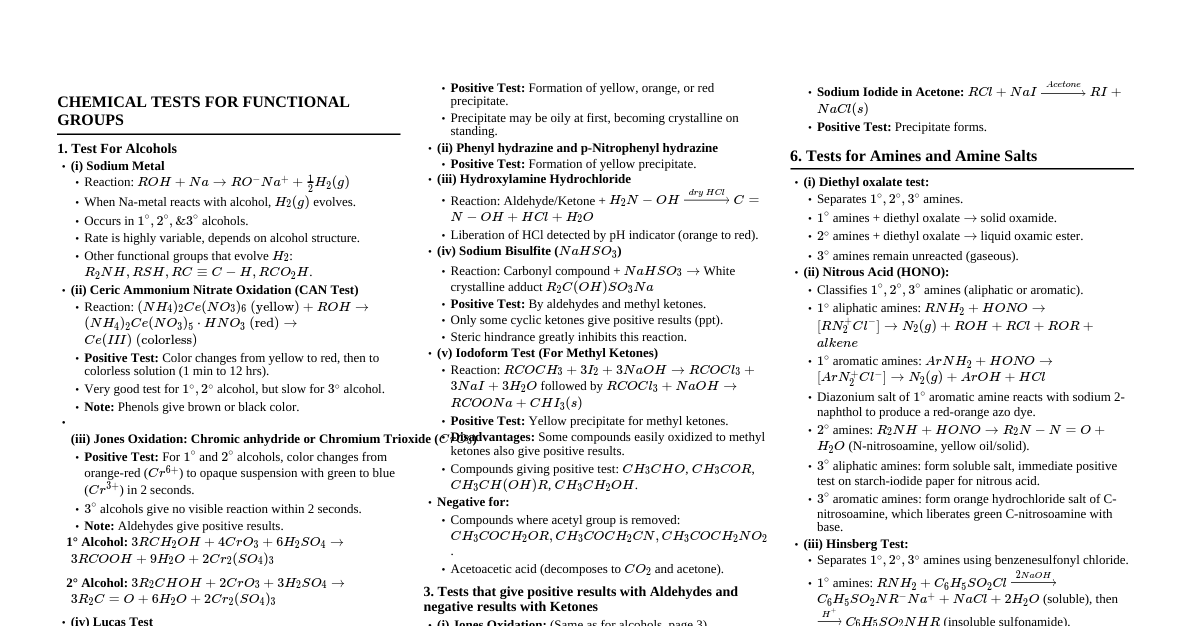
### Haloalkanes and Haloarenes #### 1. Classification - **Haloalkanes:** R-X (e.g., CH₃Cl, CH₃CH₂Br) - Primary (1°): X attached to 1° carbon - Secondary (2°): X attached to 2° carbon - Tertiary (3°): X attached to 3° carbon - **Haloarenes:** Ar-X (e.g., C₆H₅Cl) #### 2. Nomenclature - IUPAC rules: identify longest carbon chain, assign numbers, name substituents. - Common names: alkyl halide, aryl halide. #### 3. Preparation - **From Alcohols:** - R-OH + HX → R-X + H₂O (ZnCl₂ catalyst for 1°/2°) - R-OH + SOCl₂ → R-Cl + SO₂ + HCl (Darzen's reaction) - R-OH + PCl₃/PCl₅ → R-Cl - **From Alkenes:** - Addition of HX: Markovnikov's rule (H to C with more H, X to C with fewer H) - Addition of Br₂/Cl₂: Vicinal dihalides - **Free Radical Halogenation (Alkanes):** CH₄ + Cl₂ $\xrightarrow{hv}$ CH₃Cl + HCl - **Halogen Exchange:** - Finkelstein Reaction: R-X + NaI $\xrightarrow{Acetone}$ R-I + NaX - Swarts Reaction: R-X + AgF/Hg₂F₂/CoF₂/SbF₃ → R-F - **From Benzene (Haloarenes):** - Electrophilic Substitution: C₆H₆ + Cl₂ $\xrightarrow{FeCl₃}$ C₆H₅Cl + HCl - Sandmeyer's Reaction: ArN₂⁺Cl⁻ $\xrightarrow{CuCl/HCl}$ Ar-Cl - Gattermann Reaction: ArN₂⁺Cl⁻ $\xrightarrow{Cu/HCl}$ Ar-Cl - Balz-Schiemann Reaction: ArN₂⁺BF₄⁻ $\xrightarrow{\Delta}$ Ar-F + BF₃ + N₂ #### 4. Physical Properties - MP/BP: R-I > R-Br > R-Cl > R-F (due to increasing size/mass) - Solubility: Immiscible with water, soluble in organic solvents. #### 5. Chemical Reactions - **Nucleophilic Substitution (S_N1 and S_N2):** - **S_N2:** Bimolecular, one step, backside attack, inversion of configuration. - Reactivity: CH₃X > 1° > 2° > 3° (steric hindrance) - **S_N1:** Unimolecular, two steps (carbocation formation), racemization. - Reactivity: 3° > 2° > 1° > CH₃X (carbocation stability) - **Elimination Reactions (E1 and E2):** - Dehydrohalogenation: R-CH₂-CH₂-X + KOH (alc) → R-CH=CH₂ + KX + H₂O (Saytzeff's Rule: major product is highly substituted alkene) - **Reaction with Metals:** - Wurtz Reaction: 2R-X + 2Na $\xrightarrow{dry ether}$ R-R + 2NaX - Wurtz-Fittig Reaction: Ar-X + R-X + 2Na $\xrightarrow{dry ether}$ Ar-R + 2NaX - Fittig Reaction: 2Ar-X + 2Na $\xrightarrow{dry ether}$ Ar-Ar + 2NaX - Grignard Reagent: R-X + Mg $\xrightarrow{dry ether}$ R-Mg-X - **Electrophilic Substitution (Haloarenes):** Halogen is deactivating but o,p-directing. - Halogenation, Nitration, Sulfonation, Friedel-Crafts Alkylation/Acylation ### Alcohols, Phenols, and Ethers #### 1. Classification - **Alcohols:** R-OH (1°, 2°, 3°) - **Phenols:** Ar-OH - **Ethers:** R-O-R' (Symmetrical/Unsymmetrical) #### 2. Preparation of Alcohols - **From Alkenes:** - Acid-catalyzed hydration: CH₂=CH₂ + H₂O $\xrightarrow{H⁺}$ CH₃CH₂OH - Hydroboration-oxidation: (BH₃)₂/H₂O₂, OH⁻ (Anti-Markovnikov) - **From Carbonyl Compounds:** - Reduction of aldehydes/ketones: RCHO $\xrightarrow{LiAlH₄/NaBH₄}$ RCH₂OH - Reduction of carboxylic acids/esters: RCOOH $\xrightarrow{LiAlH₄}$ RCH₂OH - **From Grignard Reagent:** R-Mg-X + Carbonyl compound → Alcohol #### 3. Preparation of Phenols - **From Haloarenes:** Dow's Process: C₆H₅Cl $\xrightarrow{NaOH, 623K, 300atm}$ Sodium Phenoxide $\xrightarrow{H⁺}$ Phenol - **From Benzene Sulfonic Acid:** C₆H₅SO₃H $\xrightarrow{NaOH}$ Sodium Phenoxide $\xrightarrow{H⁺}$ Phenol - **From Diazonium Salts:** ArN₂⁺Cl⁻ + H₂O $\xrightarrow{\Delta}$ Ar-OH + N₂ + HCl - **From Cumene:** Cumene $\xrightarrow{O₂, H⁺}$ Phenol + Acetone #### 4. Preparation of Ethers - **Dehydration of Alcohols:** 2R-OH $\xrightarrow{H₂SO₄, 413K}$ R-O-R + H₂O (for symmetrical ethers) - **Williamson Synthesis:** R-X + R'-ONa → R-O-R' + NaX (SN2 mechanism, best for 1° alkyl halides) #### 5. Physical Properties - **Alcohols/Phenols:** H-bonding, higher BP than ethers/hydrocarbons. - **Ethers:** Lower BP than alcohols, less polar. #### 6. Chemical Reactions of Alcohols - **Acidity:** R-OH + Na → R-ONa + ½H₂ (Acidity: 1° > 2° > 3°) - **Esterification:** R-OH + R'-COOH $\xrightarrow{H⁺}$ R'-COOR + H₂O - **Reaction with HX:** R-OH + HX → R-X + H₂O - **Oxidation:** - 1° Alcohol $\xrightarrow{PCC}$ Aldehyde $\xrightarrow{KMnO₄}$ Carboxylic Acid - 2° Alcohol $\xrightarrow{PCC/CrO₃}$ Ketone - 3° Alcohol: Resistant to oxidation under mild conditions - **Dehydration:** R-CH₂-CH₂-OH $\xrightarrow{H₂SO₄, 443K}$ R-CH=CH₂ (Saytzeff's Rule) #### 7. Chemical Reactions of Phenols - **Acidity:** Phenol is more acidic than alcohol (due to resonance stabilization of phenoxide ion). - Phenol + NaOH → Sodium Phenoxide + H₂O - **Electrophilic Substitution:** -OH is activating and o,p-directing. - Nitration, Halogenation (Bromination with Br₂/H₂O gives 2,4,6-tribromophenol), Sulfonation - **Kolbe's Reaction:** Phenol + NaOH $\xrightarrow{CO₂, 400K, 4-7atm}$ Salicylic Acid - **Reimer-Tiemann Reaction:** Phenol + CHCl₃ + NaOH $\xrightarrow{H⁺}$ Salicylaldehyde - **Oxidation:** Phenol $\xrightarrow{CrO₂Cl₂}$ Benzoquinone - **Reaction with Zn dust:** Phenol + Zn $\xrightarrow{\Delta}$ Benzene + ZnO #### 8. Chemical Reactions of Ethers - **Cleavage by HX:** R-O-R' + HX → R-X + R'-OH (SN1/SN2 depending on R/R') - Hot HI is the most reactive. - **Electrophilic Substitution (Phenyl alkyl ethers):** -OR is activating and o,p-directing. - Halogenation, Nitration, Friedel-Crafts Alkylation/Acylation ### Aldehydes, Ketones, and Carboxylic Acids #### 1. Functional Groups - **Aldehydes:** R-CHO - **Ketones:** R-CO-R' - **Carboxylic Acids:** R-COOH #### 2. Preparation of Aldehydes and Ketones - **Oxidation of Alcohols:** - 1° Alcohol $\xrightarrow{PCC}$ Aldehyde - 2° Alcohol $\xrightarrow{PCC/CrO₃}$ Ketone - **From Hydrocarbons:** - Ozonolysis of Alkenes: R-CH=CH-R' $\xrightarrow{O₃/Zn, H₂O}$ R-CHO + R'-CHO - Hydration of Alkynes: HC≡CH $\xrightarrow{HgSO₄/H₂SO₄}$ CH₃CHO - **Special Methods for Aldehydes:** - Rosenmund Reduction: R-COCl + H₂ $\xrightarrow{Pd/BaSO₄}$ R-CHO - Stephen Reaction: R-CN + SnCl₂/HCl $\xrightarrow{H₂O}$ R-CHO - Etard Reaction: Toluene $\xrightarrow{CrO₂Cl₂}$ Chromyl complex $\xrightarrow{H₂O}$ Benzaldehyde - Gattermann-Koch Reaction: C₆H₆ + CO + HCl $\xrightarrow{Anhyd. AlCl₃/CuCl}$ Benzaldehyde - **Special Methods for Ketones:** - From Acyl Chlorides: R-COCl + (R')₂Cd → R-CO-R' - Friedel-Crafts Acylation: C₆H₆ + R-COCl $\xrightarrow{Anhyd. AlCl₃}$ C₆H₅-CO-R #### 3. Preparation of Carboxylic Acids - **From 1° Alcohols:** R-CH₂OH $\xrightarrow{KMnO₄}$ R-COOH - **From Aldehydes:** R-CHO $\xrightarrow{KMnO₄/K₂Cr₂O₇}$ R-COOH - **From Alkylbenzenes:** Ar-R $\xrightarrow{KMnO₄}$ Ar-COOH - **From Nitriles:** R-CN $\xrightarrow{H⁺/H₂O or OH⁻/H₂O}$ R-COOH - **From Grignard Reagents:** R-Mg-X + CO₂ $\xrightarrow{H⁺/H₂O}$ R-COOH #### 4. Physical Properties - BP: Carboxylic Acids > Alcohols > Aldehydes/Ketones (due to extensive H-bonding in acids) - Solubility: Low molecular weight members soluble in water. #### 5. Chemical Reactions of Aldehydes and Ketones - **Nucleophilic Addition Reactions:** - Addition of HCN: R-CHO → Cyanohydrin - Addition of NaHSO₃: R-CHO → Bisulfite addition product - Addition of Grignard Reagent: R-Mg-X + Aldehyde/Ketone → Alcohol - Addition of Alcohols: Aldehyde + R'OH $\xrightarrow{H⁺}$ Hemiacetal $\xrightarrow{R'OH}$ Acetal - Addition of Ammonia Derivatives: R-CHO + NH₂-Z → R-CH=N-Z + H₂O (Z = OH, NH₂, C₆H₅, etc.) - **Reduction:** - To Alcohols: R-CHO $\xrightarrow{LiAlH₄/NaBH₄}$ R-CH₂OH - To Hydrocarbons: - Clemmensen Reduction: R-CO-R' $\xrightarrow{Zn-Hg/Conc. HCl}$ R-CH₂-R' - Wolff-Kishner Reduction: R-CO-R' $\xrightarrow{NH₂NH₂, KOH/Ethylene Glycol}$ R-CH₂-R' - **Oxidation:** - Aldehydes are easily oxidized to carboxylic acids (Tollens' reagent, Fehling's solution). - Ketones are resistant to oxidation under mild conditions (strong oxidation breaks C-C bond). - **Aldol Condensation:** Aldehydes/ketones with α-hydrogens react in presence of dilute base to form β-hydroxy aldehydes/ketones, which dehydrate to α,β-unsaturated carbonyl compounds. - **Cannizzaro Reaction:** Aldehydes without α-hydrogens undergo disproportionation in presence of concentrated base (one molecule oxidized, one reduced). - **Electrophilic Substitution (Aromatic Aldehydes/Ketones):** -CHO and -COR are deactivating and meta-directing. #### 6. Chemical Reactions of Carboxylic Acids - **Acidity:** R-COOH + NaOH → R-COONa + H₂O (Acidity: HCOOH > CH₃COOH > CH₃CH₂COOH) - Electron-withdrawing groups increase acidity, electron-donating groups decrease acidity. - **Formation of Derivatives:** - Anhydrides: 2R-COOH $\xrightarrow{P₂O₅/\Delta}$ (RCO)₂O - Esters: R-COOH + R'-OH $\xrightarrow{H⁺}$ R-COOR' + H₂O (Esterification) - Acyl Chlorides: R-COOH + PCl₃/PCl₅/SOCl₂ → R-COCl - Amides: R-COOH + NH₃ $\xrightarrow{\Delta}$ R-CONH₂ - **Reduction:** R-COOH $\xrightarrow{LiAlH₄}$ R-CH₂OH - **Decarboxylation:** R-COONa + NaOH $\xrightarrow{CaO/\Delta}$ R-H + Na₂CO₃ - **Hell-Volhard-Zelinsky (HVZ) Reaction:** R-CH₂-COOH + X₂ $\xrightarrow{Red P}$ R-CH(X)-COOH - **Electrophilic Substitution (Aromatic Carboxylic Acids):** -COOH is deactivating and meta-directing. ### Amines #### 1. Classification - **Primary (1°):** R-NH₂ - **Secondary (2°):** R₂NH - **Tertiary (3°):** R₃N - **Aromatic Amines:** Ar-NH₂ #### 2. Preparation - **Reduction of Nitro Compounds:** R-NO₂ $\xrightarrow{Sn/HCl or H₂/Pd}$ R-NH₂ - **Ammonolysis of Alkyl Halides:** R-X + NH₃ → R-NH₂ + R₂NH + R₃N + R₄N⁺X⁻ (mixture of amines) - **Reduction of Nitriles:** R-CN $\xrightarrow{LiAlH₄/H₂/Ni}$ R-CH₂NH₂ - **Reduction of Amides:** R-CONH₂ $\xrightarrow{LiAlH₄}$ R-CH₂NH₂ - **Gabriel Phthalimide Synthesis:** Phthalimide $\xrightarrow{KOH}$ Potassium Phthalimide $\xrightarrow{R-X}$ N-Alkylphthalimide $\xrightarrow{H⁺/H₂O or OH⁻/H₂O}$ 1° Amine + Phthalic Acid (for 1° aliphatic amines) - **Hoffmann Bromamide Degradation:** R-CONH₂ + Br₂ + 4NaOH → R-NH₂ + Na₂CO₃ + 2NaBr + 2H₂O (one carbon less) #### 3. Physical Properties - BP: 1° > 2° > 3° (due to H-bonding) - Solubility: Low molecular weight amines are soluble in water. #### 4. Chemical Reactions - **Basicity:** Amines are basic due to lone pair on N. - Basicity order: Aliphatic amines > NH₃ > Aromatic amines - In aqueous solution: 2° > 1° > 3° > NH₃ (due to combination of inductive effect, solvation, and steric hindrance). - Aromatic amines are less basic due to resonance. - **Alkylation:** R-NH₂ + R'-X → R-NH-R' (secondary amine) → R-N(R')₂ (tertiary amine) → R-N⁺(R')₃X⁻ (quaternary ammonium salt) - **Acylation:** R-NH₂ + R'-COCl → R-NH-CO-R' + HCl (Amide formation) - **Carbylamine Reaction (Isocyanide Test):** 1° Amine + CHCl₃ + KOH (alc) $\xrightarrow{\Delta}$ R-NC (foul smelling) + 3KCl + 3H₂O - **Reaction with Nitrous Acid (HNO₂):** - 1° Aliphatic Amine + HNO₂ → Alcohol + N₂ + H₂O - 1° Aromatic Amine + HNO₂ $\xrightarrow{0-5°C}$ Diazonium Salt (ArN₂⁺Cl⁻) - 2° Amine + HNO₂ → N-nitrosoamine (yellow oily compound) - 3° Amine + HNO₂ → No reaction (aliphatic), or Electrophilic substitution (aromatic) - **Hinsberg's Test:** Detects 1°, 2°, 3° amines using Benzenesulfonyl chloride (C₆H₅SO₂Cl). - 1° Amine: Forms N-alkylbenzenesulfonamide, soluble in NaOH. - 2° Amine: Forms N,N-dialkylbenzenesulfonamide, insoluble in NaOH. - 3° Amine: Does not react. - **Electrophilic Substitution (Aromatic Amines):** -NH₂ is strongly activating and o,p-directing. - Bromination: Aniline $\xrightarrow{Br₂/H₂O}$ 2,4,6-tribromoaniline (due to high activation) - Nitration: Aniline $\xrightarrow{HNO₃/H₂SO₄}$ Mixture of o,m,p products (due to anilinium ion formation in acidic medium) - Sulfonation: Aniline $\xrightarrow{Conc. H₂SO₄}$ Anilinium hydrogen sulphate $\xrightarrow{453-473K}$ Sulphanilic acid (zwitterion) - **Diazotization:** Formation of diazonium salts from 1° aromatic amines. Ar-NH₂ $\xrightarrow{NaNO₂/HCl, 0-5°C}$ ArN₂⁺Cl⁻ #### 5. Diazonium Salts (Reactions) - **Replacement by Halogen/CN:** Sandmeyer's/Gattermann Reaction - **Replacement by I:** ArN₂⁺Cl⁻ + KI → Ar-I + N₂ + KCl - **Replacement by F:** Balz-Schiemann Reaction - **Replacement by H:** ArN₂⁺Cl⁻ + H₃PO₂/C₂H₅OH → Ar-H + N₂ - **Replacement by OH:** ArN₂⁺Cl⁻ + H₂O $\xrightarrow{\Delta}$ Ar-OH + N₂ + HCl - **Coupling Reactions:** Formation of azo dyes (e.g., with Phenol or Aniline) - ArN₂⁺Cl⁻ + C₆H₅OH $\xrightarrow{NaOH}$ p-hydroxyazobenzene (orange dye) - ArN₂⁺Cl⁻ + C₆H₅NH₂ $\xrightarrow{H⁺}$ p-aminoazobenzene (yellow dye) ### Biomolecules #### 1. Carbohydrates - **Definition:** Polyhydroxy aldehydes or ketones. - **Classification:** - **Monosaccharides:** Glucose, Fructose, Ribose. - **Oligosaccharides:** Sucrose (Glucose + Fructose), Lactose (Glucose + Galactose), Maltose (Glucose + Glucose). - **Polysaccharides:** Starch, Cellulose, Glycogen. - **Glucose:** Aldohexose, D-glucose, hemiacetal cyclic structure (pyranose). - Preparation: From Sucrose (hydrolysis), From Starch (hydrolysis) - Reactions: Oxidation (Gluconic acid, Saccharic acid), Reduction (Sorbitol), Reaction with HI (n-hexane), Reaction with HCN (Cyanohydrin), Osazone formation. - **Fructose:** Ketohexose, D-fructose, hemiketal cyclic structure (furanose). - **Sucrose:** Non-reducing sugar (aldehyde/ketone groups are involved in glycosidic linkage). - **Starch:** Polymer of α-glucose (Amylose + Amylopectin). - **Cellulose:** Polymer of β-glucose. #### 2. Proteins - **Definition:** Polymers of α-amino acids. - **Amino Acids:** Contains both -NH₂ and -COOH groups. - Zwitterionic form: ⁺H₃N-CHR-COO⁻ - Isoelectric point: pH at which amino acid exists as zwitterion. - **Peptide Bond:** -CO-NH- linkage between amino acids. - **Structure of Proteins:** - **Primary:** Sequence of amino acids. - **Secondary:** α-helix, β-pleated sheet (H-bonding). - **Tertiary:** 3D folding (disulfide bonds, H-bonds, van der Waals, ionic bonds). - **Quaternary:** Arrangement of multiple polypeptide subunits. - **Denaturation:** Loss of biological activity due to change in 2°, 3°, 4° structure (heat, pH change). #### 3. Vitamins - **Definition:** Organic compounds required in small amounts for specific biological functions. - **Classification:** - **Fat-soluble:** A, D, E, K - **Water-soluble:** B-complex, C - **Deficiency Diseases:** - Vit A: Night blindness - Vit C: Scurvy - Vit D: Rickets - Vit K: Blood clotting issues - Vit B1 (Thiamine): Beri-beri - Vit B2 (Riboflavin): Cheilosis - Vit B6 (Pyridoxine): Convulsions - Vit B12 (Cyanocobalamin): Pernicious anemia #### 4. Nucleic Acids - **Definition:** DNA and RNA. Polymers of nucleotides. - **Nucleotide:** Pentose sugar + Nitrogenous base + Phosphate group. - **Nitrogenous Bases:** - **Purines:** Adenine (A), Guanine (G) - **Pyrimidines:** Cytosine (C), Thymine (T) in DNA; Uracil (U) in RNA. - **DNA:** Double helix. A-T, G-C base pairing. Genetic information storage. - **RNA:** Single strand. A-U, G-C base pairing. Protein synthesis (mRNA, tRNA, rRNA). #### 5. Hormones - **Definition:** Chemical messengers produced by endocrine glands. - **Examples:** Insulin, Adrenaline, Thyroxine, Estrogen, Testosterone. #### 6. Enzymes - **Definition:** Biological catalysts. Highly specific. - **Mechanism:** Lock and key model, induced fit model. ### Polymers #### 1. Definition - Large molecules formed by repetition of small units (monomers). #### 2. Classification - **Based on Source:** - **Natural:** Starch, Cellulose, Proteins, Natural Rubber. - **Synthetic:** Polyethylene, Nylon, PVC, Bakelite. - **Based on Structure:** - **Linear:** PVC, High-density polyethylene. - **Branched:** Low-density polyethylene. - **Cross-linked:** Bakelite, Melamine-formaldehyde resin. - **Based on Mode of Polymerization:** - **Addition Polymers:** Formed by addition of monomers without loss of any molecule. (Alkenes, alkynes) - **Homopolymers:** Polyethylene, Polypropylene. - **Copolymers:** Buna-S, Buna-N. - **Condensation Polymers:** Formed by condensation of monomers with loss of small molecules (H₂O, HCl). - Polyesters (Terylene), Polyamides (Nylon 6,6), Phenol-formaldehyde resins (Bakelite). - **Based on Molecular Forces:** - **Elastomers:** Natural rubber, Buna-S. (Weakest forces) - **Fibers:** Nylon 6,6, Terylene. (Strongest H-bonding/dipole-dipole forces) - **Thermoplastics:** Polyethylene, PVC. (Intermediate forces, can be remoulded) - **Thermosetting Plastics:** Bakelite, Urea-formaldehyde resin. (Cross-linked, cannot be remoulded) #### 3. Important Polymers - **Polyethylene:** - LDPE (branched, low density, flexible) - HDPE (linear, high density, rigid) - **Polypropylene:** CH₂=CH-CH₃ monomer. - **Polytetrafluoroethylene (PTFE) / Teflon:** CF₂=CF₂ monomer. Non-stick. - **Polyvinyl Chloride (PVC):** CH₂=CHCl monomer. Pipes, insulation. - **Polystyrene:** C₆H₅-CH=CH₂ monomer. Packaging, insulation. - **Polyacrylonitrile (PAN) / Orlon:** CH₂=CH-CN monomer. Acrylic fibers. - **Nylon 6,6:** Hexamethylenediamine + Adipic acid. (Polyamide) Fibers. - **Nylon 6:** Caprolactam. (Polyamide) - **Terylene / Dacron:** Ethylene glycol + Terephthalic acid. (Polyester) Fibers. - **Bakelite:** Phenol + Formaldehyde. (Thermosetting plastic) Switches, handles. - **Melamine-Formaldehyde Resin:** Melamine + Formaldehyde. Unbreakable crockery. - **Natural Rubber:** Isoprene (2-methyl-1,3-butadiene) monomer. Cis-polyisoprene. - **Vulcanization:** Addition of sulfur to improve elasticity and strength. - **Buna-S:** Butadiene + Styrene. Synthetic rubber. - **Buna-N:** Butadiene + Acrylonitrile. Synthetic rubber. #### 4. Biodegradable Polymers - **PHBV:** Poly-β-hydroxybutyrate-co-β-hydroxyvalerate. - **Nylon 2-Nylon 6:** Glycine + Aminocaproic acid. ### Chemistry in Everyday Life #### 1. Drugs and Medicines - **Analgesics:** Pain relievers (e.g., Aspirin, Paracetamol). - **Tranquilizers:** Reduce stress and anxiety (e.g., Equanil, Valium). - **Antiseptics:** Applied to living tissues (e.g., Dettol, Savlon). - **Disinfectants:** Applied to inanimate objects (e.g., Chlorine, Phenol). - **Antimicrobials:** Kill or inhibit microbial growth. - **Antibiotics:** Penicillin, Tetracycline. - **Antiseptics/Disinfectants** - **Antihistamines:** Counteract effects of histamine (e.g., Seldane, Terfenadine). - **Antacids:** Neutralize excess stomach acid (e.g., Milk of Magnesia, Omeprazole). - **Antifertility Drugs:** Birth control (e.g., Norethindrone, Ethynylestradiol). #### 2. Food Chemistry - **Artificial Sweetening Agents:** Saccharin, Aspartame, Sucralose, Alitame. - **Food Preservatives:** Sodium benzoate, Sodium metabisulphite. - **Antioxidants in Food:** BHT (Butylated Hydroxytoluene), BHA (Butylated Hydroxyanisole). #### 3. Cleansing Agents - **Soaps:** Sodium/Potassium salts of long-chain fatty acids. - Disadvantage: Don't work in hard water (form scum). - **Detergents:** - **Anionic:** Sodium alkyl sulphates, Sodium alkylbenzenesulphonates. (e.g., Laundry detergents) - **Cationic:** Quaternary ammonium salts. (e.g., Hair conditioners) - **Non-ionic:** Esters of polyethylene glycol. (e.g., Liquid dishwashing detergents) - Advantage: Work in hard water.