Organic Chemistry Cheatsheet
Cheatsheet Content
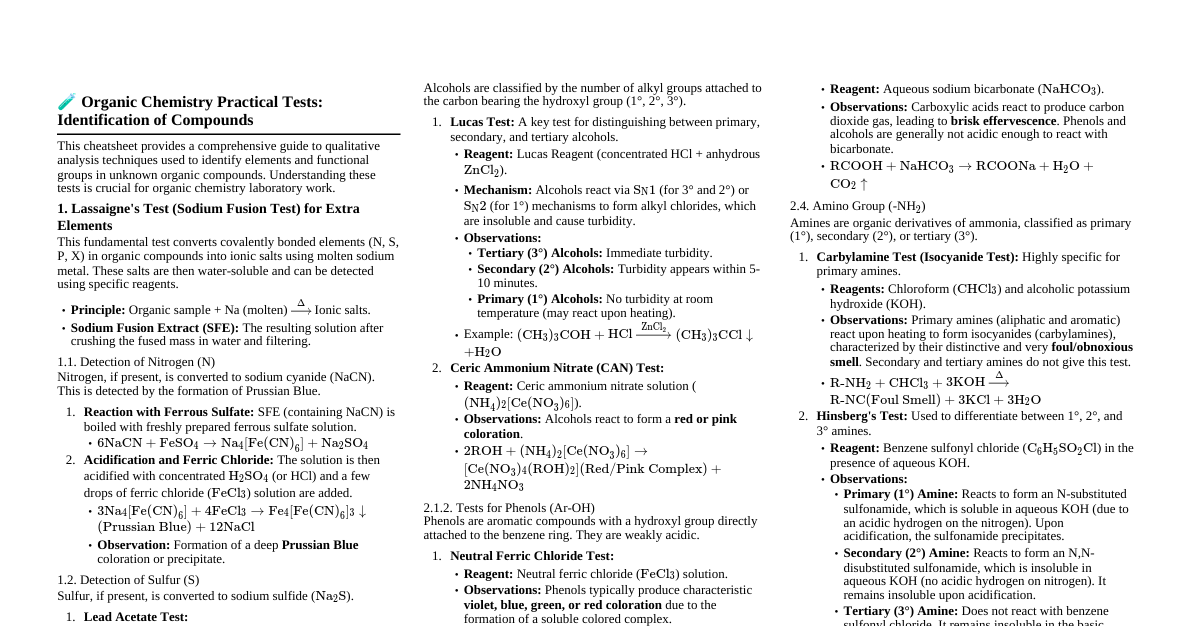
CHEMICAL TESTS FOR FUNCTIONAL GROUPS 1. Test For Alcohols (i) Sodium Metal Reaction: $ROH + Na \rightarrow RO^-Na^+ + \frac{1}{2}H_2(g)$ When Na-metal reacts with alcohol, $H_2(g)$ evolves. Occurs in $1^\circ, 2^\circ, \& 3^\circ$ alcohols. Rate is highly variable, depends on alcohol structure. Other functional groups that evolve $H_2$: $R_2NH, RSH, RC \equiv C-H, RCO_2H$. (ii) Ceric Ammonium Nitrate Oxidation (CAN Test) Reaction: $(NH_4)_2Ce(NO_3)_6 \text{ (yellow)} + ROH \rightarrow (NH_4)_2Ce(NO_3)_5 \cdot HNO_3 \text{ (red)} \rightarrow Ce(III) \text{ (colorless)}$ Positive Test: Color changes from yellow to red, then to colorless solution (1 min to 12 hrs). Very good test for $1^\circ, 2^\circ$ alcohol, but slow for $3^\circ$ alcohol. Note: Phenols give brown or black color. (iii) Jones Oxidation: Chromic anhydride or Chromium Trioxide ($CrO_3$) Positive Test: For $1^\circ$ and $2^\circ$ alcohols, color changes from orange-red ($Cr^{6+}$) to opaque suspension with green to blue ($Cr^{3+}$) in 2 seconds. $3^\circ$ alcohols give no visible reaction within 2 seconds. Note: Aldehydes give positive results. 1° Alcohol: $3RCH_2OH + 4CrO_3 + 6H_2SO_4 \rightarrow 3RCOOH + 9H_2O + 2Cr_2(SO_4)_3$ 2° Alcohol: $3R_2CHOH + 2CrO_3 + 3H_2SO_4 \rightarrow 3R_2C=O + 6H_2O + 2Cr_2(SO_4)_3$ (iv) Lucas Test Distinguishes $1^\circ, 2^\circ, \& 3^\circ$ alcohols using anhydrous $ZnCl_2$ in conc. $HCl$. Reaction: $R-OH \xrightarrow{HCl+ZnCl_2} R-Cl + H_2O$ $3^\circ$ alcohols give white turbidity immediately. $2^\circ$ alcohols give white turbidity within 5 to 10 minutes. $1^\circ$ alcohols do not give white turbidity at room temperature. Note: Benzyl alcohol also reacts immediately. (v) Victor-Mayer Test Distinguishes $1^\circ, 2^\circ, \& 3^\circ$ alcohols. 1°-Alcohol 2°-Alcohol 3°-Alcohol $R-CH_2-OH \xrightarrow{Red P+I_2} R-CH_2-I \xrightarrow{AgNO_2} R-CH_2-NO_2 \xrightarrow{HNO_2} R-C(NO_2)=N-OH \xrightarrow{NaOH} Red\ color$ $R_2CH-OH \xrightarrow{Red P+I_2} R_2CH-I \xrightarrow{AgNO_2} R_2CH-NO_2 \xrightarrow{HNO_2} R_2C(NO_2)-N=O \xrightarrow{NaOH} Blue\ color$ $R_3C-OH \xrightarrow{Red P+I_2} R_3C-I \xrightarrow{AgNO_2} R_3C-NO_2 \xrightarrow{HNO_2} No\ reaction$ (vi) Periodic Acid ($HIO_4$) Test (for Vicinal Diols and Related Compounds) Vicinal diol: $RCH(OH)CH(OH)R' + HIO_4 \rightarrow RCHO + R'CHO + H_2O + HIO_3$ 1,2-diketone: $RCOCOR' + HIO_4 \rightarrow RCOOH + R'COOH + HIO_3$ $\alpha$-hydroxy ketone: $RCOCH(OH)R' + HIO_4 \rightarrow RCOOH + R'CHO + HIO_3$ $\alpha$-hydroxy aldehyde: $RCH(OH)CHO + HIO_4 \rightarrow RCOOH + HCHO + HIO_3$ $\beta$-hydroxyamine: $RCH(OH)CH(NHR')R'' + HIO_4 \rightarrow RCHO + R'CHO + NH_3 + HIO_3$ Iodic acid detected by $5\%$ $AgNO_3$ solution (immediate precipitation of silver iodate). $HIO_3 + AgNO_3 \rightarrow HNO_3 + AgIO_3(s)$ (white ppt). Olefins, $2^\circ$ alcohols, 1,3-glycols, ketones and aldehydes are not affected by $HIO_4$. (vii) Acetyl Chloride Positive Test: Evolution of HCl gas and formation of ester as a top layer. Alcohols: $ROH + CH_3COCl \rightarrow CH_3COOR + HCl(g)$ Phenols: $ArOH + CH_3COCl \rightarrow CH_3COOAr + HCl(g)$ $3^\circ$ alcohols form primarily alkyl chloride due to reaction with liberated HCl. Other functional groups giving positive test: $1^\circ$ and $2^\circ$ amines. Amines: $RNH_2 + CH_3COCl \rightarrow CH_3CONHR + HCl(g)$ Secondary Amines: $R_2NH + CH_3COCl \rightarrow CH_3CONR_2 + HCl(g)$ 2. Classification Tests for Aldehydes and Ketones (i) 2,4-Dinitrophenyl Hydrazine Reaction: Carbonyl compound + 2,4-dinitrophenylhydrazine $\xrightarrow{pH\ 4.5-6.0}$ 2,4-dinitrophenylhydrazone + $H_2O$ Positive Test: Formation of yellow, orange, or red precipitate. Precipitate may be oily at first, becoming crystalline on standing. (ii) Phenyl hydrazine and p-Nitrophenyl hydrazine Positive Test: Formation of yellow precipitate. (iii) Hydroxylamine Hydrochloride Reaction: Aldehyde/Ketone + $H_2N-OH \xrightarrow{dry\ HCl} C=N-OH + HCl + H_2O$ Liberation of HCl detected by pH indicator (orange to red). (iv) Sodium Bisulfite ($NaHSO_3$) Reaction: Carbonyl compound + $NaHSO_3 \rightarrow$ White crystalline adduct $R_2C(OH)SO_3Na$ Positive Test: By aldehydes and methyl ketones. Only some cyclic ketones give positive results (ppt). Steric hindrance greatly inhibits this reaction. (v) Iodoform Test (For Methyl Ketones) Reaction: $RCOCH_3 + 3I_2 + 3NaOH \rightarrow RCOCl_3 + 3NaI + 3H_2O$ followed by $RCOCl_3 + NaOH \rightarrow RCOONa + CHI_3(s)$ Positive Test: Yellow precipitate for methyl ketones. Disadvantages: Some compounds easily oxidized to methyl ketones also give positive results. Compounds giving positive test: $CH_3CHO$, $CH_3COR$, $CH_3CH(OH)R$, $CH_3CH_2OH$. Negative for: Compounds where acetyl group is removed: $CH_3COCH_2OR, CH_3COCH_2CN, CH_3COCH_2NO_2$. Acetoacetic acid (decomposes to $CO_2$ and acetone). 3. Tests that give positive results with Aldehydes and negative results with Ketones (i) Jones Oxidation: (Same as for alcohols, page 3) (ii) Tollens Reagents $Ag(NH_3)_2OH$ Reaction: $RCHO + 2Ag(NH_3)_2OH \rightarrow 2Ag(s) + RCOO^-NH_4^+ + H_2O + 3NH_3$ Positive Test: Formation of silver mirror (Ag) or colloidal (granular) grey/black Ag precipitate. (iii) Schiff's Reagent Aldehyde reacts with colorless Schiff's reagent to form a violet-purple solution. (iv) Benedict's solution and Fehling's Solution Positive Test: Yellow or yellowish-green precipitate ($Cu_2O$). All aldehydes give positive results except aromatic aldehydes (negative). Reactions: Aldehyde: $RCHO + 2Cu^{2+} \rightarrow RCOOH + Cu_2O(s)$ $\alpha$-hydroxyketone: $RCOCH(OH)R' + 2Cu^{2+} \rightarrow RCOCOR' + Cu_2O(s)$ $\alpha$-hydroxyaldehyde: $RCH(OH)CHO + 2Cu^{2+} \rightarrow RCOCOOH + Cu_2O(s)$ 4. Classification Tests for Unsaturation (Alkenes & Alkynes) Alkanes are inert to most classification reactions. (i) Bromine in $CCl_4$ Reaction: $C=C + Br_2 \text{ (red-brown)} \rightarrow -CBr-CBr-$ (colorless) Alkynes: $-C \equiv C- + 2Br_2 \rightarrow -CBr_2-CBr_2-$ Positive Test: Bromine color discharged without evolution of $HBr$. Alkenes & alkynes give positive results. If $HBr$ is evolved, it indicates phenols, enols, or enolizable compounds. Bromine color discharged by amines can produce a salt, which can be mistaken for addition. (ii) Baeyer Test ($KMnO_4$ aqueous) Reaction: $3C=C + 2KMnO_4 + 4H_2O \rightarrow 3-C(OH)-C(OH)- + 2KOH + 2MnO_2(s)$ (brown) Alkynes: $3R-C \equiv C-R' + 8KMnO_4 + H_2O \rightarrow 3RCOOH + 3R'COOH + 8MnO_2(s) + 2KOH$ Positive Test: Purple color discharges, and brown precipitate ($MnO_2$) appears. Note: Aldehydes and alcohols also give positive results. 5. Tests for Alkyl Halides Aliphatic halides detected by halogen analysis. (i) Ethanolic Silver Nitrate & (ii) Sodium Iodide in Acetone Both tests involve displacement of halogen. $AgNO_3$/ethanol test: $S_N1$ process ($R_3CX > R_2CHX > RCH_2X$). $NaI$/acetone test: $S_N2$ process ($R_3CX Ethanolic Silver Nitrate: $RX + AgNO_3 \xrightarrow{CH_3CH_2OH} AgX(s) + RONO_2$ Positive Test: Precipitate forms, indicating $2^\circ$ and $3^\circ$ RX. $1^\circ$ RX, Ar-X, and vinyl halides give negative results. Allylic and benzylic RX give positive results. Halogen identity from color: $AgCl$ (white), $AgBr$ (pale yellow), $AgI$ (yellow). Sodium Iodide in Acetone: $RCl + NaI \xrightarrow{Acetone} RI + NaCl(s)$ Positive Test: Precipitate forms. 6. Tests for Amines and Amine Salts (i) Diethyl oxalate test: Separates $1^\circ, 2^\circ, 3^\circ$ amines. $1^\circ$ amines + diethyl oxalate $\rightarrow$ solid oxamide. $2^\circ$ amines + diethyl oxalate $\rightarrow$ liquid oxamic ester. $3^\circ$ amines remain unreacted (gaseous). (ii) Nitrous Acid (HONO): Classifies $1^\circ, 2^\circ, 3^\circ$ amines (aliphatic or aromatic). $1^\circ$ aliphatic amines: $RNH_2 + HONO \rightarrow [RN_2^+Cl^-] \rightarrow N_2(g) + ROH + RCl + ROR + alkene$ $1^\circ$ aromatic amines: $ArNH_2 + HONO \rightarrow [ArN_2^+Cl^-] \rightarrow N_2(g) + ArOH + HCl$ Diazonium salt of $1^\circ$ aromatic amine reacts with sodium 2-naphthol to produce a red-orange azo dye. $2^\circ$ amines: $R_2NH + HONO \rightarrow R_2N-N=O + H_2O$ (N-nitrosoamine, yellow oil/solid). $3^\circ$ aliphatic amines: form soluble salt, immediate positive test on starch-iodide paper for nitrous acid. $3^\circ$ aromatic amines: form orange hydrochloride salt of C-nitrosoamine, which liberates green C-nitrosoamine with base. (iii) Hinsberg Test: Separates $1^\circ, 2^\circ, 3^\circ$ amines using benzenesulfonyl chloride. $1^\circ$ amines: $RNH_2 + C_6H_5SO_2Cl \xrightarrow{2NaOH} C_6H_5SO_2NR^-Na^+ + NaCl + 2H_2O$ (soluble), then $\xrightarrow{H^+} C_6H_5SO_2NHR$ (insoluble sulfonamide). $2^\circ$ amines: $R_2NH + C_6H_5SO_2Cl \xrightarrow{NaOH} C_6H_5SO_2NR_2 + NaCl + H_2O$ (insoluble sulfonamide), no reaction with $H^+$. $3^\circ$ amines: $R_3N + C_6H_5SO_2Cl \rightarrow$ quaternary ammonium sulfonate salts (soluble), then $\xrightarrow{2NaOH} C_6H_5SO_3^-Na^+ + R_3N + NaCl + H_2O$ (soluble). (iv) Sodium Hydroxide Treatment of Ammonium Salt and Amine Salts: Amine salts with NaOH liberate ammonia or amine. Moistened pink litmus paper turns blue if ammonia or a volatile amine is present. (v) Libermann's nitroso test: Test for secondary amines. $R_2NH + HONO \rightarrow R_2N-N=O + H_2O$ (N-nitrosoamines, yellow oils). N-nitrosoamines + phenol + conc. $H_2SO_4 \rightarrow$ green solution, turns blue with alkali. Tertiary amines do not react. 7. Tests for Amino Acids (i) Ninhydrin Test: Amino acids react with ninhydrin to give a blue or blue-violet color. Ammonium salts ($NH_4Cl$) give a positive test. Some amines (e.g., aniline) give orange to red colors (negative test). Proline, hydroxyproline, and 2-, 3-, 4-aminobenzoic acids give yellow color instead of blue. (ii) Copper Complex Formation: Amino acids + $Cu^{2+}$ solution yields a moderate-to deep-blue liquid or a dark-blue solid copper complex. 8. Tests for Aromatics (i) Fuming Sulfuric Acid: $ArH + H_2SO_4 \cdot SO_3 \rightarrow ArSO_3H + heat$ Positive Test: Aromatic compound dissolves completely in $H_2SO_4$ with evolution of heat. (ii) Chloroform and Aluminum Chloride: $3ArH + CHCl_3 \xrightarrow{AlCl_3} Ar_3CH + 3HCl$ $Ar_3CH + R^+ \rightarrow Ar_3C^+ + RH$ (colored) Positive Test: Aromatics give colored solution or powder (orange, red, blue, purple, green). Non-aromatics give yellow color (negative result). (iii) Azoxybenzene and Aluminum Chloride: Color of solution/precipitate depends on functional groups. Aromatic hydrocarbons and halogen derivatives produce deep-orange to dark-red color. Fused aromatic rings (naphthalene, anthracene) produce brown color. Aliphatic hydrocarbons give no color or pale yellow. 9. Tests for Ethers Ethers are less polar and slightly more reactive than saturated hydrocarbons or alkyl halides. Form explosive peroxides upon standing (especially with air/light exposure). Liquid ethers with solid precipitates should not be handled. (i) Hydroiodic Acid (Zeisel's, Alkoxyl method): $R'OR + 2HI \rightarrow R'I + RI + H_2O$ $ArOR + HI \rightarrow RI + ArOH$ $Hg(NO_3)_2 + 2R'I \rightarrow HgI_2 + 2R'OH + 2HNO_3$ Positive Test: Orange or orange-red color. Note: Ethyl and methyl esters also give positive results. (ii) Iodine Test for Ethers and Unsaturated Hydrocarbons: Alkenes: $C=C + I_2 \rightarrow \pi-complex$ Ethers: $R_2O: + I_2 \rightarrow R_2O: \cdot I_2$ Positive Test: Color of solution changes from purple to tan. Aromatic hydrocarbons, saturated hydrocarbons, fluorinated hydrocarbons, and chlorinated hydrocarbons do not react. Unsaturated hydrocarbons produce a light-tan solid while retaining purple iodine color. 10. Tests for Phenols Acidic hydrogen detected by sodium (evolves $H_2$) or acetyl chloride (forms ester layer). Phenols react with yellow ceric ammonium nitrate to produce brown or black products. Phenols reduce potassium permanganate solution and undergo oxidation to quinones. Manganese reduced from $+7$ (purple) to $+4$ (brown). (i) Bromine water: Phenol + $3Br_2 \rightarrow 2,4,6$-tribromophenol (white ppt) + $3HBr$ Positive Test: Decolorization of bromine. Good for water-soluble phenols. (ii) Ferric Chloride - Pyridine Reagent: $3ArOH + FeCl_3 \rightarrow Fe(OAr)_3 + 3HCl$ (colored complex) Positive Test: Production of blue, violet, purple, green, or red-brown colors. Good for all types of Ar-OH. Positive test for enols. Carboxylic acid with $FeCl_3$ gives red color only when saturating with $NH_3$. (iii) Libermann's nitroso test: Phenol + $NaNO_2$ + conc. $H_2SO_4 \rightarrow$ deep green color, turns red on dilution with water. Alkaline solution turns blue. 11. Test For Nitro Compounds (i) Ferrous Hydroxide Reduction: $RNO_2 + 6Fe(OH)_2 + 4H_2O \rightarrow RNH_2 + 6Fe(OH)_3$ (red-brown) Positive Test: Change in color from green to red-brown or brown. Negative test: Greenish precipitate. Note: Nitroso compounds, quinones, hydroxylamines, alkyl nitrates also give positive results. (ii) Zinc and Ammonium Chloride Reduction: $RNO_2 + 4[H] \xrightarrow{Zn/NH_4Cl} RNHOH + H_2O$ (hydroxylamine) $RNHOH + 2Ag(NH_3)_2OH \rightarrow RNO + 2H_2O + 2Ag(s) + 4NH_3$ Test solution with Tollens Reagent. Positive Test: Formation of metallic silver. Only $3^\circ$ aliphatic nitro compounds and aromatic nitro compounds are reduced to hydroxylamine. Hydroxylamine detected by metallic silver formation in Tollens test (Mulliken-Baker test). (iii) Treatment of Aromatic Compounds with Sodium Hydroxide: Number of nitro groups on aromatic ring determined by reaction with NaOH. Mononitro aromatic compounds: No color change or very light yellow. Dinitro aromatic compounds: Bluish-purple color. Trinitro aromatic compounds: Red color. Color due to Meisenheimer complex. SEPARATION TECHNIQUES METHODS OF PURIFICATION OF ORGANIC COMPOUNDS Elemental analysis, physical, spectral, and solubility tests provide an initial idea. Chemical tests are essential for complete characterization. Common methods include: Sublimation Crystallisation Distillation Solvent extraction (differential extraction) Chromatography Pure compounds have sharp Melting Points & Boiling Points. Sublimation Conversion of sublimable solid to vapor directly by heating. Used for purification of solids. Separates sublimable volatile compounds from non-sublimable impurities. Examples: camphor, naphthalene, anthracene, benzoic acid, phthalic anhydride, anthraquinone, indigo, iodine, $HgCl_2$. Crystallisation Used for purification of solid organic compounds. Based on difference in solubility of compound and impurities in a suitable solvent. Impure compound dissolved in hot solvent, sparingly soluble at low temperature. Insoluble impurities separated by filtration. Filtrate cooled to crystallize pure compound. If compound is highly soluble in one solvent and less soluble in another, use a mixture of solvents. Impurities imparting color removed by activated charcoal. Repeated crystallisation needed for impurities of comparable solubilities. Fractional crystallisation separates components of a mixture with different solubilities. Example: Sugar from common salt using hot ethanol. Separation of $KClO_3$ (less soluble) and $KCl$ (more soluble). Distillation Separates volatile liquids from non-volatile impurities. Separates liquids with sufficient difference in boiling points. Simple Distillation: Used for purification of liquids that do not decompose at their boiling points. Liquid mixture heated, lower boiling point component vaporizes first, then condensed and collected. Used for liquids with boiling point difference greater than $20^\circ C$. Examples: Chloroform (BP 334 K) & Aniline (BP 457 K), Ether (BP 308 K) & Toluene (BP 384 K), Benzene (BP 353 K) & Aniline (BP 457 K). Fractional Distillation: Used if boiling point difference is less than $20^\circ C$. Vapors pass through a fractionating column for repeated condensation and vaporization. Lower boiling point fraction reaches top first. Fractionating column provides surfaces for heat exchange. Each unit of condensation/vaporization is a theoretical plate. Cannot separate azeotropic mixtures. Used in petroleum industry to separate crude oil fractions. Examples: Acetone (BP 330 K) & methyl alcohol (BP 338 K), benzene & toluene. Example: Purifying ethyl alcohol from methylated spirit. Distillation Under Reduced Pressure (Vacuum Distillation): Boils liquid below its normal boiling point by reducing pressure. Used for liquids with very high boiling points that decompose at or below their boiling points. Examples: Glycerine, $H_2O_2$, formaldehyde. Glycerol from spent-lye. Concentrating sugar cane juice. Steam Distillation: Separates organic compounds that are steam volatile and insoluble in water. Compound must have high vapor pressure (10-15 mm Hg at 373 K) and non-volatile impurities. Based on Dalton's law of partial pressures ($P = P_1 + P_2$). Examples: Aniline, nitrobenzene, bromobenzene, o-nitrophenol, o-hydroxy benzaldehyde, o-hydroxy acetophenone, turpentine oil, essential oils. Aniline and $H_2O$ are separated by steam distillation. Solvent Extraction (Differential Extraction) Process of isolating an organic compound from its aqueous solution by shaking with a suitable solvent. Organic solvent must be immiscible with water and compound more soluble in it. Forms two distinct layers, separated by separator funnel. Organic solvent distilled/evaporated to get compound. If compound is less soluble in organic solvent, continuous extraction is used. Example: Benzoic acid from aqueous solution using benzene. Ether is a better solvent due to less polarity, less reactivity, lower boiling point, and higher solubility for organic compounds. SEPARATION BY CHEMICAL METHODS Separates substances that are chemically different. Examples: Separation of acidic and basic compounds of coal-tar. $HC \equiv CH \xrightarrow{Cu_2Cl_2, NH_4OH} CuC \equiv CCu \xrightarrow{dil\ HCl} HC \equiv CH$ Pyroligneous acid $\xrightarrow{Ca(OH)_2} Calcium\ acetate \xrightarrow{conc.\ HCl} CH_3COOH$ $CH_3OH + (COOH)_2 \rightarrow$ Methyl oxalate $\xrightarrow{NaOH(aq), \Delta} CH_3OH$ Chromatography Separates mixtures into components, purifies compounds, and tests purity. "Chroma" (color) and "graphy" (writing). Consists of a stationary phase (large surface area) and a moving phase. Based on rates components move through porous medium. Mixture applied to stationary phase, mobile phase moves components at different rates. Recovery of separated substances by elution (using a suitable solvent). (a) Adsorption Chromatography: Based on differential adsorption on an adsorbent. Common adsorbents: silica gel, alumina, magnesium oxide, cellulose powder, activated animal charcoal. Components move at varying distances over stationary phase. (i) Column Chromatography: Separation over adsorbent-packed glass tube. Mixture applied to top, eluant flows down, strongly adsorbed substances retained near top. (ii) Thin Layer Chromatography (TLC): Separation on a thin layer of adsorbent (e.g., silica gel, alumina) on a glass plate. Mixture spotted near one end, plate placed in eluant. Eluant rises, components separate based on adsorption. Retardation factor ($R_f$) value: $R_f = \frac{\text{Distance moved by substance}}{\text{Distance moved by solvent}}$ Colored spots visible, colorless spots detected by UV light or spraying reagents (e.g., ninhydrin for amino acids). (b) Partition Chromatography: Based on continuous differential partitioning between stationary and mobile phases. Paper Chromatography: Special quality chromatography paper used. Cellulose acts as support, water absorbed acts as stationary liquid phase. Solvent (mobile phase) rises by capillary action, separating components. Paper strip developed is chromatogram. $R_f$ value also calculated. Additional Information: Applications of Chromatography Chemical Industry: Separates required components after synthesis. TLC monitors large-scale column chromatography. Pharmaceutical Industry: Separates chiral compounds to obtain pharmaceutically active optical isomers. Food Industry: Quality control, detects presence of additives, flavors, contaminants (mould, bacteria). Environment-Testing Lab: Determines presence and quality of pollutants in air and water. Diagnostic Technique: Detects drugs and marker compounds in blood and urine. Qualitative Analysis of Organic Compounds (Detection of Elements) Detects all elements present. Detection of Carbon and Hydrogen: Compound heated with cupric oxide (CuO). Carbon $\rightarrow CO_2$ (turns lime water milky: $Ca(OH)_2 + CO_2 \rightarrow CaCO_3 + H_2O$). Hydrogen $\rightarrow H_2O$ (turns anhydrous copper sulfate blue: $CuSO_4 + 5H_2O \rightarrow CuSO_4 \cdot 5H_2O$). (A) ELEMENTAL ANALYSIS CHART (Lassaigne method) Element Sodium Extract (S.E.) Confirmed Test Reactions Nitrogen Na + C + N $\rightarrow$ NaCN (S.E.) S.E. + $FeSO_4$ + NaOH, boil and cool, + $FeCl_3$ + conc. HCl $\rightarrow$ Blue/green color $FeSO_4 + 2NaOH \rightarrow Fe(OH)_2 + Na_2SO_4$ $Fe(OH)_2 + 6NaCN \rightarrow Na_4[Fe(CN)_6] + 2NaOH$ $3Na_4[Fe(CN)_6] + 4FeCl_3 \rightarrow Fe_4[Fe(CN)_6]_3 + 12NaCl$ (Prussian blue) Sulphur 2Na + S $\rightarrow$ Na$_2$S (S.E.) (i) S.E. + sodium nitroprusside $\rightarrow$ Deep violet color (ii) S.E. + $CH_3COOH$ + $(CH_3COO)_2Pb \rightarrow$ Black ppt. (i) $Na_2S + Na_2[Fe(CN)_5NO] \rightarrow Na_4[Fe(CN)_5NOS]$ (deep violet) (ii) $Na_2S + (CH_3COO)_2Pb \rightarrow PbS \downarrow + 2CH_3COONa$ (black ppt.) Halogen Na + X $\rightarrow$ NaX (S.E.) S.E. + $HNO_3$ + $AgNO_3$ (i) White ppt. soluble in aq $NH_3$ (confirms Cl) (ii) Yellow ppt. partially soluble in aq $NH_3$ (confirms Br) (iii) Yellow ppt. insoluble in aq $NH_3$ (confirms I) $NaX + AgNO_3 \rightarrow AgX \downarrow + NaNO_3$ $AgCl + 2NH_3(aq) \rightarrow [Ag(NH_3)_2]Cl$ (soluble) Nitrogen and Sulphur together Na + C + N + S $\rightarrow$ NaSCN (S.E.) As in test for nitrogen, but blood red coloration confirms presence of N and S. $3NaSCN + FeCl_3 \rightarrow Fe(SCN)_3 + 3NaCl$ (blood red) Detection of Nitrogen, Sulphur Halogens & Phosphorus Lassaigne's test: Organic compounds fused with dry sodium $\rightarrow$ ionic compounds. Test for Nitrogen: Sodium fusion extract boiled with $FeSO_4$ solution, acidified with conc. $H_2SO_4 \rightarrow$ Prussian blue color. $2NaCN + FeSO_4 \rightarrow Fe(CN)_2 + Na_2SO_4$ $Fe(CN)_2 + 4NaCN \rightarrow Na_4[Fe(CN)_6]$ $3Na_4[Fe(CN)_6] + 2Fe_2(SO_4)_3 \rightarrow Fe_4[Fe(CN)_6]_3 + 6Na_2SO_4$ (Prussian blue) Fails for diazo compounds (no carbon), or if N is lost as $N_2$. Beilstein's Test: Copper wire heated until no blue flame, touched with organic substance, reheated $\rightarrow$ green or blue flame indicates halogens. Limitations: Urea, thiourea give positive, but no halogens. Doesn't identify halogen. Test for Phosphorus: Compound heated with oxidizing agent ($Na_2O_2$ or fusion mixture) $\rightarrow$ phosphorus oxidized to sodium phosphate. Solution boiled with $HNO_3$, treated with ammonium molybdate $\rightarrow$ canary yellow (ammonium phosphomolybdate) precipitate. $2P + 5Na_2O_2 \rightarrow 2Na_3PO_4 + 2Na_2O$ $Na_3PO_4 + 3HNO_3 \rightarrow H_3PO_4 + 3NaNO_3$ $H_3PO_4 + 12(NH_4)_2MoO_4 + 21HNO_3 \rightarrow (NH_4)_3PO_4 \cdot 12MoO_3 + 21NH_4NO_3 + 12H_2O$ QUANTITATIVE ANALYSIS Estimates percentage composition of elements. Estimation of Carbon and Hydrogen (Liebig's combustion method): Known mass of organic compound burnt in excess oxygen with CuO. Carbon $\rightarrow CO_2$, Hydrogen $\rightarrow H_2O$. $CO_2$ and $H_2O$ absorbed (KOH for $CO_2$, anhydrous $CaCl_2$ or $Mg(ClO_4)_2$ for $H_2O$). $\%C = \frac{12}{44} \times \frac{\text{weight of } CO_2}{\text{weight of organic compound}} \times 100$ $\%H = \frac{2}{18} \times \frac{\text{weight of } H_2O}{\text{weight of organic compound}} \times 100$ Estimation of Nitrogen (Dumas method): Nitrogen converted to $N_2$. Organic compound heated with CuO in $CO_2$ gas. Gases collected over KOH solution (absorbs $CO_2$), volume of $N_2$ determined. $\%N = \frac{28}{22400} \times \frac{\text{Volume of } N_2 \text{ at STP}}{\text{Weight of organic compound}} \times 100$ Estimation of Nitrogen (Kjeldahl's method): Nitrogen converted to ammonia. Organic compound heated with conc. $H_2SO_4$ (with $K_2SO_4$, $CuSO_4$) $\rightarrow (NH_4)_2SO_4$. $(NH_4)_2SO_4 + 2NaOH \rightarrow Na_2SO_4 + 2NH_3 + 2H_2O$. Ammonia absorbed in known excess standard acid, excess acid titrated with standard base. $\%N = \frac{1.4 \times V \times N}{\text{Weight of organic compound}}$ (V = volume of acid neutralized by $NH_3$, N = normality of acid). Not applicable for compounds with nitro, nitroso, azo groups, or nitrogen in a ring. Estimation of Halogens (Carius method): Organic compound heated with fuming $HNO_3$ and $AgNO_3$ in a sealed tube. Halogen $\rightarrow$ silver halide precipitate ($AgX$). $\% \text{Halogen} = \frac{\text{Atomic weight of halogen}}{\text{Molecular weight of } AgX} \times \frac{\text{weight of } AgX}{\text{weight of organic compound}} \times 100$ $\%Cl = \frac{35.5}{143.5} \times \frac{\text{weight of } AgCl}{\text{weight of organic compound}} \times 100$ $\%Br = \frac{80}{188} \times \frac{\text{weight of } AgBr}{\text{weight of organic compound}} \times 100$ $\%I = \frac{127}{235} \times \frac{\text{weight of } AgI}{\text{weight of organic compound}} \times 100$ Estimation of Phosphorus (Carius method): Organic compound heated with fuming $HNO_3 \rightarrow$ phosphoric acid. Phosphoric acid precipitated as magnesium ammonium phosphate ($MgNH_4PO_4$), then heated to $Mg_2P_2O_7$. $\%P = \frac{62}{222} \times \frac{\text{weight of } Mg_2P_2O_7}{\text{weight of organic compound}} \times 100$ Alternatively, phosphoric acid precipitated as ammonium phosphomolybdate ($ (NH_4)_3PO_4 \cdot 12MoO_3 $). $\%P = \frac{31}{1877} \times \frac{\text{weight of } (NH_4)_3PO_4 \cdot 12MoO_3}{\text{weight of organic compound}} \times 100$ Estimation of Oxygen: Usually by difference: $\%O = 100 - (\%C + \%H + \%N + \dots)$. Aluise's method: Compound pyrolyzed in nitrogen stream. Oxygen converted to $CO$ over red-hot coke. $CO$ converted to $CO_2$ over $I_2O_5$. $CO_2$ absorbed by KOH. $\%O = \frac{16}{44} \times \frac{\text{weight of } CO_2}{\text{weight of organic compound}} \times 100$