Haloalkanes and Haloarenes
Cheatsheet Content
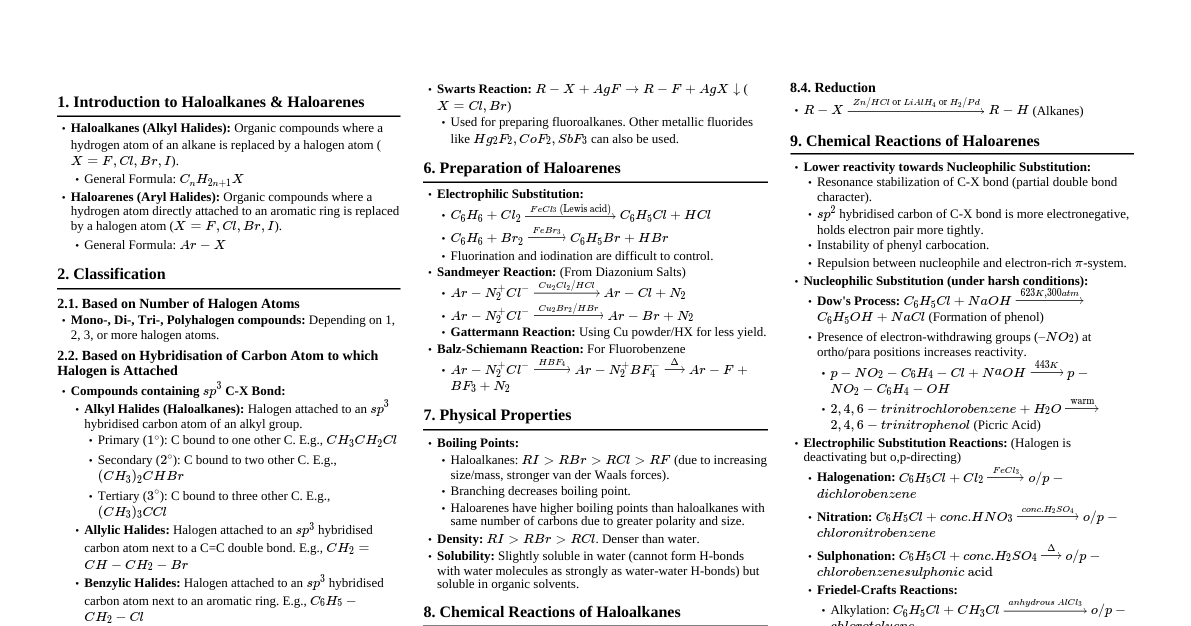
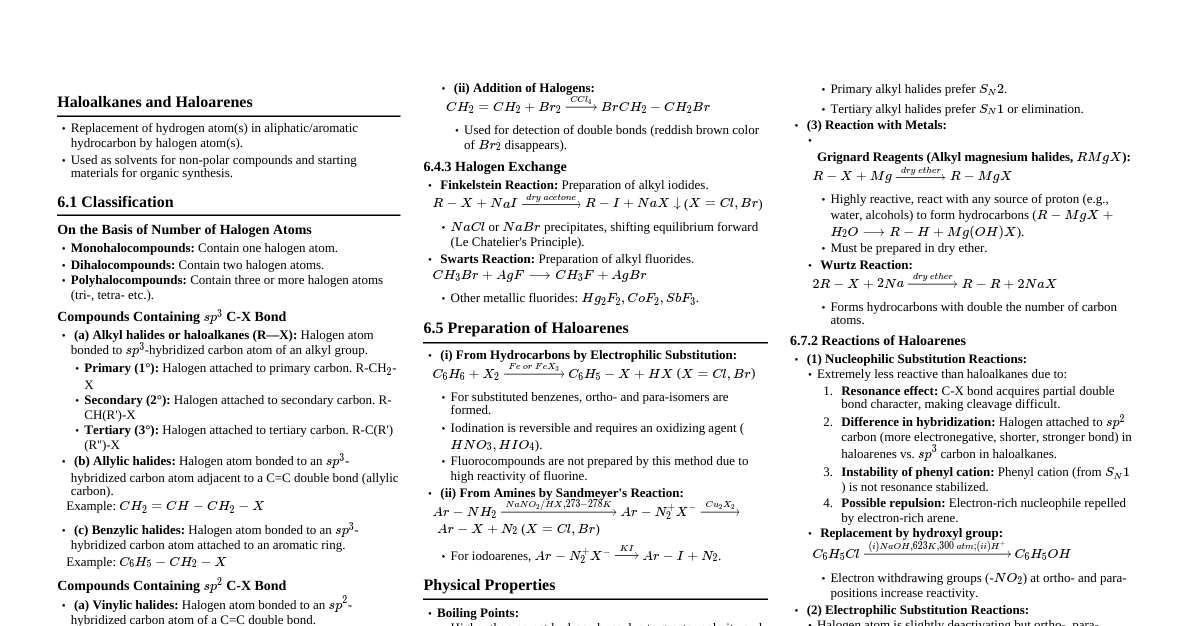
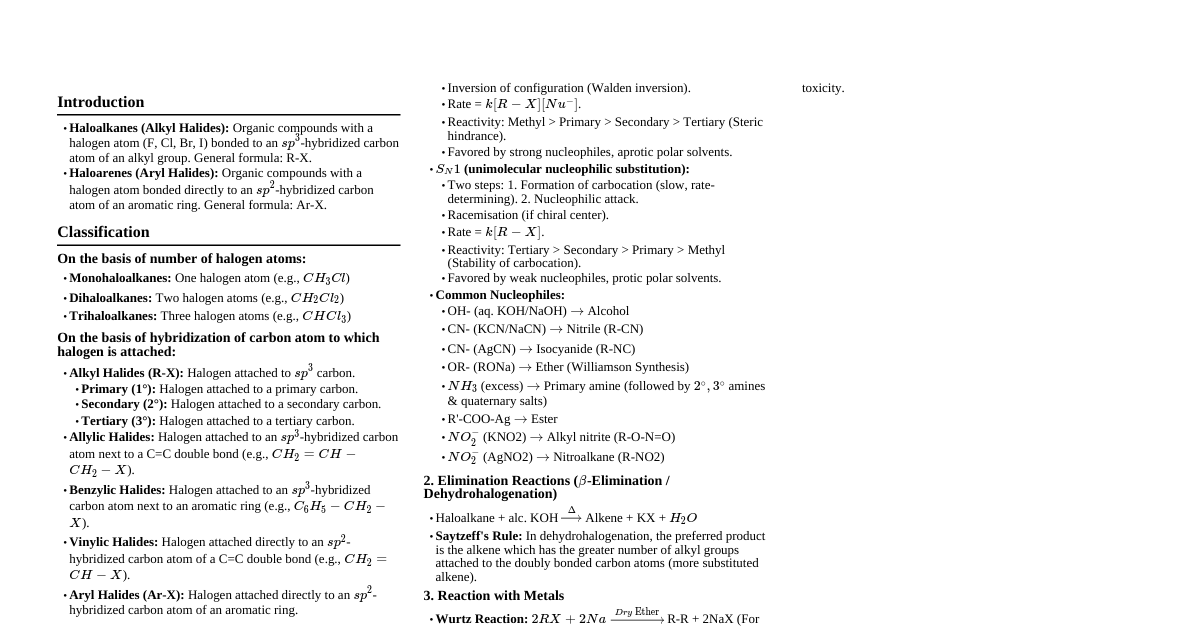
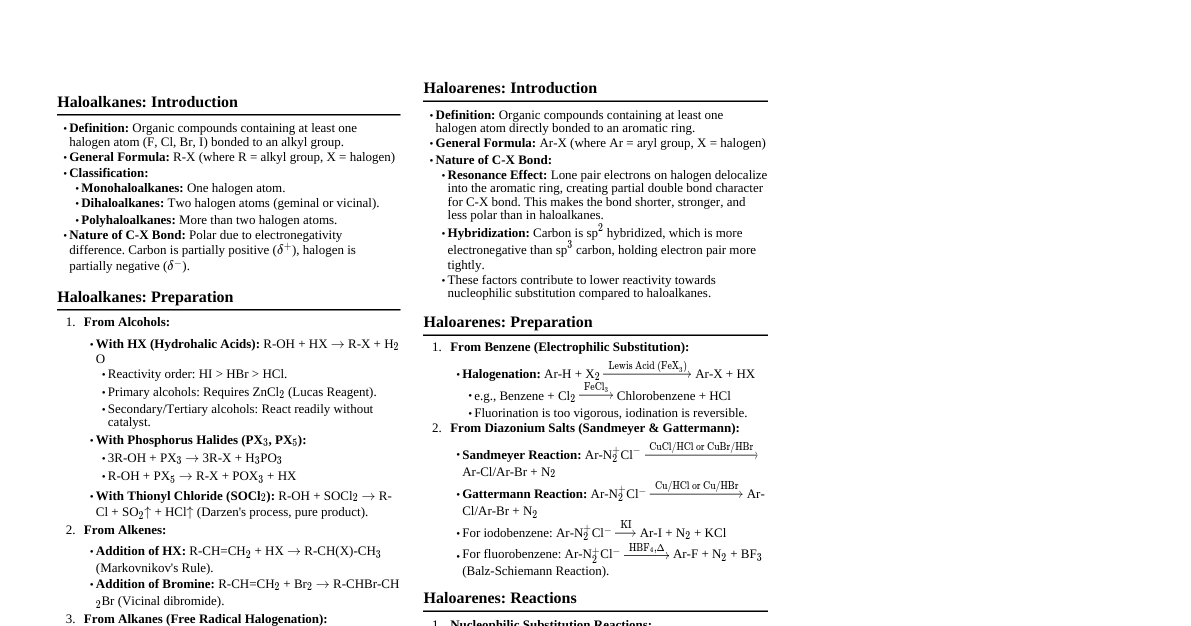
1. Introduction to Haloalkanes & Haloarenes Haloalkanes: Aliphatic hydrocarbons where one or more H atoms are replaced by halogen atoms (F, Cl, Br, I). General formula: $R-X$ (where $R$ is alkyl, $X$ is halogen) Examples: $CH_3Cl$ (Chloromethane), $CH_3CH_2Br$ (Bromoethane) Haloarenes: Aromatic hydrocarbons where one or more H atoms attached to an aromatic ring are replaced by halogen atoms. General formula: $Ar-X$ (where $Ar$ is aryl, $X$ is halogen) Examples: $C_6H_5Cl$ (Chlorobenzene), $C_6H_4Br_2$ (Dibromobenzene) 2. Classification Based on Number of Halogen Atoms: Mono-, Di-, Tri-, Polyhalogen compounds: Depending on 1, 2, 3, or more halogen atoms. Monohaloalkane: $CH_3CH_2Cl$ Dihaloalkane: $CH_2Cl_2$ (Dichloromethane) Trihaloalkane: $CHCl_3$ (Chloroform) Based on Hybridisation of Carbon Atom to which Halogen is Attached: Compounds with $sp^3$ C-X bond: Alkyl halides (Haloalkanes): Halogen attached to an alkyl group. Primary ($1^\circ$): $RCH_2X$ (e.g., $CH_3CH_2Cl$) Secondary ($2^\circ$): $R_2CHX$ (e.g., $(CH_3)_2CHCl$) Tertiary ($3^\circ$): $R_3CX$ (e.g., $(CH_3)_3CCl$) Allylic halides: Halogen attached to an $sp^3$ carbon next to a C=C double bond. $CH_2=CH-CH_2-X$ (e.g., 3-Chloroprop-1-ene) Benzylic halides: Halogen attached to an $sp^3$ carbon next to an aromatic ring. $C_6H_5-CH_2-X$ (e.g., Chlorophenylmethane) Compounds with $sp^2$ C-X bond: Vinylic halides: Halogen attached to an $sp^2$ carbon of a C=C double bond. $CH_2=CH-X$ (e.g., Chloroethene) Aryl halides (Haloarenes): Halogen attached directly to an $sp^2$ carbon of an aromatic ring. $Ar-X$ (e.g., Chlorobenzene) 3. Nomenclature Common Names: Alkyl halide (e.g., Methyl chloride for $CH_3Cl$) IUPAC Names: Haloalkane (e.g., Chloromethane for $CH_3Cl$) Number the longest carbon chain from the end closer to the halogen. For multiple halogens/substituents, use alphabetical order. For haloarenes, name as halobenzene; use ortho ($o$), meta ($m$), para ($p$) or numbers for disubstituted compounds. 4. Nature of C-X Bond Halogen atoms are more electronegative than carbon. The C-X bond is polar, with carbon having a partial positive charge ($\delta^+$) and halogen having a partial negative charge ($\delta^-$). Bond strength: $C-F > C-Cl > C-Br > C-I$ Bond length: $C-F 5. Preparation of Haloalkanes From Alcohols: $R-OH + HX \xrightarrow{ZnCl_2 \text{ (for } 1^\circ, 2^\circ)} R-X + H_2O$ (Lucas reagent for $1^\circ, 2^\circ, 3^\circ$ alcohols) $R-OH + PCl_5 \to R-Cl + POCl_3 + HCl$ $3R-OH + PCl_3 \to 3R-Cl + H_3PO_3$ $R-OH + SOCl_2 \xrightarrow{\text{Pyridine}} R-Cl + SO_2 \uparrow + HCl \uparrow$ (Darzen's process, best method) From Alkenes: Addition of HX: $CH_2=CH_2 + HBr \to CH_3CH_2Br$ (Markovnikov's rule for unsymmetrical alkenes) Addition of Halogens: $CH_2=CH_2 + Br_2 \xrightarrow{CCl_4} BrCH_2-CH_2Br$ (Vicinal dihalide) From Alkanes (Free Radical Halogenation): $CH_4 + Cl_2 \xrightarrow{h\nu \text{ or heat}} CH_3Cl + HCl$ (Mixture of products, difficult to control) Halogen Exchange (for Alkyl Iodides/Fluorides): Finkelstein Reaction: $R-Cl/Br + NaI \xrightarrow{\text{Acetone}} R-I + NaCl/NaBr \downarrow$ Swarts Reaction: $R-Cl/Br + AgF/Hg_2F_2/CoF_2/SbF_3 \to R-F + AgCl/Br$ 6. Preparation of Haloarenes By Electrophilic Substitution: $C_6H_6 + Cl_2 \xrightarrow{FeCl_3} C_6H_5Cl + HCl$ (Halogenation of benzene) $C_6H_6 + Br_2 \xrightarrow{FeBr_3} C_6H_5Br + HBr$ From Arenediazonium Salts (Sandmeyer/Gattermann): $Ar-N_2^+Cl^- \xrightarrow{Cu_2Cl_2/HCl} Ar-Cl + N_2$ (Sandmeyer) $Ar-N_2^+Cl^- \xrightarrow{Cu/HCl} Ar-Cl + N_2$ (Gattermann) $Ar-N_2^+Cl^- \xrightarrow{KI} Ar-I + N_2 + KCl$ (Direct reaction with KI) From Phenols (Industrial): Phenol $\xrightarrow{PCl_5}$ Chlorobenzene (side products) 7. Physical Properties Boiling Points: Haloalkanes: $RI > RBr > RCl > RF$ (due to increasing size/mass, stronger van der Waals forces) For isomeric haloalkanes: $1^\circ Haloarenes: Generally higher B.P. than corresponding haloalkanes due to higher molecular weight and better packing in crystal lattice. Density: Increases with increasing atomic mass of halogen and number of halogen atoms. Bromides, iodides, and polychloro compounds are denser than water. Solubility: Slightly soluble in water (cannot form H-bonds) but soluble in organic solvents. 8. Chemical Reactions of Haloalkanes A. Nucleophilic Substitution Reactions ($S_N1$ and $S_N2$) $S_N2$ (bimolecular nucleophilic substitution): One-step, concerted mechanism. Rate = $k[RX][Nu^-]$ Inversion of configuration (Walden inversion). Reactivity: $CH_3X > 1^\circ > 2^\circ \gg 3^\circ$ (due to steric hindrance) Good for primary alkyl halides. $S_N1$ (unimolecular nucleophilic substitution): Two-step mechanism (carbocation intermediate). Rate = $k[RX]$ Racemization (loss of stereochemistry). Reactivity: $3^\circ > 2^\circ > 1^\circ > CH_3X$ (due to carbocation stability) Good for tertiary alkyl halides. Factors affecting $S_N1/S_N2$: Substrate: $1^\circ$ (SN2), $3^\circ$ (SN1), $2^\circ$ (both). Nucleophile: Strong, unhindered (SN2); weak (SN1). Leaving group: Good leaving group (SN1/SN2) - $I^- > Br^- > Cl^- > F^-$. Solvent: Polar aprotic (SN2); Polar protic (SN1). Examples of Nucleophilic Substitution: Reactant Nucleophile Product Name $R-X$ $OH^-$ (aq. KOH) $R-OH$ Alcohol $R-X$ $RO^-$ (NaOR') $R-O-R'$ Ether (Williamson Synthesis) $R-X$ $CN^-$ (KCN/NaCN) $R-CN$ Nitrile $R-X$ $AgCN$ $R-NC$ Isocyanide $R-X$ $NO_2^-$ (KNO_2) $R-ONO$ Alkyl Nitrite $R-X$ $AgNO_2$ $R-NO_2$ Nitroalkane $R-X$ $NH_3$ $R-NH_2$ Primary Amine $R-X$ $R'-COO^-$ (R'COONa) $R'-COOR$ Ester B. Elimination Reactions ($\beta$-Elimination / Dehydrohalogenation) $R-CH_2-CH_2-X \xrightarrow{\text{alc. KOH, heat}} R-CH=CH_2 + HX$ Follows Zaitsev's Rule: The more substituted alkene is the major product. $E1$ (unimolecular) and $E2$ (bimolecular) mechanisms, often compete with $S_N1$ and $S_N2$. C. Reaction with Metals Wurtz Reaction: $2R-X + 2Na \xrightarrow{\text{dry ether}} R-R + 2NaX$ (for symmetrical alkanes) Wurtz-Fittig Reaction: $Ar-X + R-X + 2Na \xrightarrow{\text{dry ether}} Ar-R + 2NaX$ (for alkylarenes) Formation of Grignard Reagents: $R-X + Mg \xrightarrow{\text{dry ether}} R-Mg-X$ (Grignard reagent) Highly reactive, acts as a source of carbanions ($R^-$). Reacts with compounds having active hydrogen (e.g., water, alcohols, amines) to give alkanes. $R-Mg-X + H_2O \to R-H + Mg(OH)X$ Reaction with Lithium: $R-X + 2Li \xrightarrow{\text{ether}} R-Li + LiX$ (Organolithium compounds) Corey-House Synthesis: $2R-Li + CuI \to R_2CuLi$ (Gilman reagent) $\xrightarrow{R'-X} R-R'$ D. Reduction $R-X \xrightarrow{Zn/HCl \text{ or } H_2/Pd} R-H$ 9. Chemical Reactions of Haloarenes Lower Reactivity towards Nucleophilic Substitution: Resonance effect: C-X bond acquires partial double bond character. $sp^2$ hybridisation of carbon: $C-X$ bond is shorter and stronger than in haloalkanes. Instability of phenyl carbocation: Cannot be stabilised by resonance. Repulsion between nucleophile and electron-rich arene. Nucleophilic Substitution Reactions (Special Conditions): Reaction with $NaOH$: $C_6H_5Cl + NaOH \xrightarrow{623K, 300atm} C_6H_5OH$ (Dow's process for phenol) Presence of electron-withdrawing groups ($NO_2$) at ortho/para positions increases reactivity. $o/p-NO_2-C_6H_4Cl \xrightarrow{NaOH, \text{warm}} o/p-NO_2-C_6H_4OH$ A. Electrophilic Substitution Reactions Halogen is a deactivating group but ortho/para directing. Halogenation: $C_6H_5Cl + Cl_2 \xrightarrow{FeCl_3} o/p-C_6H_4Cl_2$ Nitration: $C_6H_5Cl + HNO_3/H_2SO_4 \to o/p-Cl-C_6H_4-NO_2$ Sulfonation: $C_6H_5Cl + conc. H_2SO_4 \to o/p-Cl-C_6H_4-SO_3H$ Friedel-Crafts Alkylation: $C_6H_5Cl + CH_3Cl \xrightarrow{Anhy. AlCl_3} o/p-Cl-C_6H_4-CH_3$ Friedel-Crafts Acylation: $C_6H_5Cl + CH_3COCl \xrightarrow{Anhy. AlCl_3} o/p-Cl-C_6H_4-COCH_3$ B. Reaction with Metals Wurtz-Fittig Reaction: $Ar-X + R-X + 2Na \xrightarrow{\text{dry ether}} Ar-R + 2NaX$ Fittig Reaction: $2Ar-X + 2Na \xrightarrow{\text{dry ether}} Ar-Ar + 2NaX$ (for symmetrical diaryls) Formation of Grignard Reagents: $Ar-X + Mg \xrightarrow{\text{dry ether}} Ar-Mg-X$ 10. Polyhalogen Compounds Dichloromethane ($CH_2Cl_2$): Solvent, paint remover, propellant. Trichloromethane (Chloroform, $CHCl_3$): Solvent, formerly anesthetic (toxic). Triiodomethane (Iodoform, $CHI_3$): Antiseptic (due to iodine release). Tetrachloromethane (Carbon Tetrachloride, $CCl_4$): Solvent, refrigerant, fire extinguishers (now banned due to ozone depletion). Freons (Chlorofluorocarbons, CFCs): $CCl_2F_2$ (Freon-12). Refrigerants, propellants. Harmful to ozone layer. DDT (Dichlorodiphenyltrichloroethane): Insecticide. Persistent organic pollutant, banned in many countries.