Haloalkanes & Haloarenes
Cheatsheet Content
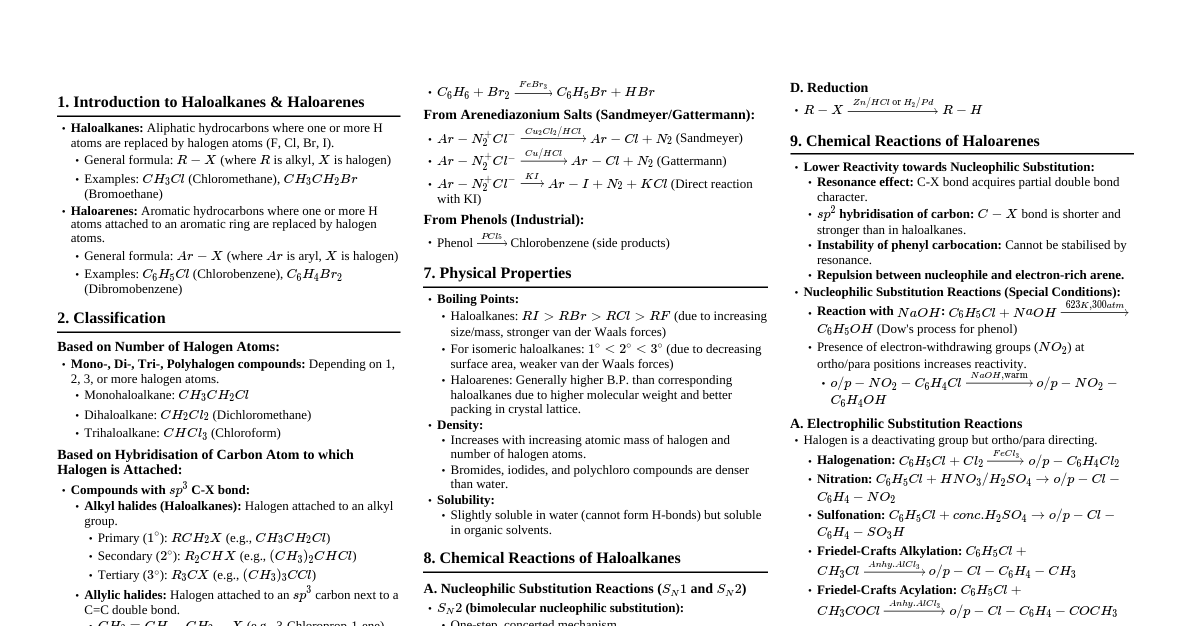
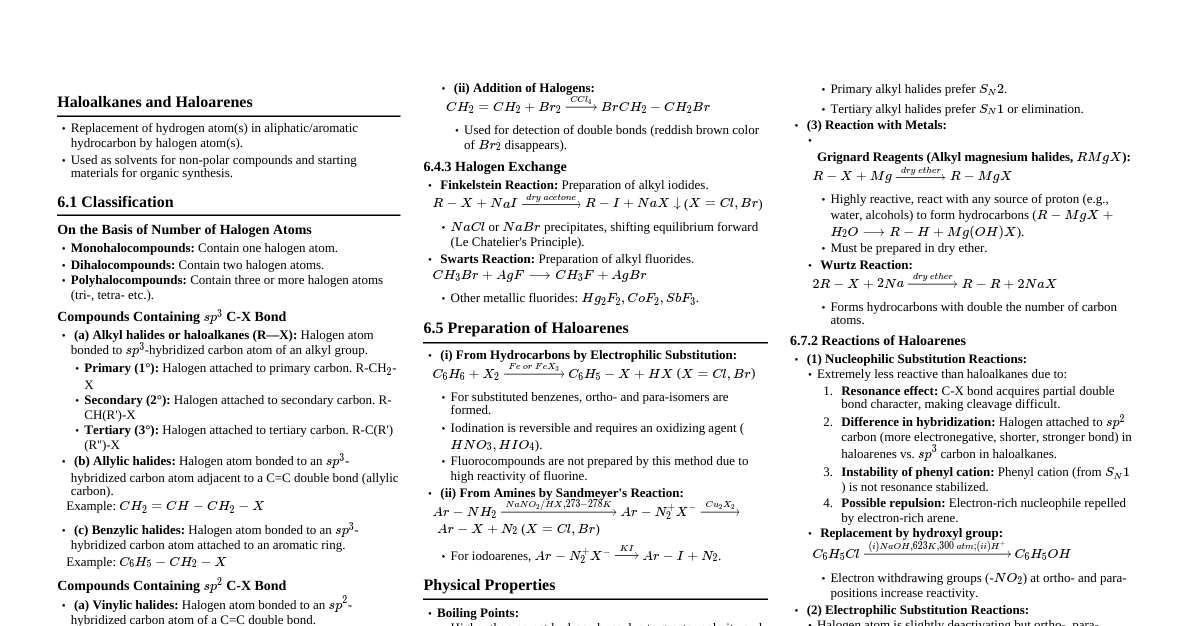
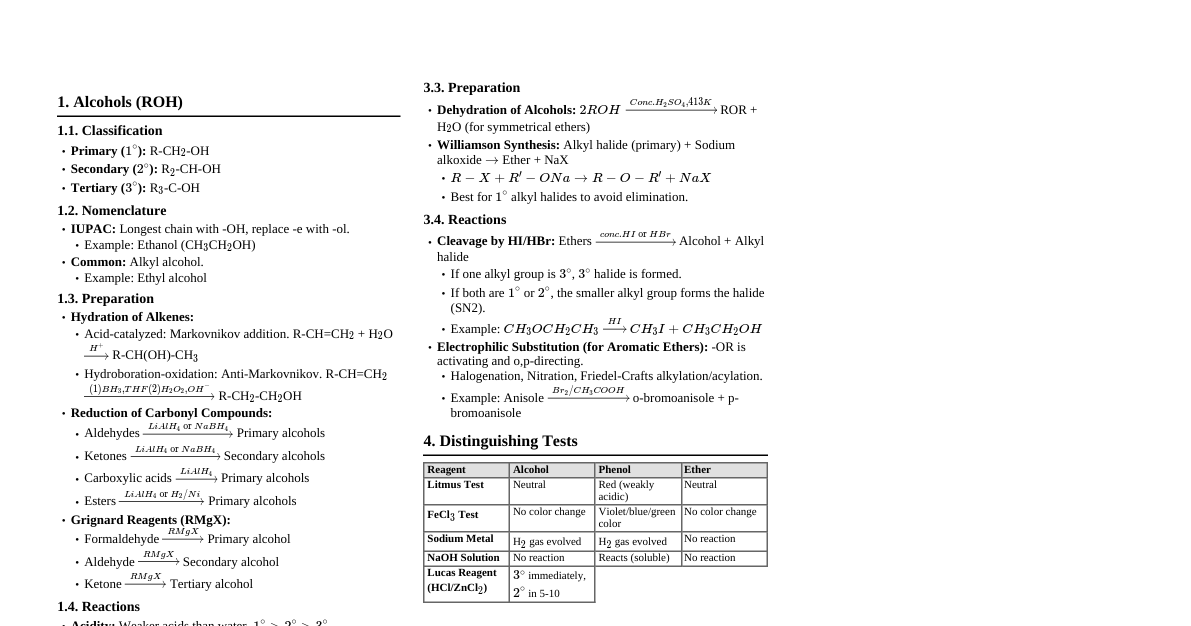
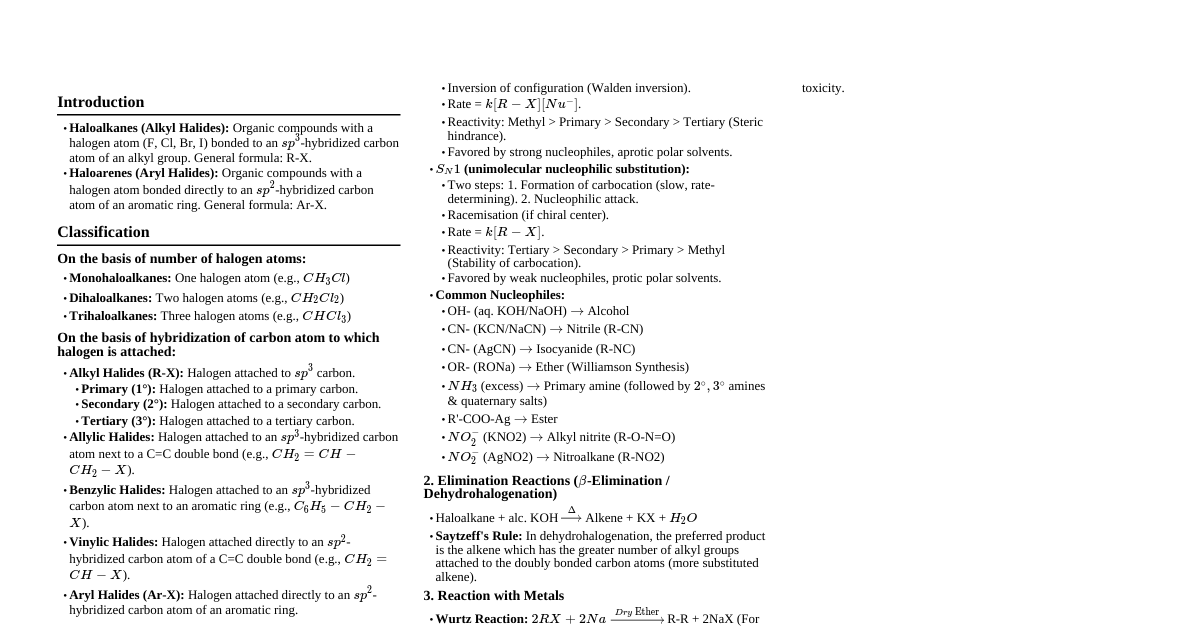
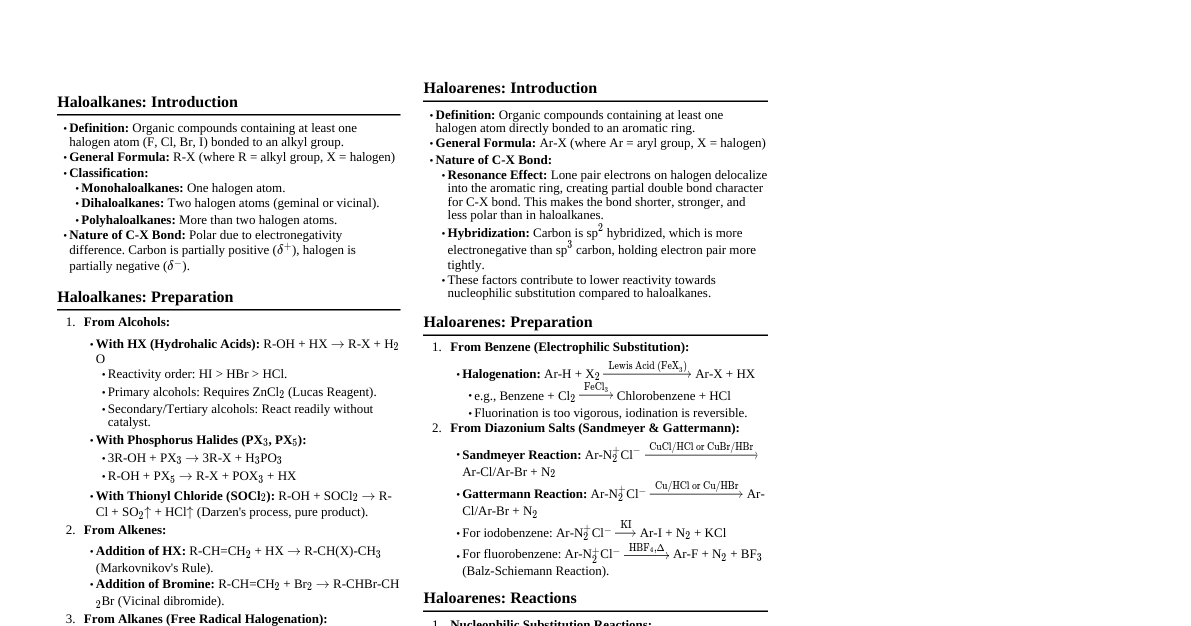
1. Introduction to Haloalkanes & Haloarenes Haloalkanes (Alkyl Halides): Organic compounds where a hydrogen atom of an alkane is replaced by a halogen atom ($X = F, Cl, Br, I$). General Formula: $C_nH_{2n+1}X$ Haloarenes (Aryl Halides): Organic compounds where a hydrogen atom directly attached to an aromatic ring is replaced by a halogen atom ($X = F, Cl, Br, I$). General Formula: $Ar-X$ 2. Classification 2.1. Based on Number of Halogen Atoms Mono-, Di-, Tri-, Polyhalogen compounds: Depending on 1, 2, 3, or more halogen atoms. 2.2. Based on Hybridisation of Carbon Atom to which Halogen is Attached Compounds containing $sp^3$ C-X Bond: Alkyl Halides (Haloalkanes): Halogen attached to an $sp^3$ hybridised carbon atom of an alkyl group. Primary ($1^\circ$): C bound to one other C. E.g., $CH_3CH_2Cl$ Secondary ($2^\circ$): C bound to two other C. E.g., $(CH_3)_2CHBr$ Tertiary ($3^\circ$): C bound to three other C. E.g., $(CH_3)_3CCl$ Allylic Halides: Halogen attached to an $sp^3$ hybridised carbon atom next to a C=C double bond. E.g., $CH_2=CH-CH_2-Br$ Benzylic Halides: Halogen attached to an $sp^3$ hybridised carbon atom next to an aromatic ring. E.g., $C_6H_5-CH_2-Cl$ Compounds containing $sp^2$ C-X Bond: Vinylic Halides: Halogen attached to an $sp^2$ hybridised carbon atom of a C=C double bond. E.g., $CH_2=CH-Cl$ Aryl Halides (Haloarenes): Halogen attached to an $sp^2$ hybridised carbon atom of an aromatic ring. E.g., $C_6H_5-Cl$ 3. Nomenclature Common Names: Alkyl halide (e.g., Ethyl chloride). IUPAC Names: Haloalkane (e.g., Chloroethane). Numbering starts from the end giving the lowest number to the halogen. For polyhalogen compounds, alphabetical order for halogens. 4. Nature of C-X Bond The C-X bond is polar due to the higher electronegativity of halogen ($X$) than carbon ($C$). $C^\delta+ - X^\delta-$ Bond length: $C-F Bond strength: $C-F > C-Cl > C-Br > C-I$ Dipole moment: $C-Cl > C-F > C-Br > C-I$ (due to size/electronegativity balance) 5. Preparation of Haloalkanes 5.1. From Alcohols Reaction with Hydrogen Halides ($HX$): $R-OH + HX \xrightarrow{ZnCl_2 \text{ (for HCl)}} R-X + H_2O$ Reactivity of $HX$: $HI > HBr > HCl$ Reactivity of alcohols: $3^\circ > 2^\circ > 1^\circ$ Lucas Test: Distinction between $1^\circ, 2^\circ, 3^\circ$ alcohols using concentrated $HCl + ZnCl_2$. Reaction with Phosphorus Halides: $R-OH + PCl_5 \rightarrow R-Cl + POCl_3 + HCl$ $3R-OH + PCl_3 \rightarrow 3R-Cl + H_3PO_3$ Reaction with Thionyl Chloride ($SOCl_2$): (Darzen's process) $R-OH + SOCl_2 \xrightarrow{Pyridine} R-Cl + SO_2 \uparrow + HCl \uparrow$ (Best method due to gaseous byproducts) 5.2. From Hydrocarbons Free Radical Halogenation (Alkanes): $CH_4 + Cl_2 \xrightarrow{UV \text{ light}} CH_3Cl + HCl$ Mixture of products, difficult to control. Electrophilic Addition (Alkenes): $CH_2=CH_2 + HBr \rightarrow CH_3CH_2Br$ (Markovnikov's Rule for unsymmetrical alkenes) $CH_3-CH=CH_2 + HBr \rightarrow CH_3-CH(Br)-CH_3$ (Major product) Peroxide effect (Anti-Markovnikov): $CH_3-CH=CH_2 + HBr \xrightarrow{\text{Peroxide}} CH_3-CH_2-CH_2-Br$ (Only with HBr) Addition of Halogens: $CH_2=CH_2 + Br_2 \xrightarrow{CCl_4} Br-CH_2-CH_2-Br$ (Vicinal dihalide, test for unsaturation) 5.3. Halogen Exchange Reactions Finkelstein Reaction: $R-X + NaI \xrightarrow{\text{Acetone}} R-I + NaX \downarrow$ ($X = Cl, Br$) Used for preparing iodoalkanes. Swarts Reaction: $R-X + AgF \rightarrow R-F + AgX \downarrow$ ($X = Cl, Br$) Used for preparing fluoroalkanes. Other metallic fluorides like $Hg_2F_2, CoF_2, SbF_3$ can also be used. 6. Preparation of Haloarenes Electrophilic Substitution: $C_6H_6 + Cl_2 \xrightarrow{FeCl_3 \text{ (Lewis acid)}} C_6H_5Cl + HCl$ $C_6H_6 + Br_2 \xrightarrow{FeBr_3} C_6H_5Br + HBr$ Fluorination and iodination are difficult to control. Sandmeyer Reaction: (From Diazonium Salts) $Ar-N_2^+Cl^- \xrightarrow{Cu_2Cl_2/HCl} Ar-Cl + N_2$ $Ar-N_2^+Cl^- \xrightarrow{Cu_2Br_2/HBr} Ar-Br + N_2$ Gattermann Reaction: Using Cu powder/HX for less yield. Balz-Schiemann Reaction: For Fluorobenzene $Ar-N_2^+Cl^- \xrightarrow{HBF_4} Ar-N_2^+BF_4^- \xrightarrow{\Delta} Ar-F + BF_3 + N_2$ 7. Physical Properties Boiling Points: Haloalkanes: $RI > RBr > RCl > RF$ (due to increasing size/mass, stronger van der Waals forces). Branching decreases boiling point. Haloarenes have higher boiling points than haloalkanes with same number of carbons due to greater polarity and size. Density: $RI > RBr > RCl$. Denser than water. Solubility: Slightly soluble in water (cannot form H-bonds with water molecules as strongly as water-water H-bonds) but soluble in organic solvents. 8. Chemical Reactions of Haloalkanes 8.1. Nucleophilic Substitution Reactions ($S_N1, S_N2$) Nucleophile: Electron-rich species, attacks electron-deficient carbon. $S_N2$ (bimolecular nucleophilic substitution): One step, concerted mechanism. Rate depends on concentration of both alkyl halide and nucleophile: Rate $= k[R-X][Nu^-]$ Inversion of configuration (Walden inversion). Favored by $1^\circ$ alkyl halides, strong nucleophiles, aprotic polar solvents. Steric hindrance hinders $S_N2$: $CH_3X > 1^\circ > 2^\circ > 3^\circ$ $S_N1$ (unimolecular nucleophilic substitution): Two steps: 1. Formation of carbocation (slow, rate-determining). 2. Nucleophilic attack. Rate depends only on concentration of alkyl halide: Rate $= k[R-X]$ Racemisation occurs (attack from both sides of planar carbocation). Favored by $3^\circ > 2^\circ > 1^\circ$ alkyl halides (due to carbocation stability), weak nucleophiles, protic polar solvents. Carbocation stability: $3^\circ > 2^\circ > 1^\circ > CH_3^+$ Reagent Product Reaction Type $KOH \text{ (aq)}$ Alcohols ($R-OH$) Hydrolysis $NaOR'$ Ethers ($R-O-R'$) Williamson Synthesis $KCN$ Alkyl Cyanides ($R-CN$) $AgCN$ Alkyl Isocyanides ($R-NC$) $KNO_2$ Alkyl Nitrites ($R-ONO$) $AgNO_2$ Nitroalkanes ($R-NO_2$) $R'-NH_2$ $R-NH-R'$ (Amine) Ammonolysis 8.2. Elimination Reactions (Dehydrohalogenation) Alkyl halides react with alcoholic $KOH$ to form alkenes. $CH_3-CH_2-Br \xrightarrow{\text{alc. } KOH} CH_2=CH_2 + HBr$ Saytzeff's Rule: In dehydrohalogenation, the preferred alkene is the one that has the greater number of alkyl groups attached to the doubly bonded carbon atoms (more substituted alkene is major product). E.g., 2-Bromobutane $\xrightarrow{\text{alc. } KOH}$ But-2-ene (major) + But-1-ene (minor) Substitution vs. Elimination: Favored by strong base/nucleophile, high temperature (elimination), $1^\circ$ (substitution), $3^\circ$ (elimination). 8.3. Reaction with Metals Wurtz Reaction: $2R-X + 2Na \xrightarrow{\text{dry ether}} R-R + 2NaX$ (Forms higher alkanes) Grignard Reagents: $R-X + Mg \xrightarrow{\text{dry ether}} R-Mg-X$ (Alkyl magnesium halide) Highly reactive, acts as a strong base and nucleophile. Reacts with compounds containing active hydrogen (e.g., water, alcohol, ammonia) to give alkanes: $R-Mg-X + H_2O \rightarrow R-H + Mg(OH)X$ Reaction with Lithium: $R-X + 2Li \xrightarrow{\text{dry ether}} R-Li + LiX$ (Alkyllithium) 8.4. Reduction $R-X \xrightarrow{Zn/HCl \text{ or } LiAlH_4 \text{ or } H_2/Pd} R-H$ (Alkanes) 9. Chemical Reactions of Haloarenes Lower reactivity towards Nucleophilic Substitution: Resonance stabilization of C-X bond (partial double bond character). $sp^2$ hybridised carbon of C-X bond is more electronegative, holds electron pair more tightly. Instability of phenyl carbocation. Repulsion between nucleophile and electron-rich $\pi$-system. Nucleophilic Substitution (under harsh conditions): Dow's Process: $C_6H_5Cl + NaOH \xrightarrow{623K, 300atm} C_6H_5OH + NaCl$ (Formation of phenol) Presence of electron-withdrawing groups ($–NO_2$) at ortho/para positions increases reactivity. $p-NO_2-C_6H_4-Cl + NaOH \xrightarrow{443K} p-NO_2-C_6H_4-OH$ $2,4,6-trinitrochlorobenzene + H_2O \xrightarrow{\text{warm}} 2,4,6-trinitrophenol$ (Picric Acid) Electrophilic Substitution Reactions: (Halogen is deactivating but o,p-directing) Halogenation: $C_6H_5Cl + Cl_2 \xrightarrow{FeCl_3} o/p-dichlorobenzene$ Nitration: $C_6H_5Cl + conc. HNO_3 \xrightarrow{conc. H_2SO_4} o/p-chloronitrobenzene$ Sulphonation: $C_6H_5Cl + conc. H_2SO_4 \xrightarrow{\Delta} o/p-chlorobenzenesulphonic \text{ acid}$ Friedel-Crafts Reactions: Alkylation: $C_6H_5Cl + CH_3Cl \xrightarrow{anhydrous \text{ } AlCl_3} o/p-chlorotoluene$ Acylation: $C_6H_5Cl + CH_3COCl \xrightarrow{anhydrous \text{ } AlCl_3} o/p-chloroacetophenone$ Reaction with Metals: Wurtz-Fittig Reaction: $Ar-X + R-X + 2Na \xrightarrow{\text{dry ether}} Ar-R + 2NaX$ Fittig Reaction: $2Ar-X + 2Na \xrightarrow{\text{dry ether}} Ar-Ar + 2NaX$ (Forms diphenyl) Grignard Reagent: $Ar-X + Mg \xrightarrow{\text{dry ether}} Ar-Mg-X$ 10. Polyhalogen Compounds Dichloromethane ($CH_2Cl_2$): Solvent, paint remover. Chloroform ($CHCl_3$): Solvent, anesthetic (now limited), stored in dark bottles to prevent oxidation by air to phosgene ($COCl_2$). Iodoform ($CHI_3$): Antiseptic (due to liberation of free iodine). Tetrachloromethane ($CCl_4$): Solvent, fire extinguisher (Pyrene), refrigerant (now phased out). DDT (Dichlorodiphenyltrichloroethane): Insecticide, now banned due to persistence and bioaccumulation. Preparation: $C_6H_5Cl + Cl_3CCHO \xrightarrow{conc. H_2SO_4} (Cl-C_6H_4)_2CHCCl_3$ Freons (Chlorofluorocarbons - CFCs): E.g., $CCl_2F_2$ (Freon-12). Refrigerants, aerosol propellants. Deplete ozone layer.