Alcohol, Ether, Phenol
Cheatsheet Content
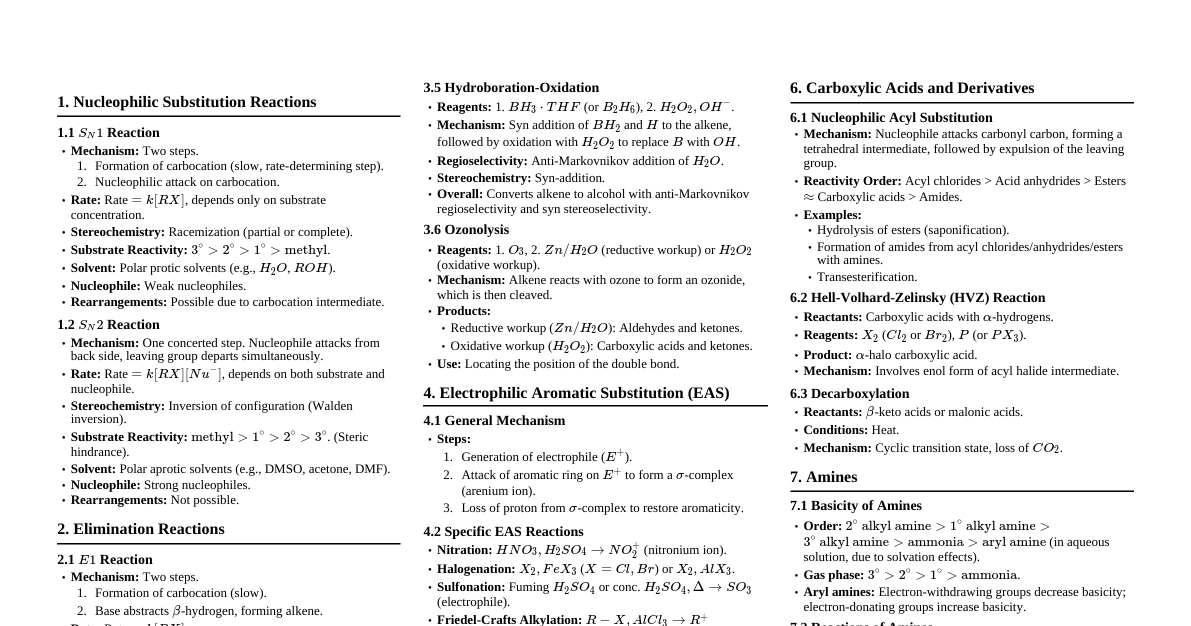
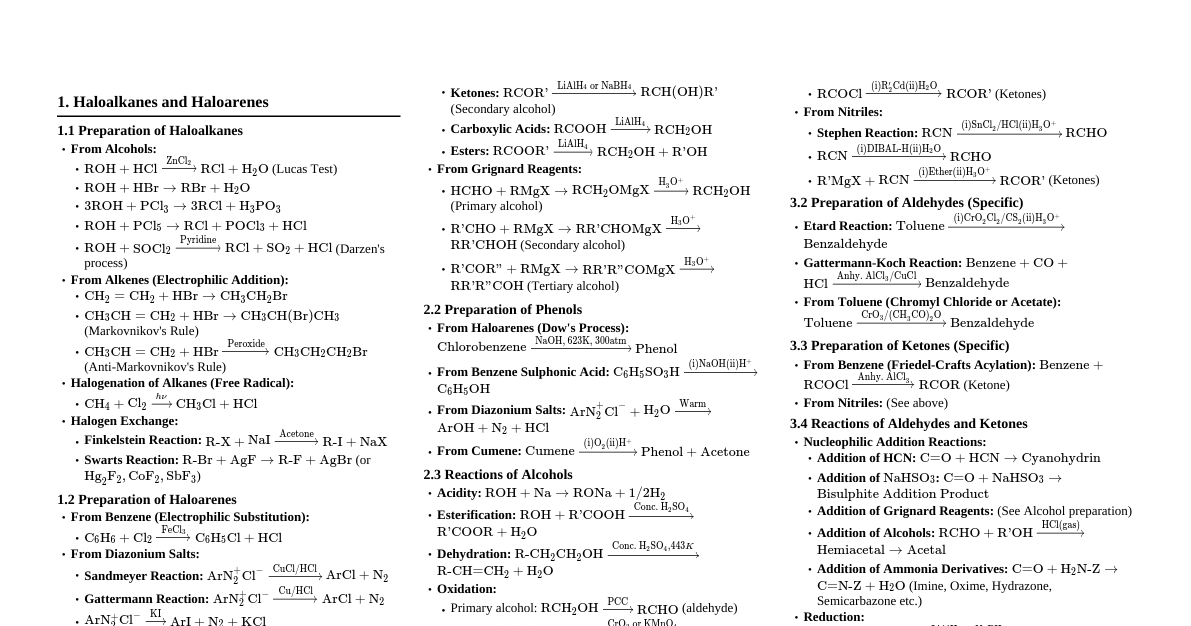
1. Alcohols (ROH) 1.1. Classification Primary ($1^\circ$): R-CH$_2$-OH Secondary ($2^\circ$): R$_2$-CH-OH Tertiary ($3^\circ$): R$_3$-C-OH 1.2. Nomenclature IUPAC: Longest chain with -OH, replace -e with -ol. Example: Ethanol (CH$_3$CH$_2$OH) Common: Alkyl alcohol. Example: Ethyl alcohol 1.3. Preparation Hydration of Alkenes: Acid-catalyzed: Markovnikov addition. R-CH=CH$_2$ + H$_2$O $\xrightarrow{H^+}$ R-CH(OH)-CH$_3$ Hydroboration-oxidation: Anti-Markovnikov. R-CH=CH$_2$ $\xrightarrow{(1) BH_3, THF (2) H_2O_2, OH^-}$ R-CH$_2$-CH$_2$OH Reduction of Carbonyl Compounds: Aldehydes $\xrightarrow{LiAlH_4 \text{ or } NaBH_4}$ Primary alcohols Ketones $\xrightarrow{LiAlH_4 \text{ or } NaBH_4}$ Secondary alcohols Carboxylic acids $\xrightarrow{LiAlH_4}$ Primary alcohols Esters $\xrightarrow{LiAlH_4 \text{ or } H_2/Ni}$ Primary alcohols Grignard Reagents (RMgX): Formaldehyde $\xrightarrow{RMgX}$ Primary alcohol Aldehyde $\xrightarrow{RMgX}$ Secondary alcohol Ketone $\xrightarrow{RMgX}$ Tertiary alcohol 1.4. Reactions Acidity: Weaker acids than water. $1^\circ > 2^\circ > 3^\circ$ Reaction with active metals: $2ROH + 2Na \rightarrow 2RONa + H_2$ Reaction with HX: Alcohols $\xrightarrow{HX}$ Alkyl halides (SN1 for $3^\circ$, SN2 for $1^\circ$) Dehydration: Alcohols $\xrightarrow{H_2SO_4, \Delta}$ Alkenes (Saytzeff's rule) Oxidation: $1^\circ$ alcohol $\xrightarrow{PCC}$ Aldehyde $\xrightarrow{Strong \text{ oxidant}}$ Carboxylic acid $2^\circ$ alcohol $\xrightarrow{CrO_3 \text{ or } KMnO_4}$ Ketone $3^\circ$ alcohol: No oxidation (under mild conditions) Esterification: $ROH + R'COOH \xrightarrow{H^+}$ $R'COOR + H_2O$ 2. Phenols (ArOH) 2.1. Structure Hydroxyl group directly attached to an aromatic ring. 2.2. Nomenclature Parent name: Phenol Substituted phenols: Ortho-, meta-, para- prefixes or numbering. Example: 2-Methylphenol (o-Cresol) 2.3. Preparation From Haloarenes: Chlorobenzene $\xrightarrow{NaOH, 623K, 300 atm}$ Sodium phenoxide $\xrightarrow{H^+}$ Phenol (Dow's process) From Benzenediazonium salts: ArN$_2^+$Cl$^-$ $\xrightarrow{H_2O, \Delta}$ ArOH + N$_2$ + HCl From Cumene (Isopropylbenzene): Cumene $\xrightarrow{(1) O_2 (2) H_3O^+}$ Phenol + Acetone 2.4. Reactions Acidity: More acidic than alcohols, less acidic than carboxylic acids. Electron-withdrawing groups (EWG) increase acidity. Electron-donating groups (EDG) decrease acidity. Reacts with NaOH, but not NaHCO$_3$. Electrophilic Aromatic Substitution: -OH is an activating and o,p-directing group. Nitration: Phenol $\xrightarrow{dil. HNO_3}$ o-nitrophenol + p-nitrophenol Bromination: Phenol $\xrightarrow{Br_2/H_2O}$ 2,4,6-Tribromophenol (white ppt) Kolbe's Reaction: Phenol $\xrightarrow{(1) NaOH (2) CO_2 (3) H^+}$ Salicylic acid Reimer-Tiemann Reaction: Phenol $\xrightarrow{(1) CHCl_3/NaOH (2) H^+}$ Salicylaldehyde Oxidation: Phenol $\xrightarrow{K_2Cr_2O_7/H^+}$ Benzoquinone Reaction with Zinc Dust: Phenol $\xrightarrow{Zn \text{ dust}}$ Benzene 3. Ethers (ROR') 3.1. Classification Symmetrical: R = R' (e.g., Diethyl ether) Unsymmetrical: R $\neq$ R' (e.g., Ethyl methyl ether) 3.2. Nomenclature IUPAC: Alkoxyalkane. Example: Methoxyethane (CH$_3$OCH$_2$CH$_3$) Common: Alkyl alkyl ether. Example: Ethyl methyl ether 3.3. Preparation Dehydration of Alcohols: $2ROH \xrightarrow{Conc. H_2SO_4, 413K}$ ROR + H$_2$O (for symmetrical ethers) Williamson Synthesis: Alkyl halide (primary) + Sodium alkoxide $\rightarrow$ Ether + NaX $R-X + R'-ONa \rightarrow R-O-R' + NaX$ Best for $1^\circ$ alkyl halides to avoid elimination. 3.4. Reactions Cleavage by HI/HBr: Ethers $\xrightarrow{conc. HI \text{ or } HBr}$ Alcohol + Alkyl halide If one alkyl group is $3^\circ$, $3^\circ$ halide is formed. If both are $1^\circ$ or $2^\circ$, the smaller alkyl group forms the halide (SN2). Example: $CH_3OCH_2CH_3 \xrightarrow{HI}$ $CH_3I + CH_3CH_2OH$ Electrophilic Substitution (for Aromatic Ethers): -OR is activating and o,p-directing. Halogenation, Nitration, Friedel-Crafts alkylation/acylation. Example: Anisole $\xrightarrow{Br_2/CH_3COOH}$ o-bromoanisole + p-bromoanisole 4. Distinguishing Tests Reagent Alcohol Phenol Ether Litmus Test Neutral Red (weakly acidic) Neutral FeCl$_3$ Test No color change Violet/blue/green color No color change Sodium Metal H$_2$ gas evolved H$_2$ gas evolved No reaction NaOH Solution No reaction Reacts (soluble) No reaction Lucas Reagent (HCl/ZnCl$_2$) $3^\circ$ immediately, $2^\circ$ in 5-10 min, $1^\circ$ no reaction (turbidity) No reaction No reaction