Animal Kingdom Classification
Cheatsheet Content
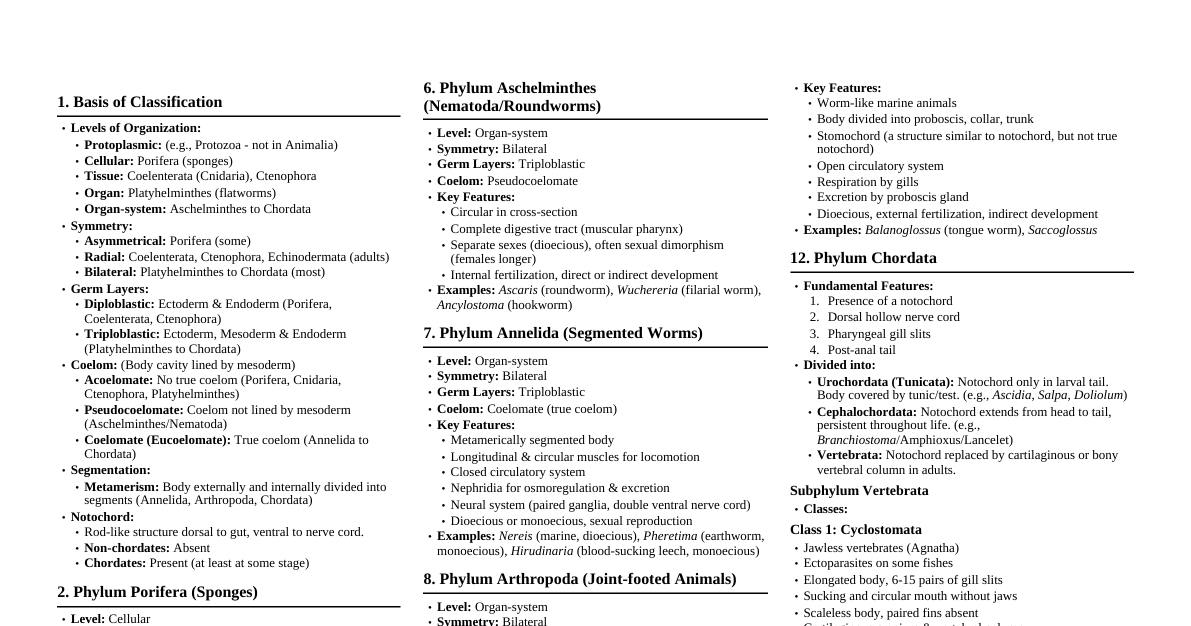
Basis of Classification (NCERT) 1. Levels of Organization Cellular Level: Cells arranged as loose cell aggregates; division of labour rudimentary. Ex: Porifera. Tissue Level: Cells performing the same function are arranged into tissues. Ex: Coelenterata, Ctenophora. Organ Level: Tissues grouped together to form organs, each specialized for a particular function. Ex: Platyhelminthes. Organ-System Level: Organs associate to form functional systems, each system concerned with a specific physiological function. Ex: Aschelminthes to Chordata. Complete Digestive System: Has two openings, mouth and anus. Incomplete Digestive System: Has a single opening serving as both mouth and anus. Ex: Coelenterata, Platyhelminthes. 2. Symmetry Asymmetrical: No plane passing through the center divides the organism into identical halves. Ex: Most Porifera. Radial Symmetry: Any plane passing through the central axis divides the organism into two identical halves. Ex: Coelenterata, Ctenophora, Echinodermata (adults). Bilateral Symmetry: Only one plane divides the organism into two identical left and right halves. Ex: Platyhelminthes to Chordata. 3. Germ Layers Diploblastic: Animals in which the cells are arranged in two embryonic layers, an external ectoderm and an internal endoderm, with an undifferentiated mesoglea in between. Ex: Coelenterata, Ctenophora. Triploblastic: Animals in which the developing embryo has a third germinal layer, mesoderm, between the ectoderm and endoderm. Ex: Platyhelminthes to Chordata. 4. Coelom (Body Cavity) The body cavity, which is lined by mesoderm, is called coelom. Acoelomates: Animals in which the body cavity is absent. Ex: Platyhelminthes. Pseudocoelomates: The body cavity is not lined by mesoderm, instead, the mesoderm is present as scattered pouches between the ectoderm and endoderm. Ex: Aschelminthes. Coelomates: Animals possessing coelom. Ex: Annelida, Mollusca, Arthropoda, Echinodermata, Hemichordata, Chordata. 5. Segmentation (Metamerism) In some animals, the body is externally and internally divided into segments with a serial repetition of at least some organs. This phenomenon is called metamerism. Example: Earthworm (Annelida), Arthropoda, Chordata. 6. Notochord The notochord is a mesodermally derived rod-like structure formed on the dorsal side during embryonic development in some animals (Chordates). Chordates: Animals with a notochord. Non-chordates: Animals without a notochord (Porifera to Echinodermata). Phylum-wise Characteristics (NCERT Key Points) Phylum Porifera (Sponges) Cellular level of organization, mostly asymmetrical, aquatic (mostly marine), sessile. Unique water canal system (water enters via ostia $\to$ spongocoel $\to$ out through osculum) for food gathering, respiratory exchange, and waste removal. Choanocytes (collar cells) line the spongocoel and canals. Digestion is intracellular. Skeleton made of spicules or spongin fibres. Hermaphrodite. Reproduction asexual (fragmentation) and sexual. Fertilisation internal, development indirect (larval stage distinct). Ex: Sycon (Scypha), Spongilla (Freshwater sponge), Euspongia (Bath sponge). Phylum Coelenterata (Cnidaria) Tissue level, radial symmetry, diploblastic. Aquatic, mostly marine, sessile or free-swimming. Presence of cnidoblasts/cnidocytes (stinging capsules called nematocysts) on tentacles and body for anchorage, defense, and prey capture. Gastro-vascular cavity with a single opening (mouth) on hypostome. Digestion extracellular and intracellular. Exhibit two basic body forms: Polyp (sessile, cylindrical) and Medusa (free-swimming, umbrella-shaped). Some show Metagenesis (alternation of generation), where polyps produce medusae asexually, and medusae form polyps sexually (Ex: Obelia ). Ex: Hydra , Jellyfish ( Aurelia ), Corals, Sea Anemone ( Adamsia ). Phylum Ctenophora (Comb Jellies) Tissue level, radial symmetry, diploblastic. Exclusively marine. Body bears eight external rows of ciliated comb plates, which help in locomotion. Bioluminescence (the property of a living organism to emit light) is well-marked. Reproduction is exclusively sexual. Hermaphrodite. External fertilisation. Indirect development. Ex: Pleurobrachia , Ctenoplana . Phylum Platyhelminthes (Flatworms) Organ level, bilateral, triploblastic, acoelomate. Dorso-ventrally flattened body. Parasitic forms (e.g., tapeworms, flukes) possess hooks & suckers. Some absorb nutrients directly through their body surface. Flame cells (protonephridia) are specialized excretory cells for osmoregulation and excretion. They have an incomplete digestive system or no digestive system (in parasitic forms). Hermaphrodite. Internal fertilisation, indirect development with many larval stages. High regeneration capacity ( Planaria ). Ex: Taenia solium (Tapeworm), Fasciola hepatica (Liver Fluke). Phylum Aschelminthes (Roundworms) Organ-system level, bilateral, triploblastic, pseudocoelomate. Body is circular in cross-section. Complete alimentary canal with a well-developed muscular pharynx. An excretory tube removes body wastes through an excretory pore. Dioecious (separate sexes). Females are often longer than males. Internal fertilisation. Development may be direct or indirect. Often parasitic in plants and animals; body wall has a thick cuticle. Ex: Ascaris (Roundworm), Wuchereria (Filaria worm), Ancylostoma (Hookworm). Phylum Annelida (Segmented Worms) Organ-system level, bilateral, triploblastic, coelomate. Aquatic or terrestrial, free-living or parasitic. Body is metamerically segmented (externally and internally into metameres). Locomotion by longitudinal & circular muscles. Aquatic annelids (e.g., Nereis ) possess lateral appendages called parapodia for swimming. Closed circulatory system. Nephridia for osmoregulation & excretion. Neural system includes paired ganglia and a double ventral nerve cord. Dioecious ( Nereis ) or Monoecious (Earthworm, Leech). Ex: Pheretima (Earthworm), Hirudinaria (Blood-sucking Leech). Phylum Arthropoda Largest phylum. Organ-system level, bilateral, triploblastic, coelomate. Chitinous exoskeleton. Jointed appendages. Body divided into Head, Thorax, and Abdomen (or Cephalothorax). Respiration via gills, book gills, book lungs, or tracheal system. Open circulatory system. Excretion by Malpighian tubules. Advanced sensory organs: antennae, eyes (compound and simple), statocysts (balance organs). Dioecious. Economically important (honey bee, silkworm), vectors (mosquitoes), gregarious pests (locust), living fossil (King crab). Ex: Prawn, Spider, Scorpion, Crab. Phylum Mollusca Second largest phylum. Organ-system level, bilateral, triploblastic, coelomate. Terrestrial or aquatic. Body divided into a distinct head (sensory tentacles), muscular foot (locomotion), and a visceral hump (internal organs). A soft and spongy layer of skin forms a mantle over the visceral hump, often secreting a calcareous shell (external, internal, or absent). Radula (file-like rasping organ) for feeding. Feather-like gills (ctenidia) in mantle cavity for respiration & excretion. Dioecious. Oviparous. Indirect development (veliger larva). Ex: Snail ( Pila ), Octopus, Cuttlefish ( Sepia ), Pearl oyster ( Pinctada ). Phylum Echinodermata Exclusively marine. Organ-system level, radial (adults) / bilateral (larvae), triploblastic, coelomate. Endoskeleton of calcareous ossicles, hence spiny-skinned. Unique water vascular system (ambulacral system) for locomotion, food capture, adhesion, and respiration. Complete digestive system (mouth on ventral, anus on dorsal side). Excretory system absent. Remarkable power of regeneration. Dioecious, external fertilization, indirect development with free-swimming larva. Ex: Starfish ( Asterias ), Sea urchin ( Echinus ), Sea cucumber ( Cucumaria ). Phylum Hemichordata Exclusively marine. Organ-system level, bilateral, triploblastic, coelomate. Cylindrical body divided into an anterior proboscis, a collar, and a long trunk. Possess a stomochord, a small, hollow projection from the buccal cavity. Open circulatory system. Gills for respiration. Proboscis gland for excretion. Dioecious, external fertilization, indirect development. Ex: Balanoglossus (Tongue worm), Saccoglossus . Phylum Chordata Fundamental distinguishing features: Presence of a notochord. A dorsal hollow nerve cord. Paired pharyngeal gill slits. A post anal tail. Closed circulatory system. Subphyla: Urochordata (Tunicata): Notochord present only in larval tail. Body covered by a tunic or test. Ex: Ascidia , Salpa , Doliolum . Cephalochordata: Notochord extends from head to tail region and is persistent throughout life. Ex: Branchiostoma (Amphioxus or Lancelet). Vertebrata: Notochord present during embryonic period, replaced by cartilaginous or bony vertebral column in adult. Possess a ventral muscular heart (2, 3, or 4-chambered), kidneys for excretion and osmoregulation, and paired appendages (fins or limbs). Classes of Vertebrata: Cyclostomata (Jawless): All are ectoparasites on some fishes. Elongated body, 6-15 pairs of gill slits. Sucking and circular mouth without jaws. Body devoid of scales and paired fins. Cartilaginous cranium and vertebral column. Marine but migrate to freshwater for spawning, die after. Ex: Petromyzon (Lamprey), Myxine (Hagfish). Chondrichthyes (Cartilaginous Fish): Marine, streamlined body, cartilaginous endoskeleton. Notochord persistent. Mouth ventral. Gill slits separate, without operculum. Placoid scales. Predaceous. Lack air bladder, so they must swim constantly. Poikilothermous. Internal fertilization, many viviparous. Ex: Sharks ( Scoliodon ), Rays ( Pristis , Trygon - electric organs in Torpedo ). Osteichthyes (Bony Fish): Marine/freshwater, bony endoskeleton, streamlined body. Mouth terminal. Four pairs of gills covered by an operculum. Cycloid/ctenoid scales. Air bladder for buoyancy. Poikilothermous. External fertilization, oviparous. Ex: Rohu, Seahorse, Flying Fish ( Exocoetus ), Angelfish. Amphibia: Dual habitat (aquatic & terrestrial). Moist skin (no scales). Tympanum represents the ear. Alimentary, urinary, reproductive tracts open into cloaca. Respiration by gills, lungs, skin. 3-chambered heart. Poikilothermous. External fertilization, oviparous, indirect development. Ex: Frog, Toad, Salamander, Limbless amphibia ( Ichthyophis ). Reptilia: Creeping/crawling locomotion. Mostly terrestrial. Dry, cornified skin with epidermal scales/scutes. Tympanum represents ear. Two pairs of limbs (if present). Heart usually 3-chambered (4 in crocodiles). Poikilothermous. Internal fertilization, oviparous. Ex: Lizard, Snake (cobra, viper), Crocodile, Turtle. Aves (Birds): Presence of feathers, most can fly (forelimbs modified to wings). Hind limbs adapted for walking/swimming/clasping. Dry skin (except oil gland). Pneumatic bones. Crop and gizzard in digestive tract. 4-chambered heart. Homoiothermous. Respiration by lungs with air sacs. Oviparous. Ex: Crow, Pigeon, Ostrich, Penguin, Vulture. Mammalia: Presence of mammary glands, hair, external ears (pinnae). Two pairs of limbs. Jaws with heterodont dentition. 4-chambered heart. Homoiothermous. Viviparous (except platypus, Ornithorhynchus ). Ex: Human, Whale, Bat, Kangaroo.