Haloalkanes & Haloarenes
Shared 5/9/2026•0 views
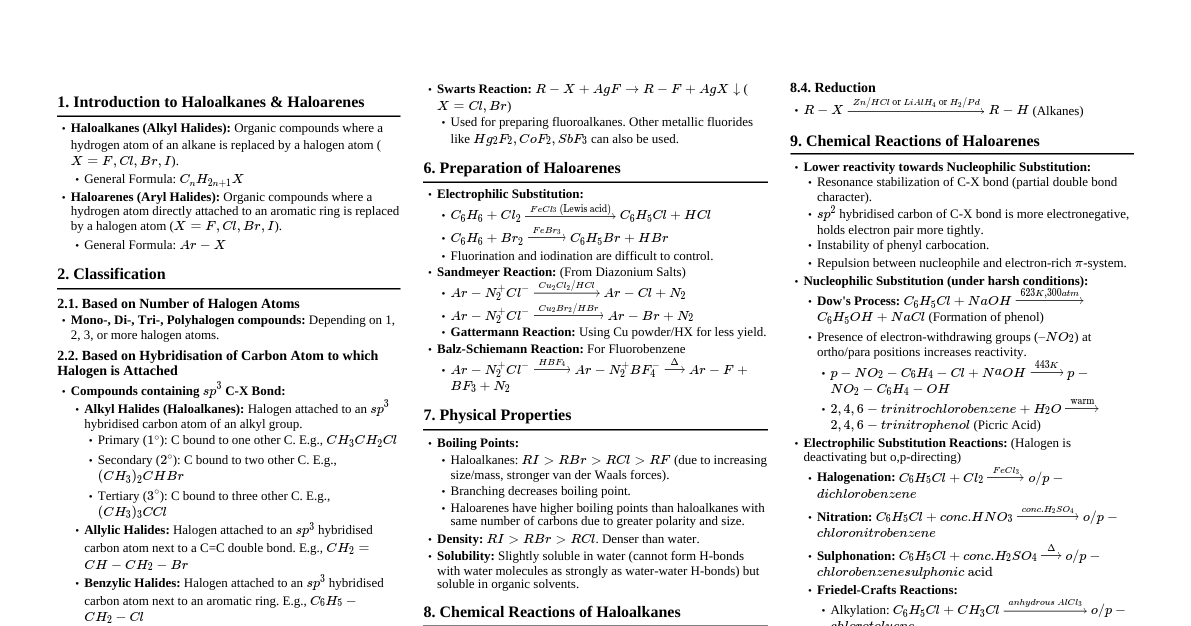
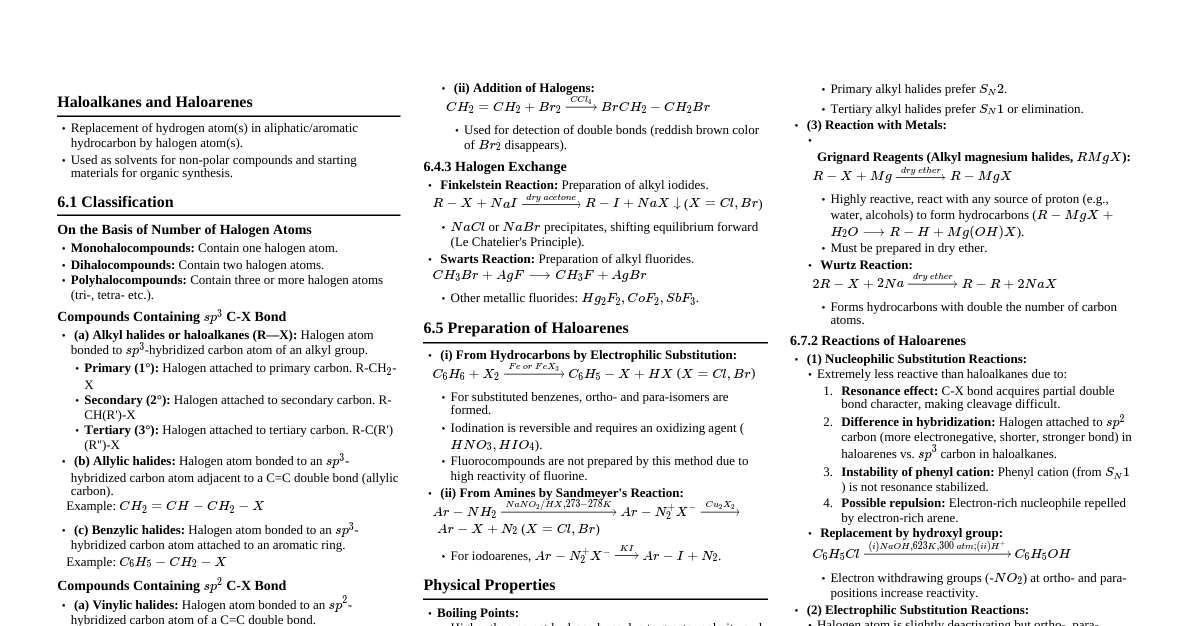
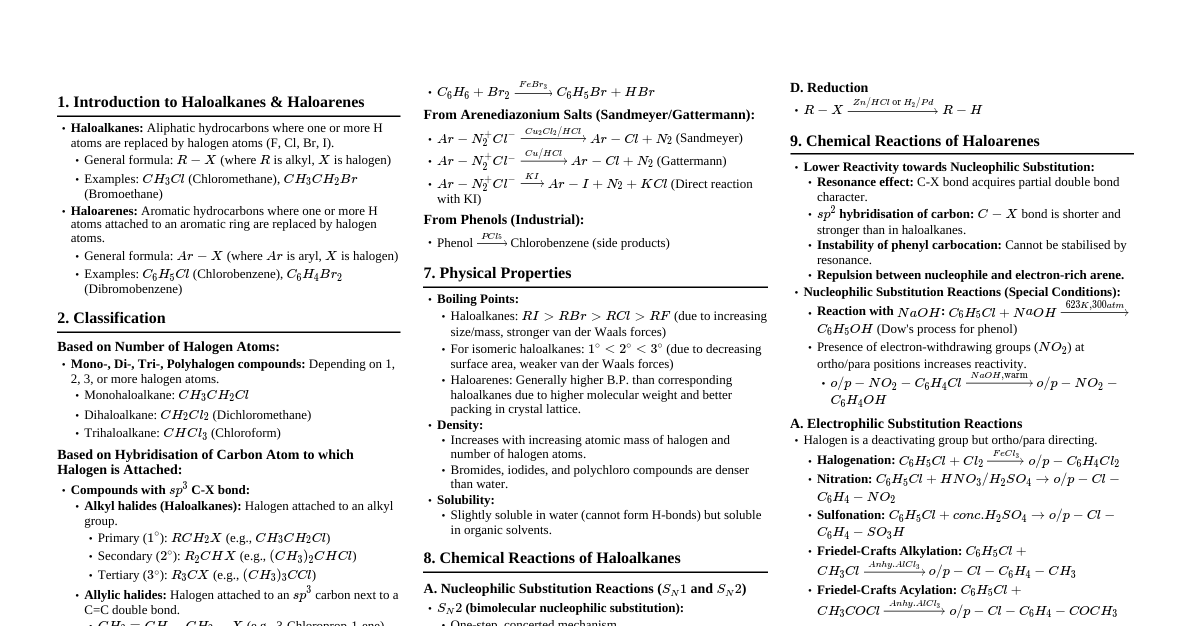
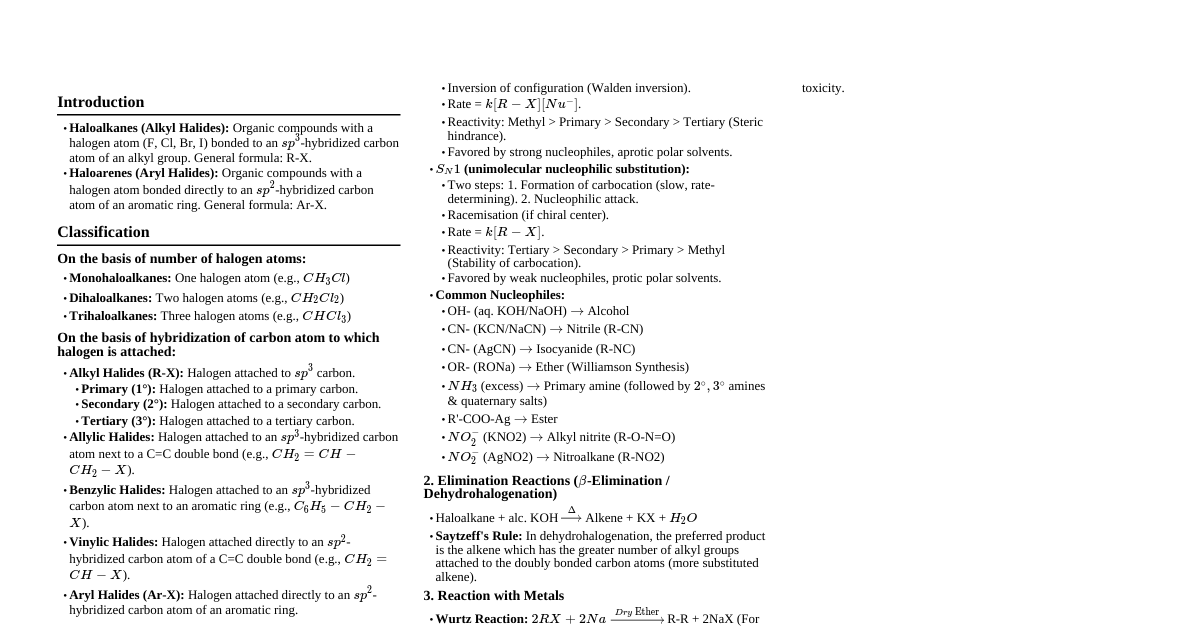
### Haloalkanes: Introduction - **Definition:** Organic compounds containing at least one halogen atom (F, Cl, Br, I) bonded to an alkyl group. - **General Formula:** R-X (where R = alkyl group, X = halogen) - **Classification:** - **Monohaloalkanes:** One halogen atom. - **Dihaloalkanes:** Two halogen atoms (geminal or vicinal). - **Polyhaloalkanes:** More than two halogen atoms. - **Nature of C-X Bond:** Polar due to electronegativity difference. Carbon is partially positive ($\delta^+$), halogen is partially negative ($\delta^-$). ### Haloalkanes: Preparation 1. **From Alcohols:** - **With HX (Hydrohalic Acids):** R-OH + HX $\rightarrow$ R-X + H$_2$O - Reactivity order: HI > HBr > HCl. - Primary alcohols: Requires ZnCl$_2$ (Lucas Reagent). - Secondary/Tertiary alcohols: React readily without catalyst. - **With Phosphorus Halides (PX$_3$, PX$_5$):** - 3R-OH + PX$_3$ $\rightarrow$ 3R-X + H$_3$PO$_3$ - R-OH + PX$_5$ $\rightarrow$ R-X + POX$_3$ + HX - **With Thionyl Chloride (SOCl$_2$):** R-OH + SOCl$_2$ $\rightarrow$ R-Cl + SO$_2$$\uparrow$ + HCl$\uparrow$ (Darzen's process, pure product). 2. **From Alkenes:** - **Addition of HX:** R-CH=CH$_2$ + HX $\rightarrow$ R-CH(X)-CH$_3$ (Markovnikov's Rule). - **Addition of Bromine:** R-CH=CH$_2$ + Br$_2$ $\rightarrow$ R-CHBr-CH$_2$Br (Vicinal dibromide). 3. **From Alkanes (Free Radical Halogenation):** - R-H + X$_2$ $\xrightarrow{\text{UV light/heat}}$ R-X + HX - Poor method for preparation due to multiple products and low yield. 4. **Halogen Exchange (Finkelstein & Swarts):** - **Finkelstein Reaction:** R-X + NaI $\xrightarrow{\text{Acetone}}$ R-I + NaX (X = Cl, Br; for iodoalkanes). - **Swarts Reaction:** R-Br + AgF $\rightarrow$ R-F + AgBr (for fluoroalkanes). - Other reagents: Hg$_2$F$_2$, CoF$_2$, SbF$_3$. ### Haloalkanes: Reactions 1. **Nucleophilic Substitution Reactions (S$_N$1 and S$_N$2):** - **S$_N$2 (Bimolecular):** - One-step, concerted mechanism. - Rate = k[R-X][Nu$^-$]. - Inversion of configuration (Walden Inversion). - Reactivity order: Primary > Secondary > Tertiary. - Favored by strong nucleophiles, aprotic solvents. - **S$_N$1 (Unimolecular):** - Two-step mechanism (carbocation intermediate). - Rate = k[R-X]. - Racemization (loss of stereochemistry). - Reactivity order: Tertiary > Secondary > Primary. - Favored by weak nucleophiles, protic solvents. - **Examples of Nucleophiles:** - OH$^-$ (Aq. KOH): R-X + KOH(aq) $\rightarrow$ R-OH + KX (Alcohol formation) - RO$^-$ (Sodium alkoxide): R-X + NaOR' $\rightarrow$ R-O-R' + NaX (Ether, Williamson Synthesis) - CN$^-$ (KCN/NaCN): R-X + KCN $\rightarrow$ R-CN + KX (Alkyl Cyanide) - AgCN: R-X + AgCN $\rightarrow$ R-NC + AgX (Alkyl Isocyanide) - NO$_2^-$ (KNO$_2$): R-X + KNO$_2$ $\rightarrow$ R-ONO + KX (Alkyl Nitrite) - AgNO$_2$: R-X + AgNO$_2$ $\rightarrow$ R-NO$_2$ + AgX (Nitroalkane) - NH$_3$: R-X + NH$_3$ $\rightarrow$ R-NH$_2$ + HX (Amine, Hoffmann Ammonolysis) 2. **Elimination Reactions (E1 and E2):** - **Dehydrohalogenation:** Removal of HX. - **Reagents:** Alcoholic KOH (strong base). - **Saytzeff's Rule:** In dehydrohalogenation, the preferred product is the alkene that has the greater number of alkyl groups attached to the doubly bonded carbon atoms. - **E2 (Bimolecular):** Concerted, favored by strong bases. - **E1 (Unimolecular):** Carbocation intermediate, favored by weak bases. 3. **Reaction with Metals:** - **Wurtz Reaction:** 2R-X + 2Na $\xrightarrow{\text{Dry Ether}}$ R-R + 2NaX (Alkane formation). - **Grignard Reagent:** R-X + Mg $\xrightarrow{\text{Dry Ether}}$ R-MgX (Alkyl Magnesium Halide). - Highly reactive, used in synthesis of various organic compounds. 4. **Reduction:** - R-X $\xrightarrow{\text{LiAlH}_4 \text{ or Zn/HCl}}$ R-H (Alkane formation). ### Haloarenes: Introduction - **Definition:** Organic compounds containing at least one halogen atom directly bonded to an aromatic ring. - **General Formula:** Ar-X (where Ar = aryl group, X = halogen) - **Nature of C-X Bond:** - **Resonance Effect:** Lone pair electrons on halogen delocalize into the aromatic ring, creating partial double bond character for C-X bond. This makes the bond shorter, stronger, and less polar than in haloalkanes. - **Hybridization:** Carbon is sp$^2$ hybridized, which is more electronegative than sp$^3$ carbon, holding electron pair more tightly. - These factors contribute to lower reactivity towards nucleophilic substitution compared to haloalkanes. ### Haloarenes: Preparation 1. **From Benzene (Electrophilic Substitution):** - **Halogenation:** Ar-H + X$_2$ $\xrightarrow{\text{Lewis Acid (FeX}_3)}$ Ar-X + HX - e.g., Benzene + Cl$_2$ $\xrightarrow{\text{FeCl}_3}$ Chlorobenzene + HCl - Fluorination is too vigorous, iodination is reversible. 2. **From Diazonium Salts (Sandmeyer & Gattermann):** - **Sandmeyer Reaction:** Ar-N$_2^+$Cl$^-$ $\xrightarrow{\text{CuCl/HCl or CuBr/HBr}}$ Ar-Cl/Ar-Br + N$_2$ - **Gattermann Reaction:** Ar-N$_2^+$Cl$^-$ $\xrightarrow{\text{Cu/HCl or Cu/HBr}}$ Ar-Cl/Ar-Br + N$_2$ - For iodobenzene: Ar-N$_2^+$Cl$^-$ $\xrightarrow{\text{KI}}$ Ar-I + N$_2$ + KCl - For fluorobenzene: Ar-N$_2^+$Cl$^-$ $\xrightarrow{\text{HBF}_4, \Delta}$ Ar-F + N$_2$ + BF$_3$ (Balz-Schiemann Reaction). ### Haloarenes: Reactions 1. **Nucleophilic Substitution Reactions:** - Generally unreactive due to: - Resonance stabilization of C-X bond. - sp$^2$ hybridized carbon of C-X bond. - Repulsion between nucleophile and electron-rich $\pi$-cloud. - **Drastic Conditions Required:** - **Dow's Process:** Chlorobenzene $\xrightarrow{\text{NaOH, 623K, 300 atm}}$ Sodium Phenoxide $\xrightarrow{\text{H}^+}$ Phenol. - **Presence of Electron-Withdrawing Groups (EWG) at ortho/para positions:** - Increases reactivity towards S$_N$Ar. - e.g., p-Nitrochlorobenzene $\xrightarrow{\text{NaOH, 443K}}$ p-Nitrophenol. - 2,4,6-Trinitrochlorobenzene (Picryl Chloride) $\xrightarrow{\text{H}_2\text{O, warm}}$ Picric Acid (very reactive). 2. **Electrophilic Substitution Reactions:** - Halogen is a deactivating group but *o,p*-directing. - **Halogenation:** Ar-X + Cl$_2$ $\xrightarrow{\text{FeCl}_3}$ *o*/ *p*-Dichlorobenzene - **Nitration:** Ar-X + conc. HNO$_3$/conc. H$_2$SO$_4$ $\rightarrow$ *o*/ *p*-Nitrohaloarene - **Sulfonation:** Ar-X + conc. H$_2$SO$_4$ $\rightarrow$ *o*/ *p*-Halobenzenesulfonic acid - **Friedel-Crafts Alkylation:** Ar-X + R-Cl $\xrightarrow{\text{Anhy. AlCl}_3}$ *o*/ *p*-Alkylhaloarene - **Friedel-Crafts Acylation:** Ar-X + R-COCl $\xrightarrow{\text{Anhy. AlCl}_3}$ *o*/ *p*-Acylhaloarene 3. **Reaction with Metals:** - **Wurtz-Fittig Reaction:** Ar-X + R-X + 2Na $\xrightarrow{\text{Dry Ether}}$ Ar-R + 2NaX - **Fittig Reaction:** 2Ar-X + 2Na $\xrightarrow{\text{Dry Ether}}$ Ar-Ar + 2NaX (Biphenyl formation) - **Grignard Reagent:** Ar-X + Mg $\xrightarrow{\text{Dry Ether}}$ Ar-MgX (Aryl Magnesium Halide) ### Polyhalogen Compounds - **Dichloromethane (CH$_2$Cl$_2$):** Solvent, paint remover. - **Chloroform (CHCl$_3$):** Solvent, anesthetic (now obsolete), precursor for freon. - **Iodoform (CHI$_3$):** Antiseptic (due to I$_2$ liberation). - **Carbon Tetrachloride (CCl$_4$):** Solvent, fire extinguisher (now restricted due to ozone depletion). - **Freons (Chlorofluorocarbons, CFCs):** Refrigerants, propellants. Responsible for ozone depletion. - **DDT (Dichlorodiphenyltrichloroethane):** Insecticide. Persistent organic pollutant, banned in many countries.