Haloalkanes & Haloarenes
Cheatsheet Content
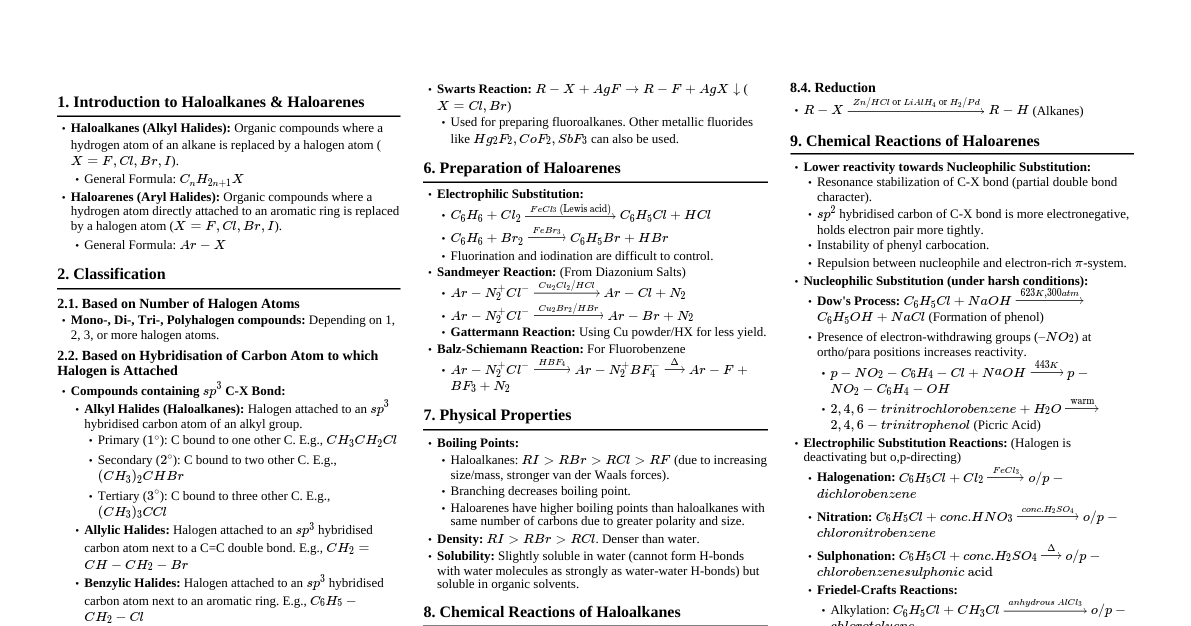
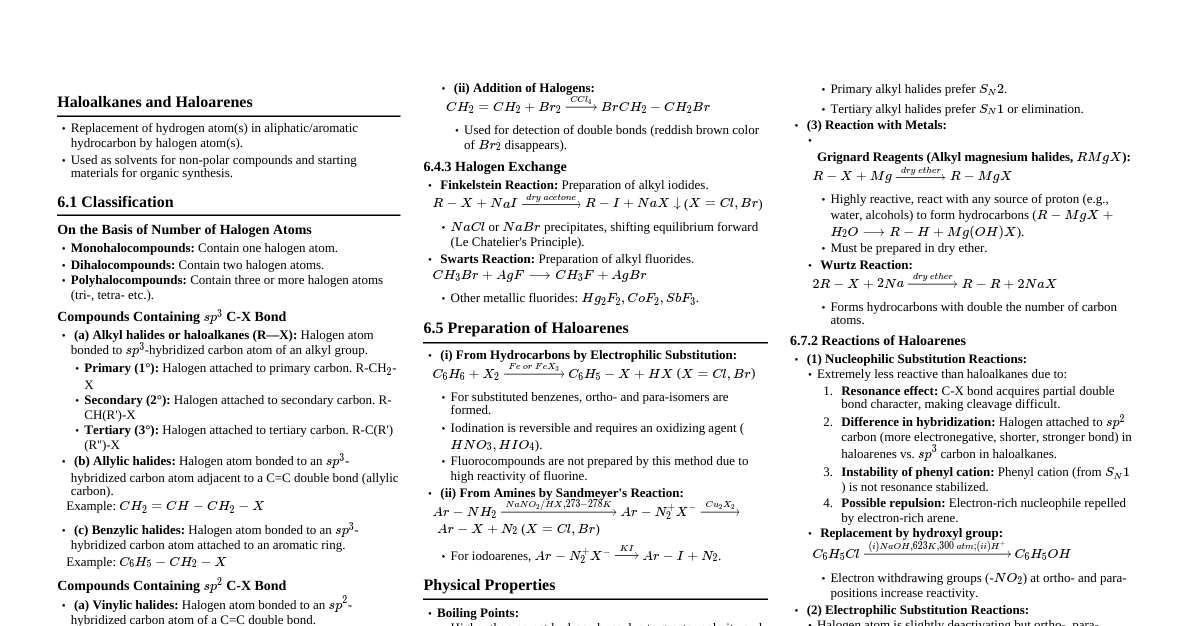
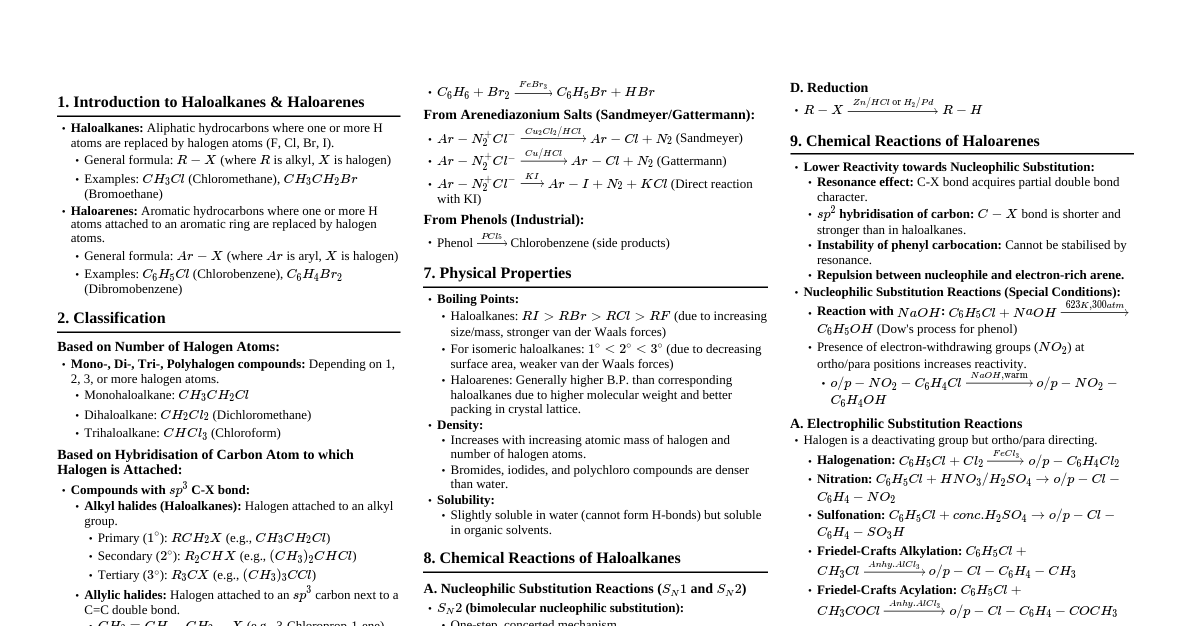
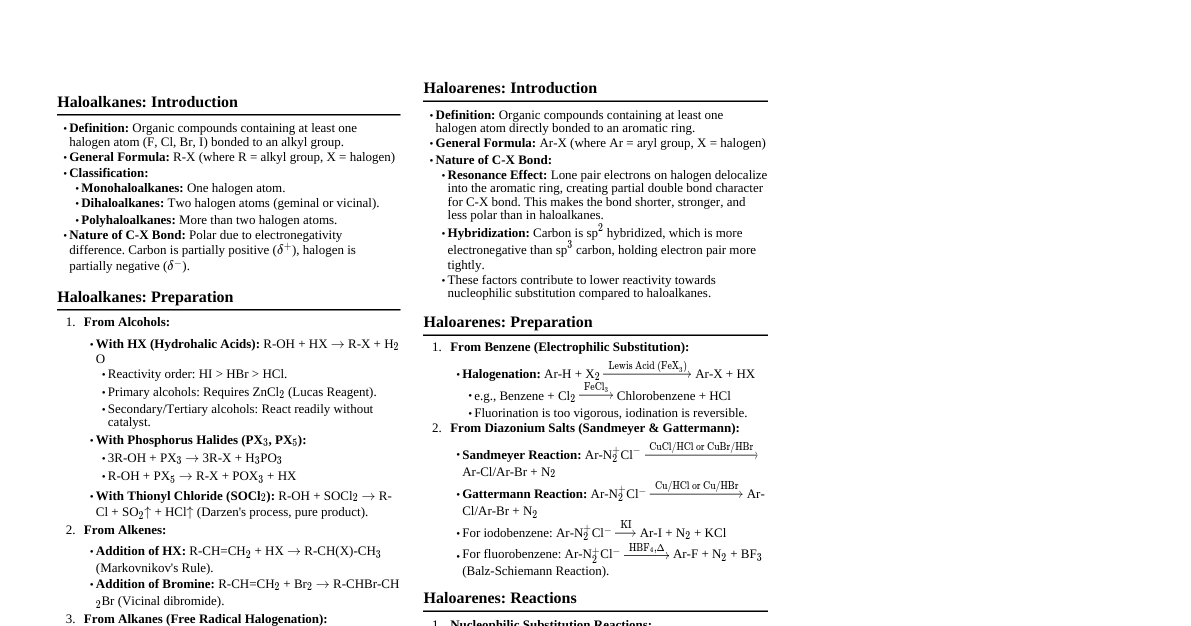
### Introduction - **Haloalkanes (Alkyl Halides):** Organic compounds with a halogen atom (F, Cl, Br, I) bonded to an $sp^3$-hybridized carbon atom of an alkyl group. General formula: R-X. - **Haloarenes (Aryl Halides):** Organic compounds with a halogen atom bonded directly to an $sp^2$-hybridized carbon atom of an aromatic ring. General formula: Ar-X. ### Classification #### On the basis of number of halogen atoms: - **Monohaloalkanes:** One halogen atom (e.g., $CH_3Cl$) - **Dihaloalkanes:** Two halogen atoms (e.g., $CH_2Cl_2$) - **Trihaloalkanes:** Three halogen atoms (e.g., $CHCl_3$) #### On the basis of hybridization of carbon atom to which halogen is attached: - **Alkyl Halides (R-X):** Halogen attached to $sp^3$ carbon. - **Primary (1°):** Halogen attached to a primary carbon. - **Secondary (2°):** Halogen attached to a secondary carbon. - **Tertiary (3°):** Halogen attached to a tertiary carbon. - **Allylic Halides:** Halogen attached to an $sp^3$-hybridized carbon atom next to a C=C double bond (e.g., $CH_2=CH-CH_2-X$). - **Benzylic Halides:** Halogen attached to an $sp^3$-hybridized carbon atom next to an aromatic ring (e.g., $C_6H_5-CH_2-X$). - **Vinylic Halides:** Halogen attached directly to an $sp^2$-hybridized carbon atom of a C=C double bond (e.g., $CH_2=CH-X$). - **Aryl Halides (Ar-X):** Halogen attached directly to an $sp^2$-hybridized carbon atom of an aromatic ring. ### Nomenclature - **IUPAC System:** Halogen is treated as a substituent and named as 'halo' (fluoro, chloro, bromo, iodo). - Example: $CH_3Cl$ - Chloromethane - Example: $CH_3CH_2Br$ - Bromoethane - **Common System (for simple alkyl halides):** Alkyl group is named followed by halide (e.g., Methyl chloride). ### Preparation of Haloalkanes 1. **From Alcohols:** - Alcohol + HX (HCl, HBr, HI) $\xrightarrow{ZnCl_2 \text{ (for HCl)}}$ R-X + $H_2O$ - Alcohol + $PCl_3 \rightarrow R-Cl + H_3PO_3$ - Alcohol + $PCl_5 \rightarrow R-Cl + POCl_3 + HCl$ - Alcohol + $SOCl_2$ (Thionyl chloride) $\xrightarrow{Pyridine}$ R-Cl + $SO_2 \uparrow + HCl \uparrow$ (Darzen's process - best method) 2. **From Hydrocarbons:** - **Free Radical Halogenation (Alkanes):** Alkane + $X_2$ (Cl, Br) $\xrightarrow{UV \text{ light/} \Delta}$ R-X (Mixture of products, low yield). - **Electrophilic Addition (Alkenes):** - Alkene + HX $\rightarrow$ R-X (Markovnikov's rule: H to C with more H's, X to C with fewer H's). - Alkene + $Br_2/Cl_2$ $\rightarrow$ Vicinal dihalide. 3. **Halogen Exchange:** - **Finkelstein Reaction:** R-X + NaI $\xrightarrow{Acetone}$ R-I + NaX (X = Cl, Br) - **Swarts Reaction:** R-X + Metallic Fluoride ($AgF, Hg_2F_2, CoF_2, SbF_3$) $\rightarrow$ R-F + Metallic Halide ### Preparation of Haloarenes 1. **From Benzene (Electrophilic Substitution):** - Benzene + $X_2$ (Cl, Br) $\xrightarrow{FeX_3 \text{ (Lewis acid)}}$ Haloarene + HX - Fluorination and Iodination usually require special conditions. 2. **From Aniline (Sandmeyer Reaction):** - Aniline $\xrightarrow{NaNO_2/HCl, 0-5^\circ C}$ Benzene diazonium chloride - Benzene diazonium chloride $\xrightarrow{Cu_2X_2 \text{ (X=Cl, Br)}}$ Haloarene + $N_2$ - For Iodobenzene: Benzene diazonium chloride $\xrightarrow{KI}$ Iodobenzene + $N_2$ - **Gattermann Reaction:** Benzene diazonium chloride $\xrightarrow{Cu/HX}$ Haloarene + $N_2$ (Lower yield than Sandmeyer) 3. **From Phenol:** Phenol $\xrightarrow{PCl_5}$ Chlorobenzene (low yield). ### Physical Properties - **Boiling Points:** R-I > R-Br > R-Cl > R-F. Increases with molecular mass. - **Density:** R-I > R-Br > R-Cl. Denser than water (except fluoro- and chloroalkanes). - **Solubility:** Insoluble in water but soluble in organic solvents. Hydrogen bonding not formed. - **Dipole Moment:** $CH_3Cl > CH_3F > CH_3Br > CH_3I$. ### Chemical Reactions of Haloalkanes #### 1. Nucleophilic Substitution Reactions ($S_N1$ and $S_N2$) - **$S_N2$ (bimolecular nucleophilic substitution):** - One step, concerted mechanism. - Inversion of configuration (Walden inversion). - Rate = $k[R-X][Nu^-]$. - Reactivity: Methyl > Primary > Secondary > Tertiary (Steric hindrance). - Favored by strong nucleophiles, aprotic polar solvents. - **$S_N1$ (unimolecular nucleophilic substitution):** - Two steps: 1. Formation of carbocation (slow, rate-determining). 2. Nucleophilic attack. - Racemisation (if chiral center). - Rate = $k[R-X]$. - Reactivity: Tertiary > Secondary > Primary > Methyl (Stability of carbocation). - Favored by weak nucleophiles, protic polar solvents. - **Common Nucleophiles:** - OH- (aq. KOH/NaOH) $\rightarrow$ Alcohol - CN- (KCN/NaCN) $\rightarrow$ Nitrile (R-CN) - CN- (AgCN) $\rightarrow$ Isocyanide (R-NC) - OR- (RONa) $\rightarrow$ Ether (Williamson Synthesis) - $NH_3$ (excess) $\rightarrow$ Primary amine (followed by $2^\circ, 3^\circ$ amines & quaternary salts) - R'-COO-Ag $\rightarrow$ Ester - $NO_2^-$ (KNO2) $\rightarrow$ Alkyl nitrite (R-O-N=O) - $NO_2^-$ (AgNO2) $\rightarrow$ Nitroalkane (R-NO2) #### 2. Elimination Reactions ($\beta$-Elimination / Dehydrohalogenation) - Haloalkane + alc. KOH $\xrightarrow{\Delta}$ Alkene + KX + $H_2O$ - **Saytzeff's Rule:** In dehydrohalogenation, the preferred product is the alkene which has the greater number of alkyl groups attached to the doubly bonded carbon atoms (more substituted alkene). #### 3. Reaction with Metals - **Wurtz Reaction:** $2RX + 2Na \xrightarrow{Dry \text{ Ether}}$ R-R + 2NaX (For alkanes with even number of carbons) - **Grignard Reagents:** R-X + Mg $\xrightarrow{Dry \text{ Ether}}$ R-Mg-X (Alkyl magnesium halide) - Highly reactive, used to prepare a wide range of organic compounds. ### Chemical Reactions of Haloarenes - **Lower reactivity towards Nucleophilic Substitution than Haloalkanes** due to: 1. Resonance stabilization of C-X bond (partial double bond character). 2. Difference in hybridization of carbon atom ($sp^2$ in haloarenes, $sp^3$ in haloalkanes). 3. Instability of phenyl carbocation. 4. Repulsion between nucleophile and electron-rich $\pi$-system. #### 1. Nucleophilic Substitution (under drastic conditions) - **Dow's Process:** Chlorobenzene $\xrightarrow{NaOH, 623K, 300atm}$ Sodium phenoxide $\xrightarrow{H^+}$ Phenol - Presence of electron-withdrawing groups ($NO_2$) at ortho/para positions increases reactivity towards nucleophilic substitution. - E.g., o- or p-nitrochlorobenzene $\xrightarrow{NaOH, H_2O, \text{ milder conditions}}$ Nitrophenol #### 2. Electrophilic Substitution Reactions - Halogen is a deactivating but o,p-directing group due to resonance effect. - **Halogenation:** Haloarene $\xrightarrow{X_2/FeX_3}$ Dihaloarene (o & p isomers) - **Nitration:** Haloarene $\xrightarrow{Conc. HNO_3/Conc. H_2SO_4}$ Nitrohaloarene (o & p isomers) - **Sulphonation:** Haloarene $\xrightarrow{Conc. H_2SO_4}$ Halobenzenesulphonic acid (o & p isomers) - **Friedel-Crafts Reactions:** - **Alkylation:** Haloarene + $R-Cl \xrightarrow{Anhyd. AlCl_3}$ Alkylhaloarene (o & p isomers) - **Acylation:** Haloarene + $RCOCl \xrightarrow{Anhyd. AlCl_3}$ Acylhaloarene (o & p isomers) #### 3. Reaction with Metals - **Wurtz-Fittig Reaction:** Haloarene + RX + 2Na $\xrightarrow{Dry \text{ Ether}}$ Alkylbenzene + 2NaX - **Fittig Reaction:** $2Ar-X + 2Na \xrightarrow{Dry \text{ Ether}}$ Biphenyl + 2NaX - **Ullmann Reaction:** $2Ar-I + 2Cu \xrightarrow{\Delta}$ Biphenyl + $2CuI$ (Specific for iodoarenes) ### Polyhalogen Compounds - **Dichloromethane ($CH_2Cl_2$ - Methylene Chloride):** Solvent, paint remover. - **Trichloromethane ($CHCl_3$ - Chloroform):** Solvent, anesthetic (now limited). - **Triiodomethane ($CHI_3$ - Iodoform):** Antiseptic (due to $I_2$ liberation). - **Tetrachloromethane ($CCl_4$ - Carbon Tetrachloride):** Solvent, fire extinguisher (phased out due to environmental concerns). - **Freons (Chlorofluorocarbons - CFCs):** $CCl_2F_2$ (Freon-12). Refrigerants, aerosol propellants. Depletes ozone layer. - **DDT (Dichlorodiphenyltrichloroethane):** Insecticide. Banned in many countries due to environmental persistence and toxicity.