English & Maths Mastery
Cheatsheet Content
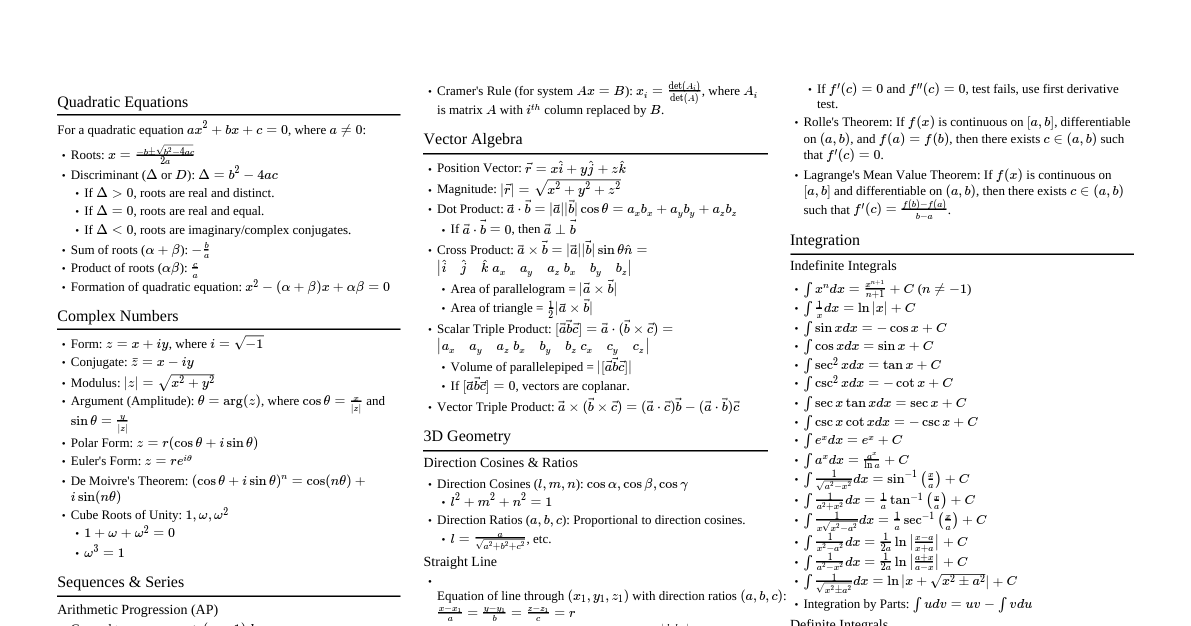
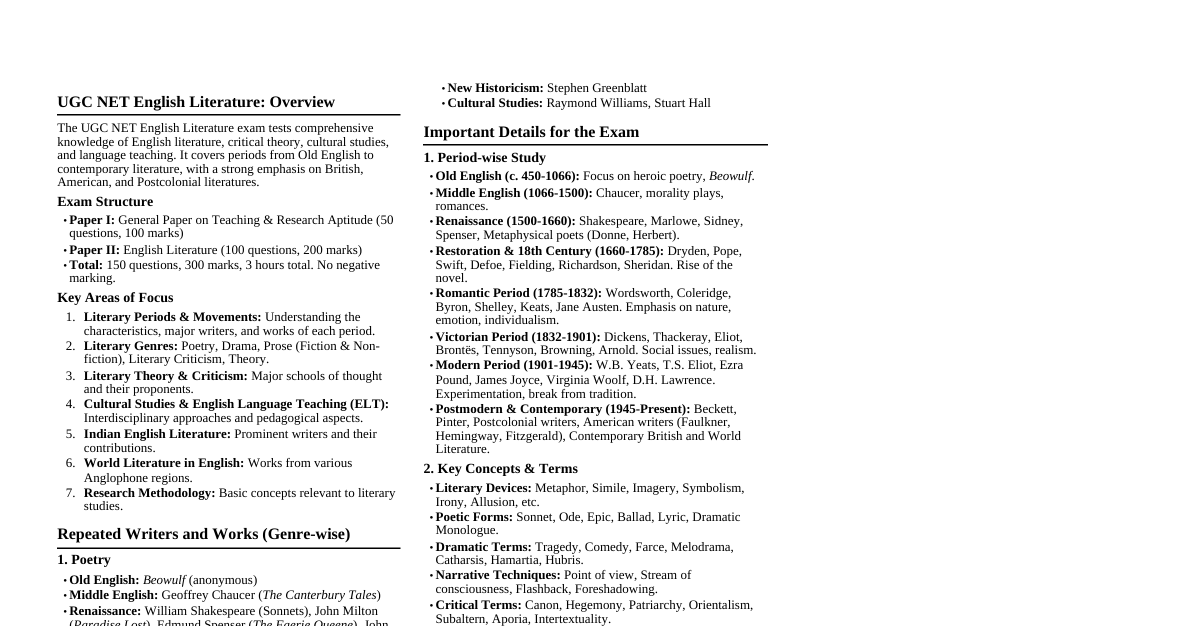
### Grammar Essentials - **Nouns:** People, places, things, ideas (e.g., *student, London, book, freedom*). - Proper Nouns: Capitalized (e.g., *Sarah, Eiffel Tower*). - Common Nouns: Not capitalized (e.g., *cat, city*). - **Pronouns:** Replace nouns (e.g., *he, she, it, they, we, you, I*). - Subjective: *I, you, he, she, it, we, they*. - Objective: *me, you, him, her, it, us, them*. - Possessive: *my, your, his, her, its, our, their*. - **Verbs:** Actions or states of being (e.g., *run, think, is, become*). - **Tenses:** - **Present Simple:** *I walk.* (habit, fact) - **Present Continuous:** *I am walking.* (now, temporary) - **Past Simple:** *I walked.* (finished action) - **Past Continuous:** *I was walking.* (action interrupted) - **Present Perfect:** *I have walked.* (started in past, continues or relevant now) - **Future Simple:** *I will walk.* (prediction, promise) - **Adjectives:** Describe nouns (e.g., *beautiful, tall, green*). - **Adverbs:** Describe verbs, adjectives, or other adverbs (e.g., *quickly, very, almost*). - **Prepositions:** Show relationships (e.g., *in, on, at, with, by*). - **Conjunctions:** Join words, phrases, clauses (e.g., *and, but, or, so, because*). - **Interjections:** Express strong emotion (e.g., *Oh! Wow!*). ### Sentence Structure - **Subject-Verb Agreement:** Subject and verb must agree in number (e.g., *The cat runs.* vs. *The cats run.*). - **Simple Sentence:** One independent clause (e.g., *The dog barks.*). - **Compound Sentence:** Two or more independent clauses joined by a coordinating conjunction (FANBOYS: For, And, Nor, But, Or, Yet, So) (e.g., *The dog barks, and the cat meows.*). - **Complex Sentence:** One independent clause and one or more dependent clauses (e.g., *Because it was raining, we stayed inside.*). - **Compound-Complex Sentence:** Two or more independent clauses and one or more dependent clauses. - **Punctuation:** - **Period (.)**: Ends declarative sentences. - **Comma (,):** Separates items in a list, clauses, introductory phrases. - **Semicolon (;):** Joins two related independent clauses. - **Colon (:):** Introduces a list, explanation, or quotation. - **Apostrophe ('):** Shows possession or contraction. - **Quotation Marks (" "):** Enclose direct speech or titles. ### Vocabulary & Spelling - **Prefixes:** Added to the beginning of a word to change its meaning (e.g., *un-*happy, *re-*do). - **Suffixes:** Added to the end of a word (e.g., happi-*ness*, runn-*ing*). - **Root Words:** The basic part of a word (e.g., *bio*logy, tele*graph*). - **Homophones:** Words that sound alike but have different meanings and spellings (e.g., *to, too, two*). - **Homographs:** Words that are spelled alike but have different meanings and sometimes different pronunciations (e.g., *bass* (fish) vs. *bass* (instrument)). - **Synonyms:** Words with similar meanings (e.g., *happy, joyful*). - **Antonyms:** Words with opposite meanings (e.g., *hot, cold*). - **Common Spelling Rules:** - **'i' before 'e' except after 'c'**: *achieve, believe* vs. *receive, deceive*. (Exceptions: *weird, foreign*). - **Drop silent 'e' when adding a suffix starting with a vowel**: *make + ing = making*. - **Double final consonant**: If a short vowel is followed by a single consonant, double the consonant before adding a suffix starting with a vowel (e.g., *run + ing = running*). ### Reading Comprehension - **Skimming:** Quickly read to get the main idea. - **Scanning:** Look for specific information. - **Identifying Main Idea:** What is the central point of the text? - **Finding Supporting Details:** Facts, examples, reasons that back up the main idea. - **Inferencing:** Drawing conclusions based on evidence and reasoning, not explicitly stated. - **Understanding Context Clues:** Using surrounding words to determine the meaning of unknown words. - **Author's Purpose:** Why did the author write this? (e.g., inform, persuade, entertain). - **Tone:** The author's attitude towards the subject (e.g., serious, humorous, critical). ### Essay Writing Structure #### 1. Introduction - **Hook:** Grab the reader's attention (e.g., surprising fact, question, anecdote). - **Background Information:** Briefly introduce the topic. - **Thesis Statement:** Your main argument or point, usually one sentence, at the end of the introduction. #### 2. Body Paragraphs - **Topic Sentence:** States the main idea of the paragraph. - **Supporting Details:** Evidence, examples, explanations, data that support the topic sentence. - **Analysis/Elaboration:** Explain how your evidence supports your topic sentence and thesis. - **Transition:** Smoothly move to the next paragraph. #### 3. Conclusion - **Restate Thesis (in new words):** Remind the reader of your main argument. - **Summarize Main Points:** Briefly recap the key ideas from your body paragraphs. - **Concluding Thought/Call to Action:** Offer a final insight, implication, or suggestion. ### Literary Devices - **Metaphor:** Direct comparison without "like" or "as" (e.g., *The world is a stage.*). - **Simile:** Comparison using "like" or "as" (e.g., *He fought like a lion.*). - **Personification:** Giving human qualities to inanimate objects or animals (e.g., *The wind whispered secrets.*). - **Alliteration:** Repetition of initial consonant sounds (e.g., *Peter Piper picked a peck...*). - **Onomatopoeia:** Words that imitate sounds (e.g., *buzz, hiss, bang*). - **Hyperbole:** Exaggeration for effect (e.g., *I'm so hungry I could eat a horse.*). - **Imagery:** Descriptive language that appeals to the senses (sight, sound, smell, taste, touch). - **Symbolism:** Use of objects or ideas to represent something else (e.g., a dove symbolizing peace). - **Irony:** Contrast between expectation and reality. - **Verbal Irony:** Saying one thing but meaning another. - **Situational Irony:** When the outcome is the opposite of what is expected. - **Dramatic Irony:** When the audience knows something the characters don't. ### Arithmetic Basics - **Order of Operations (PEMDAS/BODMAS):** 1. Parentheses/Brackets 2. Exponents/Orders 3. Multiplication and Division (from left to right) 4. Addition and Subtraction (from left to right) - **Integers:** Whole numbers (positive, negative, and zero). - Addition: $-5 + 3 = -2$ - Subtraction: $5 - (-3) = 5 + 3 = 8$ - Multiplication: $(-2) \times 3 = -6$, $(-2) \times (-3) = 6$ - Division: $-10 \div 2 = -5$, $-10 \div (-2) = 5$ - **Fractions:** Part of a whole. - **Addition/Subtraction:** Find a common denominator. $$\frac{1}{2} + \frac{1}{3} = \frac{3}{6} + \frac{2}{6} = \frac{5}{6}$$ - **Multiplication:** Multiply numerators, multiply denominators. $$\frac{2}{3} \times \frac{4}{5} = \frac{8}{15}$$ - **Division:** Invert the second fraction and multiply. $$\frac{1}{2} \div \frac{3}{4} = \frac{1}{2} \times \frac{4}{3} = \frac{4}{6} = \frac{2}{3}$$ - **Decimals:** Base-10 fractions. - **Converting Fraction to Decimal:** Divide numerator by denominator (e.g., $\frac{1}{4} = 0.25$). - **Converting Decimal to Fraction:** Place decimal over power of 10 and simplify (e.g., $0.75 = \frac{75}{100} = \frac{3}{4}$). - **Percentages:** Parts per hundred. - **Decimal to Percent:** Multiply by 100 (e.g., $0.25 = 25\%$). - **Percent to Decimal:** Divide by 100 (e.g., $50\% = 0.50$). - **"Of" means multiply:** $20\%$ of $50 = 0.20 \times 50 = 10$. ### Algebra Fundamentals - **Variables:** Symbols representing unknown values (e.g., $x, y, a$). - **Expressions:** Combinations of numbers, variables, and operations (e.g., $3x + 5$). - **Equations:** Two expressions set equal to each other (e.g., $2x + 1 = 7$). - **Solving Linear Equations:** - Isolate the variable using inverse operations. $$2x + 5 = 11$$ $$2x = 6$$ $$x = 3$$ - **Inequalities:** Compare two expressions (e.g., $ , \le, \ge$). - When multiplying or dividing by a negative number, reverse the inequality sign. $$-2x -3$$ - **Exponents:** $a^n = a \times a \times ... \times a$ (n times). - $a^m \cdot a^n = a^{m+n}$ - $\frac{a^m}{a^n} = a^{m-n}$ - $(a^m)^n = a^{mn}$ - $a^0 = 1$ ($a \neq 0$) - $a^{-n} = \frac{1}{a^n}$ - **Factoring:** Expressing a polynomial as a product of simpler polynomials. - **Greatest Common Factor (GCF):** $3x^2 + 6x = 3x(x + 2)$ - **Difference of Squares:** $a^2 - b^2 = (a - b)(a + b)$ - **Trinomials:** $x^2 + bx + c = (x + p)(x + q)$ where $p+q=b, pq=c$. (e.g., $x^2 + 5x + 6 = (x+2)(x+3)$) - **Quadratic Formula:** For $ax^2 + bx + c = 0$, $$x = \frac{-b \pm \sqrt{b^2 - 4ac}}{2a}$$ ### Geometry: Shapes & Formulas - **Perimeter:** Distance around a 2D shape. - **Area:** Space covered by a 2D shape. - **Volume:** Space occupied by a 3D object. - **Rectangle:** - Perimeter: $P = 2(l + w)$ - Area: $A = l \times w$ - **Square:** - Perimeter: $P = 4s$ - Area: $A = s^2$ - **Triangle:** - Area: $A = \frac{1}{2}bh$ - **Pythagorean Theorem (Right Triangles):** $a^2 + b^2 = c^2$ - **Circle:** - Circumference: $C = 2\pi r = \pi d$ - Area: $A = \pi r^2$ - **Cube:** - Volume: $V = s^3$ - Surface Area: $SA = 6s^2$ - **Rectangular Prism:** - Volume: $V = lwh$ - Surface Area: $SA = 2(lw + lh + wh)$ - **Cylinder:** - Volume: $V = \pi r^2 h$ - Surface Area: $SA = 2\pi r h + 2\pi r^2$ ### Functions & Graphs - **Cartesian Coordinate System:** - X-axis (horizontal), Y-axis (vertical). - Points represented as $(x, y)$. - **Slope ($m$):** Steepness of a line. $$m = \frac{\text{rise}}{\text{run}} = \frac{y_2 - y_1}{x_2 - x_1}$$ - **Linear Equations:** - **Slope-intercept form:** $y = mx + b$ (where $b$ is the y-intercept). - **Point-slope form:** $y - y_1 = m(x - x_1)$. - **Functions:** A relation where each input ($x$) has exactly one output ($y$). - Notation: $f(x) = y$. - **Domain:** Set of all possible input values ($x$). - **Range:** Set of all possible output values ($y$). - **Graphing:** - **Linear:** Straight line. - **Quadratic:** Parabola ($y = ax^2 + bx + c$). - **Exponential:** Rapid growth/decay ($y = a \cdot b^x$). ### Statistics & Probability - **Measures of Central Tendency:** - **Mean:** Average (sum of values / number of values). - **Median:** Middle value when data is ordered. - **Mode:** Most frequent value. - **Measures of Spread:** - **Range:** Max value - Min value. - **Standard Deviation:** Average distance of data points from the mean. - **Probability:** - **Definition:** $P(\text{event}) = \frac{\text{Number of favorable outcomes}}{\text{Total number of possible outcomes}}$. - **Independent Events:** Outcome of one doesn't affect the other. $P(A \text{ and } B) = P(A) \times P(B)$. - **Dependent Events:** Outcome of one affects the other. - **Mutually Exclusive Events:** Cannot happen at the same time. $P(A \text{ or } B) = P(A) + P(B)$.