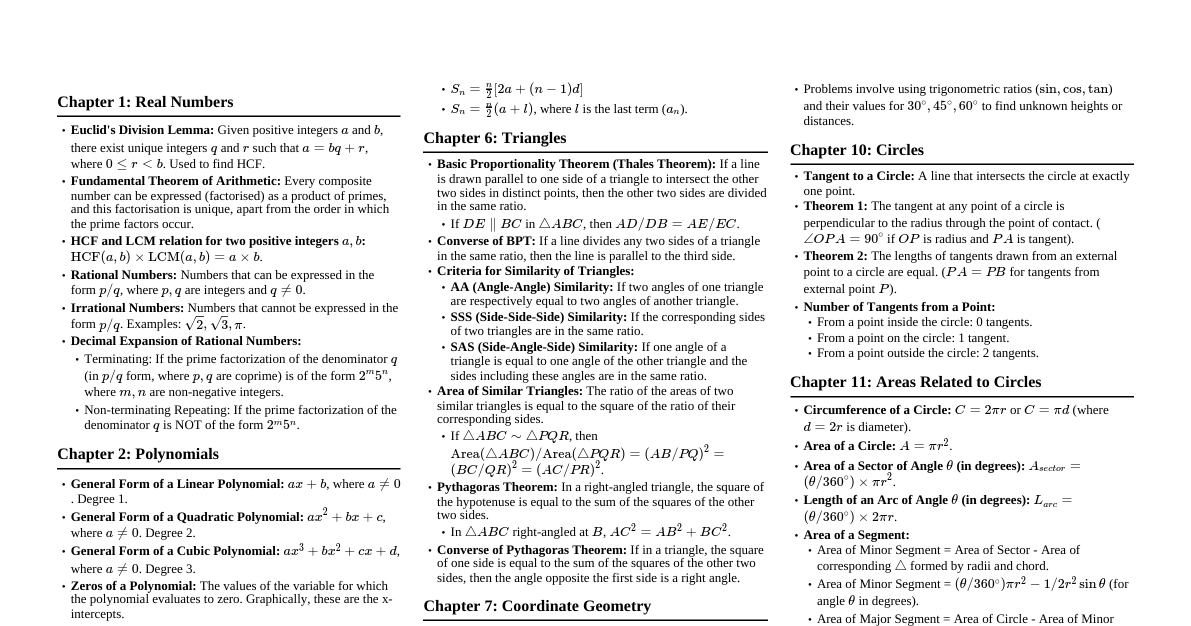
CBSE Class 10 Maths Formulas
Cheatsheet Content
1. Importance of Manufacturing Modernizes Agriculture: Provides tools, fertilizers, irrigation pumps, PVC pipes, pesticides, machines. Reduces Dependence on Agriculture: Provides jobs in secondary and tertiary sectors. Eradicates Unemployment and Poverty: Industrial development is a prerequisite for poverty eradication. Expands Trade and Commerce: Helps earn foreign exchange by exporting manufactured goods. Brings Prosperity: Countries that transform raw materials into diverse finished goods are prosperous. 2. Location of Industries Factors influencing industrial location: Availability of raw material. Labour. Capital. Power. Market. Water. Land. Transport. Government policies. Ideal location: Where all these factors are available at low cost. Agglomeration Economies: Industries tend to locate together to take advantage of common facilities (banks, insurance, transport, etc.) provided by urban centres. 3. Classification of Industries On the basis of source of raw materials: Agro-based: Cotton, woollen, jute, silk textile, rubber, sugar, tea, coffee, edible oil. Mineral-based: Iron and steel, cement, aluminium, machine tools, petrochemicals. According to their main role: Basic/Key Industries: Supply their products as raw materials to other industries (e.g., Iron and Steel, Copper smelting, Aluminium smelting). Consumer Industries: Produce goods for direct use by consumers (e.g., Sugar, Paper, Toothpaste, Sewing machines, Fans). On the basis of capital investment: Small Scale Industries: Maximum investment allowed on assets is specified by the government (currently ₹1 crore). Large Scale Industries: Investment is more than the specified limit for small scale industries. On the basis of ownership: Public Sector: Owned and operated by government agencies (e.g., BHEL, SAIL). Private Sector: Owned and operated by individuals or groups of individuals (e.g., TISCO, Reliance). Joint Sector: Jointly run by state and individuals/groups (e.g., Oil India Ltd.). Cooperative Sector: Owned and operated by the producers or suppliers of raw materials, or workers, or both (e.g., Sugar mills in Maharashtra, Coir industry in Kerala). Based on the bulk and weight of raw material and finished goods: Heavy Industries: Iron and steel, Cement. Light Industries: Electrical fans, Sewing machines. 4. Agro-based Industries 4.1. Textile Industry Largest industry in India. Contributes significantly to industrial production, employment generation, and foreign exchange earnings. Cotton Textiles: Historically, hand spinning and handloom weaving. Early mills in Maharashtra and Gujarat due to availability of raw cotton, market, port facilities, labour, moist climate. Decentralized production due to demand for varied designs and handloom weaving. Faces challenges: Power supply, old machinery, low output of labour, stiff competition from synthetic fiber. Jute Textiles: India is the largest producer of raw jute and jute goods. Most mills located in West Bengal (Hooghly basin). Factors for concentration: Proximity of jute producing areas, cheap water transport, good network of railways/roadways, abundant water for processing jute, cheap labour from West Bengal and neighbouring states. Challenges: Stiff competition from synthetic substitutes and other countries (Bangladesh, Brazil, Philippines, Egypt, Thailand). Government policy of mandatory use of jute packaging helps. Sugar Industry: India is second largest producer of sugar, but largest producer of gur and khandsari. Seasonal industry. Raw material (sugarcane) is bulky and loses sucrose content if transported far. Earlier concentrated in Uttar Pradesh and Bihar. Shifted to southern and western states (Maharashtra, Karnataka, Gujarat, Andhra Pradesh, Tamil Nadu) due to: Higher sucrose content in cane. Longer crushing season. Cooperative factories are more successful. Challenges: Seasonal nature, old and inefficient methods, transport delay of cane, need to maximize bagasse use. 5. Mineral-based Industries 5.1. Iron and Steel Industry Basic industry, as all other heavy, medium, and light industries depend on it. Heavy industry: Raw materials (iron ore, coking coal, limestone) and finished goods are heavy and bulky. Location factors: Requires iron ore, coking coal, and limestone in 4:2:1 ratio. Manganese also needed. Most plants in Chota Nagpur Plateau region due to low cost of iron ore, high-grade raw materials in proximity, cheap labour, vast growth potential. SAIL (Steel Authority of India Limited) is a major public sector undertaking. TISCO (Tata Iron and Steel Company) is a major private sector plant. India is an important iron and steel producing country, but not able to perform to full potential due to: High costs and limited availability of coking coal. Lower productivity of labour. Irregular supply of energy. Poor infrastructure. 5.2. Aluminium Smelting Second most important metallurgical industry. Light, resistant to corrosion, good conductor of heat and electricity, malleable. Used in aircraft, utensils, wires. Substitute for steel, copper, zinc, lead. Location factors: Regular supply of electricity (huge power requirement), assured source of raw material (bauxite). Major plants in Odisha, West Bengal, Kerala, UP, Chhattisgarh, Maharashtra, Tamil Nadu. 5.3. Cement Industry Essential for construction (buildings, roads, bridges, factories). Raw materials: Limestone, silica, alumina, gypsum. Bulk and heavy. Location factors: Proximity to raw materials, coal, electric power, rail transportation. First plant in Chennai (1904). Decentralised industry. 5.4. Automobile Industry Manufactures trucks, buses, cars, motorcycles, scooters, three-wheelers. Located around Delhi, Gurugram, Mumbai, Pune, Chennai, Kolkata, Lucknow, Indore, Hyderabad, Jamshedpur, Bengaluru. Liberalisation has led to new models and growth. 5.5. Information Technology and Electronics Industry Electronics industry covers a wide range of products from transistors to televisions, phones, computers. Bengaluru is the electronic capital of India. Other important centres: Mumbai, Delhi, Hyderabad, Pune, Chennai, Kolkata, Lucknow, Coimbatore. Software Technology Parks (STPs) provide high data communication facility to software exporters. Major impact on employment generation. 6. Industrial Pollution and Environmental Degradation Industries contribute significantly to air, water, land, and noise pollution. Air pollution: Smoke, unburnt gases (sulphur dioxide, carbon monoxide) from factories. Harmful to human health, animals, plants, buildings. Water pollution: Organic and inorganic industrial effluents discharged into rivers. Major culprits: Paper, pulp, chemical, textile, dyeing, petroleum refineries, electroplating industries. Thermal pollution: Hot water from factories and thermal plants discharged into rivers and ponds before cooling. Noise pollution: High intensity sound from industrial and construction activities, machinery, generators. Causes hearing impairment, increased heart rate, blood pressure. Land and Soil pollution: Dumping of solid waste, fly ash, phosphogypsum, iron and steel slags. Rainwater percolates through these wastes, carrying pollutants to groundwater. 7. Control of Environmental Degradation Minimising water usage by reusing and recycling. Harvesting rainwater. Treating hot water and effluents before releasing into rivers. Primary treatment (mechanical means). Secondary treatment (biological process). Tertiary treatment (biological, chemical, physical processes). Particulate matter in air can be reduced by fitting smoke stacks with electrostatic precipitators, fabric filters, scrubbers, inertial separators. Using oil or gas instead of coal in factories. Machinery can be redesigned to increase energy efficiency and reduce noise. Location of industries away from residential areas. Promotion of green belts. 7.1. NTPC (National Thermal Power Corporation) Shows the way in preserving the natural environment and resources. Adopts ISO 14001 management system for EMS (Environmental Management System). Proactive approach for: Optimum utilisation of equipment. Minimising waste generation. Providing green belts for ecological balance. Reducing environmental pollution through ash pond management, ash water recirculation system. Ecological monitoring and review.