English Grammar Essentials
Cheatsheet Content
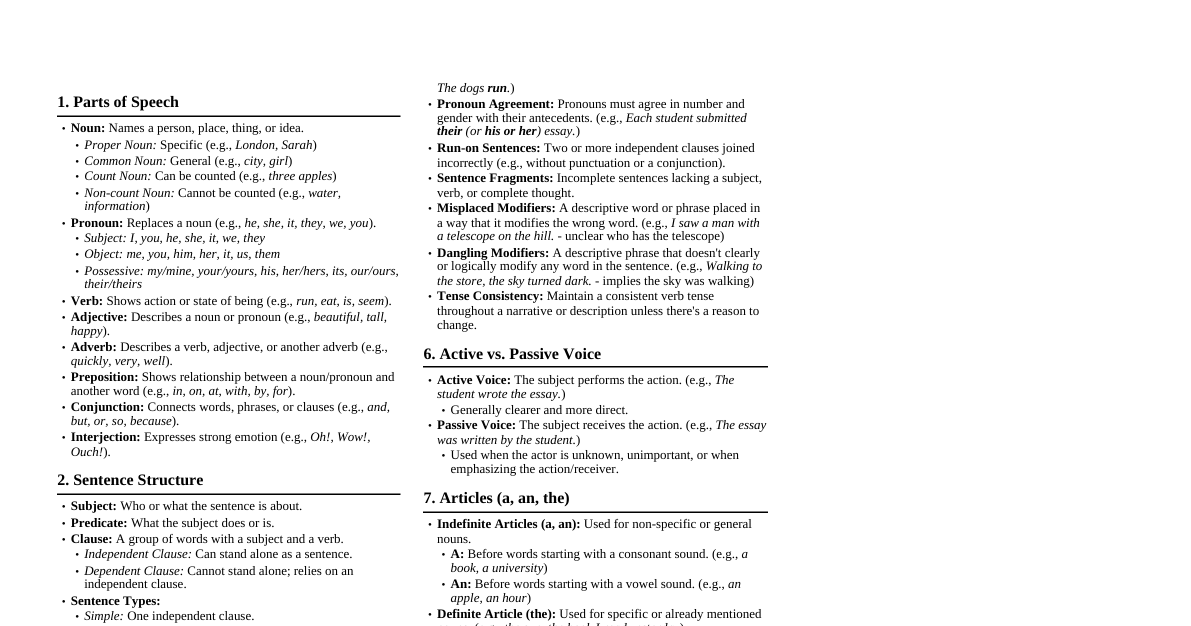
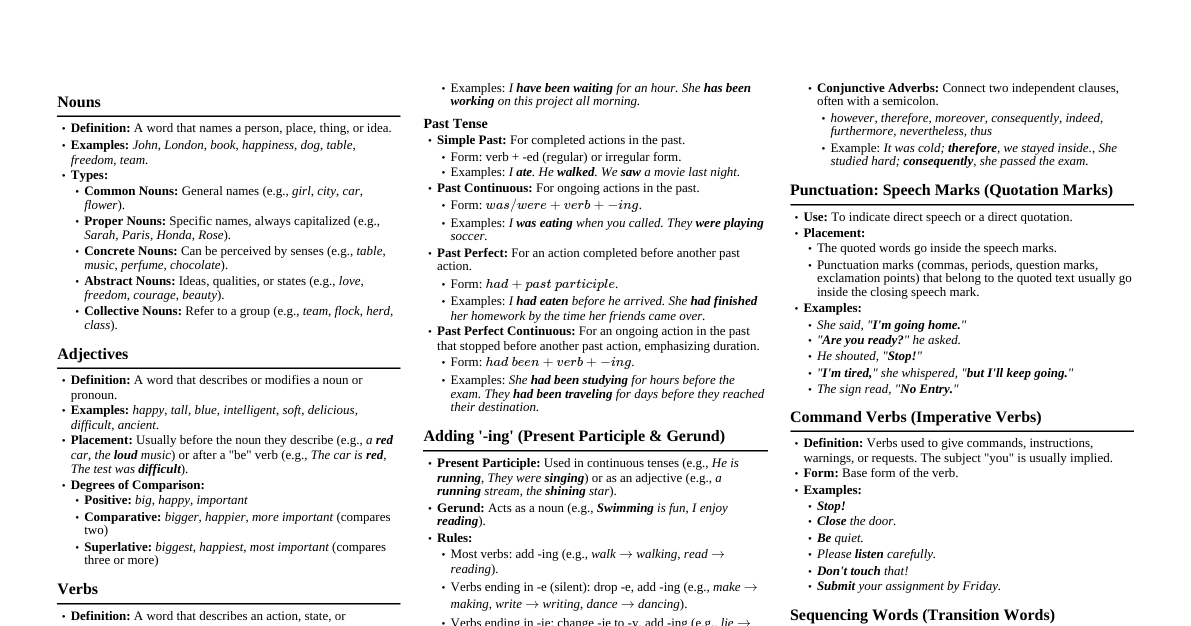
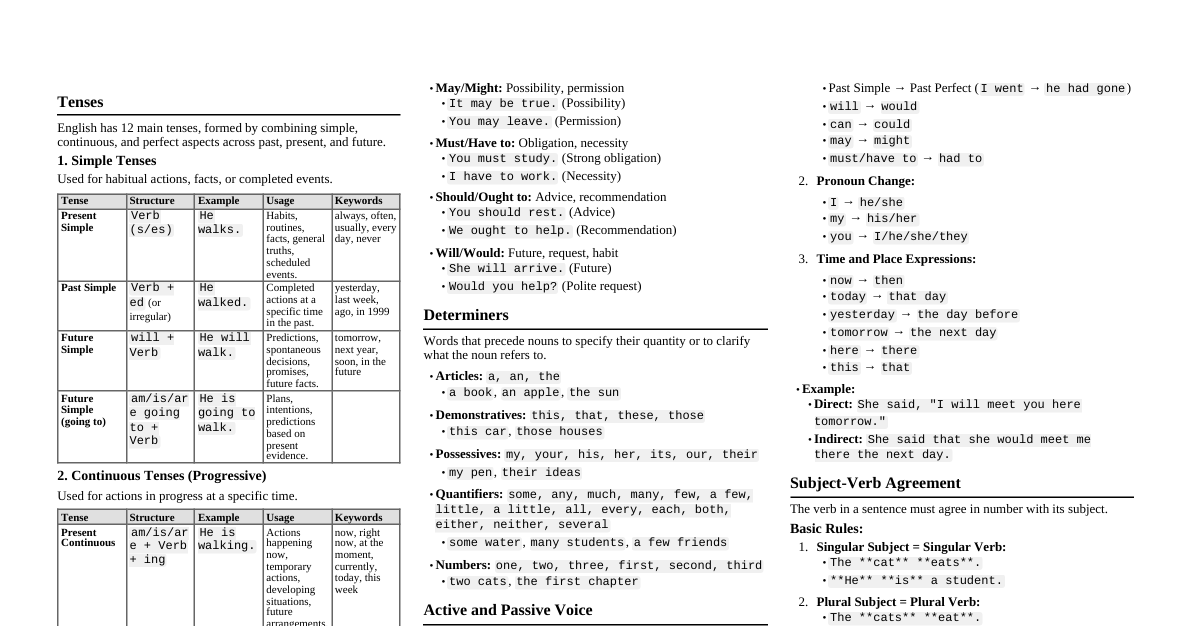
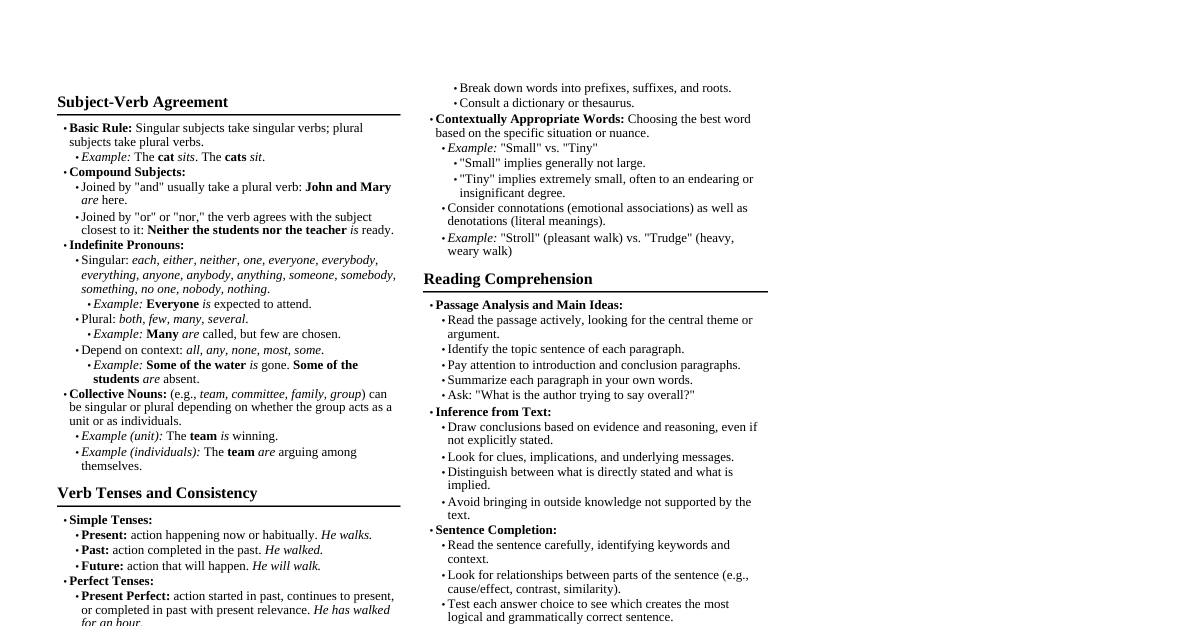
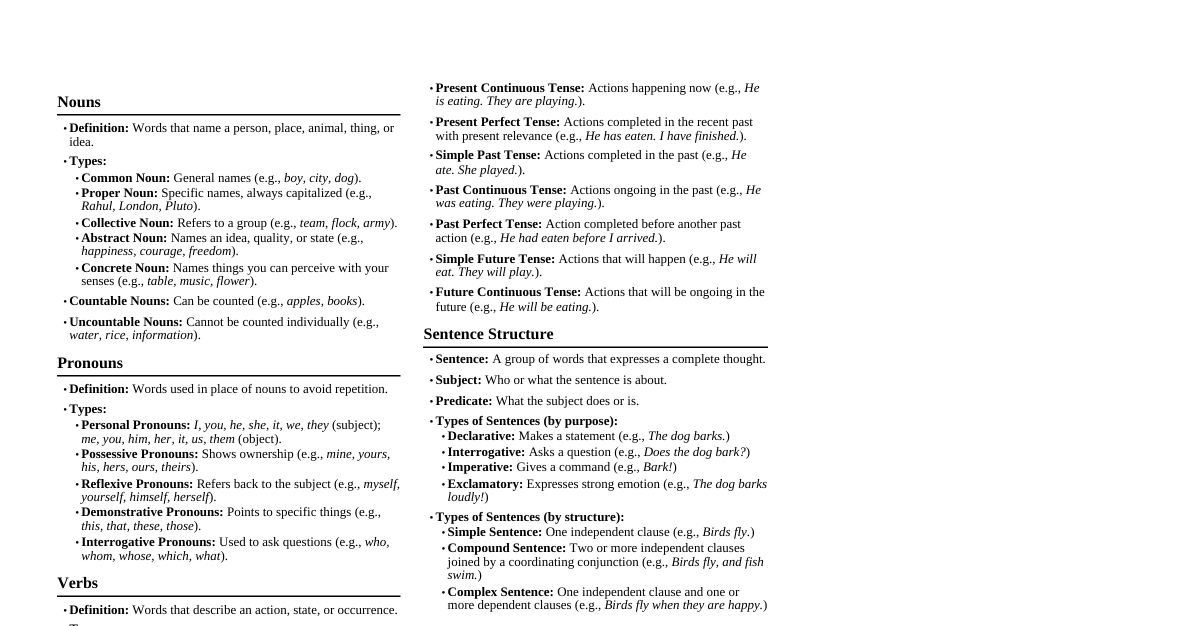
1. Parts of Speech Noun: Person, place, thing, or idea. (e.g., teacher, London, book, freedom ) Common: general ( city ), Proper: specific ( Paris ) Concrete: tangible ( table ), Abstract: intangible ( love ) Count: can be counted ( apples ), Non-count: cannot ( water ) Pronoun: Replaces a noun. (e.g., he, she, it, they, us, mine, who ) Subject: I, you, he, she, it, we, they Object: me, you, him, her, it, us, them Possessive: mine, yours, his, hers, its, ours, theirs Reflexive: myself, yourself, himself, etc. Demonstrative: this, that, these, those Interrogative: who, whom, whose, which, what Relative: who, whom, whose, which, that Verb: Shows action or state of being. (e.g., run, eat, is, seem ) Action: jump, think Linking: connects subject to complement ( is, seem, become ) Helping/Auxiliary: assists main verb ( has, will, can, must ) Adjective: Describes a noun or pronoun. (e.g., happy, blue, tall, three ) Answers: Which one? How many? What kind? Adverb: Describes a verb, adjective, or another adverb. (e.g., quickly, very, yesterday, here ) Answers: How? When? Where? To what extent? Preposition: Shows relationship between a noun/pronoun and another word. (e.g., in, on, at, by, with, for, to ) Conjunction: Joins words, phrases, or clauses. Coordinating: FANBOYS ( for, and, nor, but, or, yet, so ) Subordinating: ( because, although, while, if, since, until ) Correlative: ( either...or, neither...nor, both...and ) Interjection: Expresses strong emotion. (e.g., Oh!, Wow!, Ouch! ) 2. Sentence Structure Subject: Who or what the sentence is about. Predicate: What the subject does or is. Contains the verb. Object: Receives the action of the verb. Direct Object (DO): Answers "what?" or "whom?" after the verb. Indirect Object (IO): Answers "to whom?" or "for whom?" after the verb. Complement: Completes the meaning of the verb. Subject Complement (SC): Follows a linking verb and describes the subject (noun or adjective). Object Complement (OC): Follows a direct object and describes it. 3. Phrases and Clauses 3.1. Phrases Group of words without a subject-verb pair. Noun Phrase: the big red ball Verb Phrase: has been running Adjective Phrase: very happy about it Adverb Phrase: quite slowly Prepositional Phrase: in the garden (acts as adjective or adverb) Gerund Phrase: Swimming in the ocean (noun function) Infinitive Phrase: To sing well (noun, adj, adv function) Participial Phrase: Running quickly, the dog... (adjective function) 3.2. Clauses Group of words with a subject-verb pair. Independent Clause (Main Clause): Can stand alone as a complete sentence. (e.g., She sings well. ) Dependent Clause (Subordinate Clause): Cannot stand alone; relies on an independent clause. Noun Clause: Functions as a noun. (e.g., What he said was true. ) Adjective Clause (Relative Clause): Modifies a noun/pronoun. (e.g., The man who lives next door is kind. ) Adverb Clause: Modifies a verb, adjective, or adverb. (e.g., Because it was raining , we stayed inside. ) 4. Sentence Types (by Structure) Simple Sentence: One independent clause. (e.g., The cat slept. ) Compound Sentence: Two or more independent clauses joined by a coordinating conjunction (FANBOYS) or semicolon. (e.g., She sang, and he danced. ) Complex Sentence: One independent clause and one or more dependent clauses. (e.g., Although it was late, we finished the project. ) Compound-Complex Sentence: Two or more independent clauses and one or more dependent clauses. (e.g., She cooked dinner while he read, and they listened to music. ) 5. Punctuation Period (.): Ends declarative/imperative sentences. Question Mark (?): Ends interrogative sentences. Exclamation Mark (!): Ends exclamatory sentences or expresses strong emotion. Comma (,): Separates items in a list. Separates independent clauses joined by a coordinating conjunction. Sets off introductory elements. Sets off non-essential clauses/phrases. Separates adjectives before a noun. Semicolon (;): Joins closely related independent clauses without a coordinating conjunction. Separates items in a complex list. Colon (:): Introduces a list, explanation, or quotation. Follows an independent clause. Apostrophe ('): Shows possession ( dog's bone ). Forms contractions ( don't, she's ). Quotation Marks (" "): Enclose direct speech or titles of short works. Hyphen (-): Joins words to form compound modifiers ( well-known author ) or numbers. Dash (—): Emphasizes a break in thought, sets off an explanation, or indicates a range. 6. Verb Tenses 6.1. Simple Tenses Present Simple: Habitual actions, facts. ( I walk, He walks ) Past Simple: Completed actions in the past. ( I walked ) Future Simple: Actions in the future. ( I will walk ) 6.2. Continuous/Progressive Tenses Present Continuous: Actions happening now. ( I am walking ) Past Continuous: Actions ongoing in the past. ( I was walking ) Future Continuous: Actions that will be ongoing in the future. ( I will be walking ) 6.3. Perfect Tenses Present Perfect: Actions started in past, continuing or relevant now. ( I have walked ) Past Perfect: Action completed before another past action. ( I had walked ) Future Perfect: Action will be completed by a certain time in the future. ( I will have walked ) 6.4. Perfect Continuous Tenses Present Perfect Continuous: Action started in past, ongoing until now. ( I have been walking ) Past Perfect Continuous: Action ongoing before another past action. ( I had been walking ) Future Perfect Continuous: Action will be ongoing up to a certain point in the future. ( I will have been walking ) 7. Voice Active Voice: Subject performs the action. (e.g., The dog chased the ball. ) Passive Voice: Subject receives the action. (e.g., The ball was chased by the dog. ) Form: be verb + past participle 8. Mood Indicative: States a fact or opinion, asks a question. (e.g., She is here. Is he coming? ) Imperative: Gives a command or makes a request. (e.g., Close the door. Please sit down. ) Subjunctive: Expresses wishes, hypothetical situations, recommendations. Often uses base form of verb or "were" for "was". (e.g., If I were you... I wish he were here. I recommend that she study . ) 9. Agreement Subject-Verb Agreement: Singular subjects take singular verbs; plural subjects take plural verbs. The cat sleeps . The cats sleep . Beware of intervening phrases: The box of apples is heavy. Pronoun-Antecedent Agreement: Pronouns must agree with their antecedents in number and gender. Sarah lost her keys. The students finished their work. 10. Commonly Confused Words Affect (verb - to influence) vs. Effect (noun - result; verb - to bring about) Than (comparison) vs. Then (time) Their (possessive) vs. There (place) vs. They're (they are) To (preposition) vs. Too (also, excessively) vs. Two (number) Its (possessive) vs. It's (it is) Whose (possessive) vs. Who's (who is) Lie (to recline, no direct object) vs. Lay (to place, requires direct object) Accept (to receive) vs. Except (excluding) Lose (to misplace) vs. Loose (not tight) 11. Modifiers Dangling Modifier: A modifier that describes a word not actually in the sentence. Incorrect: Running quickly , the bus was missed. Correct: Running quickly , I missed the bus. Misplaced Modifier: A modifier placed in a way that it modifies the wrong word or seems to. Incorrect: She wore a hat on her head with a feather . Correct: She wore a hat with a feather on her head.