English Grammar Notes
Cheatsheet Content
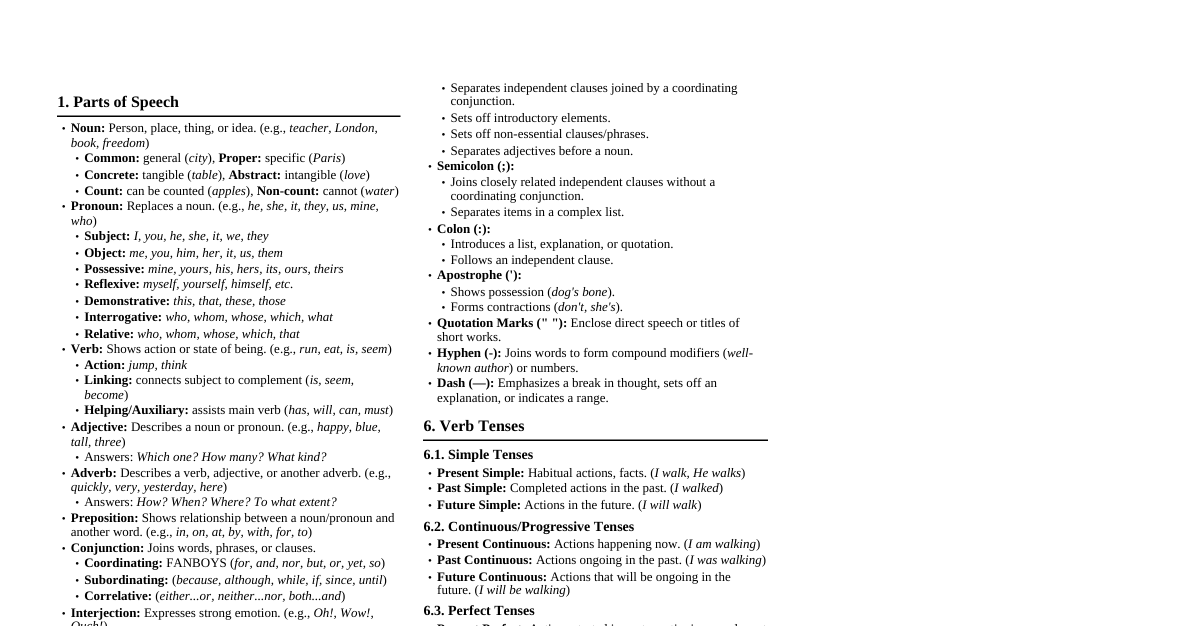
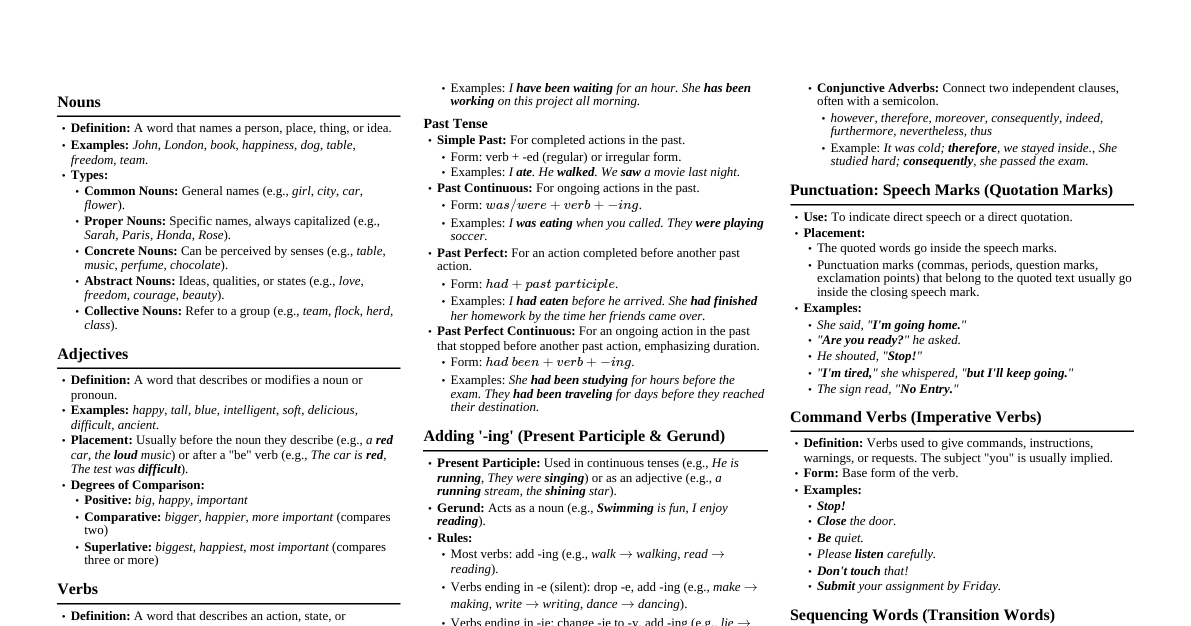
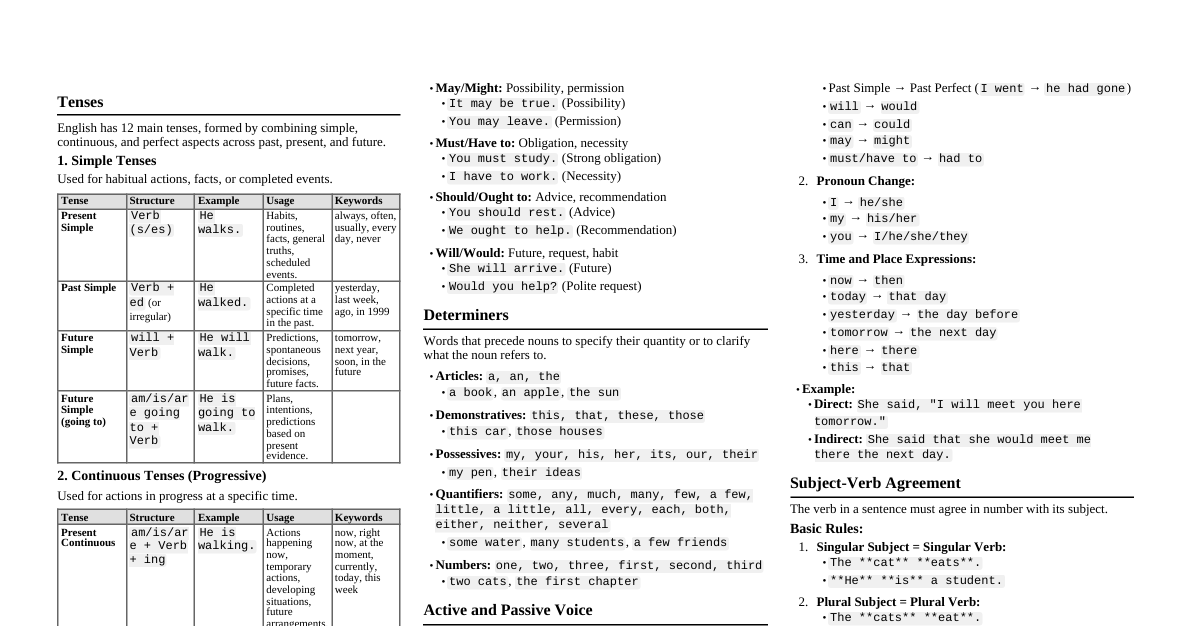
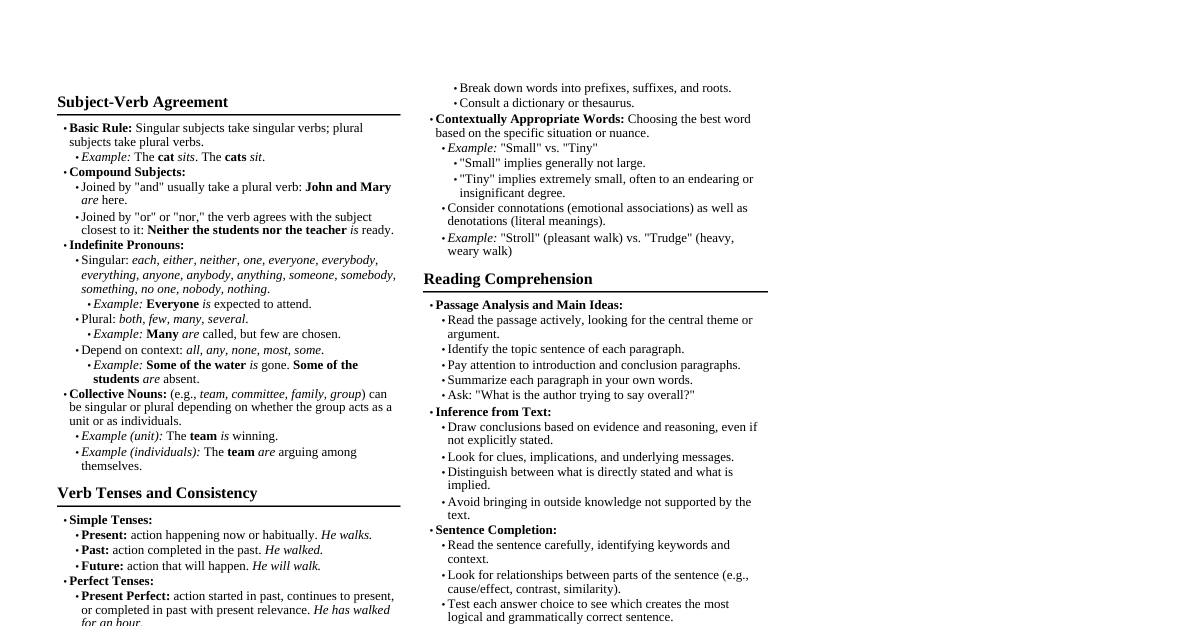
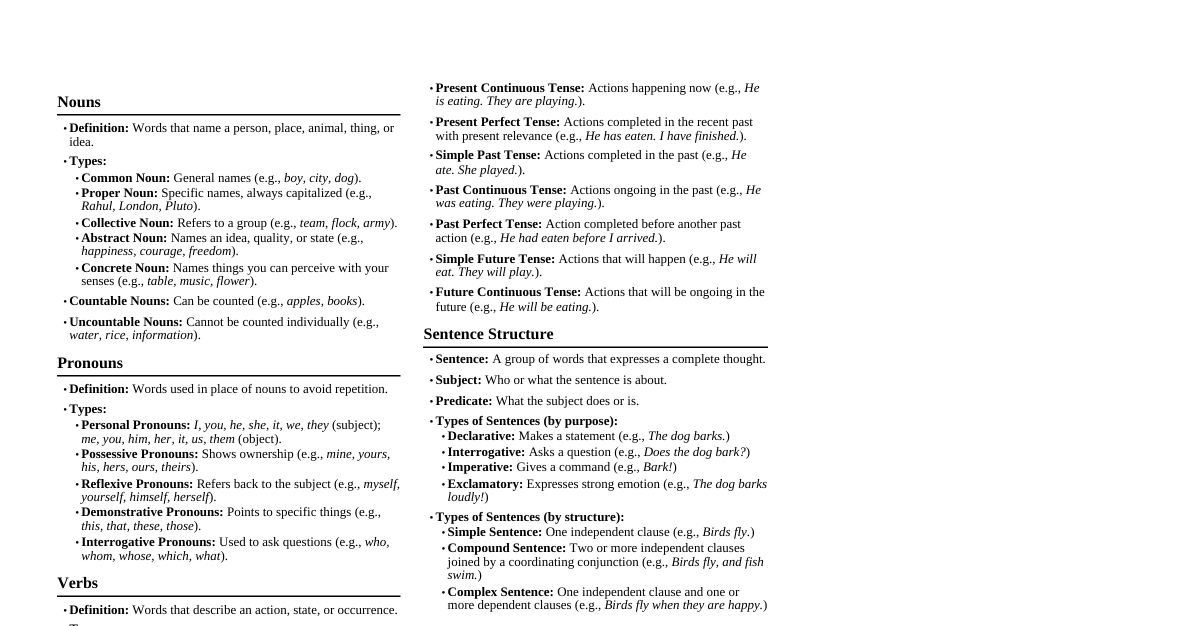
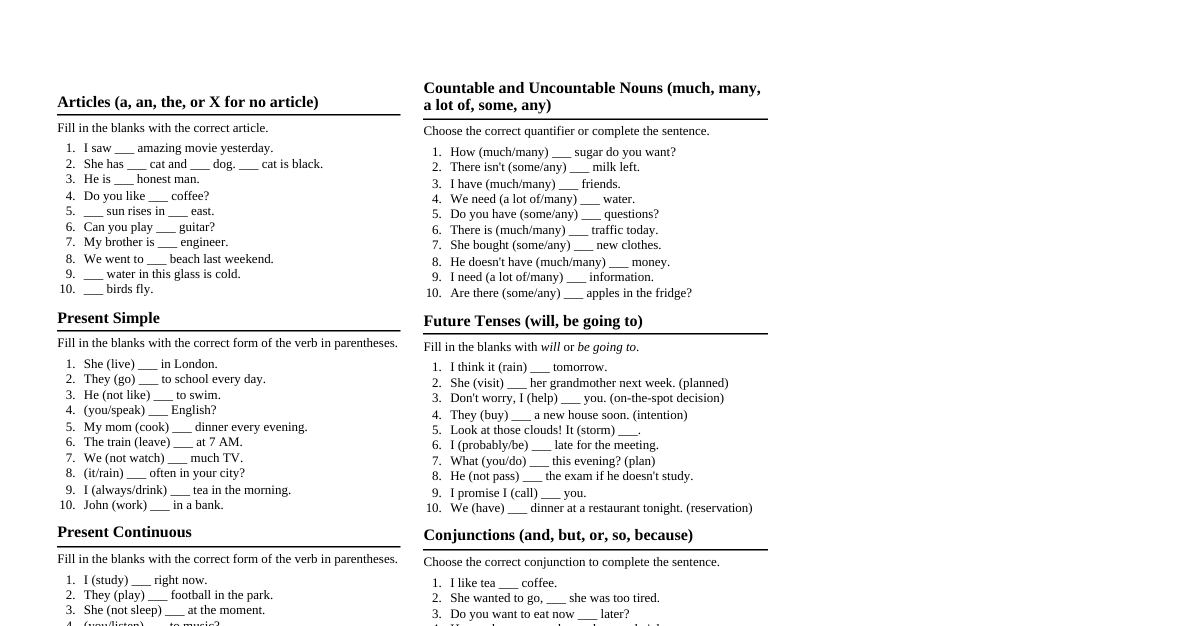
1. Parts of Speech Noun: Names a person, place, thing, or idea. Proper Noun: Specific (e.g., London, Sarah ) Common Noun: General (e.g., city, girl ) Count Noun: Can be counted (e.g., three apples ) Non-count Noun: Cannot be counted (e.g., water, information ) Pronoun: Replaces a noun (e.g., he, she, it, they, we, you ). Subject: I, you, he, she, it, we, they Object: me, you, him, her, it, us, them Possessive: my/mine, your/yours, his, her/hers, its, our/ours, their/theirs Verb: Shows action or state of being (e.g., run, eat, is, seem ). Adjective: Describes a noun or pronoun (e.g., beautiful, tall, happy ). Adverb: Describes a verb, adjective, or another adverb (e.g., quickly, very, well ). Preposition: Shows relationship between a noun/pronoun and another word (e.g., in, on, at, with, by, for ). Conjunction: Connects words, phrases, or clauses (e.g., and, but, or, so, because ). Interjection: Expresses strong emotion (e.g., Oh!, Wow!, Ouch! ). 2. Sentence Structure Subject: Who or what the sentence is about. Predicate: What the subject does or is. Clause: A group of words with a subject and a verb. Independent Clause: Can stand alone as a sentence. Dependent Clause: Cannot stand alone; relies on an independent clause. Sentence Types: Simple: One independent clause. Compound: Two or more independent clauses joined by a coordinating conjunction (FANBOYS: For, And, Nor, But, Or, Yet, So). Complex: One independent clause and one or more dependent clauses. Compound-Complex: Two or more independent clauses and one or more dependent clauses. 3. Verb Tenses 3.1. Simple Tenses Present Simple: Habitual actions, facts. (e.g., I walk, She walks ) Past Simple: Completed actions in the past. (e.g., I walked, She walked ) Future Simple: Actions that will happen. (e.g., I will walk, She will walk ) 3.2. Continuous Tenses Present Continuous: Actions happening now. (e.g., I am walking, She is walking ) Past Continuous: Ongoing actions in the past. (e.g., I was walking, She was walking ) Future Continuous: Ongoing actions in the future. (e.g., I will be walking, She will be walking ) 3.3. Perfect Tenses Present Perfect: Actions completed in the past with a present result, or actions that started in the past and continue. (e.g., I have walked, She has walked ) Past Perfect: Action completed before another past action. (e.g., I had walked, She had walked ) Future Perfect: Action that will be completed before a specific time in the future. (e.g., I will have walked, She will have walked ) 3.4. Perfect Continuous Tenses Present Perfect Continuous: Action started in the past and continuing now. (e.g., I have been walking, She has been walking ) Past Perfect Continuous: Action ongoing in the past before another past action. (e.g., I had been walking, She had been walking ) Future Perfect Continuous: Action that will have been ongoing up to a certain point in the future. (e.g., I will have been walking, She will have been walking ) 4. Punctuation Period (.): Ends a declarative sentence, abbreviations. Comma (,): Separates items in a list, clauses, introductory phrases, parenthetical elements. Question Mark (?): Ends a direct question. Exclamation Point (!): Ends a sentence expressing strong emotion. Semicolon (;): Joins two closely related independent clauses; separates items in a complex list. Colon (:): Introduces a list, explanation, or quotation. Apostrophe ('): Shows possession, contractions. Quotation Marks (" "): Enclose direct speech or titles of short works. Hyphen (-): Joins words to form compound adjectives, numbers. Dash (—): Indicates a sudden break in thought, emphasizes information. 5. Common Errors Subject-Verb Agreement: Singular subjects take singular verbs; plural subjects take plural verbs. (e.g., The dog runs . The dogs run . ) Pronoun Agreement: Pronouns must agree in number and gender with their antecedents. (e.g., Each student submitted their (or his or her ) essay. ) Run-on Sentences: Two or more independent clauses joined incorrectly (e.g., without punctuation or a conjunction). Sentence Fragments: Incomplete sentences lacking a subject, verb, or complete thought. Misplaced Modifiers: A descriptive word or phrase placed in a way that it modifies the wrong word. (e.g., I saw a man with a telescope on the hill. - unclear who has the telescope) Dangling Modifiers: A descriptive phrase that doesn't clearly or logically modify any word in the sentence. (e.g., Walking to the store, the sky turned dark. - implies the sky was walking) Tense Consistency: Maintain a consistent verb tense throughout a narrative or description unless there's a reason to change. 6. Active vs. Passive Voice Active Voice: The subject performs the action. (e.g., The student wrote the essay. ) Generally clearer and more direct. Passive Voice: The subject receives the action. (e.g., The essay was written by the student. ) Used when the actor is unknown, unimportant, or when emphasizing the action/receiver. 7. Articles (a, an, the) Indefinite Articles (a, an): Used for non-specific or general nouns. A: Before words starting with a consonant sound. (e.g., a book, a university ) An: Before words starting with a vowel sound. (e.g., an apple, an hour ) Definite Article (the): Used for specific or already mentioned nouns. (e.g., the sun, the book I read yesterday ) No Article: Used for general plural nouns, non-count nouns, or proper nouns (e.g., information, water, Paris ). 8. Conditionals Zero Conditional: General truths, scientific facts. If + present simple, present simple. (e.g., If you heat water to $100^\circ C$, it boils. ) First Conditional: Real and possible situations in the future. If + present simple, will + base verb. (e.g., If it rains, I will stay home. ) Second Conditional: Hypothetical or unlikely situations in the present/future. If + past simple, would + base verb. (e.g., If I had a million dollars, I would buy a house. ) Third Conditional: Hypothetical situations in the past (regrets, missed opportunities). If + past perfect, would have + past participle. (e.g., If I had studied harder, I would have passed the exam. )