English Literature Overview
Cheatsheet Content
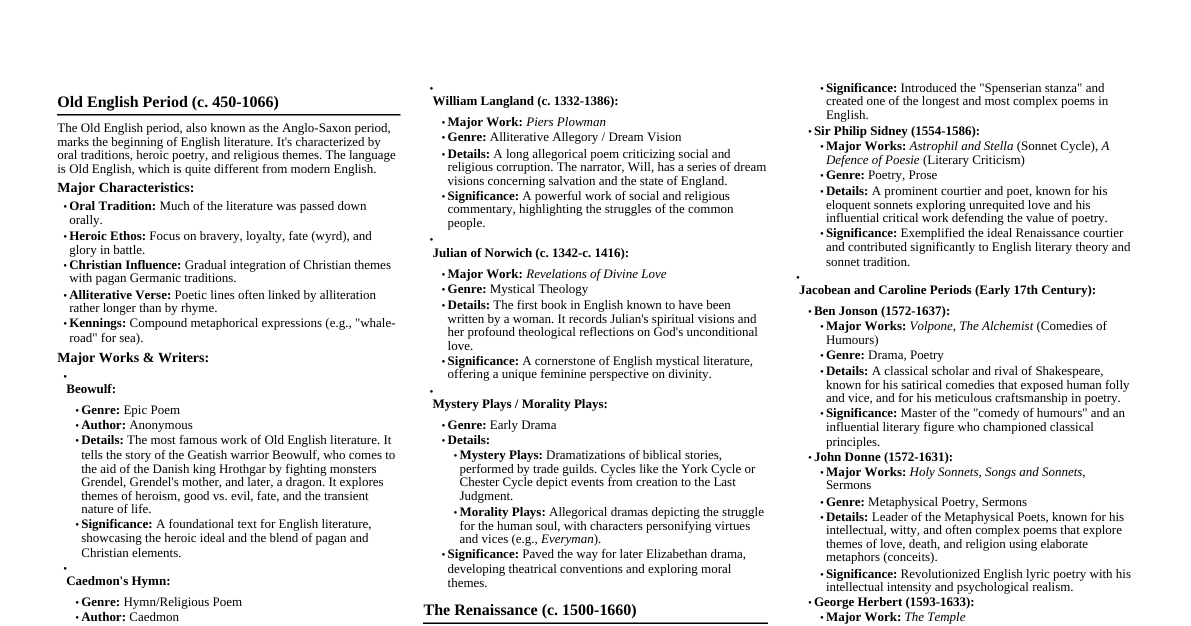
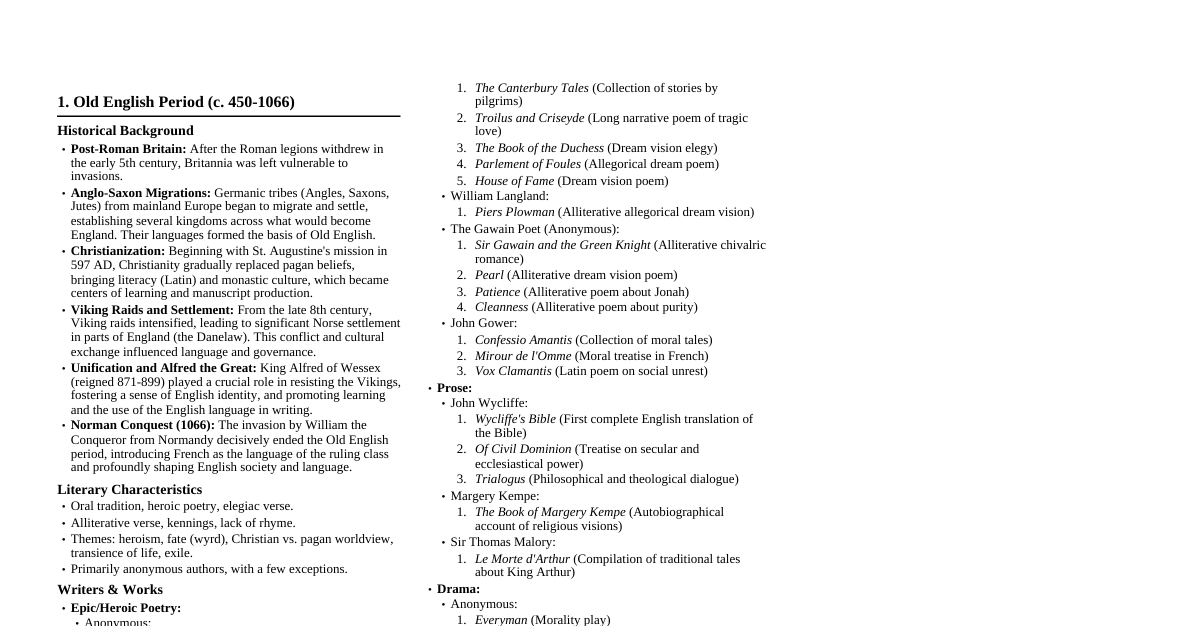
1. Old English (c. 450-1066) Historical Background: This period begins with the Anglo-Saxon invasions of Britain, establishing several Germanic kingdoms (Heptarchy). It's characterized by a transition from paganism to Christianity (c. 600-700 AD), notably influenced by Roman Catholic missions (St. Augustine) and Celtic Christianity (Iona). This conversion introduced Latin literacy, monastic scholarship, and continental European cultural connections. Viking raids and invasions (from 8th century, culminating in Danish rule under Cnut) profoundly impacted society, leading to the development of a strong English national identity in response to external threats. The Norman Conquest in 1066 marks its end, bringing profound linguistic and cultural shifts. Key Trends: Primarily an oral culture, with poetry often performed to harp accompaniment. Heroic poetry celebrates warriors, loyalty to lords, courage, and fate (wyrd). Religious verse blends Christian doctrine with traditional Germanic heroic values. Elegiac poetry expresses themes of loss, exile, and the transience of earthly life. Alliterative verse, characterized by strong stresses and alliteration rather than rhyme, is the dominant poetic form. Kennings (compound metaphorical expressions) and litotes (ironic understatement) are common stylistic features. Genre: Epic poetry, elegies, hagiography (lives of saints), riddles, battle poems, chronicles, wisdom literature, biblical paraphrases. Poets: Caedmon (fl. 7th century): The earliest known English poet, a Northumbrian cowherd whose miraculous gift of song is recounted by Bede. His work, primarily paraphrases of biblical texts like Hymn , is a foundational example of Christian Old English poetry. Cynewulf (fl. 8th-9th century): One of the few named Old English poets, identifiable by runic signatures in his works. Known for religious narrative poems, often focusing on saints' lives and Christian themes, such as Elene (the finding of the True Cross), Juliana (life of a virgin martyr), and The Fates of the Apostles . Prose Writers: King Alfred the Great (r. 871-899): A pivotal figure in the preservation and promotion of English learning during the Viking incursions. He initiated a program of translating important Latin works into Old English, including Bede's Ecclesiastical History of the English People , Boethius's Consolation of Philosophy , and Augustine's Soliloquies . His reign fostered the development of Old English prose. Aelfric of Eynsham (c. 955-c. 1010): A prolific Benedictine abbot and scholar, renowned for his clear and elegant Old English prose. He wrote numerous homilies ( Catholic Homilies ), saints' lives ( Lives of the Saints ), and educational works, significantly shaping the language's prose style. Wulfstan (d. 1023): Archbishop of York, known for his powerful and impassioned sermons, particularly Sermo Lupi ad Anglos (Sermon to the English Wolf), which vividly describes the moral decay and suffering brought by Viking attacks. Anonymous Works: Beowulf : The longest and most famous Old English epic poem, a cornerstone of English literature. It recounts the heroic deeds of the Geatish warrior Beowulf, his battles with the monster Grendel, Grendel's mother, and a dragon, exploring themes of heroism, loyalty, fate, and the transient nature of power. The Exeter Book : A major anthology of Old English poetry, including: The Wanderer , The Seafarer , Deor's Lament : Poignant elegiac poems reflecting on themes of exile, loss, the mutability of fortune, and the wisdom gained through suffering. The Ruin : An elegy lamenting the decay of ancient Roman baths. Exeter Book Riddles : A collection of nearly 100 ingenious riddles, showcasing Anglo-Saxon wit and descriptive power. The Vercelli Book : Another important poetic manuscript, containing: The Dream of the Rood : A deeply moving religious vision poem where the cross itself recounts Christ's crucifixion. The Junius Manuscript (Caedmon Manuscript): Contains biblical poems such as Genesis A and B , Exodus , and Daniel . The Battle of Maldon : A heroic poem commemorating a 991 battle against Viking invaders, celebrating the loyalty and courage of English warriors. Anglo-Saxon Chronicle : A collection of historical records, compiled and updated over several centuries by various monastic scribes, providing invaluable insights into early English history. 2. Middle English (c. 1066-1500) Historical Background: The Norman Conquest (1066) by William the Conqueror profoundly altered English society, politics, and language. French became the language of the court, law, and aristocracy, while Latin remained the language of the Church and learning. English persisted among the common people, gradually re-emerging by the 14th century, heavily influenced by French vocabulary and grammar. This period saw the Hundred Years' War (1337-1453) fostering a nascent English nationalism, the devastating Black Death (mid-14th century) which drastically reduced the population and reshaped social structures, and the Peasants' Revolt (1381) challenging feudal norms. The invention of the printing press by William Caxton in 1476 in England revolutionized book production and began standardizing the English language. Key Trends: A period of linguistic transition and fusion. French and Latin influences are evident in vocabulary, syntax, and literary forms. The rise of chivalric romance, celebrating courtly love, knightly valor, and adventure. Religious allegory and didacticism remained strong, particularly in drama (mystery and morality plays). Social commentary became more pronounced, reflecting contemporary grievances and class tensions. English gradually re-established itself as a sophisticated literary language, capable of expressing complex ideas and emotions. Genre: Chivalric romance, fabliaux (short, bawdy tales), mystery plays (biblical cycles), morality plays (allegorical dramas), saints' lives, sermons, chronicles, dream vision poetry, lyrics, beast fables, alliterative revival poetry. Poets: Geoffrey Chaucer (c. 1343-1400): Often called the "Father of English Literature" for his pivotal role in making English a respectable literary language. His work is characterized by keen observation, wit, and mastery of diverse genres and poetic forms. The Canterbury Tales : His unfinished masterpiece, a collection of stories told by a group of pilgrims from various social strata, offering a vivid and satirical cross-section of medieval English society. Troilus and Criseyde : A long, psychological narrative poem of tragic love, adapted from Boccaccio. The Book of the Duchess , The House of Fame , Parlement of Foules : Important early dream vision poems. William Langland (c. 1332-c. 1386): Author of the allegorical dream vision poem Piers Plowman , a powerful and complex work offering sharp social, political, and religious commentary, written in the alliterative style of Old English poetry. The Gawain Poet (fl. late 14th century): An anonymous but highly skilled poet of the "Alliterative Revival" in the Northwest Midlands. Sir Gawain and the Green Knight : A sophisticated chivalric romance combining Arthurian legend with elements of folklore, exploring themes of chivalry, temptation, and moral integrity. Pearl : A deeply moving and allegorical dream vision poem lamenting the loss of a child. Patience and Cleanness : Biblical narratives demonstrating moral virtues. John Gower (c. 1330-1408): A contemporary and friend of Chaucer, wrote extensively in Latin, French, and English. His major English work is Confessio Amantis , a long poem framed as a confession of a lover to the priest of Venus, interwoven with numerous classical and medieval stories. Thomas Hoccleve (c. 1368-1426): Poet and clerk, known for his autobiographical and moralistic works, including The Regiment of Princes , offering advice to the future Henry V. John Lydgate (c. 1370-c. 1451): A prolific poet and monk, a great admirer of Chaucer, known for his long narrative poems, often moralistic or historical, such as Troy Book and Siege of Thebes . Dramatists: Anonymous authors of Mystery Cycles: Collections of biblical plays (from Creation to Doomsday) performed by craft guilds on movable wagons (pageant wagons) during religious festivals (e.g., York Cycle, Wakefield Cycle/Towneley Plays, Chester Cycle). Anonymous authors of Morality Plays: Allegorical dramas featuring personified virtues and vices battling for the soul of "Mankind" (e.g., Everyman , Mankind , Castle of Perseverance ). Prose Writers: John Wycliffe (c. 1330-1384): Theologian and reformer, instrumental in advocating for and inspiring the first complete translation of the Bible into English (known as the Wycliffe Bible), making scripture accessible to a wider audience. Julian of Norwich (c. 1342-c. 1416): English mystic, author of Revelations of Divine Love (or Showings ), a profound theological text based on her visions, considered the first book written by a woman in English. Margery Kempe (c. 1373-c. 1438): Author of The Book of Margery Kempe , dictated to scribes, it is considered the first autobiography in English, detailing her spiritual experiences and pilgrimages. Sir Thomas Malory (c. 1415-1471): Compiled and adapted various French and English sources to create Le Morte d'Arthur , a comprehensive and highly influential prose account of the Arthurian legends, printed by Caxton. William Caxton (c. 1422-1491): Introduced the printing press to England, publishing numerous key Middle English texts, including Chaucer's works and Malory's Le Morte d'Arthur , significantly contributing to the standardization and spread of English. 3. The Renaissance (c. 1500-1660) Historical Background: A transformative period marked by the Protestant Reformation (Henry VIII's break with Rome), which led to religious upheaval and the establishment of the Church of England. The reigns of Elizabeth I and James I saw England's emergence as a major European power, fueled by global exploration and colonial expansion. Humanism, emphasizing classical learning, human potential, and civic virtue, was a dominant intellectual force. The period culminated in the English Civil War (1642-1651) and the Interregnum (1649-1660) under Oliver Cromwell, which temporarily overthrew the monarchy and led to the closure of theatres. Key Trends: A flourishing of drama and poetry, often inspired by classical models but adapted to English contexts. Intense lyrical expression, often exploring themes of love, beauty, time, and mortality. Religious fervor and conflict are reflected in literature. The development of sophisticated prose forms. The concept of the "Renaissance Man" (well-rounded, skilled in many areas) was an ideal. Genre: Sonnets, epic poetry, pastoral poetry, revenge tragedy, comedy, history plays, masques (court entertainment), prose essays, pamphlets, sermons, travel narratives, romances. Poets: Sir Thomas Wyatt (1503-1542): Credited with introducing the sonnet form to English literature, adapting Petrarchan models. Henry Howard, Earl of Surrey (1517-1547): Developed the English (or Shakespearean) sonnet form and was the first to use blank verse (unrhymed iambic pentameter) in English. Edmund Spenser (c. 1552-1599): Often considered the greatest non-dramatic poet of the Elizabethan age. His epic allegorical poem The Faerie Queene , celebrating Protestant virtues and glorifying Elizabeth I, is a monumental work. Also wrote sonnets ( Amoretti ) and pastoral poetry ( The Shepheardes Calender ). Sir Philip Sidney (1554-1586): The ideal Renaissance courtier, soldier, and poet. Known for his influential sonnet sequence Astrophil and Stella , and the prose treatise A Defence of Poesie (or An Apology for Poetry ). William Shakespeare (1564-1616): While primarily a dramatist, his 154 sonnets are among the most famous in English literature, exploring themes of love, beauty, time, and mortality with unparalleled depth. John Donne (1572-1631): Leading figure of the Metaphysical Poets. His poetry is characterized by intellectual complexity, paradox, elaborate conceits, and dramatic openings, often exploring themes of love, death, and religious doubt (e.g., "The Flea," "A Valediction: Forbidding Mourning," "Holy Sonnets"). George Herbert (1593-1633): Metaphysical Poet, whose religious lyrics (e.g., "The Altar," "Easter Wings," "Love (III)") are known for their intricate forms, sincere devotion, and subtle wit. Andrew Marvell (1621-1678): Metaphysical Poet, known for his lyrical wit, political verse, and meditative poems (e.g., "To His Coy Mistress," "The Garden," "An Horatian Ode upon Cromwell's Return from Ireland"). John Milton (1608-1674): Blind epic poet, author of Paradise Lost , a monumental retelling of the biblical story of the Fall of Man. Also wrote the lyrical elegy Lycidas , the dramatic poem Samson Agonistes , and political prose. Ben Jonson (1572-1637): Poet laureate, championed classical forms and precise language. His "Sons of Ben" (Cavalier Poets) were influenced by his clarity and wit. Robert Herrick (1591-1674): Cavalier Poet, known for his carpe diem lyrics (e.g., "To the Virgins, to Make Much of Time," "Corinna's Going A-Maying"). Richard Lovelace (1618-1657): Cavalier Poet, famous for "To Althea, from Prison" and "To Lucasta, Going to the Wars." Thomas Carew (1595-1640): Cavalier Poet, known for his elegant love lyrics. Dramatists: William Shakespeare (1564-1616): The most celebrated playwright in English. Wrote an unparalleled body of work including: Tragedies ( Hamlet , Othello , King Lear , Macbeth , Romeo and Juliet ). Comedies ( A Midsummer Night's Dream , Twelfth Night , As You Like It , Much Ado About Nothing ). History plays ( Richard III , Henry IV, Part 1 & 2 , Henry V ). Romances ( The Tempest , A Winter's Tale ). Christopher Marlowe (1564-1593): Shakespeare's brilliant contemporary, known for his "mighty line" (powerful blank verse) and ambitious, often Faustian, protagonists ( Doctor Faustus , Tamburlaine the Great , The Jew of Malta , Edward II ). Ben Jonson (1572-1637): Master of satirical "humours" comedy ( Volpone , The Alchemist , Bartholomew Fair ) and elaborate court masques. Thomas Kyd (1558-1594): Author of The Spanish Tragedy , a foundational work of Elizabethan revenge tragedy, highly influential on Shakespeare. John Webster (c. 1580-c. 1634): Jacobean tragedian, known for dark, violent, and psychologically intense plays ( The Duchess of Malfi , The White Devil ). Francis Beaumont (c. 1584-1616) and John Fletcher (1579-1625): Frequently collaborated on popular tragicomedies and comedies (e.g., Philaster , The Maid's Tragedy , The Knight of the Burning Pestle ). Thomas Middleton (1580-1627): Jacobean dramatist known for his sharp social satire and tragedies ( The Changeling , Women Beware Women , A Chaste Maid in Cheapside ). John Ford (1586-1639): Jacobean/Caroline tragedian ( 'Tis Pity She's a Whore ). Prose Writers: Sir Thomas More (1478-1535): Humanist and statesman, author of Utopia (written in Latin, translated into English), a seminal work of political philosophy and speculative fiction. Francis Bacon (1561-1626): Philosopher, statesman, and essayist. His concise and aphoristic Essays advocated for empirical investigation and the scientific method. Also wrote Novum Organum . Richard Hakluyt (c. 1552-1616): Compiler of extensive travel narratives, The Principal Navigations, Voiages, Traffiques and Discoueries of the English Nation , which fueled exploration and national pride. King James Bible (1611): A monumental translation of the Bible into English, commissioned by King James I. Its majestic prose and poetic language profoundly influenced subsequent English literature and the language itself. Robert Burton (1577-1640): Scholar and cleric, author of The Anatomy of Melancholy , a vast and erudite medical, philosophical, and literary treatise exploring all aspects of human sadness. Sir Thomas Browne (1605-1682): Physician and philosopher, known for his distinctive, ornate prose style and intellectual curiosity in works like Religio Medici (exploring faith and reason) and Hydriotaphia, Urn Burial (meditations on mortality). Izaak Walton (1593-1683): Author of The Compleat Angler , a classic pastoral work celebrating the art of fishing and rural life. 4. The Restoration & 18th Century (c. 1660-1785) 4.1 The Restoration (1660-1688) Historical Background: The return of Charles II to the throne in 1660 ended the Puritan Commonwealth. This period marked a powerful reaction against Puritan austerity and censorship, leading to the reopening of theatres and a more secular, sophisticated, and often cynical literary culture. French influence, particularly from the court of Louis XIV, was strong. The Great Plague of London (1665) and the Great Fire of London (1666) were significant events that shaped the era. Key Trends: Emphasis on wit, sophistication, and elegant prose. Satire flourished, targeting social follies and political corruption. Neoclassicism, valuing reason, order, clarity, and classical models, became dominant. The heroic couplet (rhymed iambic pentameter) was the preferred poetic form. Focus on urban society and manners. Genre: Comedy of Manners, heroic drama, mock-heroic poetry, early journalism, diaries, philosophical treatises. Poets: John Dryden (1631-1700): The dominant literary figure of the age, poet laureate, critic, and playwright. Known for his powerful political and religious satires ( Mac Flecknoe , Absalom and Achitophel ), heroic plays like All for Love , and influential literary criticism ( An Essay of Dramatick Poesie ). Samuel Butler (1612-1680): Satirical poet, author of the mock-heroic poem Hudibras , which lampooned the Puritans and Presbyterianism. John Wilmot, Earl of Rochester (1647-1680): A notorious courtier and wit, known for his cynical, often explicit, and highly polished lyrics and satires. Dramatists: William Wycherley (c. 1641-1716): Master of Restoration Comedy of Manners, known for his cynical and witty plays that satirized aristocratic society ( The Country Wife , The Plain Dealer ). Aphra Behn (1640-1689): The first professional female English writer. She wrote numerous successful plays (e.g., The Rover ) and is also considered a pioneer of the English novel with Oroonoko . George Etherege (c. 1636-1692): Pioneering Restoration dramatist, whose plays like The Man of Mode helped define the genre of Comedy of Manners. Prose Writers: Samuel Pepys (1633-1703): His meticulously kept and coded diary (published much later) offers an invaluable, intimate, and often candid glimpse into Restoration life, including the Plague and the Great Fire. John Evelyn (1620-1706): Diarist and essayist, whose diary provides a contrasting perspective to Pepys, focusing more on public events and gardening. John Locke (1632-1704): Hugely influential philosopher whose works ( Two Treatises of Government , An Essay Concerning Human Understanding ) laid foundations for Enlightenment thought, empiricism, and liberal political theory. John Bunyan (1628-1688): Puritan preacher and allegorist. His Christian epic The Pilgrim's Progress is one of the most widely read books in English literature, combining religious instruction with vivid narrative. 4.2 The Augustan Age / Early 18th Century (c. 1688-1744) Historical Background: Following the Glorious Revolution (1688), which established a constitutional monarchy, this period is named after the Roman Emperor Augustus's era of literary flourishing. It saw the growth of London as a publishing and cultural center, the rise of political parties (Whigs and Tories), and the expansion of the public sphere through coffee houses and periodicals. Queen Anne's reign (1702-1714) was particularly significant for literary patronage. Key Trends: Neoclassicism continued to dominate, emphasizing reason, wit, balance, clarity, and moderation. A strong satirical impulse targeted political corruption, social follies, and human vanity. The essay and early forms of the novel began to gain prominence as prose forms. Genre: Satirical poetry, essays, early novels, mock-epic, pamphlets, political tracts, journalism. Poets: Alexander Pope (1688-1744): The foremost poet of the age, a master of the heroic couplet and satirical wit. His works include the mock-epic The Rape of the Lock , the critical treatise An Essay on Criticism , and the biting satire The Dunciad , which attacked literary mediocrity. Jonathan Swift (1667-1745): Though primarily a prose satirist, his poetry also displays his characteristic wit and biting social commentary. Matthew Prior (1664-1721): Diplomat and poet, known for his light and witty verse, often dealing with political themes. Prose Writers: Jonathan Swift (1667-1745): The greatest satirist in English literature. Gulliver's Travels : A scathing satire on human nature, European society, and political systems. A Modest Proposal : A darkly ironic essay suggesting cannibalism as a solution to poverty in Ireland. A Tale of a Tub : A complex satire on religious extremism and abuses of learning. Joseph Addison (1672-1719) and Richard Steele (1672-1729): Collaborated on influential periodicals like The Tatler and The Spectator , which shaped polite society, disseminated moral essays, and fostered literary taste. Daniel Defoe (c. 1660-1731): A pioneer of the English novel, known for his realistic and journalistic style. Robinson Crusoe : Often considered the first English novel, a tale of survival and self-reliance. Moll Flanders : A picaresque novel detailing the life and adventures of a female criminal. A Journal of the Plague Year : A fictionalized, yet highly realistic, account of the 1665 plague. 4.3 The Age of Sensibility / Late 18th Century (c. 1744-1785) Historical Background: The Industrial Revolution was gaining momentum, leading to profound social and economic changes. The American Revolution (1775-1783) and the eve of the French Revolution (1789) challenged existing political orders. There was a growing emphasis on emotion, individualism, and a nascent appreciation for nature's wildness. Colonial expansion continued globally. Key Trends: Pre-Romantic stirrings began to challenge Augustan ideals of reason and order, emphasizing feeling, imagination, and the sublime. The novel solidified its position as a dominant literary form. Sentimentality, the exploration of individual psychology, and a fascination with the Gothic (the mysterious, the terrifying) became prominent. "Graveyard poetry" reflected on mortality and melancholy. Genre: Sentimental novel, Gothic novel, graveyard poetry, domestic drama, travel writing, biography, philosophical inquiry. Poets: Thomas Gray (1716-1771): Author of the highly influential "Graveyard School" poem Elegy Written in a Country Churchyard , which reflects on mortality and the lives of common people. William Collins (1721-1759): Lyric poet, known for his odes (e.g., "Ode to Evening") that prefigure Romantic themes. Oliver Goldsmith (1730-1774): Poet, novelist, and dramatist ( The Deserted Village , The Traveller ). William Cowper (1731-1800): Poet known for his deeply personal and often melancholic hymns and nature poetry. William Blake (1757-1827): A visionary poet and artist whose early works like Songs of Innocence (1789) show a unique blend of mystical, social, and spiritual concerns, marking him as a precursor to Romanticism. Robert Burns (1759-1796): Scotland's national poet, wrote in Scots and English, celebrated for his lyrical and folksy verse, often championing common people and nature ("Auld Lang Syne," "To a Mouse"). Novelists: Samuel Richardson (1689-1761): His epistolary novels explored psychological depth and moral dilemmas. Pamela; or, Virtue Rewarded : An early novel of sentiment, highly popular but also controversial. Clarissa; or, The History of a Young Lady : A tragic and influential epistolary novel exploring virtue and seduction. Henry Fielding (1707-1754): Developed the picaresque novel with comic, satirical, and epic elements. Tom Jones : A sprawling, comic masterpiece of adventure and social commentary. Joseph Andrews : Began as a parody of Pamela but developed into a significant work in its own right. Laurence Sterne (1713-1768): Highly experimental novelist, known for his digressive, humorous, and metafictional style. The Life and Opinions of Tristram Shandy, Gentleman : A groundbreaking novel that plays with narrative structure and reader expectations. A Sentimental Journey Through France and Italy . Tobias Smollett (1721-1771): Another important picaresque novelist ( Roderick Random , Humphry Clinker ). Fanny Burney (1752-1840): One of the first significant female novelists, known for her social realism and humor ( Evelina , Cecilia ). Horace Walpole (1717-1797): Author of The Castle of Otranto (1764), widely considered the first Gothic novel, which introduced elements of supernatural horror and medieval romance. Dramatists: Richard Brinsley Sheridan (1751-1816): Master of the Comedy of Manners, revitalized the genre with sparkling wit and intricate plots ( The School for Scandal , The Rivals ). Oliver Goldsmith (1730-1774): Wrote the popular sentimental comedy She Stoops to Conquer . Essayists: Samuel Johnson (1709-1784): The dominant literary figure of his time, a prolific critic, essayist ( The Rambler , The Idler ), lexicographer ( A Dictionary of the English Language ), and biographer ( Lives of the English Poets ). His prose is characterized by its clarity, wit, and moral insight. James Boswell (1740-1795): Johnson's celebrated biographer, whose The Life of Samuel Johnson, LL.D. is a landmark in biographical writing. Edmund Burke (1729-1797): Philosopher and politician, his A Philosophical Enquiry into the Origin of Our Ideas of the Sublime and Beautiful was influential for Romanticism, and his Reflections on the Revolution in France was a foundational conservative text. 5. The Romantic Period (c. 1785-1832) Historical Background: Profoundly shaped by two major revolutions: the French Revolution (1789) and its ideals of liberty and equality, and the Industrial Revolution, which brought rapid social and economic upheaval, urbanization, and harsh working conditions. The Napoleonic Wars (1803-1815) created a sense of national urgency and isolation. This era saw a deep questioning of established social orders and an emphasis on individual experience and freedom. Key Trends: A powerful reaction against Neoclassicism, emphasizing emotion, imagination, and individualism over reason and order. A deep celebration of nature, often seen as a source of spiritual insight and solace. Fascination with the sublime (awe-inspiring nature), the supernatural, the exotic, and the distant past (medievalism). Glorification of the common man and childhood. Emphasis on spontaneity, originality, and the "poet as a prophet." Genre: Lyrical poetry, Gothic novel, historical novel, autobiography, philosophical poetry, ballads. Poets: William Blake (1757-1827): Visionary poet and artist whose unique mythology and symbolism set him apart. Songs of Innocence and of Experience : Contrasting states of the human soul. Prophetic Books (e.g., The Marriage of Heaven and Hell , Jerusalem ) explored his complex philosophical and spiritual ideas. William Wordsworth (1770-1850): Central figure of the "first generation" Romantics. Advocated for poetry in common language, inspired by everyday life and nature. Lyrical Ballads (1798, with Coleridge): A foundational text of English Romanticism, proposing a new poetic language and subject matter. The Prelude : A long, autobiographical epic poem on the growth of a poet's mind. Famous shorter poems include "Tintern Abbey," "Ode: Intimations of Immortality," "I Wandered Lonely as a Cloud." Samuel Taylor Coleridge (1772-1834): Fellow first-generation Romantic, poet, critic, and philosopher. Explored imagination, the supernatural, and psychological states. The Rime of the Ancient Mariner : A long narrative poem exploring guilt, redemption, and the supernatural. Kubla Khan and Christabel : Evocative, dream-like poems, often left unfinished. Biographia Literaria : Influential literary criticism and autobiography. Lord Byron (George Gordon) (1788-1824): Charismatic, rebellious, and influential "second generation" Romantic poet. Famous for his Byronic hero. Don Juan : A satirical epic poem, famous for its wit and social commentary. Childe Harold's Pilgrimage : A narrative poem reflecting on European travels and melancholy. Shorter lyrics like "She Walks in Beauty." Percy Bysshe Shelley (1792-1822): Idealistic, revolutionary, and lyrical "second generation" Romantic. Odes ("Ode to the West Wind," "To a Skylark"), known for their musicality and philosophical depth. Prometheus Unbound : A lyrical drama expressing his political and philosophical ideals. Adonais : A pastoral elegy for John Keats. John Keats (1795-1821): Poet of intense sensual imagery, aesthetic beauty, and philosophical depth, particularly in his Odes. Odes ("Ode on a Grecian Urn," "To Autumn," "Ode to a Nightingale," "Ode to Melancholy"). Narrative poems like "La Belle Dame sans Merci" and Hyperion . Novelists: Jane Austen (1775-1817): Master of the novel of manners, known for her sparkling wit, incisive social observation, and psychological realism, often satirizing the conventions of her time. Pride and Prejudice , Sense and Sensibility , Emma , Mansfield Park , Persuasion , Northanger Abbey . Mary Shelley (1797-1851): Author of Frankenstein; or, The Modern Prometheus (1818), a seminal work of Gothic and science fiction, exploring themes of creation, responsibility, and the monstrous. Sir Walter Scott (1771-1832): Pioneer of the historical novel, romanticizing Scottish history and folklore. Waverley , Ivanhoe , Rob Roy , The Heart of Midlothian . Ann Radcliffe (1764-1823): Prominent Gothic novelist, known for her use of psychological terror and picturesque landscapes ( The Mysteries of Udolpho , The Italian ). Matthew Gregory Lewis (1775-1818): Gothic novelist, known for sensational and often overtly supernatural horror ( The Monk ). Charles Maturin (1782-1824): Irish Gothic novelist ( Melmoth the Wanderer ). Essayists: Charles Lamb (1775-1834): Known for his charming, witty, and often melancholic personal essays ( Essays of Elia ). William Hazlitt (1778-1830): Influential literary critic, essayist, and social commentator, known for his passionate and insightful prose. Thomas De Quincey (1785-1859): Author of Confessions of an English Opium-Eater , a groundbreaking work of autobiographical prose exploring the psychological effects of drug addiction. 6. The Victorian Era (c. 1832-1901) 6.1 Early Victorian (c. 1832-1848) Historical Background: This period begins with the 1832 Reform Act, which expanded suffrage and marked a shift towards a more representative democracy. It was a time of rapid industrialization, dramatic urbanization, and severe social problems (poverty, child labor, poor sanitation). Significant social unrest, including the Chartist movement, demanded further political reform. The "Hungry Forties" were characterized by economic hardship. The early railway boom transformed communication and travel. Key Trends: Strong social criticism, moral earnestness, and didacticism (desire to teach moral lessons). Literature often engaged directly with the "Condition of England" question, exploring the impact of industrialization, class divisions, and urban squalor. Emerging realism aimed to depict life accurately. Genre: Social problem novel, early realism, poetry of moral instruction, "Condition of England" novels, industrial fiction. Poets: Alfred, Lord Tennyson (1809-1892): Began his long and illustrious career as Poet Laureate. His early works include lyrical poems and narrative pieces ( Ulysses , The Lady of Shalott , Locksley Hall ), often exploring classical themes or medieval legends with a Victorian sensibility. Elizabeth Barrett Browning (1806-1861): A poet with a strong social conscience, addressing issues like child labor in "The Cry of the Children." Her early works often explored religious and social themes. Novelists: Charles Dickens (1812-1870): Began his career with vivid, often satirical, portrayals of London life, social injustices, and colorful characters. The Pickwick Papers (his first novel), Oliver Twist , Nicholas Nickleby , The Old Curiosity Shop , Barnaby Rudge , A Christmas Carol . Elizabeth Gaskell (1810-1865): Chronicle of industrial life and social conflict in the North of England ( Mary Barton , Ruth ). Edward Bulwer-Lytton (1803-1873): Prolific novelist and playwright, known for historical novels and sensational fiction. Benjamin Disraeli (1804-1881): Politician and novelist, whose "Condition of England" novels explored social divides ( Coningsby , Sybil; or The Two Nations ). Essayists: Thomas Carlyle (1795-1881): Scottish philosopher, historian, and social critic. His works ( Sartor Resartus , On Heroes, Hero-Worship, and The Heroic in History , Past and Present ) were influential critiques of industrial society and advocates for strong leadership. 6.2 Mid-Victorian (c. 1848-1870) Historical Background: The Great Exhibition of 1851 in Hyde Park symbolized Britain's industrial and imperial dominance. The Crimean War (1853-1856) exposed societal inefficiencies. Charles Darwin's On the Origin of Species (1859) profoundly challenged religious dogma and traditional views of humanity, leading to widespread scientific and religious doubt. This was the peak of the British Empire, characterized by increasing prosperity for many, but also growing concerns about moral and spiritual values. Key Trends: High realism in the novel, aiming for comprehensive and detailed depictions of society. Psychological depth in characterization. The dramatic monologue became a prominent poetic form. Poetry often grappled with themes of doubt, faith, and the complexities of modern life. The Pre-Raphaelite Brotherhood influenced art and poetry, emphasizing vivid detail and medieval themes. Sensation novels provided thrilling plots and explored moral transgressions. Genre: Realistic novel, bildungsroman (coming-of-age novel), dramatic monologue, sensation novel, historical romance, social satire. Poets: Alfred, Lord Tennyson: Continued to explore themes of loss, grief, faith, and national identity ( In Memoriam A.H.H. , a profound elegy for his friend Arthur Henry Hallam; Maud ; Enoch Arden ; further Idylls of the King ). Robert Browning (1812-1889): Master of the dramatic monologue, where a single speaker reveals their character and situation through their own words ( Men and Women , The Ring and the Book , My Last Duchess , Porphyria's Lover ). Matthew Arnold (1822-1888): Poet and influential cultural critic ( Dover Beach , Thyrsis , Culture and Anarchy , Essays in Criticism ). His poetry often expressed a sense of spiritual isolation and melancholy. Christina Rossetti (1830-1894): Pre-Raphaelite poet, known for her lyrical, often melancholic, and devotional verse ( Goblin Market and Other Poems , "Remember"). Dante Gabriel Rossetti (1828-1882): Poet and painter, a key figure in the Pre-Raphaelite Brotherhood, known for his lush, sensual, and often mystical poetry. Novelists: Charles Dickens: Continued to produce major works, often with complex plots and deep social critique ( Bleak House , Little Dorrit , A Tale of Two Cities , Great Expectations , Our Mutual Friend ). William Makepeace Thackeray (1811-1863): Known for his panoramic social satires and historical novels ( Vanity Fair , The History of Henry Esmond , The Virginians ). George Eliot (Mary Ann Evans) (1819-1880): A pioneering realist, known for her deep psychological insight, moral complexity, and detailed depictions of provincial life. Adam Bede , The Mill on the Floss , Silas Marner , Romola , Felix Holt, the Radical , and her masterpiece, Middlemarch . The Brontë Sisters: Charlotte Brontë (1816-1855): Jane Eyre , Shirley , Villette , exploring themes of passion, social constraint, and female identity. Emily Brontë (1818-1848): Wuthering Heights , a powerful and intense novel of love, revenge, and class in the Yorkshire moors. Anne Brontë (1820-1849): Agnes Grey , The Tenant of Wildfell Hall , challenging societal expectations for women. Anthony Trollope (1815-1882): Prolific and popular novelist, known for his detailed and often witty portrayals of social and political life (The Barsetshire novels, The Palliser novels). Wilkie Collins (1824-1889): Master of the sensation novel, known for intricate plots, suspense, and psychological twists ( The Woman in White , The Moonstone ). George Meredith (1828-1909): Novelist and poet, known for his complex psychological insights and comic vision ( The Egoist , Diana of the Crossways ). Essayists: John Stuart Mill (1806-1873): Philosopher, political economist, and leading proponent of utilitarianism and liberalism ( On Liberty , The Subjection of Women ). John Ruskin (1819-1900): Influential art critic, social theorist, and environmentalist ( Modern Painters , The Stones of Venice , Unto This Last ). 6.3 Late Victorian (c. 1870-1901) Historical Background: This period saw the continuing expansion of the British Empire, but also growing anxieties about its decline and the costs of imperialism. The "fin de siècle" (end of the century) mood was characterized by a sense of cultural exhaustion, introspection, and a questioning of Victorian values. Aestheticism and Decadence movements challenged conventional morality, advocating "art for art's sake." Scientific and technological progress continued, alongside increasing social reform movements (e.g., women's suffrage). Key Trends: Naturalism, a more stark and deterministic form of realism, emerged. Aestheticism and Decadence emphasized beauty, artifice, and sensory experience. Psychological realism delved deeper into characters' inner lives. Critical realism continued to examine societal problems. Early seeds of modernism were sown. The "New Woman" figure appeared in literature. Genre: Naturalistic novel, aesthetic poetry, psychological drama, children's literature, fantasy, detective fiction, science fiction, gothic horror. Poets: Gerard Manley Hopkins (1844-1889): Jesuit priest, whose highly original "sprung rhythm" poetry (e.g., The Wreck of the Deutschland , "Pied Beauty," "God's Grandeur") was largely published posthumously but profoundly influential. Algernon Charles Swinburne (1837-1909): Decadent poet, known for his musicality, lush language, and controversial themes ( Poems and Ballads ). Oscar Wilde (1854-1900): Poet, playwright, and aesthetician, whose poetry (e.g., The Ballad of Reading Gaol ) often combined beauty with social commentary. A.E. Housman (1859-1936): Classical scholar and poet, known for his melancholic and stoic collection A Shropshire Lad . W.B. Yeats (1865-1939): Irish poet, whose early works show influences of Celtic mythology and Pre-Raphaelitism, laying groundwork for his modernist phase. Thomas Hardy: Focused almost exclusively on poetry after 1898, publishing several volumes of often bleak and philosophical verse. Novelists: Thomas Hardy (1840-1928): Naturalistic novelist, exploring fate, social constraints, and tragic love in rural Wessex. Tess of the d'Urbervilles , Jude the Obscure , The Mayor of Casterbridge . Robert Louis Stevenson (1850-1894): Known for adventure fiction and psychological thrillers. Strange Case of Dr. Jekyll and Mr. Hyde , Treasure Island , Kidnapped . Oscar Wilde (1854-1900): His only novel, The Picture of Dorian Gray , is a key work of Aestheticism, exploring themes of beauty, morality, and corruption. George Gissing (1857-1903): Naturalistic novelist, depicting the struggles and grim realities of the lower-middle class and intellectual poverty. H.G. Wells (1866-1946): Pioneer of science fiction and social commentary. The War of the Worlds , The Time Machine , The Invisible Man , The Island of Doctor Moreau . Joseph Conrad (1857-1924): Polish-British novelist, explored moral ambiguity, psychological darkness, and the effects of imperialism (early works like Heart of Darkness , Lord Jim ). Rudyard Kipling (1865-1936): Nobel laureate, celebrated the British Empire, known for short stories ( Plain Tales from the Hills ), children's books ( The Jungle Book ), and novels ( Kim ). Bram Stoker (1847-1912): Author of the iconic Gothic horror novel Dracula . Arthur Conan Doyle (1859-1930): Creator of the enduring detective Sherlock Holmes. Dramatists: Oscar Wilde: His witty and satirical comedies of manners revitalized British theatre ( Lady Windermere's Fan , A Woman of No Importance , An Ideal Husband , The Importance of Being Earnest ). George Bernard Shaw (1856-1950): Irish playwright, began his career with "plays of ideas" that challenged social conventions and hypocrisy ( Mrs. Warren's Profession , Candida , Arms and the Man ). 7. Modernism (c. 1901-1945) 7.1 Edwardian Period (1901-1910) Historical Background: Reign of King Edward VII. A period of apparent stability and prosperity, but with underlying social and political tensions (rising class consciousness, women's suffrage movement, growing imperial competition). Literature often reflected a sense of societal change and unease, with traditional values being questioned. Key Trends: Continuation of Victorian realism but with increasing psychological depth and social critique. Some early critiques of Victorian morality and hypocrisy. Focus on class dynamics, gender roles, and the changing nature of society. Genre: Realistic novel, social commentary, drama of ideas, psychological realism. Poets: Thomas Hardy (1840-1928): Continued to write melancholic and philosophical poetry, often reflecting on lost loves and the injustices of fate. Novelists: H.G. Wells (1866-1946): Continued to write influential social novels ( Kipps , The History of Mr. Polly ) alongside his science fiction. Joseph Conrad (1857-1924): Explored themes of moral ambiguity, psychological darkness, and the impact of imperialism ( Nostromo , The Secret Agent , Under Western Eyes ). E.M. Forster (1879-1970): Explored social conventions, personal freedom, and cross-cultural understanding ( A Room with a View , Howard's End , Where Angels Fear to Tread ). Arnold Bennett (1867-1931): Realistic novelist, particularly known for his detailed portrayals of life in the "Five Towns" of the Potteries ( The Old Wives' Tale ). John Galsworthy (1867-1933): Chronicled the lives of an upper-middle-class family in The Forsyte Saga , satirizing their materialism and conservatism. Dramatists: George Bernard Shaw (1856-1950): His plays continued to provoke social debate and challenge conventional thinking ( Man and Superman , Major Barbara , Pygmalion ). J.M. Barrie (1860-1937): Scottish novelist and playwright, best known for Peter Pan; or, The Boy Who Wouldn't Grow Up . 7.2 Georgian Period & World War I (c. 1910-1920s) Historical Background: Reign of George V. This period was profoundly marked by World War I (1914-1918), which shattered old certainties, led to widespread disillusionment, and fundamentally altered European society. The Irish independence movement gained momentum, leading to the creation of the Irish Free State. The Russian Revolution (1917) and its socialist ideals also had an impact. Key Trends: The "Georgian Poets" reacted against Victorian excess, favoring traditional forms and themes of rural England. However, the horrors of WWI led to the emergence of powerful, realistic war poetry. Early modernist movements like Imagism (emphasizing clarity, precision, and direct presentation of images) and Vorticism (an avant-garde movement influenced by Cubism and Futurism) emerged, rejecting traditional poetic language and forms. Genre: Lyrical poetry (often pastoral), war poetry, early experimental prose, short stories. Poets: Rupert Brooke (1887-1915): An early, idealistic war poet, whose sonnets (e.g., "The Soldier") initially expressed patriotic fervor before the full reality of trench warfare set in. Edward Thomas (1878-1917): War poet and nature poet, known for his subtle, reflective verse. Wilfred Owen (1893-1918): The foremost WWI poet, known for his stark realism, compassionate portrayal of soldiers' suffering, and searing indictment of war ("Dulce et Decorum Est," "Anthem for Doomed Youth," "Strange Meeting"). Siegfried Sassoon (1886-1967): WWI poet, initially idealistic but later fiercely satirical and anti-war, exposing the brutal realities of the trenches. Robert Graves (1895-1985): Poet, novelist, and classicist, known for his historical novels ( I, Claudius ) and lyrical poetry. W.B. Yeats (1865-1939): Irish poet, his works like The Wild Swans at Coole and Michael Robartes and the Dancer reflect his mature symbolism, engagement with Irish nationalism, and evolving mystical philosophy. T.S. Eliot (1888-1965): American-born, became a British citizen. His early works like "The Love Song of J. Alfred Prufrock" (1915) captured the alienation and spiritual emptiness of modern urban life. Ezra Pound (1885-1972): American expatriate, a key figure in Imagism and Vorticism, and a powerful influence on many British poets and the modernist movement. D.H. Lawrence (1885-1930): Also wrote significant poetry, often raw and sensual, exploring nature and human relationships. Novelists: D.H. Lawrence: Began to explore psychology, sexuality, and the impact of industrialization on human relationships ( Sons and Lovers , The Rainbow ). Virginia Woolf (1882-1941): Early experimental works, moving away from traditional narrative ( The Voyage Out , Night and Day ). James Joyce (1882-1941): Irish novelist, his early work A Portrait of the Artist as a Young Man (1916) is a key modernist text. (His major works, Ulysses and Finnegans Wake , were published later). Ford Madox Ford (1873-1939): His tetralogy Parade's End vividly depicts the impact of WWI on English society. 7.3 High Modernism (c. 1920s-1930s) Historical Background: The "Roaring Twenties" (post-WWI economic boom and social liberation), followed by the Great Depression (1929 onwards) and the rise of totalitarian regimes in Europe. This was a period of intense artistic and intellectual experimentation, often reacting to the trauma of WWI and a perceived breakdown of traditional values and institutions. Psychoanalysis (Freud, Jung) profoundly influenced literary thought. Key Trends: Radical experimentation with form and narrative structure. Stream of consciousness (narrating the character's thoughts and feelings directly). Fragmentation, non-linear time, and multiple perspectives. Use of the "mythic method" (alluding to ancient myths to structure modern narratives). Exploration of urban alienation, spiritual emptiness, and the complexities of human consciousness. Symbolism and allusion are heavily used. Genre: Experimental novel, complex poetry, avant-garde drama, short stories, literary criticism. Poets: T.S. Eliot: His seminal poem The Waste Land (1922) captured the disillusionment, fragmentation, and spiritual aridity of the post-WWI era, becoming a defining work of modernism. Also wrote Ash Wednesday . W.B. Yeats: His mature work ( The Tower , The Winding Stair and Other Poems , "The Second Coming," "Sailing to Byzantium") is deeply symbolic, philosophical, and engaged with Irish history and mythology. W.H. Auden (1907-1973): Began his career with politically engaged, technically brilliant, and socially conscious poetry (e.g., "The Orators," "Spain"). Louis MacNeice (1907-1963): Irish poet of the "Auden Group," known for his intellectual wit and accessible language. Stephen Spender (1909-1995): Poet and essayist, associated with the Auden Group, often exploring political and social themes. Dylan Thomas (1914-1953): Welsh poet, known for his rich, musical language and themes of life, death, and nature (early works like 18 Poems , Twenty-five Poems ). Novelists: Virginia Woolf: A pioneer of stream of consciousness and feminist thought, exploring inner lives and social conventions. Mrs Dalloway , To the Lighthouse , Orlando , The Waves . Also influential essays like A Room of One's Own . James Joyce: His groundbreaking Ulysses (1922) redefined the novel form with its experimental language, stream of consciousness, and allusions. Finnegans Wake (1939) pushed linguistic boundaries further. D.H. Lawrence: Continued to explore relationships, sexuality, and the conflict between nature and industrialization ( Women in Love , Lady Chatterley's Lover ). Aldous Huxley (1894-1963): Dystopian novelist and social critic ( Brave New World ). Evelyn Waugh (1903-1966): Satirical novelist, often with a dark wit, critiquing English society ( Decline and Fall , A Handful of Dust , Scoop ). Graham Greene (1904-1991): Explored moral and Catholic themes, often in suspenseful narratives ( Brighton Rock , The Power and the Glory , The Confidential Agent ). Dorothy Richardson (1873-1957): Early practitioner of stream of consciousness ( Pilgrimage series). Ivy Compton-Burnett (1884-1969): Novels composed almost entirely of dialogue, exploring power dynamics within families. Jean Rhys (1890-1979): Dominican-British novelist, known for her modernist style and themes of female alienation ( Good Morning, Midnight ). Dramatists: T.S. Eliot: Wrote verse dramas exploring moral and religious themes ( Murder in the Cathedral , The Family Reunion ). 7.4 Late Modernism / WWII Era (c. 1939-1945) Historical Background: Dominated by World War II (1939-1945), which led to profound existential questioning, a sense of collective purpose, immense trauma, and significant social upheaval. The Blitz, rationing, and the threat of invasion shaped daily life. Key Trends: Literature often engaged directly with the war, exploring themes of heroism, sacrifice, loss, and the nature of evil. Renewed engagement with social issues and political ideologies. Dark humor and allegorical narratives became common. Continuation of modernist techniques, often adapted to address immediate concerns. Genre: War poetry, dystopian fiction, allegorical novels, plays reflecting wartime anxieties, propaganda. Poets: Dylan Thomas: His wartime and post-war poetry (e.g., Deaths and Entrances , "Fern Hill," "Do not go gentle into that good night") continued his lyrical intensity and focus on life cycles. W.H. Auden: His later works include longer, more philosophical poems, often exploring moral and spiritual crises ( The Shield of Achilles , For the Time Being ). Keith Douglas (1920-1944): A powerful and realistic WII poet, killed in action. Alun Lewis (1915-1944): Welsh poet and short story writer, whose work captured the experience of war. Sidney Keyes (1922-1943): WII poet, known for his intellectual and symbolic verse. Novelists: George Orwell (1903-1950): His allegorical novella Animal Farm (1945) and dystopian novel Nineteen Eighty-Four (1949, though published just after this period) became hugely influential critiques of totalitarianism. Elizabeth Bowen (1899-1973): Anglo-Irish novelist, known for her psychological insights and vivid portrayals of wartime London ( The Heat of the Day ). Graham Greene: Continued to write novels exploring moral and political dilemmas against wartime backdrops ( The Ministry of Fear , The Heart of the Matter ). Henry Green (1905-1973): Experimental novelist, known for his unique style and focus on everyday life ( Party Going , Loving ). Joyce Cary (1888-1957): Novelist, known for his trilogy featuring the rogue artist Gulley Jimson ( The Horse's Mouth ). Dramatists: T.S. Eliot: Continued his verse dramas ( The Cocktail Party , The Confidential Clerk ). 8. Postmodernism & Contemporary (c. 1945-Present) 8.1 Post-War / Early Postmodern (c. 1945-1970s) Historical Background: The immediate aftermath of WWII, the beginning of the Cold War, and the establishment of the welfare state in Britain. This period saw rapid decolonization and the end of the British Empire, leading to significant reflection on national identity. The rise of television transformed media. The "angry young men" movement in theatre and literature reflected disillusionment with the establishment. The counter-culture movements of the 1960s challenged traditional norms. Existentialism and the Theatre of the Absurd gained prominence, reflecting post-war anxieties about meaning and purpose. Key Trends: Existentialism, absurdism, social realism (often focusing on working-class life), "kitchen sink drama" (realistic portrayal of domestic life). Confessional poetry (exploring personal trauma). Early experimentation with narrative structure and metafiction. Satire, often targeting social class, politics, and consumerism. Anti-hero figures became common. Genre: Absurdist drama, social realist novel, confessional poetry, dystopian fiction, campus novel, spy thriller. Poets: Philip Larkin (1922-1985): Leading figure of "The Movement" (a mid-century poetic group emphasizing restraint and traditional forms), known for his accessible, melancholic, and often bleak poetry, capturing the quiet despair of post-war Britain ( The Less Deceived , The Whitsun Weddings , High Windows ). Ted Hughes (1930-1998): Poet Laureate, known for his powerful, often violent, nature poetry and exploration of myth and primeval forces ( The Hawk in the Rain , Lupercal , Crow ). Sylvia Plath (1932-1963): American-born, lived in England, a key figure in Confessional Poetry, known for her intense, emotionally raw verse ( Ariel - published posthumously, The Colossus ). Also wrote the semi-autobiographical novel The Bell Jar . R.S. Thomas (1913-2000): Welsh poet, known for his stark, spiritual, and often critical verse about rural Wales and its people. Thom Gunn (1929-2004): Poet influenced by both The Movement and American poets, known for his formal precision and exploration of urban life and sexuality. Geoffrey Hill (1932-2016): Complex, demanding, and historically engaged poet, known for his dense allusions and moral seriousness. Charles Causley (1917-2003): Cornish poet, known for his ballads and accessible, often nautical-themed verse. Novelists: William Golding (1911-1993): Nobel laureate, explored the dark side of human nature and civilization ( Lord of the Flies , The Inheritors , Pincher Martin ). Anthony Burgess (1917-1993): Linguistically inventive novelist, often dystopian and satirical ( A Clockwork Orange , Earthly Powers ). Iris Murdoch (1919-1999): Philosophical novelist, explored morality, power, and relationships ( Under the Net , The Sea, the Sea , The Black Prince ). Doris Lessing (1919-2013): Nobel laureate, explored social, feminist, and postcolonial themes ( The Grass is Singing , The Golden Notebook , The Children of Violence series). Kingsley Amis (1922-1995): "Angry Young Man," satirical novelist, often critical of the establishment ( Lucky Jim , That Uncertain Feeling ). John Fowles (1926-2005): Historical and philosophical novelist, exploring existential themes and metafiction ( The Collector , The French Lieutenant's Woman , The Magus ). Muriel Spark (1918-2006): Witty novelist with a dark, satirical edge and often Catholic themes ( The Prime of Miss Jean Brodie , Memento Mori , The Comforters ). B.S. Johnson (1933-1973): Experimental novelist, pushing the boundaries of narrative form ( The Unfortunates ). Alan Sillitoe (1928-2010): "Angry Young Man" novelist, depicting working-class life ( Saturday Night and Sunday Morning , The Loneliness of the Long Distance Runner ). Malcolm Lowry (1909-1957): Novelist, known for his modernist masterpiece Under the Volcano . Lawrence Durrell (1912-1990): Novelist, known for The Alexandria Quartet . Ian Fleming (1908-1964): Creator of James Bond. John le Carré (1931-2020): Master of the spy thriller ( The Spy Who Came in from the Cold , Tinker Tailor Soldier Spy ). Anthony Powell (1905-2000): Author of the twelve-volume novel sequence A Dance to the Music of Time . Dramatists: Samuel Beckett (1906-1989): Irish, but a key figure in the Theatre of the Absurd, profoundly influential on British drama ( Waiting for Godot , Endgame , Krapp's Last Tape ). Harold Pinter (1930-2008): Nobel laureate, master of "Comedy of Menace," known for his ambiguous dialogue, unspoken threats, and exploration of power dynamics ( The Birthday Party , The Caretaker , The Homecoming , Betrayal ). John Osborne (1929-1994): "Angry Young Man," whose play Look Back in Anger (1956) revolutionized British theatre with its raw portrayal of working-class angst. Arnold Wesker (1932-2016): Social realist playwright, often focusing on working-class Jewish families ( Roots , Chips with Everything ). Joe Orton (1933-1967): Known for his black comedies and satirical attacks on hypocrisy ( Loot , What the Butler Saw ). N.F. Simpson (1919-2011): Absurdist playwright. John Arden (1930-2012): Playwright, known for his epic theatre. Peter Shaffer (1926-2016): Playwright ( Equus , Amadeus ). 8.2 Late Postmodern / Contemporary (c. 1970s-Present) Historical Background: Characterized by the Thatcher era (1979-1990) and its economic and social reforms, the end of the Cold War, the rise of computing and the internet, increasing globalization, and the cultural impact of post-colonialism. Debates around identity politics, multiculturalism, and environmental concerns became central. The "Cool Britannia" era of the 1990s and the challenges of the 21st century (terrorism, climate change, digital age) continue to shape contemporary literature. Key Trends: Metafiction (fiction that draws attention to its own status as a construct), intertextuality (dialogue between texts), magical realism, historical revisionism, postcolonial themes, identity politics (gender, race, sexuality). Genre blending, playful use of language, and a simultaneous embrace of literary experimentation and accessible storytelling. Genre: Experimental novel, historical fiction, postcolonial literature, cli-fi (climate fiction), autofiction, performance poetry, graphic novel, crime fiction, fantasy, science fiction. Poets: Seamus Heaney (1939-2013): Irish poet, Nobel laureate, deeply influential, known for his lyrical language and exploration of Irish history, landscape, and identity ( North , Field Work , District and Circle ). Carol Ann Duffy (b. 1955): First female Poet Laureate (2009-2019), known for accessible yet profound poetry, often giving voice to marginalized figures ( Selling Manhattan , The World's Wife , Rapture ). Simon Armitage (b. 1963): Current Poet Laureate, known for his contemporary voice, wit, and engaging narratives. Benjamin Zephaniah (1958-2023): Dub poet, activist, and novelist, known for his powerful performances and engagement with social justice. Jackie Kay (b. 1961): Scottish poet, novelist, and short story writer, often exploring themes of race, gender, and identity. Daljit Nagra (b. 1966): Explores British Asian identity and working-class experience through vibrant language. Alice Oswald (b. 1966): Poet, often engaging with nature and classical myths in innovative ways ( Dart , Falling Awake ). John Agard (b. 1949): Guyanese-British poet, known for his performance poetry and exploration of cultural identity. Don Paterson (b. 1963): Scottish poet and musician, known for his formal skill and philosophical depth. Novelists: Salman Rushdie (b. 1947): Postcolonial writer, master of magical realism, exploring migration, identity, and history ( Midnight's Children , The Satanic Verses , Shame ). Kazuo Ishiguro (b. 1954): Nobel laureate, explores themes of memory, identity, duty, and totalitarianism with subtle psychological depth ( The Remains of the Day , Never Let Me Go , An Artist of the Floating World , Klara and the Sun ). Ian McEwan (b. 1948): Master of psychological thrillers and literary fiction, known for his precise prose and often unsettling narratives ( The Cement Garden , Atonement , Amsterdam , Saturday , Machines Like Me ). Martin Amis (1949-2023): Satirical novelist, often bleak, witty, and linguistically inventive, critiquing modern society ( Money , London Fields , The Information ). Julian Barnes (b. 1946): Explores history, memory, art, and love with intellectual curiosity and elegance ( Flaubert's Parrot , The Sense of an Ending , Arthur & George ). Angela Carter (1940-1992): Feminist, magical realist, and Gothic writer, known for her subversions of fairy tales and myths ( The Bloody Chamber , Nights at the Circus ). A.S. Byatt (b. 1936): Historical and intellectual novelist, known for her erudition and intricate narratives ( Possession , The Children's Book ). Zadie Smith (b. 1975): Explores multicultural London, identity, and contemporary social issues with wit and insight ( White Teeth , On Beauty , Swing Time , Grand Union ). Hilary Mantel (1952-2022): Two-time Booker Prize winner for her historical fiction, particularly the acclaimed Cromwell trilogy ( Wolf Hall , Bring Up the Bodies , The Mirror and the Light ). Alan Hollinghurst (b. 1954): Explores gay life in Britain with elegance and psychological depth ( The Line of Beauty , The Stranger's Child ). Sarah Waters (b. 1966): Historical novelist, often with lesbian themes and elements of Gothic, sensation, or Victorian melodrama ( Tipping the Velvet , Fingersmith , The Little Stranger ). Ali Smith (b. 1962): Experimental, playful, and politically engaged writer, known for her innovative forms and exploration of contemporary issues (Seasonal Quartet: Autumn , Winter , Spring , Summer ). Bernardine Evaristo (b. 1959): Booker Prize winner, known for her experimental narratives and exploration of Black British women's lives ( Girl, Woman, Other ). Jonathan Coe (b. 1961): Satirical novelist, often engaging with British politics and social history. David Mitchell (b. 1969): Stylistically diverse, often complex and interconnected narratives ( Cloud Atlas , Ghostwritten , The Bone Clocks ). Monica Ali (b. 1967): Explores immigrant experiences and cultural identity ( Brick Lane ). Nick Hornby (b. 1957): Popular novelist known for his humorous, music-infused stories ( High Fidelity , About a Boy ). J.K. Rowling (b. 1965): Author of the immensely popular Harry Potter series, which revitalized children's and fantasy literature. Neil Gaiman (b. 1960): Fantasy novelist and comic book writer ( American Gods , Coraline , The Sandman ). China Miéville (b. 1972): Speculative fiction writer, known for his "New Weird" genre. Ben Okri (b. 1959): Nigerian-British novelist, known for his magical realist works ( The Famished Road ). Dramatists: Tom Stoppard (b. 1937): Intellectually dazzling playwright, known for his wit, philosophical exploration, and complex structures ( Rosencrantz and Guildenstern Are Dead , Arcadia , The Coast of Utopia ). Caryl Churchill (b. 1938): Feminist playwright, known for her experimental forms, political engagement, and sharp critiques of power ( Top Girls , Cloud Nine , Serious Money , Far Away ). Alan Bennett (b. 1934): Witty and poignant playwright and prose writer, often exploring English provincial life and social class ( The History Boys , Talking Heads , The Madness of George III ). Mike Leigh (b. 1943): Playwright and film director, known for his social realist approach and improvisational techniques. Sarah Kane (1971-1999): A leading figure of "In-yer-face" theatre, highly controversial and influential for her raw, violent, and poetic explorations of trauma and love ( Blasted , 4.48 Psychosis ). Jez Butterworth (b. 1969): Playwright and screenwriter, known for his powerful, often mythic, dramas set in rural England ( Jerusalem , The Ferryman ). Lucy Prebble (b. 1980): Explores contemporary issues with wit and intelligence ( Enron , A Very Expensive Poison , The Effect ). Phoebe Waller-Bridge (b. 1985): Playwright, screenwriter, and actress, known for her sharp wit and feminist perspective ( Fleabag ). Dennis Kelly (b. 1970s): Playwright known for dark, challenging work ( Matilda the Musical , Utopia ).