11th Std Maths Formulas (Ch 1-9)
Cheatsheet Content
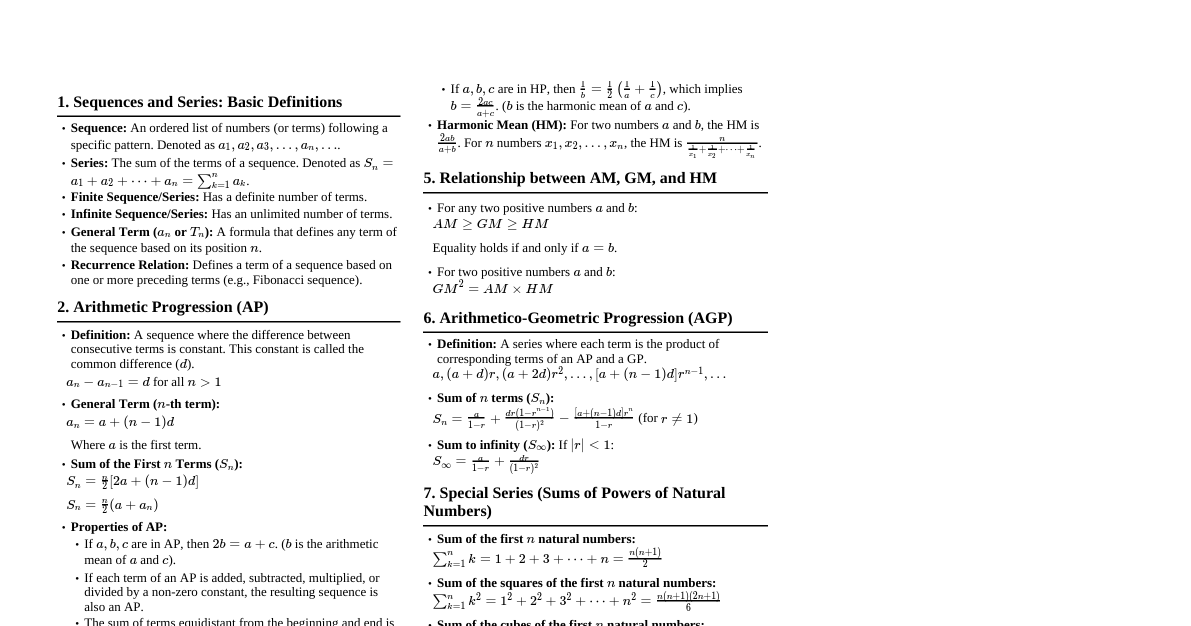
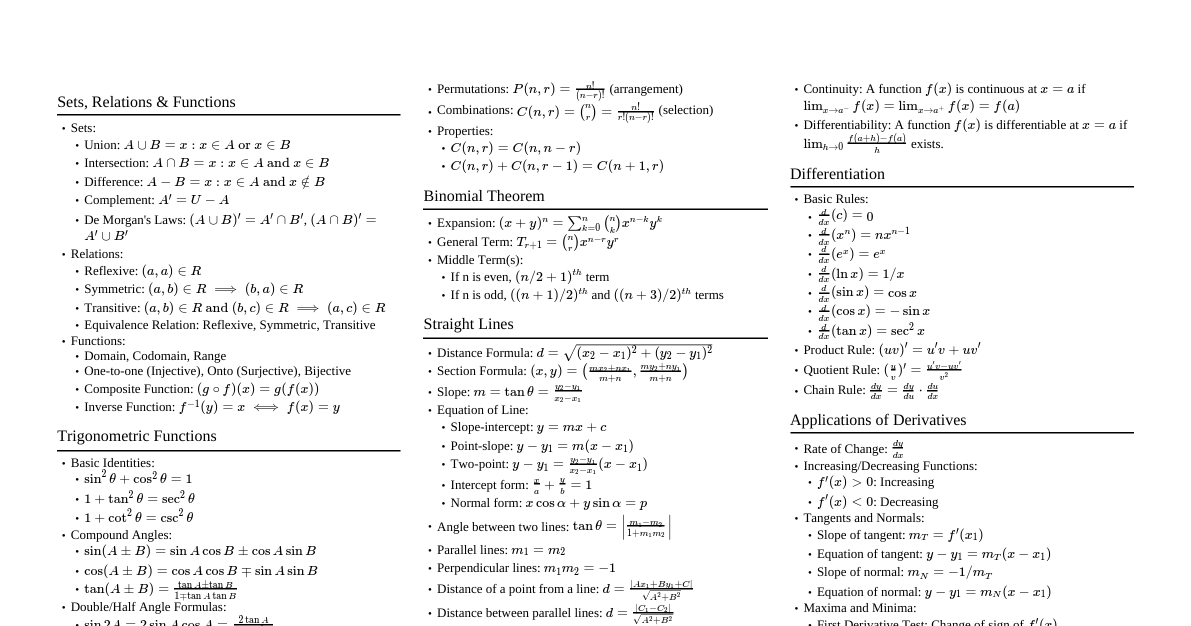
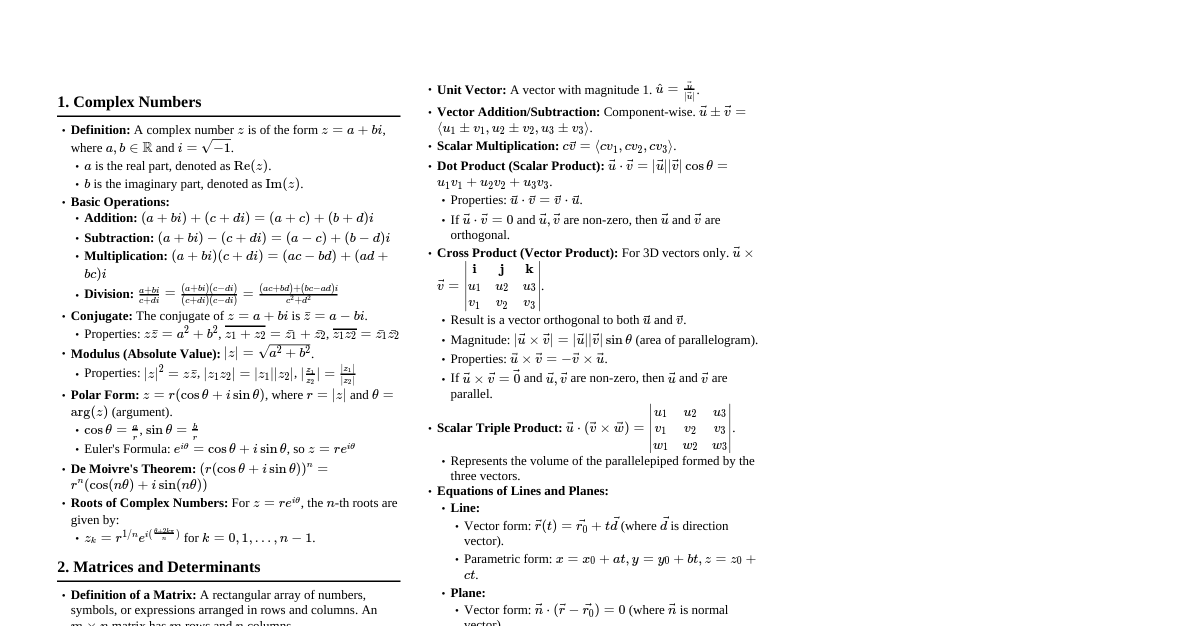
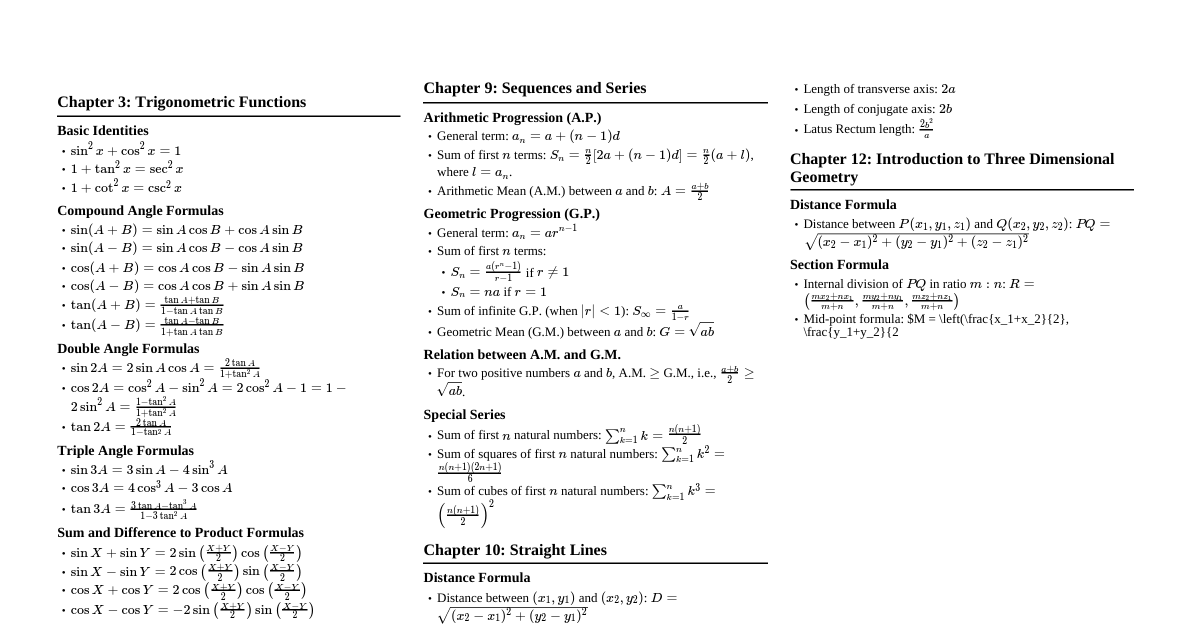
1. Complex Numbers Definition: $z = a + ib$, where $i = \sqrt{-1}$ Conjugate: $\bar{z} = a - ib$ Modulus: $|z| = \sqrt{a^2 + b^2}$ Properties: $z\bar{z} = |z|^2$ $|z_1z_2| = |z_1||z_2|$ $|z_1/z_2| = |z_1|/|z_2|$ $|z_1+z_2| \le |z_1|+|z_2|$ (Triangle Inequality) Polar Form: $z = r(\cos\theta + i\sin\theta)$, where $r = |z|$, $\theta = \arg(z)$ Euler Form: $z = re^{i\theta}$ De Moivre's Theorem: $(\cos\theta + i\sin\theta)^n = \cos(n\theta) + i\sin(n\theta)$ Square Root of $a+ib$: $\pm \left[ \sqrt{\frac{|z|+a}{2}} + i \text{ sgn}(b) \sqrt{\frac{|z|-a}{2}} \right]$ 2. Sequences and Series Arithmetic Progression (AP) General Term: $a_n = a + (n-1)d$ Sum of $n$ terms: $S_n = \frac{n}{2}(a + a_n) = \frac{n}{2}(2a + (n-1)d)$ Arithmetic Mean: If $a, A, b$ are in AP, then $A = \frac{a+b}{2}$ Geometric Progression (GP) General Term: $a_n = ar^{n-1}$ Sum of $n$ terms: $S_n = \frac{a(r^n - 1)}{r-1}$ if $r \ne 1$; $S_n = na$ if $r=1$ Sum to Infinity: $S_\infty = \frac{a}{1-r}$ if $|r| Geometric Mean: If $a, G, b$ are in GP, then $G = \sqrt{ab}$ Harmonic Progression (HP) Reciprocals of terms are in AP. Harmonic Mean: If $a, H, b$ are in HP, then $H = \frac{2ab}{a+b}$ Special Series $\sum_{k=1}^n k = \frac{n(n+1)}{2}$ $\sum_{k=1}^n k^2 = \frac{n(n+1)(2n+1)}{6}$ $\sum_{k=1}^n k^3 = \left(\frac{n(n+1)}{2}\right)^2$ 3. Permutations and Combinations Factorial: $n! = n \times (n-1) \times \dots \times 1$; $0! = 1$ Permutations ($^nP_r$): Number of ways to arrange $r$ objects from $n$ distinct objects. $^nP_r = \frac{n!}{(n-r)!}$ Number of permutations of $n$ objects where $p_1$ are of one kind, $p_2$ of another, etc.: $\frac{n!}{p_1! p_2! \dots p_k!}$ Combinations ($^nC_r$): Number of ways to select $r$ objects from $n$ distinct objects. $^nC_r = \frac{n!}{r!(n-r)!}$ $^nC_r = ^nC_{n-r}$ $^nC_r + ^nC_{r-1} = ^{n+1}C_r$ (Pascal's Identity) 4. Methods of Induction and Binomial Theorem Principle of Mathematical Induction Steps: Base Case: Verify for $n=1$. Inductive Hypothesis: Assume true for $n=k$. Inductive Step: Prove true for $n=k+1$. Binomial Theorem Expansion: $(a+b)^n = \sum_{r=0}^n (^nC_r) a^{n-r} b^r$ General Term ($T_{r+1}$): $T_{r+1} = (^nC_r) a^{n-r} b^r$ Middle Term(s): If $n$ is even, one middle term: $T_{n/2 + 1}$ If $n$ is odd, two middle terms: $T_{(n+1)/2}$ and $T_{(n+3)/2}$ Term Independent of $x$: Find $r$ such that power of $x$ is 0. Properties: $\sum_{r=0}^n (^nC_r) = 2^n$ $\sum_{r=0}^n (-1)^r (^nC_r) = 0$ 5. Sets and Relations Sets Union: $A \cup B = \{x | x \in A \text{ or } x \in B\}$ Intersection: $A \cap B = \{x | x \in A \text{ and } x \in B\}$ Difference: $A - B = \{x | x \in A \text{ and } x \notin B\}$ Complement: $A' = U - A$ De Morgan's Laws: $(A \cup B)' = A' \cap B'$ $(A \cap B)' = A' \cup B'$ Cardinality: $n(A \cup B) = n(A) + n(B) - n(A \cap B)$ $n(A \cup B \cup C) = n(A) + n(B) + n(C) - n(A \cap B) - n(B \cap C) - n(C \cap A) + n(A \cap B \cap C)$ Relations Cartesian Product: $A \times B = \{(a,b) | a \in A, b \in B\}$ Relation: A subset of $A \times B$. Types of Relations on a set $A$: Reflexive: $(a,a) \in R$ for all $a \in A$ Symmetric: If $(a,b) \in R$, then $(b,a) \in R$ Transitive: If $(a,b) \in R$ and $(b,c) \in R$, then $(a,c) \in R$ Equivalence Relation: Reflexive, Symmetric, and Transitive 6. Functions Definition: A relation $f: A \to B$ such that every element in $A$ has exactly one image in $B$. Domain: Set of all possible input values ($A$). Codomain: Set $B$. Range: Set of all output values ($f(A) \subseteq B$). Types of Functions: One-to-one (Injective): If $f(x_1) = f(x_2) \implies x_1 = x_2$. Onto (Surjective): For every $y \in B$, there exists $x \in A$ such that $f(x)=y$. Bijective: Both one-to-one and onto. Composition of Functions: $(g \circ f)(x) = g(f(x))$ Inverse Function ($f^{-1}$): Exists if and only if $f$ is bijective. If $y=f(x)$, then $x=f^{-1}(y)$. Algebra of Functions: $(f \pm g)(x) = f(x) \pm g(x)$ $(fg)(x) = f(x)g(x)$ $(f/g)(x) = f(x)/g(x), g(x) \ne 0$ 7. Limits Definition: $\lim_{x \to a} f(x) = L$ if for every $\epsilon > 0$, there exists $\delta > 0$ such that $0 Left Hand Limit (LHL): $\lim_{x \to a^-} f(x)$ Right Hand Limit (RHL): $\lim_{x \to a^+} f(x)$ Limit exists if and only if LHL = RHL = L. Limit Laws: (Assuming $\lim f(x)$ and $\lim g(x)$ exist) $\lim (f(x) \pm g(x)) = \lim f(x) \pm \lim g(x)$ $\lim (cf(x)) = c \lim f(x)$ $\lim (f(x)g(x)) = \lim f(x) \lim g(x)$ $\lim (f(x)/g(x)) = \lim f(x) / \lim g(x)$, if $\lim g(x) \ne 0$ Standard Limits: $\lim_{x \to a} \frac{x^n - a^n}{x - a} = na^{n-1}$ $\lim_{x \to 0} \frac{\sin x}{x} = 1$ $\lim_{x \to 0} \frac{\tan x}{x} = 1$ $\lim_{x \to 0} \frac{1 - \cos x}{x^2} = \frac{1}{2}$ $\lim_{x \to 0} \frac{e^x - 1}{x} = 1$ $\lim_{x \to 0} \frac{\log(1+x)}{x} = 1$ $\lim_{x \to 0} (1+x)^{1/x} = e$ $\lim_{x \to \infty} (1 + \frac{1}{x})^x = e$ L'Hôpital's Rule: If $\lim_{x \to a} \frac{f(x)}{g(x)}$ is of form $\frac{0}{0}$ or $\frac{\infty}{\infty}$, then $\lim_{x \to a} \frac{f(x)}{g(x)} = \lim_{x \to a} \frac{f'(x)}{g'(x)}$ (if the latter limit exists). 8. Continuity Definition: A function $f(x)$ is continuous at $x=a$ if: $f(a)$ is defined. $\lim_{x \to a} f(x)$ exists. $\lim_{x \to a} f(x) = f(a)$. A function is continuous on an interval if it is continuous at every point in the interval. Properties: Sum, difference, product, and quotient (denominator non-zero) of continuous functions are continuous. Composite of continuous functions is continuous. Intermediate Value Theorem: If $f$ is continuous on $[a,b]$ and $k$ is any number between $f(a)$ and $f(b)$, then there exists at least one $c \in (a,b)$ such that $f(c)=k$. 9. Differentiation Definition (First Principles): $f'(x) = \lim_{h \to 0} \frac{f(x+h) - f(x)}{h}$ Derivative at a point $x=a$: $f'(a) = \lim_{x \to a} \frac{f(x) - f(a)}{x - a}$ Rules of Differentiation: Constant Rule: $\frac{d}{dx}(c) = 0$ Power Rule: $\frac{d}{dx}(x^n) = nx^{n-1}$ Constant Multiple Rule: $\frac{d}{dx}(cf(x)) = c \frac{d}{dx}(f(x))$ Sum/Difference Rule: $\frac{d}{dx}(f(x) \pm g(x)) = \frac{d}{dx}(f(x)) \pm \frac{d}{dx}(g(x))$ Product Rule: $\frac{d}{dx}(f(x)g(x)) = f'(x)g(x) + f(x)g'(x)$ Quotient Rule: $\frac{d}{dx}\left(\frac{f(x)}{g(x)}\right) = \frac{f'(x)g(x) - f(x)g'(x)}{(g(x))^2}$ Chain Rule: $\frac{d}{dx}(f(g(x))) = f'(g(x))g'(x)$ or $\frac{dy}{dx} = \frac{dy}{du} \frac{du}{dx}$ Derivatives of Standard Functions: $\frac{d}{dx}(\sin x) = \cos x$ $\frac{d}{dx}(\cos x) = -\sin x$ $\frac{d}{dx}(\tan x) = \sec^2 x$ $\frac{d}{dx}(\cot x) = -\csc^2 x$ $\frac{d}{dx}(\sec x) = \sec x \tan x$ $\frac{d}{dx}(\csc x) = -\csc x \cot x$ $\frac{d}{dx}(e^x) = e^x$ $\frac{d}{dx}(a^x) = a^x \log_e a$ $\frac{d}{dx}(\log_e x) = \frac{1}{x}$ $\frac{d}{dx}(\log_a x) = \frac{1}{x \log_e a}$ $\frac{d}{dx}(\sin^{-1} x) = \frac{1}{\sqrt{1-x^2}}$ $\frac{d}{dx}(\cos^{-1} x) = -\frac{1}{\sqrt{1-x^2}}$ $\frac{d}{dx}(\tan^{-1} x) = \frac{1}{1+x^2}$ Implicit Differentiation: Differentiate both sides of the equation with respect to $x$, treating $y$ as a function of $x$ (use chain rule for terms involving $y$). Parametric Differentiation: If $x=f(t)$ and $y=g(t)$, then $\frac{dy}{dx} = \frac{dy/dt}{dx/dt}$ Second Order Derivative: $\frac{d^2y}{dx^2} = \frac{d}{dx}\left(\frac{dy}{dx}\right)$ Tricks and Common Pitfalls Complex Numbers: Powers of $i$: $i^1=i, i^2=-1, i^3=-i, i^4=1$. Cycle repeats every 4 powers. $1 + i^n + i^{2n} + i^{3n} = 0$ if $n$ is not a multiple of 4, otherwise 4. For $\sqrt{i}$ or $\sqrt{-i}$, use polar form or assume $x+iy$, square it and equate. Sequences and Series: Arithmetic Mean > Geometric Mean > Harmonic Mean (for positive numbers). Equality holds if all numbers are equal. For AP/GP problems, if terms are $a-d, a, a+d$ (for 3 terms in AP) or $a/r, a, ar$ (for 3 terms in GP), it often simplifies calculations. Sum of $n$ terms of an AP: $S_n = An^2+Bn \implies$ common difference $d=2A$. Permutations and Combinations: "AND" means Multiply, "OR" means Add. Circular Permutations: $(n-1)!$ for distinct objects. If clockwise/anti-clockwise are same (e.g., necklace), then $\frac{(n-1)!}{2}$. Gap Method: For "objects always together". Treat group as one unit. Tie Method: For "objects never together". Total arrangements - arrangements where they are together. When selecting items of multiple types, use product of combinations. E.g., choosing 2 boys from 5 AND 3 girls from 4 is $^5C_2 \times ^4C_3$. Binomial Theorem: If $n$ is a natural number, $(x+y)^n$ has $n+1$ terms. Check for negative/fractional $n$ (Infinite series, not covered here). For coefficient of $x^k$, use general term $T_{r+1}$ and solve for $r$. Sets and Relations: Venn diagrams are great for visualizing set operations and cardinality problems. Remember $n(A \cap B) = n(A) + n(B) - n(A \cup B)$ if you know $n(A \cup B)$ and individual cardinalities. Functions: To check injectivity: Assume $f(x_1)=f(x_2)$ and try to prove $x_1=x_2$. To check surjectivity: Assume $y$ in codomain, and try to find $x$ in domain such that $f(x)=y$. Domain restrictions: Denominator $\ne 0$, argument of $\sqrt{\cdot}$ must be $\ge 0$, argument of $\log_e(\cdot)$ must be $> 0$. Limits: Always try direct substitution first. If it's a definite value, that's the limit. Identify indeterminate forms: $\frac{0}{0}, \frac{\infty}{\infty}, \infty - \infty, 0 \times \infty, 1^\infty, 0^0, \infty^0$. Factorization, rationalization, and standard limits are key tools. For limits at infinity, divide numerator and denominator by the highest power of $x$. Remember $\lim_{x \to 0} \frac{\sin ax}{bx} = \frac{a}{b}$. Continuity: For piecewise functions, check continuity at the 'breaking points' by comparing LHL, RHL, and function value. Polynomials, exponential functions, sine, cosine functions are always continuous. Logarithmic functions are continuous in their domain. Differentiation: Practice applying chain rule correctly, especially for nested functions. E.g., $\frac{d}{dx}(\sin^2(3x)) = 2\sin(3x) \cdot \cos(3x) \cdot 3$. Implicit differentiation is crucial when $y$ cannot be easily expressed as a function of $x$. Differentiate each term w.r.t $x$, remembering to multiply $\frac{dy}{dx}$ when differentiating a $y$ term. Logarithmic differentiation is useful for functions involving products, quotients, and powers of functions, or $f(x)^{g(x)}$ forms. Take $\log_e$ on both sides first.