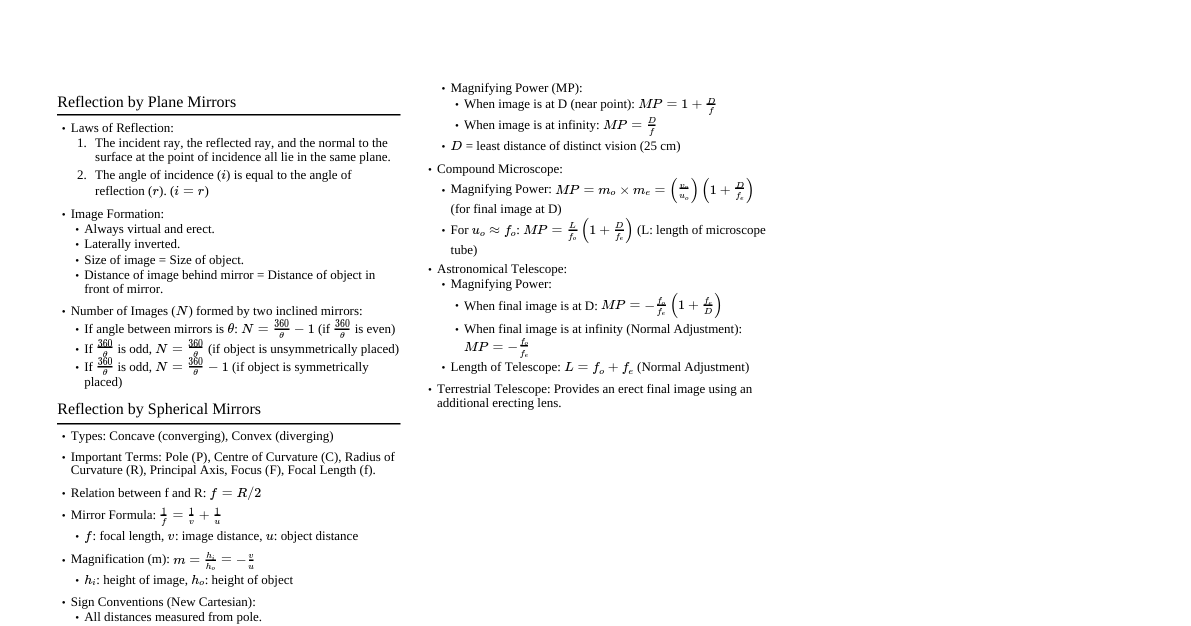
NEET Ray Optics & Instruments
Cheatsheet Content
### Advanced Mirror Concepts & Shortcuts - **Velocity of Image in Curved Mirrors (Vector Approach):** - Let object velocity $\vec{V}_O = V_{Ox}\hat{i} + V_{Oy}\hat{j} + V_{Oz}\hat{k}$. - For mirror along YZ plane, pole at origin, principal axis along X-axis: - $V_{Ix} = -m^2 V_{Ox}$ (along principal axis) - $V_{Iy} = m V_{Oy}$ (perpendicular to principal axis, in XY plane) - $V_{Iz} = m V_{Oz}$ (perpendicular to principal axis, in XZ plane) - **General Case (Object moving on principal axis):** If object moves with velocity $v_o$ towards the mirror, then image velocity is $v_i = -(\frac{v}{u})^2 v_o$. - **General Case (Object moving perpendicular to principal axis):** If object moves with velocity $v_o$ perpendicular to principal axis, then image velocity is $v_i = (\frac{v}{u}) v_o$. - **Key Insight:** The transverse magnification ($m = v/u$) applies to components perpendicular to the principal axis, and $m^2$ to components along the principal axis. The negative sign for axial velocity indicates relative direction. - **Graphical Location of Image (Beyond Ray Tracing):** - For a concave mirror, if object moves from $\infty$ to $F$, image moves from $F$ to $\infty$ (real & inverted). If object moves from $F$ to $P$, image moves from $\infty$ to $P$ (virtual & erect). - **Relativistic Mirror Formula (for moving objects):** - If mirror moves with velocity $V_M$ and object with $V_O$ (both along principal axis), then image velocity $V_I$ is given by: - $V_I = V_M - m^2 (V_O - V_M)$. This is a common trap question. - **Cutting a Mirror:** - If a spherical mirror is cut into two pieces, each piece acts as a complete mirror with the same focal length and radius of curvature. The intensity of the image will decrease. - **Combined Mirror Systems (e.g., two concave mirrors facing each other):** - The image formed by the first mirror acts as the object for the second. Pay close attention to sign conventions and distances. This often leads to multiple image formation. ### Advanced Lens Concepts & Shortcuts - **Velocity of Image in Lenses (Vector Approach):** - Identical to mirrors: - $V_{Ix} = -m^2 V_{Ox}$ (along principal axis) - $V_{Iy} = m V_{Oy}$ (perpendicular to principal axis, in XY plane) - $V_{Iz} = m V_{Oz}$ (perpendicular to principal axis, in XZ plane) - **Newton's Formula for Lenses:** - $x_1 x_2 = f^2$ - Where $x_1$ is object distance from $F_1$ and $x_2$ is image distance from $F_2$. - $x_1 = u - F_1$ (signed distance), $x_2 = v - F_2$. - Magnification: $m = -\frac{x_2}{f} = -\frac{f}{x_1}$. - **Use Case:** Very useful for problems where distances are given from focal points, or when relative motion about focal points is involved. - **Lens in a Liquid (Quantitative Analysis):** - $\frac{f_{liquid}}{f_{air}} = \frac{(\mu_g - 1)}{(\frac{\mu_g}{\mu_l} - 1)}$ - **Scenario 1: $\mu_l = \mu_g$** (lens disappears, $f_{liquid} \rightarrow \infty$). - **Scenario 2: $\mu_l > \mu_g$** (lens changes nature, e.g., convex becomes diverging). The ratio $\frac{\mu_g}{\mu_l}$ becomes less than 1, making $(\frac{\mu_g}{\mu_l} - 1)$ negative. - **Scenario 3: $\mu_l f_{air}$). - **Equivalent Lens for Thick Lens/System:** - For two thin lenses separated by distance $d$: $P_{eq} = P_1 + P_2 - d P_1 P_2$. - **Principal Planes:** For a thick lens or a combination of lenses, there are two principal planes where the effective refraction takes place. Object and image distances are measured from these planes. For NEET, usually thin lens approximation is sufficient, but understanding the concept is key for tricky questions. - **Chromatic and Spherical Aberration (Quantitative/Conceptual):** - **Longitudinal Chromatic Aberration (LCA):** $f_R - f_V = \omega f_Y$. (where $\omega$ is dispersive power, $f_Y$ is focal length for yellow light). - **Achromatic Doublet Condition:** $\frac{\omega_1}{f_1} + \frac{\omega_2}{f_2} = 0$. This ensures the net dispersion is zero. - **Aplanatic Surfaces:** Special surfaces (e.g., specific spherical surfaces for microscope objectives) that eliminate spherical aberration and coma for certain object positions. - **Lens Cutting and Combination Effects:** - **Cutting parallel to principal axis:** Intensity halved, focal length unchanged. - **Cutting perpendicular to principal axis:** Each half becomes plano-convex/concave. If original biconvex/biconcave, $f_{half} = 2f_{original}$ (assuming radii were equal). ### Advanced Refraction Concepts & Shortcuts - **Critical Angle and TIR Applications (Beyond Basics):** - **Optical Fibres:** Understanding numerical aperture (NA). $NA = \sqrt{\mu_{core}^2 - \mu_{cladding}^2} = \mu_{air} \sin i_{max}$. - **Prism Applications (e.g., right-angled isosceles prism):** Used for $90^\circ$ or $180^\circ$ deviation without absorption due to TIR. - **Mirage:** Due to continuous variation of refractive index with height in atmosphere. - **Glittering of Diamond:** High $\mu$ and low critical angle lead to multiple TIRs. - **Refraction through Multiple Slabs:** - Apparent shift through multiple slabs: $S_{total} = \sum t_i(1 - \frac{1}{\mu_i})$. - **Concept:** Image formed by first slab acts as object for second, and so on. - **Refraction at a Curved Surface (Advanced Scenarios):** - $\frac{\mu_2}{v} - \frac{\mu_1}{u} = \frac{\mu_2 - \mu_1}{R}$ - **Tricky Questions:** Object in denser medium, image in rarer medium, concave/convex surfaces. Always stick to sign conventions. - **Dispersion without Deviation and Deviation without Dispersion:** - **Achromatic Prism Combination (Dispersion without Deviation):** Net deviation $\delta_{net} = (\mu_{1,avg}-1)A_1 + (\mu_{2,avg}-1)A_2$. Condition for zero dispersion: $(\mu_{1V}-\mu_{1R})A_1 + (\mu_{2V}-\mu_{2R})A_2 = 0$. - **Direct Vision Spectroscope (Deviation without Dispersion):** Net dispersion is zero. Net deviation is non-zero. Condition for zero dispersion: $\frac{\omega_1}{\delta_{1,avg}} + \frac{\omega_2}{\delta_{2,avg}} = 0$. - **Rainbow Formation (Detailed):** - **Primary:** $42^\circ$ (red), $40^\circ$ (violet) from anti-solar point. One TIR, two refractions. - **Secondary:** $54^\circ$ (red), $51^\circ$ (violet) from anti-solar point. Two TIRs, two refractions. Fainter and reverse colour order. ### Advanced Optical Instruments & Their Nuances - **Human Eye & Defects (Quantitative Correction):** - **Myopia:** Power $P = -1/x_F$ (where $x_F$ is far point in meters). - **Hypermetropia:** Power $P = 1/x_{NP} - 1/x_N$ (where $x_{NP}$ is normal near point (0.25m) and $x_N$ is defective near point for object). - **Presbyopia:** Requires bifocal lenses (upper concave for distance, lower convex for near). - **Astigmatism:** Corrected by cylindrical lenses with specific axis orientation. - **Compound Microscope (Optimization & Limits):** - **Numerical Aperture (NA):** $\mu \sin\theta$. Directly related to resolving power. Maximize NA by using oil immersion ($\mu > 1$) and wide angle objective. - **Resolving Power:** $RP = \frac{2\mu \sin\theta}{1.22\lambda_{air}}$. Higher RP means better distinction between close objects. - **Tube Length (L):** For final image at D: $L = v_o + u_e$. For final image at $\infty$: $L = v_o + f_e$. - **Relationship with Magnification:** For a fixed $L$, $m_o$ and $M_e$ are inversely related. - **Telescopes (Types & Performance):** - **Astronomical Telescope:** - **Resolving Power:** $RP = D/(1.22\lambda)$. Large aperture $D$ is crucial. - **Light Gathering Power:** $\propto D^2$. - **Terrestrial Telescope:** Uses an erecting lens system between objective and eyepiece to produce an erect final image. Increases length. - **Reflecting Telescopes (Newtonian, Cassegrain):** - No chromatic aberration. - Reduced spherical aberration (parabolic mirrors). - Larger apertures possible (higher RP & light gathering). - Eyepiece usually on the side (Newtonian) or through a hole in main mirror (Cassegrain). - **Gregorian Telescope:** Uses a concave secondary mirror (Cassegrain uses convex). - **Galilean Telescope:** - Erect final image. - Shorter tube length ($L = f_o - |f_e|$). - Smaller field of view. - **Magnification vs. Resolving Power:** - Magnification makes an object appear larger. - Resolving power allows two closely spaced objects to be seen as distinct. High magnification without high resolving power just produces a large, blurry image. ### Advanced Photometry Concepts - **Luminous Efficiency:** Ratio of luminous flux to radiant flux (total electromagnetic power emitted). Varies with wavelength (peak at 555 nm for green light). - **Inverse Square Law:** Illuminance $E \propto 1/r^2$. - **Lambert's Cosine Law:** $E = \frac{I \cos\theta}{r^2}$. Illumination is maximum when light falls normally ($\theta=0$). - **Brightness (Luminance):** Perceived by the eye. Depends on the amount of light emitted/reflected from a surface and the viewing angle. ### Unique Questions & NEET Scenarios - **Object-Image Relative Motion in Combined Systems:** - E.g., object moving towards a lens, and then reflected by a mirror placed behind the lens. The image formed by the lens acts as the object for the mirror, and its velocity needs to be calculated. - **Minimum Length of Plane Mirror to See Full Image:** - For a person of height $H$: $H/2$. (Top edge of mirror must be at half height of eye from top of head). - **Effect of Covering Part of Lens/Mirror:** - The entire image is still formed, but its intensity is reduced. If the central part of a lens is painted, spherical aberration might decrease, but intensity decreases. - **Bubbles in Lenses/Glass Slab:** - Air bubble in glass: acts as a diverging lens inside a converging medium, or vice-versa. Apparent position of bubble is often asked. - From convex surface, bubble inside: $\frac{\mu_{air}}{v} - \frac{\mu_{glass}}{u} = \frac{\mu_{air} - \mu_{glass}}{R}$. - **Sun/Moon as Object:** - Images are formed at the focal plane of lenses/mirrors. The angular size of the image is $\theta = D/f$, where $D$ is the diameter of the sun/moon and $f$ is the focal length. - **Lens/Mirror Immersed in Different Liquids:** - What happens if a concave lens is immersed in water and then in oil, where $\mu_{oil} > \mu_{glass} > \mu_{water}$? Its nature can change. - **Multiple Reflections/Refractions:** - Light passing through a prism, reflecting off a mirror, and then passing through the prism again. Trace the path and apply formulas sequentially. - **Finding Refractive Index by Disappearing Lens Method:** - Placing a liquid in contact with a plano-convex lens and finding the focal length of the combination. If the lens-liquid combination acts as a plane plate, then $\mu_{liquid} = \mu_{lens}$. - **Power of a combination of a lens and a mirror:** - When a lens and a mirror are placed co-axially. The light passes through the lens, reflects from the mirror, and passes through the lens again. - $P_{eff} = P_{lens} + P_{mirror} + P_{lens} = 2P_{lens} + P_{mirror}$. (This is for light entering and exiting the same side). - **Image Shift due to Rotation of Optical Element:** - If a plane mirror rotates by $\alpha$, reflected ray by $2\alpha$. - If a prism rotates, the minimum deviation position also shifts. ### Important Facts & Data (NEET Critical) - **Speed of light in vacuum:** $c = 3 \times 10^8$ m/s. - **Refractive index of water:** $\approx 4/3$ or $1.33$. - **Refractive index of glass (typical):** $\approx 1.5$ (crown) to $1.65$ (flint). - **Near point (D):** 25 cm (0.25 m). - **Critical angle for glass-air:** $\sin C = 1/1.5 \Rightarrow C \approx 41.8^\circ$. - **Critical angle for water-air:** $\sin C = 1/1.33 \Rightarrow C \approx 48.6^\circ$. - **Wavelengths of visible light:** Violet (380-450 nm) to Red (620-750 nm). - **Dispersion order:** Violet deviates most, Red deviates least. - **Eye lens is convex:** It forms real, inverted, and diminished images on the retina. - **Photopic vision (daylight):** Cones, high acuity, colour vision. - **Scotopic vision (night):** Rods, low acuity, no colour perception. - **Blind spot:** Area on retina where optic nerve leaves, no photoreceptors. - **Yellow spot (macula lutea):** Central part of retina with highest concentration of cones, maximum visual acuity.