Class 10 Science (Chemistry) Practice Pa
Cheatsheet Content
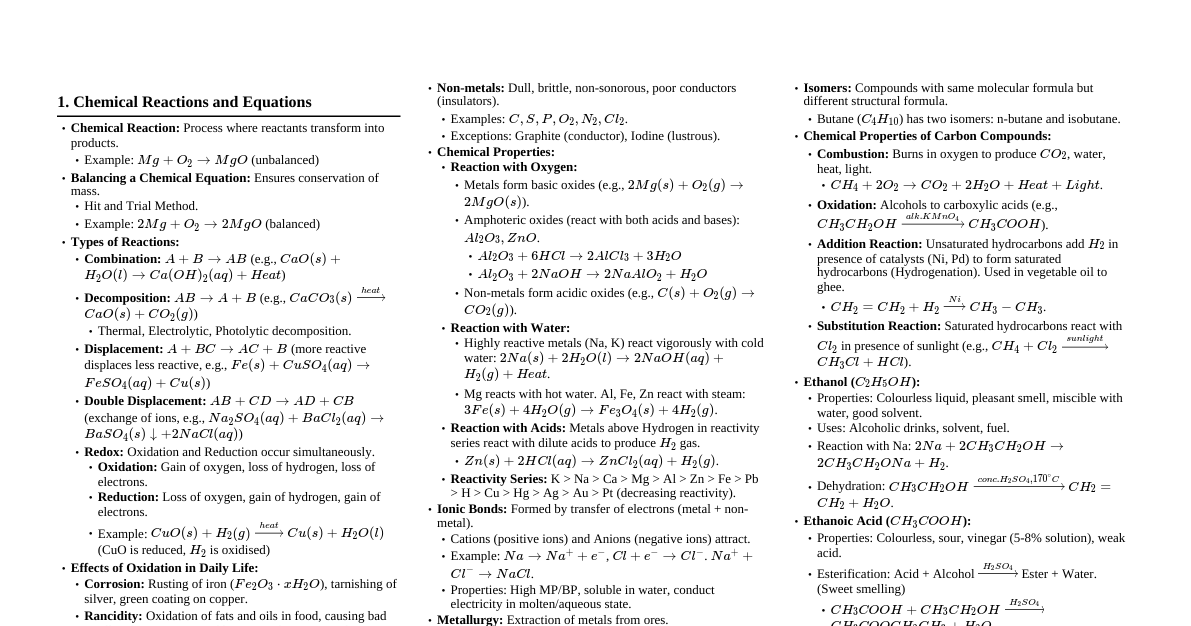
Class 10 Science (Chemistry) Practice Paper Syllabus: Chemical Reactions and Equations, Acids, Bases, and Salts, Metals and Non-metals, Carbon and its Compounds Total Marks: 100 | Time: 3 Hours SECTION A: Objective Type Questions (1 Mark each) I. Choose the correct option: Which of the following is a displacement reaction? a) $\text{MgCO}_3 \rightarrow \text{MgO} + \text{CO}_2$ b) $2\text{Na} + 2\text{H}_2\text{O} \rightarrow 2\text{NaOH} + \text{H}_2$ c) $2\text{H}_2 + \text{O}_2 \rightarrow 2\text{H}_2\text{O}$ d) $2\text{Pb}(\text{NO}_3)_2 \rightarrow 2\text{PbO} + 4\text{NO}_2 + \text{O}_2$ The pH of gastric juice released during digestion is: a) Less than 7 b) More than 7 c) Equal to 7 d) Equal to 0 Which metal is liquid at room temperature? a) Sodium b) Mercury c) Potassium d) Iron The functional group present in Propanal is: a) -OH b) -COOH c) -CHO d) -CO- Which of the following statements about the given reaction are correct? $3\text{Fe(s)} + 4\text{H}_2\text{O(g)} \rightarrow \text{Fe}_3\text{O}_4\text{(s)} + 4\text{H}_2\text{(g)}$ (i) Iron metal is getting oxidised. (ii) Water is getting reduced. (iii) Water is acting as a reducing agent. (iv) Water is acting as an oxidising agent. a) (i), (ii) and (iii) b) (iii) and (iv) c) (i), (ii) and (iv) d) (ii) and (iv) Food cans are coated with tin and not with zinc because: a) Zinc is costlier than tin. b) Zinc has a higher melting point than tin. c) Zinc is more reactive than tin. d) Zinc is less reactive than tin. Ethanol reacts with sodium and forms two products. These are: a) Sodium ethanoate and hydrogen b) Sodium ethanoate and oxygen c) Sodium ethoxide and hydrogen d) Sodium ethoxide and oxygen Aqua regia is a mixture of concentrated hydrochloric acid and concentrated nitric acid in the ratio of: a) 1:3 b) 3:1 c) 1:1 d) 2:1 Tooth enamel is made up of: a) Calcium phosphate b) Calcium carbonate c) Calcium oxide d) Potassium Which of the following is an amphoteric oxide? a) $\text{Na}_2\text{O}$ b) $\text{SO}_2$ c) $\text{Al}_2\text{O}_3$ d) $\text{CaO}$ II. Fill in the blanks: The process of coating zinc over iron is called __________. The general formula for alkenes is __________. Metallic oxides are generally __________ in nature. Plaster of Paris is obtained by heating __________ at 373 K. A reaction in which energy is absorbed is known as __________ reaction. III. State True or False: Carbon forms bonds with other atoms by sharing electrons. Copper displaces zinc from zinc sulphate solution. Distilled water conducts electricity. Precipitation reactions produce insoluble salts. Saturated hydrocarbons undergo addition reactions. IV. Match the Following: 21. Match Column A with Column B: Column A Column B (a) Bleaching Powder (i) $\text{Na}_2\text{CO}_3 \cdot 10\text{H}_2\text{O}$ (b) Baking Soda (ii) $\text{CaOCl}_2$ (c) Washing Soda (iii) $\text{CaSO}_4 \cdot \frac{1}{2}\text{H}_2\text{O}$ (d) Plaster of Paris (iv) $\text{NaHCO}_3$ (e) Slaked Lime (v) $\text{Ca(OH)}_2$ V. Give One Word Answer: Name the gas evolved when a metal reacts with an acid. Write the formula of the functional group 'Carboxylic acid'. Name the green coating that develops on copper articles when exposed to air. What is the common name of the compound $\text{CaOCl}_2$? Name the hardest substance known that is an allotrope of carbon. SECTION B: Short Answer Type I (2 Marks each) Why should a magnesium ribbon be cleaned before burning in air? Define a redox reaction. Give one example. Why does the colour of copper sulphate solution change when an iron nail is dipped in it? Why do acids not show acidic behaviour in the absence of water? What is the Chlor-alkali process? Write the chemical equation for it. Why is sodium kept immersed in kerosene oil? Differentiate between roasting and calcination. Ionic compounds have high melting points. Why? What are amphoteric oxides? Give two examples. Draw the electron dot structure of (a) $\text{CH}_4$ (b) $\text{CO}_2$. What is a homologous series? Give an example. Why are decomposition reactions called the opposite of combination reactions? What is observed when carbon dioxide gas is passed through lime water (a) for a short duration? (b) for a long duration? Name two metals which are found in nature in the free state. Define catenation. Which element exhibits this property the most? SECTION C: Short Answer Type II (3 Marks each) Balance the following chemical equations: a) $\text{HNO}_3 + \text{Ca(OH)}_2 \rightarrow \text{Ca(NO}_3)_2 + \text{H}_2\text{O}$ b) $\text{NaOH} + \text{H}_2\text{SO}_4 \rightarrow \text{Na}_2\text{SO}_4 + \text{H}_2\text{O}$ c) $\text{BaCl}_2 + \text{H}_2\text{SO}_4 \rightarrow \text{BaSO}_4 + \text{HCl}$ A solution of a substance 'X' is used for whitewashing. a) Name the substance 'X' and write its formula. b) Write the reaction of the substance 'X' named in (a) above with water. Write the chemical formula for (a) Washing soda, (b) Baking soda. State one major use of each. (a) What is the pH scale? (b) A milkman adds a very small amount of baking soda to fresh milk. Why does he shift the pH of the fresh milk from 6 to slightly alkaline? Suggest a method to separate a mixture of Iron powder and Sulphur powder if: a) They are just mixed physically. b) They are heated together to form a compound. (Explain the difference in properties). What are alloys? Name the constituents of (a) Brass, (b) Bronze, (c) Solder. Differentiate between metals and non-metals on the basis of their chemical properties (any three). Explain the mechanism of the cleaning action of soaps. Differentiate between Ethanol and Ethanoic acid on the basis of: a) Physical state/Odour b) Reaction with Sodium Carbonate c) Litmus test Explain the formation of Magnesium Chloride ($\text{MgCl}_2$) by the transfer of electrons. SECTION D: Long Answer Type (4 Marks each) (a) Explain the following terms with one example each: (i) Corrosion (ii) Rancidity (b) A brown substance 'X' on heating in air becomes black. Name the substance 'X' and the black compound formed. Write the chemical equation for the reaction. (a) What is esterification? Write the chemical equation for the reaction of ethanoic acid with ethanol in the presence of an acid. (b) What happens when an ester is treated with sodium hydroxide? Write the equation for this reaction. What is this specific reaction called?